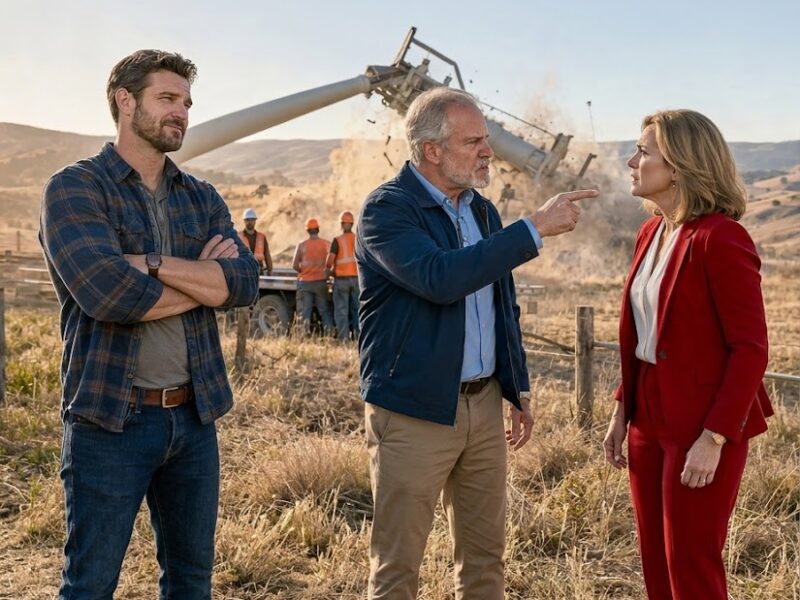
The HOA cut down my windmill. They said it was “unsightly” and gave me 30 days to remove it. Then the utility company called and asked one question: “Why did the pumps stop?”
At 6:17 that morning, Amon Rusk heard the chainsaw before he saw the trucks.
He was standing in his kitchen with a cup of black coffee when the sound rolled down from the ridge, flat and mechanical, cutting through the quiet like something that did not belong there.
He set the cup down without finishing it.
He pulled on his boots without lacing them all the way.
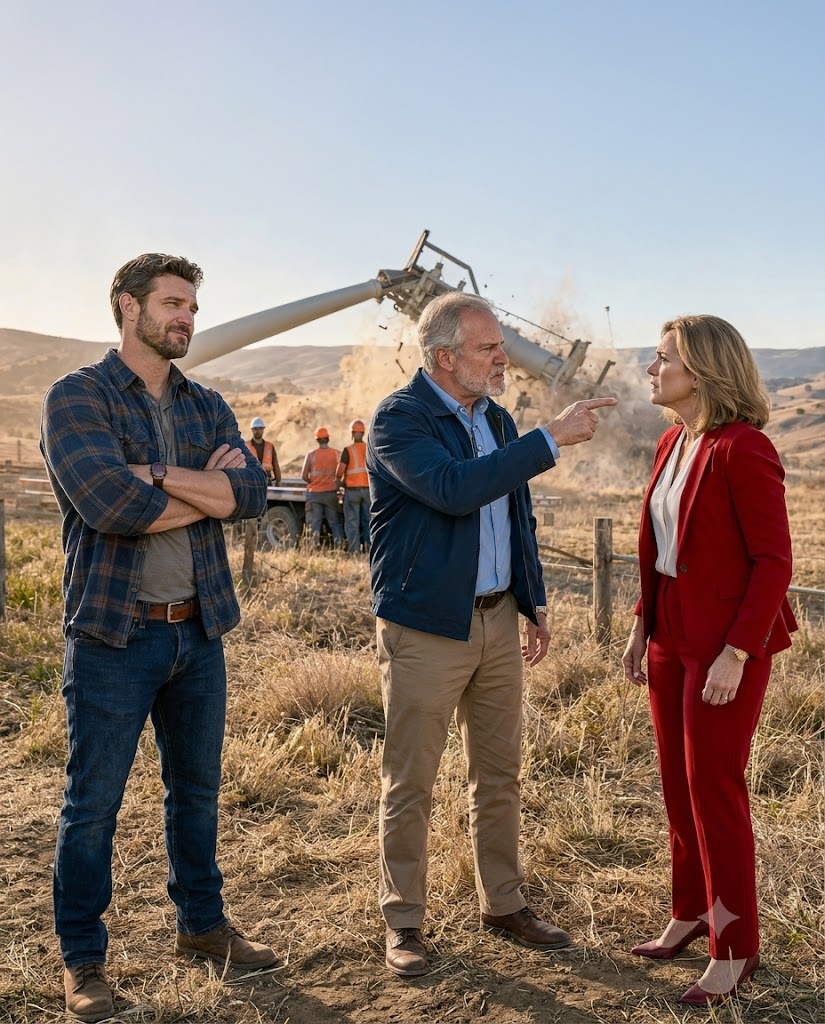
By the time he reached the top of the hill, his windmill was already collapsing into the dust.
One long groan followed by a crack that echoed across the whole property.
Three men in orange vests stood beneath it, and a woman in a white jacket watched with her arms crossed, unbothered, as if she were supervising a delivery instead of a demolition.
Her name was Maribel Voss, and she told him, without raising her voice, that the structure violated community rules.
He asked her who had authorized the shutdown.
She smiled the way people smile when they already know they have won.
“The HOA owns the view,” she said.
Then his phone rang in his pocket, and the voice on the other end belonged to an engineer from the regional utility company, and the engineer sounded confused in a way that made Amon’s stomach tighten.
“Sir, we are getting emergency alarms from your property,” the man said.
“Why did your pumps just stop?”
Amon looked at the fallen windmill lying broken in the grass, and for one long second, he understood something Maribel Voss did not.
—
The dust had not even settled when Amon walked back down the hill toward the equipment shed, and the chainsaw crew was already loading their gear into a flatbed truck as if the job were finished, as if nothing more needed to be said.
He was 44 years old, a mechanical engineer who worked for himself, and he had lived alone on this stretch of land for almost 20 years, far enough from town that most people in the subdivision only knew him by sight.
He did not attend Homeowners Association meetings.
He did not decorate his mailbox for the seasons or repaint his fence to match the approved palette.
He kept to himself, and in a community built on uniform lawns and uniform opinions, that alone had made him a target long before the chainsaw ever started.
Maribel Voss was 51, always dressed like she had somewhere important to be, and she carried herself with the kind of polished authority that made most residents nod along rather than argue.
She believed every property in the subdivision existed under one shared standard, and she had made it known more than once that Amon’s windmill offended that standard.
What she had never said out loud, not once, was why she wanted it gone so badly.
Amon stopped in front of her and asked to see the demolition order, and Maribel reached into a folder and produced a single sheet of paper, holding it out like it settled the matter completely.
He read it twice.
It cited a landscaping violation.
It said nothing about authorization to remove private equipment, nothing about a contractor, nothing about who had given the crew permission to step onto his land with power tools.
He looked up at her and asked who had approved sending workers onto private property, and she told him the board had discussed it, that residents had complained that the windmill was an eyesore nobody wanted to look at anymore.
He asked for the meeting minutes.
She said she would have someone email them.
He asked for the name of the company that hired the demolition crew, and for the first time that morning, her smile faltered just slightly before it came back into place.
That was when his phone rang again, and it was the same voice from the utility company, more urgent now, asking him not to attempt anything on his own, asking him to stay near the equipment.
Amon looked past Maribel at the twisted metal lying in the grass, at the severed cable still sparking faintly where it had been cut instead of properly disconnected, and something cold moved through him that had nothing to do with the morning air.
Whatever this windmill actually did, it was not something Maribel Voss understood, and it was not something she had bothered to ask about before she sent three men with a chainsaw up the hill to tear it down.
Amon crouched beside the base of the tower once the crew’s truck pulled away, running his hand along the severed cable, and what he found there made his jaw tighten.
The windmill had never been decorative.
It had never simply been about electricity for his own house, a detail Maribel had apparently never bothered to learn in all her years of complaining about it.
Beneath the surface, connected through a series of buried lines he had run himself over the course of two summers, the turbine powered an underground pumping system that pulled water from deep beneath the property and pushed it into a holding tank on the far ridge.
A tank that fed not just his own land, but a network of distribution lines that had been laid down long before the subdivision even had a name.
He had designed the whole system himself years earlier when the area’s water pressure had been unreliable and the local utility had needed a way to stabilize supply without running new infrastructure through half the county.
He did have a battery bank as backup.
It was enough to keep the pumps alive for a few hours, not enough to run the system indefinitely.
And every minute the windmill stayed down was a minute closer to failure.
Maribel had not left.
She stood near her car watching him work.
And when he straightened up, she told him he was overreacting, that the HOA had simply asked him to remove one ugly structure, nothing more, nothing that should require an emergency phone call to a utility engineer.
Amon turned to face her fully for the first time that morning, and his voice stayed level even as the questions came out sharper than before.
Who hired the demolition crew?
Who paid the invoice?
Who takes responsibility if that pumping system fails and the water lines behind my property go dry?
Maribel did not answer any of it directly.
She told him he should read the HOA bylaws more carefully before he tried to challenge the board’s authority.
And there was something in the way she said it, a practiced confidence that made Amon suspect this was not the first time she had used that line to end a conversation.
He crouched again and examined the cut cable more closely.
And what he saw confirmed what he had already begun to suspect.
A trained crew disconnecting equipment properly would have shut down the system first, isolated the lines, followed a sequence any competent electrician would know by instinct.
Instead, someone had simply cut through the main feed with the chainsaw, severing it in the fastest, sloppiest way possible.
The kind of shortcut a crew takes when they are rushed, or when they have been told the job needs to look finished by a certain hour, regardless of how it gets done.
The alarm on his control panel screamed before he even made it back to the shed, a solid red warning across the display that read pump failure, pressure collapse, and beneath it a cascading list of secondary faults rippling through the system like dominoes.
Amon’s hands moved fast over the keyboard, trying to isolate which line had failed first, and within seconds he had the utility company on the phone again, this time asking for someone with actual authority over the regional grid.
The voice that answered was calm in a way that only came from decades of experience, steady, unhurried, entirely unlike the nervous engineer from before.
“Do not restart the system,” the voice said, “not yet.”
Amon asked why.
And there was a pause on the other end long enough that he could hear the man exhale before answering.
The engineer’s name was Gideon Pike, 57 years old, chief engineer for the regional utility, a man who had spent three decades keeping rural power grids running through storms, droughts, and every kind of local politics imaginable.
He was not the type who scared easily, and he was certainly not the type to be pushed around by a homeowners association.
Gideon asked Amon to walk him through exactly what had happened that morning, and Amon told him about the chainsaw, about Maribel Voss standing there with her folder, about the crew leaving before he could even ask who they worked for.
Gideon went quiet for a moment.
Then he asked a single question.
“Which HOA?”
Amon gave him the name of the subdivision, and something in Gideon’s voice changed immediately, sharpened, the casual tone gone entirely.
He asked Amon to send him the exact coordinates of the property, right then, no delay.
What Gideon revealed next reframed everything.
The utility company had been monitoring a distributed energy network across that section of the county for years, a patchwork of private turbines, backup generators, and pumping stations that had stabilized the grid long before anyone official had planned for it.
When Amon’s windmill went down, a chain of sensors across the network had triggered almost simultaneously, and it was not only his property that was affected.
A pumping station nearly 3 miles away, one that fed water to two other rural properties, had lost pressure within minutes of the windmill’s collapse.
Amon stood in his shed holding the phone, staring out the window at the broken tower on the hill.
And for the first time, he understood that this windmill was never just his.
It was a piece of something larger, something he had never been formally told he was part of, something that apparently mattered enough for a utility engineer to drop everything and call him directly.
Maribel arrived again before Amon had even ended the call, walking up the gravel path with a new document in her hand.
This one asking for his signature.
It stated that the HOA bore no responsibility for the structure’s removal, that Amon had voluntarily agreed to take it down, and that he waived any right to compensation.
He read it once, set it on the workbench, and told her he would not be signing anything until he understood exactly who had ordered the crew and why.
She told him that was not how this worked, that the board’s decisions did not require his personal understanding, only his compliance.
He looked at her for a long moment and said nothing at all, which seemed to unsettle her more than any argument could have.
His phone rang again less than an hour later, and it was Gideon.
And this time there was something different in his voice, something closer to disbelief.
He told Amon he had just pulled the old property and permitting records for that ridge, going back further than anyone at the company usually bothered to check.
There was a pause, the kind that stretches just long enough to make a person brace for what comes next.
“Mr. Rusk,” Gideon said, “your windmill was never an unauthorized structure. Not even close.”
Amon asked him to explain, and Gideon told him the records showed something else entirely, something buried under decades of paperwork nobody had reason to revisit until now.
The turbine and the pumping system beneath it had been registered with the county as shared rural infrastructure back when the area still relied on a patchwork of private wells and independent generators.
That designation had never been formally revoked, never transferred, never even reviewed once the subdivision went up around it.
Which meant, as far as the utility company was concerned, Amon’s windmill carried a kind of protected status most residents in that neighborhood had no idea existed.
Gideon told him to hold on to every document he had because the utility company intended to send its own compliance officer out to walk the property before the day was over.
Amon thanked him, hung up the phone, and sat at his kitchen table for a long moment staring at the pile of paperwork in front of him with a feeling that was not quite relief and not quite anger, but something caught tightly between the two.
—
Amon spent the next two hours at his kitchen table with every folder of paperwork he owned spread out in front of him, sorting through permits, inspection certificates, and water rights documentation that dated back long before the subdivision’s homeowners association had ever been formed.
He found the original building permit issued by the county, stamped and signed, predating the HOA’s incorporation papers by nearly six years.
He found the technical certification for the turbine system, verified by an independent inspector.
He found the water usage approval tied directly to the pumping station, and a maintenance log showing every inspection the system had passed without a single violation on record.
None of it supported anything Maribel had claimed that morning.
All of it painted a very different picture.
One where the windmill was not only legal, but had been built and approved under a completely separate authority that existed before the HOA had any jurisdiction over the land at all.
The first secret buried in the paperwork was simple but significant.
Because the windmill predated the HOA’s formation, the association’s authority to regulate or remove it was questionable at best and outright invalid if the original agreements held up under scrutiny.
The second secret was more damning.
Tucked into an old addendum from the HOA’s founding charter was a clause explicitly stating that the association could not interfere with private utility infrastructure that had existed prior to incorporation, could not order the removal of private property without a legal order, and could not authorize outside contractors to enter private land without the owner’s consent or a court’s ruling.
Amon read that clause three times to make sure he was not misunderstanding it.
He was not.
He drove to Maribel’s office that afternoon with copies of everything in a folder under his arm, and when he laid the documents out in front of her, she barely glanced at them.
She told him that a handful of old papers meant nothing against an organization with lawyers on retainer, that he was welcome to try his luck if he wanted, but that people who fought the HOA rarely came out ahead.
Amon closed the folder calmly and told her he did not think old papers were going to win this.
He thought the data would.
She did not ask what he meant by that, and he did not explain, because he had already noticed something buried in a financial appendix from years earlier, something with her name on it.
Something tied directly to an agreement involving the very water system she had just spent the morning trying to dismantle.
Her office looked exactly the way he expected it to.
Framed renderings of future subdivisions on the walls, a scale model of some development sitting on a side table under glass, everything polished and deliberate in a way that felt more like a sales floor than the office of a volunteer community president.
He noticed a stack of business cards near the door that read Voss Development Group instead of any homeowners association letterhead, and he said nothing about it at the time, though he filed the detail away carefully, the same way he filed away every loose wire and mismatched reading on his control panel back home.
She walked him to the door herself when the conversation ended, telling him with a tight smile that she hoped, for his own sake, that he would reconsider his position before things became unpleasant for everyone involved.
Amon told her things had already become unpleasant the moment a chainsaw touched his property without his permission, and he did not wait for her response before he walked out to his truck.
—
Amon met Gideon Pike in person the next morning at a diner just off the highway, the kind of place with cracked vinyl booths and coffee that never stopped refilling, and Gideon brought a thick folder of his own.
He explained that years earlier the region had gone through a serious power shortage, rolling blackouts, failing infrastructure, a grid stretched far past what it was built for.
Amon had built his independent energy system during that period, not for recognition, not for profit, simply because he needed reliable power and water on land the utility company could not easily reach.
What he had not fully realized, or had perhaps forgotten in the years since, was how much that system had quietly done for everyone around him.
It reduced strain on the regional grid.
It helped stabilize pressure for pumping stations well beyond his own fence line.
It had become, without any formal recognition, a small but critical piece of the area’s infrastructure.
Since the windmill went down, the consequences had rippled outward in ways neither man had expected.
Water pressure had dropped across multiple properties.
Equipment elsewhere in the network had begun throwing errors it had never thrown before.
The regional grid had been forced into a backup configuration just to keep everything from failing outright.
Amon asked the question that had been sitting in his chest since the chainsaw first started that morning.
Why would the HOA want it gone badly enough to risk all of that?
Gideon did not answer right away.
He turned his coffee cup slowly on the table, thinking, and then he said maybe they were not thinking about the water at all.
Maybe they were thinking about something else entirely.
Amon asked what that could possibly be, and Gideon slid a folder across the table instead of answering directly.
Inside was a proposal for a large-scale development project.
Land parcels marked in red across a map that included, unmistakably, the ridge where Amon’s property sat.
The location was not incidental.
It was central, a natural point where new infrastructure could connect if the land were ever cleared and consolidated.
If Amon grew frustrated enough to sell, or simply gave up and moved away, the project’s access to that ridge would become effortless.
Amon stared at the developer’s name printed at the bottom of the proposal, and the diner around him seemed to go quiet for a moment.
The company behind the project was Voss Development Group.
Maribel Voss was not simply a homeowners association president enforcing arbitrary rules that morning.
She had a direct financial stake in seeing him gone, and the windmill had never been about aesthetics at all.
Gideon watched him absorb it, and added one more detail, quieter than the rest, as if he had been saving it for last.
The proposal had been filed with the county planning office nearly a year earlier, long before the first complaint about Amon’s windmill ever appeared on any HOA agenda.
That timeline alone told its own story.
The complaints had not come first and led somewhere.
The destination had come first, and the complaints had been built backward to justify it.
Amon sat with that for a while, turning his coffee cup slowly the way Gideon had done earlier, and when he finally spoke, his voice was quieter than before.
“She didn’t wake up one morning and decide my windmill was ugly,” he said.
“She decided she needed my land, and then she went looking for a reason.”
—
The HOA called an emergency meeting three days later, and the community room filled up faster than usual, folding chairs scraping against linoleum, neighbors murmuring to each other in a way that felt less like curiosity and more like anticipation of a spectacle.
Maribel stood at the front with a stack of papers and opened by accusing Amon of defying the association, of endangering the community with an unregulated structure, of operating equipment without proper authorization, and of consistently refusing to comply with community standards.
She spoke with the same practiced confidence she always used, the tone of someone who expected the room to simply agree with her the way it always had before.
Amon walked in without a lawyer, without raising his voice, without a single prepared speech.
He carried one cardboard box of documents and set it quietly on the table at the front of the room.
Maribel seemed almost pleased by his silence, mistaking it for surrender, and she moved quickly to call for a vote, holding up ballots for the board members to consider.
A few hands went up around the room in her favor, neighbors who had never once spoken to Amon but trusted the woman who ran their meetings.
Then Amon opened the box.
He laid out the original county building permit first, followed by the construction records predating the HOA’s founding, then the independent technical inspection report, then the water rights approval, and finally the documentation from the utility company confirming the windmill’s role in the regional grid.
He asked, in a voice that barely rose above conversational, who exactly had hired the demolition crew that came onto his land.
Maribel did not answer immediately.
Amon reached into the box one more time and produced a copy of the invoice, the one Gideon had helped him track down through utility records tied to the shared power infrastructure.
The name on the payment line was not the homeowners association.
It was Voss Development Group.
A murmur rolled through the room, quiet at first, then louder.
And one of the board members turned toward Maribel with a look that had nothing to do with support anymore.
An older man near the back, a long-time board member named Walter, stood up slowly and said the words that seemed to hang in the air longer than anything else that night.
“Maribel, you told us the HOA paid for that.”
Maribel opened her mouth to respond, and for the first time since the chainsaw had started three days earlier, no smooth answer came out at all.
Another board member, a woman named Denise who had sat on the committee for nearly a decade, asked to see the invoice for herself, and Amon slid it across the table without hesitation.
She read the payment line twice, then looked up at Maribel with an expression that made the room fall even quieter than before.
“You told the board this was a landscaping matter,” Denise said.
“You never once mentioned a development company.”
Maribel tried to explain that Voss Development Group had simply agreed to cover the cost as a courtesy to the association, a gesture of goodwill between neighbors, nothing more complicated than that.
Nobody in the room looked convinced, and Amon did not push the point any further because he did not need to.
The silence that followed her explanation did more damage to her credibility than any argument he could have made.
—
While the HOA meeting still echoed through the neighborhood grapevine, the real emergency arrived without warning at the pumping stations connected to Amon’s ridge, and this time it was not a metaphorical crisis.
The backup system that had been holding the water pressure together began to fail outright.
Alarms sounded across multiple properties as pressure dropped below safe operating levels.
Gideon called Amon directly, his voice stripped of its usual calm.
If they could not restore secondary power within a matter of hours, the utility company would have no choice but to isolate the entire line, cutting water access to every property downstream until repairs could be made properly.
Amon understood immediately what that meant, and he understood the risk of trying to fix it himself.
If he rebuilt the connection incorrectly, equipment could burn out entirely.
Pumps could seize.
Liability could shift onto his own shoulders in ways that might cost him far more than the windmill ever had.
But he also understood that waiting for a bureaucratic solution while his neighbors’ water ran dry was not a real option, not when he had the knowledge to fix it himself.
He made his decision standing in the shed with the alarm still blinking red, and he began working before he had fully finished thinking it through.
He built a temporary converter from spare parts he had kept in storage for exactly this kind of emergency, testing every wire before connecting it, refusing to rush even with the clock working against him.
He restored what remained of the battery bank, drawing every possible amp from a system never designed to bear this much weight alone.
He connected a smaller backup turbine he had installed years earlier as a secondary safeguard, one most people in the subdivision did not even know existed.
Slowly, one gauge at a time, the pressure readings across the network began to climb back toward stable numbers.
Maribel arrived at the shed while he was still working, her heels sinking slightly into the path, and she told him he was not authorized to continue, that this was still HOA property under dispute, that he needed to stop immediately.
Amon did not turn around.
He kept his hands on the wiring, his voice flat, and even as he answered her without looking up, “You cut down the one thing that made this whole system work,” he said.
“Now you want to tell me I can’t fix it.”
The warning light on the main panel shifted from red to yellow, a small but real victory, one working pump line restored among several that had failed.
But before Amon could feel any relief, his phone buzzed again with Gideon’s name on the screen, and the tone in his voice made it clear the crisis was not over yet.
“Amon,” he said, “we still have a problem.”
One pumping station further down the line remained completely without power, and nobody yet understood exactly why.
Amon wiped grease from his hands and grabbed his truck keys without a second thought, driving the three miles down the county road toward the second station with Gideon still on speaker beside him.
When he arrived, he found the panel there dark and silent, none of the usual hum he expected from a functioning unit.
He traced the wiring back toward the junction box and found a splice that looked recent, cleaner than the rest of the old infrastructure around it, the kind of work someone had done quickly and quietly, likely as part of those temporary line changes the HOA had requested months earlier.
He called Gideon back and read him the wiring configuration piece by piece, and together they worked out a way to reroute the connection using equipment already on hand, buying the station enough power to limp along until proper repairs could be scheduled.
It was not elegant.
It was not permanent.
But it held, and by nightfall, every property on the line had water again.
—
Gideon and Amon spent the following day tracing the grid’s history line by line, pulling records that had not been reviewed in years, cross-referencing outage reports against work orders that never should have existed in the first place.
What they found was a pattern that had clearly been building for some time, not a single mistake, but a series of deliberate decisions.
Several power lines in the network had been quietly labeled temporary in internal documentation despite functioning as permanent infrastructure for years.
The HOA had submitted formal requests to alter portions of the distribution system.
Changes that, on paper, seemed minor, routine, easy to overlook.
But every one of those changes happened to benefit the layout proposed in the Voss Development Group’s expansion plans.
When Amon confronted Maribel with the pattern laid out in front of her, board members from the community meeting present as witnesses this time, she no longer tried to deny it outright.
She admitted she had pushed hard for the windmill’s removal.
She admitted she knew it was connected to the pumping system in some capacity.
But she claimed she had believed, or told herself she believed, that the utility company would simply reroute power quickly enough that no real damage would occur, that the disruption would be brief and manageable, nothing more than an inconvenience on paper.
What she had not understood, or had chosen not to understand, was that Amon’s windmill functioned as a critical balancing point in a system designed decades earlier around very specific tolerances.
Removing it did not simply shift the load elsewhere.
It pushed the remaining infrastructure past limits it was never built to withstand.
A miscalculation with consequences far beyond an inconvenience.
Amon asked her directly whether she had known that outcome was possible before she authorized the crew to start cutting.
She did not answer.
And her silence answered the question on its own.
Gideon laid the technical schematics across the table for the board members still present, tracing the load paths with his finger, showing them exactly how the old design had relied on Amon’s turbine to absorb fluctuations that would otherwise ripple through the entire network.
He explained it plainly, without jargon, the way a man explains something he has spent 30 years learning to someone who has spent none.
“Take out the balancing point,” he said, “and every other piece of the system has to work harder than it was ever built to. Sometimes it holds. Sometimes it doesn’t. This time, it very nearly didn’t.”
Walter, still standing near the back of the room, asked whether the utility company had ever warned the HOA about the risk before the demolition took place.
Gideon told him plainly that no one had ever asked, because no one at the HOA had ever contacted the utility company about the windmill at all.
The decision had been made entirely in isolation, without a single call to verify what the structure actually did.
The evidence that finally closed the matter came from an internal email Gideon uncovered while auditing the utility’s shared communications with the HOA, a message Maribel had sent weeks before the chainsaw ever touched the tower.
In it, she had written plainly that once the windmill was gone, Rusk would have no reason to stay.
There was no ambiguity left in those words, no room for an innocent misunderstanding.
The entire plan had never been about landscaping standards or community aesthetics.
It had been about removing an obstacle standing between Maribel Voss and a development deal worth far more to her personally than anyone in that neighborhood had ever realized.
Amon looked at her across the table where the printed email sat between them, and his voice stayed steady even though the weight of what he was saying carried further than anything he had said to her before.
“You didn’t take down that windmill because it was ugly,” he said.
He let the silence stretch for a moment before finishing the thought.
“You took it down because you wanted me to leave.”
—
The utility company issued its formal report within the week, and its conclusions left little room for argument.
The homeowners association had no legal authority to order the removal of a structure that predated its own founding charter.
The demolition crew had failed to follow standard disconnection procedures, cutting live infrastructure in a way that directly triggered the cascading failures across the grid.
The resulting damage, both to Amon’s property and to the shared pumping network, could be traced directly back to that single reckless morning, documented, timestamped, and undeniable.
The homeowners association convened another emergency meeting, though this time the mood in the room was entirely different from the one that had greeted Amon days earlier.
Neighbors who had once nodded along with Maribel’s every word now sat with their arms crossed, waiting.
One resident stood and reminded the room that they had elected her to protect the community, not to protect her own business interests.
Another added that she had used the association’s authority as a shield for a private development deal, and that the distinction mattered more than any bylaw she had ever quoted to any of them.
A vote followed shortly after, quiet and decisive, and Maribel Voss was formally suspended from her position as HOA president, effective immediately.
Walter was asked to serve as interim president while the board searched for a permanent replacement, and one of his first actions was to send a written apology to every household affected by the water disruption, along with a formal notice acknowledging that the association had acted outside its authority.
He also proposed a new bylaw, one requiring any future action involving private utility infrastructure to be verified with the appropriate outside agency before the board could vote on it, a rule that passed unanimously within minutes.
Amon was not present for that particular vote, but Gideon told him about it later over coffee, adding with a dry smile that it was, in his professional opinion, about 20 years overdue.
She was not ready to fully concede, not yet.
She approached Amon after the meeting ended, her composure cracked but not entirely gone, and told him he had won one meeting.
That winning a meeting was not the same as winning the land itself.
Amon answered her without any edge in his voice at all, because by that point none was needed.
“I don’t need to win the land,” he said.
He gestured toward the folder still sitting on the table between them.
“I just need you to answer for what you did.”
—
A few days later, Amon’s attorney placed a new document on that same table, formal, precise, and impossible to ignore.
It was a claim for damages and a demand for full restoration of the property, backed by every certified record Amon and Gideon had assembled together.
For the first time since the chainsaw had started that morning on the ridge, the paperwork was no longer working against Amon.
It was working entirely in his favor.
Several weeks passed before the ridge finally looked whole again, the new windmill rising taller and sturdier than the one that had fallen.
Its foundation reinforced, its wiring updated to modern standards that made the old system look almost primitive by comparison.
Every layer of the pumping network was rebuilt with additional redundancy, extra safeguards installed at every point where a single failure had once been able to cascade through the entire grid.
An independent inspector certified the whole system from top to bottom, leaving no ambiguity, no gray area, nothing left for anyone to misinterpret or dispute ever again.
Gideon Pike drove out personally for the final inspection, standing at the base of the new tower with his hands in his jacket pockets, looking up at the blades turning slowly against a clear morning sky.
He told Amon that this time nobody would ever be able to claim they did not understand what the structure was there for.
The paperwork alone made that impossible now.
Filed with the county, filed with the utility company, filed in triplicate with an association that no longer had any authority to challenge it.
The legal outcome settled in Amon’s favor on every meaningful point.
The homeowners association was required to cover the full cost of the original demolition, the cost of rebuilding the system from the ground up, and a portion of the damages tied to the operational disruption that had spread across the network.
Voss Development Group withdrew its expansion plans entirely once the legal exposure became clear, abandoning any further attempt to pressure Amon into selling his land.
Maribel Voss lost her position permanently, and whatever legal consequences followed from there depended on the results of an ongoing investigation into how the demolition had been authorized in the first place.
Amon never became a wealthy man from any of it, and that fact mattered more to him than most people expected.
He never wanted a massive settlement or a windfall from someone else’s mistake.
He wanted his ownership respected the way it always should have been.
He wanted his system running the way he had built it to run.
He wanted a simple guarantee that no one, no matter how much authority they believed they carried, could walk onto his land again and decide unilaterally what stayed and what came down.
—
Word of what happened traveled through the county slowly, the way most things did out there, passed between neighbors at the feed store or over fence lines rather than through any official channel.
A few other property owners with old private systems of their own began asking questions about their standing with their own associations, some for the first time in years.
Gideon fielded more of those calls than he expected, and he told Amon once, half joking, that he ought to send him a commission for all the new business.
Amon told him he was welcome to it, so long as none of it ever came from another chainsaw at sunrise.
Neither man laughed particularly hard at that, because both of them understood it was not entirely a joke.
On the morning everything finally settled, the wind moved steadily across the open field the way it always had before any of this began.
The new windmill turned at a slow, even pace, its blades catching the early light, and far below, the pumps hummed back to life exactly the way they were designed to.
Water moved through the lines again, quiet and constant, filling tanks that had sat empty for weeks.
Amon stood at the control panel with his hand resting lightly on the edge of the console, watching the pressure gauge climb toward its steady operating range.
His phone rang once, and Gideon’s voice came through, calm again, the way it had sounded the very first time they spoke, before any of this had unraveled into lawsuits and hearings and strained titles.
“Pressure is stable,” Gideon said.
Amon looked up at the turning blades against the pale morning sky, and after a moment, he answered with a single word.
“Good.”
A few seconds passed before he spoke again, quieter this time, almost to himself as much as to the man on the phone.
“Let it turn,” he said.
The wind kept moving across the ridge long after the call ended, carrying nothing but the steady creak of the tower and the low, constant sound of water finding its way home through pipes that had been fought for, argued over, and finally protected.
There was no chainsaw left to hear.
There was no argument left to settle.
There was only the windmill turning above land that belonged to the man who built it, and the water flowing beneath it exactly the way it always should have.
Somewhere down the hill, a truck passed slowly along the county road, and its driver glanced up out of habit at the tall shape turning against the sky, the way people in that area had glanced up at it for years without ever really seeing it.
This time, though, the shape meant something different to anyone who cared to look closely enough.
It was no longer just a windmill standing on a quiet ridge.
It was proof of what happens when someone tries to erase a thing they never understood, and proof that the ground beneath a person’s feet, however small it looks on a map, can still hold more weight than the people who think they are entitled to take it.









