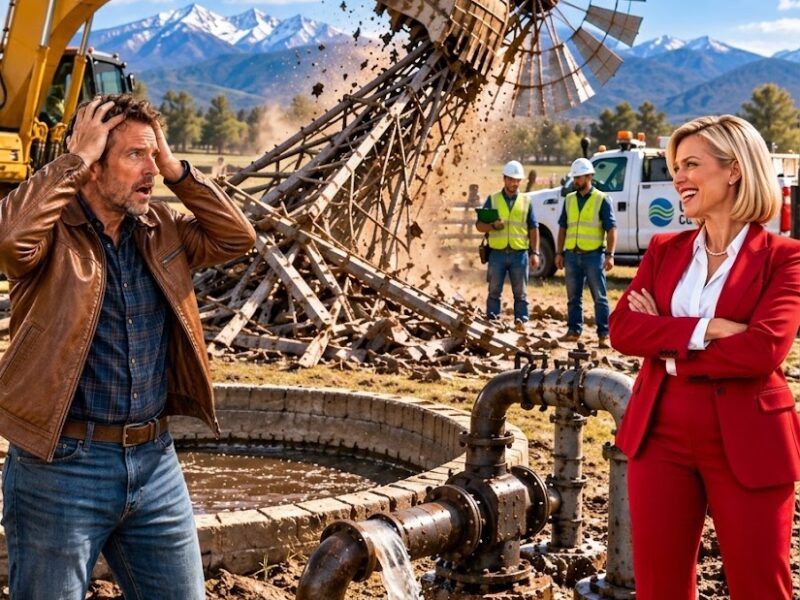
The HOA cut down my windmill. They said it was “unsightly” and gave me 30 days to remove it. Then the utility company called and asked one question: “Why did the pumps stop?”
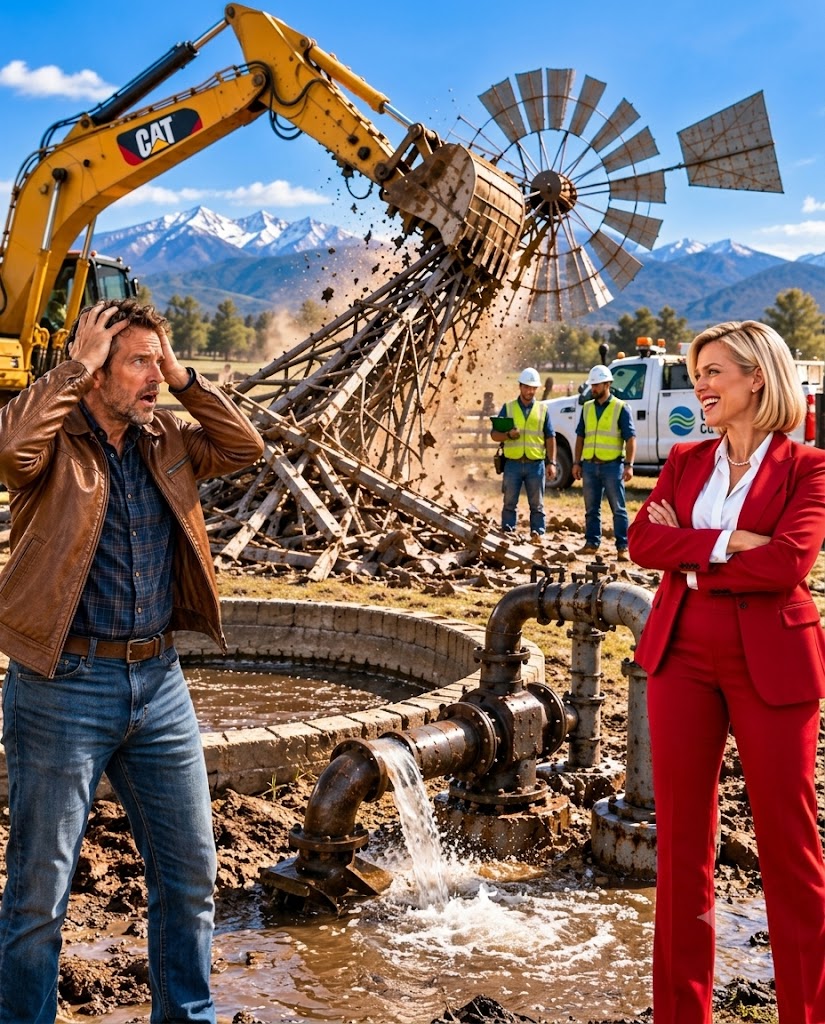
The utility power was reaching both pumps, Thomas Reed said.
Then he looked past me at the empty patch of Texas sky where my windmill had stood twenty-four hours earlier.
So tell me exactly what changed before they stopped.
Nobody answered.
Two irrigation pumps that had worked the previous morning were now silent.
The windmill that had stood on my ranch for decades was gone.
And Vanessa Cole, president of the Cedar Hollow Homeowners Association, was standing beside the pump controls with a crimson folder in her hands, insisting the two things had nothing to do with each other.
Thomas had spent nearly forty minutes testing the electrical service.
He was fifty-six, a field engineer from the local utility company, and he had the kind of calm voice that made weak answers sound even weaker.
When were these pumps last operating normally? he asked me.
Yesterday morning. Both.
Both?
Both.
And when was the windmill removed?
Yesterday afternoon.
Vanessa stepped forward.
It was an obsolete structure and a documented safety concern. Its removal was unrelated to the electrical service.
Thomas turned to her.
Who determined it was unrelated to this system?
Vanessa tightened her grip on the folder.
The windmill had been inactive for years.
That was not my question.
The silence that followed was the first moment I realized this was no longer just a fight over an old windmill.
My name is Daniel Mercer.
I was forty-five years old and I owned roughly one hundred ten acres outside Cedar Hollow, a growing community in rural Texas.
My ranch included pasture, livestock fencing, an equipment barn, a storage tank, two irrigation pumps, and a water system that had been repaired and modified by different owners and technicians over decades.
The windmill had been there long before I bought the property.
Some of the equipment around it was old, some was newer.
Some of the original mechanical pieces no longer did what they had once done.
But I had years of maintenance records showing that the water system in that area had been repaired, modified, and integrated over time.
I never cared whether it looked modern.
I cared whether it worked—until the day the homeowners association sent a contractor onto my property and removed the windmill.
It did.
Vanessa opened her folder.
The association received repeated concerns about the condition of that structure. Families could see it from their homes. There were questions about whether it presented a hazard.
Thomas looked at her.
Is Daniel’s property part of Cedar Hollow?
She paused.
No, but the structure affected the surrounding community.
Was the water system inspected before the removal?
The contractor handled the work professionally.
Thomas waited.
Did anyone inspect the operating equipment in this area before the work began?
Vanessa looked down at her papers.
I said nothing.
Months earlier, I would have interrupted.
I would have explained every maintenance receipt, every repair, every warning I had already given her about assuming authority over property Cedar Hollow did not own.
By then, I had learned something useful.
Sometimes the best thing you can do is let a person keep answering until everyone else hears what they do not know.
Thomas crouched near an older section of conduit and followed it with his eyes toward the remaining pump equipment.
I am not saying removing the windmill caused the pump failures, he said. The utility service is present. What I need to understand is what physically changed before the problem appeared.
Vanessa exhaled.
The windmill was considered abandoned.
Thomas stood.
By whom?
She hesitated.
That hesitation changed everything.
Until then, I thought Cedar Hollow simply hated looking at an old agricultural structure from its new backyards.
I thought the dispute was about appearance, property lines, and whether an association could push its preferences beyond its own boundary.
Thomas was asking the questions nobody at Cedar Hollow had bothered to ask before sending a removal crew onto my ranch.
Who decided the windmill was abandoned?
Who decided it served no active function?
Who inspected the system?
And who decided they had the right to act on my property without asking me?
Thomas looked toward the empty patch of sky one more time.
Who determined this structure was independent from the operating water system?
I met his eyes.
Nobody asked me.
Four months earlier, Cedar Hollow had still looked unfinished enough that several front yards were bare dirt and young trees stood supported by wooden stakes along streets that had not existed a year before.
From my side of the fence, I watched construction crews finish driveways, landscaping trucks arrive, and families move into houses facing the western edge of the development.
I had no problem with any of it.
Cedar Hollow belonged on somebody else’s land.
My ranch belonged on mine.
For years, that distinction had been enough.
My one hundred ten acres included pasture, an equipment barn, fenced livestock areas, my house, two irrigation pumps, a storage tank, and the old windmill near the eastern side of the property.
The windmill was not decoration.
I had not installed it to make the ranch look traditional.
It had been standing before I bought the place, and the water system around it had been repaired and modified as equipment changed over the years.
Some components were old, others had been replaced.
I maintained what still served a purpose and repaired what needed attention.
Most days, I barely noticed how the windmill looked against the Texas sky.
Apparently, people in Cedar Hollow did.
The first letter was polite.
It said several residents had expressed concern about the appearance and condition of an aging agricultural structure visible from the neighborhood.
I read it at my kitchen table and filed it away.
The second letter mentioned rust, maintenance, and a possible safety concern.
I responded in writing that the structure was located on private property outside Cedar Hollow and that I maintained the equipment on my ranch.
Two weeks later, Vanessa Cole came to see me.
She arrived in a dark SUV and parked near my equipment barn.
She was forty, sharply dressed in a crimson blazer over a white blouse with platinum blonde hair cut into a precise bob.
She introduced herself as president of the Cedar Hollow Homeowners Association.
Several families can see that windmill directly from their homes, she said. They are concerned about its condition.
Has anyone reported an actual problem with it? I asked.
People should not have to wait for a problem before raising a safety concern.
That sounded reasonable enough.
So I told her I would inspect the structure again and arrange maintenance if anything required attention.
Vanessa looked toward the windmill.
Removal would probably be the cleaner solution.
Cleaner for whom?
For everyone. It is old, Daniel. The neighborhood has changed.
I looked beyond her toward the new houses.
The neighborhood changed. My property did not.
Her expression tightened slightly.
We are trying to handle this cooperatively.
So am I. But I need to understand what you are asking. Is my property inside Cedar Hollow?
No.
Is the windmill inside Cedar Hollow?
No.
Then is this a request or an order?
Vanessa paused.
It is a community safety issue.
That does not answer the question.
She glanced toward the tower again.
Families live much closer now. Children play in those yards. Homeowners have a reasonable expectation that visible hazards will be addressed.
If there is a documented hazard, send me the inspection identifying it. I will review it.
Vanessa folded her arms.
You should not need a formal report to recognize that an aging structure deserves attention.
Attention and removal are different things.
For several seconds, neither of us spoke.
A dry breeze moved across the pasture, and the windmill turned slowly behind me with the same faint mechanical sound I had heard hundreds of times.
Vanessa finally opened her folder and removed a copy of one of the association letters.
This structure should have been dealt with before these homes were sold.
That sentence changed the conversation.
Dealt by whom?
She looked toward Cedar Hollow instead of answering.
There were planning expectations for this area.
Expectations involving my property.
The development process involved more than one property line.
She handed me the letter and returned to her vehicle a few minutes later.
I watched her drive back toward Cedar Hollow, then turned toward the windmill.
Until that moment, I had assumed some new homeowners simply disliked seeing an old agricultural structure from their backyards.
Vanessa had suggested something different.
Someone involved with Cedar Hollow apparently believed my windmill was supposed to disappear before those houses were sold.
I wanted to know who had given them that expectation.
The next morning, I called Rachel Morgan before I called anyone connected to Cedar Hollow.
Rachel was forty-nine, a property attorney who had helped me with an easement question several years earlier.
She listened while I described Vanessa’s letters, her visit, and the statement that the windmill should have been dealt with before the nearby homes were sold.
When I finished, Rachel asked one question.
Do you have your current property survey?
I did.
Good. Get the survey before you get angry.
By noon, I had it spread across my kitchen table.
The boundary lines were clear.
The windmill stood well inside my one hundred ten acres.
It was not on a shared boundary.
It was not inside Cedar Hollow.
Rachel reviewed a copy that afternoon and immediately warned me not to make the document prove more than it did.
This establishes where your property ends and where Cedar Hollow begins, she said. It does not tell us what the developer believed about the windmill or what anyone may have represented to buyers.
That became our rule.
Instead of arguing with assumptions, we started collecting records.
I found photographs taken years earlier showing the windmill beside the same general water system area.
I located maintenance invoices, pump service receipts, and repair records showing that equipment around that part of the ranch had been worked on repeatedly.
Some components had been replaced over time.
Others remained from older configurations.
Nothing in my records described the windmill as abandoned.
Rachel began looking for development materials connected to Cedar Hollow.
Several days later, she asked me to come to her office.
On her conference table was an early development exhibit showing proposed streets, residential lots, and the western edge of Cedar Hollow beside my ranch.
My property was clearly outside the development boundary.
The windmill was also visible on the exhibit as an existing agricultural feature.
I leaned over the page.
So they knew it was there.
Rachel looked at me.
It proves the people preparing this exhibit could see it and included it in their planning material.
That sounds like knowing.
Knowing it existed is not the same as promising that it would disappear.
She tapped the document with one finger.
Stay with what the evidence proves.
She was right.
The exhibit established something useful without answering the larger question.
Cedar Hollow had not suddenly discovered my windmill after families moved into their new homes.
It had been visible during the development process.
But that still did not explain why Vanessa believed it should have been dealt with before the houses were sold.
Two days later, another letter arrived from the homeowners association.
This one was more formal.
It referred to continuing concerns involving appearance, maintenance, and potential safety conditions.
It also stated that the association was reviewing available options for addressing the structure.
I read that sentence twice before calling Vanessa.
I received your latest letter.
Then you understand the board is taking the concerns seriously.
I understand that. I also reviewed my survey.
There was a brief silence.
Daniel, property boundaries do not eliminate community safety concerns.
I did not say they did. I am asking what authority the association believes it has over a structure located entirely on my property.
We are reviewing the available options.
Based on what inspection?
The condition is visible from Cedar Hollow.
Visible is not the same as inspected.
She did not answer.
I continued.
You told me the windmill should have been dealt with before these homes were sold. Who told you that?
Vanessa’s voice became more guarded.
There were expectations during the development process.
Expectations from whom?
The development involved multiple parties.
Was I one of them?
Another pause.
You need to ask the developer.
I wrote those words down immediately after the call.
That evening, I returned to the development exhibit and compared it with recent photographs of Cedar Hollow.
The windmill had not moved.
My property line had not moved.
What had changed was the number of houses looking toward it.
Someone had planned those houses while the windmill was plainly visible.
And somewhere along the way, its continued existence had apparently become a problem that people believed somebody else was supposed to solve.
I still did not know who created that expectation.
But Vanessa had finally given me a direction.
If the answer did not begin with the homeowners association, then it might have begun before the association ever sent me its first letter.
Three weeks after Vanessa told me to ask the developer, I left the ranch shortly after eight in the morning to pick up replacement fittings and filters from a farm supply store about forty miles away.
Before leaving, I walked past the windmill as I usually did when checking the eastern side of the property.
Nothing looked unusual.
The pumps had run that morning.
The storage tank was at its normal level.
By early afternoon, I turned onto my driveway and immediately knew something was different.
For years, the windmill had been the first thing I saw above the pasture when I came home from that direction.
Now, there was only open Texas sky.
I slowed the truck.
A contractor’s vehicle was parked near the eastern field, and several workers were finishing cleanup around the place where the tower had stood.
I parked near the equipment barn and walked toward them.
I did not shout.
I did not touch anything.
I took out my phone and started taking photographs.
The remaining base, the disturbed ground, the nearby water equipment, the contractor’s vehicle, the time on my phone.
A man wearing a work shirt approached me and introduced himself as Eric Dawson, the site supervisor.
Who authorized this work? I asked.
Eric looked surprised.
You were Daniel Mercer?
Yes.
His expression changed.
We were given a removal order for an obsolete agricultural structure.
By whom?
The work came through a property maintenance request connected to Cedar Hollow.
This is not Cedar Hollow property.
Eric looked toward the fence, then back at me.
Our paperwork identified the structure as an abandoned windmill presenting a safety concern.
Do you have the work order number?
He gave it to me.
I wrote down his company name, his name, the number, and the approximate time the crew had arrived.
Did anyone speak with me before entering the property?
I was told authorization had already been handled.
Did anyone inspect the water equipment before the windmill was removed?
Eric hesitated.
Our assignment was the structure.
That answer mattered more than an argument would have.
I asked the crew not to remove anything else until ownership and authorization were clarified.
Then I stepped away and called Rachel.
She listened without interrupting.
Photograph everything before anything changes, she said. Do not move components just to see what happened. Get the contractor information and preserve every letter you received.
Already doing it.
Good. Now, do not decide why they did this until we have the work order.
I spent the next hour documenting the area.
The empty space bothered me more than I expected.
It was not because the windmill had been beautiful.
It was because something that had stood on my land for decades was suddenly gone, and everyone involved seemed to believe somebody else had already answered the question of permission.
Late that afternoon, I checked the irrigation system.
One pump did not start normally.
I reset the control once, then stopped when the response was not what I expected.
Rachel had told me not to disturb anything unnecessarily, and I was beginning to understand why.
About twenty minutes later, the second pump registered a fault.
That changed my concern completely.
Both pumps had been operating that morning.
Now, within hours of the removal work, neither was functioning normally.
I walked back toward the windmill site and studied the older conduit, control equipment, and water system components around the remaining base.
Over the years, different owners and technicians had modified that system.
I knew how to operate it and maintain the parts I regularly serviced, but I could not tell from looking at the ground which older components might still interact with newer equipment.
I called Rachel again.
Now the pumps are down.
She was silent for a moment.
Do not assume the removal caused it.
I am not.
Good. Document when each pump last operated and when you discovered each problem. Then call the utility company and have the service checked.
I wrote down the times.
That morning, the windmill had been standing and both pumps had worked.
By afternoon, the windmill was gone and both pumps had problems.
Maybe those events were connected.
Maybe they were not.
But for the first time since Vanessa had started sending letters, I had a question more urgent than who believed the windmill should disappear.
I needed to know exactly what had changed when it did.
I called the utility company before sunset and reported that both irrigation pumps had stopped operating normally.
I gave them the service location, explained that the equipment had been working earlier that morning, and described the timing without offering my own theory.
The following morning, Thomas Reed arrived in a white utility truck shortly after nine.
He was fifty-six with gray at his temples, a weathered face, and the patient manner of someone who had spent years listening to people explain electrical problems before checking the equipment himself.
I walked him toward the pump controls.
Both pumps were working yesterday morning, I said. The first one failed to start normally late in the afternoon. The second registered a fault shortly afterward.
Thomas opened the service panel and began checking the incoming electrical supply.
He asked when the equipment had last been serviced, whether I had experienced recent outages, and whether anyone had performed electrical work on the property.
I answered each question directly.
After several minutes, he looked at his meter and then toward the utility connection.
The service reaching this location is present, he said. I am not seeing a general supply interruption that explains both pumps stopping when you described.
So the problem is mine.
I am saying the utility service is here. I have not told you where the problem is yet.
That distinction sounded exactly like something Rachel would have said.
Thomas continued examining the controls.
Then he asked what equipment was altered before the pump stopped.
I looked toward the eastern field.
The windmill was removed yesterday.
He stopped writing.
What windmill?
I pointed toward the empty space beyond the equipment barn.
Thomas walked with me across the pasture.
When we reached the site, he did not spend much time looking at the missing tower.
His attention went immediately to what remained near the ground.
Older conduit, water lines, control equipment, mounting points, pieces from different periods that had clearly been added or modified over time.
Who removed it? he asked.
A contractor. They said they had a work order connected to Cedar Hollow.
Did they disconnect anything before removal?
I do not know.
Did someone inspect this system first?
Not with me present.
Thomas crouched beside an older section of conduit and followed its direction with his eyes.
He did not touch it.
How old is this water system?
Parts of it are older than I am. Other parts were replaced before I bought the ranch, and I have updated equipment since then.
Do you have service records?
Years of them.
He stood.
Good. Keep them.
I asked whether he thought removing the windmill had caused the pump failures.
Thomas shook his head.
I do not have enough information to say that. Timing gives us a reason to investigate. It does not give us a conclusion.
Before I could answer, a dark SUV came up my driveway.
Vanessa stepped out carrying her folder.
She had apparently learned that the utility company was on the property.
Daniel, I heard there was an issue with the pumps.
There is.
She looked at Thomas.
The windmill removal was separate from the electrical service. It was an obsolete structure.
Thomas glanced toward the remaining equipment.
Who determined that the structure was independent from the operating water system?
Vanessa frowned.
The windmill had not been functioning in any meaningful way for years.
I am asking about the system, not whether the blades were visibly doing useful work.
She opened her folder.
The contractor was given information about the structure from an engineer.
Thomas asked, From an engineer?
Vanessa hesitated.
It came through the community safety review.
Was there an inspection of these components before the removal?
I would have to check the records.
Thomas nodded and returned his attention to the equipment.
There was no accusation in his voice, which somehow made his questions harder to dismiss.
He pointed toward one section of older infrastructure.
Systems like this can be modified repeatedly over decades. Something that looks outdated from a distance can still be connected to equipment that remains active. I need to know what was physically altered before I can tell you what matters.
Vanessa looked toward the empty patch where the tower had stood.
I watched her expression change slightly.
For months, every letter had treated the windmill as one simple object.
Old, visible, unwanted.
Thomas was looking at it differently.
To him, the tower was only one part of a system whose history nobody had bothered to trace.
He turned to me.
Get me the maintenance records and anything showing previous modifications.
Then he looked at Vanessa.
And I need whatever inspection or technical record was used to determine this structure had no active function.
Vanessa lowered her eyes to the folder.
For the first time, I wondered whether that record existed at all.
The document Vanessa could not produce arrived two days later, but it was not an inspection report.
Rachel called me just after lunch and asked me to come to her office.
Eric Dawson’s company had provided a copy of the work order after Rachel requested the records connected to the removal.
She placed the document in front of me and pointed to a line near the description of the job.
Read that carefully.
The wording was simple.
Abandoned structure. No active utility function.
I read it again.
Who told them that?
That is the question.
Rachel had already spoken with Eric.
His company had been hired to remove what they understood to be an abandoned agricultural windmill.
Their crew had not been asked to evaluate the broader water system, and they had not performed an engineering inspection to determine whether older components around the tower remained connected to active equipment.
They relied on the description they were given.
Rachel said, That does not answer whether they should have verified more before entering your property. It only tells us what their paperwork said.
I looked at the work order.
I never described it as abandoned.
Then we find out who did.
Thomas came to the ranch later that afternoon after I sent him copies of several years of maintenance records.
We spread the records across a workbench inside my equipment barn.
He followed dates carefully, comparing pump repairs, control upgrades, and older service notes.
One invoice from years earlier referred to modifications near the windmill base.
Another mentioned integration with existing water system controls.
Thomas tapped the page.
This is why I did not want to guess from appearance.
Does this prove the removal stopped the pumps?
No. It proves there is enough history here that nobody should have assumed the tower and surrounding equipment were functionally independent without checking.
He asked to see the work order.
When he reached the phrase about no active utility function, he looked at me.
What technical report supports this statement?
We have not found one.
Who inspected the system before that description was written?
We have not found anyone.
Thomas set the paper down.
Then this description is something that needs a source.
That evening, Cedar Hollow held an emergency board meeting after Rachel notified the homeowners association that we were requesting the authorization records.
Vanessa sat at the center of the table with Harold Pierce, the sixty-two-year-old board treasurer, several seats away.
Rachel and I attended because the work order appeared to have originated through a request connected to the association.
Vanessa began by saying the board had acted in response to long-standing safety concerns.
Rachel did not argue about motives.
She placed the survey and the contractor’s work order on the table.
We have three separate questions, she said. Who authorized entry onto Daniel’s property? Who supplied the description that this structure was abandoned? And what technical information supported the statement that it had no active utility function?
Vanessa looked at the work order.
The association had received information indicating the structure was obsolete.
Harold turned toward her.
Did the board vote to authorize removal?
We discussed the safety issues several times.
That was not what I asked.
Vanessa opened her folder and began reviewing meeting records.
Harold had brought his own copies.
He went through them by date.
There were discussions about appearance, discussions about potential safety concerns, references to contacting the developer and reviewing options, but Harold could not find a recorded vote clearly authorizing entry onto my property to remove the windmill.
Vanessa said some decisions had been handled through ongoing community maintenance coordination.
Rachel remained calm.
That still leaves the technical description.
Harold picked up the work order.
Where did no active utility function come from?
Vanessa looked toward another board member.
Nobody answered.
I thought about all the words used during the previous months.
Old, rusted, visible, unattractive, potentially unsafe.
None of those words meant abandoned.
None meant disconnected.
Somewhere between the first complaint and the contractor arriving on my ranch, somebody had turned an opinion about appearance into a statement about function.
Rachel gathered the papers and placed the work order on top.
Do not search for who remembers saying it, she said. Find the first document where the description appears.
Harold nodded slowly.
Vanessa said nothing.
For months, everyone had been asking whether the windmill should remain.
We were finally asking the question that mattered more.
Where had someone first decided it was no longer being used?
Harold found the first useful trail three days later.
He called Rachel, and by that afternoon, we were sitting around her conference table with a stack of Cedar Hollow correspondence arranged by date.
Vanessa had provided the homeowners association records after the board agreed that the authorization history needed to be reviewed.
Rachel started with the oldest document.
It was written months before my first letter from the association and described the windmill simply as an older agricultural structure visible from the western homes.
The next reference appeared in an email discussing neighborhood appearance.
This time the wording was apparently unused structure.
Rachel placed the pages side by side.
That is already different, she said. Older describes age. Apparently unused describes somebody’s observation.
Harold nodded.
But it still does not say abandoned.
The next document came several weeks later.
A community maintenance summary referred to the windmill as an obsolete structure.
After that, a safety discussion described it as an obsolete agricultural feature requiring resolution.
Finally, we reached the contractor request.
Abandoned structure, no active utility function.
I stared at the sequence.
No single sentence looked dramatic by itself.
That was what made it troubling.
Each version was only slightly more certain than the one before it.
Old became apparently unused.
Apparently unused became obsolete.
Obsolete became abandoned.
Then abandoned somehow became no active utility function.
Where is the inspection between these documents? I asked.
Rachel looked at Harold.
Have you found one?
No.
Any communication with Daniel confirming the windmill was unused?
No.
Any technical review before the contractor request?
Harold shook his head.
Not in the records I have.
Thomas reviewed the same documents later that day at my ranch.
He had also gone through more of my maintenance history and inspected additional portions of the pump system with a qualified service technician.
He remained careful about the conclusion.
Your records show the pumps were operating before the removal, he said. They also show that equipment around this location had been modified and incorporated into the water system over time. That does not by itself establish the exact cause of both failures. But it means the work order should not have called everything inactive. I would say I have not seen a technical basis for that statement.
That was Thomas.
He never used a larger conclusion when a smaller one was enough.
The service technician still needed to trace several components before determining exactly what had been affected.
Thomas was not willing to skip that step just because the timing looked suspicious.
Neither was I.
The following evening, Harold asked Vanessa to attend a smaller board review with Rachel and me present.
He placed copies of the documents in chronological order.
I want to understand the language, he said.
Vanessa read the first page.
These descriptions came from different communications.
I know that. That is the problem.
He moved his finger down the sequence.
Older agricultural structure. Apparently unused structure. Obsolete structure. Abandoned structure. No active utility function.
Vanessa looked toward Rachel.
Those terms were based on what people could observe.
Rachel answered calmly.
Then the records should distinguish observation from verification.
Vanessa’s expression tightened.
The windmill did appear inactive.
From where? I asked.
From Cedar Hollow, across my property line.
She looked at me but said nothing.
Harold returned to the documents.
Who changed apparently unused into abandoned?
Vanessa opened her folder and searched through several pages.
I do not know that one person made that change.
Then who approved the final description?
The contractor request moved through community maintenance coordination.
Harold leaned back.
That still does not tell me where the factual statement came from.
Rachel noticed a reference number attached to one of the intermediate emails.
She compared it with the document index Vanessa had provided.
There is an earlier message missing from this packet.
Harold looked over.
From whom?
A project coordinator connected to the development side.
Vanessa glanced at the reference and became very still.
That may be in the archived development correspondence.
Harold asked her to request the original.
The meeting ended without accusations because we still did not know what it said.
But the pattern was becoming impossible to ignore.
Nobody had started by declaring my windmill abandoned.
They had started by looking at it from a distance and deciding it appeared unused.
Every time that observation passed from one document to another, uncertainty disappeared.
By the time a contractor entered my property, an impression had become a fact.
Now one missing email might tell us where that transformation began.
The missing email arrived the next afternoon.
Harold forwarded it to Rachel, and she called me before I had finished reading the first paragraph.
Do not focus on what you think it means, she said. Focus on what it actually says.
The message had been written by a project coordinator during one of Cedar Hollow’s later development phases.
It discussed visible features along the western edge of the neighborhood and included one short observation about my property.
The old windmill appeared inactive from the development side and was not expected to remain a significant long-term feature.
That was it.
No inspection.
No conversation with me.
No maintenance records.
No statement that the windmill had been abandoned.
Rachel placed the email beside the later documents when I arrived at her office.
The progression was almost embarrassingly simple.
Appeared inactive became apparently unused.
Apparently unused became obsolete.
Obsolete became abandoned.
Abandoned eventually became no active utility function.
Nobody ever asked me, I said.
Rachel nodded.
That is what the records currently show. But do not turn poor verification into a larger accusation unless the evidence supports it.
Later that day, Thomas met me at the ranch with the service technician who had been tracing the pump system.
They had compared my maintenance records with the physical equipment remaining near the old windmill base.
Thomas walked me through their findings carefully.
Parts of the original mechanical arrangement had stopped serving their original purpose years earlier, but later modifications had reused portions of the existing infrastructure.
Control wiring and associated components near the windmill area were still part of the functioning water system before the removal work.
The technician had identified disruption in that area consistent with the pump problems that appeared afterward.
Can you say the removal caused both failures? I asked.
Thomas considered the wording before answering.
The evidence supports a connection between the work performed in this area and the loss of normal pump operation. The technician is documenting the specific components that require repair. I would not describe the entire windmill as powering your pumps because that would be inaccurate. I would say the removal work affected infrastructure associated with an active system.
That distinction mattered.
The tower itself was not some magical machine keeping my ranch alive.
The problem was that people had treated everything around it as useless because the most visible part looked old.
That evening, Cedar Hollow called another board meeting.
Rachel placed three records on the table.
My survey, the contractor work order, and the maintenance history.
The survey showed the windmill had stood on my property.
The work order described it as abandoned with no active utility function.
The maintenance records showed continuing work on the water system connected to that location.
Harold looked at Vanessa.
Did anyone from the homeowners association ask Daniel whether this equipment was active before the contractor was sent?
Vanessa glanced toward the documents.
I relied on the information available through the development and maintenance communications.
That is not what I asked.
She remained quiet.
Rachel spoke next.
We should separate the issues. The first is authority to enter Daniel’s property. The second is the factual basis for the work order description. The third is the technical effect of the removal. Each needs its own review.
Vanessa looked toward me.
The association believed the structure had been unused for years.
You believe that because somebody looked at it from Cedar Hollow? I said. Apparently. Did anyone call me?
She did not answer.
Harold picked up the original email and held it beside the contractor request.
This says appeared inactive, he said. It does not say inspected. It does not say abandoned. It does not say disconnected.
Then he tapped the work order.
But this one says abandoned structure. No active utility function.
He looked directly at Vanessa.
Where did the certainty come from?
Vanessa opened her folder, closed it, then opened it again.
No answer.
For months, she had spoken to me as though the paperwork settled everything.
Now the paperwork was doing the opposite.
Her expression changed.
Not dramatically.
She simply stopped defending the wording.
Thomas, who had been invited to explain the technical findings, kept his comments narrow.
My role is not to determine property authority or responsibility. What I can tell you is that active water system infrastructure existed in the area where the removal work occurred, and the pump problems appeared after that work. The technical repair documentation will address the affected components.
Harold leaned back and looked at the documents spread across the table.
So we went from somebody seeing an old windmill from across the property line to a contractor receiving paperwork saying it had no active function.
Nobody corrected him.
I thought about the months of letters, the arguments about appearance, and the confidence with which Vanessa had described the windmill as something that should already have disappeared.
The truth was less dramatic and more troubling.
Nobody had uncovered evidence that I abandoned it.
Nobody had discovered a forgotten agreement.
They had simply repeated an observation until the uncertainty disappeared from the sentence.
By the time anyone acted, the assumption sounded like a fact, and the one person who could have corrected it had never been asked.
The final Cedar Hollow board meeting took place a little more than three weeks later.
By then, the room no longer felt like a debate about whether an old windmill looked appropriate beside a new neighborhood.
An independent attorney retained by the homeowners association had reviewed the board records, the contractor authorization, the development correspondence, and my property survey.
Rachel had completed her own review.
Thomas had finished documenting the utility side of the pump problem, and the service technician had identified the components that needed repair.
The conclusions were careful, but they were clear.
Nobody had located a document giving Cedar Hollow authority to remove the windmill from my property.
Nobody had found a technical inspection supporting the statement that the structure had no active utility function.
The earliest development correspondence described something that appeared inactive from a distance.
Later records gradually turned that observation into something much more definite.
The association attorney recommended that the board stop making any claim over structures on neighboring property unless it could first establish actual authority.
He also recommended that no future maintenance request involving property outside Cedar Hollow move forward without documented ownership verification, and when equipment might have a technical function, appropriate professional review.
Harold read the recommendations aloud before making a motion to adopt them.
Another board member seconded it.
The motion passed.
Vanessa sat with her folder closed in front of her.
When the board opened the floor for comments, she looked toward me.
I relied on descriptions that became more definite over time, she said. I believe the windmill had been abandoned.
I could have repeated every letter she had sent me.
I could have reminded her that I had asked for an inspection before any of this happened.
Instead, I said, That is why you ask before you act.
She nodded once.
Rachel then reminded everyone that responsibility for the repair costs would be handled through the appropriate parties, insurers, and legal processes.
She did not promise me some enormous settlement.
I did not expect one.
Eric Dawson’s company provided its records and cooperated with the review.
The homeowners association’s insurer became involved.
The questions about authorization and reimbursement moved through the ordinary process where they belonged.
Thomas was equally careful about the technical findings.
The old tower itself had not directly powered my irrigation pumps.
The important point was that active water system infrastructure remained associated with the area where the removal work occurred, and that infrastructure had been disturbed.
Once the affected components were repaired and tested, both pumps returned to normal operation.
A week after the board meeting, Cedar Hollow announced that Vanessa was stepping down as president following what it called a demanding period of internal review.
Harold became interim president.
I did not celebrate.
I had never wanted her position.
I had wanted people to stop treating the view from their backyards as evidence about what happened on my land.
The association letters stopped.
The arguments about what my property should look like stopped.
Cedar Hollow established a formal process for contacting neighboring landowners when legitimate concerns arose, and I agreed to keep an open line of communication about maintenance near the shared boundary.
Courtesy had never been the problem.
Assumption had been.
Several weeks later, I stood near the eastern pasture early one morning while the repaired pumps moved water through the ranch again.
The Texas sky was pale blue, and the roofs of Cedar Hollow were visible beyond the fence.
The space where the windmill had stood still looked strange.
I had not decided whether I would rebuild the tower.
For the moment, I cared more that the system beneath and around that location had been properly documented.
Rachel had returned my original survey.
Thomas had given me copies of the technical records.
Every modification was now mapped clearly enough that the next person would not have to guess what an old piece of equipment did simply by looking at it.
Harold stopped by one afternoon to return a folder of photographs the board had borrowed during its review.
Before leaving, he looked toward the empty space in the pasture.
From our side, it really did look unused, he said.
I believe you.
He seemed surprised.
You do?
Looking unused was never the problem.
I glanced toward the pump house where the equipment was running normally again.
Deciding that looking unused meant abandoned was the problem.
Harold nodded and drove away.
I stayed beside the fence for a while after he left.
Cedar Hollow had seen an old windmill.
Someone wrote that it appeared inactive.
Someone else repeated it with stronger language.
Eventually, nobody remembered that the first statement had only been an observation.
They called it abandoned because nobody had bothered to ask the one person who still used it.
The pumps were running again.
Cedar Hollow no longer claimed authority over my windmill or anything else on my side of the fence.
The board had adopted a verification process for work involving neighboring property.
Vanessa was no longer president, and every active component around that old water system was finally documented.
So nobody could ever again turn a guess into an order simply because the equipment looked old from across a property line.
I still had not decided whether I would rebuild the windmill.
Maybe I would.
Maybe I would leave the sky open.
That decision belonged to me.
And that was the part Cedar Hollow had needed months, meetings, lawyers, contractors, and two silent irrigation pumps to understand.
They had seen an old windmill and decided it looked unused.
Someone wrote down that it appeared inactive.
Someone else repeated it with a little more certainty.
Apparently unused became obsolete.
Obsolete became abandoned.
Abandoned became no active utility function.
And eventually, a contractor arrived on my land, believing permission had already been handled.
All because nobody stopped long enough to ask the one person who actually owned the property.
Me.
Vanessa had wanted the windmill gone because Cedar Hollow had changed.
But the neighborhood changing never moved my property line.
It never transferred ownership, and it never turned an assumption into authority.
The pumps hummed steadily behind me as I looked across the fence toward Cedar Hollow.
For the first time in months, there was nothing left to argue about.
The windmill was gone.
The system was repaired.
The record was corrected.









