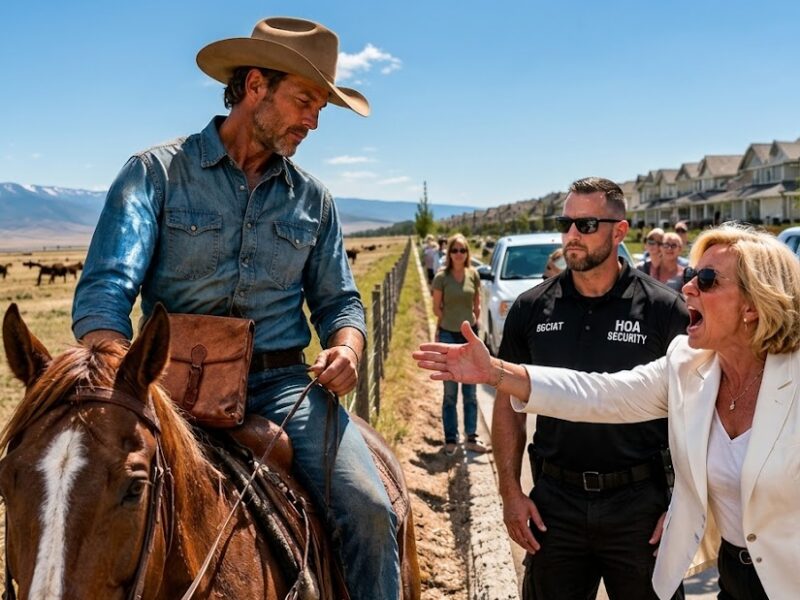
The HOA claimed 640 acres of my ranch. They sent a letter, a map, and a lawyer’s threat. There was just one problem: I’ve never been a member of anything.
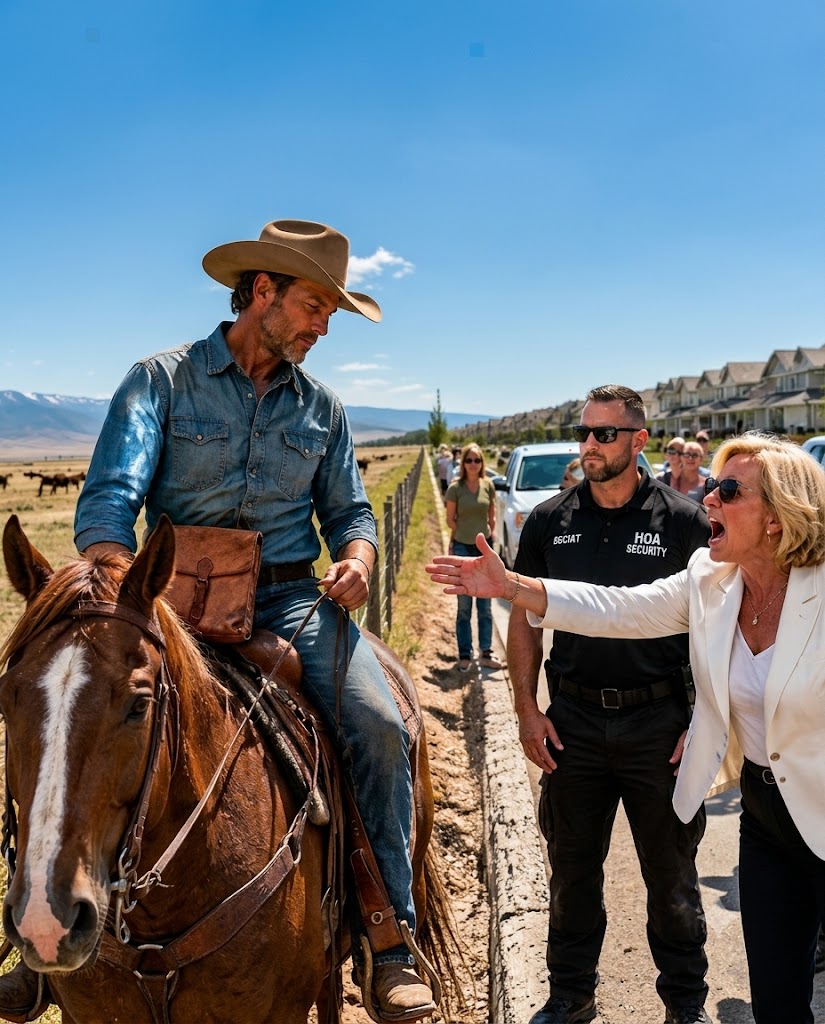
640 acres. That’s how much land a homeowners association tried to steal from me using nothing but a photocopier, a rubber stamp, and the assumption that I’d never actually read a plat map in my life.
I’ve ranched cattle on that ground since I was 19 years old.
I’ve never paid a dues invoice, never attended a meeting, never signed a single covenant because I’ve never been a member of that association or any association.
Not once. Not for one single day.
And yet there I was, standing at my own fence line, looking at a laminated sign some contractor had zip tied to my steel post that read: *Property of Whisper Creek Ranch Estates Homeowners Association. Unauthorized Access Prohibited.*
I want to tell you how that happened, because the how of it is the whole story.
This isn’t really about a fence or a sign. It’s about a stack of paper filed in a county recorder’s office that quietly tried to rewrite the boundaries of my family’s land, and what happened when I decided to read that paper instead of getting angry about it.
My name’s Walt Coy. I’m 54 years old, and I run cattle on a piece of ground in a county we’ll just call Larimer County, because the actual name doesn’t matter near as much as what happened here does.
My grandfather homesteaded the original 200 acres back in 1951. My father added to it in the ’70s and ’80s, buying out two neighboring parcels when the families who owned them wanted out of ranching.
I added the last chunk myself in 2003—110 acres of hay ground along the creek bottom that came up for sale when old man Petroski passed and his kids just wanted cash.
Altogether, the ranch runs just over 640 acres. A full section, fence to fence. And every acre of it is documented in deeds going back 70-some years, filed and refiled and re-indexed every time the county updated its records.
I tell you all that not to bore you with a land history lesson, but because it matters later. Every single one of those transactions is a matter of public record.
Every one of them has a deed with a legal description, a parcel number, a recording stamp with a date and a book and page number. That paper trail is the whole reason this story has the ending it has.
Keep that in your head.
For 30-some years, the west side of my property bordered open range and a scattering of small hobby parcels. Nothing organized, no HOA, no covenants—just neighbors who occasionally waved from their trucks.
Then, about 8 years ago, a developer bought up roughly 900 acres directly west of me and started platting out a subdivision called Whisper Creek Ranch Estates.
Big lots, 3 to 10 acres each, marketed to folks who wanted a little land and a country view without actually having to run cattle on it. They put in gravel roads, a community pond, an entrance sign with wagon wheels welded onto it. The whole aesthetic.
They formed a homeowners association to manage the shared roads and the pond and eventually to manage every single thing you can imagine an HOA deciding it needs to manage.
I had no problem with any of that. It’s their land, their subdivision, their rules for the people who bought into it. I waved at the new neighbors, same as I’d waved at the old ones.
My cattle stayed on my side of a five-wire fence I’d maintained since I was a teenager, and life went on.
The first sign something had changed came on a Tuesday morning in March when I was out checking a water trough on the west pasture and found a survey stake pounded into the ground about 60 yards inside my fence line.
Bright pink flagging tape on top. I figured it was a mistake. Maybe a county surveyor doing road work. Maybe the subdivision’s engineer running a line for something on their side.
I pulled it, tossed it in the truck bed, and didn’t think much more about it.
Two weeks later, there were four more stakes, and this time there was a folded piece of paper zip tied to one of them in a plastic sleeve.
It was a notice printed on letterhead I didn’t recognize, from something called the Whisper Creek Ranch Estates Homeowners Association Architectural and Boundary Committee.
It informed the property owner that the parcel in question, described only by a lot number I’d never heard of, was subject to association covenants regarding fencing, livestock containment, and structure setbacks. And that any existing improvements not in compliance would need to be brought into compliance within 30 days.
I stood there in my own hay field reading that notice twice because I genuinely thought somebody had made a clerical error.
I called the number on the letterhead. A woman answered—cheerful, professional, the kind of voice you’d expect from somebody running a call center. Except this was apparently the HOA’s management company, an outfit out of the county seat called Larimer Community Management Group.
I explained who I was and where my property was, and I asked why I was getting a compliance notice for land I owned outright and had owned for 20 years. Land that had never been part of any subdivision, any plat, any association of any kind.
She was polite. She said, “Let me pull up the file.”
There was a pause, some typing, and then she said something that I’ve turned over in my head a hundred times since, because it was the first thread I could have pulled right then if I’d known what was coming.
She said, “Our records show this lot was added to the association’s platted section in 2019, sir. So it would fall under our jurisdiction.”
Added, I said. Added by who?
“I don’t have that information in front of me,” she said. “You’d need to speak with the board.”
I hung up and I sat in my truck for a good 10 minutes just staring at the dashboard, because I already knew, without yet knowing any of the details, that somebody had done something to a piece of paper somewhere.
And that paper was now apparently more real in the eyes of some office somewhere than 70 years of deeds sitting in the same courthouse.
I want to pause here and tell you something about myself that’s going to matter a great deal later in this story, because I didn’t lead with it and neither did anybody at that HOA—because none of them bothered to ask.
Before I came back to run this ranch full-time in my 30s, I spent 11 years working for the state as a licensed land surveyor’s assistant. And then, after I got my own license, six more years doing boundary and title survey work for two different firms before my father’s health made me come home.
I know how plats get filed. I know how legal descriptions get written. I know the difference between a metes and bounds description and a lot and block description.
And I know exactly how much scrutiny—or lack of it—goes into recording an amended plat at most county offices, especially back before everything went digital and cross-referenced.
That background is the reason I didn’t panic that Tuesday morning. It’s the reason I didn’t call a lawyer first, and it’s the reason I didn’t drive over to the HOA’s little clubhouse and start yelling at whoever was sitting behind the folding table they called an office.
I did something much more boring. I drove to the county recorder’s office the next morning and asked to see the plat.
The clerk at the counter, a heavy-set woman named Donna who’d worked there since before I left for surveying school, pulled the file without much ceremony. Whisper Creek Ranch Estates, Phase One, recorded in 2016. 904 acres subdivided into 132 lots, exactly matching what I remembered from when the development first went in.
I compared the legal description against my own deed, which I’d brought with me in a manila folder I keep in my truck for exactly this kind of situation, and there was no overlap. Not an inch.
The subdivision’s western boundary sat a comfortable 300 feet short of my fence line.
Then I asked Donna if there’d been any amendments filed since. She typed for a minute, frowned at her screen, and said, “There’s an amended plat filed in 2019. Phase One Amended. You want a copy?”
I said, “Yes.” And I stood there at the counter while the printer spat out 11 pages. And on page six, there it was.
A revised boundary map showing Phase One Amended now extending an additional 640 acres to the east, folding in what the amendment called Lots 133 through 148. Sixteen new lots carved directly out of ground that according to every deed on file in that same building belonged to me.
I want you to sit with that for a second, because it’s the kind of thing that sounds impossible until you understand how it actually happens.
Somebody had drawn a new plat map. Somewhere on that map was my hay field, my creek bottom, my grandfather’s original 200 acres, all relabeled as 16 residential lots inside a subdivision I had never once agreed to join.
And that map had been filed, stamped, and accepted into the official records of the county, sitting there for 3 years without anybody noticing until survey stakes started showing up in my pasture and a call center employee cheerfully informed me that my land had been added to somebody else’s jurisdiction.
I asked Donna who filed it. She pulled the recording information.
The amended plat had been submitted by a licensed surveyor named Gregory Patton on behalf of the Whisper Creek Ranch Estates Homeowners Association, signed by the HOA’s board president at the time, a woman named Renata Voss.
I didn’t know either of those names yet. I would come to know them very well.
I asked Donna for certified copies of everything—the original plat, the amendment, and my own deeds, cross-referenced against the parcel numbers involved—and she made them without asking why, because that’s the kind of county office this was. The kind where nobody double-checks anything unless somebody makes them.
I drove home that afternoon with a folder on the passenger seat that I now understood to be either the laziest clerical mistake I’d ever seen or something considerably worse.
Given that the amendment specifically renamed my acreage into 16 brand-new lots, complete with lot numbers and what looked like proposed setback lines, I was leaning hard toward considerably worse.
A mistake doesn’t invent 16 lots. A mistake doesn’t draw proposed building envelopes on land it accidentally included. Somebody had sat down and designed those lots on purpose.
That night, I called my wife’s cousin, a woman named Priya Desai, who’d been practicing real estate and property law in the state for about 15 years, mostly out of a small firm two counties over.
I’d used her before for a boundary dispute with a neighbor years back—nothing dramatic—and I trusted her to tell me straight whether I was overreacting.
I read her the recording information over the phone. The book and page numbers, the date, the parcel numbers involved. She was quiet for a minute, and then she said:
“Walt, I need you to email me scans of everything tonight, and I need you to not talk to anybody from that HOA until I’ve looked at this. Not the board, not their management company, nobody. Can you do that?”
I said I could.
She called me back 2 days later, and her voice had a different tone to it than I’d heard from her before. More careful, more precise—the tone of somebody choosing every word.
“Walt,” she said, “I’ve been through the amended plat three times now, and I want to walk you through what I’m seeing, because I think you already suspect it, but I want it on the record between us exactly what I’m telling you.”
The original 2016 plat for Whisper Creek Ranch Estates Phase One was properly executed, surveyed, signed by the developer, signed by the county planning office, recorded correctly. That part’s clean.
The 2019 amendment is not clean.
First, an amended plat that adds acreage and creates new lots has to go through the same approval process as an original plat in this county. Planning commission review, public notice, the whole process—because you’re not just amending paperwork, you’re rezoning and resubdividing land.
There is no record anywhere of a planning commission hearing on this amendment. None. I checked the commission’s own meeting minutes going back to 2018, and Whisper Creek doesn’t appear on a single agenda in relation to any boundary expansion.
Second, she said, an amended plat that adds new land to a subdivision requires the consent of the owner of that land—notarized, filed alongside the amendment.
There’s a signature block on page nine of this amendment purporting to be a landowner consent form. It has a signature on it.
“Walt, whose signature is that supposed to be?”
I told her I didn’t know, because my copy from the recorder’s office didn’t have page nine. Donna’s printer must have skipped it, or it hadn’t scanned. Priya said she’d pull the full record herself electronically.
She emailed it to me while we were still on the phone, and I sat there looking at a signature that was supposed to be mine on a landowner consent form dated March of 2019, agreeing to include my 640 acres into Whisper Creek Ranch Estates Phase 1 Amended, notarized by a notary public whose name I had never heard in my life.
I have signed my name approximately several thousand times in my 54 years for various things. Deeds, checks, permits. And I can tell you with complete confidence that the signature on that form was not mine.
It wasn’t even a good forgery. Whoever did it had clearly worked off a sample, probably pulled from some public document—my own deed, maybe—but they’d gotten the slant wrong, and they’d added a flourish under the W that I have never once made in my life.
I said as much to Priya. She said, “That’s what I thought you’d say. I need you to do three things.”
“First, do not sign anything. Do not accept any certified mail from the HOA without documenting exactly when and how you received it.”
“Second, I want you to go to a bank or anywhere that keeps records of your signature—old loan documents, anything—and gather five or six samples spanning as many years as possible.”
“Third, and this is important, I want you to start keeping a written log. Dated entries of every single interaction you have with this HOA or its management company from this point forward. Every phone call, every letter, every sign they put on your fence line, everything.”
I asked her what she thought had actually happened here, and she said something I’d thought about many times since.
She said, “Walt, plat amendments almost never get scrutinized the way original plats do, because most people assume if it’s already in the system, somebody already checked it.”
“Recorder’s offices in a lot of counties, especially smaller ones, will record a document if it’s properly formatted and paid for. They’re not investigators. They’re a filing system.”
“If somebody wanted to expand a subdivision’s boundary without going through proper channels, and they had access to a cooperative or careless surveyor, and they forged one signature on one form, that’s genuinely enough to get a fraudulent amendment into the official record—sometimes for years, until somebody like you actually goes and reads it.”
That was the moment the whole shape of this thing became clear to me. This wasn’t a mistake. This was a plan, executed by somebody who understood exactly how thin the oversight was at that level of the system, and who bet correctly that nobody would ever check.
I asked her who Renata Voss was, since her name was on the board president signature line for the amendment filing. Priya said she’d looked her up already.
Renata Voss had been the HOA board president since 2018, and before that had worked for 11 years as a residential real estate agent—which explained, unfortunately, exactly how much she understood about plats, deeds, and the general laziness of county paperwork review.
She also said something about the surveyor, Gregory Patton, that stuck with me. His license had lapsed in early 2019, a few months before this amendment was filed, for reasons the state licensing board’s public database didn’t specify beyond an administrative note.
I want to slow down here and tell you what happened over the following weeks, because this is where the story stopped being about paperwork sitting quietly in a drawer and started being about a homeowners association actively, aggressively treating my land as theirs—in real time—while I was still gathering the documentation to prove it wasn’t.
The notices kept coming. Not just the compliance letter about fencing and structures, but a second one about mandatory dues, informing me that as owner of Lots 133 through 148, I owed the association four years of back dues at $320 per lot per year.
Which for 16 lots came out to $20,480. Plus a lien filing fee if payment wasn’t received within 60 days.
I want you to understand something about how that number sat with me. $20,000 is real money to any rancher, but it wasn’t even the money that got under my skin. It was the audacity of the arithmetic.
Somebody had sat at a desk somewhere and multiplied 16 fake lots by four fake years by 320 real dollars and printed that number on official letterhead and mailed it to me like it was a bill I owed for a service I’d received.
I hadn’t received a single thing from that association. Not a gravel road, not pond access, not a single ounce of anything except stakes in my pasture and a laminated sign zip tied to my fence.
Then came the sign.
I’d already found the one at the west fence line by the time the dues notice arrived, but 2 weeks later a second sign went up—this one bigger, mounted on actual posts set in concrete right at the entrance to the farm road that runs along my creek bottom.
The same road my father graded by hand in 1974.
It read: *Whisper Creek Ranch Estates Future Phase Two Development. No Trespassing Without Board Authorization.*
I drove past that sign three times before I actually stopped the truck and got out and looked at it properly, because some part of me kept expecting it to have changed to say something less absurd the next time I looked. It didn’t.
It said exactly what it said, and it was standing on a public farm road that led to my own barn, sunk into concrete on land my family had owned since Eisenhower was president.
I called Priya again, and for the first time in this whole thing I heard something sharpen in her voice that hadn’t been there before.
“They physically installed a permanent structure on your land,” she said. “Not a stake, not paper. Concrete. Walt, this changes things.”
“Because now we’re not just talking about a fraudulent document sitting in a file somewhere. We’re talking about a homeowners association acting through its board taking physical action to occupy and exclude you from your own property based on that fraudulent document.”
“That’s trespass. That’s likely a claim for slander of title given the dues lien threat. And depending on what we find about who actually authorized the sign installation, that opens up the board members personally, not just the association as an entity.”
I asked her what she wanted me to do, and she said the same thing she’d been saying all along.
“Nothing except document. Photograph the sign. Get the date stamp on your phone right. Note the exact location relative to your fence line and your deed’s legal description. And do not remove it yet, because right now that sign sitting there is evidence.”
“And if we tear it out ourselves, we lose the ability to show a judge exactly what they built and exactly where they built it.”
That was hard to hear, I won’t pretend otherwise. There’s something deeply irritating about a rancher having to leave a trespassing sign standing on his own creek road because a lawyer told him it was more useful there than in a burn pile.
But I trusted her, and I left it standing, and I photographed it from six different angles with my phone’s GPS location turned on, and I logged the date in the notebook she told me to keep.
Around the same time, I started hearing things from neighbors, which is how you learn most things worth knowing in a county like mine.
My nearest neighbor to the north, a fellow named Curtis Whaley, who ran a smaller cow-calf operation and had lived out there even longer than I had, mentioned to me at the feed store that he’d gotten a notice, too—though a different kind.
His had been an invitation, of all things, to a special board meeting regarding what the letter called “boundary clarification and expansion opportunities for Phase Two.”
Curtis hadn’t thought much of it because his land wasn’t anywhere near the HOA’s boundary. He figured it was a mass mailing error. But he still had the letter in his truck, and he dug it out and gave it to me right there in the parking lot.
It was dated about 6 weeks before I’d found my first survey stake, and it invited any landowner adjacent to Whisper Creek Ranch Estates to attend a meeting to discuss what it called an “amicable boundary adjustment to accommodate the association’s growth plans.”
I want you to notice the language there, because it matters. *Amicable boundary adjustment.* That’s the language of somebody who’s already decided what they’re going to do and is inviting you to a meeting mostly as a formality—a paper trail they can point to later and say, “We notified the neighbors. We held a public process.”
Except Curtis never got a second letter, and he never heard another word about it. And neither, as far as I could find out later, did anybody else who might have gotten that same invitation.
I gave a copy of that letter to Priya, too. She added it to what she was now calling, only half joking, “the file.” Capital T, capital F.
Though the joke didn’t last much longer, because that’s when we found out about the notary.
Priya had a paralegal at her firm run down the notary public whose stamp appeared on the forged landowner consent form. The name on the stamp was Denise Farrell, and her notary commission, according to the state database, had actually expired in October of 2018—5 months before the date on the consent form she supposedly notarized.
Either Denise Farrell had notarized a document after her commission expired, which is itself a crime, or somebody had used a forged or expired stamp to make the document look properly executed, counting on nobody checking the commission database.
Which, again, almost nobody ever does.
Priya reached out to Denise Farrell directly through a formal letter rather than a phone call, because she wanted a paper response, not a conversation that could later be denied.
Denise Farrell wrote back within a week, and her letter, when Priya forwarded it to me, made my stomach turn over—because it confirmed everything and introduced somebody new.
Denise Farrell said she had indeed been a notary until her commission lapsed in 2018, that she had let it lapse because she’d stopped doing real estate closings after leaving her job at a title company, and that she had never notarized any document for Whisper Creek Ranch Estates Homeowners Association or for anybody named Walt Coy.
She said she did not recognize the stamp impression on the document Priya had sent her, because her actual stamp had a different border pattern than the one shown.
She said—and I remember this line almost word for word, because Priya read it to me over the phone—that she had worked for a time alongside a notary supply and print shop owned by a man who did work for several local real estate offices, and that she wondered whether her old stamp design had simply been recreated by somebody who’d seen her paperwork before.
That name, the print shop owner, turned out to belong to a man who had, at one point, done business printing signage, forms, and stationery for exactly one client in the area who needed a lot of both.
Whisper Creek Ranch Estates Homeowners Association.
I want to step back here for a second and tell you what all of this was starting to look like, laid out plainly, because even I, reading it in real time, needed to say it out loud to make sense of it.
Somebody connected to the HOA’s leadership had, in early 2019, arranged for a plat amendment to be drawn up by a surveyor whose license lapsed right around that time, expanding the subdivision’s platted boundary by 640 acres of land they did not own and had never purchased.
Using a forged landowner consent form bearing a signature that was not mine, notarized with a stamp that either belonged to a notary whose commission had already expired or was an outright forgery of that notary’s stamp.
Filed at the county recorder’s office, where nobody cross-checked any of it against the planning commission’s own hearing records. And then sat on that fraudulent document for 3 years until deciding in the present day to activate it—sending survey crews, mailing dues invoices, and installing physical signage and a concrete-mounted structure on land they had zero legal claim to.
That’s not a clerical error. That’s a plan. Executed patiently by somebody who had done this kind of paperwork long enough to know exactly where the gaps were.
Priya scheduled a meeting with the county recorder directly—a woman named Marguerite Oyuelaron, who had only taken the job 2 years earlier and had inherited, along with the position, roughly 40 years of imperfectly indexed filings from her predecessors.
Priya asked me to come along, and I did, dressed about as respectably as a rancher owns clothes for, and we sat across a conference table from Marguerite Oyuelaron and laid out in order every single document.
She listened without interrupting for a long time, flipping through the copies as Priya walked through the timeline, and when Priya finished, Marguerite sat back and said something I’ve never forgotten—mostly because of how tired it sounded.
She said, “This is not the first time in the last 2 years I’ve found something recorded in this office that shouldn’t have been recorded. It’s the first time I found something this deliberate.”
“Most of what we catch is people trying to hide a lien or a backdated deed transfer to dodge a tax reassessment. This is different. This is somebody who understood the system well enough to use it as a weapon.”
She told us the process for correcting the record would involve her office issuing what the state calls a corrective instrument—essentially a formal recorded document nullifying the fraudulent amendment and restoring the original 2016 plat boundaries.
But that before she could do that unilaterally, she wanted her own office’s legal counsel to review everything. And she wanted to refer the matter to the county sheriff’s office, and likely the state, because filing a false instrument with a county recorder—especially one involving a forged notarization—isn’t a civil matter you settle with a corrected filing.
It’s a criminal act.
I asked her what that meant practically, and she said, “It means, Mr. Coy, that somewhere in the next few weeks somebody from either the sheriff’s office or possibly the state attorney general’s office is going to want to sit down with you and go through every one of these documents in detail.”
“And it means that whoever authorized and executed this filing is likely looking at criminal charges for filing a false instrument. And depending on what else comes up, possibly forgery and fraud charges as well.”
I drove home that evening with Priya’s copy of everything sitting on my passenger seat again—same as that first day at the recorder’s office—except this time I wasn’t confused anymore. I was just tired in the particular way you get tired when something you love, something with your grandfather’s sweat built into every fence post of it, gets treated like a line item on somebody else’s spreadsheet.
That night, for the first time since this whole thing started, I actually confronted somebody from the HOA directly—though not on purpose.
I’d gone into town for feed, and coming out of the co-op, I ran straight into a woman I didn’t recognize stepping out of a cream-colored Range Rover with a Whisper Creek Ranch Estates parking permit hanging from the mirror.
She had that particular put-together look—expensive haircut, a blazer that looked like it cost more than my truck’s last set of tires—and she was looking at her phone until she nearly walked into me.
She apologized, glanced up, and then did a small double take, the kind you do when you half recognize a face from somewhere.
“Aren’t you the rancher?” she said. “From out past the west boundary?”
I said I supposed I was, depending on whose map she was looking at.
She smiled, not unkindly, though there was something practiced about it. “I’m Renata Voss,” she said. “I’m the board president over at Whisper Creek. I think our office has been trying to reach a resolution with you about the boundary situation.”
I looked at her for a second, and I thought about everything Priya had told me not to do—which was argue, accuse, or escalate.
And so I just said, “There’s no boundary situation, Mrs. Voss. There’s a fraudulent document filed in the county recorder’s office with a forged signature on it, and I expect you’ll be hearing from the sheriff about it soon enough.”
I watched her face do something complicated in about half a second—a flicker of surprise that she covered almost immediately with the same practiced smile—and she said, “I’m sure there’s just been some kind of miscommunication. We’d love to sit down with you and sort it out amicably.”
I said, “I’m sure the sheriff would, too.”
And I walked past her and loaded my feed and drove home, and I didn’t feel triumphant about it the way you might expect. Mostly I just felt a kind of grim confirmation, because there’d been a flicker of something in her face when I said the word *forged* that told me everything I needed to know about how much she already understood about what had actually happened.
I called Priya as soon as I got home and told her about the run-in, and she was quiet for a second, and then said:
“I need you to write down exactly what was said, word for word, as best you remember, timestamp it. And Walt—going forward, I really do need you to not have any more conversations with board members, even accidental ones. Because anything you say can end up characterized differently than you meant it.”
“If she calls you, if any of them call you, refer them to me and hang up.”
I said I would, and mostly I did—though there was one more call that came directly to my house a few days later. And I want to tell you about it, because it shows you something important about how these situations tend to develop once the person at the center starts to feel the ground shifting under them.
It was a man’s voice this time—calm, professional-sounding—introducing himself as legal counsel retained by the Whisper Creek Ranch Estates Homeowners Association board.
He said he understood there’d been some concerns raised about a recent plat amendment, and that the board wanted to resolve the matter cooperatively, and that they were prepared to offer what he called a full release and quitclaim of any association interest in the disputed acreage, along with a written apology, provided the matter could be handled quietly and without involving law enforcement or the media.
I told him, same as I’d told Priya I would, that he needed to speak with my attorney, and I gave him her number and hung up.
But I sat with that offer for a good while afterward, because it told me something. They weren’t offering to quietly walk it back because they thought I was wrong. They were offering to quietly walk it back because somebody over there had done the math and realized exactly how bad this was going to look once it left the quiet channels and entered the loud ones—the ones with badges and subpoenas and public court dockets.
Priya called that lawyer back the next day, and she told me about the conversation afterward in a tone that had a little bit of dark amusement in it, which was rare for her.
She said he’d tried the same offer with her—full release, quitclaim, written apology, everything handled quietly—and she’d told him that the time for handling this quietly had passed the moment his clients forged an authorization to steal 640 acres, and that the recorder’s office was already coordinating with the sheriff.
And that if his clients wanted to cooperate, the way to do that now was to cooperate with the investigation, not to negotiate around it.
He’d asked, apparently, whether there was any way to keep the board members’ names out of any potential referral. Priya told me she’d said something to the effect of, “That’s not really how criminal referrals work, counselor.” And ended the call.
I want to take a moment here to walk you through what a criminal referral for filing a false instrument actually involves, because I didn’t know myself before all this, and I suspect most people watching don’t either. And understanding it helps explain why this story took the months that it did to reach its ending, rather than resolving in some single dramatic afternoon.
Filing a false instrument is a crime in essentially every state, though the exact statute name varies. In our state, it falls under a provision that makes it a felony to knowingly present a document containing a false statement or a forged execution for recording with a county office, when that document affects title to real property.
The keyword there is *knowingly*. The recorder’s office correcting the record and nullifying a fraudulent plat is a civil administrative fix. Proving somebody knowingly filed that fraudulent document, knowing it contained a forged signature, is an entirely different and much heavier lift, because it requires showing intent, not just a mistake.
That’s why, once the sheriff’s office got involved, the investigation moved slower than I wanted it to—though I understood why.
A detective named Ray Ostrowski was assigned to it, a heavy-set, unhurried man who’d apparently spent a good chunk of his career on financial and property crimes before this county. And when Priya and I met with him the first time, he laid out exactly what he needed to build a case that would actually hold up, rather than one that just felt right.
He needed to establish who physically prepared the amended plat document. He needed to establish who prepared and who signed the forged consent form. He needed to establish whether the notary stamp was a forged reproduction of Denise Farrell’s actual stamp, or an entirely fabricated one, and either way, who had access to create it.
And he needed to establish that whoever authorized filing this amendment with the county recorder knew, at the time of filing, that the consent form was not legitimately signed by me.
That last part, he told us, was usually the hardest, because board presidents and HOA officers are experienced at creating exactly enough distance between themselves and the messy details that it becomes hard to prove they personally knew about a specific fraud—even when they clearly benefited from it and clearly directed the broader scheme.
I asked him how he intended to get past that distance, and he said something that stuck with me, because it was the first time anybody in this whole process had sounded genuinely confident, rather than just procedurally careful.
He said, “People like this always leave a trail, Mr. Coy, because they don’t think anybody’s ever going to look. Give me some time with a surveyor and the print shop, and I think we’ll get there.”
He was right—though it took nearly 4 months.
The surveyor, Gregory Patton, turned out to be the loose thread that unraveled the whole thing, mostly because his license had lapsed for reasons that had nothing to do with this case and everything to do with unpaid continuing education fees and a messy divorce that had scattered his attention across several years.
By the time Detective Ostrowski tracked him down, he was working an entirely unrelated job doing equipment inspections for an oil field services company two counties away. And he was, according to Ostrowski, extremely eager to distance himself from anything that might reflect on his lapsed survey license or drag him back toward a world he’d apparently already decided to leave behind.
Patton told Ostrowski, in a recorded interview that Priya was later able to review as part of discovery, that he had been approached in early 2019 by Renata Voss directly, who told him the association needed a boundary amendment drafted to formalize what she described to him as a “done deal.”
An agreement already reached with the adjoining landowner regarding a land swap or purchase, and that all she needed was for him to draft the technical amendment and file it, since the paperwork side, as she put it, was already handled.
Patton said he never met me, never spoke to me, never received any signed consent form directly from me, and that Voss herself had provided him with what she represented to be a signed and notarized consent form—which he simply attached to the amendment package he filed, trusting, in his words, that she wouldn’t hand him something fraudulent for an official county filing.
Whether Gregory Patton was telling the whole truth about his own ignorance is something I still have my doubts about, frankly, because a licensed surveyor drafting an amendment that adds 640 acres to a subdivision without ever once walking the boundary or speaking to the actual landowner is either shockingly negligent or conveniently incurious.
And I don’t know that there’s much daylight between those two things when you’re talking about somebody’s professional obligations.
But the detective’s job wasn’t to adjudicate that nuance. It was to build the chain of evidence, and Patton’s statement did exactly what it needed to do. It put the forged consent form directly in Renata Voss’s hands, with her own claim to him that it was legitimate.
The print shop was the second piece. Detective Ostrowski subpoenaed records from the shop Denise Farrell had mentioned and found an invoice dated February of 2019 for what the shop’s own paperwork described only as “custom rubber stamp—notary style,” paid for in cash by Renata Voss personally, using her name on the work order.
When confronted with that invoice—according to what Priya later told me based on the discovery materials—Renata Voss’s own attorney tried to argue that a custom notary-style stamp could have been for any number of legitimate purposes, which is technically true.
Except that Ostrowski also obtained bank records showing the same signature on the forged consent form’s supposed notarization date lined up with a period when the real Denise Farrell could independently verify she was 500 miles away at a family funeral, with a hotel receipt and a rental car agreement to prove it.
I remember Priya calling me the day all of that came together, and there was something in her voice I hadn’t heard the whole time we’d worked on this—something close to satisfaction, rather than just careful professionalism.
She said, “Walt, I think we’re at the point where this stops being a question of *if* charges get filed and starts being a question of *how many*.”
The county recorder’s office moved first, administratively—which mattered a great deal to me even before any criminal case resolved, because it was the thing that actually restored my land on paper.
Marguerite Oyuelaron’s office, after its own legal counsel reviewed everything alongside the sheriff’s investigation, had developed and issued a formal corrective instrument nullifying the 2019 amended plat in its entirety, reverting Whisper Creek Ranch Estates Phase One to its original 2016 boundaries.
And formally striking Lots 133 through 148 from the county’s parcel records, restoring that acreage to its proper designation under my existing deeds.
I drove down to the recorder’s office the day that correction was recorded, mostly because I wanted to see it with my own eyes. And Marguerite herself walked out to the counter to hand me the certified copy personally, which I don’t think is standard practice for a recorder’s office.
But she said she wanted to.
She said, “Mr. Coy, I want you to know this office is implementing new review procedures for any plat amendment that expands acreage or adds new lots going forward—requiring proof of planning commission review and a notarized consent form that’s independently verified against our own notary database before recording.”
She said my situation, unpleasant as it had been for me, had exposed a hole in their process that had probably existed for years, and that they were grateful, in a strange way, to have finally found it before it got used again by somebody else—against somebody who might not have had the background to catch it as fast as I had.
That admission mattered to me more than I expected it to. Because the whole time this was happening, some part of me kept wondering how many other landowners out there—people without a surveying background, without a lawyer for a cousin, without the patience or the paper-trail habits I happen to have—might have just paid the dues invoice.
Might have just accepted the signed odd knee. Might have just assumed the county wouldn’t record something that wasn’t true.
The fix to their process meant this particular door was closing. At least in this county. At least for a while.
The criminal case took longer, as these things do, but it did land—and it landed hard.
Renata Voss was charged with filing a false instrument, a felony under our state’s statute, along with forgery in connection with the fabricated notary stamp and consent form, and a separate count related to fraudulent solicitation of dues based on the falsified lot inclusion.
Gregory Patton was charged with a lesser count related to filing the amendment without properly verifying the landowner consent, though the state ultimately agreed to a deferred prosecution arrangement with him in exchange for his full cooperation and testimony—given that Ostrowski’s investigation had concluded he was misled rather than a primary architect of the scheme.
Whatever doubts I privately continued to hold about how much he should have questioned.
The case against Renata Voss went to trial about 14 months after I found that first pink-flagged stake in my pasture. I sat in that courtroom through most of it, next to Priya—who wasn’t trying the case herself, since it was a criminal matter handled by the District Attorney’s office, but who’d stayed close to it the whole way through and had become, by that point, less like a hired attorney and more like somebody I considered a genuine friend.
The prosecution’s case was built almost entirely out of paper. Which felt fitting, given how this whole thing started with paper in the first place.
They walked the jury through the original clean 2016 plat, then the fraudulent 2019 amendment, then my deeds establishing continuous ownership back to 1951. Then the forged consent form, then Denise Farrell’s testimony about her expired commission and her unfamiliarity with the stamp used.
Then her hotel receipt and rental car agreement proving she was 500 miles away on the date the document claimed she’d notarized it. Then the print shop invoice with Renata Voss’s own name on the work order for a custom notary stamp. Then Gregory Patton’s recorded statement about being told this was already a done deal.
Renata Voss’s attorney tried, understandably, to build a defense around the idea that she’d relied on Patton’s professional judgment as a licensed surveyor. That she believed the consent form she’d been given was legitimate. That any irregularities were the product of Patton’s negligence rather than her own intent.
It might have even worked, if not for one piece of evidence that came out during the trial—that I hadn’t known about until that day. Something Detective Ostrowski’s investigation had turned up in a records request to the HOA management company for internal board communications.
An email sent by Renata Voss to two other board members in January of 2019, roughly a month before the print shop invoice, roughly 6 weeks before the fraudulent amendment was filed.
The prosecutor read it into the record, and I remember the courtroom going very quiet while she did.
The email read, in part:
*”I’ve been looking at the Coy parcel along our western boundary, and I think there’s an opportunity here if we’re strategic about it. He’s not a member, never has been. And from what I can tell, he’s never even attended a county planning meeting in the 8 years I’ve lived out here. If we move carefully and file this the right way, I don’t think anyone questions it for years, if ever. And by the time anybody does, we’ll have dues revenue and development plans built around it that make walking it back a real headache for them. I’ll handle the paperwork side myself, so there’s no loose ends.”*
*I’ll handle the paperwork side myself. So there’s no loose ends.*
That’s the sentence the prosecutor repeated twice for the jury, and it’s the sentence that effectively ended any argument that Renata Voss had been an unwitting victim of somebody else’s forgery.
She hadn’t just authorized this. She designed it, with a clear-eyed understanding that my absence from any HOA meetings, my lack of involvement in local government, my general quiet presence as a working rancher who kept to himself and his cattle, made me exactly the kind of landowner she assumed would never notice.
Or, if he noticed, would never have the resources or knowledge to unwind it.
She was wrong about that, obviously. And I’d be lying if I said there wasn’t a small, quiet satisfaction in knowing that the very quality she’d counted on—my low profile, my lack of involvement in anybody else’s governance structures—was the same quality that meant I had absolutely nothing to lose and no political relationships to protect by pursuing this all the way through.
I wasn’t trying to keep peace with any neighbors on that side of the fence, because I’d never had any relationship with that association to begin with. There was no HOA meeting etiquette to worry about violating.
There was just a fraudulent document and a recorder’s office and eventually a courtroom.
The jury convicted Renata Voss on all three counts: filing a false instrument, forgery, and fraudulent solicitation.
At sentencing, the judge—a stern woman named Judge Holloway, who did not seem inclined toward leniency once she’d read the full record—handed down a sentence of 3 years with the possibility of parole after serving a portion of that, along with restitution.
The restitution figure ended up being substantial once you added it all together. My legal fees, the cost of Priya’s firm’s investigation work, a survey I’d had to commission independently to certify my boundary lines for the court record, and a civil penalty tied to the attempted dues fraud against both myself and, as it turned out, three other adjoining landowners who received similar notices over the years that had simply never escalated the way mine did.
All told, the restitution ordered came to just over $190,000.
I want to be honest with you that no dollar figure really captures what this actually cost—not in money terms, but in the other currency this whole thing spent, which was time and attention and a low simmering worry that lived in the back of my mind for the better part of 2 years.
The worry that some system somewhere had decided my grandfather’s ground belonged to somebody else’s spreadsheet. And that undoing that might take longer than I had patience for.
But it didn’t, in the end. It took paperwork, and it took patience, and it took a recorder named Marguerite Oyuelaron, who cared enough to fix her own office’s blind spot instead of just quietly stamping a correction and moving on.
And it took a detective who understood that people like Renata Voss always leave a trail, because they never think anybody’s going to look.
And it took a lawyer who happened to be my wife’s cousin, and who never once let me get ahead of the evidence with my own anger.
And it took, if I’m honest, a rancher who spent 11 years learning how plats and deeds actually work before he ever went back to running cattle full-time. Which meant that when a fraudulent document tried to fold 640 acres of his family’s ground into somebody else’s subdivision, he knew exactly what questions to ask and exactly which office to walk into first.
I went back out to that creek road a few days after the correction was recorded—the same road where they’d sunk that concrete sign. Because by then the HOA’s new interim board, the one that took over after Renata Voss was removed and eventually charged, had sent out a crew to remove it as part of the settlement terms Priya negotiated on the civil side.
I stood there and watched them break up that concrete with a jackhammer and haul the pieces off in a truck bed. And when they were done, there was just a patch of disturbed gravel where the sign had stood, already starting to green over with the first of the spring grass.
I didn’t put anything up in its place. No new sign, no marker, nothing declaring anything. It’s my road, same as it’s always been, and I didn’t feel any particular need to announce that to the world with a sign of my own.
The fence line I’d maintained my whole life was still exactly where it had always been. Because it turns out you don’t actually need to move a fence when the fence was never wrong in the first place. It was just the paper that had lied.
Curtis Whaley stopped by that same week, leaning on my truck while I checked the trough on the west pasture, and he asked how it had all shaken out—since word travels fast in a county this size once a criminal trial wraps up.
I told him the short version. The corrected plat, the conviction, the restitution.
He was quiet for a second, and then he said, “You know, I got that letter and just figured it was somebody’s mistake and threw it in a drawer. Didn’t think about it again till you asked me about it that day at the feed store.”
I told him that’s exactly what they were counting on. Not just from me, but from everybody along that boundary.
Somebody figured out a long time ago that most people don’t read their own plat maps, don’t check the county recorder’s website, don’t know the difference between an original filing and an amendment, and mostly just trust that whatever’s officially on file must be accurate—because why would it not be?
That trust is a reasonable thing to have most of the time. It’s just that occasionally somebody comes along who understands exactly how much weight that trust can bear before it snaps, and decides to lean on it.
The interim board at Whisper Creek, to their credit, didn’t fight the corrective process once the investigation became public. Several of them, it turned out later through some of the discovery materials, had genuinely believed the 2019 expansion was legitimate the whole time.
Had voted in board meetings to approve dues assessments and development plans for Phase Two based entirely on Renata Voss’s representations, never once independently confirming that the land had actually been acquired the way she told them it had.
One of them, a soft-spoken man named Harold Bettencourt who’d served as treasurer during those years, actually reached out to Priya directly partway through the investigation, wanting to hand over internal financial records voluntarily, because he said once he understood what had actually happened, he didn’t want to be sitting on documents that might look like he was protecting her.
Harold’s cooperation ended up being useful for the civil side of things, establishing exactly how much dues revenue and development planning the association had built around those 16 fraudulent lots—money and plans that all had to be unwound once the correction went through.
He told me once, at a diner in town where we ended up at the same counter by pure accident, that he felt like a fool for not asking more questions when Renata first brought the expansion plan to the board back in 2019.
And I told him that’s exactly the reaction she was counting on from everybody, board members included. She didn’t need everyone to be complicit. She just needed everyone to not ask the one obvious question, which was: *Where’s the deed showing we actually own this ground?*
Nobody asked that question for 3 years. Except a call center employee reading a compliance letter over the phone, who accidentally told me the truth before she even realized what the truth meant.
That the land had been added, and nobody could tell me by who or under what authority.
I think about that phone call sometimes—that first one—because in a strange way it was the whole case in miniature. A system that absorbs information without questioning it, that files things and mails things and issues notices based entirely on what’s already sitting in a database, without anybody stopping to ask whether the thing sitting in that database actually reflects reality.
It took one landowner who happened to know how to read the actual documents to break that chain. And once it broke, the whole thing came apart fast, because there was nothing real underneath it to begin with.
There never had been. There was just a plat map sitting quietly in a drawer, waiting for somebody to either believe it or check it.
I checked it.
The last time I spoke with Priya about this whole thing at any real length was over dinner at our place, months after the trial concluded—my wife Sarah having made a point of inviting her and her husband out for the evening as a kind of overdue thank you that our check alone never really covers.
We sat on the back porch after the meal, looking out over the same pasture where this whole thing started with a pink-flagged stake. And Priya said something I’ve thought about since, which was that most people in her line of work spend their careers dealing with disputes that are genuinely complicated, genuinely ambiguous. Two reasonable parties with two reasonable interpretations of an unclear situation.
She said this wasn’t that. This was about as clean a case of somebody just deciding the rules didn’t apply to her and getting caught as she’d ever worked.
The only thing that made it take as long as it did wasn’t any real ambiguity about what happened. It was just the ordinary grinding pace of a system that has to prove things carefully before it’s willing to take away somebody’s liberty or property—even when the somebody in question clearly deserves it.
I told her I didn’t mind the pace in the end, because the pace is also what made it solid. Nobody’s going to reopen this in 5 years and find some technicality that unwinds the correction. The plat’s fixed. The conviction’s final. The restitution’s being paid, slowly, out of whatever Renata Voss has left after the legal fees she racked up defending herself—which Priya tells me is not much.
Sarah asked me later that night, after our guests had gone home, whether I felt like it was really over. And I told her something I believe pretty deeply, which is that this kind of thing is never fully over in the sense of forgetting it happened. But it’s over in every sense that actually matters.
The fence line is the fence line. The deed says what it’s always said. The cattle graze where they’ve always grazed, and nobody’s coming out here anymore to tell me otherwise with a laminated sign and a call center number.
I still keep that notebook Priya told me to start—the one with dated entries logging every interaction. I haven’t needed to add to it in a long while now, but I keep it in the same drawer where I keep the original deeds, the ones going back to 1951, because in a strange way, that notebook belongs with them now.
It’s part of the same story. The story of a piece of ground that’s had to prove, more than once over the decades, exactly whose it is on paper—to people who should have simply believed the paper that was already there.
If there’s a lesson in all of this—and I’ve turned it over enough times now to feel confident saying there is one—it’s not really about homeowners associations specifically, though God knows there’s plenty to say about how much unchecked authority some of them assume they have over land and lives they’ve got no legitimate claim to.
The real lesson is about paper. About how much weight we put on a document simply because it’s official, simply because it’s stamped and filed and sitting in a government office, without ever asking who put it there and whether they had any right to.
Most of the time the trust is fine. Most clerks, most surveyors, most notaries, most board members are doing honest work. But every system that runs on trust instead of verification has a door in it somewhere, and there is always eventually somebody willing to walk through that door if the payoff looks big enough and the odds of getting caught look small enough.
Renata Voss did the math on those odds and got it wrong, because she assumed a rancher who’d never joined an HOA in his life, who kept to himself and his cattle and his creek bottom, would never bother to check a plat map. Would never know a forged signature from a real one. Would never have a cousin who happened to practice property law. And would never have spent 11 years of his life learning exactly how this system is supposed to work before he ever went back to running cattle full-time.
She was wrong about all of it. Every single assumption.
And the ground is still mine. All 640 acres of it. Same as it’s been since long before she ever drew a line through it on somebody else’s map.
If you made it this far, I appreciate you sticking with the whole story, because I know it’s a long one—longer than most folks expect when they click on a video about a sign in a pasture.
But that’s how these things actually go in real life. Not a single dramatic afternoon, but months of quiet paperwork, careful phone calls, and one honest recorder’s office finally willing to look hard at something nobody had bothered to look hard at in 3 years.
If this is the kind of story you want more of—plain people refusing to be pushed off their own ground by people who assumed authority they never actually had—let me know down in the comments.
And consider sticking around, because there are plenty more like it.
Until then, keep your deeds close, read your own plat maps every now and then, and don’t ever assume that just because something’s filed with the county, it’s true.









