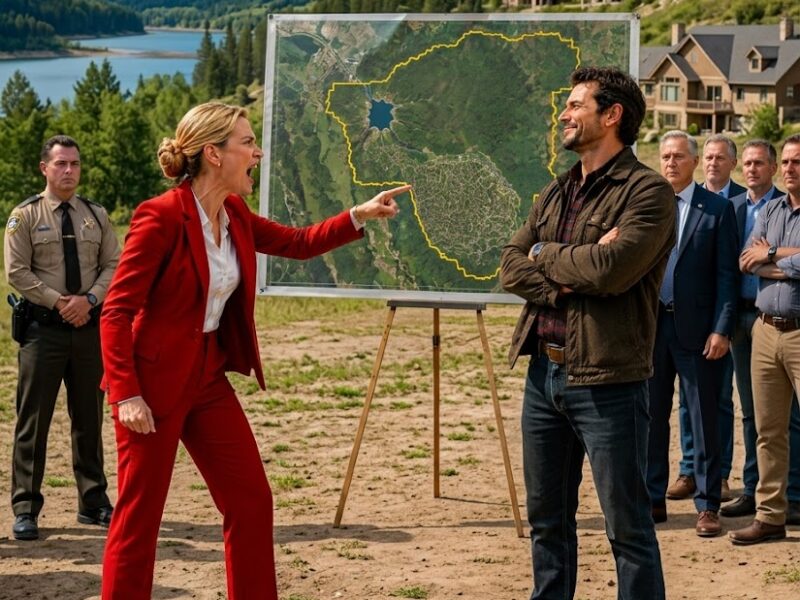
The HOA called me a squatter. They said I had no right to be on their land. They called the police. Then the mayor showed up—and revealed I owned 4,800 acres around their entire community.
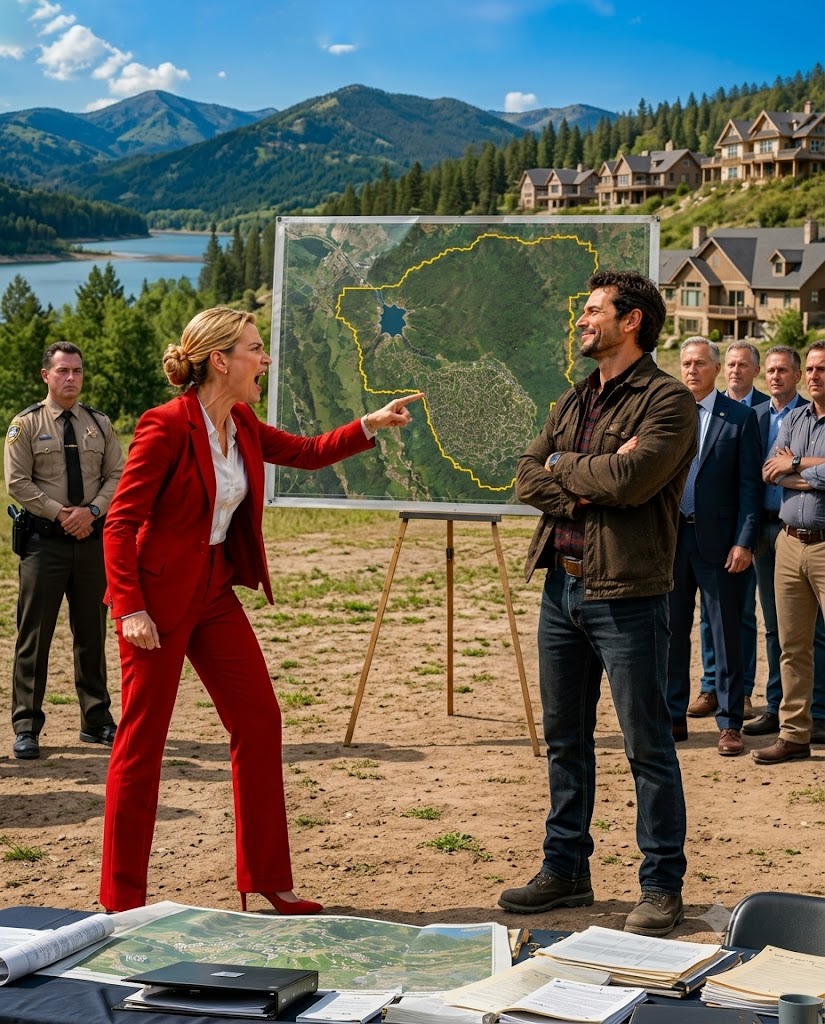
The woman blocking his pickup called him a squatter, then ordered HOA security to drag him off community property.
Graham Mercer almost laughed.
The gravel road under her heels was his.
So were the woods behind the clubhouse, the ridge above every rooftop, and nearly every acre surrounding Silver Crest.
Blair Wit kept shouting, kept pointing, kept insisting he did not belong—until the mayor pulled up with a county map.
He unfolded it across her hood, pressed his finger against one enormous boundary, and said the man she had just humiliated owned 4,800 acres around her entire neighborhood.
Blair went silent.
Graham had driven the same gravel road a hundred times as a boy, back when his father still ran cattle across these hills—long before Silver Crest existed as anything more than an idea sketched on a developer’s drawing board and a promise made to investors who had never once walked the actual land.
On that particular morning, he steered his old pickup along the northern edge of the community, past a weathered stone marker his family had placed generations earlier, and pulled off near the tree line to inspect land that had only recently been transferred fully into his name after years of quiet management by a family trust.
He had not even stepped out of the truck before two Silver Crest security vehicles came roaring up behind him, gravel spraying from their tires, lights flashing as though he were fleeing a crime scene rather than simply parking on his own land.
Blair Witcomb stepped out first, flanked by a uniformed guard who looked more uncomfortable than authoritative.
She took one look at Graham’s dusty boots, his faded work jacket, and the mud-caked truck bed behind him, and instantly decided she understood everything she needed to know.
Without asking his name, without asking why he was there, she informed him that he was standing on the Silver Crest Conservation Area, that the road beneath his tires was a designated HOA maintenance road, and that outsiders were strictly prohibited from entering.
She told him he had exactly one chance to leave peacefully before she called for reinforcement from the sheriff’s office.
Graham studied her for a long moment before responding, unhurried the way a man studies weather rolling in over a ridge he has watched his entire life.
He asked calmly whether she was certain that the road actually belonged to the homeowners association.
Blair laughed the kind of laugh reserved for people who believe they are dealing with someone far beneath them, and gestured toward a row of signs staked along the roadside, each one reading PRIVATE SILVER CREST HOA in bold red letters.
What she did not seem to notice—and what Graham noticed immediately—was that every single one of those signs stood well outside the actual platted boundary of her own community.
He said nothing about it yet.
He simply raised his phone and began photographing each sign, one after another, while Blair’s irritation visibly climbed.
Convinced that Graham was either stalling or preparing some kind of confrontation, Blair warned him that she would have him arrested for trespassing on community property if he did not leave immediately.
Graham lowered his phone, met her eyes, and told her to call whoever she wanted.
There was no anger in his voice—only a strange, steady confidence that unsettled her more than outright defiance would have.
The security guard beside her shifted his weight from one boot to the other, clearly unwilling to lay a hand on a man who seemed far too calm for someone supposedly caught trespassing.
Blair pressed further, demanding to know what business a stranger could possibly have wandering timberland behind a gated community at that hour of the morning.
Graham considered answering honestly right then—considered simply telling her his last name and letting her draw her own conclusions.
But something about her certainty made him curious how far she would take the assumption before reality caught up with her.
He told her only that he had every reason in the world to be exactly where he was standing, and that she would understand soon enough.
She took his composure as arrogance rather than confidence, and it only hardened her resolve to have him removed.
She could not have known, standing there in her tailored blazer on a gravel road she had never once verified belonged to her association, that she was standing in the middle of a parcel spanning 4,800 acres—and that the name recorded on the deed for every inch of it was Graham Mercer.
In the days that followed, Graham began methodically walking the boundaries of what his family had once owned outright—a holding that decades earlier had stretched past 6,000 acres before a modest slice, only a few hundred acres near the creek bottom, was sold off to a developer chasing a vision of mountain-view home sites.
That small sale eventually grew into Silver Crest.
The vast remainder—the ridges and meadows and timberland surrounding it on nearly every side—had never been sold, never been subdivided, and never left the family name.
When the elderly manager who had overseen the Mercer Land Trust for decades finally retired, Graham made the decision to take direct control of the property himself, which was precisely what had brought him back to that gravel road on the morning Blair mistook him for a trespasser.
He hired Nolan Briggs, an independent land surveyor with a reputation for precision and a low tolerance for shortcuts, to walk the full perimeter and confirm every boundary marker against the recorded plat.
What Nolan found in the following weeks stunned even Graham, who had grown up hearing stories about how large the old Mercer holdings once were.
Scattered across the parcel were three separate hiking trails maintained by Silver Crest, an overflow parking lot built directly behind the community clubhouse, a maintenance access road cutting deep into the timber, a picnic area reserved exclusively for association members, an irrigation reservoir feeding the neighborhood’s landscaping, a scenic overlook platform perched on the ridge, and an equipment staging yard tucked just beyond the tree line.
Every single one of those structures sat on land that belonged, on paper and in law, entirely to Graham.
Some of these installations had clearly existed for years, weathered by seasons of use, worn smooth by hikers and mowers and delivery trucks.
Blair had even featured several of them prominently in glossy marketing brochures used to attract new home buyers, describing the trails and the overlook and the private lake as exclusive Silver Crest amenities available only to residents—complete with photographs of families hiking the very ridge that belonged to Graham’s family before a single home in Silver Crest had ever been built.
What made the discovery worse was the realization that the association had been charging homeowners an annual special assessment specifically earmarked for the upkeep of amenities it did not legally possess—collecting real money from real families to maintain infrastructure sitting entirely on someone else’s land.
Graham pulled a stack of old newsletters Nolan had found archived on the association’s public records page, flipping through years of glowing descriptions praising the community’s commitment to conservation and outdoor living.
One issue proudly announced a ribbon-cutting ceremony for the scenic overlook, complete with a photograph of Blair herself standing beside a plaque, thanking residents for their generous contributions toward its construction.
Another issue celebrated the expansion of the trail network as proof that Silver Crest offered more natural space per household than any competing development in the county.
Every one of those celebrated achievements, Graham now understood, had been built entirely on land the association never owned and never asked permission to use.
He stood at the edge of the reservoir one afternoon, watching sprinklers cycle water drawn from a source he now technically owned, and understood that this was no longer a simple matter of a few misplaced signs.
Nolan put it bluntly during a phone call that evening, telling Graham that this association had not merely wandered across a boundary line by accident.
They were operating an entire section of their community infrastructure on land that had never been theirs to use, and they had been billing residents for the privilege the entire time.
Graham thanked him, hung up the phone, and sat for a long while on his tailgate, looking out over the ridge where the overlook platform stood silhouetted against the evening sky, trying to decide how far he was willing to let this go before he acted.
He thought about his father—a quiet man who had spent decades running cattle across these same slopes without ever once needing a lawyer or a survey crew to defend what belonged to him, because in those years, nobody had questioned it.
Times had clearly changed.
Somewhere along the way, a development on the edge of the family holding had grown confident enough—or careless enough—to start treating borrowed land as its own permanent inheritance.
Graham was not interested in becoming the kind of landowner who ruled through intimidation.
But he also understood that quiet patience alone was not going to convince anyone at Silver Crest to stop building on his acreage.
Something formal, something undeniable, needed to exist on paper before he confronted Blair again.
Rather than confront Blair directly, Graham chose the quieter, more deliberate path first.
He drafted a formal letter requesting that the Silver Crest Homeowners Association provide documentation for its use of his property, asking specifically for any deed, easement, lease agreement, or written permission that might explain the trails, the parking lot, the reservoir, or any other structure built on his acreage.
He mailed the letter through his attorney, expecting either silence or a reasonable request for a meeting.
Instead, Blair’s response arrived within days, and it was nothing close to reasonable.
The document she sent back was titled Notice of Unauthorized Occupancy, and it accused Graham of illegally occupying protected HOA conservation land.
According to the notice, he had 72 hours to remove his vehicle, cease all surveying activity, and refrain from returning to the property—or the association would pursue intervention from local authorities.
Reading it over, Graham felt something shift inside him—not anger exactly, but a hardening resolve.
A woman who had never once checked a county record had just issued him a legal-sounding ultimatum ordering him off land his family had held for generations.
He handed the notice to Laurel Prescott, the real estate attorney who had handled the trust transfer, and asked her to dig through every county record connected to Silver Crest’s founding plat.
Laurel read the notice twice, shook her head, and told Graham that whoever had drafted it clearly assumed no one on the receiving end would ever bother to check the underlying paperwork.
She promised him a complete title history within the week, pulling every recorded document tied to the original developer, every amendment to the association’s governing declarations, and every plat map filed with the county recorder’s office since the community’s founding.
Laurel returned within a week with findings that confirmed everything Graham already suspected.
There was no deed transferring any portion of the 4,800 acres to the homeowners association.
There was no blanket easement covering the trails or the reservoir or the maintenance road.
There was no lease agreement of any kind on file.
As far as the county was concerned, the association possessed exactly zero legal claim to a single acre beyond its own recorded boundary.
What troubled Laurel far more than the absence of paperwork was something she discovered buried inside the association’s own internal planning documents.
Several maps used by Silver Crest for years—maps referenced in board meeting minutes and included in resident newsletters—showed the community’s boundary extended hundreds of acres beyond what the official recorded plat actually allowed.
The signature authorizing the continued use of those inflated boundary maps, appearing again and again across years of paperwork, belonged to Blair Witcom.
Laurel set the file down on Graham’s kitchen table and told him plainly that if those maps had been used to justify collecting money from homeowners, Blair’s problems had just grown far larger than a simple property line dispute.
Word of Graham’s letter spread quickly through the neighborhood, and Blair moved fast to control the narrative before anyone could question her leadership.
She called an emergency association meeting inside the clubhouse, standing before a packed room of anxious residents to warn them that a land speculator named Graham Mercer was attempting to seize community assets—listing the trails, the green belt, the reservoir, and the maintenance road as though they were under active attack.
The way she framed the story flipped the entire situation on its head, transforming the rightful landowner into a predator circling their neighborhood, and transforming her own organization’s decades of unauthorized use into a noble defense of shared community heritage.
Enough residents believed her that the mood in the room grew tense and defensive, murmurs rippling through rows of folding chairs as neighbors turned to one another with worried expressions.
Someone near the back asked whether the association’s insurance covered legal battles over disputed land, and Blair assured the room—without offering any real detail—that the board had already retained outside counsel to handle the matter swiftly.
Another resident asked why nobody had ever seen a formal ownership document for the trails they had been using for years, and Blair brushed the question aside, insisting that long-standing use alone was sufficient justification under the association’s governing rules.
Blair seized on the general unease, announcing an expanded security patrol schedule and authorizing the installation of additional warning signage along every trailhead.
Within days, Graham found himself being filmed by association cameras every single time he walked his own land, his presence treated as a criminal act unfolding in real time on someone else’s property.
Blair went further still, instructing Wesley Door, the association’s longtime facilities manager, to install a physical barrier across the gravel road to permanently block Graham’s access.
Wesley, a methodical man who had spent 30 years keeping Silver Crest’s infrastructure running without controversy, asked to see the supporting documentation before authorizing any construction crew to begin work.
Blair handed him nothing but the association’s internal boundary map—the same inflated map Laurel had already flagged as inconsistent with the county plat.
Wesley studied it carefully and noticed immediately that it lacked any official stamp or signature from a licensed county surveyor, a detail he considered non-negotiable before authorizing physical construction on disputed land.
He refused to proceed, and that quiet refusal became the very first crack in Blair’s carefully maintained authority.
Meanwhile, Nolan finished his complete survey, and the final numbers were even more damaging than anyone had anticipated.
The western overflow parking lot behind the clubhouse extended 64 feet past the boundary line, sitting almost entirely on Mercer land.
The irrigation reservoir, supplying water to the community’s landscaping, sat nearly in its entirety on Graham’s property.
The maintenance access road, stretching more than two miles through dense timber, ran directly through private acreage that had never once been surveyed by the association before construction began.
Nolan stamped every page of the report with his professional seal, cross-referenced each finding against three separate historical surveys pulled from the county archive, and told Graham the numbers were as close to unimpeachable as a boundary survey could possibly get.
Despite everything he now knew, Graham chose not to lock the gates or block a single trail.
He wanted the evidence assembled completely and undeniably before he made any move that could not be undone.
Laurel agreed with that approach entirely, reminding him that a landowner who acted too quickly—even a landowner clearly in the right—could hand his opponent an easy excuse to reframe the entire conflict as recklessness rather than justice.
Patience, she told him, was not weakness.
It was the only strategy strong enough to survive a courtroom or a city council chamber without a single hole in it.
Silver Crest had a critical meeting scheduled with the city planning office to seek approval for an ambitious clubhouse expansion, along with a proposed upgrade to the community’s landscaping and amenity zones.
Blair walked into that meeting confident that formal city recognition of her association’s plans would finally settle, once and for all, any lingering questions about who controlled the surrounding acreage.
Graham arrived as well, seated quietly near the back of the room.
And the moment Blair noticed him, she rose from her chair and pointed directly at him in front of the assembled city officials and residents, announcing loudly that the man in the back row was a squatter attempting to obstruct legitimate community development.
Graham said nothing in response.
Mayor Elliot Vance, seated at the head of the table reviewing a folder of planning documents, looked up sharply and asked Blair whether she had verified the boundaries described in her expansion proposal against the official county parcel map.
Blair answered without hesitation that verification was unnecessary, since Silver Crest had managed and maintained this land for years without a single objection from anyone.
Elliot studied her for a long moment, then glanced down at the documents in front of him and asked his assistant to bring out the large county reference map kept in his office for exactly these kinds of disputes.
The map was unrolled across the long conference table, its creases worn soft from years of use in zoning hearings and land disputes across the county.
Silver Crest sat at the center, a modest rectangle of platted lots and curving streets.
Surrounding it on nearly every side, stretching outward across ridges and valleys and forest, was a single enormous parcel outlined in solid black ink.
The name printed beside the parcel number, unmistakable to everyone in the room, read GRAHAM MERCER.
And the total acreage listed beneath it read 4,800 acres.
The room fell completely silent.
Elliot looked up at Blair, his voice calm but carrying an unmistakable weight.
He told her plainly that Mr. Mercer was not squatting beside her community.
He traced his finger along the entire perimeter of the black boundary line, slowly circling the small rectangle representing Silver Crest, and said that her community was, in fact, the thing surrounded.
Blair opened her mouth to argue and found nothing came out.
A few residents seated in the gallery exchanged stunned glances, several of them reaching for their phones to photograph the map before the meeting moved on, as though they needed physical proof to believe what they had just heard spoken aloud by the mayor himself.
Elliot was not finished.
He reached for a second document—one showing the proposed footprint of the very expansion project Blair had come to seek approval for—and pointed out that a significant portion of the planned construction sat directly on Graham’s recorded land.
He explained, evenly and without any apparent satisfaction in delivering the blow, that the city could not legally approve construction plans built across a boundary the applicant did not control, regardless of how many years the association believed it had operated there without objection.
Blair asked for a recess.
Elliot granted it, but not before instructing his staff to formally note the ownership discrepancy in the official record of the meeting, ensuring the issue could never again be quietly dismissed as a rumor or a misunderstanding.
In the days after that meeting, word spread through Silver Crest far faster than any official statement could have contained it, and residents began demanding real answers from their own leadership.
Blair attempted damage control immediately, describing the entire situation to concerned neighbors as nothing more than a technical boundary dispute that lawyers would sort out quietly behind closed doors.
But Monica Harland, the association’s longtime treasurer, had grown suspicious of certain financial patterns for years, and she finally decided the time had come to bring her concerns directly to Graham and Laurel.
Monica arrived at Laurel’s office carrying a thick folder of financial statements stretching back nearly a decade, and what those records revealed left little room for Blair’s explanation to survive.
Line after line documented special assessments charged to homeowners under labels including “Trail Maintenance Assessment,” “Conservation Fee,” “Private Lake Maintenance,” “Scenic Overlook Improvement,” and “Western Parking Expansion.”
Every single one of those line items corresponded directly to structures sitting on Graham’s property.
Monica explained that she had raised quiet concerns about several of these line items during past budget meetings, only to be told each time that the boundary questions had already been resolved by legal counsel—a claim she now understood had never actually been true.
Worse still, the original marketing brochures used to sell homes throughout Silver Crest described these very areas as “permanent HOA-controlled open space,” a phrase that implied legal ownership the association had simply never possessed.
Laurel pointed out that language like that—printed and distributed to prospective buyers making one of the largest financial decisions of their lives—carried consequences well beyond an ordinary boundary dispute.
Families had chosen homes in Silver Crest, in part, because of amenities the association had promised them permanently—promises built on land the association did not control and had never taken any legitimate steps to secure.
Graham made a point, in every conversation that followed, of drawing a sharp distinction between the association’s leadership and the families who actually lived in the community.
His dispute was never with the residents who had paid their assessments in good faith, trusting that their money funded amenities their association legitimately owned.
His dispute was with a leadership structure that had spent years building an empire of borrowed land and collecting fees on a foundation that had never once been verified.
He said as much directly to several neighbors who approached him outside the clubhouse one afternoon, assuring them he had no intention of ever asking a single family to leave Silver Crest, and that his fight had nothing to do with the people who simply wanted a safe, well-kept place to raise their families.
That distinction mattered enormously to the neighbors who eventually heard it, and it kept public sympathy from turning against him, even as tensions in the community continued to rise.
Monica revealed one more detail that removed any remaining possibility this had all been an innocent misunderstanding.
Years earlier, an independent surveying firm hired for a minor trail expansion project had sent a written warning directly to the board, cautioning that ownership of the surrounding acreage needed formal verification before any further construction proceeded.
That warning had been filed, acknowledged, and quietly ignored.
From that point forward, nothing about the association’s continued use of Graham’s land could reasonably be described as an honest mistake.
Cornered on nearly every side, Blair played what she believed was her strongest remaining card.
At a tense follow-up meeting with city officials and Graham’s legal team present, she produced a photocopied document she described as a “historic access agreement,” claiming that a previous owner of the Mercer land had granted the original developer permanent rights to use the trails, the green belt, and the surrounding open space decades earlier.
If genuine, such a document could have seriously weakened Graham’s position and validated years of the association’s conduct in one dramatic reversal.
Laurel examined the photocopy carefully and found three problems within minutes that Blair had apparently never anticipated anyone checking closely.
The legal description written into the agreement did not match the actual boundaries of the Mercer parcel at all.
The document carried no valid recording number linking it to any official county filing.
And the person whose signature appeared at the bottom had, according to county employment records, already stepped away from managing the family trust years before the date printed on the page.
Graham chose not to immediately accuse Blair of fabrication in front of the room, preferring instead to let the facts speak for themselves through official channels.
He requested that the county formally verify the original filing against its archives, a process that took less than a week to complete.
Nolan, working in parallel, compared the road described in Blair’s supposed historic agreement against decades of archived aerial survey photography.
What he found was simple and devastating.
The very road named in the agreement did not exist yet on the date the document claimed to have been signed.
Aerial photographs from that period showed nothing but unbroken forest where the road was later cut.
Laurel presented the combined findings to the county recorder’s office, along with a formal request that the document be flagged as invalid within the public record so it could never again be cited as legitimate proof of any easement.
The recorder’s office agreed without hesitation, and once the discrepancies were laid out side by side, the historic access agreement Blair had once presented with such confidence was formally struck from consideration in every ongoing proceeding.
Blair had staked her entire remaining credibility on a piece of paper that could not survive even the most basic scrutiny, and once it collapsed, nothing remained standing between her and the truth she had spent years avoiding.
Mayor Elliot responded by placing an immediate hold on every pending city approval connected to the association’s expansion plans until the underlying land ownership question was resolved beyond doubt.
For Blair, who had spent years operating with almost unquestioned authority inside Silver Crest, the hold represented the first moment she truly lost control of the narrative she had been shaping since the morning she first called Graham a squatter on the gravel road.
Once the official survey was formally recorded with the county, Silver Crest was forced to confront a reality that could no longer be spun or delayed.
Graham had never wanted to displace a single homeowner, and he made that clear at every opportunity.
But the practical truth remained that many of the amenities residents relied upon—and had paid to maintain for years—sat entirely on land that was never theirs to use freely.
The maintenance road connecting the western neighborhoods, the irrigation reservoir feeding every lawn in the community, the overflow parking lot serving the clubhouse, the network of hiking trails winding through the timber, and the scenic overlook prized by residents for its sunset views could not simply continue operating as though nothing had changed.
Laurel drafted a formal proposal outlining a path forward that Graham genuinely believed could resolve the situation fairly for everyone involved.
The association could negotiate a legitimate lease and easement agreement covering continued use of the reservoir and select trail sections, provided several conditions were met first.
Every sign falsely claiming Mercer land as association property needed to come down immediately.
The unauthorized occupancy notice against Graham needed to be formally rescinded.
Accurate boundary maps needed to be published and distributed to every resident.
Funds collected under false pretenses for amenities the association never owned needed to be accounted for and addressed.
The full cost of the independent survey needed to be reimbursed.
And every future marketing document needed to stop describing Graham’s private acreage as community-owned open space.
Blair refused every single condition outright, apparently still convinced that residents dependent on the trails and parking and water would eventually pressure Graham into backing down rather than losing access to conveniences they had grown accustomed to.
She told the remaining board members privately that Graham was bluffing—that no landowner in his position would actually follow through on shutting down amenities an entire community relied on daily, and that patience would eventually wear him down the way it had always worn down anyone who challenged her leadership before.
Graham did the opposite of what she expected.
Rather than blocking access to anything genuinely essential for resident safety or basic movement through the neighborhood, he formally closed off only the recreational and commercial elements the association had never possessed any legal right to use, marking each closure with proper legal notice and clearly defined fencing along the true boundary line.
He instructed his crew to work carefully and respectfully, avoiding any damage to the trails themselves in case a future agreement allowed their continued use, because he had no interest in destroying something residents genuinely valued out of spite toward the woman who had mismanaged it.
Almost overnight, the clubhouse lost most of its overflow parking capacity during weekend events.
The trail network lost the majority of its mileage, reduced to only the small segments actually sitting within the association’s legitimate boundary.
The scenic overlook—a favorite gathering spot for evening walks—became entirely inaccessible, and the wooden bench residents had donated years earlier now sat behind a clean line of survey stakes and a small printed notice explaining that the platform stood on private property without any current agreement permitting public use.
None of this required any retaliatory or unlawful action on Graham’s part whatsoever.
A single accurate survey, properly recorded and properly enforced, was enough on its own to shrink the empire Blair had spent years quietly building on land that was never hers.
Residents who had once dismissed the dispute as a minor disagreement between the association and an outsider now found themselves personally inconvenienced every single day.
And inconvenience proved far more persuasive than any legal argument Graham’s team had presented so far.
Parents who once let their children bike the full trail loop now found the route cut short by half.
Weekend visitors circled the clubhouse lot twice before giving up and parking along the street.
The absence of amenities the community had taken for granted for years became the loudest argument of all—louder than any deed or survey stake, because it touched daily life in ways nobody could ignore.
Financial pressure inside the association mounted quickly as residents grew increasingly frustrated by the sudden loss of amenities they had paid assessments to maintain for years.
A group of homeowners formally petitioned for a special meeting to address the crisis directly, and the turnout on the scheduled evening filled every seat inside the clubhouse and lined the walls with residents standing shoulder to shoulder.
Blair walked in that night still carrying herself with the same confident posture she always had, apparently still believing she could shift blame entirely onto Graham one final time in front of her neighbors.
This time, however, Graham was not the one required to defend himself.
Monica stood first, methodically walking the room through years of financial records, laying out every assessment tied to amenities the association never legally owned, every misleading brochure, every ignored warning from the original surveying firm, every dollar spent on legal costs that could have been avoided entirely with a simple boundary check years earlier.
She spoke without raising her voice, letting the numbers themselves carry the weight of the accusation, and by the time she finished, several board members seated near Blair had visibly shifted their chairs a few inches further away from her.
Wesley followed, confirming publicly that Blair had personally instructed him to construct a physical barrier across Mercer land without ever producing a valid deed to justify the order, and adding that he had documented the exchange in writing at the time precisely because something about the request had felt wrong to him from the very beginning.
Nolan presented the finalized survey results in full detail, walking residents through the stamped maps and explaining in plain language anyone in the room could follow exactly how far the association’s amenities extended onto land it never owned.
Laurel laid out the complete county documentation, confirming beyond any argument that the city had never transferred ownership of the surrounding 4,800 acres to the homeowners association at any point in its history, closing her presentation by noting that every board decision built on that false premise now stood on legally uncertain ground.
Backed into a corner with no remaining argument, Blair raised her voice and accused Graham of holding the entire community hostage over what she still insisted was little more than a boundary technicality.
For the first time throughout the entire ordeal, Graham stood and addressed the room directly, his voice steady and unhurried.
He reminded everyone present of the morning months earlier when Blair had stood on his own family’s land and called him a squatter without ever once asking his name.
He told them plainly that he had never asked for a single inch belonging to Silver Crest, while her association had spent years quietly claiming acre after acre that was never theirs, dressing theft up as community heritage.
Residents called for an immediate vote, and by the end of that same meeting, Blair Witcom was formally removed from her position as association president.
Even after her removal, the consequences of what had unfolded were far from finished.
The newly elected leadership of Silver Crest moved quickly to repair the relationship with Graham, recognizing that continued hostility served no one and that a fair negotiated agreement offered the community’s best realistic path forward.
Graham, who had never harbored any desire to see his neighbors suffer for decisions made entirely without his knowledge or consent, agreed to sit down and negotiate in good faith once the new leadership demonstrated genuine willingness to correct the record.
The agreement that eventually emerged formally established a legitimate paid lease covering continued use of select trail sections and the irrigation reservoir, structured with clear terms, a defined annual payment, and proper legal documentation—this time filed with the county exactly the way it should have been filed from the very beginning.
The overflow parking lot was reduced and rebuilt entirely within the association’s true recorded boundary, funded in part by the very reimbursement the new board agreed to pay for the cost of the original survey.
Every unauthorized structure sitting beyond that boundary without a valid agreement was scheduled for removal or relocation, including the equipment staging yard that had sat quietly on Graham’s timberland for years without anyone questioning it.
New signage went up across the property, replacing every previous claim of association ownership with clear language identifying the land as “Mercer Preserve – Private Property,” clearly distinct from anything belonging to Silver Crest.
Graham chose to keep the majority of his acreage exactly as it had always been—forest and open meadow and grazing land—while setting aside a separate section for the slow, careful restoration of an old ranch road his family had used two generations earlier, a project he had wanted to undertake for years but had never found the time to begin until this entire dispute forced him to walk every inch of the property himself.
Blair’s departure from the board came with consequences that followed her well beyond a single lost election.
She faced formal questions from residents and eventually from the association’s own legal counsel regarding the assessments she had personally approved for years—funds collected from homeowners under the false premise that the association legitimately owned the land those fees were meant to maintain.
A committee of homeowners was formed to review every assessment tied to the disputed amenities, and several residents openly discussed whether a portion of the fees they had paid over the years should be refunded once the accounting was complete.
Graham never sought to punish her personally, never pursued anything beyond the return of his own property and an honest accounting of what had happened.
But the accountability she now faced arrived entirely through her own choices, documented in her own signature across years of paperwork she had assumed no one would ever bother to check.
Wesley, reflecting on it all sometime later, told a neighbor that the whole affair had never really been about a road or a parking lot at all.
It had been about one woman’s certainty that authority alone was enough to make a claim true—and about how quickly that certainty crumbled once someone finally asked to see the paperwork behind it.
Several weeks later, Graham drove his pickup along the exact same gravel road where the entire conflict had first ignited—the same stretch where Blair had once stood in his path and ordered him off land that had belonged to his family for generations.
The old sign reading “Silver Crest HOA Property” was gone, completely removed, along with every other marker that had falsely claimed his land as someone else’s.
In its place stood a new sign, simple and unmistakable, reading: MERCER PRESERVE – PRIVATE LAND – 4,800 ACRES.
Mayor Elliot happened to be driving the same road that same afternoon, and he pulled his car alongside Graham’s truck when he noticed the new sign standing tall against the tree line.
He studied it for a long moment through his open window, then looked over at Graham with the faint trace of a smile, remarking that it had become fairly difficult to call the man a squatter these days.
Graham looked out past the sign toward Silver Crest, its rooftops nestled quietly among the trees his family had owned for generations, surrounded on nearly every side by forest and ridge and open meadow that had always, in truth, belonged to him.
He told the mayor, without any bitterness left in his voice, that he had never actually needed anyone in that community to believe him.
He nodded toward the old stone property marker resting near the roadside, worn smooth by decades of weather and time, and said simply that all he had ever needed was for someone to finally read the deed.
Elliot asked what Graham planned to do with the rest of the acreage now that the boundary dispute had finally settled into something resembling peace.
Graham looked out across the timber stretching toward the ridge—the same land his father had once ridden on horseback, checking fence lines long before any of this controversy began—and said he intended to keep most of it exactly as it had always been: open and quiet and unspoiled by anything more permanent than a fence line and a gravel road.
He mentioned the old ranch trail he planned to restore, the grazing rights he might eventually lease to a neighboring cattle operation, and a small parcel near the creek he was considering setting aside permanently as protected timberland—not because any ordinance required it, but because his family had always believed some land was worth more left alone than developed.
Blair had spent years turning Graham’s land into something she called community property, piece by piece, acre by acre, convinced that no one would ever look closely enough to notice.
In the end, it took nothing more than a single accurate map to show the entire county exactly who had been standing on the wrong side of the boundary line all along.









