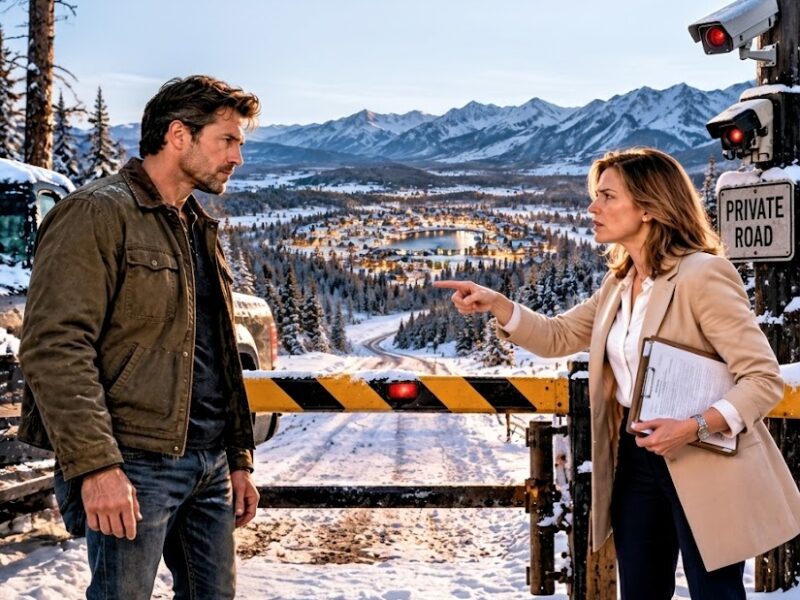
The HOA bought my neighbor’s road to box me in at Christmas. They thought they’d won. Then I bought the 4,200-acre ranch around them.
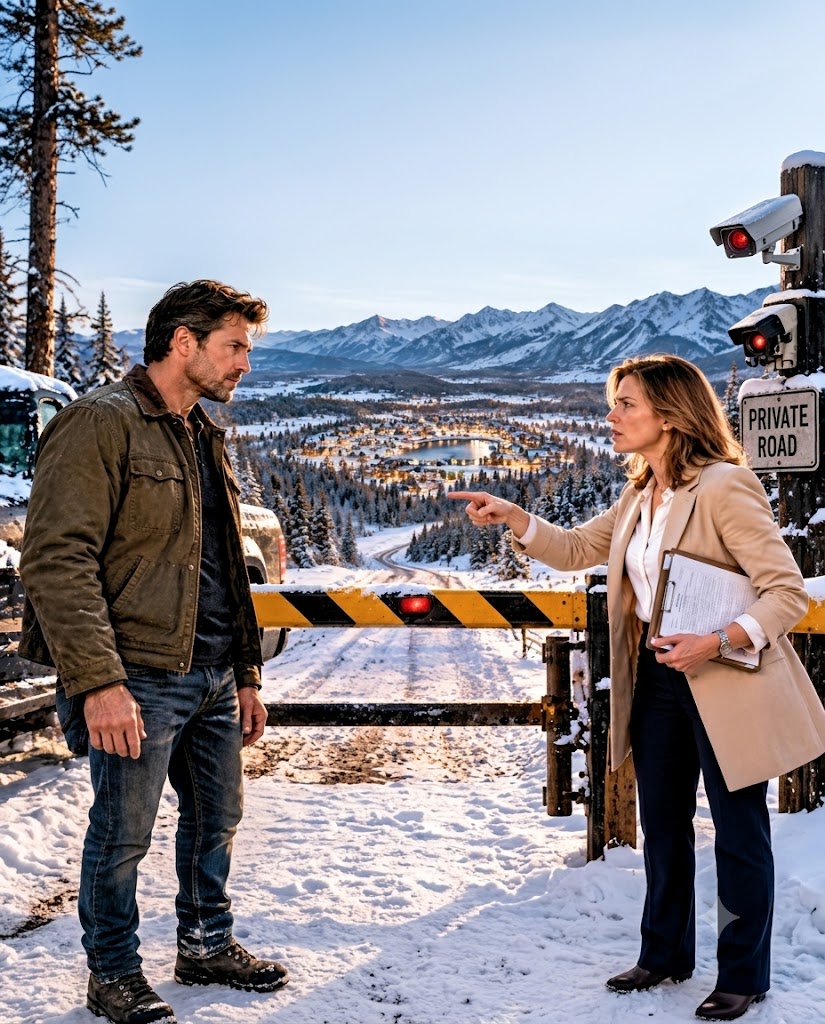
On Christmas Eve, Gideon Mercer drove home to his ranch and found the only road into his own land shut tight.
Not with a fence—with paperwork.
The homeowners association from the gated community next door had paid a small fortune to buy the road from his neighbor for one reason only: to trap him in the middle of his own property.
Their president, a woman named Vivian Harrow, stood at the gate, smiled, and told him he no longer had the right to pass.
Gideon did not argue.
He called his lawyer.
Twenty minutes later, he asked her one question that wiped the smile off her face.
Was she certain she knew who owned all the land her association had just surrounded?
The snow had started somewhere north of Bozeman and never let up.
By the time Gideon Mercer turned off the county highway, the sky over western Montana had gone the color of cold iron, and the wipers on his truck were losing the fight.
He was forty-two years old.
He had been gone four days, sitting in a hotel conference room in Billings, signing grazing leases and listening to men in pressed shirts talk about cattle as if cattle were only numbers on a screen.
He was tired.
He wanted a fire, a pot of black coffee, and the silence of the place he had spent fifteen years building.
The ranch covered 4,200 acres of hills, timber, open grass, and creek bottom.
No wife, no children, no neighbor close enough to see his porch light.
Gideon had chosen it that way, and he had never once regretted it.
The road to the ranch ran two miles off the highway, a gravel lane that crossed the southern edge of Earl Pruitt’s property before it reached Gideon’s gate.
Ranchers had driven that lane for more than sixty years.
Gideon had driven it a thousand times in every kind of weather Montana could throw at a man.
Tonight, his headlights hit something new.
A steel barrier arm, painted yellow and black, lay across the gravel.
Beside it stood a freshly bolted sign: PRIVATE ROAD, NO THROUGH ACCESS.
Above the sign, a security camera blinked one small red eye into the falling snow.
And behind the barrier, lit by the glare of two idling SUVs, waited a group of people in expensive winter coats who looked like they had been standing there a while.
Gideon stopped the truck and let the engine idle.
He did not get out right away.
He studied the faces first.
He recognized several of them from the gated community to the east, Elkridge Estates—the place with the stone entrance, the private golf course, and the homeowners association that had been mailing him letters for three years.
In the center of the group stood a woman in a long camel coat, leather gloves, and tall boots that had never touched mud.
Vivian Harrow, forty-four years old, president of the Elkridge Homeowners Association.
She held a black folder against her chest the way a gambler holds a winning hand.
Gideon stepped out into the cold.
The wind pushed snow across the gravel between them.
Vivian smiled.
“Good evening, Mr. Mercer. Merry Christmas.”
He looked at the barrier, then at her.
“Move it.”
“I’m afraid I can’t do that,” she said. “This road doesn’t belong to you anymore. As of last Friday, it belongs to the Elkridge Homeowners Association. We purchased it from Mr. Pruitt. Every foot of it.”
Gideon said nothing.
Behind her, a heavy-set board member named Douglas Fenn crossed his arms and grinned like a man watching a bull get loaded into the wrong trailer.
Gideon understood the play before Vivian finished explaining it.
For three years, Elkridge had wanted his land.
They wanted the ridge for luxury homes, the meadow for a second golf course, the creek for a brochure.
He had said no every single time.
Now they had found what they believed was the one weak point in 4,200 acres: the only road in.
And they had bought it out from under him on the last business day before Christmas.
Vivian opened the folder and held out a single document.
“This is formal notice. Your access across association property is revoked, effective immediately. If you’d like to discuss alternatives, the board is prepared to make a very generous offer for the ranch. I’d consider it before the weather gets worse.”
Gideon took the paper.
He did not read the paragraphs.
He looked at the county recording stamp in the corner, the date, and the legal description of the parcel.
Then he looked up.
“Did you check the full land records?”
Vivian laughed softly, the sound of a woman who had already won.
“Our attorneys checked everything, Mr. Mercer. Very carefully.”
Gideon folded the paper once and slid it into his coat.
“Then you should check again.”
He walked back to the truck, climbed in, and dialed a number he knew by heart.
It rang twice.
“Calder.”
“I’m listening,” said the voice on the other end, calm and dry, the voice of a man who had spent thirty years reading deeds by lamplight.
“Open the file on the south parcel.”
A pause.
“All of it?”
Gideon looked through the windshield at the yellow barrier, at the blinking camera, at the sign that said the road belonged to someone else now.
“No,” he said. “Just the part they think they just bought.”
Fifteen years earlier, Gideon Mercer had bought the ranch from the estate of an old cattleman named Walter Whitaker.
The Whitaker place had once been a sprawling operation that covered most of the valley.
Over the decades, the family had sold pieces of it away—a few hundred acres here, a section there—until what remained was 4,200 acres of the best ground in the county.
Rolling hills on the north, lodgepole pine and fir on the high slopes, grass meadows that turned gold in August, a clear creek that ran cold even in July.
On the eastern side, an old gravel road threaded through the property, and the closing documents carried a thick stack of historic easements, some dating back to the 1940s.
Gideon had read every page.
It was a habit he never broke.
Before the ranch, he had spent his twenties in commercial real estate in Denver, buying and selling land for men who never set foot on it.
He had walked away from that life at twenty-seven, with enough money to never answer to anyone again, and with one lesson burned into him for good.
Land is not owned by the person standing on it.
Land is owned by the person who understands the paper.
For more than a decade, nobody tested that lesson.
The valley was quiet.
Earl Pruitt ran a few dozen head of cattle on the south side and waved from his tractor.
The deer came down to the creek at dusk.
Then the developers came.
Elkridge Estates rose on old Whitaker pasture to the east—a ring of stone mansions behind an iron gate, with a clubhouse, a golf course, and a homeowners association that governed everything from mailbox colors to the brightness of Christmas lights.
Vivian Harrow became president in the second year.
She was sharp, polished, and relentless.
She had sold luxury property in Scottsdale and Aspen before moving north, and she looked at the valley the way a chess player looks at an open board.
To her, Gideon’s ranch was not a ranch.
It was the next phase.
The first offer came by letter, polite, generous.
Gideon declined.
The second came in person at his kitchen table with architectural renderings spread across the scarred pine.
Villas along the ridge, a championship course on the meadow, a boutique resort beside the creek.
“Do you understand what you’re sitting on?” Vivian asked him that afternoon. “This property is worth tens of millions of dollars, and you’re using it to raise cattle.”
Gideon poured her a cup of coffee and slid the renderings back across the table without looking at them a second time.
“I’m not keeping it for the cattle,” he said. “I’m keeping it because it’s mine.”
After that, the letters changed tone.
Notices that his fence line was an eyesore visible from the fourth tee.
Complaints about dust from his hay trucks.
A formal request that he repaint his barn in a shade approved by the association’s architectural committee.
Gideon read each one and dropped it into a kitchen drawer.
He was not a member of the Elkridge Homeowners Association.
He had never signed their covenants.
His land sat entirely outside their boundary, and their rules had about as much authority over him as the bylaws of a yacht club in Florida.
Vivian knew it.
That was exactly what made her dangerous.
When the rules failed, she went looking for leverage.
Sometime that autumn, studying a county plat map in her office, she found what she believed was the only door she could lock: the road.
Earl Pruitt was seventy-eight, worn out, and two years behind on his property taxes.
The association offered him more than three times what the strip was worth.
He signed without asking a single question, packed his truck, and moved to his daughter’s place in Spokane before the ink had dried.
Vivian wanted the barrier in place before Gideon knew there was anything to fight.
She wanted him to come home in the dark, in the snow, on Christmas Eve, and understand in one cold moment that he had already lost.
Now, Gideon sat in his truck at that barrier with the heater running and snow piling on the hood.
The Elkridge people had climbed back into their SUVs and pulled away, their taillights fading toward the warm glow of the gated community.
He did not move.
He watched the red light on the camera blink, steady as a pulse, and he waited.
Twenty minutes later, his phone buzzed.
“Gideon,” Calder said.
His voice was quieter now, more careful.
“We have a problem.”
“What kind of problem?”
“They didn’t just buy a road.”
A long silence filled the line.
“They bought into a right-of-way that’s already recorded in your ranch’s title,” Calder said. “And I don’t think they have the faintest idea.”
Gideon kept the engine running and asked Calder to walk him through the whole chain of title, from the first patent to the deed Earl Pruitt had signed the week before.
Calder had the file open on his desk in Missoula—three inches of yellowed paper he had pulled out of a fireproof cabinet the day Gideon bought the ranch.
He started at the beginning.
In 1952, Walter Whitaker’s father had sold the southern parcel to the Pruitt family.
But the old man had not been careless.
In that deed, he reserved a perpetual access easement over the gravel lane for the benefit of the ranch, attached to the land itself, binding on every future owner.
More than that, he kept an undivided one-half interest in the road strip.
The Pruitts never owned the whole road.
They owned half of it, and the half they owned was burdened by the ranch’s permanent right to cross.
“So what did the association buy?” Gideon asked.
Calder let out a slow breath.
“They bought Earl’s half. A half interest in a strip of gravel that you already have a recorded right to use forever. They can’t lock you out of it. They can’t charge you for it. Legally, they can’t even put that barrier arm across it without your consent.”
Gideon looked at the steel bar in his headlights.
“Then why does their deed describe the whole road?”
“Because Earl’s deed describes the whole road,” Calder said. “He inherited it that way and never read the reservation. Their title company relied on a short search. Thirty years back, maybe forty. The reservation sits in the 1952 deed. Nobody went that far.”
Vivian Harrow had paid a fortune for something she believed was an exclusive private road.
What she actually owned was half of a shared lane and a lawsuit waiting to happen.
At nine o’clock that night, while Gideon was still parked at the barrier, his phone chimed with an email from the association’s attorney.
The subject line read: ROAD USE AGREEMENT.
The terms were simple.
If Mr. Mercer wished to continue crossing association property, he would pay an annual access fee of $250,000, payable in advance, along with liability insurance naming the association, a cap on truck traffic, and a requirement that all ranch vehicles register their plates with the Elkridge security office.
If he refused, the barrier would remain closed indefinitely.
At the bottom, in a separate paragraph, the association repeated its offer to purchase the ranch.
The price had dropped by $4 million since the summer.
Gideon read it twice and forwarded it to Calder.
“They think I don’t have another way out,” he said.
“According to their maps, you don’t,” Calder answered. “The county’s online parcel map shows one access point—that lane. Everything else is creek, timber, and steep ground.”
Gideon almost smiled.
He reached into the glove box and pulled out a folded paper map, soft at the creases, marked in pencil over fifteen years of walking his own land.
The south lane was the only entrance anyone in Elk Ridge knew about.
But 4,200 acres is a lot of country, and the Whitakers had run cattle and timber across it for most of a century.
On the western edge of the ranch, an old logging road climbed out of the creek bottom, wound through the timber, and came down on the far side to meet Miller Creek Road—a county road that ran north to the highway.
The Whitakers had used it until the 1970s, when the sawmill closed and the trucks stopped running.
After that, the forest took it back.
Snow and deadfall buried the grade.
From the air, it looked like nothing but trees.
Every inch of that road lay on his land.
Every inch of it was his.
“I can file for an injunction the day after Christmas,” Calder said. “Emergency hearing. That barrier comes down within a week, and they’ll owe you fees for the trouble.”
Gideon folded the map.
“Don’t.”
The line went quiet.
“Don’t what?”
“Don’t sue them.”
Calder took a long moment before he answered.
“Gideon, they’ve blocked a recorded easement and sent you an extortion letter on Christmas Eve. This is the easiest case I’ll see all year. Why on earth would we wait?”
Gideon looked at the camera on its pole, at the red light still blinking, recording a man who appeared to be stuck.
“Because if we win in a week, they’ll just find something else,” he said. “I want to know what they’re really after, and I want them to keep believing they’ve already won.”
On Christmas Eve, the clubhouse at Elkridge Estates glowed like a postcard.
A fourteen-foot spruce stood in the great room, wrapped in white lights and silver ribbon.
A string quartet played carols near the stone fireplace.
At eight o’clock, Vivian Harrow stepped up to the small stage beside the tree and tapped a glass.
The room went quiet.
She thanked everyone for a wonderful year.
Then she told them the news they had all been waiting for.
The road was theirs.
The ranch next door was cut off.
“Mr. Mercer,” she said with a small satisfied smile, “will soon have to face reality. And when he does, Elk Ridge will finally be able to grow into what it was always meant to be.”
The room applauded.
Douglas Fenn raised his glass and called out that maybe the cowboy could rent a helicopter.
People laughed.
A few residents near the back did not join in, but nobody noticed them.
The quartet started up again.
Outside, the snow kept falling over the gated streets and the golf course and the dark line of timber to the west, where at that same hour a pair of headlights was moving slowly down Miller Creek Road.
Gideon had made one more phone call after he hung up with Calder.
Wade Holloway was a licensed surveyor and contractor who lived twenty miles north—a broad, quiet man who had worked on half the ranches in the county and owed Gideon a favor from a hard winter years before.
He hitched his flatbed, loaded a compact bulldozer and a skid steer, called his two grown sons, and met Gideon at the western gate a little after nine o’clock.
Wade walked the first quarter mile with a headlamp and a survey map, checking the old boundary pins against his instrument.
He came back with snow on his shoulders and a look of mild amusement.
“It’s all yours,” he said. “Every foot. Grade still good under there. They built it right.”
They worked through the night.
Gideon set the rules before the first tree came down.
No crossing anyone else’s line.
No new cuts into the hillside.
No widening beyond the original grade.
They would only reopen what was already there on land that was already his.
The dozer pushed deadfall aside.
The skid steer cleared young fir from the old ruts.
Gideon walked ahead with a chainsaw and a flashlight, marking culverts so the machines would not crush them.
Around three in the morning, they reached the high point of the ridge, and from there they could see the lights of Elkridge far below, still glowing from the party.
By the time the sky turned gray on Christmas morning, the old western road ran clean from Miller Creek Road to the front porch of Gideon’s house.
He slept four hours, then he made coffee, fed the horses, and at eleven o’clock on Christmas morning, he drove his truck out the western gate and north toward town to pick up a part for his well pump.
Douglas Fenn saw him first.
Fenn was driving back from his brother’s house on Miller Creek Road when a familiar ranch truck pulled out of the timber ahead of him and turned onto the pavement.
He followed it for two miles to be sure.
Then he called Vivian.
“That’s impossible,” she said. “He can’t get out.”
Fenn told her what he had seen.
She hung up without saying goodbye.
By noon, she had the association surveyor on the phone—a nervous man named Phil Granger who had been pulled away from his family’s Christmas dinner.
When he called back, his voice was apologetic.
The western road appeared on aerial surveys from 1962.
It sat entirely inside the boundaries of the Mercer Ranch.
It touched no association land, no county right-of-way except where it met Miller Creek Road at an existing approach, and no one else’s property at all.
There was nothing the association could block.
There was nothing they could buy.
Vivian stood very still in her kitchen and listened to him explain it twice.
She did not stay still for long.
On the twenty-sixth of December, the association filed a complaint with the county planning department accusing Gideon Mercer of building an unpermitted road through sensitive timberland without environmental review.
Vivian called the county commissioner she had golfed with in October.
By the end of the week, a county planner named Ruth Ellison drove out to inspect the work.
She walked the grade with Wade Holloway.
She compared it with the old photographs.
Then she wrote a two-page memo.
The road was a historic private ranch road.
Clearing existing ruts and deadfall on private agricultural land required no permit.
The complaint was closed.
Vivian got the memo on a Friday afternoon.
That evening she called Gideon herself for the first time since the barrier went up.
Her voice was even, but there was an edge in it he had never heard before.
“You knew about that road.”
“I did.”
“You let us buy the lane. You let us put up the barrier. You let me stand in front of the whole community and announce that you were finished.”
Gideon was sitting on his porch watching the light go blue over the meadow.
“I didn’t let you do anything, Ms. Harrow. You did it all by yourself.”
She was quiet for a moment.
“Did you know about this before Christmas Eve?”
“I know a lot more than you think,” he said, and ended the call.
What Vivian did not know was that three days earlier, Gideon had asked Calder to pull the ownership records on every single parcel surrounding his ranch and every parcel surrounding Elk Ridge.
Gideon never went after the association directly.
He did not send threatening letters.
He did not file a single complaint.
Instead, over the long gray months of that winter and into the spring, he started buying land.
Not his land.
Theirs.
Or at least the land they had been planning to make theirs.
Calder brought him the records in a stack of manila folders, one parcel at a time, and Gideon went through each one at his kitchen table with a pencil and the same patience he had once used on office towers in Denver.
He was looking for owners who were tired.
Owners who had been lowballed.
Owners who had been waiting a long time for someone to offer them a fair price and treat them with respect.
The first was the Lindquist place, 240 acres of hay ground directly north of Elk Ridge, owned by a widow named Ingrid Lindquist who had been fielding insulting offers from the association for two years.
Gideon paid her the appraised value and let her keep a life estate in the farmhouse.
The second was a small cattle operation to the northeast, run by two brothers who wanted to retire to Arizona.
The third was an abandoned gravel pit along the county road that nobody had wanted for twenty years.
The fourth was an old feed warehouse and its lot near the highway.
The fifth was a narrow strip of frontage along the highway itself, barely three hundred feet wide, owned by a family trust in Oregon that had forgotten it existed.
Each deal closed at fair market value with no pressure and no tricks.
None of them carried Gideon’s name.
Calder had formed a company called Copper Gate Land Company, and every purchase ran through it.
The sellers knew who they were dealing with because Gideon met every one of them in person and shook their hands.
But on the county records, the buyer was simply Copper Gate.
Nobody at Elk Ridge noticed because nobody at Elk Ridge was looking.
They were still waiting for him to crack.
Every few weeks the association sent another letter reminding Mr. Mercer that the access fee remained available and that the purchase offer would not stay on the table forever.
Gideon read each one at breakfast and dropped it into the kitchen drawer with the others.
Meanwhile, Elk Ridge pushed ahead with Phase Three, its long-planned expansion.
Vivian had promised the residents forty new luxury lots, a second entrance off the highway, and a new clubhouse wing.
The board approved the plans in March, but the plans depended on land the association did not yet own, and one by one the parcels they needed slipped out of reach.
The Lindquist hay ground, which was supposed to hold twenty of the new lots, had sold.
The highway strip, which was supposed to become the second entrance, had sold.
The gravel pit, which was supposed to become the construction staging yard, had sold.
Each time the association’s agent called a seller, he heard the same polite answer: “Sorry, it’s already gone.”
By May, the county plat map of the valley looked very different than it had at Christmas.
Gideon had not broken a single law.
He had not paid anyone a dollar under value.
He had simply done what Vivian Harrow had done to him, only better, more patiently, and with far more respect for the people across the table.
One evening in late May, Calder drove out from Missoula and spread a new map across Gideon’s kitchen table.
The ranch sat in the center, outlined in dark green.
Around it, in lighter green, were the new parcels.
Around those, in a thin gray island, sat Elk Ridge Estates.
Calder tapped the map with one finger.
“Your 4,200 acres used to be one ranch sitting next to a subdivision. Now it’s the center of a much larger block.”
Gideon leaned over the table and studied the shape of it.
“How large?”
“Large enough,” Calder said, “that the association doesn’t surround you anymore.”
He paused and let the silence settle over the kitchen.
“It’s the other way around.”
Gideon picked up a pencil and touched the gray island in the middle of all that green—the gated streets, the golf course, the clubhouse where they had laughed at him on Christmas Eve.
“Now,” he said quietly, “they’re the ones on the inside.”
The emergency meeting of the Elkridge board was called for a Tuesday night in early June, and nobody brought champagne this time.
The seven board members sat around a long walnut table in the clubhouse library while rain streaked the tall windows.
Vivian sat at the head.
In front of her lay a report from the association’s land agent, and every page carried the same bad news.
The Lindquist parcel had sold in February.
The highway frontage had sold in March.
The gravel pit, the warehouse lot, and the cattle operation to the northeast had all changed hands before the end of April.
Phase Three, the expansion she had promised the residents for two years, no longer had anywhere to go.
“Who bought them?” Douglas Fenn demanded.
“Some company called Copper Gate,” the agent said. “Montana limited liability company. Registered agent is a law office in Missoula.”
Marjorie Kessler, the board secretary, a retired accountant with reading glasses on a beaded chain, had already opened her laptop.
She pulled up the state business records.
She found Copper Gate Land Company, then its annual report, then the name of its managing member.
She read it once, then turned the screen toward the head of the table without a word.
Mercer Land Holdings.
Vivian looked at the screen for a long time.
Nobody else said anything at all.
Vivian called Gideon that same night, standing alone in the clubhouse parking lot under a dripping umbrella.
He answered on the fourth ring.
“You bought those parcels,” she said.
It was not a question.
“I did,” Gideon said.
“All of them?”
“All the ones that matter.”
“Are you trying to destroy this association?”
“No.”
“Then what do you want?”
There was a pause on the line, long enough that she checked whether the call had dropped.
When Gideon spoke again, his voice was perfectly level.
“I wanted you to understand what it feels like when someone else decides what happens to your land.”
Vivian gripped the umbrella.
“You can’t do this. The association has rules governing development adjacent to our community. There are covenants. There are architectural standards.”
“Those rules apply to your members,” Gideon said. “I’m not a member. I never was.”
“We’ll take this to court.”
“That’s your right,” he said. “But you should talk to your lawyers before you do.”
She did.
Two days later, the association’s attorneys filed a lawsuit accusing Gideon Mercer of interfering with the association’s business relationships and acting in bad faith to sabotage Phase Three.
Calder answered it within a week.
His response ran nine pages and read like a slow, polite execution.
There was no law preventing a private citizen from buying land at fair market value from willing sellers.
There was no contract between Gideon and the association that he could have breached.
There was no covenant that bound property outside the Elk Ridge boundary.
Calder went further.
He attached the 1952 deed, the recorded access easement, and a copy of the association’s own Christmas Eve letter demanding $250,000 a year to use a road Gideon already had a permanent right to cross.
He noted mildly that a court reviewing the matter might find that letter far more interesting than anything Mr. Mercer had done.
The association’s lawyers read it.
They called Vivian.
They told her, in the careful language lawyers use when a client has made an expensive mistake, that they did not recommend proceeding.
Ten days later, the lawsuit was quietly withdrawn.
Vivian finally understood what she had done.
She had bought a road to lock one man inside his own ranch.
Instead, she had handed him the reason to look outward, past his own fences, at every piece of ground around her.
She had picked a fight with someone she believed was a stubborn cowboy with no options.
She had never bothered to learn who he had been before he became a rancher, or what he had once done for a living.
The plan was supposed to corner Gideon Mercer.
It had cornered Elk Ridge instead, and she had stood up on Christmas Eve, in front of everyone, and taken credit for it.
On a warm evening in late June, Gideon was splitting firewood behind the barn when his phone buzzed in his shirt pocket.
He set down the maul, wiped his hands on his jeans, and opened an email from Calder.
There was no greeting, no signature, only one sentence.
We just found something bigger.
Gideon read it, looked out across the meadow where the evening light lay gold on the grass, and picked up the maul again.
He finished the stack before he drove to Missoula.
Calder had spent three weeks in the basement of the county courthouse going through records that no one had touched in decades.
Handwritten survey notes from the 1920s.
He met Gideon in a small conference room with the door closed and a pot of bad coffee between them, and he laid it out piece by piece.
The ranch had once been part of the much larger Whittaker Cattle Company, which in its prime had run from the river to the mountains.
When the Whitakers started selling off pieces after the war, the old man had been careful about one thing above everything else.
He never sold water, and he never sold access.
In 1952, when the pasture to the east was sold off, the deed did more than reserve the south lane.
It also reserved a perpetual easement for an irrigation ditch and a stock drive running from a headgate on the creek across the eastern pasture and back onto the ranch.
The ditch carried water under a senior water right filed in 1898, one of the oldest rights in the valley.
That eastern pasture was the land Elkridge Estates was built on.
The ditch had gone dry and grassy after the Whitakers stopped irrigating, and the developers had treated it as an overgrown gully.
But the easement had never been released.
It ran straight through the heart of the land the association had set aside for Phase Three.
Calder unrolled a copy of the Phase Three site plan and laid the old ditch alignment over it in red pencil.
The line ran directly under eleven planned lots, a new road, and an ornamental pond.
“Here’s the problem for them,” he said. “Their lender approved the construction loan on the assumption of clean title. Their purchase agreements with the builders say the same thing. Vivian signed those agreements personally on behalf of the board. If this easement becomes public, the bank will freeze the money. The builders can walk away and sue for damages. Phase Three doesn’t just stall—it collapses, and the association could be on the hook for millions.”
Gideon studied the red line for a long time.
He could see exactly how it would go.
A single recorded notice.
A phone call to the bank.
A letter to the builders.
Vivian Harrow would lose her expansion, her reputation, and probably her seat on the board.
It would be legal.
It would be clean.
It would be entirely deserved.
Calder waited.
He had known Gideon for fifteen years and had learned not to rush him.
“Record a notice of the easement,” Gideon said finally. “Just the facts. The deed, the water right, the alignment. Nothing more.”
Calder raised an eyebrow.
“No letter to the bank?”
“No.”
“No letter to the builders?”
“No.”
“Gideon, they put a barrier across your road on Christmas Eve and tried to charge you a quarter of a million dollars a year to drive home. You could end this tonight.”
“I know.”
Calder set his pencil down.
“So no retaliation at all?”
Gideon finished his coffee and stood.
“I don’t need it,” he said. “I only want what’s mine protected, and I want them to admit in writing that this ranch belongs to me and not to their master plan.”
He drove home that evening through a long summer dusk.
The notice went to the county recorder the next morning—a plain two-page document—and Calder mailed a courtesy copy to the association’s attorneys with no cover letter at all.
For four days nothing happened.
Gideon fixed a stretch of fence on the north line.
He moved cattle onto the high meadow.
On the fifth day, a little after sunset, he heard tires on gravel coming up the western road.
He walked out onto the porch and saw a silver sedan stop at the gate.
Vivian Harrow stood beside it.
No lawyers, no board members, no folder under her arm.
She had come alone.
Gideon walked down the long drive to the gate and stopped on his side of it.
He did not open it.
Vivian looked different than she had on Christmas Eve.
Same good coat, same careful hair, but there were shadows under her eyes and her hands were bare.
For a long moment, neither of them spoke.
Then she began, and she did not start with an apology.
She started with numbers.
The road had cost the association $1.2 million, drawn from reserves that were supposed to cover twenty years of roof and street repairs.
To refill those reserves, the board had passed a special assessment of $18,000 per household.
The residents had paid it because she had promised them that Phase Three would pay it all back.
Now the bank had seen the recorded easement.
The construction loan was frozen pending review.
Two of the three builders had sent letters reserving their rights.
A group of residents had started a petition to remove her as president, and they were close to having enough signatures.
“I’ve spent eight years building that community,” she said. “I’m not here to beg. I’m here because I’ve been told very clearly that the only person who can end this is you.”
She looked at him across the gate.
“So I’ll ask you directly. What do you want, Mr. Mercer? What will it take to make this stop?”
Gideon had known for weeks what he would say.
“Three things,” he said. “First, the association records a formal acknowledgement of the ranch’s access rights. The south lane, the easement, all of it, in plain language, filed with the county. Second, the association withdraws every offer, demand, and threat to force a sale of this ranch, and puts in writing that it will never make another one. Third, you withdraw the Christmas Eve notice and the access fee letter, and you correct the record. Every false notice you sent me gets retracted on association letterhead.”
Vivian waited for the rest.
“That’s all?”
“That’s all.”
“You don’t want money?”
“No.”
“You don’t want my resignation?”
“No.”
“You don’t want the road back? You don’t want us to sell you Earl’s half at a loss?”
Gideon shook his head.
“I never wanted to control your neighborhood, Ms. Harrow.”
He let a moment pass.
“I only wanted you to stop trying to control my ranch.”
Vivian looked down at the gravel.
She was quiet for so long that the light began to fade from the ridge.
Then she nodded once.
Calder had already drafted the agreement.
It arrived by courier the next morning, and Vivian signed it at her own kitchen table that afternoon, along with two other members of the board.
The barrier arm came off the south lane two days later.
A county crew pulled the camera off its pole.
The PRIVATE ROAD sign disappeared.
For the first time since Christmas, Gideon drove home the old way, down the gravel lane past Earl Pruitt’s empty farmhouse, and nobody stopped him.
He thought it was over.
Then, on the first Monday in August, a certified letter arrived from the county.
A public hearing had been requested before the Board of County Commissioners.
The petitioners were a group of Elk Ridge residents, led by Douglas Fenn.
The petition asked the county to rezone every parcel Gideon had bought that year, restricting them to minimal use, and to investigate what it called a deliberate scheme to encircle and economically strangle a residential community.
The hearing was set for a Thursday evening in the old county courthouse in town.
By six o’clock, the commission chambers were packed past capacity.
Residents of Elk Ridge filled the front rows in pressed shirts and summer dresses.
Ranchers from up and down the valley stood along the back wall in work boots and sweat-stained hats, because word had gotten around, and in a county that size, everybody wanted to see how it ended.
Douglas Fenn spoke first, and he spoke for twenty minutes.
He said a wealthy outsider had secretly bought up every piece of land around their homes.
He said the man had used shell companies to hide his identity.
He said the man had sabotaged their expansion, frozen their bank loan, and driven their property values down.
He said families who had invested their life savings in Elk Ridge now lived surrounded by one man’s private empire, and that the county had a duty to stop it.
Several residents stood to agree.
The commissioners took notes.
A few of them glanced toward the second row, where Gideon sat with his hat on his knee, saying nothing at all.
When the chairwoman finally called his name, Gideon stood, walked to the front of the room, and set a large easel beside the podium.
Wade Holloway had built him a mounted map, four feet wide, and placed it on the easel.
Gideon did not raise his voice.
He did not attack anyone.
He simply pointed.
Here was the ranch, 4,200 acres, bought fifteen years ago before Elkridge existed.
Here was the old western road on aerial photograph since 1962.
Here was the south lane with a 1952 reservation that gave the ranch a permanent right to cross it.
Here was the half interest the association had bought from Earl Pruitt.
Here were the parcels he had purchased, each one at fair market value from a willing seller, each one recorded in the county’s own files.
And here, in red, was the old irrigation easement running through the land the association had planned for Phase Three.
Then he turned to the room.
“I’m not surrounding you,” he said.
He let the silence hold for a moment.
“I bought land you didn’t want to pay a fair price for. Ingrid Lindquist is sitting right over there. Ask her how many offers your association made her and what they were.”
Heads turned.
An elderly woman in the third row lifted her chin and nodded.
Gideon continued.
“Last Christmas Eve, your association bought a road for one reason: to trap me on my own land and force me to sell. You put up a barrier, a camera, and a sign. You sent me a bill for a quarter of a million dollars to drive to my own house. I didn’t sue you. I didn’t call the newspaper. I opened an old road on my own property and then I bought some land. That’s the whole story.”
The room shifted.
Not all at once, but the way a herd shifts when the wind changes.
Residents who had been nodding along with Fenn stopped nodding.
A retired schoolteacher named Harold Brennan, who lived on the north loop of Elk Ridge, rose from his chair near the aisle.
He had paid the special assessment like everyone else.
He had never been told why.
“I want to ask the president a question,” he said. “Is it true? Did the board buy that road to lock this man out of his own ranch?”
Every face in the chamber turned toward Vivian Harrow, who was sitting at the end of the front row.
She stood up slowly.
For a moment, she looked at Fenn, who was staring hard at her, willing her to deny it.
Then she looked at the map.
Then she looked at Gideon.
“Yes,” she said. “We did. I proposed it and the board approved it. We believed he had no other access and we believed he’d sell. We misjudged the situation. We misjudged the law and we misjudged him.”
She paused.
“And I owe this community an explanation for the money we spent doing it.”
The room went completely silent.
Fenn sat down hard.
Somewhere along the back wall, an old rancher let out a low whistle.
The commissioners deliberated for less than ten minutes.
The petition was denied.
Lawful purchases of private land at fair value did not constitute a nuisance, and no zoning authority existed to punish a landowner for buying property next to a subdivision.
But before the chairwoman could close the hearing, Gideon asked for one more minute.
She granted it.
He told the room that he intended to place a permanent conservation easement on the parcels surrounding Elk Ridge—the hay ground, the gravel pit, the northern acreage—held by a land trust and recorded with the county.
No houses, no commercial buildings, no development of any kind forever.
Not because the association had asked, not because anyone had forced him, but because the land deserved to stay open.
Afterward, as the crowd spilled out into the warm night, Vivian caught up with him on the courthouse steps.
She stood beside him without speaking for a while, watching the trucks pull out of the lot.
Then she asked the question she had been holding all evening.
“And what are you going to do with your 4,200 acres?”
Gideon looked past the town, past the dark shapes of the hills, toward the faint line of the ridge where his ranch began.
“What I should have done from the very beginning,” he said.
A year passed.
The second Christmas came to the valley quietly, the way snow comes in the night.
By then the ranch had changed, though not in any way Elk Ridge had once imagined.
There were no villas on the ridge, no golf course on the meadow, no resort beside the creek.
The 4,200 acres had not been sold, divided, or developed.
Instead, in the spring, Gideon had signed a conservation easement over nearly the entire ranch with a Montana land trust, binding it permanently.
As long as the mountain stood, that land could never be broken into lots, no matter who owned it, no matter how much money anyone offered.
It would stay a working ranch with cattle, timber, grass, and water forever.
That was what he should have done from the start.
He had spent the year restoring it.
The western road was graded and graveled now, with new culverts and a cattle guard at the county approach.
The fence lines on the north and east had been rebuilt with new posts and tight wire.
Wade Holloway’s sons had thinned the timber on the high slopes to protect it from fire.
The old irrigation ditch, the one that had caused so much trouble, had been cleaned out and put back to work.
And in July, the eastern meadows had turned green for the first time in forty years.
Ingrid Lindquist still lived in her farmhouse, and every Sunday she sent over a loaf of bread.
Elk had started coming down to the creek again in the evenings.
The south lane was no longer a weapon.
Under the agreement Vivian had signed, the association and the ranch now shared the road, split the cost of plowing and grading, and kept a simple written schedule for maintenance.
The barrier arm sat rusting in a scrap pile behind the Elk Ridge maintenance shed.
Phase Three had been redesigned—smaller and quieter, with the new homes pulled back from the old ditch line, and a walking trail laid along it instead.
Vivian Harrow had survived the recall vote by eleven ballots.
She was still president, but the board had changed.
Douglas Fenn had moved to Bozeman, and the letters to the ranch had stopped entirely.
On Christmas Eve, just before dusk, a silver sedan came up the south lane and stopped at Gideon’s gate.
Vivian stepped out into the cold.
She wore the same camel coat, but this time she had on a pair of plain work boots, and she carried a small box wrapped in brown paper and tied with red string.
Gideon walked down from the house to meet her.
“Merry Christmas, Mr. Mercer,” she said.
“Merry Christmas.”
She handed him the box.
He untied the string and lifted the lid.
Inside lay a certified copy of a recorded document from the county, bearing the official seal, the recording number, and the signatures of the entire Elk Ridge board.
It was the formal acknowledgement of the ranch’s access rights, corrected and complete.
Every easement named, every reservation honored, all the way back to 1952.
“I thought you might want to keep that,” she said, “somewhere safe.”
Gideon turned the pages slowly, reading the legal description line by line, the way he read everything.
Then he looked up at her with something close to a smile.
“Looks like you finally read it carefully.”
Vivian laughed, a real laugh, surprised out of her before she could stop it.
For a moment the two of them simply stood there at the gate on opposite sides of a long year as the first snowflakes began to drift down from a gray sky.
He stood alone at the gate for a long time.
Below him, the whole ranch spread out under the falling snow—4,200 acres of meadow and timber and creek, the barn roof already turning white, the windows of the house glowing amber against the dusk.
He thought about Christmas Eve a year before, the barrier, the camera, the smiles.
He understood something now that he had not fully understood then.
He had not won because he bought more land than the association.
He had won because he never once let anyone else decide what he would do with what was his.
Gideon closed the gate and latched it.
There was no argument, no lawyer on the phone, no camera blinking on a pole, only the soft hiss of the snow, the smell of wood smoke, and the Christmas lights strung along the porch of the house in the middle of all that open land.
He walked slowly back up the drive toward the warmth.
They had once bought a road to lock him inside his own ranch.
What they never understood was that all they had really done was make him look again at 4,200 acres and see the truth.
He had never been trapped.
They were the ones standing outside the gate.









