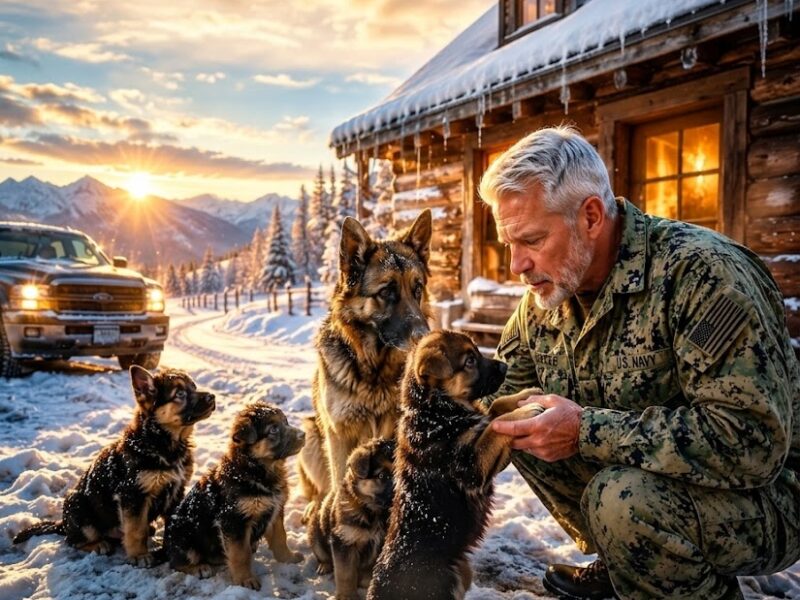
The Grieving Navy SEAL Wanted a Life of Silence—Then Four German Shepherd Puppies Invaded His Cabin
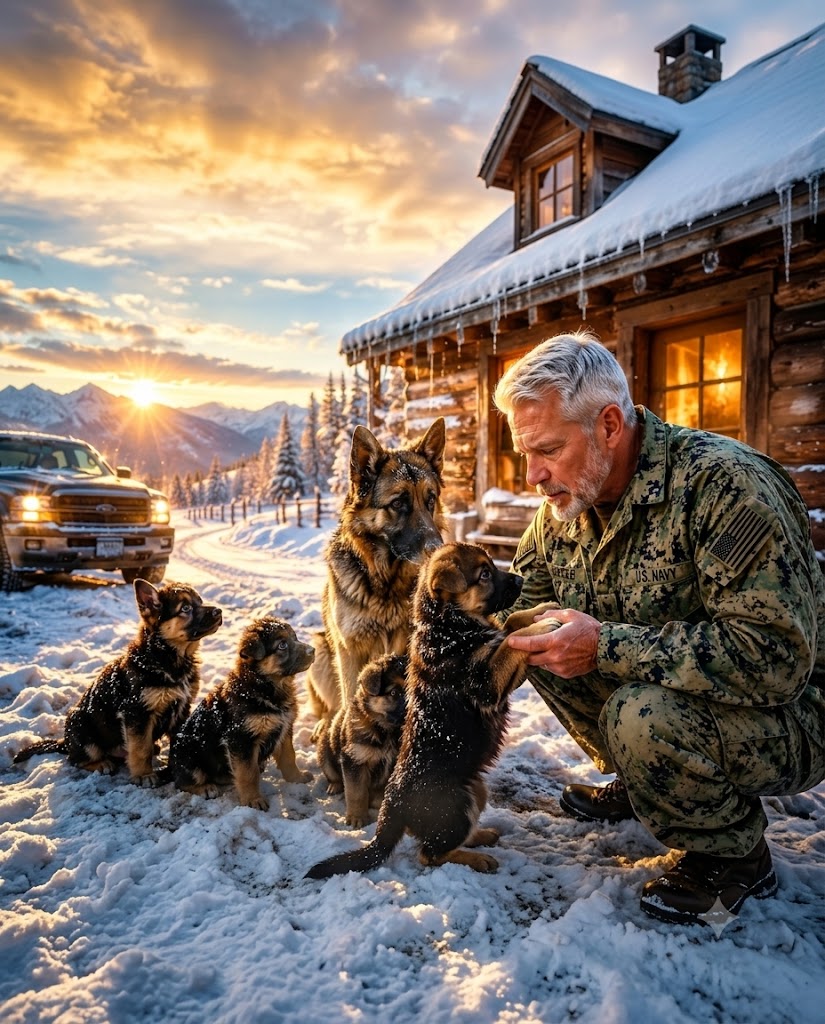
Garrett Cole had buried two things in the same year: his wife and his belief that anything in this world could be trusted to stay.
Claire went first, in June, after 14 months of a fight that stripped the color from her face and the certainty from his hands.
Rook followed in September — a big black lab who had slept across Garrett’s feet every night for 11 years, who had made the 2 a.m. memories easier to wake up from, who had been the last living thing in that house that needed Garrett to be okay.
The vet had been watching a tumor for 2 years, and then the tumor stopped waiting.
Four months. That’s all it took to lose both of them.
Garrett was 51 years old, and he had spent 22 of those years as a Navy SEAL, doing things in places whose names he still couldn’t say out loud in mixed company.
He had lost men he would carry in his chest until the day he didn’t have to carry anything anymore.
He had come home from all of that and somehow — somehow — built a life worth having.
A daughter named Ellie. A house in Bozeman that smelled like Claire’s bread on Sunday mornings. A dog named Rook.
And then he had watched it all come apart anyway, which taught him something he had already suspected but never wanted confirmed: survival was not the same thing as being spared.
So he sold the house in Bozeman for $487,000 and bought 23 acres outside of town, where the nearest neighbor was a retired schoolteacher named Holt, who waved from his truck maybe once a week and had the decency not to expect a wave back.
Garrett had chosen the property in November, when the mountains were already white and the silence was the kind that pressed against your ears like cupped hands.
He had stood on the porch of the old farmhouse, looked out at nothing but tree line and gray sky, and felt something close to relief for the first time in 14 months.
He did not want another dog.
He had told Ellie this plainly when she suggested it 3 months after Rook.
He had told Holt the same thing when Holt mentioned his cousin’s golden retriever had a litter coming.
He had told himself this every morning when he walked the property at first light, passing the corner of the porch where Rook used to sit and watch the deer in the east meadow with a patience Garrett had always secretly admired.
He did not want another dog.
He did not want something that looked at him like he was worth looking at.
He did not want to be responsible for a living thing’s happiness.
He had not done well at that lately, and the evidence was everywhere he turned.
The quiet was honest. The quiet didn’t ask anything of him.
That was his position in February when the temperature dropped to 11 degrees and the snow came sideways for 3 days, and Garrett spent most of his time splitting wood, reading, and going to bed earlier than he had since he was 8 years old.
On the fourth morning, he put on his boots and his Carhartt and walked out to check the woodpile under the tarp on the north side of the barn.
And that was when he saw her.
She was a German Shepherd, or most of one.
The fur was matted and dirty, and she was thin in a way that made the word thin feel insufficient.
She had dragged herself into the gap between the woodpile and the barn wall and was lying on her side in the snow, and for one terrible second, Garrett thought she was dead.
Then she lifted her head.
Her ears came up, sharp and alert, the way German Shepherd ears do, and something moved in his chest — fast and unwelcome, like a splinter being pressed deeper instead of pulled out.
He stood there. She watched him.
The temperature was 11 degrees. She was lying in the snow.
He was not going to stand there and watch a dog die in the snow on his property, regardless of how he felt about dogs right now.
He understood that this was not a moral position so much as a plain fact about who he was.
So he went inside and came back with a blanket, a bowl of water, and the last of some leftover chicken he’d made two nights ago.
She didn’t try to stand when he approached. She let him come close, which told him she’d been around people before.
It probably told him something else, too — that she didn’t have the energy to be afraid.
He set the water near her face. She drank for a long time.
She ate the chicken in four careful bites, like she was trying to remember her manners.
He brought her inside.
He told himself it was temporary.
He told himself he was not adopting a dog. He was providing emergency shelter to an animal in distress, which was something any reasonable person would do.
And when the storm broke, he would take her to the vet in Bozeman and from there to a rescue organization, and that would be the end of it.
He settled her on the old blanket near the wood stove, checked her over as best he could — no collar, paws raw, ribs visible under his hand like a xylophone.
And then he sat in the armchair across the room and watched her breathe.
She was pregnant.
He figured this out approximately 90 seconds after settling her down, because even under the matted fur and the terrible thinness, the shape of her was unmistakable.
Garrett sat with this information for a long moment and then said out loud to no one, “Of course you are.”
The dog lifted her head and looked at him.
“I’m not set up for this,” he said.
She put her head back down.
He named her nothing. He was not naming her.
He called the vet’s office in the morning and described the situation and was told to keep her warm, keep her hydrated, watch for signs of distress, and bring her in when the roads cleared — which would probably be tomorrow.
He did all of this.
He heated broth and let it cool and brought it to her in a low bowl, and she drank it slowly while he held the bowl.
He noticed she kept her eyes on his face the whole time she drank, which was a thing Rook had done, too.
He looked away.
The roads did not clear the next day.
The storm that had been moving east stalled and turned and sent another 2 feet of snow into the valley overnight, and Garrett woke to the sound of wind and the sight of drifts against the kitchen window that were level with the sill.
He checked on the dog first thing, before coffee, before anything.
She was in the same spot, but her breathing had changed — shorter, more deliberate — and she looked at him when he came in with an expression he had learned to read over the years in a lot of different faces.
She was working hard. She was concentrating.
She had four puppies before noon.
Garrett had assisted in field medicine situations that had required a certain calm under pressure, and he brought that same quality to the next several hours.
Clean towels and warm water. A phone call to the vet, where he described each stage and received instructions in a steady voice from a woman named Dr. Patel.
She sounded like she had talked many panicked people through many of these situations and did not find Garrett’s careful, precise descriptions unusual.
Three of the four puppies were strong from the first breath.
One was smaller and slower and required more attention, which Garrett gave it because that was simply what the situation demanded.
By afternoon, all four were nursing.
The mother had eaten half a can of the wet food Dr. Patel had told him to pick up before the storm.
He’d had it in the truck from a supply run two weeks ago, bought for no reason he could name at the time.
And she was resting.
Garrett sat on the floor with his back against the armchair, which was not something he did typically, and watched them.
He still hadn’t named her.
The roads cleared on the third day.
He loaded her carefully into the truck with the puppies in a laundry basket lined with the softest blanket he owned — which had been Claire’s, and which he had not used since Claire — and drove into Bozeman.
Dr. Patel was a small woman with reading glasses pushed up on her head and the brisk warm manner of someone who has spent 30 years caring deeply about animals and has found efficient ways of showing it.
She examined the mother and the puppies with thorough hands and declared them all five remarkably healthy given the circumstances.
“She was someone’s dog,” Dr. Patel said, checking the mother’s teeth. “Well cared for at some point. Two, three years old. No chip.”
“I’ll contact the rescue organizations,” Garrett said.
Dr. Patel looked at him over her glasses. She was very good at that look — the kind that communicated a full opinion without requiring any words.
“I’m not in a position to keep a dog,” Garrett said. “Let alone five.”
“Hmm,” said Dr. Patel.
“Not known. Five.”
“Hmm,” said Dr. Patel, which also communicated a full opinion.
He brought them home because the rescue organizations were at capacity and the earliest any of them could take a nursing mother and four newborns was 3 weeks.
And 3 weeks was manageable.
Three weeks was not an option.
Three weeks was logistics.
The puppies opened their eyes in the second week. This was when things became complicated.
There were four of them, and they were all distinct within about 48 hours of figuring out how to move around.
The biggest one, a male with a black saddle marking and an apparent belief that he was in charge of the others, who Garrett started mentally calling Major because the attitude demanded a rank.
A female with pale fur along her ears, the quietest of the four, who had a habit of appearing in rooms without Garrett noticing her until she was already there, sitting and watching.
He started calling her Ghost in his head involuntarily, because she kept doing it at 5 a.m. when he got up for water, and he’d turn around and she’d just be there.
A third one, darker male, who was the comedian.
He fell over his own feet constantly, chased his own tail with a commitment that bordered on professional, and had once managed to get his head stuck in Garrett’s boot and walked around with it for a solid 30 seconds before shaking free with an expression of pure indignation.
Garrett called him Trip in his head, which became Trip out loud sometime around day nine, and he knew as soon as he heard himself say it that he’d made an error in judgment.
The fourth puppy, the small one from the first day, the one who had needed more attention at the start, was a female — lighter than her siblings.
And she was the one who found Garrett first.
He didn’t mean for it to happen.
He was sitting on the floor one evening going through some paperwork from Claire’s estate — things Ellie had sent him and that he’d been avoiding for 2 months — and he had them spread out on the floor around him and was reading with his reading glasses on when something climbed into his lap and fell asleep.
He looked down. The small one.
She had picked her way through the documents with a delicacy that was almost respectful, and she was curled against his stomach and already asleep.
Small ribs moving. One paw resting against his hand.
He sat there for a while without moving. The paperwork didn’t seem urgent anymore.
The quiet in the house was different with them in it.
Not the absence of something. Just quiet.
He had forgotten that quiet could mean that.
He called her Lucky in his head because of the first day.
And then out loud.
And then he understood that he had named all four of them, and that this had happened without his permission while he was apparently looking the other way.
He called Ellie on Sunday and told her about the dog. He had not told her yet.
There was a long pause on the phone.
“Dad,” Ellie said, “how long have you had a dog?”
“Three and a half weeks.”
“You said you didn’t want a dog.”
“I didn’t.”
“And now you have five.”
“The mother is being transferred to a foster home next week,” he said. “The puppies are 8 weeks in 2 days. They’ll go to the rescue after that.”
Another pause.
“Are you going to let that happen?”
Garrett looked across the room.
Major was attempting to climb the leg of the armchair with a focus that was almost militarily precise.
Ghost was sitting near the window watching something outside that Garrett couldn’t see.
Trip had fallen asleep in his water bowl — not beside it, in it — with the serene confidence of someone for whom this was a reasonable decision.
Lucky was on Garrett’s foot.
“I don’t know,” he said.
Which was the most honest thing he’d said to Ellie in 14 months.
The mother left on a Wednesday.
Garrett had prepared himself for this, had told himself it was the right outcome, had confirmed with the rescue that she was going to a foster home with an experienced handler.
He carried her to the transport carrier himself.
She turned around once inside and looked at him through the metal door with dark, steady eyes — the same way she’d looked at him over the water bowl on the first night — and then she turned away and was quiet.
He stood in the driveway for a while after the car left.
When he went back inside, Trip ran into a shin at full speed and bounced off with a look of total surprise, as if the shin had appeared from nowhere.
Garrett looked down at him. He looked up.
“All right,” Garrett said.
He was not sure what he was agreeing to, but he said it, and Trip wagged.
The 3 weeks became 4, became 6, became the puppies being 12 weeks old and Garrett having not called the rescue since week 9.
Dr. Patel called him instead to check in, and he told her the situation hadn’t changed, and he was still evaluating the logistics, and she made the “Mhm” sound again and told him to call if he needed anything.
What happened at week 13 was this:
There was a trail on the eastern edge of the property that Garrett walked every morning.
A narrow path through pine and scrub that came out at a ridge with a view of the valley that on clear days was the kind of thing that made you believe the world had been thought through carefully.
He had been taking the dogs on this walk since they were old enough — all four of them off leash because the property was fenced and they were good about following.
They had their roles on the walk.
Major led.
Ghost appeared and disappeared at the tree line.
Trip ran into things.
Lucky stayed near Garrett’s left side, which was — and he had noticed this and not remarked on it — the same side Rook had always walked on.
On the morning of week 13, Lucky stopped.
Garrett was maybe 200 yards from the trail junction when he noticed she was no longer beside him.
He turned.
She was standing 30 feet back, ears up, nose working, staring into the trees to the north.
Not moving. Not making a sound.
Just absolutely, completely still in the way that working dogs go still when they found something real.
“Lucky,” he said.
She didn’t look at him. She took three steps into the trees and stopped again.
He followed her.
She led him 60 yards off the trail through snow that was thinner under the pines to a place where the ground dipped toward a dry creek bed.
There was an old tree there, a big pine that had come down maybe last spring, and wedged underneath the root ball was a coyote — young, maybe a year old.
A rear leg caught where two roots had come together in the fall.
It had been there a while.
It was alive, barely, and it was terrified, and it stopped struggling when they came close, maybe because it was too tired to struggle.
Garrett stood there in the cold and looked at the coyote, and the coyote looked at him.
Lucky sat down next to him.
Not pressing against him. Just present. Just beside him while he worked out what he was going to do, the way good partners do.
Not solving anything. Not pulling in any direction. Just there.
He went back to the house for tools.
He freed the coyote — careful work, the animal too exhausted to fight much, though it managed one half-hearted snap that he’d expected and moved away from easily.
When the leg was free, it lay still for a moment, and then it gathered itself and stood.
Stood unsteadily, but it stood.
Garrett moved back.
The coyote looked at him once — the same way the mother dog had looked at him through the carrier door — and then it moved into the trees and was gone.
He walked back to the trail.
Lucky fell in beside him on the left.
Major had, at some point during this, discovered a pine cone of apparently exceptional interest and was carrying it back to the house with the gravity of someone transporting important cargo.
Trip had gotten a stick caught on both sides of a narrow gap between two trees and was walking backward with a puzzled expression.
Ghost materialized from the tree line and simply joined the group as if she had been there the whole time.
Garrett walked home with four dogs and understood, in the particular quiet way that men like him come to understand things.
Not with words first, but with the body. With the breath.
With something settling in the chest that had been unsettled for a very long time.
He was not going to make any phone calls to any rescue organizations.
He called Ellie instead.
“I’m keeping them,” he said when she picked up.
A pause. Then, “All four?”
“Yeah.”
“Dad.”
He could hear her smiling. It sounded like Claire smiling, which was a thing he hadn’t been able to think about for over a year without the grief hitting him clean and cold.
Now it just was. It was there, it was real, and it wasn’t the only thing in the room anymore.
“What are their names?”
He told her.
She laughed at Trip, which was fair.
She asked about Ghost, and he tried to explain about the appearing-without-warning thing, and she said that sounded exactly like a dog he would end up with.
When he got to Lucky, she was quiet for a moment.
“She found a coyote,” Garrett said. “Trapped. She led me to it.”
“She knew you’d help it.”
He hadn’t thought about it that way. He turned it over.
“Maybe.”
“She knew,” Ellie said, with the certainty of someone who has not yet been worn down into maybe by the world.
And Garrett found he didn’t want to argue with that.
He sat on the porch that evening after the dogs had eaten and the sun was going down behind the mountains and the valley was turning that particular shade of gold that Montana saves for February evenings when the snow is clean and the air has gone still.
Major sat beside the porch steps with his pine cone, guarding it against threats that had not yet materialized but clearly would.
Ghost was on the railing somehow, which shouldn’t have been physically possible, watching the meadow.
Trip was asleep against the wall, legs moving slightly, running in a dream after something he would probably miss in the dream, too.
Lucky was on his foot.
Garrett looked out at the mountains.
He thought about Claire — the way she used to stand at the kitchen window watching the first snow of every season, the way she had of going completely still with wonder at things the rest of the world had already moved on from.
He thought about Rook across his feet in the dark all those years, all those nights when the memories of the things he’d done and the things he’d seen came up at 2 a.m. and Rook would shift, press closer, not asking anything, just there.
He hadn’t been able to think about either of them without it hollowing him out since June.
Right now he was thinking about both of them, and the hollow was still there.
It would always be there. He understood that now.
But it was shaped differently. It had something in it.
It had the weight of a small dog on his foot and three ridiculous puppies and a coyote moving through snowy trees toward something Garrett hoped was home.
The stars came out over Montana.
One, and then several, and then too many to count.
Garrett Cole, who had asked only for silence, sat on his porch with four dogs and felt for the first time in a long time that the night was not something to get through.
It was just the night.
And it was fine.
—
The next morning, Garrett woke at 5:47 a.m. to the sound of Trip falling off the couch.
It was not a subtle sound. It was the sound of a 22-pound German Shepherd puppy discovering gravity in real time, followed by a yelp of genuine surprise, followed by the click of claws on hardwood as he immediately forgot the entire incident and went looking for breakfast.
Garrett lay in bed for a moment, staring at the ceiling.
The ceiling had a crack in it that ran from the light fixture to the far corner, and he had been meaning to fix it since November.
He had not fixed it.
He had not fixed a lot of things.
He got up.
The routine had formed without his permission over the past several weeks, the way routines do when you’re not paying attention.
Down the stairs. Open the back door. Four dogs poured out into the dark yard like water from a tipped glass, Major first, Trip tripping over the threshold, Ghost already somehow outside despite the fact that Garrett had not seen her pass him, and Lucky waiting politely at his heel until he said, “Go on,” which he had started saying without realizing he’d started saying it.
Coffee. Two cups, because one wasn’t enough anymore and he wasn’t sleeping great, which was not new, but the reasons were different now.
The reasons had four legs and cold noses and a tendency to stand on his chest at 4 a.m. to make sure he was still breathing.
He had not asked for that. He had not asked for any of it.
But here it was.
At 6:30, he put on his boots and his coat and took them out to the trail.
The snow had settled into that crusty late-winter texture, the kind that held your weight for two steps and then broke through on the third, and the air had that sharp clean bite that made Garrett think of early mornings on the teams, when the world was still dark and the mission was still ahead and everything was possible because nothing had gone wrong yet.
Major led, as always.
Ghost vanished into the tree line, as always.
Trip found a stick within 40 seconds of leaving the porch and carried it with the intense focus of a dog who believed this stick was the solution to a problem no one else understood.
Lucky walked on Garrett’s left.
The trail wound through the pines, past the ridge, down toward the dry creek bed where the coyote had been.
Garrett paused there.
He didn’t know why. It wasn’t a memorial. It wasn’t anything.
But he paused, and Lucky paused with him, and they stood there for a moment in the cold morning quiet while the other three dogs did their various dog things — Major patrolling, Ghost watching from somewhere Garrett couldn’t see, Trip trying to fit the stick into a hole that was too small for it.
Garrett looked at the fallen pine, at the root ball, at the empty space where the coyote had been.
He thought about the way it had looked at him. The way the mother dog had looked at him.
The way Claire had looked at him, near the end, when she couldn’t say much anymore but her eyes still did all the talking.
He thought about the way Ellie had sounded on the phone when he said he was keeping them — the relief in her voice, the hope, the thing she had been trying not to say for 14 months, which was: *I was so scared I was going to lose you, too.*
He hadn’t realized she was scared.
He had been so busy being fine that he hadn’t noticed.
Or maybe he had noticed, and he had just been too far down in the quiet to care.
Either way, he knew now.
He started walking again. Lucky fell in beside him.
The trail looped back toward the house, and by the time they got there, the sun was up over the mountains and the valley was doing that thing it did in the morning, where the light hit the snow and turned everything gold and pink and blue, and Garrett stood on the porch for a moment before he went inside.
He had spent 22 years as a SEAL.
He had been shot at, blown up, buried alive, and sent into places that didn’t exist on any map.
He had lost friends, lost men, lost pieces of himself that he had never gotten back.
He had come home and built a life, and then he had watched that life come apart, and he had moved to Montana to be alone because alone was the only thing that didn’t hurt.
And now he had four dogs.
It was, he thought, the most ridiculous thing that had ever happened to him.
It was also, he thought, the best thing that had happened to him since Claire.
He went inside. Trip had somehow gotten his head stuck in the boot again. Major was standing on the couch, surveying his kingdom. Ghost was sitting on the kitchen counter, which was definitely not allowed and definitely something she had figured out how to do without being taught.
Lucky was already in the spot by the wood stove where she liked to sleep, curled into a tight ball with her nose under her tail.
Garrett looked at them, all four of them, and felt something in his chest that he hadn’t felt in a long time.
It took him a minute to identify it, because it had been so long.
It was happiness. Small, quiet, battered, but there.
He had not asked for it. He had not wanted it. He had told anyone who would listen that he was done, that he was fine, that he didn’t need anything else.
And then a German Shepherd had dragged herself into his woodpile in the middle of a blizzard, and everything had changed.
He still missed Claire. He still missed Rook. He still had nights where the memories came up and the dark felt like it was pressing in, and the only thing that helped was the weight of a dog on his feet and the knowledge that in the morning, there would be four of them waiting for him.
But that was okay. That was enough.
That was, he had come to understand, everything.
The phone rang at 9 a.m. It was Ellie.
“Hey, Dad.”
“Hey, kid.”
“How are the dogs?”
“Trip got his head stuck in my boot again.”
“That’s not the first time.”
“It’s the fourth time.”
She laughed. He could hear one of the kids in the background, yelling about something, and Ellie saying, “Hang on, hang on, I’m talking to Grandpa.”
“Grandpa,” Garrett said. “That’s still weird.”
“You’ll get used to it.”
“I don’t think I will.”
“You will.”
He could hear her smiling again. He could hear the thing she wasn’t saying, the thing she had been not-saying for 14 months, which was: *I’m glad you’re still here. I’m glad you didn’t disappear. I’m glad you found something to hold onto.*
He didn’t say it either. They weren’t that kind of family.
But he thought it.
He thought it, and he looked at the four dogs scattered around his living room, and he thought about the coyote moving through the trees, and he thought about Claire and Rook and all the things he had lost, and he thought about all the things he had found.
The quiet in the house was different now. It wasn’t empty. It was full.
Full of breathing and movement and the occasional crash of a puppy falling off something he shouldn’t have been on.
Full of life.
Garrett Cole had asked only for silence.
And what he had gotten, instead, was this: four German Shepherds, one suspicious coyote, a daughter who called every Sunday, a neighbor who waved from his truck, and a life that, despite everything, was still worth living.
He hadn’t asked for it.
He hadn’t wanted it.
But he was grateful for it.
And that, he thought, was the difference between surviving and living.
He had spent a long time just surviving.
Now, finally, he was living.
—
Lucky found another coyote in April.
Garrett was on the trail, same as always, same as every morning, and she stopped again, ears up, nose working, staring into the trees.
He followed her.
This time, it was a den — a small one, tucked under a rock outcropping, with three pups inside, too young to be on their own, no mother in sight.
He didn’t know what had happened to the mother. He didn’t need to know.
He called the wildlife rescue in Bozeman, and they sent someone out, and the pups were taken to a rehabilitation center where they would be raised and released.
The woman who came to get them was named Sarah, and she had been doing this for 15 years, and she looked at Garrett and Lucky and said, “She’s got a nose for it.”
“She’s got a nose for something,” Garrett said.
“What’s her name?”
“Lucky.”
Sarah smiled. “That’s a good name.”
“She found me,” Garrett said. “In a blizzard. She was pregnant. She had four puppies on my floor.”
Sarah looked at him for a moment. “And you kept them?”
“Yeah.”
“All four?”
“Yeah.”
She nodded, like that made sense, like that was exactly what she would have expected.
“Good,” she said. “That’s good.”
She loaded the pups into her truck and drove away, and Garrett stood in the driveway with Lucky beside him and watched until the truck was out of sight.
Then he went back inside, where Major was standing on the kitchen table, Trip was eating something he definitely shouldn’t have been eating, and Ghost was on top of the refrigerator, watching everything with her pale, unreadable eyes.
Garrett looked at them.
“You’re all ridiculous,” he said.
Major wagged his tail. Trip looked up with a piece of something dangling from his mouth. Ghost blinked slowly.
Lucky sat down beside him and leaned against his leg.
He reached down and scratched behind her ears, and she closed her eyes and sighed, and he felt that thing in his chest again — the thing he had been missing for so long, the thing he had thought was gone forever.
It was still there. It had been there all along.
He just hadn’t been able to feel it.
He called Ellie that night and told her about the coyote pups.
“Lucky found another one?”
“Three of them. Orphans.”
“And you called the rescue?”
“Yeah.”
“Dad.”
“What?”
“You’re a softie.”
“I’m not a softie.”
“You’re a softie who has four dogs and rescues coyotes and lives on a farm in Montana.”
“It’s not a farm. It’s 23 acres.”
“Same thing.”
“It’s not.”
“It is.”
He could hear her laughing. He could hear the kids in the background, and he could hear the TV, and he could hear the life in her voice, the fullness of it, the way she had built something of her own.
He was proud of her. He didn’t say it enough.
“You did good, kid,” he said.
“What?”
“You did good. You and Mark. The kids. All of it.”
There was a pause. Then, softly, “Thanks, Dad.”
“Yeah.”
“You did good, too.”
“I don’t know about that.”
“I do.”
He didn’t argue. He wasn’t sure he believed it, but he wasn’t sure he didn’t, either.
And that, he thought, was progress.
The summer came slow that year, the way it always did in Montana, the snow melting into mud and then into grass, the trees filling in, the valley turning green and gold and then green again.
Garrett fixed the crack in the ceiling.
He fixed the fence on the north side of the property.
He built a dog door so he didn’t have to get up at 5 a.m. to let them out, which was the best decision he had made in years.
The dogs grew. Major got bigger and more imperious. Trip got bigger and more accident-prone. Ghost got bigger and more mysterious, appearing and disappearing at will, always watching, always knowing something Garrett didn’t.
And Lucky stayed by his side, on the left, where she had always been.
He took them on the trail every morning. He took them to the ridge, where the view made you believe the world had been thought through carefully.
He took them to the creek bed, where the coyote had been, and he stood there sometimes and remembered.
He thought about Claire. He thought about Rook. He thought about the life he had lost and the life he had found.
And he thought about the fact that he was still here, still breathing, still walking, still alive.
He had not asked for any of it.
But he was grateful for it.
And that, he knew, was the whole thing.
That was the point.
—
One year after Claire died, Garrett drove to Bozeman and had lunch with Ellie and the kids.
They went to a diner downtown, the kind of place with vinyl booths and a jukebox that still worked and a waitress named Deb who had been there for 30 years and knew everyone’s order.
Ellie’s kids — Maya, who was four, and James, who was two — climbed all over Garrett like he was a piece of playground equipment, and he let them, because he had learned that grandkids were different, that they didn’t ask anything of you except that you be there, and that was something he could do.
Maya asked about the dogs. She had seen pictures, had heard stories, and she wanted to know everything.
“Major is the boss,” Garrett said. “He thinks he’s in charge.”
“Is he?”
“Don’t tell him, but no.”
She giggled.
“Trip falls over a lot. He’s not very coordinated.”
“Like Daddy?”
Ellie snorted. “Hey.”
“What about Ghost?”
“Ghost is… Ghost. She appears and disappears. You never know where she’s going to be.”
“Like a ghost?”
“Exactly like a ghost.”
“And Lucky?”
Garrett paused. “Lucky is the one who found me.”
“Found you?”
“I wasn’t looking for a dog. I didn’t want a dog. But Lucky found me anyway.”
Maya thought about this. “So she’s your favorite?”
“I don’t have favorites.”
“You do. You just don’t say.”
He laughed. “Maybe.”
Ellie watched him from across the table, and he could see the thing in her eyes — the relief, the happiness, the quiet joy of seeing her father alive again.
He hadn’t realized how worried she had been. He hadn’t realized how much he had disappeared.
But he was back now. He was here.
And that was enough.
After lunch, they walked around town. Bozeman had changed since he’d lived there — new buildings, new people, new everything — but some things were the same.
The bakery where Claire used to buy bread on Saturday mornings.
The park where they had taken Ellie when she was little.
The bench by the river where they had sat and watched the sunset on their anniversary, every year, for 22 years.
He stopped at the bench. Ellie stopped with him.
“You okay?” she asked.
“Yeah.”
“You sure?”
He looked at the river. He looked at the mountains. He looked at the sky, which was that particular shade of blue that Montana gets in September, when the summer is ending and the fall is coming and everything feels like it’s holding its breath.
“I’m okay,” he said. “I’m actually okay.”
She took his hand. He let her.
They stood there for a while, not saying anything, just being there, just being together.
And Garrett thought about all the things that had brought him to this moment — the war, the loss, the grief, the silence, the dogs.
He thought about Claire, who would have loved this, who would have loved seeing him with the grandkids, who would have loved knowing that he was still here, still alive, still finding reasons to keep going.
He thought about Rook, who had carried him through the worst of it, who had been the bridge between the life he had and the life he had lost.
And he thought about Lucky, who had found him in the snow, who had led him to the coyote, who had shown him that there was still something worth caring about.
He thought about all of it, and he felt the hollow in his chest, the one that had been there since June, the one that would always be there.
But it was different now. It was filled with something.
Not with grief, though the grief was still there.
Not with loss, though the loss would never go away.
With love. With gratitude. With the quiet, stubborn knowledge that life goes on, that joy comes back, that even the deepest winter eventually gives way to spring.
He squeezed Ellie’s hand.
“Let’s go home,” he said.
They walked back to the car, and Garrett drove back to the property, and when he got there, four dogs were waiting for him on the porch.
Major, standing guard.
Trip, wagging so hard he was practically vibrating.
Ghost, appearing from nowhere, as always.
And Lucky, on the left, where she belonged.
Garrett got out of the car and walked up the steps and sat down on the porch, and the dogs gathered around him, and he looked out at the mountains and the valley and the sky.
The sun was going down. The light was turning gold.
The quiet was there, the same quiet he had come here for, the same quiet he had thought he wanted.
But it was different now. It was full.
Full of breathing and movement and the occasional crash of a puppy falling off something he shouldn’t have been on.
Full of life.
Garrett Cole had asked only for silence.
And what he had gotten, instead, was everything.
—
**THE END**









