
The Entire Restaurant Mocked the Poor Woman—Until the Billionaire’s Son Walked In and Knelt Before Her
The maître d’ at The Golden Coast in downtown Boston nearly choked on his own smirk when the elderly woman walked through the revolving glass doors. Her worn navy coat hung loose on thin shoulders, and her scuffed shoes left faint marks on the polished marble floor.
She clutched a yellowed envelope to her chest like a lifeline, her eyes scanning the glittering chandeliers and white tablecloths as if she’d stepped into another world.
“We don’t validate parking for non-guests,” the hostess said, her voice dripping with manufactured politeness. A few diners at the bar swiveled on their stools, their conversations dying as they watched the spectacle unfold.
“I’m here to see Mr. Nathaniel Boateng,” the woman said, her voice steady despite the tremor in her hands. “I’ve traveled a long way.”
The restaurant erupted in laughter. Not the gentle kind, but the sharp, cutting laughter that slices through dignity and leaves wounds that never quite heal.
—
The hostess, a young woman named Madison with perfectly coiffed hair and a designer dress that cost more than most people’s monthly rent, stepped back as if the elderly woman carried something contagious.
“Wait a minute. Are you seriously telling us that you traveled all the way from Cape Cod because you want to meet Nathaniel Boateng?” Madison’s voice carried across the dining room like a bell announcing bad news. “The billionaire’s son?”
A man in a charcoal suit laughed into his whiskey glass, ice cubes clinking like applause.
“Oh, this is unbelievable,” Madison continued, gesturing at the elderly woman’s attire. “Ma’am, do you even know who that young man is? People with important appointments wait for weeks before they can see him.”
She circled the elderly woman like a shark sensing blood in the water.
“Yet, you walked into one of the most expensive restaurants in Boston carrying an old envelope and expecting him to appear. Look around you, mother. This isn’t a roadside diner where anybody can walk in off the street.”
The elderly woman’s name was Abena Mensah, though no one in that restaurant bothered to ask.
She stood perfectly still as the laughter washed over her, her fingers tightening around the envelope that had traveled with her on a five-hour bus ride from Cape Cod to Boston.
“Please, somebody explain to this woman how things work here before she embarrasses herself further,” Madison said, throwing her hands up dramatically.
—
A woman at a nearby table, dripping in diamonds and holding a flute of champagne, leaned toward her companion and whispered loudly enough for everyone to hear: “These people, they just don’t understand how the real world works.”
Abena finally spoke, her voice quiet but carrying a weight that silenced the nearby tables.
“My daughter, I understand that my clothes may not look like the clothes worn by people who eat in places like this. I also understand that you may find it difficult to believe that someone like me could have anything to discuss with you.”
She paused, letting her words settle in the air.
“But I did not come here to beg for money, food, or sympathy. I came because 25 years ago, something terrible happened to an innocent man, and the truth was buried to protect somebody else.”
The diamond-draped woman set down her champagne glass with a soft clink.
“You may laugh at my appearance,” Abena continued, “but you don’t know what I’ve carried inside this envelope for a quarter century. All I’m asking is for someone to deliver my name to Mr. Boateng. After that, if he refuses to see me, I will quietly return to Cape Cod.”
—
The restaurant manager, Victor Asante, appeared from his office like a man who had smelled smoke and was desperate to find the fire before it consumed everything he’d built.
He was in his late fifties, silver-haired, and wore a suit that had been tailored to conceal the extra weight he’d gained over the years. His smile was the kind that never quite reached his eyes.
“Madam Abena, I believe we’ve already discussed this matter,” Victor said, his voice polished to a smooth finish. “I don’t understand why you’re still insisting on disturbing our guests.”
He gestured vaguely at the room full of diners who had now abandoned all pretense of not watching.
“Mr. Nathaniel Boateng is a very busy businessman, and this restaurant has established procedures for arranging appointments with the owners. You cannot simply appear here with an envelope, mention a name from 25 years ago, and expect everybody to abandon their responsibilities.”
Victor’s voice dropped to a conspiratorial whisper that everyone could still hear.
“Whatever happened to Daniel Quartey was investigated long ago, and I strongly advise you not to reopen matters you may not fully understand. Please cooperate with our staff and leave peacefully. I would rather resolve this quietly than allow an unnecessary misunderstanding to become a public embarrassment.”
—
Abena’s eyes met Victor’s, and something in her gaze made the manager take an involuntary step backward.
“Mr. Asante, I’ve listened to everything you’ve said, but now I want you to listen to me.”
Her voice was no longer quiet. It had transformed into something that commanded attention, the voice of a woman who had spent 25 years rehearsing this moment in her mind.
“Twenty-five years ago, Daniel Quartey stood before people who called themselves his friends and colleagues. Nobody gave him the opportunity to defend himself.”
She paused, and the silence in the restaurant became absolute.
“I was there when he begged for the original payment ledger to be examined. I was there when you promised him that the truth would come out, Victor. And I was there when that promise was broken.”
Victor’s face had gone pale, his carefully constructed smile crumbling like stale bread.
“Today I am standing in a room filled with people who have already judged me without knowing why I came. But this time I will not allow fear to silence me. You may ask me to leave, but you cannot make the truth disappear simply because it makes powerful people uncomfortable.”
—
A young man in his early thirties had emerged from a private dining room at the back of the restaurant, drawn by the commotion. He wore an expensive watch and an expression of curiosity that suggested he was used to being entertained by the world around him.
Nathaniel Boateng had his father’s sharp jaw and his mother’s calculating eyes. He was worth more than most small countries, and he knew it.
“Victor, what’s going on here?” Nathaniel asked, his voice carrying the easy authority of someone who had never been told no in his life. “I could hear the commotion from my private dining room.”
Before Victor could answer, Abena turned. She reached into her envelope and pulled out a photograph, holding it up so Nathaniel could see.
“Where did you get that photograph?” Nathaniel’s voice changed instantly, the casual authority replaced by something raw and uncertain.
The photograph showed a younger Emmanuel Boateng, Nathaniel’s father, standing outside a small restaurant with a group of employees. Among them was a young Black man with a kind face and honest eyes.
“Madam, please tell me this photograph is real,” Nathaniel said, taking a step forward. “Because if it is, my father has been hiding the truth from me for 25 years.”
Abena’s voice was gentle now, the voice of a mother speaking to a child who had just discovered that the world was not what he believed it to be.
“My son, the photograph is real. But what happened that night is something your father never wanted you to discover.”
—
Victor stepped between them, his hands raised as if to physically block the conversation.
“Nathaniel, please. You don’t understand what you’re doing. There are things about that night you were never supposed to know.”
Nathaniel looked at the manager he had trusted for years, and something in his expression shifted. The confusion hardened into resolve.
“Then perhaps it’s time everybody in this restaurant heard the truth.”
—
Two hours earlier, fifty miles south of Boston, a bus rattled along Route 3 toward Cape Cod. The morning light filtered through grimy windows, illuminating the faces of passengers lost in their own worlds.
Abena sat by the window, her envelope clutched to her chest. Beside her sat a young man named Marcus, a college student returning home for spring break.
He had noticed the elderly woman’s agitation the moment she boarded and had offered her his seat. She had declined initially, but something in his kind eyes had made her accept.
They had been traveling in silence for nearly an hour when Marcus finally worked up the courage to speak.
“Mother, please forgive me for asking,” he said, his voice gentle. “But ever since we left Cape Cod, you haven’t slept, you haven’t eaten, and every few minutes you look out the window as though your entire life depends on what you’re going to find.”
He paused, choosing his next words carefully.
“Are you traveling to Boston to visit your children? Or is there something waiting for you there that you’re afraid to face?”
Abena turned to look at him, and for the first time that morning, a small smile touched her lips.
“I know we are strangers,” Marcus continued, “but sometimes speaking to someone you don’t know can make a heavy heart feel a little lighter.”
—
Abena was quiet for a long moment, watching the highway markers flash past.
“My son, there are some journeys a person makes with her feet, and there are others she makes with her conscience. Today, I’m making both.”
She adjusted her grip on the envelope, and Marcus noticed that her hands were trembling.
“Twenty-five years ago, I watched an innocent man lose everything he had worked for—his job, his dignity, his friends, and eventually his life. People called him a thief. Nobody wanted to hear his side.”
Marcus listened without interrupting, his young face serious.
“I knew there was something terribly wrong. I was afraid to speak. Now, after all these years, I’ve discovered something that could finally prove he was telling the truth.”
“Twenty-five years is a very long time to carry such a burden, mother,” Marcus said softly.
—
Abena nodded, and for a moment, she seemed to age another decade before Marcus’s eyes.
“But I want you to understand something,” he continued. “People who build their lives around a lie don’t usually welcome the person who comes to expose it. If this matter involves powerful people, you must be careful.”
He reached over and gently touched her arm.
“Money can buy expensive houses, beautiful cars, and influential friends, but it cannot purchase a clean conscience. Are you certain the people you’re going to meet will allow you to tell your story?”
Abena’s eyes glistened with unshed tears.
“And more importantly,” Marcus added, “are you prepared for what might happen when they discover what you’ve been carrying?”
—
“I am afraid, my son,” Abena admitted, her voice barely above a whisper. “I’m an old woman, and I have no powerful friends waiting for me in Boston. But I am more afraid of meeting my maker carrying a truth that could save a man.”
She paused, wiping her eyes with the back of her weathered hand.
“Daniel Quartey died believing the whole world had turned against him. His children grew up ashamed of a father who had done nothing wrong. Today, I’m going to look the Boateng family in the eyes and tell them what really happened.”
Her voice strengthened, the trembling replaced by a quiet determination.
“And if they refuse to listen, I will leave these documents where the truth can finally be found. Forgive me for taking so long.”
—
The bus continued its journey toward Boston, carrying Abena toward a confrontation she had spent half her life preparing for.
Marcus walked with her to the station exit, offering to accompany her further.
“You’ve already given me more than you know,” Abena said, pressing his hand between both of hers. “Go home to your family. Tell them what you’ve learned today—that sometimes the smallest kindness can give a person the courage to face the biggest fear.”
She boarded a city bus heading toward downtown, leaving Marcus standing on the sidewalk with tears in his eyes.
—
At The Golden Coast, the lunch rush was in full swing. Essie Williams, a young waitress who had worked at the restaurant for three years, was reviewing the day’s reservations when her manager appeared.
“Essie, Mr. Nathaniel Boateng is visiting this afternoon,” Victor said, his voice clipped and efficient. “I need the VIP section prepared immediately. And I want you to personally confirm all appointments before allowing anyone into the private areas.”
“Yes, sir,” Essie replied, making notes on her clipboard.
Victor started to walk away, then turned back.
“There’s an elderly woman who may arrive today. She’ll likely claim she has business with the Boateng family. If she appears, inform me immediately. She is not to be admitted without my explicit authorization.”
Essie frowned but nodded.
—
The moment Victor disappeared into his office, a colleague named Tina leaned close to Essie.
“What do you think that’s about? He looked like he’d seen a ghost.”
Essie shook her head. “I don’t know, but something tells me it’s important. I’ve never seen him this rattled.”
Before Tina could respond, the restaurant’s front door opened, and the elderly woman from the bus walked in.
Essie watched as Madison, the hostess, approached her with the condescension of someone who had never known struggle.
The laughter that followed made Essie’s blood boil.
—
She recognized the look on the elderly woman’s face—pride warring with desperation, determination fighting against humiliation.
It was the same look her own grandmother had worn when she’d been turned away from a hospital in Mississippi because of the color of her skin.
Essie moved closer, listening as the elderly woman explained her purpose.
“A meeting with Mr. Nathaniel Boateng? That’s not possible without an appointment,” Madison was saying, her tone dripping with false sympathy.
“I’m here about Daniel Quartey,” the elderly woman said. “It’s important.”
The name sent a jolt through Essie’s memory. She had heard it somewhere before, a forgotten detail from a conversation she wasn’t meant to overhear.
And then Victor appeared, and everything changed.
—
Essie watched from behind the reception desk as Victor tried to intimidate the elderly woman into leaving. His voice was calm, but his posture was that of a man trying to defuse a bomb.
When the woman refused to back down, Victor’s face flickered with something that looked remarkably like fear.
“The name Daniel Quartey may mean very little to people working in this restaurant today,” the elderly woman said, “but 25 years ago, that name belonged to one of the most honest men I ever knew.”
Essie’s fingers tightened around her clipboard.
—
“Daniel worked beside us when this company was nothing more than a small restaurant,” the woman continued, her voice carrying to every corner of the room. “He was the kind of man who would return even the smallest amount of money that didn’t belong to him.”
She paused, and Essie saw tears forming in her eyes.
“But one terrible morning, money disappeared. Daniel was accused of stealing it. Nobody listened. He lost his job, his reputation, and the respect of people who once called him their friend.”
Essie felt something shift in her chest. She had seen the financial records—the discrepancies, the altered documents, the authorization codes that didn’t match up.
“I have carried the pain of what happened,” the woman said, “something that could finally prove he was innocent.”
—
Victor stepped forward, his voice low and threatening. “Whatever documents you’re carrying, I suggest you take them back to Cape Cod where they belong. There is nothing to be gained by disturbing people who have already moved on with their lives.”
The elderly woman looked at Victor, and Essie saw something remarkable happen.
The fear was gone, replaced by the kind of courage that only comes from having nothing left to lose.
“Victor Asante, look at me carefully,” the woman said. “Do you remember the small kitchen behind Emmanuel Boateng’s first restaurant? Do you remember the wooden cupboard where the payment ledgers were kept?”
Victor’s face went white.
“And do you remember the morning Daniel Quartey stood before you crying and begging you to examine those records before accusing him of stealing?”
—
“I remember everything,” the woman continued. “I remember how you promised him. I remember how quickly that promise was forgotten.”
She took another step forward, and Victor took another step back.
“You may be wearing an expensive suit today. This restaurant may be filled with people. But none of that changes what happened 25 years ago. I did not travel here to insult you or destroy reputations. I came because an innocent man’s children need to know the truth about their father.”
Essie could no longer stay silent.
“Mr. Asante, please forgive me for interrupting,” she said, stepping forward.
Victor whirled on her, his face twisted with fury. “Essie, this doesn’t concern you.”
—
“I think it does, sir,” she replied, her voice steady despite her racing heart. “Madam Abena has made a reasonable request. She’s not asking for money, and she hasn’t threatened anybody. All she wants is an opportunity to present her documents to someone who can examine them properly.”
She paused, choosing her next words carefully.
“I understand that this restaurant has procedures, but surely there must be a way to arrange a private meeting without making her leave.”
Victor’s eyes narrowed. “Essie, I appreciate your concern, but I must remind you that this is a professional establishment, not a place where employees interfere in confidential management decisions.”
—
But Essie had seen the financial records. She had noticed the discrepancies that didn’t add up.
And she had heard the name Daniel Quartey whispered in the accounting office when Lydia Amponsah had confronted Victor that morning.
“Sir, I hope you won’t misunderstand me for saying this,” Essie continued, “but there were concerns about supplier payments, and Madam Abena is talking about an investigation. I don’t know whether these matters are connected, but I believe it would be unwise to dismiss her before anyone has even looked at the evidence.”
Victor’s face twisted with anger, but before he could respond, a voice from behind them made everyone freeze.
“I agree with the young lady.”
—
Nathaniel Boateng stepped out of the private dining room, his expression unreadable.
“Mr. Boateng,” Victor sputtered, his composure crumbling. “I didn’t know you were—”
“I arrived a few minutes ago,” Nathaniel said, his eyes fixed on Abena. “I heard enough.”
He walked toward the elderly woman, studying her face as if trying to remember something he had long forgotten.
“Madam, I apologize for the way you’ve been treated. My name is Nathaniel Boateng, and I’m Emmanuel Boateng’s son.”
Abena looked at him, and Essie saw the older woman’s eyes fill with tears.
“I understand that you worked with my father when he was still building his first restaurant,” Nathaniel continued. “And that you’ve come here because of something that happened 25 years ago.”
“Yes, my son,” Abena said, her voice trembling. “I have.”
—
Nathaniel turned to Victor, his expression hardening.
“Victor, I want you to arrange a meeting with Lydia Amponsah. And bring me the relevant historical records. I don’t want conclusions or excuses—I want the facts.”
Victor’s jaw tightened. “Mr. Boateng, I don’t think—”
“That wasn’t a request,” Nathaniel interrupted. “I’ve been receiving reports about supplier payment discrepancies for weeks. Now an elderly woman arrives carrying documents connected to an old financial investigation. I think it’s time we started asking questions.”
He turned back to Abena.
“Madam, I want to hear everything you have to say. And I want to see everything you’ve brought.”
—
An hour later, the restaurant’s private conference room had been transformed into an impromptu investigation center.
Lydia Amponsah, the restaurant’s chief accountant, had arrived with a box of documents from the company’s archives. Her expression was grim as she laid out the evidence.
“Mr. Boateng, before you examine these records, I want you to understand that I’m not accusing anyone of committing a crime,” Lydia said. “I’m bringing them to your attention because several important details do not agree with the official investigation from 25 years ago.”
Nathaniel nodded, his face pale.
“According to this report, Daniel Quartey was dismissed because a supplier claimed they hadn’t delivered the goods listed on their invoices. But when I examined the surviving access records, I discovered that Daniel’s authorization privileges had already been suspended before those payments were processed.”
—
“What does that mean?” Nathaniel asked, though his voice suggested he already knew.
“It means that Daniel could not have approved those transactions,” Lydia replied. “Someone else must have used his authorization code—or had it used on their behalf.”
She pulled out another document.
“There’s also a missing page from the payment ledger. The records suggest a supervisor may have witnessed what happened. I’m referring to a statement given by Abena Mensah herself.”
Nathaniel turned to Abena. “You gave a statement?”
Abena nodded. “I told them what I saw. But my statement was removed from the final report. No one ever explained why.”
—
Victor, who had been standing silently in the corner, finally spoke.
“Mr. Boateng, I respect your decision to examine the company’s historical records, but I must caution you against interpreting incomplete documents as evidence of wrongdoing.”
He stepped forward, his hands spread in a placating gesture.
“Twenty-five years ago, our accounting procedures were very different from the systems we use today. Some approvals were recorded manually, others were processed through temporary authorization arrangements, and certain records were transferred when the company expanded.”
“But what about the missing authorization page?” Nathaniel asked. “What about Madam Abena’s statement that was removed from the final report?”
Victor’s eyes flickered. “I’m sure there are explanations for—”
—
“Victor, I agree that we must approach this matter carefully,” Nathaniel interrupted. “And that means we cannot accuse anyone without reliable evidence. But it also means we cannot refuse to ask difficult questions.”
He paused, his gaze fixed on the manager.
“If Daniel Quartey was wrongly accused, then his family has lived with the consequences of a terrible injustice. And if the investigation was conducted properly, it should help us understand how those conclusions were reached.”
“What concerns me,” Nathaniel continued, “is that every time someone mentions Daniel’s name, you seem more interested in ending the conversation than establishing the facts.”
Victor’s face had gone gray.
—
Nathaniel turned to Lydia. “Prepare copies of the relevant records. Arrange for an independent forensic accountant to examine them. And Victor—” he paused, “—I expect your full cooperation.”
“Yes, Mr. Boateng,” Victor said, his voice barely above a whisper.
Nathaniel turned to Abena, his expression softening.
“Madam, first of all, I want to apologize for keeping you waiting after you’ve traveled such a long distance. I understand that you worked with my father when he was still establishing his first restaurant, and that you’ve come here because of something that happened 25 years ago.”
He pulled out a chair and gestured for her to sit.
“I’ve examined some of the old financial records, and there are several things I don’t understand. But before we discuss those documents, please don’t feel intimidated by this building or the people sitting around this table.”
Abena sat, her fingers still clutching her envelope.
“Despite the position my family holds today, we still have a responsibility to listen. So, tell me, Madam Abena—what happened to Daniel Quartey? Why have you waited until now to bring these documents to us?”
—
Abena took a deep breath, and for a moment, she was transported back 25 years.
“My son, when your father opened his first restaurant, it was a small place with an old stove and a roof that leaked whenever it rained. Daniel Quartey was responsible for recording deliveries. He was quiet, hardworking, and believed honesty was more important than money.”
She paused, her voice wavering.
“But one morning, payment to a supplier was found to have been made for goods that never arrived. Daniel was blamed because his name appeared on some of the documents. He begged everyone to investigate properly, but the investigation moved so quickly that he never received a fair hearing.”
—
“I watched it happen,” Abena continued. “I saw how they treated him—like a criminal, like someone who had never been honest a day in his life. But I knew Daniel. I knew he would never steal.”
She opened her envelope and pulled out a photograph.
“This was taken many years ago, when your father was still struggling to keep his first restaurant open. The person who took this photograph was your father himself.”
Nathaniel took the photograph, his hands trembling.
“What is this?” he whispered.
Abena’s voice grew stronger. “That photograph shows your father, Daniel, and several other employees. And on the back, your father wrote something that he never told you.”
She pointed to the handwriting on the back of the photo.
“Read it, my son.”
Nathaniel’s voice broke as he read aloud: “To the people who helped me build my dream—Emmanuel Boateng.”
—
“There’s something else written below that,” Abena said softly. “Look closer.”
Nathaniel squinted at the faded ink.
“Abena, thank you for protecting my boy when I couldn’t.”
He looked up, confusion and fear warring in his eyes.
“What boy? What was my father talking about?”
Abena reached across the table and took his hand.
“Nathaniel, there’s something about your childhood that your father never told you.”
—
“I don’t understand,” Nathaniel said, his voice cracking. “My father wrote that you protected his son, but I have no memory of ever meeting you before today. Growing up, my father told me many stories about the struggles of building his first restaurant. He never mentioned that you protected my life.”
Abena’s eyes filled with tears.
“I remember being told that I became seriously ill when I was a little boy,” Nathaniel continued. “But whenever I asked what happened, my father would simply say that it was a difficult time and change the subject.”
He leaned forward, his hands gripping the table.
“If you’re telling me that you were involved, then I need to know everything. What happened to me? Why did my father keep it a secret? And how does Daniel Quartey fit into this story?”
—
Abena wiped her eyes with the back of her hand.
“My son, you were only nine years old when it happened, so I don’t blame you for not remembering everything. Your father was struggling to keep the restaurant open, and he often brought you there after school because there was nobody available to look after you.”
She paused, gathering her strength.
“One afternoon, you became very ill while playing behind the kitchen. At first, we thought you were simply tired, but you collapsed and stopped responding when we called your name. Your father had traveled to meet a supplier, and we couldn’t reach him immediately.”
Nathaniel’s face had gone pale.
“Daniel Quartey was the first person to realize how serious the situation had become. He carried you to his car and drove you to the hospital himself. I rode with him, holding you in my arms the entire way.”
—
“That journey was one of the longest and most frightening moments of my life,” Abena continued. “When we arrived at the emergency room, the doctors said you needed immediate treatment. Daniel stayed at the hospital and cried like a man who had nearly lost his own child.”
She paused, and Nathaniel noticed that Lydia had stopped taking notes.
“When we reached the hospital, the staff asked for payment, and I didn’t have enough money with me. Daniel took out the savings he had been keeping for his daughter’s education and used it to cover the immediate expenses while the doctors treated you.”
Nathaniel’s eyes widened.
“He never complained,” Abena said. “When your father returned, he promised to repay every penny. But then the investigation began. Daniel’s name appeared on documents he had never signed. I cannot tell you who altered them because I didn’t see that happen. But I remember Daniel.”
She took Nathaniel’s hand again.
“My son, Daniel saved your life.”
—
Nathaniel sat in stunned silence for a long moment.
“Daniel Quartey used his savings to help save my life?” he finally whispered. “And then he was accused of stealing from my family?”
“Yes, my son,” Abena replied. “And he never regretted what he did. He told me once that saving a child’s life was worth any price.”
Nathaniel’s hands were shaking.
“Victor,” he said, his voice cold. “Were you aware of this?”
Victor’s face was a mask of barely controlled panic. “I knew Daniel assisted during an emergency, but I wasn’t involved in the hospital arrangements.”
Lydia spoke up. “Mr. Boateng, there’s a payment recorded here. The description says ‘reimbursement,’ but the name is crossed out.”
“Can you identify who approved it?” Nathaniel asked.
“There’s a signature, but the original authorization page is missing.”
—
Abena reached into her envelope one more time.
“Then perhaps it’s time you saw the letter Daniel gave me before he died.”
Nathaniel’s breath caught. “What letter?”
“He told me to keep it safe until someone from the Boateng family was finally ready to hear the truth.”
Abena unfolded a worn piece of paper, its edges frayed from years of careful handling.
“These are his words: If you’re reading this letter with the Boateng family, then perhaps the truth has finally found its way home. I have been called a thief, dismissed from the company I helped build, and rejected by people I once considered my brothers. But God knows the truth.”
—
She continued reading, her voice steady despite the tears streaming down her face.
“I was asked to approve payments for suppliers whose goods had not been delivered. When I refused because it was against company procedure, my access to the accounts was suspended. Yet payments continued to appear. I don’t know who approved them. Someone used my position to hide their actions. Please protect the documents I have given you. I remained an honest man until my final breath.”
Nathaniel sat motionless, tears running down his cheeks.
“Madam Abena, I don’t even know what to say after hearing those words. For most of my life, I believed that Daniel Quartey was dismissed because of financial misconduct. Nobody ever told me that he helped save my life when I was a child. And nobody explained that he spent his final years trying to clear his name.”
He stood up abruptly.
“Then my family owes Daniel’s children an explanation that should have been given many years ago.”
—
“But I also understand,” Nathaniel continued, “that a letter alone cannot establish everything. We need the surviving financial records and an independent investigation to determine who actually approved those payments.”
He turned to Victor.
“Victor, I want you to listen carefully. Daniel mentioned you by name in his letter. You were there when this happened, and I believe you deserve the opportunity to explain your involvement before I draw any conclusions.”
Victor’s composure finally cracked.
“Nathaniel, I—” He stopped, swallowed hard, then started again. “I won’t pretend that Daniel and I never disagreed because we did. We worked together during a difficult period when your father’s business was struggling, and there were times when decisions had to be made quickly.”
He took a deep breath.
“Yes, I approached Daniel. I asked him to approve an urgent supplier payment even though the documents weren’t complete. But he refused. I was angry. And I made it worse.”
—
Victor’s voice dropped to a whisper.
“I later allowed another employee to process the payment using an authorization code that had been assigned to Daniel’s department. I convinced myself that the transaction would be corrected before anyone noticed. But when the money disappeared and the investigation began, I became frightened.”
He looked at Nathaniel, his eyes pleading for understanding.
“I knew that admitting what I’d done could cost me my career, so I remained silent while suspicion fell on Daniel. I told myself that the investigation would eventually uncover the truth without my involvement. But it didn’t. And every year that passed made it harder for me to admit what I knew.”
—
Lydia spoke up. “Mr. Boateng, Victor’s statement is important. It explains several discrepancies we’ve been unable to reconcile. The records show Daniel’s privileges had already been suspended before those payments were processed.”
She paused, choosing her words carefully.
“However, we still need independent verification before determining exactly who received the money. Victor, your admission that you allowed someone else to process the payment is a serious matter, and it should be formally documented.”
Nathaniel nodded slowly.
“I recommend preserving every original document, commissioning an independent forensic review, and referring any substantial misconduct to the appropriate authorities. Daniel Quartey’s family deserves more than an emotional apology—they deserve an accurate account supported by evidence that can withstand proper scrutiny.”
Victor’s shoulders slumped.
“I should have spoken when Daniel was still alive,” he whispered. “I cannot undo what my silence cost him.”
—
“Victor, your statement will be recorded and reviewed,” Nathaniel said. “Effective immediately, you are relieved of financial authorization duties pending an independent investigation.”
He turned to Abena, his expression softening.
“Madam Abena, you carried this truth for 25 years. You traveled from Cape Cod when you could have remained silent. And after everything you’ve endured today, you’re still thinking about Daniel’s children.”
He paused, his voice catching.
“There’s something I need to ask you before you leave.”
“What is it, my son?”
“When I was nine years old and you sat beside me in that hospital, did I ever say anything to you?”
Abena smiled through her tears.
“Yes, Nathaniel. You held my hand and asked me not to leave you alone. And I promised you I wouldn’t.”
—
Nathaniel’s face crumpled.
“The woman who held my hand—that was you?”
“That was me, my son.”
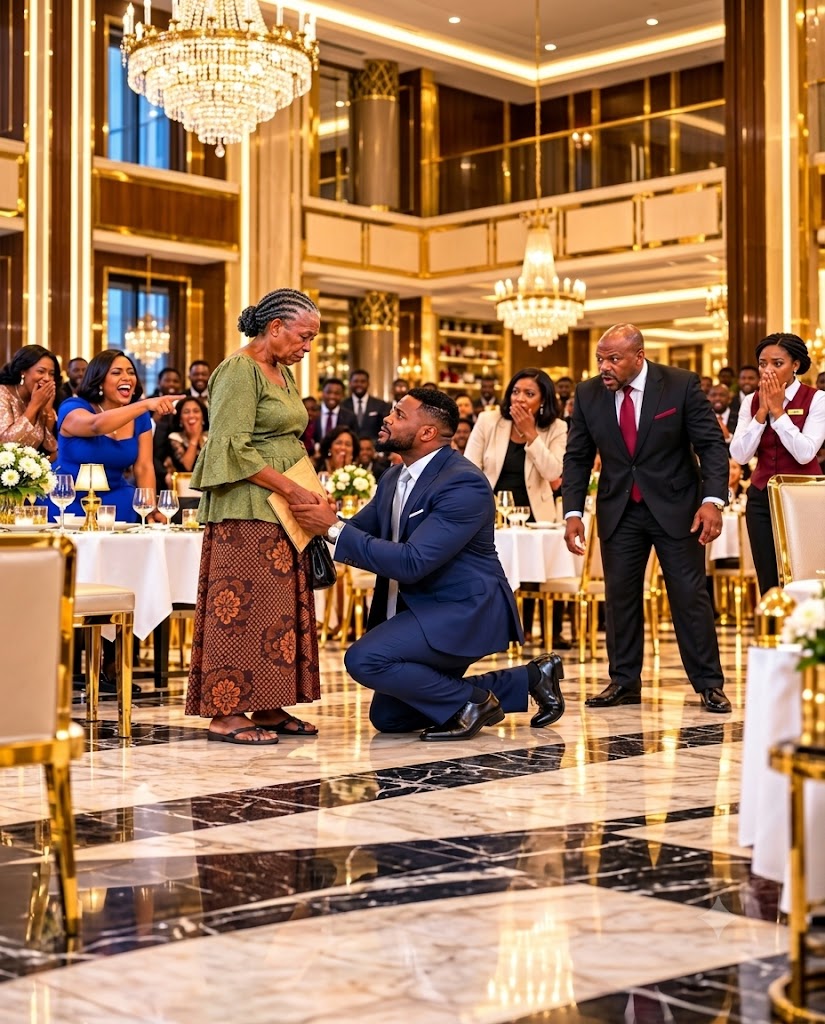
Without warning, Nathaniel dropped to his knees in front of the elderly woman.
“Madam Abena, please allow me to kneel before you. Not because I’m the son of a billionaire, and not because I want the people in this restaurant to admire me. But because I finally understand something my father never had the courage to explain to me.”
The restaurant had gone completely silent. Diners who had laughed at Abena just hours before now watched in stunned disbelief.
“Twenty-five years ago, when I was a helpless little boy lying in a hospital bed, you held my hand and promised you wouldn’t leave me alone. Daniel Quartey sacrificed his savings to save my life. And while my family continued building a business that would eventually become worth millions, Daniel’s own family suffered under an accusation he spent the rest of his life trying to clear.”
Tears streamed down Nathaniel’s face.
“I promise his name won’t be treated as a source of shame. This family will mention him with honor. Madam Abena, I’m kneeling because wealth means nothing when we forget who helped us.”
—
“Thank you for protecting my life,” he continued. “Thank you for refusing to abandon Daniel’s memory. And please forgive my family for taking so long to listen.”
Abena reached down and gently lifted his chin.
“My son, please lift your head and look at me. I did not travel from Cape Cod because I wanted a wealthy man to kneel before me. I came because Daniel Quartey deserves to be remembered as he truly was—honest, hardworking, and generous, even when he had little.”
She smiled, and for the first time that day, the sadness in her eyes was replaced by peace.
“He believed doing right mattered more than praise. He simply did what his conscience told him to do. I never imagined that the little boy I held in that hospital would one day become the man kneeling before me. But today, seeing you here reminds me that kindness is never wasted.”
—
She continued, her voice firm but gentle.
“Don’t build a statue or a library simply to impress people. Help Daniel’s children recover their father’s good name. Treat your workers with fairness. Remember that every person deserves dignity.”
Nathaniel nodded, rising to his feet.
“Madam Abena, I don’t know whether you can forgive me after the way I spoke to you earlier. But I need to apologize in front of the same people who heard my words.”
He turned to face the restaurant, addressing everyone who had witnessed the confrontation.
“When you entered this restaurant, I made assumptions about you without knowing anything about your life. I laughed because I believed someone like you couldn’t have a reason to meet the Boatengs. I allowed the comfort of my own position to make me disrespectful toward someone who had done absolutely nothing to deserve it.”
He paused, his voice breaking.
“But watching you stand here today has made me understand that you carried a truth that powerful people were afraid to confront. Madam, I’m sorry for embarrassing you. I cannot take back what I said, but I can take responsibility from today forward—about how I treat people, especially those whose stories I don’t know.”
—
The young hostess, Madison, stepped forward, her face flushed with shame.
“Madam, I don’t know whether you can forgive me after the way I spoke to you earlier. But I need to apologize in front of the same people who heard my words.”
She twisted her hands nervously.
“When you entered this restaurant, I made assumptions about you without knowing anything about your life. I laughed because I believed someone like you couldn’t have a reason to meet the Boatengs. I allowed the comfort of my own position to make me disrespectful toward someone who had done absolutely nothing to deserve it.”
Tears welled in her eyes.
“But watching Nathaniel kneel before you has made me understand that you carried a truth that powerful people were afraid to confront. More than that—you carried a truth that many of us sitting in this beautiful restaurant were too comfortable to even consider.”
—
Madison took a shaky breath.
“Madam, I’m sorry for embarrassing you. I cannot take back what I said, but I can take responsibility from today forward about how I treat people, especially those whose stories I don’t know.”
Abena looked at the young woman for a long moment.
“My daughter, I forgive you. But I want you to remember something. The person you overlook today may be the person whose kindness changes your tomorrow. Never judge a person’s worth by their clothing, their occupation, or the money in their pocket.”
Madison nodded, tears streaming down her face.
—
Nathaniel addressed the room.
“Ladies and gentlemen, before everyone returns to their meals, I want to make something clear. What happened here today—the public confrontation, the way an elderly woman was treated with disrespect—should never have occurred. Madam Abena deserved dignity the moment she walked through these doors, long before anyone knew her connection to my family.”
He paused, his voice hardening.
“I also want to address the matter involving Daniel Quartey. Our internal review has uncovered serious irregularities that led to his dismissal, and Victor Asante has acknowledged withholding important information. Effective immediately, pending an independent investigation, we will preserve the original records, cooperate with the appropriate authorities, and commission an independent review.”
—
“We will also offer Daniel Quartey’s family access to the findings, along with appropriate restitution for any harm the company is responsible for.”
Nathaniel looked around the room.
“This is not about protecting wealthy customers or maintaining appearances. It is about doing what is right. That is the standard by which this company will operate from this day forward.”
He turned back to Abena.
“Madam Abena, you came here seeking justice for someone the world had forgotten. May I take you home to Cape Cod myself?”
Abena smiled, her eyes glistening.
“My son, I came here carrying a heavy heart. Today, I can return home with peace.”
—
As Nathaniel helped Abena gather her documents, Essie approached them.
“Madam, thank you for reminding us that doing the right thing still matters.”
Abena reached out and took Essie’s hand.
“My daughter, never stop being kind. You may never know whose life your kindness will change.”
Essie nodded, tears in her eyes.
—
That afternoon, the people who had laughed at an old woman’s appearance knelt before someone they had dismissed because of her poverty.
Daniel Quartey’s story had not yet reached its final legal conclusion, but the silence surrounding his name had finally been broken.
As Abena walked out of The Golden Coast, her worn coat still hanging loose on her thin shoulders, she paused at the door and looked back.
The restaurant that had laughed at her just hours before now stood in respectful silence.
She smiled, thinking of Daniel—of his kind eyes, his honest heart, his unwavering belief that doing right mattered more than praise.
“Your name is cleared, my friend,” she whispered to the sky. “Your children will know the truth.”
—
The last thing Abena saw as Nathaniel’s car pulled away from the curb was Essie standing at the restaurant window, waving goodbye.
The young waitress had risked her job to speak up for a stranger. She had refused to stay silent when silence would have been easier.
Sometimes, Abena thought, the smallest kindness can give a person the courage to face the biggest fear.
And sometimes, the person you overlook today may be the person whose kindness changed your tomorrow.
—
Six months later, a small ceremony was held in Cape Cod.
Daniel Quartey’s children stood beside Abena as a plaque was unveiled in their father’s honor. The inscription read: “Daniel Quartey—A man of honesty, courage, and generosity. His kindness saved a life. His truth changed a family.”
Nathaniel Boateng attended the ceremony with his father, Emmanuel, who had finally found the courage to acknowledge what had happened 25 years before.
The old man wept as he embraced Daniel’s children, offering not just his apology but his commitment to making things right.
Abena watched it all with a peaceful smile, her envelope finally empty.
The truth had found its way home.
—
Years later, when people asked Nathaniel what had changed him, he would tell them about the day an elderly woman walked into his restaurant carrying an old envelope.
He would tell them about the laughter that turned to silence, the pride that turned to shame, and the kneeling that became the most important moment of his life.
But mostly, he would tell them about Abena Mensah—a woman who carried the truth for 25 years, who refused to be silenced, and who taught a billionaire’s son that the measure of a person is not found in their wealth, but in their willingness to do what is right.
And he would always end the story the same way:
“Never judge a person’s worth by their clothing, their occupation, or the money in their pocket. The person you overlook today may be the person whose kindness changed your tomorrow.”
—
*THE END*
—
**Author’s Note:** This story is a work of fiction inspired by themes of justice, dignity, and the power of truth. Any resemblance to actual persons, living or dead, or actual events is purely coincidental.









