**The Enemy Jets Surrounded the Transport — Until the Co-Pilot Released Her Secret Callsign**
Part 1
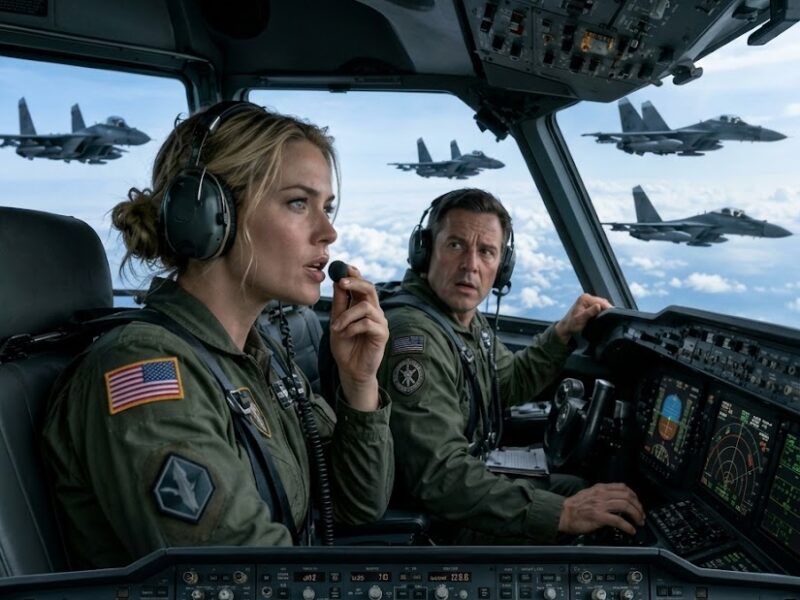
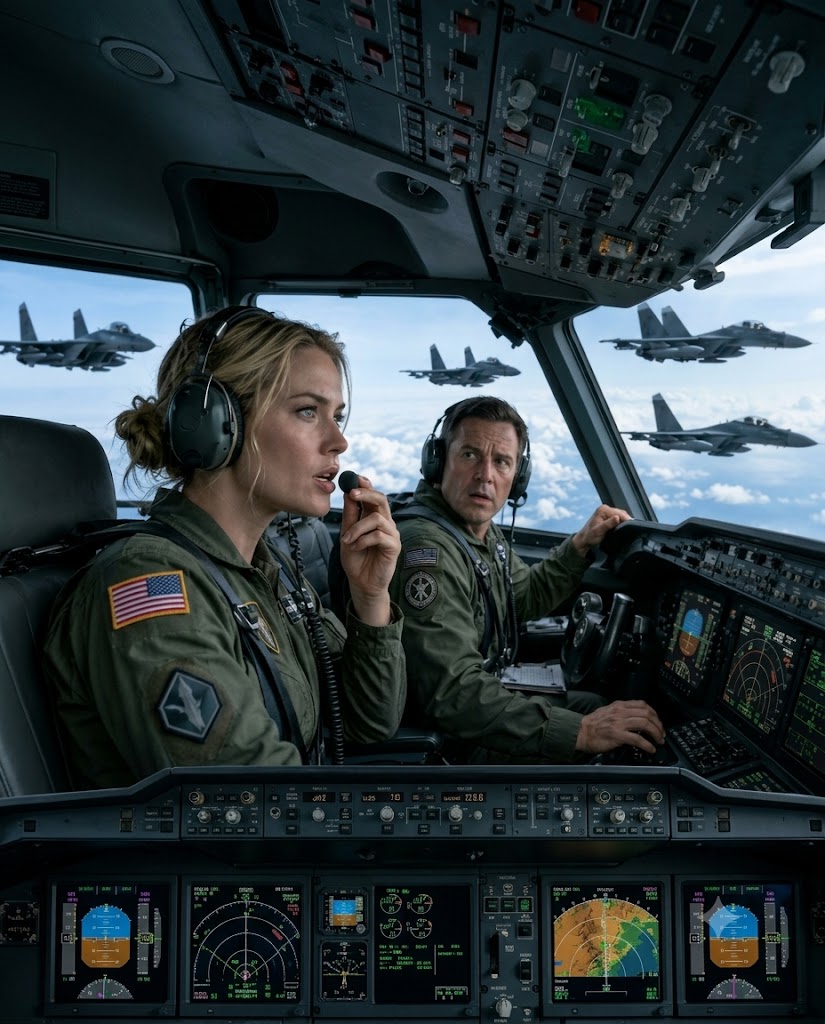
Cruising at 32,000 feet, a heavy military transport plane is nothing but a sitting duck in the sky. When four hostile fighter jets suddenly boxed in Flight 818, the crew braced for a fiery death.
They were unarmed, outmaneuvered, and completely alone. But the enemy had made one fatal, irreversible mistake.
They didn’t know the true identity of the woman sitting in the co-pilot’s seat. The flight deck of the C-17 Globemaster III was submerged in the dim, red tactical lighting standard for night operations.
Outside the thick, reinforced glass of the canopy, the world was a sprawling abyss of pitch-black sky and a merciless ocean below. This was the Cardon Corridor, a highly contested stretch of international airspace hugging the jagged borders of three nations currently locked in a bitter cold war.
To the air crews of Air Mobility Command, it was affectionately known as the meat grinder. At the yoke sat Major Donovan Hayes, a 20-year veteran of moving heavy things from point A to point B.
Donovan was a pragmatic, by-the-book aviator whose idea of an exciting flight was one where the coffee maker didn’t break down over the Atlantic. He was relaxed, his posture slumped comfortably into the sheepskin-covered seat, casually scanning the dancing green digits of the navigation displays.
To his right, occupying the co-pilot’s seat, was Captain Valerie Cross. If Donovan was a relaxed, lumbering bear, Valerie was a coiled spring.
Even in the dead of night, halfway through a tedious 12-hour haul, her posture was rigidly perfect. Her hands rested lightly near the controls, her eyes constantly sweeping the instrument panels in a relentless, predatory rhythm.
She didn’t belong in a heavy transport, and everyone on the crew knew it. Until 18 months ago, Valerie had been the tip of the spear.
She was a top-tier fighter interceptor pilot qualified in the fifth-generation F-35 Lightning II. She was a ghost in the sky, a decorated combat aviator with a classified service record that read like a Hollywood script.
But then came the incident over the Altanian border, a mission so heavily redacted that not even Donovan had the clearance to know the details. The fallout had resulted in a quiet, unceremonious transfer.
The top brass had clipped her wings, stripping her of her fighter, and throwing her into the right seat of a trash hauler to serve out the remainder of her contract in disgrace. “You’re going to burn a hole through the radar screen, Cross,” Donovan muttered, his voice a low, gravelly rumble through the intercom headset.
“Wait, take a breath. We’re two hours out from friendly airspace. It’s a milk run.”
Valerie didn’t blink. “Radar is clear, Major, but the weather band is picking up localized atmospheric static. It’s the kind of interference you see when a high-output jamming pod is operating just over the horizon.”
Donovan chuckled, reaching for his thermos. “Always the fighter jock. Look, the locals down there are always playing electronic grab ass. They turn on their jammers to mess with commercial airliners. It’s noise, Valerie, just noise.”
Behind them, sitting at the engineering station, flight engineer Gregory Miller chimed in. “Captain’s right about the static, Major. Getting some weird ghosting on the secondary comms. Nothing I can’t filter out, but it’s thick.”
“Keep an eye on it, Greg,” Donovan replied, taking a sip of his lukewarm coffee. “But don’t go raising the alarm. We have VIP cargo tonight. I don’t want to spook the suits in the back.”
Down in the cavernous unheated belly of the C-17, secured by heavy-duty cargo straps, sat a single heavily reinforced titanium crate. It was flanked by four pallets of standard humanitarian rations, a crude disguise for anyone doing a cursory inspection.
But more telling than the titanium construction were the two men guarding it. They wore unmarked tactical gear, carried suppressed submachine guns, and hadn’t spoken a single word since they boarded the aircraft in Ramstein.
Their presence meant that this was a Rick Black Book logistics run. Whatever was in that crate, it was valuable enough to kill for.
Valerie adjusted her headset, her eyes narrowing as she studied the digital horizon. The static on the radar wasn’t random.
It had a rhythm. It was a localized blinding technique, a way to create a hole in a transport plane’s situational awareness.
She had used the exact same tactic during offensive counter-air missions. “Major,” Valerie said, her voice dropping an octave, devoid of any conversational warmth. “I recommend we bank five degrees south. Put some distance between us and the territorial limit.”
“Negative, Cross,” Donovan sighed. “If we deviate south, we burn more fuel fighting the jet stream. We’re holding course, standard operating procedure.”
“Standard operating procedure applies to standard flight, sir,” Valerie pushed back gently but firmly. “This interference is targeted. We are flying completely blind on our left flank.”
“Captain, I am the aircraft commander,” Donovan said, his tone sharpening. “You are here to assist, not to play tactical mastermind. Relax. That is an order.”
Valerie’s jaw tightened. She took her hand off the instrument panel and rested it on her lap.
“Copy that, Major. Holding course.”
For 20 excruciating minutes, the C-17 lumbered forward through the dark. The steady, hypnotic hum of the four massive turbofan engines vibrated through the floorboards.
To Donovan, it was a lullaby. To Valerie, it was a countdown.
Then, the radar warning receiver shrieked to life. It wasn’t a gentle pain.
It was a blaring, ear-piercing siren that flooded the headsets of every crew member in the cockpit. The threat display illuminated in angry red geometry.
Beep. Beep. Beep. Beep.
“Missile lock,” Gregory shouted from the engineering panel, his voice cracking with sudden terror. “We’re being painted. Radar lock on our six o’clock.”
Donovan slammed his coffee thermos into the cup holder, his complacency vanishing in a millisecond. “Where did they come from? Evasive maneuvers. Dropping flares.”
Donovan hauled the heavy yoke to the left, attempting to bank the massive aircraft, but a fully loaded C-17 maneuvers with the grace of a flying school bus. The aircraft groaned under the sudden G-forces, metal stressing as automated countermeasure dispensers spat magnesium flares into the night sky, creating a brilliant, blinding cascade of fireworks behind them.
“It’s not a missile,” Valerie said. Her voice was terrifyingly calm.
While Donovan and Gregory were caught in the panic of a sudden ambush, Valerie had instantly shifted into a state of hyper-focused combat flow. Her eyes darted across the threat display, analyzing the bandwidth of the radar painting them.
“It’s an acquisition lock. They’re pacing us. Trying to force our hand.”
Suddenly, shadows detached from the darkness outside the cockpit windows. Sleek, delta-winged silhouettes sliced through the clouds, moving with terrifying, effortless agility.
They were painted in a matte black, radar-absorbent coating, devoid of any national insignia or tail numbers. “Bogies visual,” Valerie called out, her head on a swivel.
“Two on the left, one on the right, one in the slot directly behind us. Su-35 Flankers, heavy loadout. They’ve got air-to-air missiles on the pylons.”
Donovan stared out his window, his face going pale as a multi-million-dollar war machine coasted just 50 feet off his left wing tip. The hostile pilot was so close Donovan could see the green glow of the man’s helmet visor.
Flight 818 was well and truly trapped. The emergency guard frequency, 121.5 MHz, crackled in their headsets, cutting through the panicked breathing of the crew.
“Unidentified heavy transport,” a voice hissed. The accent was thick, distinctly Eastern, and dripping with malicious confidence.
“You are violating restricted sovereign airspace. You are to immediately drop your airspeed to 200 knots, alter your heading to 040, and prepare to land at a designated airstrip. Comply, or you will be shot down.”
Donovan grabbed his microphone, his hand trembling slightly. “Unknown fighters, this is United States Air Force Flight 818. We are flying in international airspace. We are an unarmed logistics flight. Check your navigational charts. We have the right of transit.”
There was a three-second pause. Then, the Su-35 on their left wing dipped its nose and squeezed the trigger of its 30-mm autocannon.
A terrifying stream of glowing red tracer rounds ripped through the dark, crossing mere inches in front of the C-17’s nose. The supersonic crack of the rounds firing was audible even through the transport’s thick hull.
Donovan flinched hard, instinctively pulling back on the yoke and sending the transport into a steep, agonizing climb. “Do not test us, Flight 818,” the voice on the radio returned, colder this time.
“That was a courtesy. The next burst will go through your cockpit. Heading 040. Now.”
The cockpit descended into controlled chaos. Gregory was frantically cycling through distress frequencies, trying to get a signal out to allied command, but his console was a mess of static.
“Major, they’re jamming our outbound comms,” Gregory yelled. “VHF, UHF, SATCOM, everything is blocked. We can’t reach base.”
“Keep trying,” Donovan barked, sweat beading on his forehead as he leveled the heavy aircraft out. He looked at Valerie, his eyes wide.
“If we turn to 040, they’re taking us deep into hostile territory. We’ll be on the ground in an hour. We’ll be hostages.”
Before Valerie could respond, the reinforced cockpit door hissed open. One of the operatives from the cargo hold, the lead agent, stepped in.
He didn’t look panicked. He looked deadly serious.
He held a suppressed pistol at his side. “Major,” the agent said, his voice a low whisper. “Under no circumstances do we land this aircraft at that airstrip. Do you understand me? If you cannot lose them, you are ordered to ditch this aircraft in the ocean.”
Donovan spun around in his seat. “Are you insane? Ditching a C-17 in the dark is a death sentence for everyone on board. Who the hell are you to give me orders?”
“My authority supersedes yours, Major,” the agent said coldly. “The cargo cannot fall into their hands. Whatever they just threatened you with, I promise you what happens if they get that crate is infinitely worse. Ditch the plane.”
Valerie watched the exchange, her mind processing the variables at a million miles an hour. Four Flankers, highly aggressive, coordinated jamming, and an Allied operative willing to crash a multi-million-dollar plane and kill its crew just to keep a box out of enemy hands.
This wasn’t an interception. This was an assassination.
The enemy didn’t just stumble upon them. They had exact intel on this flight, the cargo, and the blind spot in the radar coverage.
Donovan was hyperventilating now, caught between a firing squad outside his window and a loaded gun in his cockpit. “We don’t have a choice. I have to turn the plane. I can’t kill my crew.”
“Major, take your hands off the yoke,” Valerie said. Her voice wasn’t loud, but it cut through the panic in the small space like a razor blade.
It carried the absolute, unshakable authority of a combat commander. Donovan looked at her, stunned.
“Cross, what are you doing?”
“I said, take your hands off the yoke,” Valerie repeated. She reached out and firmly gripped her own controls.
“I have the aircraft.”
“Captain, you are out of line.”
“Major, if you turn this plane, we are dead,” Valerie said, her eyes locked onto the Su-35 pacing them on the right. “They aren’t going to take us hostage. Once we’re out of international airspace and out of sight of Allied satellites, they will shoot us down and claim it was a navigational error. They just want us out of the corridor so there are no witnesses.”
The agent in the doorway stepped forward. “She’s right. Ditch the plane, Captain.”
Valerie didn’t even look back at the agent. “Shut up and get out of my cockpit before I depressurize the cargo hold and suck you out the back ramp.”
The agent blinked, taken aback by the sheer venom in her voice. Valerie turned back to the instrument panel.
“Gregory, stop fighting the jammer on the standard frequencies. They have the bandwidth to block our standard comms, but they can’t block a localized line-of-sight encrypted tactical data link. Boot up the Link 16 terminal.”
Gregory looked confused. “Captain, Link 16 is for fighter coordination. We don’t have the software package to use it on a transport.”
“I spent six hours in the avionics bay before we took off rewriting the software patch,” Valerie lied smoothly. Though in reality, she had hardwired the system herself months ago out of pure paranoia.
“Boot it up. Set encryption key to Sierra Tango 99. Direct transmission.”
“But who are we transmitting to?” Gregory asked, his fingers flying across the keyboard.
“Them,” Valerie said, nodding toward the enemy fighters outside.
Donovan grabbed her shoulder. “Valerie, you can’t talk to them on a classified tactical frequency. That’s a breach of protocol.”
Valerie finally turned to look at Donovan. The stoic, quiet co-pilot he had known for the past 18 months was gone.
The eyes looking back at him were the eyes of an apex predator. “Major, my name isn’t Valerie Cross, and I didn’t get grounded for making a mistake.”
She reached forward and flipped the master switch for the tactical data link. A green light illuminated on the console, indicating a secure, unblockable connection directly to the onboard computers of the four hostile Su-35s outside.
Valerie pulled the microphone close to her lips. She didn’t use the standard USAF call signs.
She didn’t use international aviation English. She spoke in flawless, unaccented Russian.
“Hostile flight lead, this is United States Air Force combat call sign Viper Actual.”
The moment she spoke the name, the radio went dead silent. The hostile fighter on their left wing visibly wobbled.
The pilot’s hand clearly jerked the stick in sudden shock. “I am currently seated in the right seat of the aircraft you are attempting to hijack,” Valerie continued, her voice radiating lethal, icy confidence.
“I recognize your flight tactics, Commander. 14th Guards Fighter Aviation Regiment. You’re flying outside your borders without your transponders, but I know who you are and you know who I am.”
Inside the C-17, Donovan, Gregory, and the armed operatives stared at her in stunned, breathless silence. “Viper Actual,” a voice crackled back over the tactical link.
It was the same hostile commander, but the smug arrogance was entirely gone. It was replaced by a tight, strained tension.
The name Viper Actual was a ghost story whispered in the officer’s messes of the Eastern Bloc. It was the call sign of the pilot who had single-handedly dismantled an entire squadron over the Altanian border 18 months ago, flying a jet they could never see on radar until it was too late.
“So, Commander,” Valerie said, her finger hovering over a secondary, highly classified switch hidden beneath the console. “Here is my counter offer. You will immediately bank away, return to your airspace, and pretend this never happened. Because if you pull that trigger again, I promise you, I will make what happened in Altania look like a training exercise.”
There was a long, agonizing pause. The four fighters maintained their formation, boxing in the defenseless transport.
The tension in the air was so thick, it was suffocating. Then, the enemy commander spoke, his voice trembling with a mixture of fear and defiance.
“You are bluffing, Viper. You are in a cargo plane. You have no weapons. You have no escort. You cannot fight us.”
Valerie smiled, a cold, terrifying smile. “Who said I don’t have an escort?”
She flipped the hidden switch.
Deep in the freezing, cavernous belly of the C-17, a violent mechanical clank echoed over the deafening roar of the turbofan engines. Agent Harrison Cole, the operative who just minutes ago had ordered them to crash into the ocean, spun around in absolute bewilderment.
He raised his suppressed submachine gun, his eyes locking onto the heavy titanium crate secured to the floorboards. It was moving.
The crate was never just a storage container. It was a classified, self-contained deployment pod, and Valerie had just entered the remote launch sequence directly from the cockpit console.
Heavy hydraulic latches disengaged with a series of sharp pneumatic hisses. The outer titanium shell folded outward like the petals of a metallic flower, revealing the sleek, predatory silhouette of an experimental XQ-58A Valkyrie stealth unmanned combat aerial vehicle.
It was painted in the same radar-absorbent matte black as the enemy fighters, but its payload was completely different. It wasn’t loaded with explosive munitions.
It was packed to the gills with a next-generation electronic warfare suite. “What the hell is she doing?” Agent Cole screamed into his headset, rushing toward the rear of the aircraft.
“Major Hayes, she just overrode the cargo bay locks. The aft ramp is dropping.”
Donovan looked at the instrument panel in horror. The warning lights for the rear cargo door flashed brilliant amber.
The massive aft ramp of the Globemaster began to lower into the slipstream, howling wind instantly, violently depressurizing the cargo hold and sucking every loose piece of debris out into the black night. “Valerie, you’re venting the aircraft,” Donovan yelled, fighting the yoke as the sudden drag disrupted the plane’s aerodynamics.
“Hold her steady, Major,” Valerie replied, her voice remaining terrifyingly flat. “Releasing the Hound.”
With the press of a final button, the Valkyrie drone’s heavy solid rocket booster ignited inside the hold. The explosive force shoved the drone backward, launching it down the ramp and violently spitting it out into the frigid night air.
The moment the drone cleared the massive tail of the C-17, the booster detached and its internal turbofan roared to life, propelling the unmanned craft upward at an extreme angle of attack.
Outside the cockpit, the Russian commander in the lead Su-35 Flanker was waiting for Valerie’s bluff to crumble. He had his finger hovering over the weapon release button, fully intending to shoot the transport down if they didn’t alter their heading.
Then, his radar warning receiver screamed a sound he had never heard before. It wasn’t a standard missile lock tone.
It was the chaotic, ear-shattering shriek of a catastrophic system override. Every screen inside the enemy commander’s cockpit flickered wildly.
The digital horizon flipped upside down. The targeting reticles duplicated, spinning violently across the glass displays.
“Commander!” one of his wingmen shouted over the tactical radio, panic bleeding through his thick accent. “My radar is flooded. I have 20, no, 30 hostile contacts. They are everywhere. We are completely surrounded.”
The Valkyrie drone had engaged its primary weapon, an aggressive, highly focused electromagnetic pulse masking system. It didn’t just jam the Russian radars, it actively fed them false telemetry data.
Within seconds, the computers inside the four Su-35s were convinced they had just been ambushed by an entire squadron of F-22 Raptors dropping out of the stratosphere. The ghost signals boxed them in, painting fake missile locks from every conceivable angle.
Valerie keyed the encrypted tactical data link once more. “I told you I had an escort, Commander,” Valerie whispered into the microphone, her voice dripping with lethal satisfaction.
“You are currently being painted by six fifth-generation stealth fighters. You have exactly 10 seconds to break formation and burn for your border before they turn your aircraft into falling scrap metal.”
“This is a trick,” the commander yelled, though his voice wavered heavily. He looked frantically out the canopy, straining his eyes into the darkness, desperately trying to spot the invisible armada that his screaming instruments insisted was there.
“You are in a cargo plane. You are lying.”
“Am I?” Valerie asked. She typed a rapid sequence into her console, linking directly to the Valkyrie’s targeting computer.
“Check your wingman, the one flying on our right flank, call sign Ivan 2. Ask him what he sees.”
In the cockpit of the Su-35 on the right, the pilot let out a terrified scream. “Commander, I have a hard lock. Heat signature detected directly above me. It’s dropping into the slot. I can’t break the lock.”
It wasn’t a fake signal. The Valkyrie, possessing a smaller radar cross-section than a bird, had seamlessly maneuvered into the blind spot directly above the right-flank Su-35.
It was practically resting on the enemy jet’s canopy, matching its speed perfectly, totally invisible to the naked eye in the pitch-black sky, but projecting a concentrated targeting laser directly into the pilot’s cockpit. The green beam illuminated the Russian pilot’s helmet, proving beyond a shadow of a doubt that a weapon was physically bearing down on him.
“Nine seconds, Commander,” Valerie said coldly. “Or are you going to die for a box you know nothing about?”
The silence on the radio was agonizing. The C-17 rattled violently, the open rear ramp creating massive turbulence that shook the entire airframe.
Donovan’s arms were burning as he fought to keep the massive bird level, completely, utterly relying on the disgraced fighter pilot sitting next to him. The Russian commander’s heavy breathing echoed over the open channel.
He was a veteran, a man who had flown dozens of intercept missions, but he had never faced a phantom. The sheer psychological terror of being targeted by an enemy he could not see, while his wingman screamed about a laser lock in the dark, shattered his resolve.
The legend of Viper Actual was too heavy. “Flight, break formation,” the commander choked out, his pride completely breaking.
“Full afterburners. Evasive maneuvers. Return to base.”
Outside the cockpit windows, Donovan watched in absolute awe as the four black silhouettes suddenly snapped away. They rolled inverted, igniting their massive twin afterburners, creating four brilliant streaks of blue fire as they dove desperately toward the ocean, scattering in opposite directions to evade the phantom missile locks.
Within 30 seconds, the immediate airspace was completely empty. The threat displays inside the C-17 went dark.
The high-pitched warning sirens finally ceased, leaving only the rushing wind and the heavy breathing of the crew. “Major,” Valerie said, reaching out to retract the aft cargo ramp.
“Threat neutralized. You have the aircraft. Let’s go home.”
Donovan slumped back in his seat, his uniform completely soaked in sweat. He stared at Valerie, utterly speechless.
Gregory, the flight engineer, was shaking so hard he could barely read his instruments. Down in the cargo bay, Agent Harrison Cole lowered his weapon.
He stared at the empty titanium shell, a slow, stunned realization washing over him. The cargo wasn’t what they were protecting.
The cargo was the weapon, and the demoted co-pilot was the trigger.
Five hours later, Flight 818 touched down on the reinforced tarmac of Ramstein Air Base in Germany. The sun was just beginning to rise, painting the overcast sky in bruised shades of purple and gray.
The moment the heavy wheels screeched against the concrete, a convoy of armored black SUVs and military police vehicles swarmed the aircraft, boxing it in before the engines had even fully spooled down. When the crew cabin door opened, Donovan and Valerie descended the metal stairs onto the tarmac.
Waiting for them at the bottom was a man wearing the sharp uniform of a four-star officer. It was General Bradley Mitchell, the head of Joint Special Operations Command.
Donovan immediately snapped a crisp salute. “General Mitchell, sir. We had an incident over the corridor.”
“Hostile intercept?”
“They knew exactly where we were.”
General Mitchell returned the salute, but his eyes bypassed Donovan entirely, locking onto Valerie. A faint, almost imperceptible smile tugged at the corner of his weathered face.
“I know they knew, Major,” General Mitchell said softly, “because I leaked the path myself.”
Donovan blinked, stumbling backward as if he had been punched in the chest. “You leaked it? Sir, they nearly shot us out of the sky.”
“We had a high-level intelligence leak in European Command for two years, Major,” Mitchell explained, his voice low and serious. “We needed to bait the mole into feeding the Russians a target too good to ignore. A lone, unarmed transport carrying classified cargo through a radar blind spot. It was the perfect trap.”
“But you risked my crew,” Donovan said, his voice rising in anger. “You sent us up there to die.”
“I didn’t send you to die, Major,” Mitchell replied, stepping closer. “I sent you up there with an experimental drone capable of blinding an entire squadron. And more importantly, I sent you up there with the only pilot in the United States Air Force skilled enough to deploy it mid-flight and ruthless enough to make the enemy commander blink.”
Mitchell turned to Valerie, reaching into his pocket. He pulled out a pair of silver oak leaves, the insignia of a lieutenant colonel.
“Your 18 months of disgrace are officially over, Viper,” Mitchell said, handing her the rank insignia. “The mole took the bait. Federal agents arrested him 20 minutes ago in Brussels. The operation was a complete success. Your fighter wing is waiting for you in Nevada. Your F-35 is fueled and ready.”
Valerie looked down at the silver insignia in her palm, her face completely unreadable. She didn’t smile.
She didn’t celebrate. She simply closed her fist around the metal, her eyes narrowing as she looked past the general, staring up into the vast open sky above the airbase.
“Sir,” Valerie said, her voice carrying the same icy edge she had used against the Russian commander. “With all due respect, I don’t want the F-35.”
Mitchell raised an eyebrow. “Then what do you want, Colonel?”
Valerie looked back at the massive, hulking C-17 resting on the tarmac, its engines still ticking as they cooled in the morning air. “I want the Valkyrie program,” Valerie said flatly.
“And I want my own squadron. If they are afraid of ghosts, General, then I want to give them an entire haunted house.”
Mitchell stared at her for a long moment, a shiver running down his spine despite the morning heat. He nodded slowly.
“Done.”









