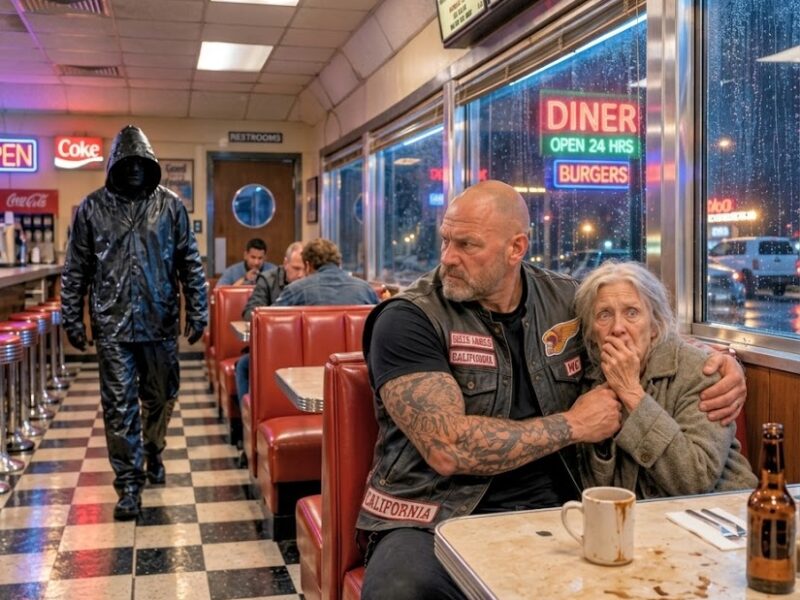
The Elderly Widow Was Completely Alone — Until A Hells Angel Sat Beside Her
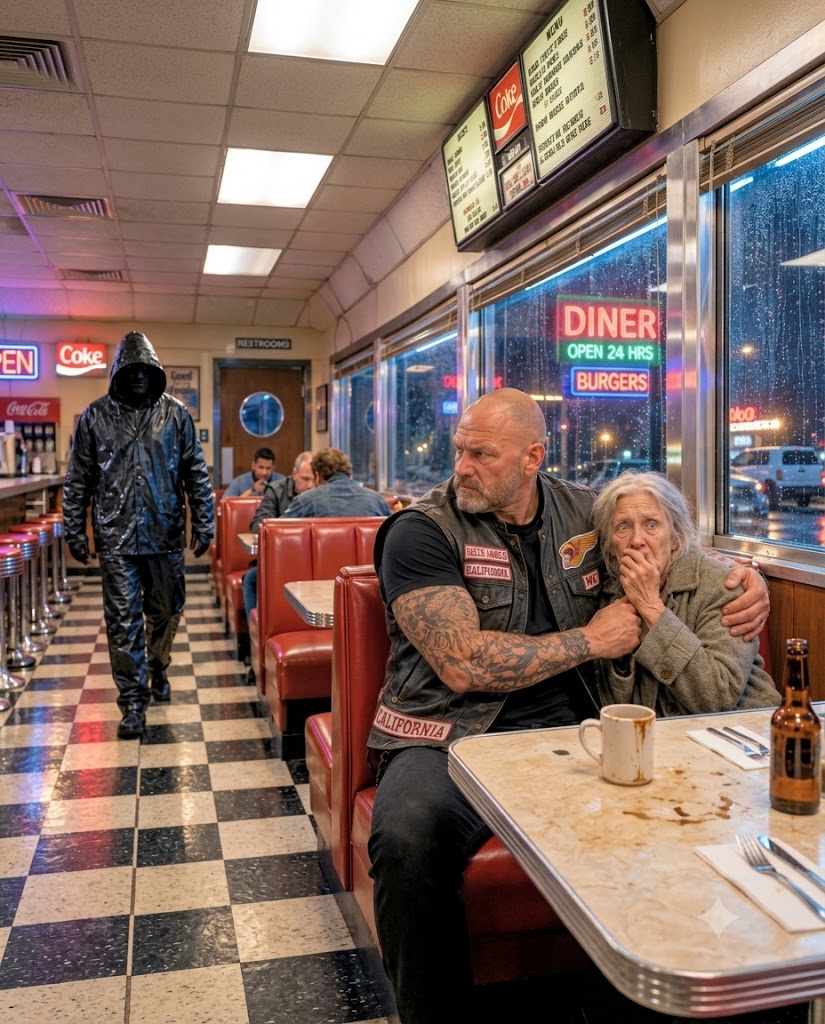
A heavy fist slammed down on a diner table and the coffee jumped out of the cup.
Spoons rattled. A napkin holder tipped over and rolled off the edge. A big man in a leather jacket leaned across the table and stabbed his finger toward a small gray-haired woman in the corner booth.
He was loud. He wanted her gone. He told the whole room she was crazy, that she talked to nobody, that she belonged in a home.
Nobody moved. Nobody said a word. The waitress just stood there with the pot shaking in her hand, and she could not look at anyone.
That small woman was Elena Puit, 78 years old, and she had been coming to that booth for 11 years. She did not cry. She did not leave.
What she did next made a room full of grown men freeze.
Stay with me on this one. Let me back up and tell you about the booth first because you need to understand the booth.
Dot’s Diner sits off Route 9 out where the corn runs right up to the gravel and the nearest town is 12 minutes in either direction. It has eight tables, a counter with red stools and a pie case that hums and it has one corner booth by the window.
That booth was a leaner. Not officially. Nobody put a sign on it. But every Sunday for 11 years at 11 in the morning, a leaner Puit walked in through that door, hung her coat on the hook, and slid into the same side of that same booth.
Rain or snow, hip aching or not, she came. She’d walk slow across that lot with her little handbag pressed to her side, and she’d nod at whoever held the door, and she’d go to her booth.
And every Sunday she ordered two coffees, two one for her, one for the empty seat across from her. The waitress, a young woman named Callie, learned the routine in her first week. Two coffees, one with cream, one black.
Set the black one down across from a leaner in front of the empty seat like there was a man sitting there. because for 41 years there had been his name was Walter Walter Puit and he had passed 11 years ago in the spring and the very next Sunday Alener had walked into dots alone and ordered two coffees anyway.
Here’s the thing. She wasn’t confused. People assumed she was. They saw a little old woman talking quietly to an empty chair and they filled in the story themselves. Lost her marbles, lonely old bird. Sad, but you know how it goes.
That’s what they assumed. They were wrong. Alina knew exactly what she was doing. She tells plain as day. I know he’s not there, honey,” she said once, patting the girl’s hand. “But this is where we talked.”
41 years. This is where we came. If I stop coming, then he’s gone twice. I’m not ready for him to be gone twice. And Callie, 19 years old, had to go into the back and press a dish towel to her face.
So every Sunday, Elena talked to Walter. She told him about her week. She told him the garden was coming in slow this year. She told him the Henderson’s boy had gotten into the state school, and wasn’t that something.
She’d tell him when the roof needed looking at, and which neighbor had been kind, and which one had let their dog run loose again. She sipped her coffee and now and then she’d look at the black cup across the table and smile like he’d said something back.
It was the calmst hour of her whole week. It was, if you want to know the truth, the only hour she really talked to anybody at all because Elina was alone. Really alone. No children. Walter and Elener never had any.
and they’d made their peace with that a long time ago and turned each other into the whole family instead. Her sister had died two years back. The friends her age were mostly gone or in the county home over in Mary’sville.
The phone didn’t ring at her house anymore. The mailbox held bills and flyers and not much else. What she had left was the house, the garden, the dog she’d lost the winter before, and one hour on Sunday in the corner booth at Dots with a cup of coffee for a man who wasn’t there.
That hour got her through the other 167. She’d count down to it. Saturday nights, she’d lay out her good cardigan, the blue one Walter had liked, so she’d have it ready in the morning.
Now, on this particular Sunday, it was raining, coming down hard, the kind of gray afternoon that fills up a diner because there’s nowhere else to be. The place was near full.
And in walked a man named Chad Beexley. You know a Chad Beexley. Every town has one. Big through the shoulders, loud through the mouth. 40 years old and still acting like the high school parking lot belongs to him.
He drove a truck that cost more than a leaner’s house and he made sure you heard it in the lot. He was the kind of man who talked to waitresses like they owed him something and tipped like he was doing them a favor.
He came in with three of his buddies, all of them wet and laughing too loud, and they wanted the big booth by the window. the corner booth, Elena’s booth. There were open tables, two of them. But Chad didn’t want a table.
He wanted the booth. And there was a little old woman sitting in it alone, talking to nobody. That’s where it started. Callie saw it coming before it happened. She’d worked enough Sundays to feel it in the air.
She moved toward Chad fast or pad out. Smile on trying to steer him. Hey Chad, I got a great table right by the now. He wasn’t even looking at her. He was looking at a leaner. Now we want the booth.
That booth’s taken, hun. Taken. He laughed. He looked back at his buddies and said it again louder so the whole room got it. Taken by who? There’s one lady in it. She’s talking to herself.
He raised his voice another notch. Ma’am. Ma’am, you want to scoot to a table so some actual paying customers can sit down? Elena looked up. She had gentle eyes and a soft way of blinking.
And she said quiet and polite, “I’m sorry. I come here every Sunday. This is my booth.” “Your booth?” Chad grinned. “You own it. You got a deed.” No, I just because I’ve been coming here longer than you, sweetheart, and I’ve never seen anybody reserve a booth for one person and a coffee.
He leaned down. He looked at the second cup, the black one across from her, and something mean moved across his face when he understood what it was. Who’s the coffee for?
Elena’s hands went still on the table. just for a second. Then she folded them in her lap. The way a person does when they’ve decided not to answer a question that’s going to hurt.
And Chad Beexley, God help him, decided to make it a show. That’s where we are now. That’s the fist on the table, the coffee jumping, the napkin holder rolling off the edge.
That’s Chad standing over a 78-year-old woman. loud enough for every ear in the place, telling the whole diner that she’s crazy, that the coffee is for her dead husband, that she comes in here every week to talk to a chair, that somebody ought to call somebody, that she needs to be in a home where they can watch her, and can we please just get her out of the good booth?
And the room did what rooms do. Nothing. 15, 20 people, and every single one of them found something fascinating in their plates. A man near the door half rose, then thought about the size of Chad and his three friends, and sat back down.
A mother pulled her kid a little closer and stared out the window. Two men at the counter traded a look that said somebody ought to, and then both of them looked back down at their eggs.
Callie stood frozen with the coffee pot shaking in her hand, her mouth open, no words coming out. She was 19. He was a regular who tipped when he felt like it and complained to the owner when he didn’t.
She didn’t have it in her. Nobody had it in them. Elina didn’t argue anymore. That’s the part that got people later when they told the story. She didn’t cry and she didn’t yell.
She just went very small and very still, the way old people do when the world gets loud around them. And she reached out one thin hand and slid the black coffee cup a little closer to her side of the table like she was protecting it.
Like she was protecting him. and she said so soft you almost couldn’t hear it over the rain. Please don’t. Two words. Please don’t. And Chad Beexley laughed.
So it looked for one long ugly second like it was over. Like Chad had won. And the little woman would gather her coat and shuffle out into the rain and that would be that.
Callie set the pot down because she was afraid she’d drop it. Somebody’s fork scraped a plate. The whole diner held that breath you hold when something bad is happening and you’ve decided not to be the one to stop it.
But there was one more person in that room I haven’t told you about yet. Down at the end of the counter on the last red stool, a man had been sitting alone the whole time. nursing a coffee gone cold an hour ago.
He hadn’t said a word. He was old, 60some, weathered like a fence post, a long gray beard and a gray ponytail, and a leather vest with patches sewn all over the back of it.
big hands, scarred knuckles, reading glasses of all things pushed up on his forehead, and a folded newspaper he’d stopped reading. And curled up on the floor at his boots, chin on his paws, was an old German Shepherd with a gray muzzle.
The dog’s name was Biscuit. The man’s name was Roy Vance, but nobody in that county had called him Roy in 30 years. They called him Deacon. He’d heard every word.
He’d heard the fist hit the table. He’d heard the coffee jump. He’d heard a grown man call a widow crazy in a room full of cowards. And through the whole thing, he hadn’t moved a muscle.
He just sat there with his cold coffee and his old dog listening. The way a man listens when he’s already decided what he’s going to do and he’s just waiting for the right second to do it.
His jaw had gone tight somewhere in the middle of it. That was the only tell. Everything else about him stayed still as a stone. The second came when a leaner said, “Please don’t.”
Deacon set down his cup. He didn’t slam it. He set it down soft. And that soft little click was somehow louder than everything Chad had said. He stood up off the stool slow on knees that had a lot of miles on them.
He was tall, taller than Chad and wider through the back and old in a way that reads as dangerous instead of weak. Because a man doesn’t get to be that old in the life Deacon had lived by being soft.
His boots hit the floor. Biscuit’s head came up and the whole room turned to look at him because a man that size standing up in a quiet diner changes the weather in the place.
Chad turned two and for just a flicker before he covered it up, you could see him do the math. vest, patches, the dog, the way the old man carried himself. Chad’s grin got a little tighter around the edges.
But he’d come this far in front of his buddies, so he doubled down the way that kind always does. You got something to say, Grandpa? Deacon didn’t answer him. Not yet.
He didn’t even look at him. He looked at Chad about as long as you’d look at a wet spot on the floor. And then he looked away. He walked across the diner, slow and easy, biscuit padding along at his heel without being told.
He walked right past Chad like Chad wasn’t there. and he stopped at the corner booth at a leaner’s booth and he took off the ball cap he was wearing and held it against his chest and he looked down at that small frightened woman with the gentlest face you ever saw on a man who looked like that.
Ma’am, he said, would it be all right if I sat down with you a minute? Elena blinked up at him. Whatever she’d been braced for, it wasn’t that. I don’t want to trouble you, she said.
No trouble. He nodded at the empty seat at the black coffee sitting in front of it. That seat taken. And here’s where the whole room stopped breathing because everybody knew what that seat was.
Everybody had heard Chad make his cruel little joke about it. not two minutes before and this huge old biker was asking to sit in it like it was the most natural question in the world.
Elena looked at the seat. She looked at the coffee. She looked back up at Deacon’s face, at the reading glasses on his forehead and the gray beard and the eyes that weren’t laughing at her.
and something in her chest that had been braced hard for 11 years let go just a little. “It’s my husband’s seat,” she said. “A steady, not ashamed,” daring him almost to make the joke.
“I know it is,” Deacon said. “That’s why I’m asking.” And a leaner Puit nodded. So he sat. This mountain of a man folded himself down into the little booth across from a 78-year-old widow, careful, like the seat was made of glass, and he set his cap on the table, and he did not touch the black coffee.
He left it right where it was in front of him, untouched, like he understood it wasn’t his to drink. an old biscuit. The greymuzzled shepherd walked around the end of the table and put his big head down in a leaner’s lap and looked up at her with those brown eyes.
Elena made a sound, a small broken sound. Her hand came down onto the dog’s head into the soft fur behind his ears, and she just held on. She’d lost her own dog that winter, an old thing she’d had since before Walter passed, and she hadn’t touched a dog since.
Couldn’t bring herself to. And this one had walked right up out of nowhere and given her something warm to hold, and her chin started to shake. If you’re still with me, do me a favor and hit that subscribe button because stories like this one, the ones where the quiet person finally gets somebody in their corner, are the whole reason this channel exists.
And I want you here for the part that comes next. Because Chad Beexley wasn’t done. And what Deacon said to him is the part I really need you to hear.
Now understand, Chad had been standing there this whole time getting smaller in front of his friends, and he couldn’t take it. A man like that would rather do something stupid than look weak.
So he stepped up to the booth and he reached down and he grabbed the black coffee cup, Walter’s coffee, and he lifted it off the table. Enough of this circus, he said. There’s nobody sitting here. You crazy old.
He didn’t finish it. Deacon’s hand came up off the table and closed around Chad’s wrist. Not fast. Not violent. Just closed around it the way a bear trap closes and held it there.
And Chad’s whole arm stopped like it had hit a wall. The coffee slushed but didn’t spill. And Deacon looked up at him for the first time since he’d stood off that stool.
And when he spoke, his voice was so low and so calm that the men at the other end of the diner leaned in to hear it. “Put it back,” he said. “Gentle, right where it was.”
And here’s the moment the whole thing turned because it stopped being about a booth. It stopped being about who was loud and who was old. Chad, red in the face, tried to save it the only way he knew how, which was to make it bigger.
You know who my uncle is, he said. My uncle’s buying this place at the end of the month, this whole diner. So, I’ll sit wherever I want, and I’ll have this whole crew of bikers thrown out on the road, and I’ll have that scenile old bat band from the property, and there won’t be a thing any of you can.
Put it back, Deacon said again. The same voice. Exactly the same. And he let go of Chad’s wrist. Chad, breathing hard, set the cup down.
Not gentle, but he set it down and he stepped back and he was working himself up to something. You could see it. Some last loud thing to walk out on with his pride still stuck together.
Deacon didn’t give him the chance. You want to know who this seat’s for? Deacon said he wasn’t quiet anymore. He said it so the whole room could hear him. every last coward in it.
Since you’ve been so curious about it, since you’ve been making everybody laugh about it, he looked at a leaner. May I, ma’am? Elanor, both hands in the dog’s fur now, nodded once.
This seat is for Walter Puit. Deacon said, “And I’d bet my bike not one of you knows that name. So, let me tell you about the man whose coffee you just picked up.
The room was dead silent. Even the rain seemed to back off. In the spring of 1969, Deacon said there was a 19-year-old kid in a rice patty on the other side of the world with two bullets in him and his whole unit already gone.
That kid was bleeding out in the mud and he had made his peace with dying because there was nobody left to come for him. He’d stopped calling out. He was just watching the sky get light and waiting on it.
And then somebody came for him. a medic, an army medic who was not even assigned to that unit, who had no reason to go back into that field and who went back anyway and picked up a 180 lb kid and carried him.
Not a 100 yards, not half a mile. Three miles. Three miles through the dark. Stopping every few minutes to plug the holes so the kid wouldn’t bleed out on his back.
Talking to him the whole way, telling him he was not going to die out there, telling him to keep his eyes open, telling him about a diner back home and a girl he was going to marry.
And when they finally got somewhere safe, that medic didn’t even stay for a thank you, he just went back out to find the next one. Deacon’s voice caught just for a second and he pushed through it.
That kid lived, he said. That kid got old. That kid is sitting in this booth right now talking to you. He tapped his own chest with one scarred finger.
And for 57 years, I never knew that medic’s name. They shipped me one way and him the other, and I never got it. I asked. For years, I asked.
I wrote letters to men who might have known and got nothing back. I have spent my whole life wanting to say thank you to a man whose name I did not have.
He turned and looked at a leaner and his hard old face came all the way apart until about 20 minutes ago when I heard a lady in a corner booth order two coffees and say a name to an empty chair.
Walter Elener’s mouth opened. No sound came out. Ma’am, Deacon said, and his voice was breaking now, and he did not care who saw it. Was your Walter a medic in ‘ 69?
Was he the kind of man who’d go back out for a stranger and never once mention it after? Elina Puit started to cry. She was nodding and crying at the same time, and she got the words out in pieces.
He never talked about the war. He said the only part worth remembering was the men. He said she pressed her hand to her mouth. He said he only ever did one thing over there that mattered and he wouldn’t say what it was.
41 years and he never told me. He’d just get quiet and look out the window. It was me, Deacon said. It was me, ma’am. I’m the one thing that mattered.
And then this enormous old outlaw, this man with a lifetime of hard road written into his face, reached across the table and took both of a leaner’s small hands in his and held them.
And he bowed his head over them, and he cried. in a diner in front of everybody. For the man who’d carried him out of the dark and gone home and married this woman and sat in this booth for 41 years and never told a soul what he’d done.
Now, let me tell you about Chad Beexley since we started with him. Chad had gone the color of old paper. He was standing there with his three friends and his three friends were not looking at him anymore.
They were looking at him. The way you look at a man, you’re about to stop knowing. One of them said, “Lo, Chad man, just that Chad man.” And that was the whole verdict right there.
There wasn’t anything left for him to say. There’s no loud thing you can say after that. He’d stood over a war widow and called her crazy and reached for a dead medic’s coffee.
And now the whole diner knew exactly what he was. And worse, so did his friends. He looked around for somebody to back him, and there was nobody. Every face in that place had turned against him at once, quiet and final.
He grabbed his jacket. He knocked into a chair on his way out and didn’t stop to fix it. And Chad Beexley walked out into the rain and got in his expensive truck and drove away.
And I would love to tell you he learned something, but I think men like that mostly just find a different town. What I can tell you is that he never came back to dots. Not once.
His uncle bought the diner at the end of the month like he said. And you know the first thing that uncle did when he heard the whole story from Cali. He had a little brass plate made for the corner booth.
But I’m getting ahead of myself. Because the thing you have to understand is what happened in that diner after Chad was gone. Deacon lifted his head. He wiped his face with the back of his big hand, not embarrassed, and he looked at a leaner and he said, “Ma’am, I owe your husband a debt I can never pay, but I can pay a little of it to you if you’ll let me.”
And he took out his phone, this old biker, and he made a call, and he said a few quiet words into it, and he put it away. Then he looked around that silent diner at all the people who’d stared at their plates and he didn’t yell at them.
He didn’t shame them. He just said, “You all have a good afternoon.” And he turned back to a leaner and he stayed. He stayed the whole rest of the hour.
He drank his cold coffee. He asked her about Walter, real questions, what he was like, whether he laughed a lot, what his hands looked like, whether he still woke up early out of old habit.
And Alener talked and talked because it had been 11 years since anybody wanted to hear about Walter. And Biscuit kept his head in her lap the entire time. She laughed once, telling a story about Walter in a lawnmower, an actual laugh.
And Callie, watching from the counter said later it was the first time she’d ever heard the old woman laugh in all those years. Here’s what that phone call was.
The next Sunday, Alener walked into Dots at 11 in the morning like always, and she stopped dead in the doorway because the parking lot was full of motorcycles. 20 of them.
30 chrome shining in the sun, lined up in neat rows, and standing beside them a whole crew of men and women in leather vests, gray beards and tattoos, and hard faces, and every one of them took off their cap or their sunglasses when she came to the door.
Deacon was at the front. He told them. He told the whole club about the medic named Walter Puit who’d carried their brother three miles through hell and gone home and told nobody.
And bikers, whatever else you want to say about them, they understand exactly one thing all the way down to the bone. And that thing is loyalty to the man who comes back for you.
To them, Walter wasn’t a stranger. He was family they’d never gotten to meet. And his widow was family, too. Starting that morning. They didn’t crowd her.
They didn’t make a fuss. Deacon just walked her to her booth, and he pulled out her side for her, and he set Old Biscuit’s head in her lap. And then he sat down across from her in Walter’s seat, careful as ever, and left the black coffee where it was.
and that became the way of it. Every Sunday after that, a leaner was never alone again. There were always two or three of them there in the booth or at the counter close by.
And they never once made her feel watched or managed. They just made her feel like family. They fixed her gutters that fall without being asked. They plowed her drive all winter.
When her furnace died in January, four of them showed up the same afternoon with a new one in the back of a truck and would not take a dime. They cleared the leaves out of her yard and painted the porch rail that had been peeling since Walter passed.
One of them, a big, quiet fellow they called Tuck, took to bringing her tomatoes from his own garden because she’d mentioned hers weren’t coming in. And every single one of them before they left would go by the corner booth and put a hand flat on the table for a second.
Quiet the way you touch a headstone because that’s what it was to them now. Holy ground. The uncle’s brass plate went up in the spring screwed to the wall right above the corner booth.
Small so you had to be close to read it. It said reserved. for Walter Peruit US Army and for the men he carried home under that it just said and for Elena always Elena Puit lived for more years.
Good years the best she’d had since Walter. She told Calie and she meant it. She never took a single Sunday off and she was never once alone for one of them again.
Deacon was there for most of them in that seat getting older right alongside her. That gray dog getting grayer at her feet. They talked for the whole hour. And sometimes they wouldn’t talk at all, just sit.
And that was fine, too. And when it was two coffees, it was still two coffees because some things you don’t change. one with cream, one black across the table in front of the seat that everyone in that county now knew better than to touch.
When she passed in her sleep in the spring, they buried her next to Walter. And I’ll tell you who dug that grave and stood over it in the rain with his cap against his chest and his old dog beside him, and who put a black cup of coffee down on the fresh dirt before he left.
You already know. So the next time you see somebody sitting alone, talking soft to a chair that looks empty to you, do me a favor. Don’t you dare decide you know their whole story.
Because you don’t know what that person carried or what was carried for them or whose name is sitting in that empty seat. The loudest man in that diner thought he had it all figured out. He had nothing figured out.
The quietest man in the room, the one everybody was scared of, turned out to be the only one who understood what that booth really was. Walter Puitit went back into the dark for a stranger and never asked for a thing.
57 years later, that one act reached across a whole lifetime and put a leather-vested army around a lonely old woman, so she’d never eat another Sunday breakfast by herself. That’s not luck.
That’s what one good man’s kindness does when it finally comes back around. Two coffees, one with cream, one black. That seat was never empty. Not once.
It just took the whole room a while to see who was in it.









