
The CEO’s Family Mocked the Pregnant Delivery Driver—Minutes Later, She Was the Only One Who Could Save Him
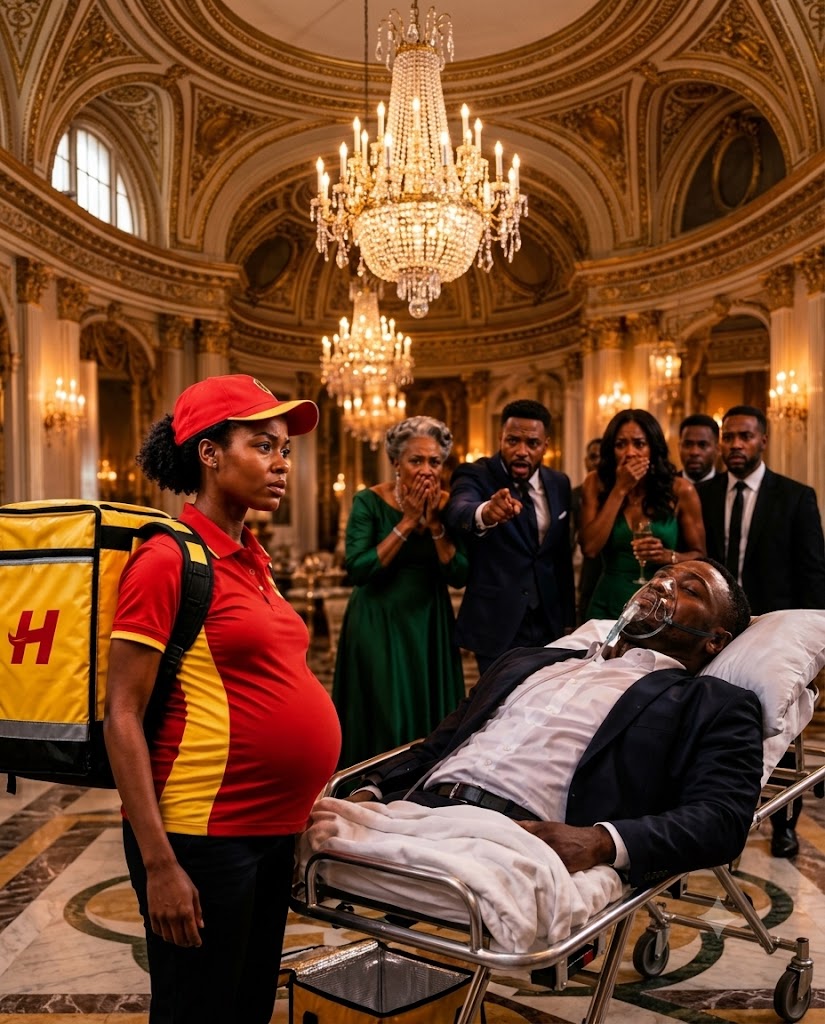
Watch where you’re going. You’re blocking the entrance.
The words landed before Amara Johnson even fully registered the faces behind them—a cluster of guests in five-figure outfits, crystal flutes in hand, standing between her and the service table she’d been instructed to find.
She was seven months pregnant, her ankles had surrendered around five o’clock, and she had four more deliveries stacked in her queue before midnight.
But none of that mattered to the man in the slate blue suit who had just stepped deliberately into her path, forcing her to angle around him while the insulated bag on her shoulder bumped his sleeve.
He looked down at his jacket as if she’d smeared something on it.
“Careful,” he said. “Some of us don’t want takeout grease on Tom Ford.”
The woman beside him—emerald silk, champagne laugh—gave Amara a slow once-over that started at her red and yellow uniform and ended at her belly.
“She’s got a bag bigger than her stomach. Careful, sweetheart. Don’t drop the shrimp cocktail.”
A ripple of chuckles moved through the small cluster near the garden doors.
Not everyone laughed. A few looked away, uncomfortable, the way people do when they’d rather not be associated with cruelty but aren’t quite brave enough to stop it either.
One older man frowned faintly and turned back to his conversation.
No one said anything in her defense.
Amara felt her jaw tighten, felt the old familiar heat crawl up the back of her neck—not embarrassment, she’d stopped being embarrassed by ignorant people years ago, but something closer to fatigue.
The particular exhaustion of being reduced again to a costume.
A red polo and a yellow cap and a body that announced her condition to anyone who cared to comment on it, uninvited.
She had been a trauma nurse for six years.
She had held a teenager’s femoral artery closed with her bare hand in a parking lot before the ambulance arrived.
She had called codes, run codes, been the calmest person in rooms where everyone else was losing their minds.
None of that was visible in this uniform, and she understood in a distant, clinical way that none of it would matter to these people even if it were.
She didn’t correct them.
She didn’t defend herself.
She found the folding table near the garden’s edge—exactly where the house manager, a tired-looking woman named Priya, had told her to set the bags down—and she did.
“I’m so sorry about that,” Priya murmured, glancing over her shoulder toward the cluster of guests. “They’ve had a lot to drink already, and it’s—” She hesitated. “It’s a complicated night for this family.”
“It’s fine,” Amara said, because it had to be, and because she genuinely did not have the bandwidth tonight to unpack a stranger’s family dysfunction.
“Can you sign here?”
Priya signed. Amara turned to go, already thinking about the four remaining deliveries, already doing the mental math on whether she’d make it home before midnight, when she heard the woman with the silver chignon say—not quietly at all—”I don’t understand why he insists on hiring these apps instead of a proper catering staff. It’s like inviting the help to the wedding.”
“It’s an engagement party, Mother, not a wedding,” said another voice, male, weary in the specific way of someone who had spent his whole life being the reasonable one in an unreasonable family. “And she’s not staying. She’s leaving.”
Amara glanced toward the voice out of nothing more than reflex—the automatic pull of attention toward the one person in a crowded room who sounds like he might not be cruel—and saw him for the first time.
He was standing near the edge of the terrace, half in shadow, dressed simply compared to the peacocks around him.
A dark suit, no tie, sleeves rolled once at the wrist, like he’d been working before he’d been forced into hosting.
He was tall, broad-shouldered, with the kind of tired handsome that came from long hours rather than good genetics alone—though he had those, too.
He wasn’t looking at her the way the others had.
He was looking at his mother with something like exhausted disappointment, and then, briefly, at Amara with something that looked almost like an apology he didn’t have the energy to voice.
She didn’t know his name.
She didn’t know that he was Marcus Kingsley, thirty-eight years old, CEO of Kingsley Vance Biotech, the man whose face was on the cover of two business magazines this quarter, and whose engagement party this technically was—to a fiancée who, Amara would learn much later, had already quietly left an hour earlier after a fight nobody was discussing.
She only knew that he hadn’t laughed.
It wasn’t enough to make the night better, but it was enough that she remembered it later, when everything else about that house went sideways.
She turned and walked back through the garden gate, past the string lights and the swan of ice slowly weeping onto white linen, and she did not look back.
She had three more stops before her shift ended.
She got as far as her scooter, one foot already through the strap of her helmet, when she heard the first scream.
—
The scream came from inside the house—high and short, instantly swallowed by a second voice yelling something Amara couldn’t make out, and then a third voice, a woman, shrieking, “Someone call 911. Oh my god, somebody help him.”
Amara’s body reacted before her mind finished processing the words.
Six years of trauma nursing did not turn off because she’d traded scrubs for a delivery uniform.
The part of her brain that had once triaged gunshot wounds and cardiac arrests in under ten seconds was already moving, already cataloging the sound of that scream—not fear-of-a-spider fear, not someone-broke-a-vase fear, but the particular pitch of someone-is-dying fear—before she’d consciously decided to run back through the garden gate.
She shoved past the same guests who’d mocked her twenty minutes earlier.
Nobody stopped her this time.
Nobody was looking at her uniform now.
They were all looking toward the terrace doors, where a small crowd had gathered around something on the ground—everyone talking over everyone else, nobody doing anything useful.
“Move,” Amara said, and something in her voice—flat, hard, utterly unlike the voice she’d used all night to make herself smaller—made the crowd part before her brain even fully registered whose body was on the marble floor.
It was him. The man from the terrace.
Marcus Kingsley was on his back near the bar, his tie already loosened by some well-meaning but useless hand, his lips faintly blue at the edges, his chest not moving the way a chest should move.
Desmond was crouched beside him, phone pressed to his ear, shouting the address at a 911 dispatcher with the panicked repetition of someone who had never had to be calm in his life.
Vivian Kingsley stood a few feet back with both hands pressed over her mouth, the diamonds at her throat catching the chandelier light with each shallow, horrified breath.
“Is he breathing?” Amara dropped to her knees beside him, ignoring the twinge in her lower back, ignoring the belly that made kneeling on marble a genuine athletic feat.
She pressed two fingers to his carotid artery.
Faint. Thready. Wrong.
“Who are you?” Vivian’s voice cracked with something between hysteria and outrage, as if the pregnant delivery girl kneeling over her son’s body was a second emergency competing for attention with the first. “Get away from him. You don’t— You can’t just— She’s a—what?”
Desmond lowered the phone half an inch. “You need to move, lady. The paramedics are coming. You’re not—”
“Your paramedics are eleven minutes out on a Saturday night in this traffic, and he doesn’t have eleven minutes if this is what I think it is,” Amara said, without looking up, already tilting Marcus’s head back, checking his airway. “Does he have any allergies? Food? Medication? Anything? Think. Right now.”
“I don’t— I don’t know. Why would I know that?” Desmond stammered.
“Shellfish,” said a new voice.
Priya, the house manager, pushed through the crowd with her hand pressed to her chest. “He’s allergic to shellfish. There’s an EpiPen. He keeps one in the study. I’ll get it.”
She was already running.
Amara’s hands moved fast and sure over Marcus’s chest, feeling for the rise and fall that wasn’t coming properly, listening to the faint high-pitched wheeze fighting its way out of a throat that was closing.
Anaphylaxis.
The shrimp cocktail Desmond had joked about an hour ago had very possibly just tried to kill his own brother.
“He’s in anaphylactic shock. His airway’s constricting,” Amara said, loud enough for the whole terrified circle to hear, because information kept panicking people from doing something stupid. “I need that EpiPen the second she gets back, and I need someone to call the caterer over here right now and ask exactly what was in every dish that’s been served in the last hour.”
“You can’t just— You’re not a doctor,” Vivian said, her voice climbing. “You deliver food. Get away from my son before you make this worse.”
“Mother.” The word came out of Desmond low and strangled, and for the first time all night, he wasn’t performing anything. He was just a terrified younger brother. “Mother, shut up. Just— Shut up and let her—”
Priya came sprinting back across the terrace with a small case in her hand, breathless. “Here. Here, is this—”
Amara took it, checked the label with the speed of someone who had administered a thousand injections in a hundred worse conditions than this, and without a second’s hesitation, pressed the auto-injector to Marcus Kingsley’s outer thigh—through his tailored trousers—and held it for the full count.
Nothing happened for three seconds that felt like three years.
Then his chest heaved—a real breath, a rattling, desperate, beautiful breath—and his eyes fluttered half open, unfocused, panicked, alive.
“There you go,” Amara said quietly, close to his ear, in the voice she used to use for terrified patients coming back from the edge. “You’re okay. You’re going to be okay. Stay with me. Keep breathing. Help is almost here.”
Somewhere behind her, she heard Vivian Kingsley let out a sound that was half sob, half something she would never admit to feeling—toward a woman in a delivery uniform.
Desmond had gone completely silent, staring at his brother’s chest rising and falling like he was witnessing a resurrection.
The paramedics arrived four minutes later to find Marcus Kingsley conscious, breathing, color returning to his lips, and a very pregnant woman in a red and yellow uniform kneeling beside him with her hand still resting lightly on his sternum, monitoring a pulse that had, an hour ago, mocked her for existing.
—
Amara didn’t go home that night.
She told herself it was because the lead paramedic had asked her—twice—to ride along and brief the ER on what she’d witnessed. Timeline, dose, response. Since she was clearly the only person on scene who understood what had actually happened.
She told herself it was professional courtesy, one clinician to another, nothing more.
She did not examine too closely the part of herself that hadn’t wanted to leave until she knew for certain that he was going to be fine.
At Saint Osmond Medical Center, she gave her report to a young resident who kept glancing at her belly and then her uniform with visible confusion, unable to reconcile the precision of her medical vocabulary—epinephrine administered intramuscularly, anterolateral thigh, immediate improvement in respiratory effort, no loss of consciousness after initial episode—with the logo on her chest.
“You’re a nurse,” the resident finally said. Not a question.
“I was,” Amara said.
“I see you in trauma. Six years?”
“Grover County General. Before it closed.”
She didn’t answer that one. It wasn’t a story she owed a stranger in scrubs at eleven at night, three months before her due date, in a hospital that wasn’t hers.
She was preparing to finally—finally—head home, feet screaming, back aching, the particular bone-deep tiredness of a twelve-hour shift compounded by an emergency she hadn’t clocked in for, when Vivian Kingsley found her in the hallway outside the ER.
The older woman looked different than she had at the party.
The diamonds were still there, but the composure had cracked around the edges—mascara smudged faintly beneath one eye, hands trembling slightly as she clutched a small designer bag like a life raft.
“Miss—” Vivian trailed off, and Amara realized the woman didn’t know her name.
Had screamed at her, insulted her, tried to physically pull her away from a dying man—and didn’t know her name.
“Johnson,” Amara said. “Amara Johnson.”
“Miss Johnson.” Vivian’s throat worked visibly. “The doctors say— they say if you hadn’t acted when you did, my son would have— that the ambulance wouldn’t have arrived in time. That you saved his life.”
“I did what anyone with the training would have done,” Amara said, because it was true, and because she didn’t have the energy tonight to accept gratitude from a woman who ninety minutes earlier had called her *the help*.
“Where did you learn to do that?” Vivian asked, and there was something almost desperate in the question, as if she needed there to be an explanation that made sense of a universe where a delivery driver outperformed every guest at her son’s engagement party—including two physicians who’d been standing in that very crowd, frozen, doing nothing.
“I was a trauma nurse,” Amara said simply. “Before I was a delivery driver.”
Vivian’s face did something complicated. Surprise, and beneath it, the faint unwelcome heat of shame.
“I said some things tonight, I—”
“You did,” Amara agreed, not unkindly, but not letting her off the hook either. “I need to get home, Mrs. Kingsley. I have work in the morning.”
She left the older woman standing in the hallway with her mouth slightly open, and did not look back a second time that night.
—
Amara assumed that was the end of it.
A strange, adrenaline-soaked night. A story she might tell her sister over the phone. A man whose name she’d looked up once out of curiosity—Marcus Kingsley, CEO, Kingsley Vance Biotech—and then filed away, because rich men’s lives didn’t intersect with hers past the delivery threshold.
She was wrong.
Four days later, a black car she did not recognize was parked outside her apartment building when she came down for her morning shift.
A driver stepped out, held up a tablet with her name on it, and said, “Ms. Johnson, Mr. Kingsley would like to see you, if you have a few minutes. He asked me to say it’s not a delivery.”
Amara considered several responses, most of them declining, all of them practical.
She had a shift. She had bills. She had a body that ached in new places every single day, and no margin in her schedule for rich men’s whims.
But something in her—the same something that had once made her the calmest person in a code—was curious, and curiosity, she’d learned, usually paid better than caution.
She got in the car.
Marcus Kingsley’s office occupied the top two floors of a glass tower downtown, and Amara noted, with the dry humor of someone used to being underestimated, that the elevator required a key card just to reach his floor.
A level of security that made the *do not use the front door* instruction at his mother’s house look almost egalitarian by comparison.
He was standing when she walked in, which surprised her. Most people in his position didn’t bother standing for delivery drivers.
He looked better than the last time she’d seen him. Color back in his face, no oxygen line, dressed in a simple gray suit. But there was a new carefulness in the way he moved—the residual caution of a body that had recently tried to kill itself without permission.
“Ms. Johnson.” He extended a hand. She shook it. His grip was steady, but his eyes weren’t entirely. There was something searching in them, like a man trying to reconcile the woman his family had mocked with the one who’d kept him alive.
“I don’t fully know how to start this conversation, so I’m going to start with the obvious part. Thank you. I’ve been told you’re the reason I’m standing here having this conversation at all.”
“You’re welcome,” Amara said simply. She’d rehearsed nothing gracious to say, and didn’t intend to perform gratitude acceptance for an audience of one. “How are you feeling?”
“Better. Chastened. Extremely aware of every ingredient in every dish that comes near me now.” A ghost of a smile. “The hospital said you gave a report so clean the attending assumed you worked there. I looked into it. Six years, trauma and ICU, Grover County General. Then nothing on paper for the last year and a half.”
Amara’s spine straightened almost imperceptibly. “You looked into me.”
“I did. I hope that doesn’t feel invasive. I run a company that lives and dies by due diligence, and I wanted to understand who just saved my life.” He paused. “I found a nurse with an exemplary record who vanished from her field the same month Grover County General shut its ICU down in a budget crisis, laid off forty percent of its nursing staff, and never reopened. I found six job applications since then, all for hospital positions, all rejected. Not for lack of skill, from what I can tell, but because half the hospitals in this city aren’t hiring right now, and the other half wanted someone who could commit to overnight shifts. A woman seven months pregnant with no family support listed on her applications, understandably, could not guarantee.”
Amara said nothing.
It was, infuriatingly, an accurate summary of the worst eighteen months of her adult life—delivered by a stranger who’d apparently pulled her employment history like a credit report.
“I’m not telling you this to embarrass you,” Marcus added, more quietly, seeing something shift in her face. “I’m telling you because I want to fix a mistake, and I don’t know how to do that without first proving to you I actually did my homework instead of throwing money at the problem and calling it gratitude.”
“What mistake would that be?”
“You didn’t say a word to me that night. You didn’t laugh, but you didn’t stop it either.”
The observation landed exactly as sharp as she’d meant it to.
Marcus’s jaw tightened, and for a moment he looked less like a CEO and more like a man being honestly, uncomfortably seen.
“You’re right,” he said. “I stood there and let my family humiliate a pregnant woman doing her job in my own home, at my own party, because I was too tired and too checked out of my own engagement to fight one more battle that night. That’s on me. I’d like the chance to be better than that.”
It wasn’t a polished apology. It wasn’t flowers or a fainting fit of remorse. It was a plain admission of failure, delivered by a man who clearly wasn’t used to making them.
And something in its bluntness disarmed Amara more than an elaborate speech would have.
“What did you have in mind?” she asked, arms crossing over her belly, wary but listening.
“Kingsley Vance is opening an on-site medical and wellness division next quarter. Occupational health, emergency response training for staff, a proper clinic instead of the joke of a first aid kit we currently have bolted to a break room wall—which, incidentally, is part of why nobody in that house four nights ago knew what an EpiPen even looked like.” He paused. “I’d like you to run it. Full salary, full benefits, maternity leave that doesn’t require you to reapply for your own job afterward, and a contract that starts the day you’re ready, not the day I’m impatient.”
Amara stared at him for a long moment.
She had expected an envelope of cash pressed into her hand and a car ride home—the kind of gratitude rich people paid to feel finished with.
She had not expected an actual job. One that used the six years of training currently gathering dust under a delivery uniform.
“That’s a very large offer for one EpiPen,” she said finally, testing him.
“It’s not payment for the EpiPen,” Marcus said. “It’s payment for six years of expertise your résumé proves you have and my industry has been too disorganized to properly use. The EpiPen just happened to be how I found out.”
She didn’t say yes that day.
She told him she’d think about it, because she’d learned the hard way that generosity from powerful people sometimes came with fine print nobody read until it was too late.
But she left that glass tower with something she hadn’t carried in eighteen months.
The small, stubborn beginning of hope.
—
What Amara didn’t know—what she would only learn over the following weeks, piece by piece, in board meetings she wasn’t technically invited to but somehow kept getting pulled into—was that Marcus’s collapse had set something loose inside his family that had been circling for years, waiting for an opening.
Desmond Kingsley was chief operating officer of Kingsley Vance in name, though anyone who worked there long enough understood that the title was decorative—a birthright dressed up as a job.
He had spent a decade in his older brother’s shadow, resentment curdling slowly into something closer to entitlement, and Marcus’s brush with death, however brief, had shown him with sudden clarity exactly how thin the line was between heir apparent and actual heir.
Two weeks after the party, while Marcus was still on modified hours per doctor’s orders, Desmond convened an emergency board session—technically within his rights as COO, though the timing made several longtime board members visibly uncomfortable—to discuss what he called *continuity planning in light of recent health concerns*.
Amara heard about it secondhand from Priya, who had become an unlikely ally since the night of the party, and who called her, voice tight with worry, three days after Amara had quietly accepted the medical director position and begun the process of setting up her new office.
“They’re trying to get the board to appoint him interim CEO,” Priya said without preamble. “Using the collapse as proof Marcus is a liability. There’s a clause in the founding bylaws—if the CEO is deemed medically unfit by a board vote, operational control transfers to the COO pending review. Desmond’s been quietly lobbying board members for a week.”
“Is Marcus unfit?” Amara asked, genuinely curious, because from a purely clinical standpoint, a well-managed shellfish allergy with an EpiPen on hand was hardly a disqualifying condition.
“No, obviously not. But Desmond’s had Vivian talking to board wives at charity lunches for two weeks, planting the idea that Marcus is fragile, that the company needs stability. It’s disgusting. It’s also working. A little.”
Amara sat with that information for a long moment, turning it over the way she used to turn over a confusing set of vitals before a diagnosis clicked into place.
She thought about Desmond’s face at the party—not fear for his brother in that first frozen instant before the screaming started, but something closer to shock that the moment had actually arrived.
She thought about how quickly he’d started dialing a family lawyer’s number in the ambulance bay while Marcus was still being loaded onto a gurney—a detail Priya had mentioned once, almost as an aside.
She thought about anaphylaxis. About how someone who’d grown up in that house, attended a hundred parties with shrimp on the menu, would know exactly which dish his brother couldn’t touch.
And how the seating chart that night had, oddly, placed the shellfish tower directly beside Marcus’s assigned spot at the bar—despite the caterer’s notes explicitly flagging his allergy in the event brief Priya had personally submitted three weeks earlier.
It could have been an accident.
Amara had seen enough real medical emergencies to know that most catastrophes were caused by incompetence, not malice. A caterer’s mistake, a mislabeled tray, human error stacked on human error until something broke.
She wasn’t in the business of manufacturing conspiracies out of grief and gratitude.
But she also hadn’t survived a career in trauma medicine without learning to trust the small, cold voice that noticed when a story didn’t quite add up.
“Priya,” she said slowly, “do you still have the original event brief? The one with the allergy notes and the seating chart?”
“I have everything. I document everything. It’s the only way to survive working for this family.” A pause. “Why?”
“Because I’d like to see it before anyone at that board meeting decides Marcus Kingsley’s near-death experience is a leadership opportunity.”
—
It took Amara three evenings—after her own long days setting up the new clinic—to go through the file.
The caterer’s brief. The seating chart. The guest list. The emails between the event planner and the household staff in the weeks leading up to the party.
She wasn’t a detective. She kept telling herself that, half as a warning against overreach and half as an excuse for how invested she’d become in a family drama that technically was none of her business.
But nursing had taught her to read documentation the way other people read novels—looking for the gaps, the inconsistencies, the places where the story someone was telling didn’t match the story the paper trail actually supported.
The allergy notation was there. Unambiguous. In bold red text in the original brief: *Guest of honor, severe shellfish allergy, no shellfish within 10 ft of head table.*
The seating chart, revised twice, showed the shellfish station moved progressively closer to Marcus’s assigned seat with each revision.
The final version placed it less than four feet away. Directly beside the bar he’d been standing at when he collapsed.
Both revisions had been requested by the same email account—not Vivian’s, not the event planner’s, but an assistant’s account that, cross-referenced against the company directory Amara had access to as a new employee, belonged to a junior staffer who reported directly to Desmond Kingsley’s office.
It didn’t prove intent.
Amara understood that clearly, sitting at her kitchen table at eleven o’clock at night with her ankles propped on a second chair and her son doing slow, thoughtful somersaults against her ribs.
It proved, at most, carelessness—a chain of small decisions that had put a known allergen dangerously close to a man who could die from it.
Juries convicted on less. Boardrooms destroyed careers on far less.
But it also, quite possibly, proved nothing at all. An assistant moving furniture around to accommodate a bigger dessert table. A coincidence dressed up as a conspiracy by a woman who had grown fond—faster than she’d meant to—of the man now recovering two floors above her new office.
She didn’t take it to the board.
She took it to Marcus.
—
She found him in his office on a Thursday evening, well past the hour anyone else was still in the building, going through quarterly reports with the specific grim focus of a man trying to prove to himself he hadn’t nearly died of nothing more dramatic than a shrimp puff.
“I need to show you something,” Amara said. “And I need you to look at it as a businessman, not a brother, or it’s not going to be useful to either of us.”
She laid the documents on his desk one at a time.
The allergen brief. The revised seating charts. The email trail.
And watched his face change with each page—the way faces changed in the ICU when families finally understood the numbers on a monitor they’d been avoiding.
“This doesn’t prove he tried to kill me,” Marcus said finally, quietly. And Amara noted that he’d gone straight to the word she’d been carefully avoiding.
“No,” she agreed. “It proves someone in his office moved a known allergen within arm’s reach of you, twice, against explicit written instructions, three weeks before a health emergency conveniently occurred that would have made him CEO if you hadn’t happened to have a former trauma nurse standing in your garden that night.”
“You think it was deliberate?”
“I think,” Amara said carefully, “that I’ve spent six years learning not to assume the worst about people based on incomplete information. And I’ve spent the last two weeks watching your brother try to use your medical emergency to seize your company while you were still in a hospital gown. I think those two facts are allowed to coexist in the same conversation.”
Marcus was silent for a long time, staring at the seating chart like it might rearrange itself into something less damning if he looked hard enough.
When he finally spoke, his voice had the flat, controlled quality of a man doing everything in his power not to shatter something on his desk.
“He tried to have me declared unfit while I was still on oxygen.” He said it slowly, like he was testing each word for structural integrity. “My own mother helped him build the narrative. And now this.” He looked up at her. “Why are you telling me? You have a job here now. The safe thing would have been to say nothing and let the board sort out family politics you have no stake in.”
Amara considered the question honestly, because it deserved honesty.
“Because I spent a year and a half getting told by hospital after hospital that my expertise didn’t matter as much as my due date,” she said. “And I watched, three weeks ago, a room full of people who could have helped you freeze while your brother made calls to lawyers instead of paramedics. I don’t have a stake in your company, Marcus. I have a stake in not watching competence get punished twice in one month.”
Something in his expression cracked open at that.
Not gratitude exactly, but recognition. The specific relief of being seen accurately by someone with no reason to flatter him.
“What do you want me to do with this?” he asked.
“That’s not my decision,” Amara said. “I’m not your lawyer. And I’m not your family. I’m your medical director, and as far as I’m concerned, my professional opinion ends at: someone in this building was reckless with a man’s life. Whether or not they meant to be. And reckless people shouldn’t be trusted with more responsibility as a reward for it.”
—
Marcus Kingsley did not confront his brother that night or the next.
He was, whatever else could be said about him, a careful man—and careful men did not fire family members over circumstantial evidence in a fit of anger they’d regret in a boardroom full of lawyers a week later.
Instead, he did what he did best. He investigated. Quietly. Thoroughly. Using resources far more sophisticated than Amara’s kitchen detective work.
He pulled the catering company’s internal records—subpoenaed nothing, because he didn’t need to, simply asked, as the client, for a full accounting of who had authorized each seating revision and why.
He interviewed the junior staffer directly. Alone. Without warning. And watched her crumble within four minutes under the mildest possible questioning, admitting that Desmond had told her the seating change was for better traffic flow near the bar, and that she’d never been told about the allergy notation at all—because Desmond had personally removed her from the email thread that contained it three weeks before the party.
It was, in the end, exactly the kind of story Amara had suspected.
Not a murder plot from a thriller, but something colder and more banal: a man who hadn’t needed to poison his brother, only to remove one small safeguard and let carelessness and shellfish do the rest.
Whether Desmond had known with certainty that the change could kill Marcus, or had simply not cared enough to check, Marcus never fully determined—and in some ways it didn’t matter.
Both were disqualifying.
Both were the actions of a man who had looked at his brother’s mortality as an opportunity rather than a tragedy.
The board meeting where it came out was, by every account Amara later heard, one of the shortest and most brutal in Kingsley Vance’s history.
Marcus presented the timeline himself. Flatly. Without theatrics. And asked Desmond, in front of eleven board members, to explain why he had removed a life-threatening allergy notice from an event brief three weeks before conveniently attempting to seize operational control of the company during his brother’s hospitalization.
Desmond did not have an answer that survived contact with the room.
He was removed from his position within the week—not through a dramatic public firing, which Marcus considered beneath the company and unnecessary given the paper trail, but through a quiet, thorough separation agreement that included his resignation from the board and a confidentiality clause that ensured the story never made the business press.
Sparing the company’s stock price.
And sparing Marcus, Amara suspected, the particular exhaustion of having his family’s dysfunction dissected in the *Wall Street Journal*.
Vivian Kingsley’s reckoning was quieter still, and in some ways harder.
Marcus did not remove her from his life the way he’d removed Desmond from the company. She was, after all, his mother.
But he drew a boundary so firm and so final that even she understood it was not open for negotiation.
She would no longer speak for the family in business matters. She would no longer be consulted on company events, board dinners, or anything bearing the Kingsley Vance name.
And she would, Marcus informed her in a conversation Amara was not present for but heard about later in careful detail from Priya, apologize to Amara Johnson. Properly. Not the hallway half-apology of a frightened woman relieved her son was alive, but a real one—acknowledging exactly what she had said and why it had been indefensible.
Vivian did, eventually.
It was stiff, and it clearly cost her something to deliver—standing in the doorway of Amara’s new office with her hands clasped in front of her like a schoolgirl awaiting punishment.
But it was specific.
“I called you *the help*. I told you to get away from my dying son. I judged you by a uniform instead of asking you a single question about who you were.”
And specific apologies, Amara had learned over years of difficult family conversations in hospital hallways, were the only kind worth accepting.
“Thank you,” Amara said simply when Vivian finished.
She didn’t offer forgiveness she didn’t feel yet, and she didn’t pretend the wound was fully closed. But she accepted the apology for what it was: a start.
—
None of this happened in a straight line, and none of it happened quickly.
Companies don’t restructure overnight. Families don’t heal in a single conversation. And Amara Johnson did not fall into a fairy tale simply because she’d once pressed an EpiPen into the right thigh at the right moment.
But over the months that followed—through the slow rebuilding of Kingsley Vance’s leadership, through the launch of the on-site clinic Amara built from scratch with a budget most hospital departments would have wept over, through the final weeks of her pregnancy and the arrival of her son, a boy she named Elijah, born on a Tuesday in early spring with a full head of dark curls and a set of lungs that impressed even his mother—she had spent a career being underestimated by people who judged competence by uniform, by paycheck, by the size of a belly under a red and yellow polo shirt.
She had learned the hard way, twice over, that dignity was never something other people could grant or withhold from her.
It had been hers the whole time.
It simply took the right room, finally, to notice.
—
The clinic opened on a Monday in late April, three floors below Marcus’s office, in a space that had previously been a storage room for outdated server equipment.
Amara had spent six weeks designing it—not just the layout, but the protocols, the training materials, the emergency response drills she planned to run quarterly for every department.
She’d hired two nurses, a physician’s assistant, and a part-time occupational health specialist who’d spent fifteen years in manufacturing and knew more about workplace safety regulations than anyone Amara had ever met.
The budget Marcus had given her was, as promised, generous.
But the thing that mattered most to Amara wasn’t the equipment or the staffing. It was the sign on the door.
**Kingsley Vance Medical & Wellness — Director: Amara Johnson, RN, BSN**
Her name. In brass. On a door she walked through every morning.
The first time she saw it, she stood in the hallway for a full minute, Elijah asleep in the carrier on her chest, and let herself feel it.
Not pride exactly. Something quieter. Something closer to relief.
She had spent eighteen months being told, in a hundred small ways, that her expertise was negotiable. That her value was conditional. That the gap in her résumé—the gap created by a hospital closure she hadn’t caused and a pregnancy she hadn’t planned—was a permanent stain.
The sign on the door said otherwise.
—
Marcus came down to see the clinic on its third day of operation.
He stood in the doorway for a moment, taking it in—the exam table, the locked medication cabinet, the wall-mounted AED, the small waiting area with its deliberately comfortable chairs.
“You built this in six weeks,” he said.
“I had help.”
“You had a budget and a mandate. The rest was you.” He walked slowly around the room, running his fingers along the edge of the counter. “My father used to say that the measure of a company wasn’t in its profits but in how it treated the people who kept it running. I used to think that was just something he said to make himself feel better about the size of his bonus.” He turned to face her. “I’m starting to think he actually meant it.”
“He probably did,” Amara said. “People can mean things and still fail to live up to them. It’s the failing that matters. Whether you get up and try again.”
Marcus was quiet for a moment. Then he said, “Desmond’s gone. My mother’s in a kind of exile she built for herself. The board is stabilized. The company is fine.” A pause. “But I keep thinking about that night. Not the collapse—the part before. The way everyone laughed. The way I stood there and let it happen.”
“You’ve apologized for that.”
“I know. But apologizing doesn’t change what I did. It just acknowledges it.” He looked at her directly. “I want you to know that I’ve been thinking about what you said. About competence getting punished. About dignity being something other people can’t take from you.” He smiled, faintly. “You were the most competent person in that house that night. And you were also the only one who didn’t need anyone’s permission to act.”
Amara considered that.
“I had permission,” she said. “I had six years of training and a license that says I can be trusted with people’s lives. The uniform didn’t change any of that. It just made it easier for everyone else to forget.”
“And now?”
“Now the uniform is a lab coat with my name on it.” She glanced down at Elijah, still asleep against her chest, his small breath warm through the carrier fabric. “And nobody in this building forgets who I am.”
—
The story got out eventually, of course.
Not through the business press—Marcus’s confidentiality agreements were airtight, and Desmond had no interest in reliving his own humiliation in public. But through the quieter channels that mattered: the gossip networks of the city’s philanthropic circles, the boardrooms where Vivian Kingsley’s friends still whispered about what had happened at that engagement party, the hospital where Amara had given her report that night.
A reporter from a local business journal called Amara’s office three months after the clinic opened, asking for a comment on “rumors that Kingsley Vance’s new medical director saved the CEO’s life at a private event last year.”
Amara declined to comment.
But she didn’t deny it either.
The story spread anyway, the way stories do—reshaped and retold and occasionally exaggerated into something closer to myth than fact. In some versions, Amara was a former combat medic who’d served in Afghanistan. In others, she was a secret millionaire who’d been working as a delivery driver to teach her spoiled neighbors a lesson about humility.
In the version that mattered most—the one Priya told to new hires when they asked about the clinic’s director—Amara was simply a woman who had shown up to do a job and had ended up doing something far more important.
“She didn’t hesitate,” Priya would say. “That’s the thing people forget. Everyone else in that room was screaming or crying or calling lawyers. She was the only one who moved.”
—
Amara’s son Elijah turned one year old on a Tuesday in early spring, the same day of the week he’d been born, the same season that had marked the beginning of her new life.
She threw a small party in the clinic’s waiting area—balloons taped to the counter, a cake from the bakery around the corner, a handful of coworkers who had become something closer to friends.
Marcus came, which surprised her. He brought a gift—a children’s book about a nurse who saves a kingdom—and stayed for exactly twenty minutes, which was long enough to be polite and short enough to be respectful.
Before he left, he pulled Amara aside.
“I never asked you,” he said. “Why did you take the job? You could have said no. You could have taken the money and walked away. Most people would have.”
Amara thought about it.
“I took the job because it was the right job,” she said. “Because it used what I knew. Because it meant I didn’t have to choose between being a nurse and being a mother. Because it meant I could look at my son one day and tell him that his mother didn’t just survive—she built something.”
“That’s a good answer.”
“It’s the true one.”
Marcus nodded. Then he said, “I’ve been thinking about what you said that night. About dignity. About competence. About the difference between the two.” He paused. “I don’t think I understood either one until I met you.”
Amara smiled. “You understand them now.”
“I’m trying.” He glanced toward the door, where Elijah was being passed around by the clinic staff like a tiny celebrity. “That’s all any of us can do, isn’t it? Try.”
“That’s all anyone can ask.”
—
The story of the pregnant delivery driver who saved a CEO’s life became, over time, the kind of story people told to make a point.
To their children, about the importance of kindness.
To their employees, about the value of expertise regardless of appearance.
To themselves, about the possibility of being underestimated and still prevailing.
But for Amara, it was never a story about being underestimated.
It was a story about being seen—finally, fully, by someone who had every reason to look past her and had chosen, instead, to look directly at her.
It was a story about a man who had nearly died and had woken up determined to be better.
It was a story about a woman who had spent a career being judged by her uniform and had finally found a room where her competence was the only thing that mattered.
And it was a story about a moment—one moment, at a garden party on Windermere Lane, when a woman in a red and yellow polo shirt had dropped to her knees on marble and refused to let a stranger die.
That moment had changed everything.
Not because it had made Amara a hero.
But because it had made everyone else in that room finally see what she’d known all along:
That dignity wasn’t something you wore.
It was something you carried.
And nobody—no guest in a five-figure outfit, no CEO in a glass tower, no mother with diamonds at her throat—could take it from you unless you let them.
Amara Johnson had never let them.
And she never would.
—
The clinic grew.
Within a year, it had expanded to include a full-time physician, a physical therapist, and a mental health counselor who specialized in workplace stress and burnout.
Within two years, Marcus had asked Amara to oversee a company-wide initiative to train every employee in emergency response—not just CPR and first aid, but the kind of quick thinking that had saved his life.
Within three years, the program had been adopted by three other companies in the city, and Amara had been asked to speak at a national conference on workplace safety.
She brought Elijah with her, because he was three by then and she couldn’t imagine leaving him for a week, and because she wanted him to see her standing on a stage, speaking to a room full of people who had come to hear what she had to say.
The talk was called “Competence Has No Uniform.”
She opened with the story of the engagement party.
She told it plainly—no dramatics, no self-pity, no villainizing. Just the facts: a woman doing her job, a family that underestimated her, a moment that required action, a decision that saved a life.
Then she told the rest of the story: the job offer, the investigation, the board meeting, the slow rebuilding of a company and a family.
And she ended with the thing she had learned.
“Dignity isn’t given,” she said. “It’s not something you earn from other people. It’s something you carry inside you, whether or not anyone else can see it. And the only thing anyone else can do is decide whether they’re going to recognize it.” She paused. “I was lucky. Someone finally recognized mine. But I didn’t need him to. I already knew what I was worth.”
The room was silent for a moment.
Then someone started clapping—a woman in the back row, standing up, tears on her face—and the applause spread until it filled the hall.
Amara looked out at the audience and saw, for the first time, how many people had been waiting to hear that.
How many had been underestimated, dismissed, judged by something as shallow as a uniform or a bank account or a belly under a red and yellow polo shirt.
How many had been carrying their dignity like a secret, waiting for someone to finally see it.
She thought about Marcus, who had seen it. About Priya, who had helped her prove it. About Vivian, who had learned to apologize for failing to recognize it. About Desmond, who had tried to exploit it and lost everything because of it.
And she thought about herself—the woman she had been, the woman she had become, the woman she would keep becoming.
The woman who had walked into that garden gate with a delivery bag on her shoulder and walked out with a purpose.
She smiled at the audience.
“Thank you,” she said. “For seeing me.”
And the applause continued, louder than before, as if the room itself had been waiting for permission to believe that dignity could be carried, not given.
That competence could be recognized, not granted.
That a woman in a delivery uniform could save a life—and then spend the rest of hers making sure the world knew she’d always been capable of it.
—
The sun set over the city as Amara left the conference hall, Elijah’s hand in hers, his small voice asking questions about the lights and the buildings and the people.
She answered as best she could, and when he asked why everyone had been clapping, she thought about it for a moment.
“Because they were happy,” she said. “Because they heard something they needed to hear.”
“What did they hear?”
“That you don’t have to be who other people think you are.” She squeezed his hand. “You just have to be who you are. And eventually, the right people will see it.”
“Did they see you?”
Amara smiled.
“They did,” she said. “They finally did.”
And as she walked into the evening with her son beside her, she thought about the moment that had started it all—a garden gate, a service bell, a family that had mocked her, a man who hadn’t laughed.
A moment when she could have walked away.
But hadn’t.
She had stayed.
She had acted.
She had saved a life.
And in doing so, she had proven something she’d known all along:
That dignity wasn’t handed out.
It was proven.
Every single day.









