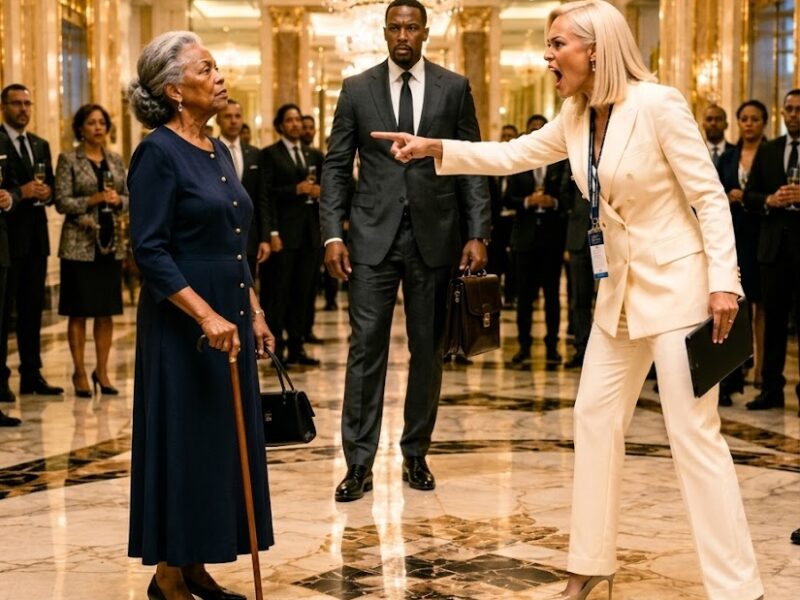
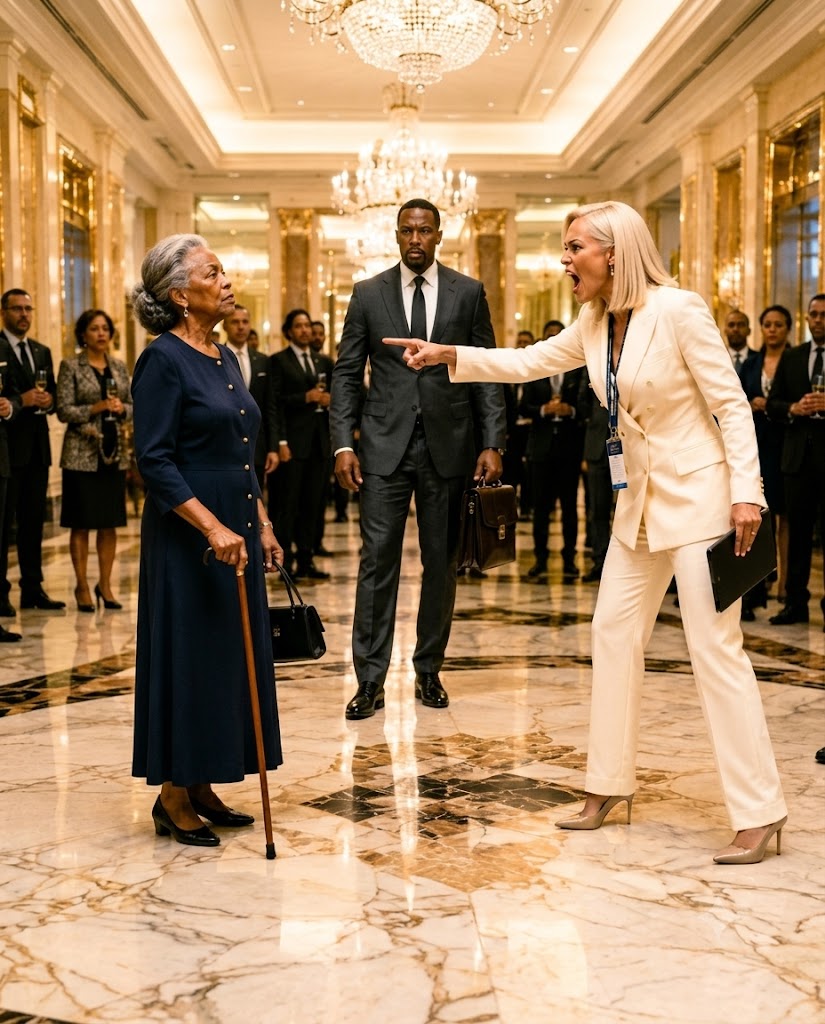
The CEO’s Daughter Humiliated a Black Grandmother—Then Her Billionaire Son Canceled Their $2 Billion Deal
The service corridor smelled like industrial cleaner and old grease, and May Washington had been sitting there for forty minutes.
She rested both hands on the dark wood cane with the silver ferrule at the tip, her back straight against the plastic chair that had no cushion.
Through the wall, she could hear the string quartet tuning up—Brahms, maybe, something slow and deliberate that she had once played on the chapel piano at Spelman when her fingers were still strong enough to work the higher registers.
She was sixty-eight years old, a retired professor with thirty-two years in the Department of English, and her name was on the VIP guest list for Table One.
But the young woman in the navy blazer had looked at her dress, her cane, the auction package wrapped in department store paper, and decided before she ever checked the list.
*We’ll figure it out*, the young woman had said. *But I need you to wait over there while I verify.*
That was fifty-one minutes ago.
May set her auction package on her knee and thought about her son.
—
Darius Washington had texted her at four o’clock that afternoon: *Just checking you’re getting ready, Mama.*
She had sent back a photo of the dress laid out on her bed, freshly ironed twice—once the night before and once that morning because the first press wasn’t quite right at the collar—the small pearl buttons catching the light.
He had responded with three words and a period: *You look beautiful.*
She had laughed because he hadn’t even seen her yet.
That was Darius. He made room for her in whatever he was doing, even when she told him he didn’t have to, even when she could see how busy he was building something enormous over the last fifteen years.
Washington Infrastructure Partners. Three hundred employees across five states. Contracts with four state governments.
And he still called her on Sunday mornings to tell her about whatever he’d been reading.
She was so proud of him it sometimes felt like a physical thing, a warmth that started in her chest and spread outward until her whole body was part of it.
The corridor door swung open on its slow pneumatic hinge, and a young woman appeared from the direction of the main kitchen.
Dark hair pulled back, hotel uniform, name tag too far away for May to read—she was moving quickly, checking over her shoulder.
She crouched beside May’s chair, her voice barely above a whisper.
“Mrs. Washington, I’m so sorry.”
She pressed a plastic cup of water into May’s hands.
“I’ve been watching from the event station. I looked up the guest list. Your name is there. Table One, plus-one.”
May looked at her—young-faced, serious eyes, twenty-something, worried but not for herself.
Or not only for herself.
“Thank you,” May said. She took the water. Her hands were steadier than she expected them to be. “What’s your name?”
The young woman turned her badge. *Petra Leon. Event Coordination.*
“Petra,” May said. “You didn’t have to come back here.”
“I know.” Petra glanced toward the corridor door. “Miss Harrove didn’t specifically tell me not to. She just—she has a way of making it clear.”
She paused.
“I’m going to find your son the moment he arrives. I’ll make sure he knows where you are.”
May studied her—the certainty in her voice, the way she was crouching on a concrete floor in her pressed uniform like it was the most natural thing in the world.
“I appreciate that,” May said. “But I don’t want you losing your job over this.”
Petra shook her head slightly.
“Some things matter more than a job.”
—
May was quiet for a moment.
Then she said, “How long have you been here at this hotel?”
“Three years.”
“Do you like it?”
Petra looked at her, slightly surprised. “Mostly, yes.”
“Good work isn’t easy to find.” May set the cup carefully on the shelf beside her. “Don’t throw it away for nothing. But this—” she nodded at the corridor, the fluorescent light, the mop bucket— “this isn’t nothing.”
Petra nodded. She stood up, smoothed her jacket, and looked toward the corridor door again.
“Your son’s car is supposed to arrive in about fifteen minutes. I’ll be at the front desk.”
She left.
The corridor door swung closed behind her on its slow pneumatic hinge.
May sat for a moment in the renewed quiet.
She looked at the water Petra had brought her and thought about what it had cost the girl—not the water, but the decision to come back here, the calculation she must have made in about thirty seconds.
Her job against someone else’s dignity.
Most people didn’t even realize they were making that calculation. They just quietly chose the easier thing and called it good judgment.
Not Petra.
The string quartet on the other side of the wall had moved into something slower now, more deliberate.
May couldn’t be certain from this distance.
She thought about the evening her son had planned—the table he’d reserved, the note he’d put on the guest list himself six months ago.
*Personal request from Darius Washington.*
She thought about his voice on the phone, telling her he’d be finalizing the biggest deal of his career that night, and he wanted her there to see it.
She hadn’t even hesitated.
She’d said, *Tell me what to wear.*
She looked down at the pearl buttons on her navy dress.
She had ironed it twice.
—
The door at the far end of the corridor opened slightly, and a kitchen worker appeared—young man, white apron, looking at her with an expression she recognized.
The look of someone who wanted to do something and had concluded they couldn’t.
She gave him a small nod.
He ducked back through the door.
She understood. She didn’t blame him.
Forty minutes passed.
The corridor did not change. The bulb kept buzzing. The refrigerator kept cycling.
Somewhere beyond the wall, three hundred guests were filing into the ballroom under crystal chandeliers, and her name was on the guest list for Table One, and she was sitting next to a mop bucket in a chair with no cushion.
She could leave.
She had thought about it twice in the past hour.
Just walk herself out through the service door and onto the street and take a cab back to her apartment and her cat and her books and never mention this to anyone.
But she thought about Darius walking into that room, looking around for her, asking someone where his mother was.
The look on his face if no one could tell him.
She was not leaving.
At 7:45, her phone buzzed.
A text from Darius: *5 minutes out. Can’t wait for you to see this place, Mama.*
She looked at the concrete ceiling, the buzzing bulb.
She texted back: *I’ll be here. Take your time.*
She put her phone away and waited.
—
On the other side of the wall, she heard the ballroom doors open.
The ballroom was everything Celeste Harrove had built it to be.
Three hundred guests moved beneath crystal chandeliers that threw small diamonds of light across the ceiling.
Round tables dripped in white linen, centerpieces of white orchids and eucalyptus.
A live string quartet played from the raised corner platform.
Wait staff moved between tables with silver trays of shrimp ceviche and duck confit crostini.
Everything was exactly as planned, timed, and executed.
Celeste moved through it with the particular satisfaction of a person watching a machine they built run perfectly.
She accepted compliments from event coordinators and board members.
She directed a waiter to adjust the spacing between two tables.
She switched out a centerpiece at Table Seven because one of the orchids was browning at the tip.
Small things. She had an eye for small things.
The one thing she did not do was check on May Washington.
—
Victor Harrove stood near the ballroom entrance, working the room with the ease of someone who had been doing it for forty years.
A handshake here, a name remembered there, a joke delivered with the right timing.
He was good at this. He had always been good at this.
But his assistant had been at his elbow four times in the last twenty minutes, and each time Victor’s smile had stayed in place while his eyes tracked across the room to the VIP table at center front.
Table One. Washington Infrastructure Partners. Three settings. Immaculate.
One place card reading *Reserved for Guest*.
A chair that was empty.
He pulled his assistant aside.
“Washington’s team confirmed arrival?”
“7:42, sir. His car is en route. Five minutes maximum.”
Victor nodded slowly. He looked at the VIP table again.
“The moment he walks through those doors, you walk him there personally. You open the Bordeaux before he sits down. Whatever he asks for, the answer is yes. Do you understand?”
“Understood.”
Victor released him.
He stood for a moment looking at the room he’d built over forty years—the company, the connections, the reputation.
Three hundred people in this room tonight who owed him something or wanted something from him or both.
And all of it, every square foot of it, balanced on one conversation that hadn’t happened yet.
He had overleveraged two projects this year. He knew it when he’d done it, and he’d done it anyway because the infrastructure corridor opening up in the Southeast was a ten-year opportunity, and he hadn’t wanted to miss it.
The Marietta Development and the Westside Transit Hub.
Both of them committed, both of them partially drawn down, and Washington Infrastructure Partners as the planned equity partner for both.
Without Darius Washington’s signature tonight, Harrove Holdings would spend the next eighteen months selling assets to cover its commitments.
Forty years.
He had built this company over forty years, and it had come to this—a signature he hadn’t gotten yet, on a deal that was supposed to be done.
—
Graham Harrove appeared at his father’s elbow.
Graham was forty, VP of Finance, quieter than Celeste and more precise.
He had their mother’s eyes and his father’s patience.
“He’s almost here,” Graham said.
“I know. The team confirmed.”
“The team confirmed.” Victor looked at his son. “Has the Washington plus-one been seated? Celeste was supposed to check.”
Graham looked across the room toward the VIP table.
The guest chair was empty.
He looked back at his father. “I’ll find Celeste.”
He moved through the ballroom toward the entrance where Celeste was working the room near the bar.
He reached her elbow and leaned in.
“Washington’s plus-one,” he said quietly. “Has she been seated?”
Celeste turned toward him. Her expression was that of someone checking a mental list.
“There was a mix-up at the front,” she said. “I handled it. It’s being sorted.”
Graham looked at her for a long moment. “What kind of mix-up?”
“An uninvited guest in the lobby. I had security manage it. It’s handled.”
“And the Washington guest?”
Celeste’s gaze moved past him toward the ballroom entrance. “I’ll go check.”
Graham watched her walk away.
Something in his chest went still and quiet in the way things went still and quiet when you heard something that didn’t quite add up, but you couldn’t name the problem yet.
He walked back to their father.
“She’s checking,” he said.
Victor nodded. He checked his watch.
7:54.
—
At that moment, the event management system pinged in the earpiece of Harrove’s front-of-house coordinator, and she turned toward the lobby.
She touched her ear and then looked across the room at Victor.
She walked quickly to his side and leaned in.
“Mr. Harrove, Washington Infrastructure Partners is arriving at the front entrance now.”
She paused.
“Their advance coordinator is asking if Mrs. Washington has been seated. She says it was a condition Mr. Washington mentioned specifically before tonight.”
Victor looked at her. “A condition?”
“His words, sir. He said he wanted confirmation that his guest was comfortable before he entered the ballroom.”
Victor turned toward the entrance.
Then he turned toward the VIP table—the empty guest chair.
He looked for Celeste and didn’t find her immediately.
Graham was already moving toward the lobby.
—
Fifty-one minutes.
That was how long May Washington had been in the service corridor when she heard the ballroom doors open through the wall.
She hadn’t been counting, not exactly, but she had a habit of marking time.
Her phone showed 7:56, and she had arrived at the hotel at 6:42.
She had done the math quietly the way she did with most things—not to brood, just to be precise about what was actually happening.
Fifty-one minutes in a chair beside a mop bucket in a corridor that smelled of bleach and old floor wax, in a hotel where her name was on the VIP guest list and where she had not been permitted to sit in a chair with a cushion.
She thought about her students.
Thirty-two years at Spelman. She had taught African-American literature from Reconstruction through the present, with particular emphasis on the women writers who had documented what it felt like to be perpetually questioned in spaces that had not been built with you in mind.
She had assigned Toni Morrison’s first essay to every incoming freshman for twenty years.
She had given a lecture at the Library of Congress in 2019 about the literature of endurance.
She had been invited to speak at the White House Garden Party for Women in Education in 2021.
She had also, in thirty-two years at Spelman, been asked to show her faculty ID seven times by campus security guards who did not recognize her face.
She had been addressed as “ma’am” by students who assumed she was administrative staff.
She had been thanked for her service by a vice president who apparently thought she was catering.
Each time she had straightened her spine and said, “I’m Dr. Washington, Department of English.”
And she had moved on—not because it didn’t matter, but because she had learned long ago that people who question your presence are not in the position to determine your worth, and she refused to give them that additional authority.
But fifty-one minutes was a long time to sit in a service corridor.
She heard the door open.
—
Petra appeared again, moving faster this time. Her cheeks were flushed slightly.
She crouched beside May’s chair and kept her voice low.
“I have about forty seconds. Your son’s car just pulled up at the front entrance.”
She reached into her jacket pocket and pressed a small folded paper into May’s hand.
“That’s my direct line. If I can’t find you when you need something, text me.”
May looked down at the number.
“Petra—”
“Ma’am, when you walk back out there, stand near the front desk. When your son asks about me, tell him exactly where I am.”
Petra nodded. No hesitation. “I will.”
She stood and moved back toward the main corridor. The door swung shut.
May unfolded the paper, read the number once, refolded it, and tucked it into the pocket of her dress.
She sat with her hands resting on her cane and thought about her son.
Darius had been born during a heatwave.
She had been in labor for nineteen hours, and when he finally arrived, the first thing he did was look at her—not cry, not close his eyes.
Look.
She had always remembered that. The way he came into the world with his eyes already open.
He had been like that ever since. Attentive, precise. He noticed things other people walked past. He remembered everything you told him.
He was one of those rare people who made you feel, when he was talking to you, that you were the only person in the room.
She had watched him build Washington Infrastructure Partners from a two-person firm operating out of a rented office in downtown Atlanta into something that employed three hundred people across five states.
She had watched him turn down offers he could have taken the easy way.
She had watched him walk away from partnerships that would have been profitable but that didn’t sit right with him.
She had watched him do the right thing too many times to count, and she had never once been surprised by it.
She heard the front doors open.
A different kind of energy moved through the building. She could feel it even here, behind two walls and a heavy door.
The kind of energy that arrives when someone specific arrives. Someone who matters to the room.
Her son was here.
—
She looked at the service corridor—the stacked cardboard, the concrete floor with its old grease stains, the cup of water Petra had brought her an hour ago, still on the shelf, mostly untouched.
She adjusted her grip on her cane. She straightened her posture. She smoothed her dress over her knee.
She thought, *He will find me. He always does.*
And somewhere very close, on the other side of the wall, she heard the string quartet change its tempo.
Something brighter now. Something that moved.
She waited.
—
Darius Washington came through the front doors of the Meridian Grand at 7:58, and the lobby rearranged itself around him the way lobbies do when someone walks in who knows exactly what they are doing.
He was forty-four years old, lean, unhurried, wearing a charcoal suit that had been made for him.
Raymond Cole, his senior counsel, walked half a step behind him to the right. Two associates followed.
They moved like people who were used to moving together—quiet, organized, no wasted energy.
The hotel general manager was already crossing the lobby.
“Mr. Washington, welcome to the Meridian. Everything is prepared for your party this evening.”
“Thank you.” Darius shook his hand. His eyes were moving across the lobby—entrance, desk, ballroom doors, seating areas. “My mother should already be here. May Washington. She arrived around 6:45. Could you point me to her?”
The general manager’s pace slowed almost imperceptibly. He looked toward the front desk.
“Let me check with the desk staff for you, Mr. Washington.”
“She arrived over an hour ago,” Darius said. His voice was the same—controlled, even—but there was something in it now. Not urgency. Precision. “She texted me at 7:45. She said she’d be here.”
Victor Harrove appeared from the ballroom entrance and crossed the lobby with his hand extended. The practiced warmth was fully deployed.
“Darius, it is wonderful to finally have you here.” The handshake, the second hand on top. “We have been looking forward to this evening for months. Everything is ready.”
“I appreciate it.” Darius accepted the handshake without matching Victor’s warmth. He looked past him toward the front desk. “I need to find my mother first. May Washington. She’s 68. She uses a cane. She was supposed to be seated at our table an hour ago.”
Victor glanced at his assistant. The assistant shook his head slightly.
“I’m sure she’s been settled in,” Victor said. “Let me have someone do a thorough check.”
Darius had already pulled out his phone. He dialed.
It rang four times and went to voicemail.
He dialed again. Four rings. He tried a third time.
Voicemail.
He lowered the phone. Said nothing. He looked at Victor.
“She always answers,” Darius said.
He was not accusing. He was stating a fact the way you state facts about someone you know precisely.
“When she knows I’m on my way, she keeps her phone in her hand. She has done this my entire life.”
—
Graham Harrove appeared at his father’s side. He had come in from the ballroom, and his face had a look that Victor didn’t immediately recognize.
Not anxiety. Something more careful than that.
Celeste appeared a moment later from the same direction. She had composed herself. Her jacket was straight. Her expression arranged.
“Mr. Washington.” She extended her hand. “I’m Celeste Harrove. I’ve been managing the event this evening. I want to—”
“Have you seen my mother?” Darius said. He looked at her hand but did not take it.
Something moved across Celeste’s face.
“I’m sorry?”
“Sixty-eight years old. Uses a cane. She arrived around 6:45. Small item for the charity auction. She was put on the guest list personally.”
He looked at her steadily.
“Have you seen her?”
The look that crossed Celeste’s face in that moment was the kind of look you get when two separate things your mind has kept in separate rooms suddenly find each other.
6:45. Cane. Older woman. Auction item.
The woman from the lobby.
Celeste’s lips parted slightly. The connection was making itself slowly and horribly, the way you feel a floor give way before it actually falls.
Her hand dropped.
“There was—I handled a situation earlier—”
“Where is my mother?” Darius said.
His voice had not risen. It would not rise. That was the thing about Darius Washington. He never needed to raise his voice to make a room understand what the situation was.
Victor looked at Graham. Graham looked at his sister.
Then, at the edge of the lobby near the corridor to the event station, a young woman stepped forward.
Dark hair, hotel uniform, hands clasped together. She had been standing there for thirty seconds, waiting for the right moment, or waiting for her nerve.
It was hard to say which.
“Mr. Washington.”
Every head in the lobby turned.
Petra Leon’s voice was small but clear. It did not waver.
“I know where your mother is.”
—
The lobby went very quiet.
Victor’s face had gone several shades paler. Celeste stood completely still.
Raymond Cole looked from Petra to Darius and back, then reached into his briefcase without looking at what he was reaching for.
Darius looked at Petra. One word.
“Where.”
It filled the room.
Petra swallowed. She looked at Celeste, then at the floor, then back at Darius.
“Follow me,” she said. “Please.”
She turned and walked toward the corridor.
Darius followed immediately.
The rest of the room—Victor, Graham, Celeste, Raymond Cole, two associates, the general manager—followed without a word, pulled in the wake of whatever was about to happen.
The transition was thirty feet and a different world.
Polished marble became linoleum. Linoleum became bare concrete.
The smell of fresh flowers became industrial cleaner and faint kitchen grease.
The temperature dropped noticeably—a physical fact, not an impression.
Petra led them through the service corridor without speaking. The fluorescent tubes overhead threw a flat, buzzing light that made everyone look slightly ill.
Cardboard boxes stacked along one wall. A rolling shelving unit with cleaning supplies. A mop bucket.
A stainless steel prep table blocking the view around the corner.
Darius walked just behind Petra. Victor behind him. Graham behind Victor.
Celeste was last.
Around the corner—the chair.
The fluorescent light over it was the one that buzzed the loudest. The one that flickered twice per minute and then steadied.
Beneath it, in a plastic chair with no cushion, sat May Washington.
Her cane was across her knees. The small auction package was beside her on the shelf, still wrapped.
A plastic cup of water that was mostly full stood beside the package.
She had her hands folded in her lap. Her posture was very straight.
She heard them before she saw them. She looked up.
She saw her son.
Her face did not do what faces do in movies. It did not collapse or crumble.
It opened the way a room opens when someone turns on a light.
She smiled. Not a small, careful smile. A real one—wide and warm and full of something that had been waiting patiently for this exact moment.
“Baby,” she said. “You’re here.”
—
Darius stopped walking.
He stood in the corridor for three full seconds.
His eyes moved across the scene in the methodical way of someone who notices everything—the chair, the concrete, the cardboard boxes, the mop bucket, the buzzing light, the plastic cup of water with one small sip taken from it.
His mother’s dress, the pearl buttons, the cane across her knees, the way her arms were folded—not in defiance, but because the corridor was cold, and those were her arms, and that was how you stayed warm in a cold concrete room.
His hands were at his sides. They were very still.
He walked forward and crouched beside her chair.
He took both her hands. They were cold. He held them between his palms.
“Mama.” His voice came out quiet. “How long have you been here?”
“A while,” she said. She squeezed his hands. “Don’t let this ruin your evening. You work so hard for tonight.”
“How long, Fen?” he said again.
May looked at him.
“Over an hour.”
He was quiet for a moment. He looked at her hands. Then he looked at her face, and he took in all of it—the composure she was wearing, the way she had decided to wear it, the cost of wearing it for over an hour.
He stood up slowly.
He turned around.
Victor Harrove was standing three feet away. Graham stood to Victor’s left.
Celeste stood behind them both, and her face had reached a specific kind of pallor—not the pallor of illness, but of someone watching a consequence arrive that they had told themselves would not arrive.
Darius looked at Victor.
“What is this?”
Victor’s mouth opened. No words came out immediately.
He was a man who had spent forty years having words ready when he needed them, and right now there were none.
Graham spoke. His voice was quiet and flat.
“She had her removed from the lobby.”
The words landed in the corridor the way words land when they don’t need to be loud.
Celeste’s head turned toward her brother.
“I—” she started. “There was a situation. A guest verification issue. I was managing the lobby, and I didn’t—”
“She was on the guest list,” Graham said. He was still looking at Darius. “She’s been on it for six months.”
Victor looked at his daughter. A long look. The look of a man deciding in real time how many things he had chosen not to see.
Celeste’s mouth was still open. Her voice had lost its professional arrangement.
“I didn’t—the name didn’t register. I was managing three hundred people. I had one hour before the event. I couldn’t stop—”
“Stop,” Darius said.
It was quiet.
Celeste stopped.
He was not looking at her. He was looking at Raymond Cole, who had moved to stand just inside the corridor entrance.
Raymond gave a small, precise nod, reached into his briefcase, and found what he was looking for.
Then Darius looked at Celeste—just for a moment. One look, complete and final.
He reached down and picked up his mother’s auction package from the shelf. He picked up her handbag from the floor where it had slid from the shelf at some point in the past hour.
He held them both. He straightened.
“Get my mother a car,” he said to the general manager, who had gone completely still near the wall. “A car and someone to help her outside. Right now.”
He looked at Victor.
“We’re done here.”
—
The lobby felt different on the way back.
Maybe it was the same marble, the same chandeliers, the same lilies, but the room had a different temperature now.
The hundred-forty-dollar-a-plate guests near the ballroom entrance watched a small procession move through their periphery and understood without being told that something had shifted.
Darius walked beside his mother. He had offered her his arm, and she had taken it—not because she needed it, but because she wanted it.
They moved at her pace, which was steady and unhurried. He matched it without comment.
Victor Harrove followed behind them, and behind him Graham, and behind him Celeste, whose heels had gone silent on the marble.
“Darius.” Victor moved up alongside him. His voice was low, controlled, still performing something close to calm. “I understand your frustration. I genuinely do. But if we could have five minutes—”
“There’s nothing to explain,” Darius said. He did not slow down. “I saw the room.”
Victor stayed at his pace. “What happened tonight was not—”
“I know what happened tonight.”
The doors. The valet moved immediately. A town car was at the curb in forty-five seconds.
May moved toward it. Darius opened the door for her. He helped her in with the careful, particular attention of someone who had been doing this for years.
Not performance. Not compensation. Just attention.
He handed her the auction package.
“You can keep this for another event,” he said.
She looked at him. “You don’t have to—”
“I want to.”
He shut the door gently.
He turned.
Victor was standing on the sidewalk five feet away, looking like a man holding something very heavy that he was not yet ready to set down.
“Darius, please.” The performance was gone from his voice now. This was something more real. “This company. Everything we’ve been building toward for eight months. I am asking you to give me the chance to—”
“I know what your company needs,” Darius said. “I’ve known it for eight months. I read your financials. I know what happens if this deal doesn’t close.”
He looked at Victor directly.
“I need you to understand something. That’s not the reason I’m leaving.”
Victor was very still.
“I’m leaving because my mother sat in a concrete corridor for over an hour with a mop bucket next to her chair. And no one in your building thought it mattered enough to find out whose mother she was.”
He paused.
“And I know—I know the answer you want to give me is that she should have been recognized, that it was a mistake, that if anyone had known—”
He paused again.
“But that’s not it,” he said. “That’s not close to it.”
—
Celeste had come through the doors. She stood on the sidewalk a step behind Victor. Her expression had moved through several phases in the last five minutes and had arrived at something she couldn’t quite arrange.
“I didn’t know,” she said. Her voice was smaller than it had been in the service corridor. “I didn’t know who she was.”
Darius looked at her.
“I know you didn’t,” he said.
A beat.
“That is the part you should think about.”
He held her gaze for a moment. Then he turned, said something quiet to Raymond Cole, and got into the town car beside his mother.
The car moved away from the curb.
Raymond stayed on the sidewalk. He looked at Victor.
“Don’t call tonight,” Raymond said. “Give him twenty-four hours. Whatever you’re going to say, wait until you know what you actually mean.”
Then he walked to his own car.
Victor stood on the sidewalk for a while, after everyone else had gone back inside. The city moved around him—taxis, music from somewhere down the block, the distant sound of the gala carrying through the hotel’s glass doors behind him.
Three hundred people who had come to watch him finalize the deal of the decade.
He didn’t move for a long time.
When he turned around and walked back through the doors, Graham was waiting in the lobby.
They stood next to each other and didn’t speak for a moment.
“This isn’t the first time, Dad,” Graham said. His voice was not angry. It was precise.
Victor looked at him.
“Tell me,” he said.
—
The hotel had a small executive suite on the third floor that Harrove Holdings kept on retainer for exactly these situations—conversations that needed a door.
Victor had been in this room twice before, both times for things he hadn’t wanted to say in public.
He sat in one of the two wing chairs by the window. Graham sat across from him.
The party was still going, three floors down. You could feel it in the building if you paid attention—a low hum, the structure carrying the weight of a hundred conversations happening at once.
Victor did not pay attention to it.
“Two years,” Graham said. He had his hands in his lap. He was looking at his father, not at the floor, not at the wall. “Celeste has been running a pattern for two years, and I chose not to tell you because I thought—I kept telling myself it was family, and that I was the one misreading it. But I wasn’t misreading it.”
Victor said nothing. He was listening the way he listened when something mattered.
“The Brixton account,” Graham said. “Last spring. The Brixton Group pulled out of our preferred vendor list and cited communication issues. Celeste had a call with their regional coordinator the week before. I don’t know exactly what was said, but I heard the end of the call. The coordinator’s name was Deanna. She was soft-spoken. She’d been with Brixton for eleven years. Celeste talked to her like she was someone’s assistant who had gotten above her station.”
Victor was quiet.
“The year before that, the Whitmore Hotel Group. Their partnership director told our events manager, off the record, that he didn’t feel his team could work with Celeste long-term. They renewed the base contract but didn’t expand. They should have expanded. That was a pavilion and a half in follow-on work that walked away.”
Victor looked at the window.
“And then there’s tonight,” Graham said. “Which isn’t a vendor account or a partnership negotiation. It’s a woman who came to support her son at an event her son’s company was the reason for.”
He paused.
“And we put her in a concrete corridor.”
“You’re saying I should have known.”
“I’m saying I knew,” Graham said. “And I didn’t tell you because I was protecting the wrong thing.”
They sat in silence for a moment.
The door opened.
—
Celeste came in. She had composed herself on the way upstairs, but not entirely.
Her posture was still present, her jacket still straight, but something around her eyes had loosened, and her voice when she spoke was not quite its usual register.
“I didn’t know who she was,” she said. “That’s not an excuse, but I need you to understand—I was managing an event for three hundred people. I had an unknown person in my lobby with no documentation, and I made a judgment call.”
Victor looked at her.
He had known his daughter for thirty-seven years. He had watched her develop into the version of herself she had brought to this company—the certainty, the precision, the particular way she occupied authority.
He had admired it. He had been proud of it.
He had also, if he was being honest with himself, seen the edges of it—the moments when certainty curdled into contempt.
The way she spoke to junior staff when she thought no one important was watching.
The times he had registered something and then decided not to look directly at it, because looking directly at it would have required him to do something about it.
He had built a company over forty years. He had made hard decisions.
He had looked away from this one.
“A woman came to support her son,” Victor said. His voice was quiet. Flat. “At an event we invited him to. And you put her in a service corridor.”
Celeste said nothing.
“Her name was on the guest list for the most important table in the room, and you put her next to a mop bucket.”
He looked at her.
“You didn’t know who she was because you didn’t ask.”
“I was—”
“I know what you were doing.” He stood up slowly, the way a man stands up when he is done sitting. “You were doing what you do. You looked at someone who didn’t fit your image of who belongs, and you decided before you finished looking.”
Celeste’s mouth pressed into a thin line.
“And I’ve been watching you do some version of that for two years,” Victor said. “And I chose not to see it. Which makes tonight partly mine.”
She looked at him for a moment. She looked young—not in the good way, but in the way of someone who has not yet understood the full weight of what they have done.
“You’re blaming me for everything,” she said.
“I’m starting with tonight,” Victor said. “And I’m starting with this. You are removed from all client-facing and external operations, effective immediately. Graham will step in on an interim basis. HR will conduct a full review.”
The room was very quiet.
“Dad—”
Celeste.” He looked at her steadily. “You didn’t lose us a deal. You lost us *the* deal, and that’s a different thing. This was our last viable path forward for two projects, and we have eighteen months to find another.”
He paused.
“But that’s not what’s keeping me up right now.”
He looked at his daughter for a long moment.
“What’s keeping me up is the woman in that corridor who sat there for an hour and didn’t say a word about it—except to ask where her son was.”
Celeste looked away.
She stood there for another moment in the room with her father and her brother, and then she turned and walked out.
The door closed behind her, not loudly.
—
Graham looked at his father.
Victor sat back down.
“Pull me everything you have on the two years,” he said. “Every account, every interaction. I want to see all of it.”
Graham nodded.
“And find out who Petra Leon is,” Victor said.
Graham looked up. “The events coordinator? The young woman who brought May Washington water and told her son where she was?”
Victor looked at the window.
“Find out who she is.”
—
The letter arrived at 8:47 the next morning.
Washington Infrastructure Partners letterhead, one page, signed by Raymond Cole.
Victor read it standing at his desk because he hadn’t gotten around to sitting down yet, and by the time he finished, he wasn’t sure there was much point.
The language was careful and professional. No names, no incident description.
One paragraph of business language that translated, in plain terms, to this isn’t going to happen.
*Given a comprehensive review of the conditions necessary for a partnership of this scale and nature, Washington Infrastructure Partners has determined that those conditions were not met. We are withdrawing from the current negotiation as of this date. We wish Harrove Holdings well in its future endeavors.*
Victor read it twice.
He folded it along the original crease and placed it in the center drawer of his desk.
Then he sat down.
Graham was already in the office. He had been there since seven. He had brought coffee and the two-year account review Victor had asked for, and the coffee had gone cold while Victor read the Raymond Cole letter and Graham waited.
Graham placed a folder on the desk.
“The Brixton account,” he said, pointing to the first tab. “The Whitmore Hotel Group. And a third one—the Meridian Southeast Partnership, which we lost in February. I didn’t put that one together until I looked at the file last night. The timeline matched.”
Victor opened the folder.
Three accounts. Two years. Three relationships that had quietly deteriorated in ways that had never been flagged, never been escalated, and had collectively cost the company somewhere in the neighborhood of $2.5 million in follow-on work that didn’t happen.
None of it as large as the Washington deal.
All of it pointing in the same direction.
“The HR files,” Victor said.
“Two complaints. Both from junior staff. Both filed in the last eighteen months.” Graham’s voice was even. “Both downgraded. One marked as resolved through informal mediation, which meant someone talked to Celeste, and Celeste said she understood, and the complaint went into a drawer.”
Victor sat with the folder on his desk.
“What are our options?” he said finally.
“With the Washington deal gone?” Graham pulled out a legal pad where he’d been working through the numbers since six a.m. “Two paths. First, find a replacement infrastructure equity partner within ninety days. There are three candidates in the Southeast with the capital capacity. I’ve already sent preliminary outreach to two of them. Turnaround time is uncertain but not impossible.”
“And the second?”
“Sell thirty percent equity in the Marietta project to the Caldwell Consortium. They’ve been interested for six months. We say no every time because it dilutes our stake, but it stabilizes the capital position and lets us complete the Westside Transit Hub on schedule.”
Graham set the legal pad down.
“Either way, we survive. Neither way is what last night was supposed to be.”
Victor nodded slowly.
He looked out the window at the Atlanta skyline—the towers of Midtown, the construction cranes, the particular kind of sky that Atlanta had in August when the heat was climbing toward the middle of the day.
He had built something real here. Forty years of something real.
He wanted to be angry about it.
But the thing he kept coming back to was not the deal or the letter or the $2.5 million in lost follow-on work.
It was the plastic cup of water on the shelf, mostly untouched.
“Tell the Marietta equity,” he said. “And call the board. All of them. I want a full meeting this week.”
Graham looked at him. “What are you going to tell them?”
Victor looked at his son for a long moment.
“Everything,” he said.
Graham was quiet.
“That’s the only version that lets us keep the company worth keeping,” Victor said. “If I walk into that boardroom and try to manage this, I become the thing I’ve been looking away from. And I’m not doing that anymore.”
Graham nodded. He was already reaching for his phone.
Victor’s assistant knocked and entered. Her face was carefully arranged.
“Sir, I have a call holding for you.”
She paused.
“She said her name is May Washington.”
—
Victor went very still.
He looked at his assistant for a moment. Then he looked at the center drawer where he had placed the letter.
“Put her through,” he said.
The call lasted eleven minutes.
Victor had expected anger, and when it didn’t come, he felt for a moment unmoored—as though he had prepared for a particular kind of conversation and had arrived at a different one entirely.
May Washington’s voice was the same as it had been in the service corridor. Unhurried, precise. The voice of someone who had decided before picking up the phone exactly what she wanted to say.
“Mr. Harrove,” she said. “I’m calling because I don’t want last night to become the whole story.”
Victor had his hand flat on the desk in front of him. He kept it there like an anchor.
“Mrs. Washington, I owe you an apology that I’m not sure there are words for.”
“I know,” she said. “I believe that you mean it. But that’s not actually why I called.”
He waited.
“I’ve spent sixty-eight years watching people do the thing that was easy over the thing that was right,” May said. “I know what that looks like. I also know that most of the time, the people who do it aren’t monsters. They’re just people who chose comfort over clarity, over and over, until it became the shape of who they are.”
A pause.
“Your daughter is young enough to become someone different. But only if someone who matters to her stops making it comfortable for her to stay the same.”
Victor was quiet for a long time.
“I know what you’re saying,” he said finally.
“I want you to look at her clearly,” May said. “Not to protect her. Not to fix last night for my sake. Just to see. And then to require something of her that is actually worth her becoming.”
He hadn’t expected that. He had expected demands. He had expected to be asked for things—compensation, acknowledgment, something he could provide.
Instead, he was being asked for a level of parenting he wasn’t sure he had ever managed.
“You’re not angry,” he said. It came out more like an observation than he intended.
“Oh, I was angry,” May said. “I was angry for about the first twenty minutes in that corridor. After that, I was something else.”
She was quiet a moment.
“I’ve had a lifetime of practice sitting in rooms where someone had decided I didn’t belong. I don’t like it any better now than I did forty years ago. But I know that the person who put me in that corridor last night was telling me exactly who she was. And that had nothing to do with who I am.”
Victor said, “She didn’t ask who you were.”
“No,” May said. “She didn’t. And I think that’s the thing that will stay with her, if she lets it. Not what she did. What she didn’t do. She didn’t ask.”
He thought about that. He thought about how simple it was. The smallest possible action—one question, two seconds—that could have changed everything.
“There was also a young woman,” May said. “Petra Leon. She was at the event station. She came to the corridor and brought me water. Your daughter had made it clear there would be consequences for anyone who helped me, and this young woman came anyway.”
Victor had written the name down the night before.
“I know who she is.”
“Good,” May said. “She did a difficult thing. Someone should acknowledge it.”
“I’m going to take care of that,” Victor said. “I’ve already asked about her.”
“Good,” May said again.
Another pause. The quiet kind—the kind between two people who have run out of easy things to say and are deciding whether to say the harder ones.
“My son built something remarkable,” May said. “He’ll find another partner for this deal. He’ll be fine. I want you to know that I’m not telling you that to hurt you. I’m telling you because I need you to understand that what you’re losing is not just a number on a contract.”
Darius doesn’t work with people he doesn’t trust. You had eight months of that trust, and it was real.”
Victor looked at the center drawer.
“I know,” he said.
“Whatever you rebuild from here,” May said, “build it on what actually happened. Not on the version that’s easier to live with.”
She said goodbye. Simple, clean, unhurried—the same way she did everything.
Victor held the phone for a moment after she hung up. Then he set it down and looked out the window.
He thought about a woman who had sat in a concrete corridor for over an hour, who had been told by the wrong people in a dozen different ways over a lifetime that she didn’t belong in the room, and who had called him the morning after to offer him clarity instead of retribution.
He picked up his phone again and dialed.
“Graham,” he said. “Call the board. We’re meeting Friday.”
—
The Harrove Holdings board of directors met on Friday morning in the thirty-second-floor conference room at the downtown Atlanta office.
Nine members. Four had served on the board for more than a decade. Two were former clients. One was a university president who had come onto the board two years ago at Celeste’s recommendation.
Victor opened the meeting without the usual preamble—no housekeeping items, no approval of the prior minutes.
“On Tuesday evening,” he said, “at the Harrove Holdings annual urban development gala, a woman named May Washington arrived at the Meridian Grand Hotel as the invited guest of Darius Washington, founder and CEO of Washington Infrastructure Partners.”
“May Washington is sixty-eight years old. She uses a cane. She is a retired professor with thirty-two years at Spelman College.”
The room was attentive in the particular way rooms become attentive when they understand they are about to hear something they won’t be able to unhear.
“She was removed from the lobby by my daughter and placed in a service corridor, where she remained for over an hour. During that time, my daughter explicitly warned hotel staff against assisting her.”
Victor looked around the table.
“May Washington is Darius Washington’s mother. Her name was on his guest list as his personal plus-one. When Darius Washington arrived and found his mother in a service corridor, he withdrew from negotiations. The following morning, Raymond Cole delivered a formal withdrawal letter on behalf of Washington Infrastructure Partners.”
One board member—Gerald Voss, who had been on the board for fourteen years—started to speak.
Victor raised one hand.
“I haven’t finished,” he said.
He placed Graham’s folder in the center of the table. He opened it to the first tab.
“The Brixton account. The Whitmore Hotel Group. The Meridian Southeast Partnership. Three relationships that deteriorated over the past two years due to a pattern of conduct by Celeste Harrove that was reported internally—twice, in writing—and was not escalated or acted upon.”
He looked at the board.
“That is a failure of institutional structure. It is also my personal failure. I was told through channels I could have seen if I had chosen to look. And I chose not to.”
The room was completely quiet.
Celeste was present. Victor had not asked her to leave. She sat at the far end of the table with her hands folded in front of her, and she did not speak.
Victor walked them through the numbers—the Washington deal, the two overleveraged projects, the proposed Marietta equity sale to the Caldwell Consortium.
He walked them through the three prior account losses and their financial impact.
He walked them through the HR complaints, both of them, and why they had not been addressed appropriately.
Then he made two motions.
The first: Celeste Harrove was removed from all client-facing and operational leadership, pending the completion of a full HR review.
The motion passed 8 to 1, with Celeste abstaining.
The second: Graham Harrove was named interim VP of Operations, effective immediately, with a review to be conducted within sixty days.
Passed unanimously.
The Marietta equity sale had already been approved in a separate call earlier in the week.
Victor sat down.
The board members looked at their papers, or at each other, or at the window.
Gerald Voss said, “You didn’t have to present it this way.”
Victor said, “Yes, I did.”
Voss was quiet after that.
—
Celeste stood at the end of the meeting, before anyone else had moved.
She picked up her jacket from the back of her chair. She looked at her father for one moment—a long moment, something that contained more than either of them could say in a boardroom.
Then she walked to the door.
She opened it. She didn’t slam it.
She just left.
Graham followed her into the hallway. She was already at the elevator, standing with her back to him, waiting.
“Celeste.”
She didn’t turn.
“You can come back from this,” he said. “But not by defending what happened. Not by finding the version of it that makes you less responsible. Those don’t lead anywhere.”
The elevator arrived. She stepped in. She turned around and looked at him across the hallway.
Her face had arrived, finally, at something he recognized as real. Not composure. Not performance. Something underneath both.
She said nothing.
The doors closed.
Graham stood in the hallway for a moment. Then he walked back into the boardroom, where his father was still sitting at the head of the table, looking at the unsigned deal summary that had been printed and bound and placed in front of every seat at the table.
A summary for a deal that no longer existed.
On the table in front of Victor, where he had placed it that morning, was Raymond Cole’s letter, folded, centered.
Victor looked at it for a moment. Then he reached over and placed it inside the Harrove folder with the other documents.
The things that had happened. The record.
His assistant knocked.
“Sir, I have confirmation on the Petra Leon matter. HR completed the review this morning.”
“Send the letter today,” Victor said. He picked up his pen. “And bring me the note paper.”
—
Six weeks later, Petra Leon opened the letter on a Tuesday morning before her shift.
It had been placed in her employee mailbox overnight in a sealed envelope from Harrove Holdings, and she read it standing in the break room with her jacket still on and her coffee getting cold on the counter.
A formal promotion to senior events coordinator. Effective the first of the following month. A salary adjustment. A note about her expanded responsibilities.
And underneath the typed letter, a small piece of personal stationery, handwritten.
*Miss Leon,*
*What you did on the evening of August 22 required the kind of integrity that is harder to find than talent. This promotion is long overdue—on behalf of Harrove Holdings, and personally.*
*Thank you,*
*V. Harrove*
She read it twice. She put it back in the envelope. She put the envelope in her bag.
Then she picked up her coffee, went to her station, and started her shift.
—
The Georgia Tech College of Architecture, Urban Design, and Planning held a guest lecture series in the fall, and the event had been on May Washington’s calendar for a month before the one at the Meridian Grand had even been scheduled.
She had agreed to speak in July, long before anyone at Harrove Holdings knew her name.
The lecture was called *Whose Story Gets Told: Narrative Power and the Architecture of Memory.*
One hundred sixty students, three faculty members, two visiting researchers from Emory.
And in the third row, wearing a dark blue suit with no name tag and no announcement, Victor Harrove.
He had not told anyone he was coming. He had found the listing on the Georgia Tech events calendar himself and made the drive from his office in forty minutes, parked in a visitor spot, and taken a seat while the room was still filling.
May Washington came to the podium with a glass of water and her notes and the particular kind of unhurried confidence of someone who has given this lecture in different forms for thirty-two years and knows exactly what she wants to say.
She spoke for fifty-five minutes.
She talked about the writers who documented what it meant to move through the world in a body that certain rooms refuse to see clearly.
She talked about Toni Morrison, about Zora Neale Hurston, about the lesser-known women writers of the Harlem Renaissance who had no platforms but made them anyway.
She talked about the specific intelligence required to maintain your dignity in spaces designed to make that difficult.
She did not talk about Tuesday, August 22.
She didn’t need to.
Darius sat in the back row. He had driven his mother to the campus and then taken a seat in the last row so she wouldn’t feel watched.
He had a bottle of water and nothing in his hands.
He watched his mother at the podium and thought about the plastic cup of water on the shelf in the service corridor.
He thought about what she had carried into that hotel and what she had carried out.
She had carried out everything she brought in.
—
After the lecture, people gathered at the front of the room to speak with May.
Students with questions. Faculty with compliments. A researcher who wanted to follow up about a particular point she had made about narrative and institutional memory.
Victor waited in the hallway.
He stood near the door, slightly apart from the other attendees moving through.
And when May came through with Darius at her side, he stepped forward.
He didn’t extend his hand. He just stood.
And she saw him.
She looked at him. Her face was composed. Not closed. Composed.
“Mr. Harrove,” she said.
“Dr. Washington.” He paused. “I came because I wanted to see who you are.”
He said it simply, directly—the way May herself would have said something.
May looked at him for a moment.
“Now you know,” she said.
She walked past him.
Darius followed, and as he passed: “Mr. Harrove.” Briefly. Not warmly, not coldly. Clearly.
Victor watched them go.
He stood in the hallway until they turned the corner, and then he stood there a moment longer.
He was not forgiven. He hadn’t asked to be.
What he had received was something harder and more useful: the truth about what he had looked away from, and the knowledge of what it had cost.
He walked back to his car.
—
Celeste Harrove was not in Atlanta that evening.
She had driven to the house her parents had owned in Decatur—the one she’d grown up in—and she was sitting on the back porch in the dark.
She was not on her phone. She was not planning anything.
She had been in counseling for three weeks. It was going slowly, which her therapist said was normal.
She was working in a reduced internal capacity at Harrove. Numbers, documents. Nothing client-facing.
It was strange and uncomfortable, and the days were quieter than she was used to.
She sat on the porch and thought about what Darius Washington had said on the sidewalk outside the Meridian Grand.
*You didn’t know who she was. That is the part you should think about.*
She had thought about it. In fact, quite a lot.
She was still thinking about it.
The full weight of it was still arriving in stages, the way the full weight of things does when you stop running from it.
She didn’t know what came next. That was also strange. She had always known what came next.
She sat in the dark and listened to the neighborhood settle into the evening, and she thought about a question she hadn’t asked.
—
That night, May and Darius had dinner at her apartment.
She made the shrimp and grits she always made when he came over, and he sat at her kitchen table the way he had sat at it since he was young—comfortably, without needing to perform anything.
He told her about the new infrastructure partnership that was taking shape, a consortium approach that was actually more favorable than the Harrove deal would have been.
She listened with the focused attention she had given everything he told her since he was a boy.
When they were done eating, she told him she was glad he had walked out.
“Not because of the deal,” she said. “I know what you walked away from, and I know you’ll rebuild it. You always do.”
She looked at her son.
“I’m glad you walked out because it was the right thing for the right reason. That’s the only kind of right that lasts.”
Darius looked at his mother.
He thought about everything she had chosen not to say about that night—the hour in the corridor, the concrete floor, the mop bucket, the buzzing light.
She hadn’t complained about any of it. Not then, not since.
Not because it hadn’t mattered, but because she had known long before he walked through the door that she was going to be fine.
“I got you something,” he said.
He reached into his jacket pocket and set a small box on the table between them.
She opened it.
Inside was a pen. A good one—heavy silver, with a small inscription on the barrel.
*For the next 32 years.*
She laughed. A real laugh, warm and full.
“You,” she said.
He smiled. “You have more to say. I just wanted you to have the right tool.”
She picked up the pen and held it in her hand. She turned it once, the way she always turned a new pen—feeling its weight, its balance.
Then she set it next to her notes on the table. The notes for the next lecture. The one after Georgia Tech. The one she had already been asked to give in November.
Outside, Atlanta moved through its evening.
Lights came on in windows. A siren moved somewhere several blocks away and faded.
The city continued doing what cities do—indifferent to what had happened in one of its hotels six weeks ago, indifferent to what had been learned and what had been lost, and what slowly and imperfectly was beginning to grow back.
May Washington picked up her notes and began to read.









