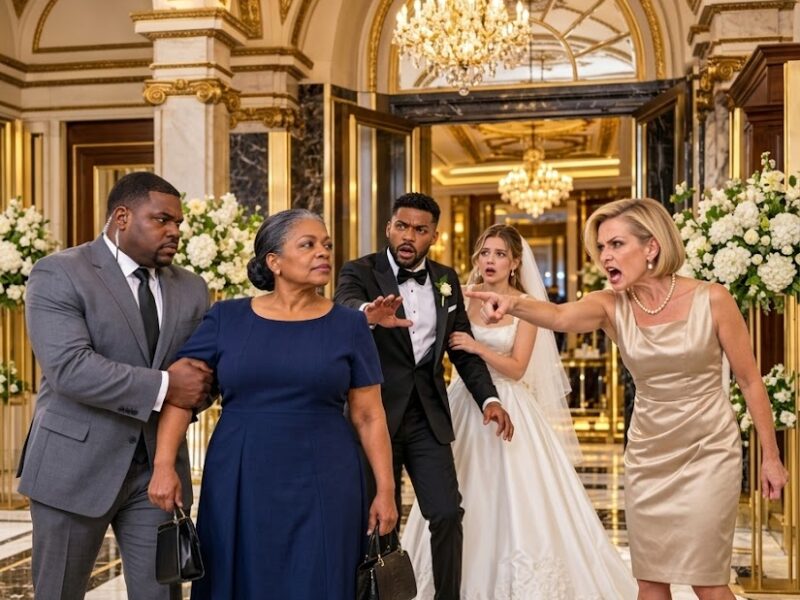
The bride’s rich mother ordered security to drag the groom’s Black mom out of the hotel. She had no idea the woman she just humiliated owned the entire building.
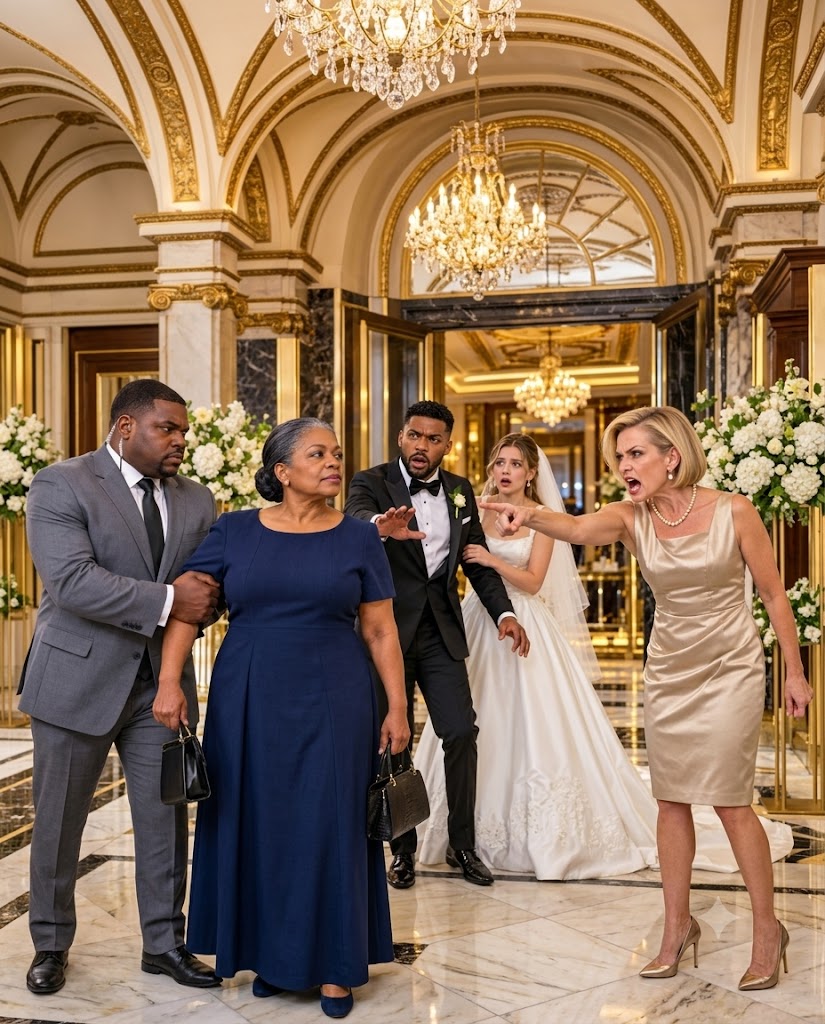
The Belmont Hotel in Charlotte had seen a thousand weddings, but it had never seen anything quite like this one.
Loretta Hayes stood at the service entrance with her nurse shoes planted on the concrete, watching the white delivery vans pull up to the loading dock with their cargo of orchids and French linen.
She recognized the driver, a young man named Darnell who had worked the back dock for six years.
“Morning, Mrs. H,” he said, tipping his cap.
“Morning, baby,” she replied.
—
Patricia Whitmore had been planning this wedding for eighteen months, and she had spreadsheets for her spreadsheets.
The Belmont was her masterpiece venue, the crown jewel of Charlotte society, and her daughter Emily was going to have the wedding that would be talked about for a decade.
She stood in the grand lobby with its marble staircase, the one Emily had dreamed about since she was eight years old, and she directed traffic like an air traffic controller at a major airport.
“The flowers go left, the ice sculpture goes right, and somebody please tell me why the groom’s mother isn’t here yet.”
—
Marcus Hayes pulled into the staff parking lot around back, just like his mother had told him to.
He had wanted to pick her up, but she had insisted on driving herself, saying she needed her own car in case she wanted to leave early.
He knew what that meant, and it made his chest tight.
—
Loretta had bought one kind of shoe for thirty-nine years.
The first pair had been white nurse shoes with thick rubber soles, purchased at a uniform store on the first shift of her first job at a motel front desk.
Every day since, she had bought the same kind, though not the same pair, because the Lord himself couldn’t keep a pair of shoes alive for thirty-nine years.
—
Emily Whitmore had been raised to be kind, but she had also been raised to be comfortable.
And sometimes, when you were comfortable, being kind was easy because it cost you nothing.
She didn’t know yet that the real test of kindness was when it cost you everything.
—
The first sign that something was wrong came when Loretta tried to enter through the main lobby.
A young security guard named Kevin stepped in front of her, polite but firm.
“I’m sorry, ma’am, these steps are for the guests coming in for photos.”
Loretta looked at him for a long moment.
“Family goes in through the side,” Kevin continued. “It’s faster.”
—
Patricia had given specific instructions about the seating.
The front row was for her side of the family, the wedding party, and Judge Harriet Boone, who had turned down four previous invitations from Patricia over the years.
When Loretta arrived and saw her place card, she understood.
The vendor table was by the kitchen door, next to the DJ and the photographer.
—
“The staff here are wonderful,” Loretta said to no one in particular as she took her seat.
A young server named Bernice Clark stopped in her tracks.
“Mrs. Hayes?”
Loretta looked up and smiled.
“Bernie. You’re still here.”
“Thirty years,” Bernice said. “And you’re still wearing those shoes.”
“Same kind,” Loretta said.
—
Emily found Loretta at the vendor table just as the salads were being cleared.
She had been looking for her future mother-in-law for twenty minutes, and her mother had told her not to worry about it.
“Mrs. Hayes, I’m so sorry about the seating,” Emily said. “My mother, she can be…”
“A chair’s a chair,” Loretta said.
—
“Can I sit?” Emily asked.
“It’s your wedding, baby.”
Emily sat down and looked at the older woman, really looked at her for the first time.
“I’m sorry about the club,” Emily said. “When I laughed, I wasn’t…”
“You were scared,” Loretta said. “I know. I’ve been scared before.”
—
Marcus watched his wife and his mother from across the room, and his heart cracked a little.
He had promised his mother that he would wait for her nod, that he wouldn’t reveal anything until she said so.
But watching Emily sit at the vendor table, watching his mother eat the boxed chicken, he wondered if he could keep that promise.
—
The photographs began at eight o’clock.
“Families of the bride and groom,” the photographer called out. “Everybody up here.”
Patricia directed traffic like a general.
“Bride first, Mrs. Hayes. Then we’ll call you.”
Loretta stood off to the side, watching.
—
The photographer looked at his shot list.
“Groom side. Where’s the groom’s mom? I don’t have her in anything.”
Patricia didn’t miss a beat.
“She’s not in this set. We’re behind. Speech is in five.”
Loretta heard every word.
She had heard worse.
—
The speeches started at nine.
Patricia took the microphone like she had been born holding it.
“When Emily was eight, she walked into this lobby and said, ‘Mommy, I’m getting married here.’ And I said, ‘Then we’ll do it right.'”
The applause was generous.
—
“Judge Boone will give our next toast,” Patricia announced.
The judge stood up, checking her phone.
“Traffic on Tryon. I apologize.”
The DJ cued the music, and Marcus noticed something.
Track nine was missing.
“Somebody took this off the program,” he said.
—
Marcus walked to the DJ booth and looked at the playlist.
“Mother-son dance. The groom requested it. 9:15.”
The DJ shrugged.
“The planner said it got cut.”
Marcus looked at his mother, sitting at the vendor table, and he saw her nod.
—
“Turn that off,” Patricia said, pointing at the music.
The room went quiet.
“Could security help her outside?”
Kevin and another guard, Darnell, stepped forward.
Marcus moved faster than he had ever moved in his life.
“Get your hands off my mother-in-law.”
—
Emily stood up from her seat at the head table.
“Emily, go back to your seat,” Patricia said.
“No.”
“Sweetheart, everybody is watching you.”
“I’m sorry. I promised.”
“Promised what?”
“You want her out?” Emily said. “You’ll have to drag the bride, too.”
—
Patricia’s face went white.
“I paid for every chair in this room,” she said. “Every glass, every song. Get her out.”
Darnell looked at Loretta, and Loretta gave him a small nod.
“Kevin, let go of Mrs. Hayes,” Darnell said.
“Excuse me?”
“You heard me.”
—
A woman in a business suit pushed through the crowd.
“My client is…”
“The Belmont won’t be taking your bookings again,” Loretta said.
“On whose say so? You manage this hotel. You work for the owners.”
Loretta stood up and straightened her jacket.
“Mrs. Hayes.”
“My name is Loretta Hayes. This is my hotel.”
—
The silence that followed was the loudest thing anyone in that room had ever heard.
Patricia’s mouth opened and closed like a fish on a dock.
“She cleaned rooms here,” Patricia finally managed. “She told us herself.”
“I did,” Loretta said. “For eleven years.”
—
Judge Boone stepped forward, her phone forgotten.
“Loretta? Loretta Hayes?”
“Evening, Harriet.”
“This is your boy?”
“That’s my boy.”
The judge looked at Patricia with something that might have been pity.
“I’ve been trying to get a meeting with this woman for two years.”
—
“Somebody cut my dance off the program tonight,” Loretta said, taking the microphone. “So I’ll take the time.”
She looked out at the room, at the faces of Charlotte society, at her son and his bride.
“Thirty-nine years ago, I clocked in at that time clock downstairs, fourth floor. I made beds in this building for eleven years.”
—
“Then I saved up and bought a little motel off the highway. Twelve rooms, bad roof. I named it after my mother, Ivy Rose.”
She paused.
“Nine years ago, this place came up for sale. So, I bought it.”
Patricia sat down heavily in the nearest chair.
—
“I didn’t come tonight as the owner. I came as Marcus’s mother. I ate the chicken they gave me. It was good.”
Laughter rippled through the room, nervous and surprised.
“Emily, you came and sat with me at that table before you knew any of this. And tonight, you stood up when it cost you something.”
—
Loretta reached into her purse and pulled out a small parcel wrapped in plain brown paper.
“Baby, go get that parcel for me.”
Marcus walked to his mother and took the package.
“These are my old uniforms. Eleven years of them. I kept every one.”
She unwrapped the paper, revealing folded white uniforms, worn and soft.
—
“It’s done now,” Loretta said.
She looked at Marcus.
“Now I believe somebody promised me a dance.”
The DJ, who had been standing frozen, scrambled to cue the music.
Track nine filled the room.
—
Marcus took his mother’s hand, and they walked to the center of the floor.
The song was slow and sweet, something old that Loretta had hummed while making beds.
Patricia watched from her chair, her face a mask of shock and humiliation.
Emily watched from the head table, tears streaming down her face.
—
“You said you made a call,” Marcus said as they danced. “You said you got us the date.”
“I did make a call.”
“To who?”
Loretta smiled.
“This Saturday belonged to the Kesler Gala. Mrs. Hayes moved it so her son could get married here.”
—
After the dance, Loretta found Patricia in the corner of the ballroom.
“Ivy Rose,” Patricia said, her voice hollow.
“What?”
“The meeting Tuesday. It’s with her.”
Loretta nodded.
“Mrs. Hayes.”
“Gregory. About Tuesday. I’ll pull the bid. After tonight, I can’t sit across a table from you.”
—
Loretta looked at her for a long moment.
“Don’t.”
Patricia blinked.
“What?”
“I felt that napkin at the club. Tight weave, good hem.”
“You remember that?”
“It’s my job to remember that. Bring your numbers Tuesday. You’ll get looked at like everybody else.”
—
“Like everybody else.”
“No better, no worse.”
Patricia nodded slowly.
“Tuesday.”
“Ready?” Marcus asked, appearing at his mother’s side.
“I’m on the clock.”
“Then the clock can wait.”
—
Patricia found Loretta again as the reception wound down.
“That’s my seat,” she said, pointing at the chair Loretta had claimed near the exit.
“Ma’am, we got a seat back here. The box chicken’s very good.”
Mrs. Hayes, if someone had told me, if Marcus had said one word…”
“You’d have been very kind to the owner.”
“Yes.”
“I needed you to be kind to the housekeeper.”
—
Patricia was quiet for a long moment.
“I’m sorry. Then tell her…”
“Tell her what?”
“I don’t know your name.”
“Bernice Clark. Thirty years.”
“Mrs. Clark. Today in the hallway. I’m sorry.”
Bernice looked at her.
“Mhm. Can I get a pair of those?”
“They’re not cute.”
“I’m a nurse. I don’t need cute.”
—
Loretta found Emily in the bridal suite, still in her wedding dress, staring at her reflection.
“I’m sorry,” Emily said. “I should have said something sooner.”
“You said something when it mattered.”
“My mother…”
“Your mother is going to have to learn what people are when they think you don’t count. That’s how I want to meet her. Like the girl with the cart.”
—
“And Emily. Emily, too.”
“She’s going to be my wife.”
“Then she’ll still be your wife. I just want to know her. The real her.”
Emily turned from the mirror.
“Promise me. Not her mama. Not her daddy. Not Emily.”
“Mama.”
“Say it, baby.”
“I promise.”
—
The next morning, Loretta sat in the hotel restaurant with a cup of coffee, watching the sun rise over Charlotte.
Marcus and Emily walked in, hand in hand.
“Morning, Mama,” Marcus said.
“Morning, baby. Morning, Emily.”
Emily sat down across from her.
“I have a question.”
“Ask it.”
“Can you teach me how to fold a napkin?”
—
Loretta laughed, the sound filling the quiet restaurant.
“Honey, I can teach you anything you want to know.”
She reached across the table and took Emily’s hand.
“But first, you need to understand something.”
“What’s that?”
“The help doesn’t go in the family photos. But family? Family goes everywhere.”
—
Three months later, the Belmont hosted the Whitmore-Hayes wedding reception, part two.
This time, there was no vendor table.
This time, Loretta Hayes sat in the front row, wearing her nurse shoes, because they were the only kind she had worn for thirty-nine years.
And this time, when the photographer called for family, Emily grabbed her mother-in-law’s hand and pulled her into the frame.
—
Patricia Whitmore stood at the edge of the photo, uncertain.
Loretta caught her eye and nodded.
Patricia stepped forward, taking her place beside the woman she had tried to have removed from her own hotel.
The photographer snapped the picture.
—
“I never got your name,” Patricia said later, as the reception wound down.
“Bernice Clark.”
“I know. I meant…”
“I know what you meant.”
Patricia nodded.
“I’m sorry.”
“I know that, too.”
—
The Ivy Rose Hotel chain expanded to fourteen locations over the next five years.
Loretta Hayes still wore the same kind of shoes.
When asked why, she always gave the same answer.
“Thirty-nine years I’ve bought one kind of shoe. First shift on the fourth floor, front desk at my first motel. Every day since this kind.”
—
Marcus and Emily had two children, a boy and a girl.
Every summer, they spent a week at Grandma Loretta’s house, where they learned to fold napkins and make beds and treat everyone they met like they mattered.
Because their grandmother had taught them that the measure of a person wasn’t in what they owned, but in how they treated those who owned nothing.
—
The quilt that Loretta had been working on the night everything changed was finally finished.
She gave it to Marcus and Emily on their tenth anniversary.
It was made from scraps of her old uniforms, eleven years of them, stitched together with love and memory and the kind of patience that only comes from knowing what it’s like to be invisible.
—
“Who’s this quilt for?” Emily asked, remembering the question she had asked years ago.
“Whoever you end up married to,” Loretta said.
“I’m marrying Emily.”
“It’s done now.”
—
Patricia Whitmore eventually became one of Loretta’s closest friends, though neither of them would have predicted it.
She learned to fold napkins, though never as well as Bernice.
And she learned that the help, as she had once called them, were the people who had built everything she had ever taken for granted.
—
The Belmont Hotel still stands in Charlotte, a monument to a woman who cleaned rooms for eleven years and then bought the place.
The staircase in the lobby, the one Emily had dreamed about since she was eight, is still there.
And if you look closely at the bottom of the banister, you can see a small plaque.
It reads: “Loretta Hayes. She counted.”
—
Every year, on the anniversary of the wedding, Loretta hosts a dinner for the staff.
Not the executives, not the investors, but the housekeepers and the servers and the security guards.
She sits at the vendor table, and she eats the box chicken, and she tells them the same thing she told Emily all those years ago.
“The help doesn’t go in the family photos. But family? Family goes everywhere.”
—
The napkin that Patricia had felt at the country club, the one with the tight weave and the good hem, still sits in a frame in Loretta’s office.
It reminds her of the night everything changed, the night her son stood up for her, the night her daughter-in-law chose her over comfort.
It reminds her that sometimes, the smallest things matter most.
—
Marcus Hayes never forgot the look on his mother’s face when she stood up in that ballroom and said her name.
He never forgot the way Emily stood beside her, or the way the room went silent, or the way his mother’s nurse shoes clicked on the marble floor as she walked to the dance floor.
He never forgot, and he never let his children forget either.
—
Loretta Hayes lived to see her great-grandchildren.
She taught them to fold napkins and make beds and treat everyone they met with kindness.
And when she finally passed, at the age of eighty-seven, she was buried in a pair of white nurse shoes, the same kind she had worn for thirty-nine years.
The same kind.
Always the same kind.
—
The Ivy Rose Hotels continued to grow, but the Belmont remained the crown jewel.
A portrait of Loretta hung in the lobby, right next to the staircase where Emily had once dreamed of walking down as a bride.
It showed her in her nurse shoes, standing in the lobby she had bought with her own two hands.
The plaque beneath it read: “Loretta Hayes. She counted.”
—
And every year, on the anniversary of the wedding, the staff gathered at the vendor table.
They ate box chicken and told stories about the woman who had cleaned their rooms and then bought the hotel.
They laughed and cried and remembered.
And they knew, each and every one of them, that they counted too.
—
**THE END**









