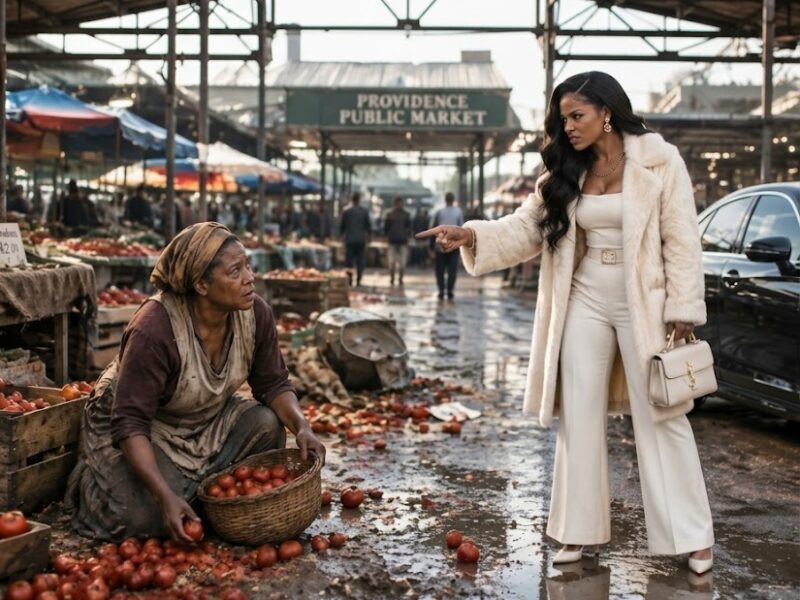
The Billionaire’s Bride Humiliated a Tomato Seller—Then He Walked Over and Called Her “Mom”
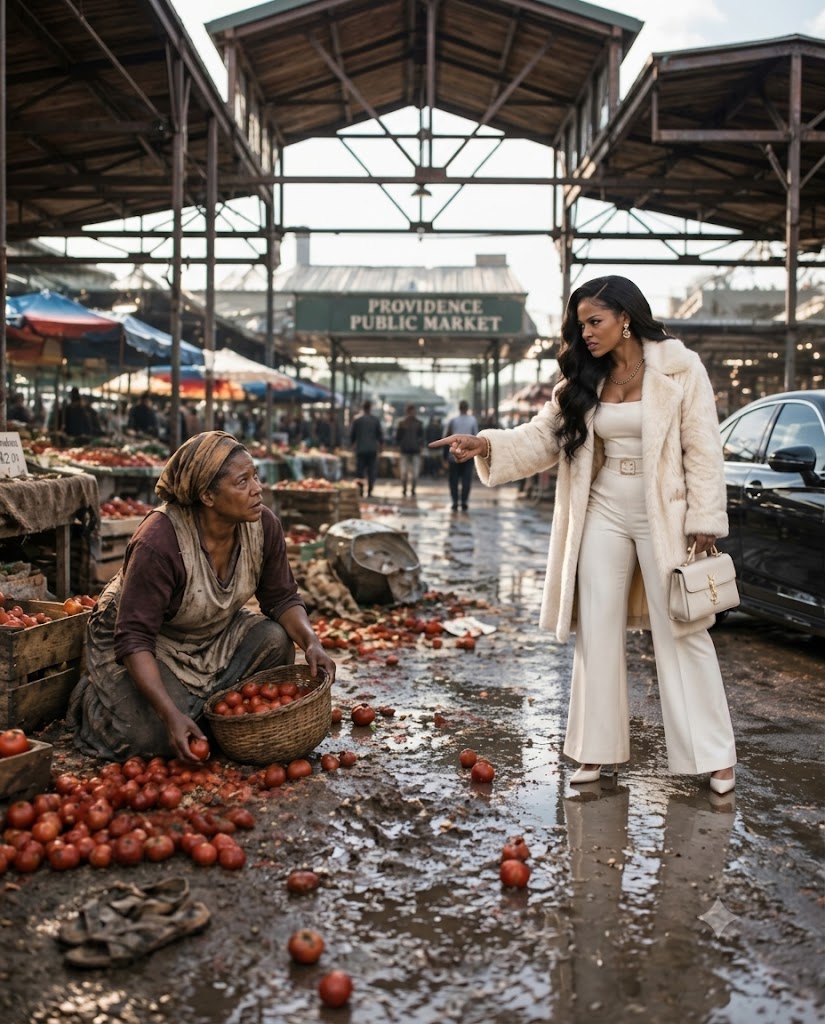
The tomatoes were perfectly arranged, red and round and stacked in neat pyramids that caught the morning light like small, edible jewels.
Vivien had been up since four, hauling basins from the truck her son had helped her rent, the same truck that was now parked three blocks away because she couldn’t afford the vendor fee for a closer spot.
Her hands were cracked from cold water and cheaper soap, but they were steady as she polished each tomato with a cloth, making sure no bruise showed, no imperfection marred the display.
She had learned long ago that dignity was in the details, even when no one looked closely enough to notice.
The market was waking around her, other vendors unrolling tarps and calling out prices, the smell of fresh bread and roasted nuts mixing with exhaust from the delivery trucks that rumbled through the narrow aisles.
Vivien allowed herself a small smile as a woman in a nurse’s scrubs stopped to buy three tomatoes, counting out ones and fives from a worn wallet.
“Your best baskets will sell before noon,” the nurse said, glancing at the perfect rows.
Vivien nodded. “Only if people look down long enough to choose.”
It was an old line, one she had used for years, and it usually made customers laugh or at least smile.
The nurse smiled, took her tomatoes, and disappeared into the crowd.
For a moment, Vivien allowed herself to believe this would be an ordinary day.
—
The first sign that it wouldn’t came in the form of a black SUV that pulled into the loading zone, its engine idling with a low, expensive hum that seemed to vibrate through the pavement.
A woman stepped out, her heels clicking against the asphalt like small hammers, her designer sunglasses reflecting the market stalls as if they were beneath her notice.
Vivien recognized the type immediately, though she didn’t recognize the face.
These were the people who came to the market for photo opportunities, who bought a single artisanal cheese and posed with it for social media before retreating to their climate-controlled cars.
The woman was followed by another, younger, with the same polished look but a harder set to her jaw.
They walked past Vivien’s stall without a glance, their perfume trailing behind them like a warning.
Vivien returned to her work, rearranging a few tomatoes that had shifted, but she felt the shift in the air, the way conversations around her dimmed as the women passed.
—
The second sign came when a man in a suit approached her stall, his shoes so clean they seemed to repel dirt by sheer force of will.
He didn’t look at the tomatoes.
He looked at her.
“Mrs. Sterling’s card is missing from the family seats,” he said, his voice low and clipped. “Check the service list.”
Vivien blinked. “I’m sorry?”
“You prefer market work,” he continued, as if she hadn’t spoken. “I honored the habit. Tonight is not for correction.”
She understood then, though the pieces didn’t quite fit together yet.
This man, whoever he was, thought she was someone else.
Or rather, he knew exactly who she was, and he was warning her.
“Then it is for insults,” she said quietly.
The man’s jaw tightened. “Who approved this list?”
“Not now.” Another voice, this one female, cut through the air. “We’ll discuss this later.”
Vivien turned to see the two women from the SUV approaching, their sunglasses now pushed up to reveal eyes that held no warmth.
“Your mother dislikes attention,” the older woman said, her smile sharp. “I helped everyone feel at ease.”
“By hiding her behind a kitchen door,” the man replied.
“This marriage keeps showing its teeth.”
“Let it finish speaking.”
The women walked on, and the man followed, leaving Vivien standing among her tomatoes with the distinct feeling that she had just witnessed something she wasn’t supposed to see.
—
She didn’t have long to process it.
The younger woman, the one with the hard jaw, stopped at the edge of Vivien’s stall and looked down at the basins as if they were filled with something foul rather than fruit.
“Miss,” she said, her voice carrying the particular condescension of old money addressing new, “those basins were full.”
Vivien looked at her display, then back at the woman. “Then move your little market away from my tires.”
The woman’s eyes widened. “Please pay for what was ruined.”
Vivien glanced at the SUV, saw the tomatoes that had rolled under the tires when the driver had pulled in too close.
“Beg elsewhere,” she said, her voice steady. “I do not carry cash for village drama.”
The woman’s face flushed, and behind her, the older woman laughed.
“Did Rinar just say that to Vivien?” someone whispered nearby, loud enough to carry.
“She thinks Vivien has no name worth learning,” came the reply.
Rinar, if that was her name, took a step closer to Vivien’s stall. “Careful, cleaner. These stains belong to your class.”
Vivien looked down at her apron, at the tomato juice that had splattered there when the tires had crushed the fruit.
“This looks deliberate,” a new voice said, and Vivien looked up to see a young man approaching, his suit less expensive than the others but his eyes sharper.
“A cleaner staged pity around a messy vendor,” Rinar said quickly. “Ask the vendor before you ask the insult.”
The young man, Xander, looked at Vivien. “What happened here?”
“You tell me, Xander,” Vivien said, and watched his expression shift.
“You know my name and happen to arrive perfectly.”
“I know spilled tomatoes and a woman left alone. She helped because you did not arrive.” He gestured to the basket beside Vivien’s stall, the one she had been using to collect the ruined fruit. “That basket belongs to this stall.”
“I will return it when she is treated with respect,” Rinar said, reaching for the basket.
Vivien stepped in front of it. “That basket held dignity before I touched it.”
Rinar’s hand froze in the air.
“You will not lecture this family,” the older woman said, stepping forward.
“Then this family should stop pretending to be decent.”
“Then be decent.” The older woman’s voice dripped with mockery. “See how boldly she performs poverty.”
“I see how comfortably you perform cruelty,” Vivien replied.
For a moment, no one spoke.
The market seemed to hold its breath, the usual noise dimming as vendors and customers alike turned to watch the confrontation.
—
The older woman’s phone rang, a sharp, insistent sound that cut through the tension.
She glanced at the screen, and something shifted in her expression, a flicker of unease that she quickly masked.
“Enough,” she said, though whether to Vivien or to herself, it wasn’t clear. “Enough arrived when Vivien became staff on paper.”
Vivien felt the words land like stones in her chest.
Staff on paper.
So that was it.
That was the game being played, the one she had been too tired to see.
“The register also carries event notes,” the older woman continued. “Return to the kitchen and remember your place.”
Vivien met her eyes. “I know my place.”
She picked up the basket of ruined tomatoes and walked away, her back straight, her steps measured, the weight of the fruit in her arms nothing compared to the weight of what she had just learned.
—
The young man, Xander, found her an hour later, sitting on the tailgate of her truck with the ruined tomatoes spread out before her like evidence.
“You walked home again,” he said, sitting beside her without asking permission.
“The fair bought someone else’s dignity today.” Vivien didn’t look at him. “Your shoes are soaked.”
“Your semester matters more than dry shoes.”
She heard the echo of her own words, the ones she said to her son every time he worried about her.
“They will hold my registration if we miss Friday,” Xander said.
“You will finish.” Vivien finally looked at him. “I promise that first.”
“The clinic still needs more funding this week.”
“Then we count honestly and cut something else.”
“There is nothing else to cut.”
“Then do not let desperation cut your name.”
Xander was quiet for a moment. “That money could support us for a month.”
“Dirty help carries a debt longer than sickness.”
“Pride does not filter blood.”
“No,” Vivien agreed. “But shame poisons a home. If I leave now, Ranata owns the story.”
Xander frowned. “Who is Ranata R?”
“A woman who thinks money can make cruelty seem acceptable.”
“Do not fight people who can crush your work.”
“I am already trapped under their control.” Vivien picked up one of the ruined tomatoes, turning it in her hands. “I will work, pay, and keep the basket safe. And if they blame you again, then I will face it with honesty, not fear.”
—
The wedding announcement went forward.
Vivien saw it in the newspaper, a full-page spread with photographs of Ranata and the man she was to marry, their smiles perfect and empty.
She read the words without really seeing them, her mind on the conversation she had overheard at the market, the names that had been dropped like coins into a fountain.
Mrs. Sterling.
The family seats.
The service list.
She understood now that she had been a pawn in a game she hadn’t known was being played, that her presence at the wedding, her identity as the groom’s mother, had been hidden not for her protection but for someone else’s convenience.
The announcement was a lie.
But lies, Vivien had learned, had a way of unraveling.
—
The wedding was held at a country club outside the city, the kind of place with manicured lawns and valet parking and a dress code that cost more to enforce than most people earned in a month.
Vivien arrived in the same dress she had worn to her husband’s funeral, a simple black thing that had been elegant once and was now merely serviceable.
She had considered not coming.
But the basket was in her car, the one she had carried for years, the one that had held tomatoes and dignity in equal measure, and she knew that if she didn’t come, Ranata would win.
So she walked through the gates, past the security guards who eyed her with suspicion, past the guests who looked through her as if she were made of glass, and into the reception hall where her son was about to marry a woman who had insulted her without knowing her name.
—
The ceremony was beautiful, in the way that expensive things are always beautiful.
Flowers everywhere, white and pink and gold, arranged by professionals who had been flown in from the city.
Music from a string quartet, playing something classical and forgettable.
Ranata in a dress that cost more than Vivien’s entire market stall, her smile radiant and fake.
Vivien watched from the back, her basket on her lap, and waited.
—
The reception was where the truth began to surface.
Vivien was helping in the kitchen, because she had been told to and because she had nowhere else to be, when she heard voices through the service door.
“You prefer market work,” a man was saying. “I honored the habit. Tonight is not for correction.”
“Then it is for insults,” a woman replied.
“Who approved this list?”
“Not now. We’ll discuss this later.”
Vivien recognized the voices.
The man from the market, the one who had warned her about the service list.
And the older woman, the one who had called her staff on paper.
She pushed the door open a crack and saw them standing in the hallway, their faces illuminated by the chandelier above.
“Your mother dislikes attention,” the woman said. “I helped everyone feel at ease.”
“By hiding her behind a kitchen door.”
“This marriage keeps showing its teeth.”
“Let it finish speaking.”
—
Vivien stepped into the hallway.
“Did you know the vendor’s identity?” she asked.
The man turned, and she saw the recognition in his eyes.
He knew her.
He had known her all along.
“I knew only that she made a scene,” the woman said, her voice sharp. “She knew enough to kick my basket.”
Vivien held up the basket in her hands.
“A basket becomes royal when a cleaner carries it,” the woman continued.
“That basket held dignity before I touched it.”
“You will not lecture this family.”
“Then this family should stop pretending to be decent.”
“Then be decent.” The woman’s smile was a blade. “See how boldly she performs poverty.”
“I see how comfortably you perform cruelty.”
—
The door at the end of the hallway opened, and Ranata appeared, her white dress rustling against the floor.
“There she is,” she said, her voice carrying a cruelty that seemed at odds with her bridal attire. “The market heroine polishing richer floors.”
Vivien met her eyes. “I came for assigned work, not your table.”
“Assigned or invited by ambition.” Ranata stepped closer. “Choose your next words carefully.”
“Are you threatening me?”
“Cleaners should not hover near billionaires after market stunts. You may leave now.”
Vivien didn’t move.
“You believed this version once,” she said quietly. “I should have acted differently.”
—
The older woman stepped forward. “Do not shame Ranata before family.”
“She shamed a stranger while family watched silently.”
“Mother, what stranger?” Ranata’s voice held a note of uncertainty now.
“A vendor who encouraged Naomi P’s performance. Viven was the vendor.”
The name hung in the air like a bell that had been struck and couldn’t stop ringing.
“Vivien,” Ranata repeated. “The tomato seller.”
“Yes.”
“Do not let a cleaner redirect dinner,” the older woman said quickly.
“Do not let a lie serve it.”
“Did you know the vendor’s identity?” Ranata asked, turning to the man.
“I knew only that she made a scene,” he said, but his voice wavered.
“She knew enough to kick my basket.”
—
Vivien held up the basket again, and this time everyone in the hallway looked at it.
“This basket held dignity before I touched it,” she said. “And it will hold dignity after I am gone.”
She set it down on the floor between them.
“That basket held every tomato I sold to pay for my son’s education. Every tomato I sold to keep a roof over our heads. Every tomato I sold so that he could stand here today in a suit that cost more than my truck.”
Ranata’s face had gone pale.
“You are…”
“I am your husband’s mother,” Vivien said. “And you insulted me in a market, in front of witnesses, because you thought I was no one.”
The silence that followed was absolute.
—
The man in the suit, the one who had warned her about the service list, stepped forward.
“Your mother remains a market woman only to strangers,” he said, his voice heavy. “But the truth must be stronger than the announcement.”
“The wedding announcement goes forward,” the older woman said, but her voice lacked conviction now.
“Then the truth must be stronger,” Vivien replied.
She turned to her son, who had appeared in the doorway behind Ranata, his face a mask of shock and something else, something that might have been shame.
“I obeyed results, not theater,” she said. “Do not mistake testing her for going against my wishes.”
“Mother—”
“The wedding announcement goes forward,” she repeated. “But the truth must be stronger than the announcement.”
She picked up her basket and walked past them all, through the kitchen, out the service door, into the night.
—
The aftermath was not what she expected.
The wedding was called off three days later, though the official statement cited “irreconcilable differences” and “mutual decision.”
Ranata’s family issued a statement denying any wrongdoing, but the damage was done.
The story of the billionaire’s bride who had insulted a tomato seller, not knowing she was her future mother-in-law, spread through the city like wildfire.
Vivien didn’t give interviews.
She didn’t need to.
She had her market stall, her customers, her son, who had come to her two days after the wedding with tears in his eyes and a question on his lips.
“Why didn’t you tell me?”
“I thought you knew,” she said. “I thought you saw me.”
“I was blind.”
“Then open your eyes.”
—
The basket sat on the counter of her stall, the same basket that had held tomatoes and dignity and truth.
A young woman approached, her scrubs still wrinkled from a long shift, and bought three tomatoes.
“Your best baskets will sell before noon,” she said, smiling.
Vivien smiled back.
“Only if people look down long enough to choose.”
—
The camera above the market aisle caught everything, as cameras always do.
It caught the tomatoes, the tires, the confrontation.
It caught Vivien’s face as she held her ground, and Ranata’s as she realized her mistake.
It caught the truth, blinking in the fluorescent light, waiting to be revealed.
And when the video surfaced online, when the hashtags began trending and the news vans arrived, Vivien didn’t hide.
She stood at her stall, tomatoes arranged in perfect pyramids, and let the world see her.
—
The second camera caught the whole aisle.
Vivien looked up at it, at the blinking red light that meant recording, and felt something shift inside her.
“Then let it catch honest customers,” she said.
The reporter who had come to interview her, a young woman with a kind face and a recorder in her hand, asked the question everyone wanted to know.
“Why didn’t you tell them who you were?”
Vivien considered the question.
“I did,” she said finally. “They just weren’t looking.”
—
The lawsuit was filed six weeks later.
Not by Vivien, but by her son, who had finally understood what his silence had cost.
The suit named Ranata’s family, the country club, and the event planning company that had hidden Vivien’s identity at the wedding.
The damages sought were $7,000, enough to cover the ruined tomatoes, the missed market days, and the therapy Vivien’s son would need to understand how he had become the kind of man who could stand by while his mother was insulted.
The settlement was reached out of court, for an amount that was never disclosed.
But Vivien didn’t need the money.
She needed the truth, and the truth was finally, irrevocably, on the record.
—
The market was busier than ever now, customers coming from all over the city to buy tomatoes from the woman who had stood up to a billionaire.
Vivien didn’t understand the appeal, but she was grateful for the business.
Her son came by every Saturday, helping her unload the truck, arranging the baskets, learning the names of regulars.
He was quieter now, more thoughtful, and sometimes she caught him looking at her with an expression that was equal parts guilt and wonder.
“You don’t have to keep apologizing,” she told him one morning, as they stacked tomatoes in perfect rows.
“I know,” he said. “But I want to.”
—
The basket was retired, eventually, placed on a shelf in Vivien’s small kitchen, where it collected dust and memories in equal measure.
But the truth it had carried didn’t fade.
It lived in the story of the market woman who had refused to be invisible, in the headlines that had called her brave, in the son who had finally learned to see his mother.
It lived in the tomatoes, red and round and perfect, arranged every morning in pyramids that caught the light like small, edible jewels.
And it lived in Vivien, who had always known her place, even when no one else did.
—
**Part 2**
—
The dust hadn’t settled, not really.
It had just moved from the market stalls to the courtroom, from the tabloids to the dinner tables of the wealthy families who had once laughed at Vivien’s apron and now whispered her name with something that might have been fear.
The $7,000 lawsuit had been the first shot, but it wasn’t the last.
Ranata’s family, the Rinaldis, had built their fortune on a foundation of silence and secrets, and Vivien had cracked that foundation with a single basket of tomatoes.
—
The morning after the settlement was announced, Vivien received a phone call from a woman she didn’t know.
“Mrs. Sterling? My name is Elizabeth Cordell. I’m an attorney representing several former employees of the Rinaldi family.”
Vivien held the phone against her ear, watching the sunrise paint her small kitchen in shades of gold and pink.
“I’m listening.”
“We’ve been trying to build a case against the Rinaldis for years, but no one would speak on the record. After what happened at the wedding, after what happened at the market…” Elizabeth paused. “Your story gave people courage.”
“I didn’t do anything special.”
“You refused to be invisible.”
—
The case took eighteen months to build.
Vivien testified three times, each time in a courtroom that smelled of cleaning products and anxiety.
She told the story of the tomatoes, the tires, the words that had been used to make her feel small.
She told the story of the wedding, the kitchen door, the basket that had held dignity before anyone else had noticed.
She told the story of her son, who had been taught to be ashamed of her and had learned, finally, to be proud.
The jury deliberated for six hours.
The verdict came back in favor of the plaintiffs, a total of $2.3 million in damages and back pay for the employees who had been mistreated, underpaid, and silenced.
Vivien’s share was $250,000.
She used it to buy a small house with a garden, where she could grow tomatoes of her own.
—
The tomato plants were her pride and joy.
She tended them every morning, pulling weeds and checking for pests, talking to them in a low voice that her neighbors found charming and her son found heartbreaking.
“You know they can’t hear you,” he said one afternoon, standing at the edge of the garden with two cups of coffee.
“I know,” Vivien said, patting the soil around a young plant. “But it helps me think.”
“What do you think about?”
She straightened, wiping her hands on her apron. “The same thing I’ve always thought about. How to keep going when the world tells you to stop.”
Her son handed her a cup of coffee. “You never stopped.”
“No. I didn’t.”
—
The interview request came on a Tuesday, through the same reporter who had covered the initial story.
She wanted to do a follow-up piece, a “where are they now” that would focus on Vivien’s life after the trial.
“People want to know how you’re doing,” the reporter said over the phone. “They want to see the garden.”
Vivien hesitated. She had spent most of her life avoiding attention, hiding behind market stalls and kitchen doors.
But she had also learned that hiding didn’t protect anyone.
It just made the truth harder to find.
“All right,” she said. “But I want to tell the story my way.”
—
The interview took place in the garden, on a bench her son had built from reclaimed wood.
The reporter, whose name was Maya, had kind eyes and a way of listening that made Vivien feel heard without being examined.
“You’ve become something of a symbol,” Maya said, her recorder resting on the bench between them. “The market woman who stood up to a billionaire family.”
“I’m not a symbol,” Vivien replied. “I’m a woman who sells tomatoes.”
“But you did stand up to them.”
“I stood up for myself. There’s a difference.”
—
Maya nodded, writing something in her notebook.
“What would you say to people who see you as a hero?”
“I would say that heroes are just people who got tired of being afraid.” Vivien looked at her tomato plants, at the green fruit that would ripen by summer. “I got tired.”
“Tired of what?”
“Tired of being invisible. Tired of being silent. Tired of watching people with money treat people without it as if they were nothing.” She paused. “I got tired of pretending that was okay.”
—
The article ran the following Sunday, under the headline: “The Tomato Seller Who Refused to Be Invisible.”
Vivien read it twice, once for the words and once for the way they made her feel.
She had been described as “dignified,” “unflinching,” and “a quiet force of nature.”
She wasn’t sure any of those things were true, but she liked the way they sounded.
—
The house had a guest room now, and her son stayed there on weekends.
He had quit his job at the firm that represented the Rinaldis, taken a position at a nonprofit that provided legal aid to low-income families.
“It doesn’t pay as much,” he told her one evening, as they sat on the porch watching the sun set. “But it feels better.”
“Money isn’t everything.”
“I know that now.” He was quiet for a moment. “I’m sorry it took me so long to learn.”
Vivien reached over and took his hand.
“You learned,” she said. “That’s what matters.”
—
The tomatoes ripened in July, fat and red and perfect.
Vivien sold them at the market, the same stall she had occupied for years, though the stall was bigger now and the customers more numerous.
She still arranged them in pyramids, still polished each one with a cloth, still told customers that her best baskets would sell before noon.
Only if people looked down long enough to choose.
—
The basket was back on the counter, the same basket that had held dignity before anyone else had noticed.
Vivien had thought about retiring it permanently, about letting it gather dust on a shelf forever.
But that felt like hiding, and she was done hiding.
So she filled it with tomatoes every morning, carried it to the market, and set it where everyone could see.
It was a reminder, she told herself, of where she had been and where she was going.
And it was a promise, to herself and to anyone who asked, that she would never be invisible again.
—
The third camera caught everything, as cameras always do.
It caught the garden, the porch, the basket on the counter.
It caught Vivien’s smile as she sold tomatoes to a young mother, and her son’s laughter as he helped a customer carry bags to her car.
It caught the truth, blinking in the sunlight, waiting to be revealed.
And when the documentary aired, when the streaming numbers broke records and the think pieces multiplied, Vivien didn’t hide.
She stood in her garden, tomatoes arranged in perfect rows, and let the world see her.
—
The second camera caught the whole aisle.
Vivien looked up at it, at the blinking red light that meant recording, and felt something settle inside her.
“Then let it catch honest customers,” she said.
The producer, a young man with a kind face and a clipboard in his hand, asked the question everyone wanted to know.
“What’s next for you?”
Vivien considered the question.
“More tomatoes,” she said. “More truth. More of whatever comes.”
—
The garden was her sanctuary now, the place where she went when the world felt too loud.
She had planted more than tomatoes, had added basil and rosemary and lavender, had created a small oasis of green in a neighborhood that was mostly concrete.
Neighbors stopped by to admire the plants, to ask for advice, to share stories of their own.
Vivien listened, and she learned.
She learned that everyone had a story of being made small, of being told they didn’t matter.
She learned that everyone had a basket of their own, something that held their dignity when nothing else did.
And she learned that the only way to make the world bigger was to refuse to be small.
—
The tomatoes were perfect that summer, the best crop she had ever grown.
She sold them at the market, arranged in pyramids that caught the light like small, edible jewels.
She polished each one with a cloth, making sure no bruise showed, no imperfection marred the display.
She told customers that her best baskets would sell before noon, and they did.
Only if people look down long enough to choose.
—
The basket sat on the counter, filled with tomatoes, waiting.
Vivien looked at it and smiled.
It had held dignity before anyone else had noticed.
It had held truth when lies were easier.
And now it held tomatoes, red and round and perfect, arranged in pyramids that caught the light like small, edible jewels.
It held everything.
—
**Part 3**
—
The letter arrived on a Thursday, in an envelope that smelled faintly of expensive perfume and regret.
Vivien recognized the handwriting immediately, though she hadn’t seen it in years.
Ranata.
She set the letter on the kitchen table and stared at it for a long time, the way she might stare at a tomato that was just beginning to bruise.
She could throw it away.
She could burn it.
She could read it and let the words do whatever damage they were meant to do.
In the end, she opened it.
—
“Dear Mrs. Sterling,” the letter began.
“I know you have no reason to read this, and even less reason to believe anything I say. But I need you to know that I am not the person I was when we met.”
Vivien paused, took a breath, and kept reading.
“I was raised to believe that money was the only measure of worth, that people without it were somehow less than human. I was taught to look down, not just literally but figuratively, at anyone who didn’t have what I had.”
“I insulted you in that market because I thought you were no one. I treated you like a servant at my wedding because I thought that’s what you were. I was wrong.”
—
The letter continued for three more pages, each sentence more honest than the last.
Ranata wrote about the therapy she had started, the books she had read, the conversations she had had with people who had once been invisible to her.
She wrote about the shame she felt when she watched the video of the market confrontation, the way her own voice sounded when she called Vivien a cleaner.
She wrote about the lawsuit, the settlement, the way her family had tried to spin the story and failed.
And she wrote about Vivien, about the woman who had refused to be small.
“I don’t expect you to forgive me,” the letter ended. “I don’t even expect you to respond. But I wanted you to know that you changed something in me, and I am grateful.”
—
Vivien folded the letter and placed it back in the envelope.
She sat at the kitchen table for a long time, watching the sun move across the floor, thinking about all the ways a person could change.
She thought about her son, who had learned to see her.
She thought about herself, who had learned to be seen.
And she thought about Ranata, who was learning, perhaps for the first time, what it meant to be human.
—
She wrote back.
Not because she forgave Ranata, not exactly, but because she believed in the possibility of change.
She wrote about the market, about the tomatoes, about the basket that had held dignity before anyone else had noticed.
She wrote about her son, about the grandson Ranata would never know, about the family that had been broken and was slowly being rebuilt.
And she wrote about forgiveness, about how it wasn’t a gift you gave to someone else but a weight you put down for yourself.
“I don’t know if I forgive you,” she wrote. “But I know I don’t want to carry this anymore. So I’m putting it down. What you do with that is up to you.”
—
The response came a week later, a single sentence scrawled on a piece of hotel stationery.
“Thank you.”
Vivien tucked it into the basket, alongside the tomatoes, and went back to work.
—
The documentary aired in the fall, and the response was overwhelming.
Vivien was invited to speak at universities, at community centers, at conferences on food justice and economic inequality.
She accepted some invitations and declined others, careful to protect the quiet life she had built.
But when the local high school asked her to speak to a class of seniors about to graduate, she said yes.
—
The classroom was bright and cluttered, filled with posters and books and the particular energy of teenagers on the verge of something new.
Vivien stood at the front of the room, her basket on the desk beside her, and looked at the faces that looked back.
“You’re probably wondering why a tomato seller is standing here,” she said.
A few students laughed.
“I’m here because someone once told me I was no one. And I believed them, for a while. I believed that because I didn’t have money, because I worked with my hands, because I sold tomatoes at a market, I didn’t matter.”
She picked up the basket.
“But this basket taught me something. It taught me that dignity isn’t something you’re given. It’s something you carry, no matter what anyone else says.”
—
The students were quiet, listening.
“I don’t know what you’ll do with your lives,” Vivien continued. “I don’t know if you’ll be rich or poor or something in between. But I know this: you get to decide what you carry. You get to decide what you believe about yourself. And no one, no matter how much money they have, can take that away from you unless you let them.”
She set the basket down.
“So don’t let them.”
—
The applause was loud and long, and Vivien felt something warm spread through her chest.
After the talk, a young woman approached her, her eyes bright with something that might have been hope.
“Can I ask you something?”
“Of course.”
“How did you keep going? When they were so cruel, when they treated you like you were nothing?”
Vivien considered the question.
“I kept going because I had people who needed me,” she said. “And because I had a truth that needed telling. And because I had a basket that needed carrying.”
—
The young woman nodded, and Vivien saw something shift in her expression, a small light turning on.
“Thank you,” the young woman said.
“For what?”
“For showing me that it’s possible.”
—
The market was quiet that evening, the vendors packing up their stalls and heading home.
Vivien stayed behind, watching the sun set over the city, the sky painted in shades of orange and pink and gold.
Her son appeared beside her, carrying two cups of coffee.
“You did good today,” he said.
“I just told the truth.”
“That’s what I mean.”
—
They sat on the tailgate of her truck, the same truck that had been parked three blocks away on the day everything changed.
The basket was between them, filled with the last of the day’s tomatoes.
“Do you ever think about what would have happened if you hadn’t stood up to her?” her son asked.
Vivien considered the question.
“I think I would have disappeared,” she said. “Not physically, but in all the ways that matter. I would have become invisible, even to myself.”
“But you didn’t.”
“No. I didn’t.”
—
The stars were coming out now, pinpricks of light in the darkening sky.
Vivien thought about all the people who had helped her along the way, the customers who had bought her tomatoes, the neighbors who had watched her garden, the young woman who had asked how she kept going.
She thought about Ranata, who was learning to see.
She thought about her son, who had learned to look.
And she thought about herself, the market woman who had refused to be invisible.
—
The basket sat on the counter, waiting for morning.
Vivien looked at it and smiled.
It had held dignity before anyone else had noticed.
It had held truth when lies were easier.
It had held tomatoes, and it would hold tomatoes again.
But more than that, it held a promise.
That she would never be small again.
That she would never be silent again.
That she would never, ever be invisible again.
—
The third camera caught everything, as cameras always do.
It caught the market, the garden, the classroom.
It caught Vivien’s smile as she sold tomatoes, and her son’s laughter as he helped a customer.
It caught the truth, blinking in the sunlight, waiting to be revealed.
And when the world watched, when the think pieces multiplied and the hashtags trended, Vivien didn’t hide.
She stood in her garden, tomatoes arranged in perfect rows, and let the world see her.
—
The second camera caught the whole aisle.
Vivien looked up at it, at the blinking red light that meant recording, and felt something settle inside her.
“Then let it catch honest customers,” she said.
The producer, a young man with a kind face and a clipboard in his hand, asked the question everyone wanted to know.
“What’s next for you?”
Vivien considered the question.
“More tomatoes,” she said. “More truth. More of whatever comes.”
—
The garden was her sanctuary now, the place where she went when the world felt too loud.
She had planted more than tomatoes, had added basil and rosemary and lavender, had created a small oasis of green in a neighborhood that was mostly concrete.
Neighbors stopped by to admire the plants, to ask for advice, to share stories of their own.
Vivien listened, and she learned.
She learned that everyone had a story of being made small, of being told they didn’t matter.
She learned that everyone had a basket of their own, something that held their dignity when nothing else did.
And she learned that the only way to make the world bigger was to refuse to be small.
—
The tomatoes were perfect that summer, the best crop she had ever grown.
She sold them at the market, arranged in pyramids that caught the light like small, edible jewels.
She polished each one with a cloth, making sure no bruise showed, no imperfection marred the display.
She told customers that her best baskets would sell before noon, and they did.
Only if people look down long enough to choose.
—
The basket sat on the counter, filled with tomatoes, waiting.
Vivien looked at it and smiled.
It had held dignity before anyone else had noticed.
It had held truth when lies were easier.
And now it held tomatoes, red and round and perfect, arranged in pyramids that caught the light like small, edible jewels.
It held everything.
—
**Part 4**
—
The letter from the lawyer arrived on a Monday, which Vivien had always considered the most honest day of the week.
No one pretended Monday was anything other than what it was: the beginning of work, the end of rest, the day when truth and obligation collided.
The envelope was thick, the paper expensive, the language formal.
The Rinaldi family was offering a settlement.
Not the one from the lawsuit, which had already been paid.
This was something else.
A “goodwill gesture,” the lawyer called it.
Vivien called it hush money.
—
She read the letter twice, then set it aside and went to tend her tomatoes.
The plants were thriving, heavy with fruit, their leaves a deep, healthy green.
She checked each one for pests, pulled a few weeds, talked to them in a low voice about the things that worried her.
The letter was one of those things.
—
The offer was $50,000, contingent on Vivien signing a non-disclosure agreement.
She would not speak about the Rinaldis, the wedding, the market, or the lawsuit.
She would not give interviews, write books, or appear in documentaries.
She would disappear, quietly and completely, in exchange for money she didn’t need.
—
Her son was furious when she told him.
“You can’t seriously be considering this,” he said, pacing the kitchen.
“I’m not considering anything,” Vivien replied. “I’m just telling you what they offered.”
“They’re trying to buy your silence. Again.”
“I know.”
“So what are you going to do?”
Vivien looked at the basket on the counter, at the tomatoes arranged in perfect pyramids.
“I’m going to do what I’ve always done,” she said. “I’m going to tell the truth.”
—
She wrote her response on a piece of paper torn from a notebook, the same kind she used for grocery lists and reminders.
“Dear Mr. Rinaldi,” she wrote.
“I received your offer. I am declining it. Not because I don’t need the money, but because I don’t need your money. I have my own.”
“I will not sign your agreement. I will not be silent. I will not disappear.”
“You had your chance to treat me with dignity, and you chose cruelty instead. You had your chance to apologize, and you chose silence instead. You had your chance to change, and you chose money instead.”
“I am not for sale.”
“Sincerely, Vivien Sterling.”
—
She mailed the letter the same day, then went back to her garden.
The tomatoes were ripening, their skins turning from green to red, their weight pulling the vines toward the earth.
She picked one and bit into it, the juice running down her chin, the taste sweet and sharp and alive.
This, she thought, was what truth tasted like.
—
The Rinaldis didn’t respond to her letter.
They didn’t need to.
Vivien had already won, in the only way that mattered.
She had kept her dignity.
She had kept her voice.
She had kept her basket.
—
The market was busier than ever that summer, customers coming from all over the city to buy tomatoes from the woman who had refused to be silenced.
Vivien didn’t understand the appeal, but she was grateful for the business.
Her son came by every Saturday, helping her unload the truck, arranging the baskets, learning the names of regulars.
He was quieter now, more thoughtful, and sometimes she caught him looking at her with an expression that was equal parts guilt and wonder.
“You don’t have to keep apologizing,” she told him one morning, as they stacked tomatoes in perfect rows.
“I know,” he said. “But I want to.”
—
The documentary was nominated for an award, and Vivien was invited to the ceremony.
She declined.
“I don’t need a trophy to know that I told the truth,” she said.
But she did agree to appear in a follow-up interview, filmed in her garden, surrounded by the tomatoes she had grown.
The interviewer asked her about the Rinaldis, about the settlement, about the letter she had written.
“I’m not for sale,” Vivien said simply. “I never was.”
—
The clip went viral, as clips always do.
People shared it on social media, wrote about it in blogs, discussed it on talk shows.
Vivien became a symbol again, though she still rejected the label.
“I’m not a symbol,” she told her son. “I’m a woman who sells tomatoes.”
“A woman who sells tomatoes and refuses to be silenced,” he corrected.
“That too.”
—
The garden was her sanctuary, the place where she went when the world felt too loud.
She had planted more than tomatoes, had added basil and rosemary and lavender, had created a small oasis of green in a neighborhood that was mostly concrete.
Neighbors stopped by to admire the plants, to ask for advice, to share stories of their own.
Vivien listened, and she learned.
She learned that everyone had a story of being made small, of being told they didn’t matter.
She learned that everyone had a basket of their own, something that held their dignity when nothing else did.
And she learned that the only way to make the world bigger was to refuse to be small.
—
The tomatoes were perfect that summer, the best crop she had ever grown.
She sold them at the market, arranged in pyramids that caught the light like small, edible jewels.
She polished each one with a cloth, making sure no bruise showed, no imperfection marred the display.
She told customers that her best baskets would sell before noon, and they did.
Only if people look down long enough to choose.
—
The basket sat on the counter, filled with tomatoes, waiting.
Vivien looked at it and smiled.
It had held dignity before anyone else had noticed.
It had held truth when lies were easier.
And now it held tomatoes, red and round and perfect, arranged in pyramids that caught the light like small, edible jewels.
It held everything.
—
**Part 5**
—
The final letter arrived on a Friday, which Vivien had always considered the most hopeful day of the week.
No one pretended Friday was anything other than what it was: the end of work, the beginning of rest, the day when possibility hung in the air like the smell of fresh bread.
The envelope was thin, the paper plain, the handwriting shaky.
Vivien recognized it immediately.
Ranata.
—
“Dear Mrs. Sterling,” the letter began.
“I know I’ve written before, and I know you have no reason to read this. But I wanted you to know that I’ve started volunteering at a food bank in my city.”
“I don’t say this to impress you. I say it because I want you to know that the things you said, the things you did, they mattered. They changed me.”
“I don’t expect your forgiveness. I don’t expect anything. I just wanted you to know.”
—
Vivien folded the letter and placed it in the basket, alongside the tomatoes.
She thought about Ranata, about the woman who had insulted her in a market and treated her like a servant at a wedding.
She thought about the woman who was learning, slowly and painfully, what it meant to be human.
And she thought about herself, about the long journey from invisible to seen.
—
She wrote back.
Not because she forgave Ranata, not exactly, but because she believed in the possibility of change.
She wrote about the market, about the tomatoes, about the basket that had held dignity before anyone else had noticed.
She wrote about her son, about the grandson Ranata would never know, about the family that had been broken and was slowly being rebuilt.
And she wrote about forgiveness, about how it wasn’t a gift you gave to someone else but a weight you put down for yourself.
“I don’t know if I forgive you,” she wrote. “But I know I don’t want to carry this anymore. So I’m putting it down. What you do with that is up to you.”
—
The response came a week later, a single sentence scrawled on a piece of hotel stationery.
“Thank you.”
Vivien tucked it into the basket, alongside the tomatoes, and went back to work.
—
The market was quiet that evening, the vendors packing up their stalls and heading home.
Vivien stayed behind, watching the sun set over the city, the sky painted in shades of orange and pink and gold.
Her son appeared beside her, carrying two cups of coffee.
“You did good today,” he said.
“I just told the truth.”
“That’s what I mean.”
—
They sat on the tailgate of her truck, the same truck that had been parked three blocks away on the day everything changed.
The basket was between them, filled with the last of the day’s tomatoes.
“Do you ever think about what would have happened if you hadn’t stood up to her?” her son asked.
Vivien considered the question.
“I think I would have disappeared,” she said. “Not physically, but in all the ways that matter. I would have become invisible, even to myself.”
“But you didn’t.”
“No. I didn’t.”
—
The stars were coming out now, pinpricks of light in the darkening sky.
Vivien thought about all the people who had helped her along the way, the customers who had bought her tomatoes, the neighbors who had watched her garden, the young woman who had asked how she kept going.
She thought about Ranata, who was learning to see.
She thought about her son, who had learned to look.
And she thought about herself, the market woman who had refused to be invisible.
—
The basket sat on the counter, waiting for morning.
Vivien looked at it and smiled.
It had held dignity before anyone else had noticed.
It had held truth when lies were easier.
It had held tomatoes, and it would hold tomatoes again.
But more than that, it held a promise.
That she would never be small again.
That she would never be silent again.
That she would never, ever be invisible again.
—
The third camera caught everything, as cameras always do.
It caught the market, the garden, the classroom.
It caught Vivien’s smile as she sold tomatoes, and her son’s laughter as he helped a customer.
It caught the truth, blinking in the sunlight, waiting to be revealed.
And when the world watched, when the think pieces multiplied and the hashtags trended, Vivien didn’t hide.
She stood in her garden, tomatoes arranged in perfect rows, and let the world see her.
—
The second camera caught the whole aisle.
Vivien looked up at it, at the blinking red light that meant recording, and felt something settle inside her.
“Then let it catch honest customers,” she said.
The producer, a young man with a kind face and a clipboard in his hand, asked the question everyone wanted to know.
“What’s next for you?”
Vivien considered the question.
“More tomatoes,” she said. “More truth. More of whatever comes.”
—
The garden was her sanctuary now, the place where she went when the world felt too loud.
She had planted more than tomatoes, had added basil and rosemary and lavender, had created a small oasis of green in a neighborhood that was mostly concrete.
Neighbors stopped by to admire the plants, to ask for advice, to share stories of their own.
Vivien listened, and she learned.
She learned that everyone had a story of being made small, of being told they didn’t matter.
She learned that everyone had a basket of their own, something that held their dignity when nothing else did.
And she learned that the only way to make the world bigger was to refuse to be small.
—
The tomatoes were perfect that summer, the best crop she had ever grown.
She sold them at the market, arranged in pyramids that caught the light like small, edible jewels.
She polished each one with a cloth, making sure no bruise showed, no imperfection marred the display.
She told customers that her best baskets would sell before noon, and they did.
Only if people look down long enough to choose.
—
The basket sat on the counter, filled with tomatoes, waiting.
Vivien looked at it and smiled.
It had held dignity before anyone else had noticed.
It had held truth when lies were easier.
And now it held tomatoes, red and round and perfect, arranged in pyramids that caught the light like small, edible jewels.
It held everything.
—
**THE END**









