The Billionaire Returned Early and Saw His Fiancée Strike the Maid—Then the Quiet Woman Revealed Why She Had Endured It
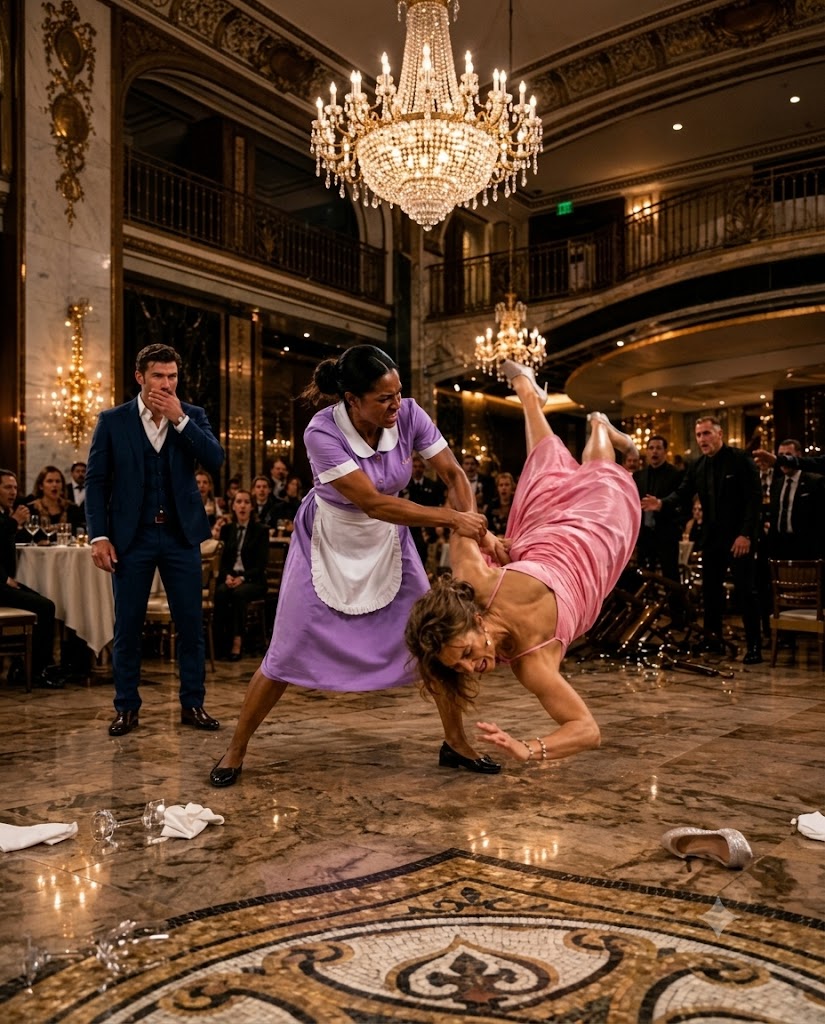
The Witmore Grand Hotel on Fifth Avenue had never looked more beautiful than it did that October night.
Crystal chandeliers the size of small cars hung from the ceiling, throwing warm gold light across 300 guests dressed in silk and tailored black.
Champagne towers glittered near the entrance, and a string quartet played somewhere near the back, soft enough that conversation could still float over it.
Everyone in New York who mattered was there because Daniel Witmore, 34 years old, one of the youngest real estate billionaires in the country, was about to announce his engagement.
Daniel stood near the head table in a navy three-piece suit, his dark hair combed back, his jaw clean shaven, his watch worth more than most people’s cars.
He looked exactly like what he was—a man who had built an empire from nothing but his father’s small construction company and his own relentless drive.
People loved to say Daniel Witmore had the Midas touch.
What they didn’t know was that underneath the tailored suits and the boardroom confidence, he was still, in some quiet corner of himself, a scared eight-year-old boy who remembered what it felt like to almost lose everything.
Beside him in a flowing pink satin gown that had cost more than a year of some people’s rent stood Bianca Reyes, 30 years old, radiant, camera-ready, the kind of beautiful that stopped conversations.
She laughed at the right moments.
She touched Daniel’s arm at the right moments.
She was, by every outward measure, the perfect fiancée for a man like him.
And near the back wall, almost invisible against the marble columns, stood a woman in a lavender maid’s uniform with a crisp white apron.
Her hair was pulled back tight into a bun.
Her hands, folded in front of her, were rough—the kind of rough that came from twenty years of scrubbing floors, carrying trays, and never once complaining.
Her name was Grace Alvarez.
She was 34 years old and she had worked in the Witmore household longer than Bianca had even known Daniel existed.
Most of the guests that night didn’t look at her twice.
To them, she was furniture, a uniform, a pair of hands that refilled glasses and cleared plates and disappeared the moment her job was done.
That was the way it had always been for Grace.
And honestly, she had made peace with it a long time ago.
She didn’t need to be seen.
She needed to survive—to send money home to her younger sister, to keep her head down and her mouth shut in a world that had taught her over and over that women like her were not supposed to be noticed.
But there was one thing about Grace that nobody in that ballroom knew.
One thing buried so deep in her past that even Daniel, who had known her for years, had never once asked the right question.
Grace hadn’t always folded napkins for a living.
Twenty-six years ago, in a small town two states away, Grace Alvarez had worn a very different kind of uniform.
She had grown up the daughter of an Army veteran who taught her, before he taught her almost anything else, how to fall without breaking, how to turn an attacker’s weight against them, how to protect herself in a world that did not always protect women like her.
By nineteen, she had earned a black belt in Krav Maga.
By twenty-two, she had briefly served overseas as a combat medic before a family tragedy called her home for good.
She never spoke about any of it.
Not to her co-workers, not to her employer, not even to the few friends she allowed herself to have.
Grace had learned the hard way that some parts of a person’s past are safer left buried.
So on that October night, as she stood quietly near the wall, refilling a champagne glass for an elderly guest, nobody had any reason to think of her as anything other than the maid.
Daniel, for his part, barely noticed her either.
Not out of cruelty, but out of the particular blindness that comes with a life lived at the top.
He was focused on the toast he was about to give, on the ring box in his jacket pocket, on the woman beside him who he believed with his whole heart loved him for exactly who he was.
What Daniel did not know—what almost no one in that room knew—was that Bianca Reyes had a temper that only came out when she believed no one important was watching.
She had learned over three years with Daniel exactly how to control her image in front of cameras, in front of his business partners, in front of his mother’s old friends.
But in front of staff, in front of people she considered beneath her notice, Bianca did not perform.
Bianca simply was.
And tonight, something small—something almost nothing—was about to happen.
A spilled drop of red wine.
A quiet apology from the maid near the wall.
And a reaction from Bianca Reyes that would reveal, in front of 300 witnesses and one very shocked billionaire, exactly who she really was.
Nobody in that ballroom could have guessed that the woman about to be humiliated in front of New York’s elite had once been trained to survive things far worse than a stranger’s cruelty.
And nobody could have guessed that by the end of the night, it wouldn’t be Grace who left that ballroom in shame.
—
The wine glass never should have mattered.
It was such a small thing—the kind of accident that happens a hundred times a night at events like this.
Grace had been moving carefully through the crowd with a tray of refills when a guest turned suddenly, bumping her elbow.
A single drop of red wine landed on the hem of Bianca’s pink satin gown.
Not a splash.
Not a stain that would ruin the dress.
Just one small dark drop against pale pink silk.
Grace felt her stomach drop instantly.
She set the tray down on the nearest table and reached for the cloth napkin folded over her arm.
“I am so sorry, ma’am,” she said quietly, kneeling slightly to dab at the fabric. “Let me get that before it sets.”
For most people, this would have ended there.
An apology, a dab of club soda, a laugh maybe about how these things happen.
But Bianca Reyes was not most people.
She looked down at Grace as if she were looking at something that had crawled out from under the hotel’s marble floor.
Her face, which had been glowing with camera-ready warmth just seconds earlier, hardened into something colder, sharper.
“Do you have any idea what this dress cost?” she snapped, her voice cutting through the string quartet’s soft melody.
Heads nearby began to turn.
“I’m very sorry,” Grace repeated, still kneeling, still trying to blot the fabric. “I can have it cleaned tonight. It will—”
“Don’t touch me.”
Bianca yanked her arm back so hard that Grace stumbled slightly on the marble.
“You people are so careless. Do you not train your staff before letting them near guests?”
The word *you people* landed in the room like a dropped glass.
A few guests near the front exchanged uncomfortable glances.
Daniel, still at the head table finishing a conversation with an investor, hadn’t yet noticed what was unfolding twenty feet away.
Grace straightened up slowly, her jaw tightening, though her voice remained level.
Twenty years of service work had taught her exactly how to swallow her pride in front of people who believed they owned it.
“I understand you’re upset,” she said calmly. “I’ll fetch the concierge and we’ll take care of the dress right away.”
She turned to walk away.
And that was when Bianca grabbed her wrist.
Hard.
Hard enough that Grace felt her fingernails dig into skin.
“I wasn’t finished talking to you,” Bianca hissed.
Her voice was low now—meant only for Grace, meant to humiliate without an audience catching every word.
“Look at me when I’m speaking. You people always think you can just walk away.”
Something in Grace’s chest went very still.
It wasn’t the grip on her wrist that did it.
She had endured worse—plenty of worse—in twenty years of quiet service.
It was the tone.
It was the casual, practiced cruelty of someone who had done this before to other people in other rooms and had never once faced a consequence for it.
It was the flicker of the words *you people*, said the exact way certain people say it when they believe no one worth listening to is in the room.
Grace turned her head calmly toward Bianca’s hand, still locked around her wrist.
“Let go of me,” she said, quiet and even.
But something underneath the words had shifted.
“Or what?” Bianca laughed—a short, sharp, disbelieving sound. Loud enough now that nearby tables definitely heard it. “You’ll do what, exactly?”
That was the moment Daniel finally turned around.
He caught only the tail end of it—his fiancée’s hand locked around the maid’s wrist, Bianca’s face twisted into something he had genuinely never seen before.
Not in three years together.
“Bianca,” he started, already moving toward them, already feeling something cold settle in his stomach.
But Bianca wasn’t finished.
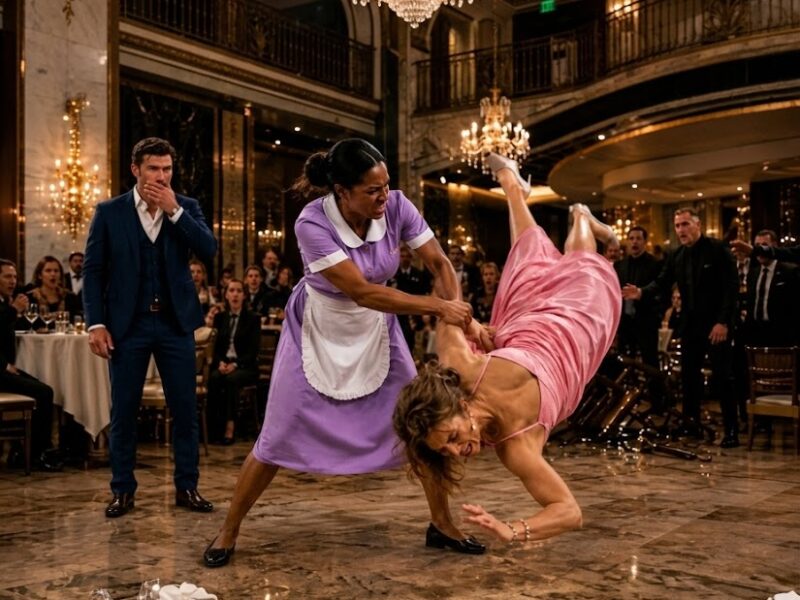
In one final, ugly motion, she shoved Grace backward.
Hard.
Meant to embarrass.
Meant to put the help back in her place in front of 300 of New York’s finest.
She did not expect what happened next.
Grace’s body reacted before her mind fully caught up.
Twenty years of buried training surfacing in a fraction of a second.
She didn’t throw a punch.
She didn’t need to.
She simply redirected the momentum of the shove, pivoted her weight the way her father had drilled into her a lifetime ago, and used Bianca’s own force against her.
Bianca’s designer heels left the marble floor entirely.
For one suspended second, the ballroom seemed to hold its breath.
Three hundred guests watching a woman in pink satin flip through the air as if the laws of gravity had briefly been suspended for her alone.
Champagne glasses froze halfway to lips.
The string quartet stumbled to a stop mid-note.
And Daniel Witmore stood frozen, hand over his mouth, watching the woman he was about to propose to go tumbling across the dance floor—thrown without a single ounce of visible effort by the maid he had walked past a thousand times without ever really seeing her.
The silence that followed was the loudest sound Grace had ever heard.
She looked down at her own hands as if they belonged to someone else.
Twenty years of staying invisible, of keeping her past locked away, of surviving quietly—undone in three seconds, in front of everyone who mattered in Daniel Witmore’s world.
She had no idea, standing there in that stunned silence, that this single moment was about to unravel a secret far bigger than her own.
—
Nobody moved for what felt like a full minute.
Bianca lay sprawled on the marble, her pink gown pulled around her, one heel still spinning slowly a few feet away.
For a woman who had spent her entire adult life curating every angle of how she appeared in public, this was the single worst moment of exposure she had ever experienced—and it had happened in front of the exact people whose opinions mattered most to her.
Daniel reached her first, crouching down, his voice tight with panic.
“Bianca, are you hurt? Someone call 911. Call a doctor.”
“I’m fine,” Bianca snapped, though her voice cracked with humiliation more than pain.
She scrambled to her feet, refusing help.
Her eyes locked on Grace with an expression that had curdled from anger into something closer to hatred.
“She attacked me. Everyone saw it. She attacked me.”
Whispers rippled through the crowd.
Phones, which had been discreetly tucked away for the elegant evening, began quietly rising.
A few had already caught the fall on video.
Two hotel security guards moved quickly through the parting crowd toward Grace, who stood perfectly still—her hands now folded in front of her exactly as they had been all night, as if the last ten seconds had never happened.
“Ma’am, we’re going to need you to come with us,” one guard said, reaching for her arm.
“Don’t,” Daniel said suddenly.
Everyone turned.
Even Bianca.
Daniel straightened up slowly, his eyes moving from his fiancée—still catching her breath on the floor—to the woman in the purple uniform who had just, without a single ounce of visible struggle, thrown a grown woman off her feet using nothing but redirected momentum.
Something about the movement had looked familiar to him.
Too clean.
Too controlled.
Too deliberate to be some kind of lucky reflex.
“Grace,” he said slowly, using her name for what felt like the first time all night, though she had worked events for his family for years. “What was that?”
Grace’s jaw tightened.
She glanced at the ring of phones now openly recording, at Bianca’s furious face, at Daniel’s confused one—and she made a decision that had been twenty-six years in the making.
“She grabbed my wrist and shoved me,” Grace said, her voice steady despite the entire ballroom hanging on every word. “I reacted. I’m sorry it happened in front of your guests, Mr. Witmore. It won’t happen again.”
“That’s not what I asked,” Daniel said quietly. “I asked what that was. That wasn’t a reaction. That was—”
He trailed off, searching for the word.
“That was trained.”
Grace said nothing.
Twenty years of silence were hard habits to break.
Even now.
It was Bianca, still trembling with fury and humiliation, who broke the moment wide open.
“Who even are you?” she spat at Grace, loud enough for the front tables to hear clearly now. “Some maid throws me across a ballroom, and everyone’s acting like it’s a mystery. Fire her, Daniel. Fire her right now, or I swear—”
“Bianca.”
Daniel’s voice was low, but it carried an authority that silenced her instantly.
The same voice he used in boardrooms when a deal was about to collapse.
“You put your hands on her first. I saw enough of it to know that.”
The room’s attention swung between them like a held breath.
“You’re taking her side?” Bianca’s voice cracked with disbelief. “In front of everyone? Over the help?”
And that word—*help*—spoken with such open contempt in front of 300 witnesses, seemed to finally crack something loose in Daniel that had been quietly forming for weeks.
Small things he had brushed aside.
The way Bianca spoke to waiters.
The way she’d once complained, half-joking, about how exhausting his mother’s old housekeeper was.
The way she’d never once, in three years, learned the names of the people who worked in his home.
“I need everyone to give us a moment,” Daniel said to the crowd.
His voice carried the practiced calm of a man used to controlling a room full of much bigger crises than this.
Slowly, reluctantly, conversation resumed at the edges of the ballroom, though every eye remained fixed on the small drama still unfolding center stage.
He turned to Grace.
“Where did you learn to move like that?”
Grace hesitated.
Twenty-six years of burying a past that had nearly cost her everything once already.
Twenty-six years of believing that some doors, once closed, were safer left shut forever.
But something about the way Daniel was looking at her—not with anger, not with suspicion, but with something closer to genuine curiosity, maybe even respect—made the old, careful walls inside her waver for the first time in a very long time.
“My father was a soldier,” she said finally, quietly, choosing her words with care. “He made sure I could protect myself. That’s all it was.”
It wasn’t a lie.
It also wasn’t the whole truth.
And the way Grace’s eyes flickered—just barely, just for a second—told Daniel that there was a great deal more beneath the surface of the woman who had spent years quietly serving drinks in his family’s home.
A woman he realized, standing there in the wreckage of his engagement announcement, that he actually knew almost nothing about.
Bianca, watching the exchange, felt something cold and dangerous settle behind her eyes.
She smoothed her disheveled gown, straightened her spine, and forced her voice back into its practiced, camera-ready calm.
“Fine,” she said, too evenly. “Believe her sob story if you want, Daniel. But I want her gone from this house by morning.”
What Bianca did not know—what nobody in that glittering ballroom yet knew—was that firing Grace Alvarez was about to become the single most dangerous decision Bianca Reyes had ever made.
Because Grace wasn’t just some maid with a mysterious past.
She was about to become the reason everything Bianca had built her entire relationship with Daniel on came crashing down.
—
The morning after the engagement party, Whitmore Manor was unusually quiet.
Daniel hadn’t slept.
He sat in his study long after Bianca had gone to bed, still furious, staring at nothing, replaying the ballroom over and over in his mind.
Not the fall.
That image had already burned itself into every phone and social feed in the city by midnight.
The video was racking up views under captions like *Billionaire’s Fiancée Gets Destroyed by Maid* and *You Won’t Believe What This Maid Did*.
No.
What kept Daniel awake wasn’t the spectacle.
It was the look on Grace’s face right before she’d said, *My father was a soldier.*
He had seen that look before.
Once, a long time ago, when he was eight years old, in the back office of his father’s small construction company—the week everything had almost fallen apart.
Daniel’s father, Robert Whitmore, had built the family business from a single truck and a handful of tools.
But before the empire, before the money, there had been a year Daniel had only ever heard fragments of—when the company had nearly collapsed.
A workplace accident.
A lawsuit that could have bankrupted them.
And somehow, mysteriously, the whole thing had simply resolved.
His father had never fully explained how.
He’d only ever said, with a strange, faraway look in his eyes, *Someone helped us when they didn’t have to. I never got the chance to properly thank her.*
Daniel sat up straight in his chair as a memory buried for twenty-six years began clawing its way to the surface.
He was eight years old.
His father’s office.
A woman in the doorway—maybe thirty—wearing an Army duffel bag over one shoulder, calm and steady in a way that had stuck with him even as a child.
The way she’d looked his frantic, panicking father directly in the eye and said, *Mr. Whitmore, I need you to trust me. I can fix this, but you have to let me.*
Daniel had never learned her name.
He’d been rushed out of the room minutes later.
But he remembered her face.
He remembered it because, as a terrified eight-year-old watching his father’s world nearly collapse, that woman’s calm had been the only steady thing in the room.
He remembered her eyes.
The same eyes that had looked back at him last night in the ballroom.
Right before she said, *My father was a soldier.*
Daniel’s hands were shaking slightly as he pulled up his laptop and began searching through his father’s old company archives—records his mother had kept, boxed away in the manor’s storage after his father passed three years ago.
It took him almost two hours, digging through decades-old personnel files and insurance settlements, before he found it.
A single scanned document.
A handwritten letter of gratitude dated twenty-six years earlier, addressed to a woman named Grace Alvarez—a former Army combat medic and family friend of an employee who had personally stepped in during a workplace accident that could have killed one of Robert Whitmore’s workers.
Stabilizing him with battlefield trauma skills until paramedics arrived.
And who had later, quietly and without ever asking for credit, convinced the injured man’s family not to pursue a lawsuit that would have bankrupted the company—because she believed, in her words, that *Robert Whitmore is a good man who made an honest mistake, and good men deserve a second chance.*
Daniel stared at the name on the page until his vision blurred.
Grace Alvarez.
The same woman who had, for the past six years, quietly refilled water glasses in his family’s dining room.
The same woman his fiancée had just demanded be fired without a second thought.
The same woman who, twenty-six years ago, had single-handedly saved his father’s company—and by extension, everything Daniel had ever built on top of it—and had never once, in six years of working in his home, mentioned a single word of it.
He sat back slowly, the full weight of it settling over him like cold water.
His entire empire—the skyscrapers, the deals, the inheritance that had let him become one of the youngest billionaires in the country—existed because of a decision this woman had made twenty-six years ago.
For no reward.
No recognition.
Nothing at all except the simple belief that his father deserved a chance to make things right.
And last night, his own fiancée had grabbed that same woman by the wrist, called her *you people*, and demanded she be thrown out onto the street by morning.
Daniel closed his laptop and sat in the dark study for a long time, feeling something inside him shift permanently.
Not just about Grace.
Not just about Bianca.
But about the entire life he had been building, seemingly without ever really looking at the people who had quietly made it possible.
When the sun finally rose over Whitmore Manor, Daniel Witmore walked downstairs, still in yesterday’s shirt, and found Grace exactly where she always was at that hour—quietly setting the breakfast table as if the entire world hadn’t turned upside down twelve hours earlier.
“Grace,” he said softly. “We need to talk. About twenty-six years ago.”
For the first time since he’d known her, Grace Alvarez went completely still, the color draining slightly from her face.
The secret she had buried for a quarter of a century had finally found her.
—
Grace stood frozen in the doorway of the breakfast room, a stack of folded linen napkins still in her hands, watching Daniel Whitmore look at her the way no one had looked at her in twenty-six years.
Like he actually saw her.
“You know,” she said quietly.
It wasn’t a question.
“I found the letter my father kept,” Daniel said, setting a worn manila folder on the table between them. “The one about the accident. About the lawsuit that never happened. About a combat medic who saved a man’s life with her bare hands and then convinced his family to give my father a second chance he didn’t deserve.”
He paused.
“About Grace Alvarez.”
Grace set the napkins down slowly, her hands trembling just slightly—the first crack in twenty-six years of careful composure.
“I didn’t want anything from him,” she said. “I didn’t do it for a reward. I did it because it was right.”
“I know,” Daniel said. “That’s exactly why I can’t understand why you never told me. Six years, Grace. Six years working in this house, and you let me believe you were just—”
He stopped himself before the word came out, ashamed of how close he’d come to saying it.
“Just the help,” Grace finished for him, without bitterness. “Just quiet honesty. That’s all right, Mr. Whitmore. That’s what I was hired to be.”
“Don’t call me that,” Daniel said, something raw breaking through his usual composure. “Not after everything. Please. Just Daniel.”
Grace allowed herself, for the first time in years, to actually sit down in the presence of the family she worked for.
Daniel poured her coffee himself—an act so small and so unfamiliar to both of them that neither quite knew what to do with the silence that followed.
“My father used to talk about a woman who saved everything,” Daniel said eventually. “He never told us her name. He said it wouldn’t be right—that she never wanted credit. I always pictured someone… I don’t know. Older. A stranger who appeared once and vanished.”
He shook his head slowly.
“Not someone who’s been quietly serving my family breakfast for six years.”
“I needed the work,” Grace said simply. “After I left the service, after my father passed, things were hard. My sister was young. I was the only one left to take care of her. A friend told me the Witmore family was hiring household staff. I almost said no when I saw the name. I wasn’t sure I could face your father again without him recognizing me and making a whole thing out of it. But your father had passed just before I was hired. And by then, honestly, I needed the paycheck more than I needed to protect my pride.”
“And you never told anyone,” Daniel said. “Not once in six years.”
“What was there to tell?” Grace looked at him steadily. “That once, a long time ago, I did something decent for a stranger. That’s not a story, Daniel. That’s just what you do when you can.”
Daniel felt something tighten in his throat.
He thought of every extravagant party he’d thrown, every headline about his business acumen, every magazine profile calling him a self-made success.
And he thought about how none of it—not one single deal, not one skyscraper—would exist if this woman hadn’t chosen decency over convenience twenty-six years ago, expecting absolutely nothing in return.
“Last night,” he said slowly, “Bianca demanded I fire you in front of 300 people.”
Grace’s expression didn’t change, though something in her eyes flickered.
“I heard.”
“I need you to know,” Daniel said, “that’s not happening. Not now. Not ever.”
He hesitated, then added, quieter: “And I need to figure out what it means that the woman I was about to marry could treat someone like that without a second of hesitation. The moment she thought no one important was watching.”
Grace said nothing to that.
It wasn’t her place.
And twenty years of careful silence weren’t habits that broke overnight, even now.
But she didn’t need to say anything.
The truth of Bianca Reyes had already announced itself loudly in front of an entire ballroom.
Upstairs, unbeknownst to either of them, Bianca Reyes stood at the top of the staircase, one hand gripping the banister, having heard just enough of the conversation drifting up through the open hallway to understand two very dangerous things.
Daniel knew about the letter.
And Daniel was no longer looking at Grace Alvarez as the help.
Bianca’s mind moved quickly, the way it always did when her carefully built world felt threatened.
She had spent three years learning exactly who mattered in Daniel’s life and exactly how to keep them at a careful distance—his overprotective older sister, his skeptical business partner, and now, apparently, a maid with a secret debt owed to the entire Whitmore fortune.
If Daniel started seeing Grace as something more than staff, if this story got out publicly—*a billionaire’s fiancée humiliating the very woman who saved his family’s company*—Bianca’s carefully polished public image would not survive it.
She needed to get ahead of this.
And she needed to do it before Daniel had time to think any further.
By the time she descended the stairs twenty minutes later, freshly composed, her voice sugar-sweet, Bianca had already built her plan.
“Daniel, darling,” she said, gliding into the breakfast room as if the previous night’s humiliation had simply never happened. “I’ve been thinking. I was clearly overwhelmed last night. The stress of the party. I said things I regret.”
She turned toward Grace with a smile so practiced it barely moved her eyes.
“I’d love to make it right. Perhaps a nice bonus. And we put this whole unfortunate misunderstanding behind us.”
Grace studied her carefully, recognizing immediately what this was.
Not remorse.
Damage control.
Daniel, for the first time in three years, recognized it, too.
“Bianca,” he said slowly. “I think it’s time we talked. Just the two of us.”
The sweetness in Bianca’s expression flickered.
Just slightly—like a mask sliding half an inch out of place.
Enough for Grace, standing quietly by the window, to see exactly what was underneath.
And enough for Daniel to finally understand that the woman he had planned to marry and the woman standing in his family’s kitchen with two decades of quiet integrity behind her were not even close to being cut from the same cloth.
—
The conversation between Daniel and Bianca lasted almost two hours behind the closed doors of his study, and by the time it ended, half the household staff—careful never to appear as though they were listening, though, of course, they were—understood that something fundamental had shifted in Whitmore Manor.
“You’re seriously choosing a maid’s feelings over three years of us?”
Bianca’s voice, muffled through the heavy oak door, had lost all of its ballroom polish.
“I’m not choosing anyone over you,” Daniel replied, his voice steady but firm. “I’m asking you to explain why the first instinct you had—the very first—when a woman apologized to you for an accident, was to grab her and throw her back like she was garbage.”
“She embarrassed me in front of everyone.”
“She apologized to you, Bianca. Immediately. And you grabbed her wrist hard enough to leave marks.”
There was a long pause.
When Bianca spoke again, her voice had dropped into something colder, more calculating.
“This isn’t about her, is it? This is about that letter. About what she did for your father. You’re not defending some maid, Daniel. You’re falling for a story.”
“I’m defending someone who was treated cruelly for absolutely no reason,” Daniel said. “That should have been true regardless of any letter.”
Bianca laughed—sharp and humorless.
“Would you have even noticed if she wasn’t secretly some war hero who saved your daddy’s business? Be honest. If she was just some random woman who spilled a drink on me, would you be standing here defending her right now? Or would you already be halfway through firing her like I asked?”
The silence that followed was long enough that even the staff pretending not to listen in the hallway held their breath.
Because the truth—uncomfortable as it was—sat heavy in Daniel’s chest.
Would he have reacted the same way if Grace had just been an anonymous employee with no extraordinary past, no secret debt owed to his family?
He wanted to believe yes.
He wanted to believe he would have defended anyone treated that cruelly, regardless of who they turned out to be.
But some small, honest part of him wasn’t entirely sure.
And that uncertainty bothered him more than anything Bianca had said all morning.
“That’s not a fair question,” he said finally, though his voice had lost some of its earlier conviction.
“It’s the only fair question,” Bianca snapped. “You’re not a good person for defending her now, Daniel. You’re just a person who got lucky enough to find out her secret before it was too late.”
It was a cruel thing to say.
And worse, it landed somewhere true.
Not about Grace—but about Daniel himself.
About a life spent moving through the world without truly seeing the people who made it run.
He thought of every driver, every housekeeper, every assistant he’d walked past over the years without learning a single detail about their lives beyond their job title.
He thought about how easily this exact same scene could have played out with any other member of his staff—someone without a hidden letter buried in his father’s old files.
And how, if it had, would he have even paused to ask questions at all?
That night, alone in his study, long after Bianca had stormed off to the guest wing, Daniel made a decision that had nothing to do with Grace’s secret past and everything to do with the kind of man he wanted to actually be.
He found Grace in the small staff kitchen near the back of the house, finishing the last of the evening cleanup, and he sat down across from her without any of the formality that usually separated them.
“I need to ask you something honestly,” he said. “And I need you to answer honestly, even if it’s not what I want to hear.”
Grace set down her cloth, waiting.
“If you’d never saved my father’s company,” Daniel said slowly, “if there was no letter, no debt, nothing extraordinary about your past at all—would what Bianca did to you last night still have been wrong?”
Grace looked at him for a long moment, surprised perhaps that this was the question he’d chosen to ask.
“Of course it would,” she said simply. “Cruelty doesn’t need a résumé to be wrong, Daniel. It’s wrong whether the person on the receiving end saved a company or scrubbed floors their whole life without ever doing anything anyone would call extraordinary. You don’t get to decide someone deserves basic decency based on what they’ve done for you.”
A pause.
“That’s the mistake most people in your world make, if you don’t mind me saying so. You think respect is something people earn through impressive stories. Most of us are just trying to get through the day without being made to feel small.”
Daniel sat with that for a long moment, the weight of it settling somewhere deep and uncomfortable—somewhere he suspected would stay with him for a long time.
“You’re right,” he said quietly. “And I’m sorry it took a letter from twenty-six years ago for me to actually see you.”
Grace allowed herself, for the first time since the ballroom, a small, tired smile.
“You’re seeing me now,” she said. “That’s more than most people ever manage.”
Neither of them yet knew that Bianca, listening quietly from the hallway once again, had just heard enough to understand that her carefully built future with Daniel Whitmore was slipping through her fingers.
And that she was about to make one final, desperate attempt to hold on to it—in a way that would expose exactly who she really was to the entire world.
—
By the following week, the ballroom video had exploded across the internet.
What began as a single grainy clip—a woman in pink satin flipping through the air on a marble dance floor—had transformed within days into a full-blown media story.
News outlets that would never have covered an ordinary society engagement suddenly couldn’t get enough of it.
*Billionaire’s Fiancée Humiliated by Family Maid*, one headline read.
Another, more accurately: *Daniel Whitmore’s Fiancée in the Wrong? Viewers Weigh In.*
Video essays broke down the footage frame by frame.
Commentators debated Bianca’s body language, her tone, the exact moment her hand closed around Grace’s wrist.
Bianca Reyes, who had spent three years carefully cultivating a public image of effortless grace and old-money warmth, watched her reputation crumble in real time—one viral repost at a time.
She tried, at first, to control the narrative.
A carefully worded statement released through a publicist called the incident “a private matter blown out of proportion by strangers online,” insisting she and the staff member in question had “resolved things amicably.”
But the internet, as it so often does, had already moved past anything she could control.
Someone had tracked down a former assistant of Bianca’s who came forward anonymously, describing a pattern.
Small cruelties toward waitstaff, drivers, assistants—all carefully hidden from Daniel and from cameras, all dismissed by Bianca as simply “having standards.”
The story was no longer about one spilled drop of wine.
It had become about who Bianca Reyes really was underneath three years of careful performance.
Daniel watched it all unfold with a growing, uncomfortable clarity.
Every day brought a new detail, a new anonymous account, a new piece of a puzzle he realized, with a sinking feeling, he should have noticed himself years ago.
He thought about small moments he’d brushed aside.
Bianca’s clipped tone with a rideshare driver once.
Her off-hand comment about how “some people just aren’t built for hospitality work.”
The way she’d never once, in three years, learned the name of his longtime driver, Marcus, despite riding with him weekly.
He hadn’t seen it because he hadn’t been looking.
That realization sat heavier with him than almost anything else.
Grace, meanwhile, had become an unlikely—and entirely unwilling—public figure.
Reporters staked out the gates of Witmore Manor hoping for a comment.
Her photo, pulled from an old military archive—her posture straight, her eyes steady—began circulating alongside captions calling her a hero, a warrior, a woman who deserved better than a lifetime of invisibility.
Grace found none of it comfortable.
She had spent twenty-six years carefully avoiding exactly this kind of attention.
“I never wanted this,” she told Daniel one evening, sitting in the same small kitchen where their most honest conversations had started happening. “I liked being invisible. It was safer.”
“Safer from what?” Daniel asked gently.
Grace considered the question for a long moment.
“From people deciding my worth based on a story,” she said finally. “For twenty years, nobody looked at me twice. And that was fine, because it meant nobody got to decide whether I mattered based on what I’d done or hadn’t done. Now the whole world knows about that letter. And suddenly I’m a hero. But I was the same person a month ago when I was just the maid. Nobody noticed. Nothing about who I am has changed. Just what people know.”
Daniel absorbed that with the same discomfort as everything else Grace had quietly taught him over the past week.
“That’s a hard thing to hear,” he admitted.
“It’s not meant to hurt you,” Grace said. “It’s meant to help you see clearly. The version of me worth defending was always here, Daniel. Long before you found that letter.”
That evening, Daniel made a decision that would end up defining the entire next chapter of his life, though he didn’t fully realize it yet.
He called Bianca into his study one final time.
“I can’t marry someone,” he said quietly, “who only shows kindness when she thinks it’s being watched. I spent three years believing I knew you. I’m not sure I ever really did.”
Bianca’s composure, worn thin by weeks of public scrutiny, finally cracked entirely.
“You’re going to throw away three years,” she said, her voice trembling now with something closer to genuine desperation than performance, “over a maid?”
“No,” Daniel said, and for the first time in the entire ordeal, his voice carried no anger at all—only a tired, settled clarity. “I’m ending this because of who you showed me you really are. The moment you thought it didn’t matter who was watching. Grace didn’t do this to you, Bianca. You did this to yourself.”
The engagement ring—the one meant to be presented that fateful ballroom night—was quietly returned to its box the following morning.
And by the end of the month, Bianca Reyes had left Whitmore Manor for good.
Her carefully built future, dissolved not by a single scandal, but by the slow, undeniable unraveling of a truth that had been sitting underneath her polished surface the entire time.
The manor felt different in the weeks that followed.
Quieter—but not in the heavy, uncomfortable way it had felt during the media storm.
This was a different kind of quiet.
Settled.
Earnest.
Daniel found himself, almost without meaning to, spending more time in the parts of the house he’d rarely paid attention to before.
The kitchen in the early mornings.
The small staff dining area.
The garden, where the groundskeeper—a soft-spoken man named Eli—had worked for fifteen years without Daniel ever once learning his last name.
He learned it that month.
Delgado.
He learned Marcus, his longtime driver, had a daughter starting college that fall.
He learned the head chef, Priya, had trained in Paris before immigrating and building an entirely new career from nothing.
He learned, slowly and with no small amount of shame, that he had been living inside a house full of entire lives he had simply never bothered to notice.
Grace watched this transformation with quiet, careful hope—not for herself particularly, but for what it seemed to mean about the kind of man Daniel was choosing to become.
She had seen plenty of wealthy people, over twenty years of service work, suddenly discover a conscience in a moment of crisis only to let it quietly fade once the cameras moved on to the next story.
She waited to see if Daniel would be different.
He was.
A month after the engagement ended, Daniel called a full staff meeting at Whitmore Manor—something that had genuinely never happened before in the history of the house.
He stood in front of nearly thirty employees, some of whom had worked there for decades, and did something none of them expected.
He apologized.
“I’ve spent most of my adult life believing that running this house, running this company, meant focusing on the big decisions,” he said. “The deals. The investments. The headlines. I never once stopped to think about the people who actually made any of that possible. The people who kept this house running, who raised this company up brick by brick alongside my father, who I walked past every single day without learning their names.”
He paused, his eyes finding Grace near the back of the room.
“I found out recently that one of you saved my father’s entire company twenty-six years ago, expecting absolutely nothing in return—and never told a single soul. That’s not an isolated story. I have a feeling most of you have given more to this family than I’ve ever bothered to notice. That changes starting today.”
He announced, that same afternoon, a complete restructuring of staff benefits.
Better wages across the board.
Full health care coverage.
A college fund program for employees’ children—modeled, he said, after nothing more complicated than finally treating people the way they always should have been treated.
And for Grace specifically, he made one more offer—not out of guilt, and not out of debt repaid, but out of something that had grown slowly and unexpectedly into genuine respect.
“I want to start a foundation,” he told her, sitting once again in the small kitchen that had become the site of so many honest conversations. “For veterans transitioning out of service. Especially women—who don’t have an easy path back into stable work. I don’t know the first thing about how to run something like that well. But I know someone who does.”
Grace looked at him for a long moment, disbelief, gratitude, and something like cautious hope moving across her face all at once.
“You want me to run it?”
“I want you to build it,” Daniel said. “However you think it should be built. I’ll fund it and stay out of your way.”
For twenty-six years, Grace Alvarez had quietly carried the weight of a past she believed the world had no room for.
A soldier’s training folded away beneath a maid’s uniform.
A life of service before service, invisible even to the people who benefited most from her choices.
She had made peace, long ago, with being unseen.
She had never once let herself imagine being seen like this.
“I’d like that,” she said quietly, her voice thick with something she hadn’t let herself feel in a very long time. “I’d like that very much.”
—
The Alvarez-Witmore Foundation for Veteran Transition launched eight months later in a converted community center just outside the city—a far cry from the marble ballrooms and crystal chandeliers of that October night, and exactly the kind of place Grace insisted it needed to be.
She had spent those eight months pouring everything she had into building something real.
Partnering with veteran hospitals.
Designing job training programs specifically for people like her—who had spent years learning skills the civilian world rarely knew how to value.
She hired other veterans first.
Women especially.
Women who had spent years feeling exactly as invisible as she once had.
Daniel kept his promise.
He funded it fully and quietly stepped back, showing up not as the billionaire whose name was on the building, but simply as a volunteer most Thursday afternoons—learning, slowly, what it actually meant to build something that mattered rather than simply write a check and call it charity.
The two of them had not, in the months since Bianca’s departure, rushed into anything resembling romance.
Grace had made it clear—gently but firmly—early on that she had no interest in becoming some kind of storybook ending.
A maid swept off her feet by the billionaire she’d once saved.
“I don’t want to be a headline,” she told him once. “I want to build something that outlasts both of us.”
Daniel had respected that completely.
What grew between them instead—slowly, and without any pressure—was something steadier.
Genuine friendship.
Built on honesty.
Built on two people who had each, in their own way, been forced to confront who they really were underneath everything the world assumed about them.
It was nearly a year after that October night when Grace’s younger sister, Elena—now twenty-six and newly graduated from nursing school, thanks in part to the foundation’s scholarship program—stood in front of a small graduation ceremony and told the story publicly for the first time.
Not the viral ballroom version.
The real one.
A sister who had given up nearly everything for twenty years to make sure Elena never had to worry about where her next meal was coming from.
A woman who had buried an entire heroic past because survival, for people like them, rarely left room for anyone to ask about who you used to be.
Grace, sitting in the audience, cried for the first time in longer than she could remember.
Not from sadness—but from the strange, overwhelming relief of finally being fully seen.
Not as a viral moment.
Not as a headline.
But as exactly who she had always quietly been.
Daniel, sitting beside her, reached over and took her hand.
Not as a billionaire.
Not as her employer.
But simply as a man who had learned the hard way what it actually meant to notice the people who had been standing right in front of him the entire time.
—
Two years after that October night, the Witmore Grand Hotel hosted another event.
Smaller this time.
No chandeliers dripping gold.
No 300 curated guests.
Just a modest gathering to celebrate the foundation’s second graduating class of veterans transitioning into stable careers.
Forty-three men and women who had walked through Grace Alvarez’s doors with nothing but training the world didn’t know how to value—and walked out with futures they’d built with their own two hands.
Grace stood at the front of the room, no longer in a maid’s uniform, no longer invisible, wearing a simple navy dress and the same steady calm she had carried through every version of her life.
The soldier.
The medic.
The quiet caretaker.
The woman who had once been thrown across a headline for defending herself in a ballroom—and had turned that moment, against every odd, into something that had already changed dozens of lives.
“I spent twenty years believing that the safest thing I could be was invisible,” she told the room, her voice steady despite the weight of what she was about to say. “I thought if nobody looked at me too closely, nobody could take anything else away from me. I was wrong. Being seen isn’t dangerous. Being unseen—being treated like you don’t matter until you’ve proven some extraordinary reason why you should—that’s the real danger.”
She paused, letting the words settle.
“Every person in this room deserves basic decency. Not because of what they’ve survived. Not because of some medal or some letter buried in someone’s files. But simply because they’re human beings trying to build a life. That’s the whole lesson. That’s all it ever needed to be.”
Daniel, standing near the back of the room, no longer needed anyone to explain that lesson to him.
He had learned it the hard way, in the worst possible spotlight, in front of 300 witnesses and eventually the entire internet.
He had learned that the people easiest to overlook are so often carrying the heaviest, most extraordinary lives.
And that real character isn’t measured by how someone treats the people who can do something for them—but by how they treat the people who, as far as they know, can’t.
Grace Alvarez never set out to be anyone’s hero.
She had simply, quietly, for twenty-six years, chosen decency when it would have been easier not to.
First, for a struggling family she barely knew.
And again, without meaning to, for a billionaire who finally learned to see the people standing quietly in the rooms he’d built his whole life around.
—
*If this story moved you even a little, do me a favor. Hit that like button. It genuinely helps this story reach more people who need to hear it. Subscribe if you’re new here, because we tell stories exactly like this one every single week. And if you know someone who could use a reminder that kindness—even the quiet, unnoticed kind—always finds its way back around, share this with them today. Because somewhere out there right now, someone is being overlooked the exact same way Grace once was. And you never know whose whole life you might change just by finally choosing to see.*









