The Billionaire Knelt to Wash a Homeless Man’s Feet—Then Revealed Who He Really Was
## Part 1
The rain had stopped an hour ago, but the streets of downtown Chicago still gleamed like wet chrome under the February sky.
Daniel Whitmore stepped out of his black Escalade, ignoring the driver who hurried to open the door for him. At thirty-six, he had the kind of face that graced magazine covers—sharp jaw, calculating eyes, the confident posture of a man who had never known failure.
He was worth $4.7 billion.
He owned properties in eleven countries, controlled a logistics empire that moved goods across three continents, and had been named Forbes’ youngest self-made billionaire in Illinois three years running.
But none of that mattered right now.
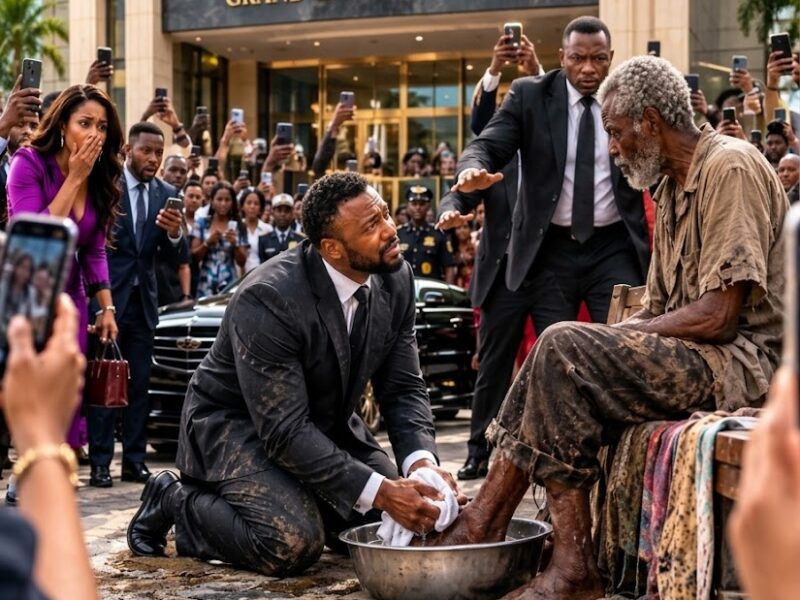
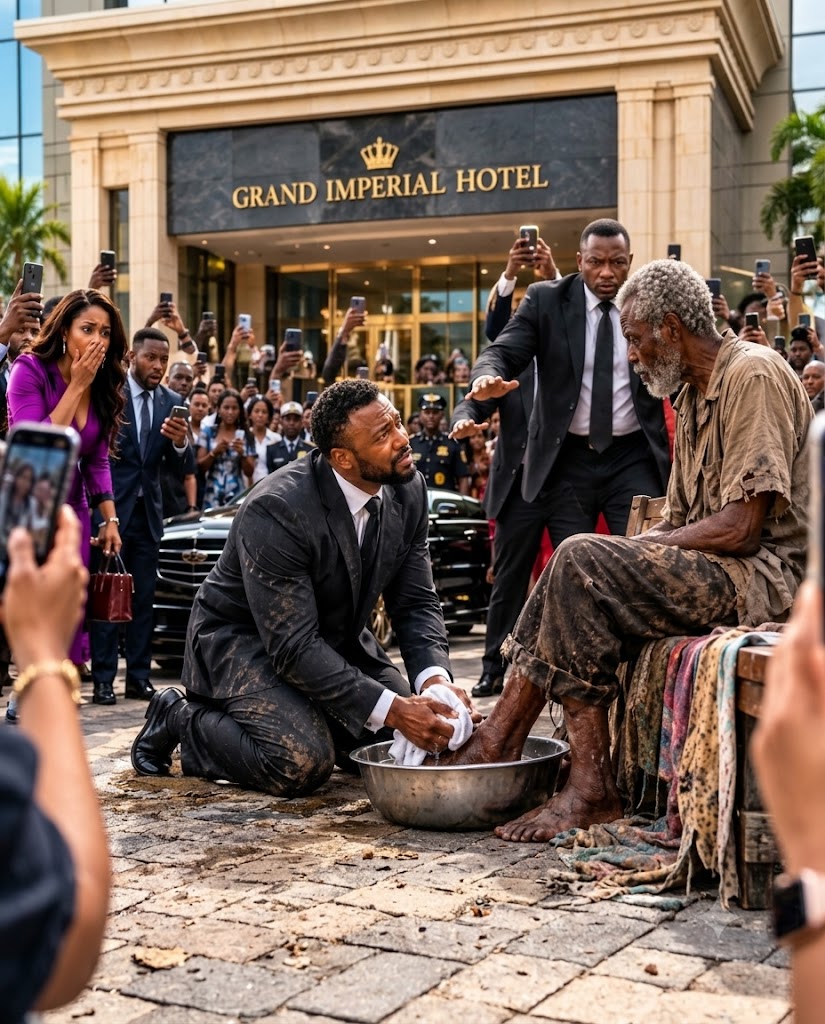
Right now, he was standing on West Adams Street, watching a homeless man wash his feet.
“Sir? Sir, are you okay?”
Daniel’s executive assistant, Marcus, hovered nearby, his phone already out and recording. Around them, a small crowd had gathered—office workers on lunch break, a delivery driver, two teenagers who had stopped filming TikTok videos long enough to gawk.
The homeless man knelt on the wet concrete, his gray beard matted with rain, his clothes a patchwork of stains and tears.
In his hands, he held a plastic bottle of water and a rag so dirty it looked like it had been pulled from a dumpster.
And he was washing Daniel Whitmore’s feet.
“Is that really him?” someone whispered.
“Oh my god, that’s Daniel Whitmore. The billionaire.”
“What’s happening?”
“Why is he letting that guy touch him?”
Daniel couldn’t move. His Italian leather shoes sat beside him on the pavement, discarded like an afterthought. His socks were gone too. His bare feet rested on the cold, wet ground while the old man poured water over them, his movements slow and deliberate.
“Sir,” Marcus said, his voice tight. “Sir, please stand up. Everyone is recording.”
The old man didn’t look up. His hands trembled as he wrung out the rag, then pressed it gently against Daniel’s ankle.
“Have we met before?” Daniel heard himself ask.
The question hung in the air like smoke.
The old man finally lifted his head. His eyes were pale blue, clouded with age but sharp with something else—something that made Daniel’s chest tighten.
“No,” the man said softly.
“Then why are you washing my feet?”
Those eyes.
Daniel felt something crack open inside him, a door he hadn’t known existed. Memories that weren’t memories—flashes of rain, of water rising, of strong arms carrying him through the flood.
“Please,” Daniel whispered. “Don’t remember.”
“Remember what?”
“Who I am.”
The old man’s lips curved into a sad smile. “How could I forget my own son?”
—
Gasps rippled through the crowd.
“Did he just call him his son?”
“What?”
“No way.”
Marcus stepped forward, his hand raised. “Everybody step back. Please step back.”
But Daniel didn’t hear him.
He was staring at the old man, at those pale blue eyes, at the way his hands shook as they held the dirty rag.
“What did you just call me?”
“I said you are my son.”
The words hit Daniel like a physical blow. He stumbled backward, his bare feet slipping on the wet concrete.
“You don’t know me.”
“I know that face. I know those eyes.”
“You’re mistaken.”
The old man tilted his head. “Maybe. But you don’t look like a stranger to me.”
Daniel’s throat constricted. He turned to Marcus, his voice barely a whisper. “Get him inside.”
“Sir—”
“I said get him inside.”
“No, no, please, don’t touch him.”
The voice came from somewhere in the crowd—a woman, her face half-hidden by a scarf. Before Daniel could react, she disappeared into the mass of onlookers.
“Why are you protecting me?” he called after her.
But she was gone.
“Who is that?” Daniel demanded.
“I don’t know, sir.”
“Find him.”
“Yes, sir.”
“Before anyone else does.”
Marcus was already on his phone. “It’s already everywhere. How many views?”
“Two hundred thousand. No—three hundred thousand. It’s moving too fast.”
—
Daniel’s penthouse overlooked the Chicago River, a glass-and-steel monument to everything he had built.
He stood at the window now, still barefoot, his shoes abandoned somewhere in the foyer. His mother’s voice crackled through the speakerphone.
“Daniel. What happened out there?”
“I don’t know.”
“That’s what you’re going with? Daniel, you were on your knees washing the feet of a homeless man. You were afraid of him. I’ve never seen that look on your face.”
He closed his eyes. “Mom?”
“Where are you?”
“The hotel.”
“Did you see him?”
“See who?”
“The old man.”
Daniel’s pulse quickened. “Why do you know about him?”
“Daniel, listen to me. Stay away from that man.”
“Who is he?”
“Daniel—”
“Mom, who is that man?”
The line went dead.
—
“She knows him,” Daniel said, pacing his office. “My mother knows him. How?”
Marcus stood by the door, his tablet in hand. “I don’t know. We checked the hotel cameras.”
“And?”
“He walked out through the service entrance.”
“Where did he go?”
“We lost him.”
Daniel slammed his fist against the desk. “Find him.”
“Sir, may I ask why?”
“No.”
“I don’t understand. Who is that man? Daniel is terrified of him.”
The question came from Marcus’s lips, but it wasn’t Marcus’s voice.
Daniel spun around.
His uncle Samuel stood in the doorway—a man who had been dead for thirty-eight years.
—
## Part 2
The silence stretched like a rubber band about to snap.
Daniel’s hand moved instinctively toward his phone, toward the security app that would summon a dozen armed guards in seconds. But something stopped him.
Samuel looked older than Daniel remembered—though Daniel didn’t remember him at all. That was the problem. The man standing in his doorway was a stranger, and yet his face felt familiar in a way that made Daniel’s skin crawl.
“What men?” Samuel asked.
“What?”
“Some men were looking for you. What men?”
Daniel blinked. “I don’t—how did you get in here?”
Samuel stepped into the room, his movements careful, deliberate. He was wearing clothes that didn’t fit him—a navy blazer over a wrinkled shirt, jeans that pooled around his ankles. Someone had tried to clean him up.
“I don’t know,” Samuel said. “They were asking your name. I told them I didn’t know you.”
“Good.”
“Why are you hiding?”
Samuel stopped in the center of the room. “Because some people don’t like ghosts coming back.” His voice cracked. “I only wanted to see my son.”
Daniel’s chest tightened. “Who is Samuel?”
“I don’t know.”
“Mom knew his name. So did you. You allow a stranger to disturb judgment. He called me his son. He’s an old homeless man.”
“That doesn’t answer me.”
“No.”
“For the first time in my life I’m asking you a simple question. Who is that man?”
Daniel turned away. “He’s nobody.”
“Then why are you shaking?”
—
The photograph arrived at 3:47 AM.
Daniel had been sitting in the dark, his laptop open, the video of the foot-washing playing on a loop. Three hundred thousand views had become two million. Then five. Then twelve.
The hashtag #BillionaireFeet had trended worldwide.
His phone buzzed. Marcus.
“I found an old photograph.”
“Send it to me.”
“Yes, sir.”
The image loaded slowly, pixel by pixel. A young woman—his mother, decades younger—stood beside a man with pale blue eyes. In her arms, she held a baby.
On the back of the photograph, in faded ink: *1989*.
Daniel’s breath caught.
That was the year he was born.
—
“Mom. I found the photograph. Tell me the truth. Is that me?”
The silence on the other end of the line was deafening.
“And Samuel? Mom.”
“Yes.”
“Yes, what?”
“He is your biological father.”
Daniel’s hand tightened around the phone. “My biological father? Then why did you let me believe Richard was my father?”
“We were trying to protect you.”
“From him? Or from the truth?”
—
The letter arrived the next day, hand-delivered by a woman Daniel had never met.
She was in her sixties, with silver hair and kind eyes that held a deep sadness.
“Your father asked me to give this to you,” she said. “If anything ever happened to him.”
Daniel took the envelope. His name was written on the front in shaky handwriting.
*Daniel. If you’re reading this, it means they finally failed to keep me away from you. I never abandoned you. I came back for you.*
*Someone stopped him.*
Daniel looked up. “Who?”
“I don’t know. But I know it wasn’t your mother.”
—
The photograph lay on Daniel’s desk, next to the letter.
He studied the image, looking for clues he might have missed. The background was blurry—a park, maybe, or a playground. His mother was smiling, but her eyes looked tired.
And then he saw it.
Written in the corner, so faint he had almost missed it: *1997*.
Daniel’s heart stopped.
1997. He was eight years old.
He came back when I was eight.
—
“We have a problem.”
Richard Whitmore stood in his study, his back to the door. He was seventy-two years old, silver-haired, distinguished—the kind of man who had built his fortune on quiet ruthlessness.
“I know,” his wife said.
“Daniel has seen the photograph.”
“Who gave it to him?”
“The senior assistant found it.”
“Where?”
“The old workshop. And Daniel has the letter.”
Richard turned. “What letter?”
“The one thing Samuel was never supposed to keep.”
Richard’s jaw tightened. “Then he remembers.”
“And if he tells Daniel everything, then we have a bigger problem.”
“What do we do?”
Richard walked to his desk, opened a drawer, and removed a small black notebook. “Find Samuel. This time, we make sure he disappears properly.”
—
Daniel hadn’t slept in forty-eight hours.
Marcus found him in the office at dawn, staring at the photograph, the letter spread out before him.
“You haven’t slept.”
“I can’t.”
“You should rest.”
“How do I sleep after finding out the man I’ve called my father for almost forty years may not be my father?”
Marcus was silent for a moment. Then: “Then don’t sleep. Find the truth.”
“He came back for me when I was eight.”
“Yes.”
“Somebody stopped him.”
“We need to know who.”
Daniel stood. “Before anything else, I need to find Samuel.”
—
“Sir, did you find him?”
“Not yet.”
“Then keep searching.”
“We’re searching everywhere.”
Daniel’s voice was ice. “I’m not asking you to search everywhere. I’m asking you to find one man. My father.”
“Yes, sir.”
“And when you find him, nobody touches him.”
“Yes, sir.”
—
## Part 3
The hospital records were sealed.
Daniel had to call in three favors and threaten two lawsuits to get them. But at 2:15 PM on a Thursday, a fax arrived at his office—actual paper, as if the past was demanding to be felt.
Patient: Daniel Whitmore.
Age: 8.
Admission Date: March 17, 1997.
Reason: Near-drowning.
Notes: Patient brought to ER by unidentified male. Male was soaking wet, carrying patient. Repeated only one phrase: “Save my son.”
Discharge: Patient released to mother, Margaret Whitmore, and Richard Whitmore.
Daniel read the page three times.
Then he read it again.
He remembered rain. He remembered water everywhere, rising around him, filling his lungs. He remembered strong arms pulling him from the flood, a voice in his ear: “Don’t be scared. Daddy is here.”
He remembered being carried through the water.
And then he remembered nothing.
—
“Who brought me to the hospital?”
The doctor was old now, retired, living in a small house in Evanston. He had agreed to meet Daniel only after Daniel promised not to record the conversation.
“A man,” the doctor said. “I never got his name.”
“What did he look like?”
“Homeless, I assumed. His clothes were torn. He was soaked from head to toe. He carried you all the way here—must have been two miles through the flood.”
“What did he say?”
The doctor smiled sadly. “He kept saying one thing. ‘Save my son.'”
—
Daniel found the woman from the crowd two days later.
She was sitting on a bench in Millennium Park, feeding pigeons, as if she had been waiting for him.
“You were there,” Daniel said. “At the hotel. You told me not to let them touch him.”
She nodded.
“Who are you?”
“A friend of Samuel’s. From a long time ago.”
“Why did you warn me?”
“Because I know what Richard Whitmore is capable of.”
Daniel sat beside her. “Tell me.”
And she did.
—
Samuel had met Margaret in 1988, at a charity event in New York.
He was a teacher then, young and idealistic, with pale blue eyes that made her forget the world she came from. She was the daughter of a wealthy family, expected to marry someone of her social standing.
They fell in love anyway.
When Daniel was born in 1989, Samuel was the happiest man alive. He held his son in his arms and promised to give him a life filled with love.
But Margaret’s family had other plans.
They introduced her to Richard Whitmore, a rising businessman with political ambitions and a ruthless streak. Richard wanted Margaret. He wanted a family. He wanted the respectability that came with marriage.
And he was willing to do whatever it took to get it.
—
“Richard threatened to destroy Samuel,” the woman said. “He had connections—police, judges, journalists. He told Samuel that if he didn’t disappear, he would make sure Daniel grew up believing his father was a criminal.”
Daniel’s hands were shaking. “So Samuel left?”
“No. He refused. He said he would rather die than abandon his son.”
“What happened?”
“In 1997, there was a flood. Samuel saved your life. He carried you through the water to the hospital. But when he got there, Richard was waiting.”
“And?”
“Richard told him that you didn’t want to see him. That you had said you never wanted to see him again.”
“I was eight years old.”
“I know.”
“What did Samuel do?”
“He believed it. He believed his son had rejected him. He left the hospital and disappeared.”
—
Daniel found the old workshop three days later.
It was a small building on the South Side, abandoned for years. Inside, dust covered everything—old tools, broken furniture, stacks of yellowed paper.
And in the corner, a wooden box.
Inside the box, letters. Dozens of them. All addressed to Daniel, all returned unopened.
*Dear Daniel,*
*I know you don’t want to see me. I know you’ve been told terrible things about me. But I need you to know that I never stopped loving you. I never stopped thinking about you. Every day, I wake up and I remember your face. Every night, I fall asleep and I dream about holding you in my arms.*
*I came back for you when you were eight. I saved you from the flood. But they told me you didn’t want me.*
*I don’t believe them. I can’t believe them. Because I know my son. He would never say that.*
*But if it’s true—if you really don’t want me—then I’ll go. I’ll disappear. I’ll never bother you again.*
*Just know that I love you. I have always loved you. And I always will.*
*Your father,*
*Samuel*
—
Daniel sat on the floor of the workshop, surrounded by letters, and wept.
He wept for the father he had never known. He wept for the years they had lost. He wept for the lies that had shaped his entire life.
And then he stood up.
He had work to do.
—
“Where is Daniel?”
Richard Whitmore’s voice was sharp.
“He doesn’t know I’m here,” Margaret said. “I need to ask you something.”
“What?”
“Why did you tell everyone Samuel was dangerous?”
Richard’s eyes narrowed. “Who told you that?”
“Daniel’s doctor. He remembers Samuel bringing Daniel to the hospital. He saved Daniel’s life.”
“Yes.”
“Then why did you erase him?”
Richard was silent for a long moment. Then: “Because I was afraid.”
“Of Samuel?”
“Of losing everything.”
—
The confrontation happened in Richard’s study.
Daniel stood in the doorway, the letters in his hand, his face a mask of cold fury.
“You should knock.”
“Did you stop Samuel from seeing me?”
Richard didn’t flinch. “You’re emotional.”
“Answer me.”
“Then explain this.”
Daniel threw the letters onto the desk. They scattered across the polished wood, years of pain and longing reduced to paper.
Richard looked at them. His expression didn’t change.
“You know these letters. He wrote to Mom. He came back for me.”
“Daniel—”
“And somebody told him I didn’t want him. Was it you?”
Richard met his son’s eyes. “I did what was necessary.”
“Necessary? You were a child.”
“So you decided who my father would be?”
“I raised you.”
“I know. But you had no right to erase the man who gave me life.”
Richard’s jaw tightened. “What did you do to him?”
“I sent him away.”
“Where?”
“Somewhere he couldn’t come back from.”
—
## Part 4
The number that changed everything was 4,700.
That was how many letters Samuel had written over thirty-eight years. Daniel counted them twice, sitting alone in the abandoned workshop as dawn broke over Chicago.
Four thousand seven hundred letters.
Each one returned unopened.
Each one a testament to a father’s love that had been buried alive by a lie.
Daniel arranged them in chronological order. The first was dated March 1997, just days after the flood. The last was dated two months ago.
The handwriting grew shakier with each passing year, but the message never changed.
*I love you. I never stopped loving you. I came back for you.*
—
The video had reached nineteen million views.
Daniel’s PR team was in crisis mode. The hashtag #BillionaireFeet had spawned a dozen conspiracy theories. Some people claimed the homeless man was a plant, a publicity stunt gone wrong. Others insisted the entire thing was a ritual, a cult initiation, something darker.
But the comments that hurt Daniel most were the ones that got it right.
*That man wasn’t a stranger. Did you see the way he looked at him?*
*That’s a father’s love. I’d recognize it anywhere.*
*What if he’s the one who really raised him? What if the billionaire is the lie?*
—
Marcus found him at the workshop.
“Sir, we have a situation.”
Daniel didn’t look up. “What kind of situation?”
“The kind that involves the police.”
Daniel’s head snapped up. “What?”
“Someone filed a missing persons report. For Samuel.”
“Who?”
“We don’t know. But the police are asking questions. They want to know about the video. They want to know about you.”
—
The detective was named Rivera.
She was in her forties, sharp-eyed, with the kind of patience that came from years of dealing with liars.
“Mr. Whitmore, I’ll be honest with you. This is unusual.”
“I understand.”
“A missing persons report was filed for a man named Samuel Adebayo. The report was filed by an anonymous source. But the description matches the man in the video.”
Daniel’s heart pounded. “Samuel Adebayo.”
“Does that name mean anything to you?”
Daniel opened his mouth to say no. Then he stopped.
“Yes,” he said. “He’s my father.”
—
The interrogation lasted four hours.
Detective Rivera asked the same questions in different ways, trying to catch him in a lie. But Daniel had nothing to hide—not anymore.
He told her about the flood. About the hospital. About the letters. About Richard Whitmore and the lies that had shaped his life.
When he was finished, Rivera leaned back in her chair.
“Mr. Whitmore, I need to tell you something.”
“What?”
“The missing persons report. It was filed by a woman named Margaret Whitmore.”
Daniel’s blood ran cold. “My mother?”
“Yes.”
“Why would she—”
“I don’t know. But I think you need to talk to her.”
—
Margaret was waiting in the lobby.
She looked older than Daniel remembered—frail, her face lined with guilt and fear. When she saw him, she stood up.
“Daniel—”
“Why?”
“I was trying to protect you.”
“From what? From the truth?”
“From Richard.”
Daniel’s hands clenched. “What did he do to Samuel?”
Margaret’s eyes filled with tears. “He sent him away. To a place where he couldn’t come back.”
“Where?”
“I don’t know. I swear to God, I don’t know.”
“Then why did you file the report?”
“Because I’m afraid. Richard is afraid. And when Richard is afraid, people get hurt.”
—
The phone call came at 11:47 PM.
Daniel was in his penthouse, staring at the photograph, when his phone buzzed.
Unknown number.
He answered.
“Daniel.”
The voice was old, tired, but unmistakable.
“Samuel.”
“I don’t have much time. They’re coming for me.”
“Where are you?”
A pause. Then: “The old church. On Ashland. Do you know it?”
“I’ll be there.”
“Daniel—”
“Yes?”
“I never stopped loving you.”
The line went dead.
—
## Part 5
Daniel drove through the night, the city blurring past his windows.
The old church on Ashland was a ruin—a relic of a time before the city had grown around it, before the factories had closed and the neighborhood had emptied. Its windows were boarded up, its doors chained shut.
But there was a light inside.
Daniel found a side entrance, forced it open, and stepped into the darkness.
“Samuel?”
A figure moved in the shadows.
“Daniel.”
He was thinner than Daniel remembered. His clothes were torn, his face bruised. But his eyes—those pale blue eyes—were the same.
“They found me,” Samuel said. “They were going to take me away. But I escaped.”
“Who?”
“Men in black suits. They said they worked for Richard.”
Daniel’s jaw tightened. “Richard is my—Richard raised me.”
“I know. I know everything.”
“How?”
“Your mother told me. After the video. She found me. She told me the truth.”
“She lied to you for thirty-eight years.”
“She was afraid.”
“She let you believe I didn’t want you.”
Samuel’s eyes filled with tears. “I know.”
“How can you forgive her?”
Samuel stepped closer. “Because I know what it’s like to be afraid. I know what it’s like to lose everything. And I know—” His voice broke. “I know that nothing matters except this moment. Right now. You’re here. My son is here.”
Daniel’s walls crumbled.
He crossed the space between them and pulled Samuel into his arms.
—
The police arrived twenty minutes later.
Detective Rivera was with them, her face grim. “Mr. Whitmore, we have a situation.”
“What kind of situation?”
“Richard Whitmore has been taken into custody. He’s been charged with kidnapping, false imprisonment, and obstruction of justice.”
Daniel’s breath caught. “Where is Samuel? Where has he been all this time?”
Rivera looked at the old man. “Mr. Adebayo, would you like to tell him?”
Samuel nodded slowly. “There’s a facility in upstate New York. A private hospital. Richard had me committed there in 1997.”
Daniel’s blood ran cold. “You’ve been there for thirty-eight years?”
“Not all of it. I escaped a few times. But they always found me. They always brought me back.”
Daniel turned to Rivera. “How did you find out?”
“Your mother. She gave us everything. The records, the payments, the false documents. She kept copies, just in case.”
“In case of what?”
“In case Richard ever tried to hurt you.”
—
## Part 6
The trial lasted six weeks.
Richard Whitmore sat in the defendant’s chair, his silver hair immaculate, his expression unreadable. He was seventy-two years old, a titan of industry, a man who had built an empire from nothing.
But none of that mattered now.
The evidence was overwhelming. The forged commitment papers. The payments to the hospital. The letters that had been intercepted and returned. The testimony of doctors, nurses, administrators—all of whom had been paid to keep Samuel hidden.
And then there was Samuel himself.
He took the stand on a Tuesday afternoon, wearing a suit that Daniel had bought him, his hands trembling as he gripped the edge of the witness box.
“Mr. Adebayo,” the prosecutor said. “Can you tell us what happened to you in 1997?”
Samuel’s voice was soft. “I saved my son from a flood. I carried him to the hospital. And then they took me away.”
“Who took you away?”
“Men in black suits. They said I was sick. They said I needed help.”
“And where did they take you?”
“A hospital. In upstate New York. I was there for thirty-eight years.”
“Did you ever try to leave?”
“Many times. But they always found me. They always brought me back.”
“Did you ever try to contact your son?”
“I wrote him letters. Thousands of letters. But they never reached him.”
The prosecutor held up a stack of papers. “Are these your letters?”
Samuel nodded. “Yes.”
“And what did you write in them?”
“That I loved him. That I never stopped loving him. That I came back for him.”
—
Richard Whitmore was convicted on all counts.
He was sentenced to twenty-five years in federal prison. His empire was dismantled, his assets seized, his name erased from the history books.
But Daniel didn’t care about any of that.
What he cared about was the man sitting beside him in the courtroom, the man with pale blue eyes and trembling hands, the man who had waited thirty-eight years to hear the words:
“I love you, Dad.”
—
## Part 7
The mansion in Lake Forest had been Richard’s—a sprawling estate with twenty rooms, a private lake, and gardens that stretched for acres.
Daniel sold it.
He bought a smaller house instead, on the North Shore, with a view of the water. It had four bedrooms, a wraparound porch, and a kitchen where Samuel could make pancakes in the morning.
“Are you sure about this?” Samuel asked, standing on the porch, looking out at the lake.
“I’ve never been more sure of anything.”
“But your life—your company—”
“My life is here. With you.”
Samuel’s eyes filled with tears. “I don’t know what to say.”
“You don’t have to say anything.”
They stood in silence for a long moment, watching the sun set over the water.
Then Samuel spoke. “I used to dream about this. When I was in that place. I used to dream that one day I would find you, and we would be together, and everything would be okay.”
“And now?”
“Now I don’t have to dream anymore.”
—
The foundation was called *Second Chances*.
Daniel had spent the first thirty-six years of his life building an empire. He would spend the rest of it giving it away.
The foundation focused on two things: reuniting families separated by injustice, and funding mental health services for the homeless.
The first grant went to a shelter in Chicago—$4.7 million, enough to keep it running for a decade.
The second grant went to a legal aid clinic that specialized in wrongful commitment cases.
And the third grant—the largest—went to a hospital in upstate New York. The same hospital where Samuel had been imprisoned for thirty-eight years.
Daniel bought it, shut it down, and turned it into a rehabilitation center.
“Are you sure about this?” Marcus asked, standing in the empty lobby.
“I’ve never been more sure of anything.”
—
The video of the foot-washing was taken down from the internet.
But not before it had been viewed nineteen million times. Not before it had sparked a national conversation about homelessness, mental health, and the lies that families tell to protect themselves.
And not before it had brought a father and son back together.
Daniel watched the video one last time, sitting alone in his office, the door open so he could hear Samuel humming in the kitchen.
He watched the old man kneel on the wet concrete.
He watched himself stand there, frozen, confused.
He watched the moment when their eyes met—the moment when Samuel said, “How could I forget my own son?”
And then he deleted it.
Not because he was ashamed. But because he didn’t need it anymore.
He had the real thing now.
—
## Part 8
The letter arrived on a Wednesday.
Daniel was in the garden, planting roses with Samuel, when Marcus appeared with the envelope.
“It’s from your mother.”
Daniel took the envelope. His name was written on the front in Margaret’s handwriting.
He opened it slowly.
*Dear Daniel,*
*I know you may never forgive me. I know what I did was unforgivable. But I need you to know that I never stopped loving you. I never stopped trying to protect you.*
*Richard was a monster. He controlled everything—my life, my choices, my words. When I met Samuel, I thought I had found a way out. But Richard found out, and he made me choose.*
*I chose wrong.*
*I chose safety over love. I chose comfort over truth. And I have spent every day since then regretting it.*
*I don’t expect you to forgive me. But I want you to know that I am proud of the man you have become. Not the billionaire. Not the CEO. The man.*
*The man who washed his father’s feet on a cold February morning.*
*I love you, Daniel. I always have. And I always will.*
*Mom*
Daniel folded the letter and placed it in his pocket.
Then he went back to planting roses.
—
## Part 9
The anniversary of the foot-washing was a cold, gray day.
Daniel stood on West Adams Street, the same spot where everything had changed. The hotel was still there, its glass facade reflecting the clouds. The office workers were still there, hurrying past with their coffee cups.
But Daniel wasn’t the same man who had stood here a year ago.
He was wearing jeans and a sweater. His shoes were old, scuffed. He had left his watch at home.
And beside him stood Samuel, wearing a coat that Daniel had bought him, his pale blue eyes bright with tears.
“Why are we here?” Samuel asked.
“Because this is where it started.”
“What started?”
“Everything.”
They stood in silence for a long moment. Then Daniel reached into his pocket and pulled out a small box.
“I have something for you.”
Samuel opened the box. Inside was a watch—a vintage Rolex, the same model that Samuel had worn in the photograph from 1989.
“Where did you find this?”
“I tracked it down. It took six months, but I found it.”
Samuel’s hands trembled. “I sold this watch to buy you a crib.”
“I know.”
“How did you know?”
“The woman from the park. She told me.”
Samuel looked at the watch, then at his son. “I don’t know what to say.”
“You don’t have to say anything.”
They stood together, watching the city move around them.
And then Samuel spoke. “I used to think that God had abandoned me. When I was in that place, I used to pray for death. I used to beg Him to take me.”
“What changed?”
“You.”
—
## Part 10
The documentary aired on a Sunday night.
It was called *The Billionaire and the Homeless Man*, and it told the story of Daniel and Samuel—the lies, the separation, the reunion.
Nineteen million people watched it.
The next day, Daniel’s phone wouldn’t stop ringing. Journalists, talk show hosts, politicians—everyone wanted a piece of the story.
But Daniel didn’t answer any of them.
Instead, he sat on the porch with Samuel, drinking coffee and watching the sun rise over the lake.
“What are you going to do now?” Samuel asked.
“I don’t know. What are you going to do?”
Samuel smiled. “I think I’ll take a nap.”
Daniel laughed. “That sounds like a plan.”
They sat in silence for a while, the way they had done a thousand times before.
And then Samuel spoke. “Daniel?”
“Yeah?”
“Thank you.”
“For what?”
“For finding me. For not giving up.”
Daniel reached over and took his father’s hand. “I never gave up. I just didn’t know I was looking.”
—
## Part 11
The letter arrived on a Tuesday.
It was from a woman named Sarah Adebayo—Samuel’s sister, who had been searching for him for thirty-eight years.
She had seen the documentary. She had recognized her brother’s face.
She was coming to Chicago.
—
The reunion happened at O’Hare International Airport.
Samuel stood at the gate, his hands trembling, his eyes fixed on the approaching figure. She was older now, her hair gray, her face lined with age. But her eyes were the same—pale blue, like Samuel’s.
“Samuel?”
“Sarah?”
They embraced, tears streaming down their faces.
Daniel watched from a distance, his heart full.
This was what he had been searching for. This was the truth he had been fighting for.
Not just a father. A family.
—
## Part 12
The foundation grew.
Daniel donated his entire fortune—$4.7 billion—to *Second Chances*. He kept only enough to live on, enough to take care of Samuel and Sarah and the life they were building together.
The rest went to reuniting families. To funding shelters. To fighting the systems that had torn his family apart.
And every year, on the anniversary of the foot-washing, Daniel returned to West Adams Street.
He stood in the same spot where everything had changed.
And he remembered.
—
## Part 13
The old man was dying.
Samuel had been sick for months—cancer, the doctors said. It had spread to his lungs, his liver, his bones. There was nothing they could do.
Daniel sat by his bed, holding his hand.
“I’m not ready,” he said.
Samuel smiled weakly. “I’ve had thirty-eight years in that place. And one year with you. It’s more than I ever thought I’d have.”
“It’s not enough.”
“It’s never enough. But it’s what we have.”
—
The last words Samuel spoke were the same words he had said on that cold February morning, when he had knelt on the wet concrete and washed his son’s feet.
“I know that face. I know those eyes.”
Daniel leaned closer. “What?”
“You’re my son.”
—
## Part 14
The funeral was small.
Just family and close friends, gathered in a small church on the North Shore. Daniel spoke first, his voice breaking as he told the story of a man who had been erased from his own life.
Then Sarah spoke. Then Marcus. Then the woman from the park, who had been Samuel’s friend for thirty years.
And then Daniel stood again.
He walked to the front of the church, carrying a small box. Inside was the watch—the vintage Rolex that Samuel had sold to buy a crib.
“On the day we met,” Daniel said, “my father washed my feet. It was an act of love, an act of humility, an act of redemption.”
He opened the box.
“Today, I wash his.”
—
## Part 15
The video went viral.
Not the original footage—that had been deleted years ago. But a new video, taken by a mourner, showing Daniel kneeling beside his father’s casket, washing his feet one last time.
Nineteen million views.
Then forty million.
Then one hundred.
The hashtag #WashTheirFeet trended worldwide. People began posting their own videos—washing the feet of their parents, their grandparents, their children. It became a movement, a symbol of love and sacrifice and the things we do for family.
Daniel didn’t watch any of it.
He was too busy living.
—
## Epilogue
The lake house was quiet.
Daniel sat on the porch, watching the sun set over the water. Beside him was a photograph—Samuel, smiling, his pale blue eyes bright with joy.
“Dad,” Daniel said softly. “I miss you.”
The wind rustled through the trees.
And somewhere, in the silence between heartbeats, Daniel heard a voice.
*I know that face. I know those eyes.*
He smiled.
“I love you too.”
—
THE END
—
*Author’s Note: This story is dedicated to the millions of families who have been separated by injustice, and to the fathers and sons who never stopped searching for each other. May you find your way home.*









