The Billionaire CEO Fired a Gatekeeper for Refusing to Bow—Then Learned He Was the Father She Thought Was Dead
PART 1
The morning sun cut through the tall glass windows of the CEO’s penthouse office like a blade made of light, and Victoria Ashford stood at the center of it all, her designer heels clicking against the marble floor as she reviewed the day’s schedule on her tablet.
She was a woman who had built empires from scraps, who had turned a modest inheritance into a billion-dollar conglomerate, and who had done it all before her thirty-fifth birthday.
But none of that mattered to the man standing at the gate downstairs.
Kunle Okafor had been working as a gateman for the Ashford estate for three years, and in those three years, he had opened that gate every single morning without fail.
He had greeted every guest with a smile, had carried groceries for the kitchen staff, had once chased off a stray dog that had wandered onto the property, and had never once asked for a raise.
He was fifty-seven years old, with gray streaks threading through his dark hair and hands that had known hard labor long before they had known the smooth brass of a gate handle.
And this morning, when Victoria Ashford walked past him without so much as a glance, he had simply said, “Good morning, madam.”
She had stopped.
Not because she was moved by his greeting, but because she was irritated by something else entirely—a missed call from her ex-husband, a board meeting that had been pushed back by an hour, a stain on the sleeve of her three-thousand-dollar blouse that she had only just noticed.
“Good morning, Kunle,” she had replied, her voice flat.
And then her assistant, a nervous young woman named Felicia who had been working for Victoria for only six months, had leaned in and whispered something about the gate being left open the night before.
Victoria’s eyes had narrowed.
“Kunle,” she said, turning to face him fully for the first time that morning. “Did you leave the gate open last night?”
“No, madam,” Kunle said. “I closed it at ten, like always.”
“Then why did my security system send me an alert at 2:47 AM?”
Kunle’s brow furrowed. “I don’t know, madam. But I closed it.”
Victoria stared at him for a long moment, and then she did something she had never done before.
She smiled—not warmly, but with the cold precision of a woman who had already made up her mind.
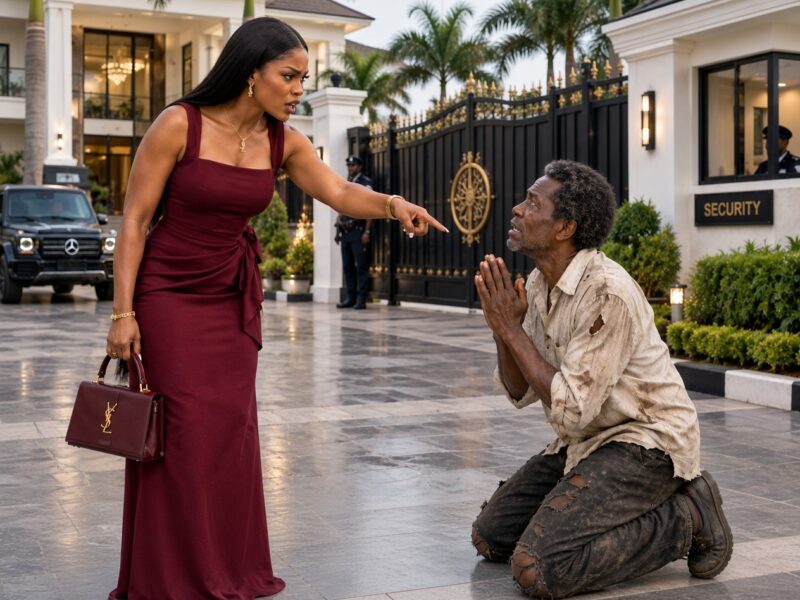
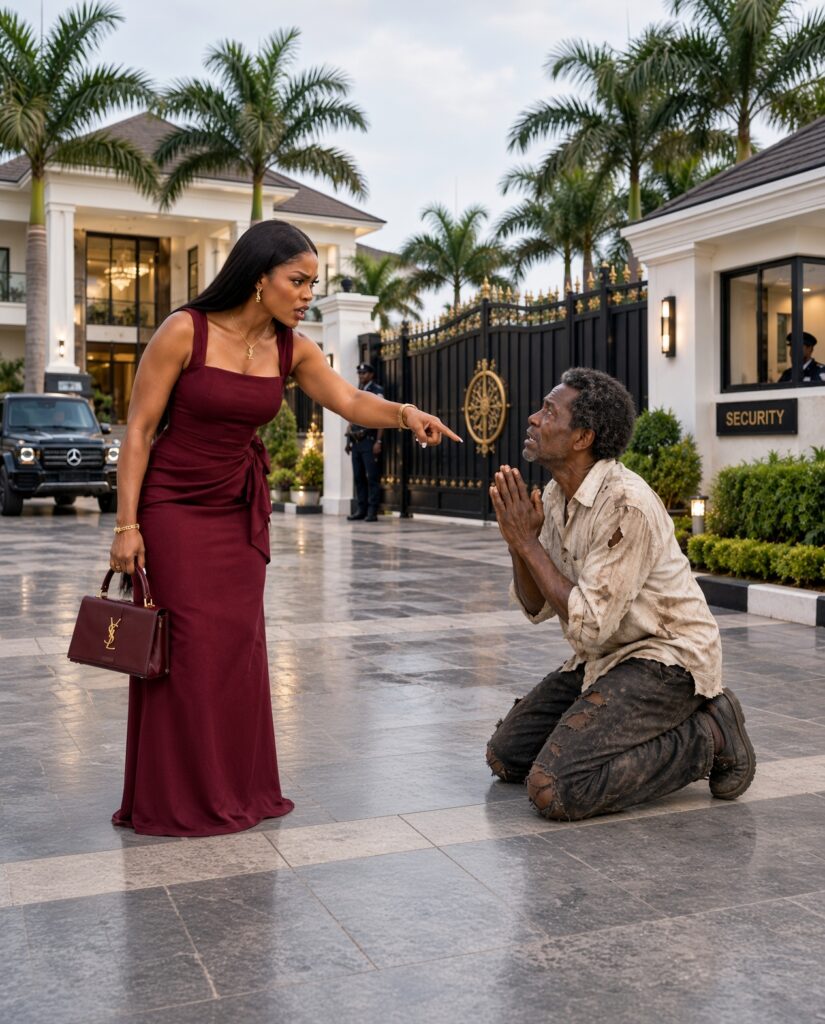
“Kunle,” she said, “greet me properly.”
The words hung in the air like a challenge.
Kunle blinked. “Madam?”
“You heard me. Greet me properly. Bow.”
And Kunle, who had spent his entire life bowing to no one but God, who had survived a civil war, who had buried a wife and raised a daughter on his own, who had worked jobs that would have broken lesser men, looked Victoria Ashford in the eye and said the words that would change everything.
“I don’t bow to anybody that’s not my God.”
The silence that followed was thicker than the morning humidity.
Victoria’s jaw tightened. “What did you say?”
“You heard me.”
And in that moment, something inside Victoria Ashford snapped.
She had been disrespected before—by business rivals, by journalists, by her own family—but never by someone she paid.
Never by someone she owned.
“This man here is fired,” she said, her voice carrying across the courtyard. “Fired!”
Kunle said nothing.
He simply nodded, picked up the small bag he kept by the gate, and walked away.
—
**PART 2**
—
The bus ride home took forty-five minutes, and Kunle spent every one of them staring out the window, watching the city of Houston blur past him like a life he had never quite belonged to.
He had moved to America twenty-three years ago, after his wife had died in childbirth, after the doctors had handed him a baby girl and told him she was his, after he had buried the only woman he had ever loved and promised her that he would raise their daughter right.
And he had.
Sade Okafor was twenty-three years old now, a nursing student at the University of Houston, with her mother’s smile and her father’s stubbornness.
She was the reason he had taken the job at the Ashford estate in the first place—the salary was decent, the hours were manageable, and it had allowed him to put her through school without taking on debt.
But now, as the bus pulled up to the small apartment complex on the east side of the city, he wondered how he was going to tell her that he had lost it all in a single morning.
She was waiting for him at the door, still in her scrubs, her hair pulled back in a messy bun.
“Daddy,” she said, her smile fading the moment she saw his face. “What’s wrong?”
Kunle stepped inside, set his bag down, and sank into the old armchair by the window.
“I lost my job today.”
Sade’s eyes widened. “How?”
“I had a disagreement with madam.”
She sat down across from him, her hands clasped in her lap.
“Daddy,” she said slowly, “did she slap you?”
“Why would she do that?”
“Because you refused to bow.”
Kunle let out a long breath.
“I’m getting old,” he said. “I can’t start learning how to fear people now.”
Sade was quiet for a moment, and then she reached over and took his hand.
“So what will you do now?”
“I’ll find something.”
“You don’t have to find another job immediately,” she said. “We’ve been talking about doing something of our own.”
“With what?”
“We can start small—even if it’s just selling something around the neighborhood. At least you’ll be working for yourself.”
Kunle looked at her, and for the first time that day, he smiled.
“You already have everything planned?”
“Not yet,” she admitted. “But we can figure it out.”
“Then we’ll figure it out.”
—
**PART 3**
—
But Victoria Ashford was not done with Kunle Okafor.
She had spent the entire day replaying the morning’s events in her head, and the more she thought about it, the angrier she became.
Not because he had refused to bow—she had dealt with insubordination before.
But because he had done it in front of everyone.
The security guards, the house staff, the gardener, the delivery driver who had been dropping off a package—they had all seen it.
They had all watched as a gateman had looked the CEO of Ashford Industries in the eye and told her, in no uncertain terms, that he did not answer to her.
And that, Victoria could not tolerate.
“I still can’t believe he spoke to you like that,” her daughter, Teni, said that evening as they sat in the living room of the mansion. “In front of everyone.”
Victoria swirled the wine in her glass. “Enough. Everyone saw. He thinks I’m nothing.”
“He’s nobody,” Teni said. “Just a gateman.”
“Exactly,” Victoria said. “And we need to teach him a lesson.”
She set her glass down and looked at her daughter.
“Get the manager. Does he have anyone else?”
“No, madam,” Felicia said from the doorway. “Just a daughter.”
“Where do they live?”
Felicia hesitated. “You want to go there?”
“I want to have a conversation with him,” Victoria said. “And this time, he’s going to listen.”
—
The next morning, Victoria and Teni drove to the east side of Houston in Victoria’s black Range Rover, with Felicia in the back seat giving directions from her phone.
They parked across the street from the apartment complex and watched as Sade Okafor walked out the front door, a bag of oranges in her hand, heading toward the bus stop.
“That’s her,” Felicia said. “She just finished her morning shift at the hospital.”
Teni leaned forward in her seat. “She looks just like the security man.”
“She had no idea who her father disrespected,” Victoria said. “Should we call her out?”
“No,” Teni said. “We’ll deal with both of them in another way.”
She reached into her purse and pulled out a stack of cash.
“I’m short of cash,” she said, handing it to Felicia. “Take them.”
Felicia stared at the money. “Are you sure?”
“Yes, ma.”
Felicia got out of the car and walked toward the bus stop, where Sade was standing with her bag of oranges.
“God bless you, my daughter,” Felicia said, pressing the cash into Sade’s hand.
“Amen, ma,” Sade said, her eyes wide with confusion.
“How much for the oranges?”
“Fifty cents each.”
“And something else?”
Sade frowned. “Your name?”
“You came for oranges.”
“I know. I changed my mind.” Sade smiled. “My name is Sade.”
“I’m Femi,” Felicia said, using the fake name Victoria had given her.
And then, from across the street, a young man appeared.
He was tall, well-dressed, with the kind of smile that made women stop in their tracks.
“Wait,” Teni said, her voice sharp. “Is that your boyfriend, Femi?”
Victoria turned to look.
“I can see him with the security man’s daughter,” Teni said. “This is not a coincidence. This family is coming for you piece by piece.”
Victoria’s eyes narrowed. “What exactly does this family want from me?”
“I don’t know,” Teni said. “But you’re about to find out. Stay away from him.”
“Away from who?”
“Don’t play with me.”
—
**PART 4**
—
The young man’s name was Marcus, and he was not, in fact, Teni’s boyfriend.
He was a business associate of Victoria’s—a young entrepreneur she had been mentoring for the past year—and he had stopped by the neighborhood to pick up a package from a friend.
But when he saw Sade standing at the bus stop, he had smiled and walked over to say hello.
“Sade,” he said. “I didn’t know you lived around here.”
She laughed. “I could say the same about you.”
“I sold the man oranges,” Sade said, gesturing to the bag in her hand. “Do you have any idea who you’re talking to?”
Marcus frowned. “What are you talking about?”
“Don’t ever do that again,” Teni said, stepping out of the car and walking toward them.
Sade’s eyes widened. “Teni?”
“Enough.”
“How did you even know I was here?” Sade asked. “Were you following me?”
“I was following her,” Marcus said, nodding toward Teni. “I wanted to make sure you didn’t do exactly this.”
“So you’re defending her?”
“I’m stopping you. You don’t know what you’re getting yourself into.”
“Neither do you,” Sade said. “Ask her what her family did to my father.”
Teni’s face went pale.
“You’re the one,” Marcus said, realization dawning. “You’re the woman from the gate. You fired her father.”
“Now you understand.”
“Then you should have left them alone.”
“Take her,” Teni said to the security guard who had accompanied them.
“Teni—”
“Leave me! LEAVE ME ALONE!”
—
**PART 5**
—
Sade should have been back three hours ago.
Kunle had called her phone seventeen times, and each time it had gone straight to voicemail.
He had called the hospital, and they had told him she had left at the end of her shift.
He had called her friends, and none of them had seen her.
And now, as he stood in the doorway of his apartment, staring at the young man who had just knocked on his door, he felt a fear he had not felt since the night his wife had died.
“Who are you?” he asked.
“Sir, are you Sade’s father?”
“Where is my daughter?”
“I tried to stop her. I couldn’t.”
“Then you will take me to that mansion. Now.”
—
The Ashford mansion was a sprawling estate on the west side of Houston, with iron gates and marble fountains and a driveway that seemed to stretch for miles.
Kunle had opened those gates every morning for three years, but he had never once stepped inside.
Now, as he walked through the front door with Marcus at his side, he felt like he was entering a different world.
“Sir, you can’t go in,” a security guard said, stepping in front of him.
“My daughter is inside.”
“You need permission, sir.”
“MOVE!”
“SIR, STOP!”
But Kunle was already through the door, his eyes scanning the room until they landed on Sade, who was sitting on a couch with tears streaming down her face.
“Daddy,” she said, her voice breaking.
“Are you okay?”
“Yes, Daddy. She slapped me. She slapped me first.”
Kunle turned to Victoria, who was standing by the fireplace with a glass of wine in her hand.
“You slapped my daughter,” he said, his voice low and dangerous. “And you expected to walk away from it?”
“Because she was talking to my boyfriend,” Teni said.
“I don’t even know him,” Marcus said.
“Enough!” Victoria snapped. “You came into my daughter’s life today and created this mess.”
“Your daughter created it,” Kunle said.
“You should be more careful with the way you speak in this house.”
“Respectfully, ma, I have been respectful all my life. Your daughter just doesn’t recognize respect unless it comes with fear.”
“Watch your tone.”
“And if I don’t? You’ve already taken my job.”
“You’re standing in my house shouting.”
“Then I’ll leave it. Come, Sade.”
“This whole family is crazy.”
“Wait,” Victoria said.
“Daddy, go back upstairs. I’m handling it.”
“Your name,” Victoria said. “Say your name again.”
“Kunle. Kunle Babatunde.”
Victoria’s glass slipped from her hand and shattered on the floor.
“What can’t be?” Teni asked.
“Where did your wife give birth?”
“Why are you asking me that?”
“Just answer me.”
“St. Mary’s Hospital.”
“What year?”
“2003.”
“And your wife—she passed away after the delivery.”
“How do you know that?”
“Then I know who she is.”
“Emeka,” Victoria said, turning to her husband, who had just entered the room. “Emeka, what are you talking about?”
“The baby you took home that night wasn’t yours.”
“Daddy,” Teni said. “You’re saying this woman is your daughter?”
“Yes,” Emeka said. “That one standing right there.”
“This is total rubbish,” Victoria said. “Tell him it’s rubbish.”
“Say something, ma,” Kunle said. “Your husband just told me my daughter is not my daughter.”
“He’s unwell.”
“I’m not unwell, Adeze,” Emeka said. “I’m finally tired. Sit down. You need to hear what happened.”
“I’ll stand.”
“Then stand, but hear it.”
—
**PART 6**
—
The story came out in pieces, like a puzzle that had been hidden for twenty-three years.
Emeka Ashford had been a young man when he married Adeze, and they had been desperate for a child.
But Adeze had suffered two miscarriages, and by the time she was pregnant for the third time, the doctors had warned them that there could be complications.
“Madam, there’s something you need to know,” the doctor had said. “The scan isn’t good. Serious complications.”
“How serious?”
“We may not know the full picture until after delivery.”
“Will my baby survive?”
“Sir, I can’t promise you that.”
“Then I want a healthy baby.”
“Sir?”
“I want to carry a healthy child.”
“Sir, that would mean taking somebody else’s.”
“Then find one.”
“Sir, I can’t—”
“How much do you earn in a year? I’ll pay you five times that. Find one.”
“There’s a woman in the next ward delivering tonight. Her husband is Mr. Kunle.”
“Her baby is healthy. I’ve lost two already. I’m not carrying a third coffin out of this place. Are you sure you can do it?”
“God forgive me. Yes, sir. When your wife goes out, I will switch the baby.”
—
**PART 7**
—
“Mommy,” Teni said, her voice trembling. “Tell me he’s lying. Tell me he’s lying.”
But Victoria said nothing.
“Twenty-three years,” Kunle said. “Twenty-three years you knew, and you sat in this house and let me open your gate every morning.”
“I know,” Emeka said. “My wife died that night. She held a baby for four minutes before she went. Are you telling me she held the wrong child? No, I don’t accept it. Get a doctor for your wife before she starts believing her own lie. Let’s go.”
“Kunle, please.”
“I’m sorry, ma, but I won’t let anybody in this house convince me that Sade isn’t my daughter. I’ve raised her all her life. That’s my daughter.”
“Then whose daughter am I?” Teni asked.
—
**PART 8**
—
The drive home was silent.
Sade sat in the passenger seat of Marcus’s car, staring out the window, while Kunle sat in the back, his hands folded in his lap.
“You didn’t sleep?” Sade asked when they finally got home.
“Neither did you.”
“Daddy, we should do a DNA test.”
“So you believe them?”
“No. I want to bury it. As long as there’s no paper, they will keep coming to this house with their story.”
“And if the paper says they are right?”
“Then it says it. It won’t change who carried me on his back to school.”
“And if it says they are right, what happens to the girl in that mansion?”
—
**PART 9**
—
The DNA test was scheduled for the following week.
Both families would be tested—Kunle and Sade, Emeka and Victoria, and Teni.
Victoria had insisted on it, despite Emeka’s reluctance.
“I don’t want that test,” Emeka said.
“Why not? If it clears her, you keep everything.”
“Because I’m afraid of the answer.”
“Daddy, we should do the test,” Teni said.
“Why? We refused them this morning.”
“Because I want the truth—not their version, not ours. The truth.”
“Teni, do you know what you’re asking me to do? You’re asking me to hand somebody a paper that could say you were never mine.”
“I could never stop being yours.”
“Then why give them the test?”
“Because if they’re lying, I want the truth to bury their lie. And if they’re telling the truth, I still want to know. I’d rather know and choose you than never know and wonder.”
“Whatever that paper says, you’re still the girl I raised.”
“Then we’ll do it.”
—
**PART 10**
—
The results came back on a Tuesday afternoon.
Kunle and Sade sat in the living room of their apartment, staring at the envelope on the coffee table.
“I can’t open it,” Kunle said.
“Then I will,” Sade said.
She tore open the envelope and pulled out the paper inside.
Her eyes scanned the words, and then she looked up at her father.
“Daddy,” she said. “I’m your biological daughter.”
Kunle let out a breath he hadn’t realized he had been holding.
“I’m here,” he said. “I’m still here. You are my daughter.”
“And you’re mine,” Sade said.
—
**PART 11**
—
But the story was not over.
The test had revealed something else—something that no one had expected.
Teni Ashford was not Emeka’s biological daughter.
She was not Victoria’s biological daughter.
She was, in fact, the daughter of a woman named Zainab, who had been working at the hospital the night Sade was born.
And when Victoria learned the truth, she was devastated.
“I don’t know you,” she said to Teni.
“I know,” Teni said. “I don’t know you, either. We’ll have to start.”
“How did you raise her?” Victoria asked Kunle. “How did she turn out like that with nothing?”
“The way my own father raised me.”
“How?”
“We didn’t have much, but he taught me one thing. Being poor was never an excuse to be poor in character.”
“You were really going to hide this forever?” Teni asked Victoria.
“I was afraid.”
“Afraid of what?”
“The doctor said there could be complications. I had lost two babies before you. I panicked.”
“So you took another woman’s child?”
“No. When your father told me, I thought he was joking. I did not know he took the child.”
“What do you want?” Teni asked.
“I came to see you.”
“Why?”
“Because I don’t know what you are to me anymore. My sister, or the person who took everything?”
“I didn’t take anything.”
“You didn’t have to.”
“I never asked for your family. They came looking for me.”
“They want you now.”
“I don’t want what they have. I already have my family.”
“Then why does it feel like you’ve taken everything from me?”
“Maybe because you thought everything belonged to you. Money gave you a place at the table. It didn’t make you better than the people serving it. You still have a family, Teni. You just have to learn how to keep them.”
—
**PART 12**
—
The months that followed were not easy.
There were lawyers, and court dates, and conversations that lasted late into the night.
There were tears, and apologies, and moments of silence that felt like they would never end.
But slowly, painfully, the two families began to find their way back to each other.
Kunle opened a small produce stand in the neighborhood, and it became a gathering place for the community.
Sade continued her nursing studies, and graduated at the top of her class.
Teni started volunteering at a shelter for women and children, and discovered a purpose she had never known she was missing.
And Victoria, who had spent her entire life building an empire, began to understand that some things could not be bought.
“I know we don’t deserve anything from you,” she said to Sade one afternoon. “But you’re my daughter.”
“You swapped me because of what you were afraid I’d become. Now you’re standing in my father’s house because I turned out well. Yes. You were afraid of me before you even knew me.”
“And that is what I’ll regret for the rest of my life.”
“He raised me. Whatever happens, we don’t erase that.”
“We’re not asking you to erase it. We’re not asking him to give you to us. We’re asking you to let us know you.”
“And what about me?” Teni asked. “Where do I belong now?”
“With me,” Victoria said. “If you want it. You never stopped being somebody’s daughter.”
“Even after what you found out?”
“What I found out doesn’t change what you are to me.”
—
**PART 13**
—
The final piece of the puzzle came six months later, when Kunle received a letter from Emeka Ashford.
Inside was a deed to a small house on the west side of Houston, and a note that read:
*”I know we can’t undo what was done. But we can try to make it right. This house is yours. Not as payment, but as an apology. And if you’ll let us, we’d like to be part of your lives. All of us.”*
Kunle read the letter three times before he showed it to Sade.
“What do you think?” he asked.
“I think we should accept it,” she said. “Not for the house, but for the chance to heal.”
“And what about Teni?”
“She’s family now. We all are.”
—
**PART 14**
—
The housewarming party was held on a Sunday afternoon, and for the first time in twenty-three years, the two families sat at the same table.
There was laughter, and there were tears, and there was a moment when Kunle stood up and raised his glass.
“To family,” he said. “Not the one we were born into, but the one we choose.”
“To family,” everyone echoed.
And as the sun set over the Houston skyline, painting the sky in shades of gold and pink, Sade looked at her father and smiled.
“Daddy,” she said. “I treated you like you were beneath me. I insulted you at that gate. I slapped you, and I didn’t even know you were my father. I’m sorry.”
“You did wrong,” Kunle said.
“I know.”
“But now you know something. Respect isn’t something you give people after you discover who they are.”
“You give it before you know.”
“I’ll remember that.”
—
**PART 15**
—
The produce stand grew into a small grocery store, and the grocery store grew into a chain.
Kunle Okafor, the gateman who had refused to bow, became a respected businessman.
Sade Okafor, the nursing student who had been swapped at birth, became a pediatric nurse and a advocate for children’s rights.
Teni Ashford, the heiress who had lost everything, found something more valuable than money.
And Victoria Ashford, the CEO who had fired a man for not bowing, learned the hardest lesson of her life.
Respect is not demanded.
It is earned.
—
**EPILOGUE**
—
Ten years later, on a warm summer evening in Houston, a young woman stood at the gate of a familiar estate.
She was not a gateman, and she was not a CEO.
She was simply Sade Okafor, and she had come home.
“Good evening,” she said to the security guard.
“Good evening, madam.”
“Greet me properly,” she said, and then she smiled.
The guard blinked, confused.
“I’m just kidding,” Sade said. “You don’t have to bow. Nobody should have to bow.”
And with that, she walked through the gate and into the house where her story had begun.
—
**THE END**
—









