The Bank Froze His $158,000 Farm Loan to Force a Land Sale – Then 12 Tractors Changed Everything
The bank manager slid the pen across the desk with the quiet confidence of a man who had already won. Outside the window, the June sun hung heavy over Holmes County, Ohio, baking the fields that had been in the farmer’s family for nearly sixty years. “Sell the eastern land,” the manager said, his voice flat and professional. “You don’t have enough money to keep this harvest going through the week.”
The old farmer didn’t touch the pen. He sat with his weathered hands folded on his worn denim jeans, his cap still on his head, and studied the man across from him. He was seventy-six years old, and he had been farming since he was old enough to reach the pedals of a tractor. He knew exactly what was happening here, and it made his stomach turn.
“I didn’t come here to sell land,” he said, his voice steady despite the anger building in his chest. “I came to use the operating credit your bank already approved.”
The manager leaned back in his leather chair, the kind that probably cost more than the farmer’s first tractor. He was in his sixties, heavy-set, always dressed in a dark suit that seemed out of place in a county where most folks wore boots and jeans. He had been running this branch for less than a year, and in that time, he had made it clear that he saw the world differently than the farmers who had banked here for generations.
“The credit line has been frozen,” the manager said, and the words landed like a hammer on the farmer’s chest. “However, we can release the money if you agree to sell those 164 acres on the eastern side of your property. There’s a buyer who’s already waiting.”
The old man understood in that moment exactly what was happening. The bank wasn’t just being difficult. They were tying his approved credit to the sale of his land. His own money, the money he had qualified for months ago, was being held hostage until he gave up the most valuable part of his family’s farm.
“So you want me to sell my land just to use the credit your bank already agreed to give me?” he asked.
The manager didn’t deny it. He didn’t even have the decency to look uncomfortable. Instead, he delivered his final blow with the cold precision of someone who had done this before. “If you walk out without signing,” he said, “don’t come back when your equipment stops in the middle of harvest.”
The farmer stood up slowly, his knees creaking from decades of climbing on and off tractors. He put his cap back on and walked toward the door without saying another word. Behind him, the manager watched with the quiet certainty of a man who believed he had already won.
What the bank manager didn’t know was that this old farmer still had another option. At a different agricultural lending institution, he had an unused equipment credit line of $386,000. He had arranged it earlier in the year with a simple plan: finish the harvest with the machines he already owned, then replace the weakest ones after the season, when he could compare prices and make smart decisions without a gun to his head.
That money couldn’t solve every problem, but it gave him something the bank manager had never considered. He was not yet forced to sell his land just because his operating credit had been blocked. He had a path forward, and he intended to take it.
—
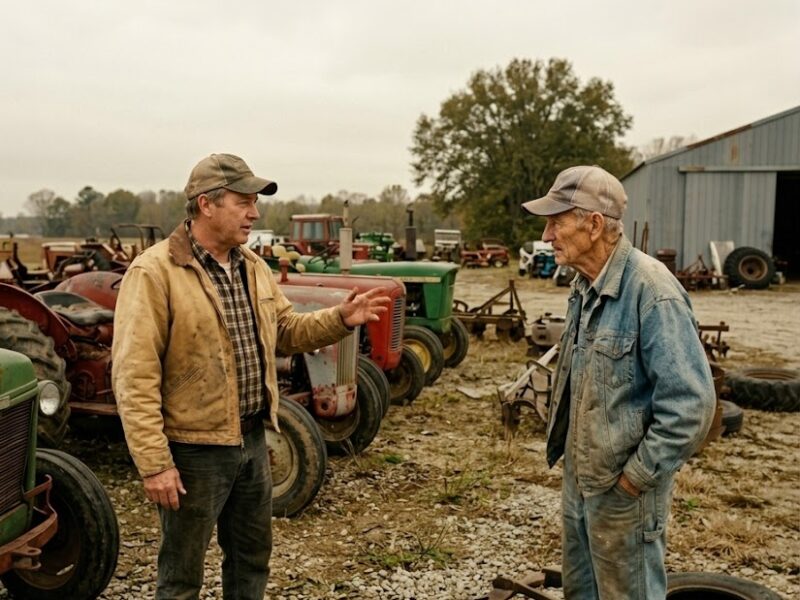
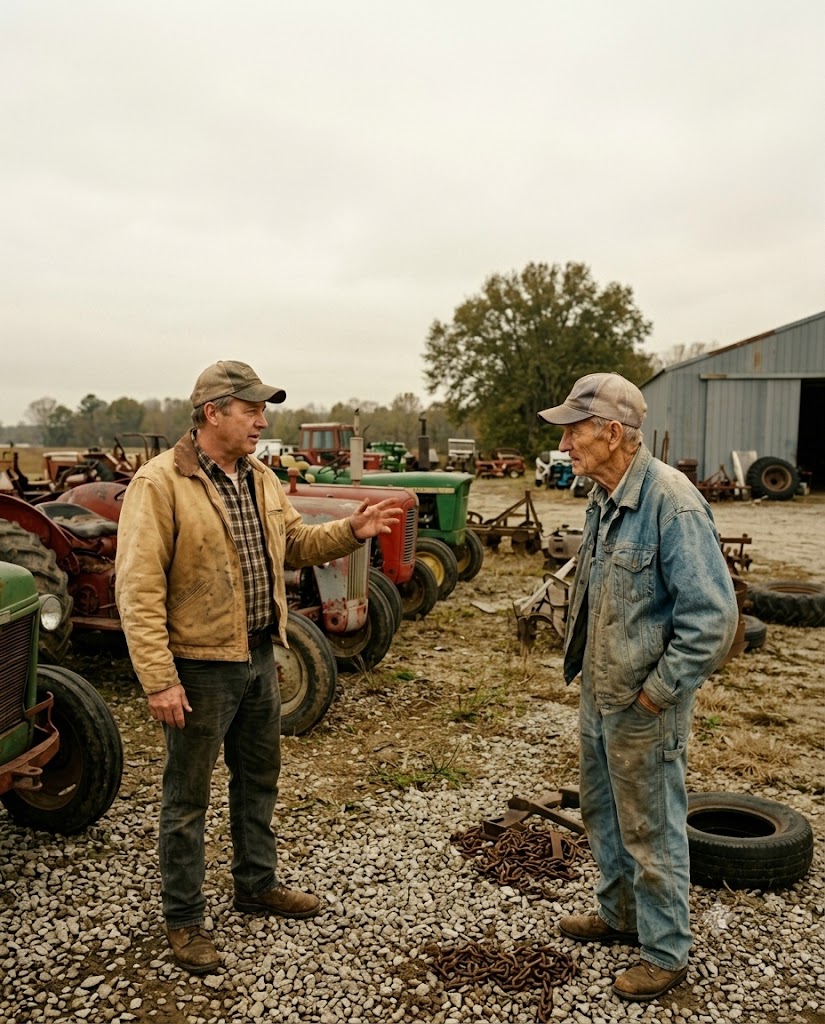
The old farmer lived in the countryside near Kilbuk in Holmes County, Ohio. His family had farmed that land for nearly sixty years. After his father passed, and then his wife a few years later, he kept working the family’s 512 acres alone, with two hay barns, a small repair shop, and a fleet of farm equipment that had already seen many years of service. The machines were old, but he knew every one of them like they were family.
—
He knew which tractor tended to run hot in the transmission. He knew which one leaked hydraulic fluid and needed to be checked every morning. He knew which machine needed extra attention before a long day in the field. Because he understood his equipment so well, he had kept the farm running without taking on more debt. He didn’t want new machines just because financing was available. Equipment should be replaced when it truly needed replacing, not simply because a lender was willing to loan more money.
—
That was the philosophy that had kept his farm alive through good years and bad. And it was the philosophy that had led him to arrange that $386,000 equipment credit line earlier in the year. The plan was simple. Finish the harvest with the machines he already owned, then replace the weakest ones after the season. Once the pressure was over, he could take his time, inspect equipment carefully, and make decisions from a position of strength.
—
The credit line had always been meant as a backup. A safety net that would be there if he needed it. But everything changed one morning in the middle of June.
—
His strongest tractor suddenly suffered a transmission failure while working a field of more than eighty acres. The machine had been running fine all morning. Then, without warning, it lurched, made a terrible grinding sound, and stopped dead in the middle of the field. The farmer knew immediately what had happened. He had heard that sound before, years ago, on a different tractor. It was the sound of a transmission giving out, and there was no quick fix.
—
Less than three hours later, his main baler had to shut down because its gearbox temperature climbed far above normal. Two major breakdowns in the same morning threw the entire operation out of balance. The remaining machines could still work, but they could not replace the capacity he had just lost. While several fields were already reaching the right time to harvest, in a single day, nearly one-third of his harvesting capacity was gone.
—
The weather forecast showed only eight more dry days before a long stretch of rain was expected to move into Ohio. Hay across several fields was already ready to cut, so he could not afford to spend weeks waiting for repairs. If he missed that weather window, the entire 2,080-acre schedule could start slipping beyond his control. He had to restore his harvesting power almost immediately, before two broken machines turned into a crisis that could destroy the entire season.
—
The next morning, the old farmer went straight to the bank he had used for more than twenty years. His $158,000 operating line had been approved before the season began for fuel, repairs, equipment rental, and labor when needed. This was exactly the kind of emergency it was meant for. But when he asked to draw the money to deal with the two broken machines, the new manager suddenly blocked the release. Not a dollar went out.
—
While every dry hour in the fields kept slipping away, the bank manager sat in his air-conditioned office, protected from the reality of what was happening outside. The manager did not look at the fields around Kilbuk the way a farmer did. To the old man, that land was productive ground and the foundation of his family’s livelihood. The manager cared more about its development value. In his eyes, a good field could also be land that had not yet reached its full commercial value.
—
That attitude had become clearer a few months earlier when the bank helped finance a new logistics development near a major road east of Kilbuk. The project attracted companies looking for land for warehouses, truck lots, and distribution centers. Property with easy access to the main road quickly became more valuable. Prices rose faster than ordinary farmland, and land around the new development began drawing serious attention.
—
Of the farmer’s 512 acres, the 164 acres on the eastern side had the best location. The property sat between the new development and a road that could give trucks easy access to the highway without a long detour. Because of that, a land investment company had already offered to buy it twice. He had refused both offers.
—
To him, those 164 acres were not just property going up in value. They were part of the family farm that had been protected for years. His father had worked that ground. His wife had helped him plant and harvest there. Every fence post, every tree line, every acre held memories that could not be measured in dollars.
—
A third offer arrived only a few days before his equipment began breaking down. The farmer had no proof that the land company and the bank were working together, so he made no accusation. But when the manager tied the sale of those exact 164 acres to the decision to reopen his credit line, the message was clear. He was being pushed toward one choice. Sell the most valuable part of his farm just to use credit the bank had already approved.
—
He walked out of the bank without signing anything. On the drive home, he did not call the land buyer. Instead, he contacted an independent farm equipment dealer nearly sixty miles away. He asked how many used tractors the dealer could find within three days that were reliable enough to work long hours. He did not care if they looked good or were newer models. He needed working machines fast.
—
Before the weather window closed, the dealer told him he could not promise clean, good-looking tractors. He could only promise to look for machines that still had enough life left to work hard. That was exactly what the farmer wanted to hear. He was not trying to build a brand new fleet. He was not looking for perfect equipment. He needed tractors that could go straight into the field, keep running, and help carry the harvest through the dangerous days ahead.
—
That night, he spread a map of all 2,080 acres across his kitchen table and studied the way his entire operation worked. For years, one tractor might pull a mower, then switch to a tedder, then move to a rake or baler. Every equipment change and every move between fields cost time. Sometimes the workers were ready and the weather was good, but a field still had to sit untouched because the tractor they needed was busy somewhere else.
—
The longer he studied the map, the clearer the real problem became. The broken tractor had not created the weakness. It had only exposed it. His whole system depended on too few machines. When one tractor went down, it did not stop just one job. It delayed everything behind it. If mowing slowed, tedding had to wait. If raking fell behind, baling stopped, too.
—
If he wanted to save the season, he could not simply replace one broken tractor. He had to change the way the entire fleet operated. He divided the 2,080 acres into four zones. Each zone would have three machines assigned to fixed jobs. One for mowing, one for tedding and raking, and one for baling or hauling.
—
If he could build that system, four crews could work at the same time without constantly changing implements or waiting for tractors to move from one field to another. A breakdown in one zone would also be less likely to shut down the entire operation. From that moment on, buying more machines was no longer just an emergency fix. It became a complete redesign of the harvest.
—
The new system could only work if he had twelve reliable machines for the four zones. Of the equipment he already owned, only four machines were strong enough for continuous work. That meant he needed eight more, and he needed them fast.
—
The dealer began searching farms that had recently upgraded their equipment, liquidation sales, and used machinery yards across nearby counties in Ohio and Pennsylvania. The farmer’s requirements were simple. The machines did not have to look good or be new. They just had to be ready to go straight into the field.
—
In only two days, the dealer found all eight machines. Some had already worked more than ten seasons. Their paint was faded and their cabs showed years of use, but the old farmer did not care about appearance. Before accepting any machine, he had the engine, transmission, and hydraulic system checked. Anything showing signs of needing a major overhaul was rejected.
—
He chose only machines that could work long hours and start earning their place the moment they arrived at the farm. When the cost of buying, long-term leasing, and trading equipment was added together, the total reached $627,000. To make the plan work, he sold and traded several machines that no longer fit the operation, bringing in $181,000.
—
He added another $63,000 of his own cash and used $383,000 from the equipment credit line he had arranged earlier that year. In just a few days, almost all of the backup financing he had planned to save until the end of the season was gone. After the deals were finished, the farm had only about $29,000 left in cash reserves.
—
He now had enough machines to run four crews, but his financial safety margin had become dangerously thin. If fuel prices climbed, a payment was delayed, or several machines broke down at the same time, that money could disappear quickly. He had solved the problem of harvesting capacity, but he was far from safe. From that point on, every working day had to produce results.
—
News that the farmer had brought in eight more machines quickly reached the bank manager. But instead of becoming concerned, the manager became even more convinced that the old man was digging himself into a deeper hole. In his view, twelve machines would burn far more fuel than the old fleet. While the farmer had only about $29,000 in cash left, he believed the old man was simply buying time before he would be forced to return to the bank and finally agree to sell the 164 eastern acres.
—
The four harvest crews went to work with less than five days remaining before the bad weather was expected to arrive. For the first time, several fields could be worked at the same time instead of waiting for one tractor to move from place to place. But the new system did not run smoothly right away.
—
During the first two days, mistakes in coordinating workers, machines, and transport trucks kept appearing. The operation was faster, but one bad decision could still erase the time advantage they had just gained. One rake was sent to the wrong zone, leaving one crew waiting while another had more equipment than it needed. Two trucks arrived at the same field, while another zone had no vehicle available to haul bales.
—
Then one of the recently purchased machines blew a hydraulic hose in the middle of a shift. None of those problems was serious enough to stop the plan, but each one burned valuable hours. Their already small time cushion kept shrinking as the rain moved closer.
—
By the third day, the system began to settle down. Each crew stayed in its assigned zone. The machines no longer had to constantly switch implements, and every worker knew what came next after one field was finished. Downtime dropped sharply and daily production began rising just as the old farmer had expected.
—
For the first time since his two key machines had failed, he had a real reason to believe the new system might carry them through the weather window. But just as the harvest finally found its rhythm, the first shipment to the livestock feed plant created another problem.
—
Testing showed that some of the hay bales had moisture levels above the limit allowed by the contract. The plant did not yet know whether the problem affected only a small portion of the load or the entire shipment. So it temporarily held the payment while more testing was done.
—
For a farm running twelve machines for long hours every day, having that money delayed immediately created pressure. The held payment put the farm’s cash flow under immediate strain. Twelve machines running day after day meant far more diesel was being burned than before, and the fuel bill was climbing fast.
—
While the money from the feed plant remained frozen, the fuel supplier warned that the next delivery would not leave the terminal until the current balance was paid. The old farmer finally had enough machines to save the harvest. But now the entire operation was in danger of stopping for one simple reason. He might not have enough cash to keep fuel in the tanks.
—
Just as the farm’s cash flow tightened, the weather forecast got worse. The rain was now expected to arrive almost a full day earlier, cutting the remaining dry window even shorter. The old farmer’s phone kept ringing. Landowners wanted to know exactly when his crews would reach their fields. One farmer with more than 130 acres told him that if he could not give a firm schedule, he would hire another harvest crew before the rain came.
—
At the same time, rumors began spreading through town that the bank had cut off the old farmer’s credit because he could no longer repay his debts. Some people even claimed the eight machines he had just brought in were liquidation equipment because he could not get normal financing. None of that was true, but rumors traveled fast.
—
A few customers started wondering whether he still had enough money to finish their contracts, and the trust he had built over many years began to come under pressure. One day later, the company that had tried to buy the 164 eastern acres sent another offer. This time, they promised to wire the deposit as soon as he signed and gave him only forty-eight hours to decide.
—
The money would be enough to pay the fuel account and keep all twelve machines running through the remaining days before the rain. The offer arrived at the exact moment he was shortest on cash, making the land sale the fastest way to solve the immediate crisis.
—
The bank manager believed everything was unfolding exactly as he had expected. In his mind, buying more machines had only caused the old farmer to burn through money faster. It did not matter how many tractors he owned if he could not afford diesel. The manager waited for the farmer to return, sign away the 164 acres, take the deposit, and finally accept that the eastern land could no longer be saved. To him, the financial pressure had finally pushed the old man exactly where he wanted him.
—
That afternoon, the old farmer stood in the equipment yard and watched all twelve machines shut down one by one to save fuel. The fuel truck had not arrived because the current account had not been paid. The feed plant was still holding his money, and the rain was now coming earlier than expected.
—
The fields that still needed work were spread across the map in front of him. For the first time that season, he honestly did not know whether he would have enough fuel to send all four crews back into the fields the next morning. The contract to sell the 164 acres was sitting on the bed of his pickup truck. All he had to do was sign it.
—
The deposit could be transferred immediately. The fuel problem would disappear and all twelve machines could go back to work during the most important days of the season. But he knew something else. If he sold that land just to survive one difficult week, he could never undo the decision after harvest was over. A short-term solution could cost his family part of the land they had protected for nearly sixty years.
—
Instead of signing, he pulled out the map of all 2,080 acres and threw out his old plan completely. He stopped trying to finish everything before the rain. He divided every field into three groups. Hay that had already been cut and had to be saved, important contracts that had to be completed, and fields where the grass could remain standing through the rain without serious damage.
—
From that point on, the goal was no longer to clear the entire map. The goal was to use the remaining fuel only where it mattered most. The new plan meant about 330 acres would have to wait. That would reduce revenue and delay work for some customers. But if he kept chasing the old schedule across all 2,080 acres, he would waste fuel driving between fields he could never finish before the rain anyway.
—
By leaving 330 acres that could safely wait, the four crews could cut travel time and focus every available hour on the fields that had to be saved first. That same evening, he hired an independent agricultural inspection company to test all the hay connected to the payment the feed plant was holding. Instead of treating the entire shipment as one lot, the inspectors sampled separate groups of bales and measured the moisture in each group.
—
The farmer wanted to know exactly what met the contract and what did not. By the next morning, the results were clear. About 86% of the hay was still within the contract’s moisture limit. He took the report directly to the feed plant. He did not argue about the 14% that failed inspection, and he did not demand payment for all of it.
—
Instead, he asked the plant to release payment immediately for the 86% that had been confirmed to meet the contract and reduce the price fairly on the rest. The plant agreed. The money was released that same day, and he immediately used it to pay the fuel bill before the final tanker truck left the terminal.
—
The diesel truck reached the farm before daylight. As soon as the storage tank was filled, all twelve machines were fueled one by one, and the four crews headed back into the fields. This time, the old farmer did not follow the original schedule. Hay that had already been cut came first because it could be ruined if the rain arrived. After that, the crews moved to the contracts that would suffer the greatest losses if left unfinished.
—
Every gallon of fuel, every machine, and every worker was focused on the jobs that mattered most. The next three days became a real race against the weather. The four crews worked almost non-stop with each zone staying focused on its assigned jobs. By the time rain began falling around Kilbuk, almost all the cut hay in the most important areas had been raked, baled, and removed from the fields.
—
About 330 acres were still standing, but those acres had been left on purpose under the new plan. They were not forgotten because the harvest had failed. When dry weather returned, the crews went back to finish the remaining 330 acres. The old farmer personally called every landowner whose work had been delayed. He explained what had happened, gave them a new schedule, and reduced part of the service fee when necessary.
—
The farmer with more than 130 acres, who had once considered hiring another crew, decided to stay. He had seen the old man return exactly when he promised and finish the work under the revised schedule. By the end of the season, all 2,080 acres had been completed. The profit was lower than expected. Some of the hay had to be sold at a discount, and the equipment financing would take years to repay, but the operation survived.
—
His main customers stayed with him, and not one acre of the family’s 512 acres had to be sold. The eight additional machines also became part of the four-zone system that had proved itself during the hardest week of the season. Only after the harvest was finished did the old farmer return to the issue of the frozen $158,000 operating line.
—
A former loan officer helped him recover the original approval records from the beginning of the season. The documents showed that the credit line had already passed reviews of his collateral, cash flow, and payment history before it was approved. In other words, the bank had already determined that he qualified to use that money for seasonal operating expenses.
—
He kept reviewing the records and found no overdue payment serious enough to explain why the bank had stopped releasing the funds. Then he discovered that the decision to freeze the credit line had been entered into the system during the same week the investment company sent its offer for the 164 acres.
—
He did not accuse the bank and the company of working together because he had no proof. Instead, he organized the documents by date and sent everything to the bank’s compliance department for review. The investigation lasted nearly two months.
—
The final finding did not say the bank had officially forced a customer to sell land, but it did determine that the branch manager had used his authority over the credit decision to pressure the farmer toward a property sale that was not part of the loan terms. The bank restored the operating line, refunded several fees, and moved the farmer’s account to another department.
—
But for the old man, the biggest problem could not be fixed that easily. The trust was gone. When the bank told him it wanted to keep him as a longtime customer, he had already made his decision. He moved his operating credit to another agricultural lender, split his equipment financing between two institutions, and built a cash reserve large enough to cover at least six weeks of fuel and repair costs.
—
From then on, the farm would never depend completely on one lender to keep running during an emergency. Only then did the bank manager understand how badly he had miscalculated. He had believed that freezing the money at the right moment would force a seventy-six-year-old farmer to sell 164 acres. Instead, after that season, the farm ran more smoothly.
—
The equipment system became more efficient, and major contracts were renewed. Several other longtime agricultural customers also began moving their business to the same lenders the old farmer was now using. The manager tried to reconnect with him, offering to restore the full banking relationship and give the farm better terms than before, but it was too late.
—
The old farmer did not return to get revenge or start an argument. He simply said that a trustworthy bank is not one that gives you money when everything is going well. It is one that keeps its word when you truly need it.
—
Two years later, the 164 eastern acres were still covered with hay every summer, and the twelve machines were still working across the four-zone system he had designed during the hardest week of the harvest. Meanwhile, the manager had to watch a customer of more than twenty years, along with several other farm accounts, leave the branch. He regretted what he had done, but the relationship was already gone. No lower rate, better loan, or special offer could buy back the trust he had destroyed.
—
The old farmer never forgot that week. He never forgot the feeling of standing in his equipment yard, watching his machines shut down one by one, knowing that a single signature could solve everything. He never forgot the weight of that contract sitting on his truck bed, waiting for him to give up part of his family’s legacy just to survive one more week.
—
But he also never forgot the moment he chose to fight instead. The moment he pulled out that map and redesigned his entire operation. The moment he called the inspection company and refused to accept the feed plant’s blanket rejection. The moment he decided that his family’s land was worth more than a temporary fix.
—
The four-zone system became the backbone of his operation. Each zone had its own crew, its own machines, its own rhythm. The workers learned to stay in their assigned areas, to communicate clearly, to anticipate what came next. Breakdowns still happened, but they no longer crippled the entire operation.
—
The twelve machines, some of them older than the workers running them, became a symbol of what could be accomplished when you refused to give up. They weren’t pretty. They weren’t new. But they worked, day after day, through the most critical week of the season.
—
The bank manager eventually left his position at the branch. Some said he was transferred. Others said he resigned. The old farmer never asked and never cared. He had moved on, building a stronger operation with lenders who understood that farming wasn’t just about numbers on a spreadsheet.
—
It was about trust. It was about keeping your word. It was about understanding that the land wasn’t just an asset to be bought and sold. It was a legacy to be protected.
—
And every summer, when the hay grew tall on those 164 eastern acres, the old farmer would stand at the edge of the field and remember. He would remember the bank manager’s cold words. He would remember the feeling of being backed into a corner. He would remember the moment he decided to fight back.
—
And he would smile, because he knew that some things were worth more than money. Some things were worth fighting for. And some things, once lost, could never be bought back.
—
The twelve tractors still worked the fields every season. The four-zone system still kept the operation running smoothly. And the 164 eastern acres still produced some of the best hay in Holmes County.
—
The old farmer was seventy-eight now, but he still climbed onto his tractor every morning. He still checked the oil and the hydraulic fluid. He still listened to the engine, waiting for any sign of trouble. He still knew every machine like it was family.
—
Because that was the lesson he had learned. Not just about farming, but about life. You take care of what matters. You fight for what’s yours. And you never, ever let anyone take what you’ve built without a fight.
—
The bank manager had tried to take his land. He had tried to use money as a weapon, to exploit a moment of weakness, to force a decision that would have changed everything. But he had underestimated the old farmer. He had underestimated his resourcefulness, his determination, his refusal to give up.
—
And in the end, that was what mattered most. Not the money. Not the machines. Not the land. But the spirit of a man who refused to be broken.
—
The hay still grew on those 164 eastern acres. The twelve machines still worked the fields. And the old farmer still stood tall, a reminder that some things were worth more than any price a bank could offer.
—
*The End*









