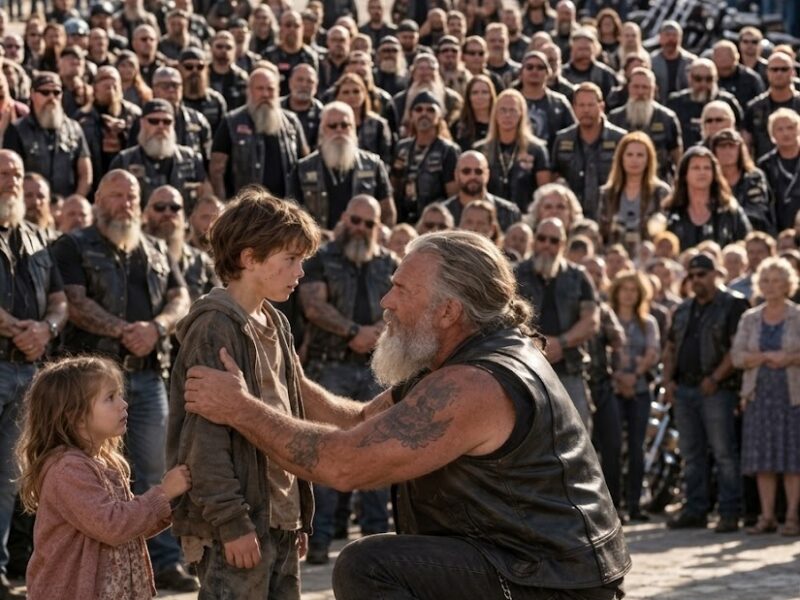
“That’s my son now,” the club president said in front of the whole town. Nobody dared to argue.
The boy had not slept in a bed for eleven days, and every soul on North Main Street could see it in the way he moved.
Torn jeans. A gray hooded sweatshirt that had been black in the spring and was now stiff with dirt. His little sister’s fist wound tight into his sleeve like a knot he was afraid to untie.
He walked out of the alley behind Haskell’s Bakery into the five o’clock sun, and three hundred people stopped breathing.
At the far end of the bricks stood a man twice the boy’s width. Cracked black leather. Forearms inked wrist to elbow. A white beard down to his chest. The whole street had already reached its verdict, and the verdict was guilty.
They had decided he was dangerous. They had decided he was cruel. They had decided he had taken those children.
The boy kept walking anyway.
—
What happened when he reached that man is the reason nobody on that street has ever forgotten the silence.
The last time anyone had said Gavin Leford’s name out loud, it was a lunch lady at Hannibal Middle School, and she had said it the way people say the name of someone who owes them money.
That was Tuesday. Now it was Friday, September 8th, 2023, a quarter past five in the afternoon, and the heat left the tar sticky between the old bricks on North Main Street.
Gavin stood at the mouth of the alley, holding his little sister’s hand and trying to look like a boy waiting for his mother. He was eleven. His jeans were torn open at the right knee, and a scab on his chin sat under grime he had stopped noticing on Wednesday.
Hazel was five, in a pink cardigan buttoned one hole off, and sneakers two sizes too big, packed with paper towels.
Their mother had left in the last week of August with a duffel bag, forty dollars, and a promise of one week. She had said things like that before and always come back. Then the landlord taped a notice to the door of lot 14, and the power company finished what the notice began.
Now they slept in the loft of a boarded-up shoe warehouse off North Third Street on flattened cardboard.
He knew what would happen if he told an adult. He had been seven the last time. A woman with a clipboard and a gentle voice had put him in one car and his sister in another. And for seven months he saw her every other Sunday in a room with a bin of broken crayons.
Never again. So no adults.
The rule had one weakness, and the weakness was hunger. Hazel had eaten half a sleeve of crackers since morning, and on Fridays Mrs. Haskell set day-old rolls beside her dumpster.
He had taken two steps toward them when he felt the sound before he heard it.
It came up through the bricks first, a low hum in the soles of his ruined sneakers. Then it rounded the corner from Broadway like a thunderstorm that had learned to ride on two wheels.
Forty motorcycles in a double column, chrome flaring in the low sun.
Gavin’s stomach turned to ice water. When he was eight, a man with a vest and a motorcycle had lived with them for four months and left a hole in the bathroom door the shape of a fist. Gavin remembered the vest better than the face.
The columns swung into the little plaza at the foot of Hill Street, where the bronze statue of Tom Sawyer and Huck Finn stood in the shade, and the engines died one by one.
Big men swung off their bikes. Leather vests, sun-bleached. Forearms heavy with faded tattoos. The Bluff Hawks motorcycle club.
A man in a polo shirt stepped out of the insurance office, looked, and stepped back in. Across the street, Mrs. Haskell planted herself on the sidewalk in her blue flowered dress and gray cardigan, seventy-four years old, and folded her arms.
“Shiny,” Hazel whispered.
It was the first word she had said since Wednesday. Before Gavin could close his fingers, she slid her hand out of his and walked toward the nearest motorcycle, a deep red one with a tank polished to a mirror, where a five-year-old face looked back at her wide-eyed from the chrome.
Gavin went after her, but not fast enough.
The largest man in the plaza was already there.
—
He was sixty-eight, broad as a door, gray hair pulled into a low ponytail, white beard falling to his chest, a tattooed eagle spreading across one thick arm. A patch on his vest said PRESIDENT.
He lowered himself onto one knee on the warm bricks ten feet from her, rested both hands on his thigh where she could see them, and spoke so quietly that Gavin had to lean in to hear.
“That’s a lot of chrome, isn’t it.”
Hazel nodded once.
“I won’t touch you, and I won’t ask you one question you don’t want to answer.”
Then, to Gavin, without raising his eyes any higher than the boy’s chest: “I’ve got two ham sandwiches in this bag I won’t get to. I’ll set them on that bench and walk to the far side of the plaza. They’re not a trade.”
Gavin could not move. He was watching the man’s hands. The hands did not move either.
“You get away from those children.”
Mrs. Haskell had crossed the street faster than her knees allowed. “Don’t you lay a finger on that little girl. I’m calling the police this minute. I saw you down on your knees right in front of her.”
Hazel burst into tears, and the sound broke whatever held Gavin in place. He snatched her hand and ran up the ladder to the loft, where he watched through a crack in the boards.
A police cruiser rolled up with its lights off, which was somehow worse. Sergeant Glenn Tuttle, fifty-two, climbed out thick through the middle in mirrored sunglasses, with a hand that rested near his belt out of habit.
“Rayburn. Sergeant.” Mrs. Haskell’s voice carried. “He approached two kids.”
“I offered them lunch.” The big man stood slowly, hands open. “Their shoes are stuffed with paper towels. The boy stood between me and the girl like a man in front of a door. Those children are alone, Sergeant. The name Leford is on his backpack strap in marker. Please take it seriously.”
“You get all that from ten feet?”
“It’s what I was looking at.”
Tuttle studied him. “I want you and your friends out of this plaza by dark.”
“We’ll go. I’ll be back tomorrow at five and every day after that.”
He set two sandwiches on the bench. He took a pen from his vest, wrote something on a paper napkin, and tucked it under the plastic wrap. Then he walked to the far side of the plaza and turned his back to the alley, and he did not look toward it. Not once.
In eleven years, Gavin had never seen a grown man not look. It had to be a trick. Everything was a trick.
Still, when the plaza had emptied and the streetlights buzzed on, Gavin crept down the ladder and across the bricks and took the sandwiches. He unfolded the napkin and read it twice, and a third time, because he could not make the words fit the man.
The napkin said four things.
You are not in trouble. I will not lie to you. I’ll be here at five every day. Take all the time you need.
And beneath that, a single word: Cliff.
—
Gavin carried it back up the ladder and read it again by the orange glow of the freight-yard lights. Hazel ate her half of a sandwich in small, careful bites, the way she ate everything now, as if food was something that could be taken back. Gavin ate his in three bites and felt ashamed of how fast it was gone.
A trick, he told himself. Men said things like “I will not lie to you” right up until they did.
So he tested it.
At five o’clock on Saturday, from a gap in the loft boards, he watched the same huge man walk alone up Hill Street from a dark red motorcycle carrying a canvas bag. He sat on the bench beside the bronze statue, set the bag at the far end, pulled a paperback from his vest, and began to read.
He did not look at the alley. He did not look at the warehouse. At six-thirty, he marked his page, stood, and left the bag where it was.
Gavin waited for full dark. Inside were four sandwiches, two apples, a gallon of water, a wool blanket that smelled like wood smoke, a flashlight with fresh batteries, and a coloring book with a box of crayons.
There was another napkin. The blue one is probably the best one.
Hazel took the blue crayon and would not let go of it for a day.
By Sunday, Gavin had started a ledger in the back of his math notebook. Two columns: things he did, things he didn’t. Under the first, he wrote, “Sat down, brought food.” Under the second, in smaller letters, the list kept growing.
Didn’t look at the alley. Didn’t say “come here.” Didn’t raise his voice. Didn’t ask where our mom was.
Gavin had never kept a column like that about a grown man before, and he did not trust it, and he could not stop adding to it.
—
Nine o’clock that same Saturday morning, Clifford Rayburn had been sitting in a plastic chair at the Hannibal Police Department with both hands on his knees, trying to take up less room than he did.
Beside Sergeant Tuttle’s desk sat a tired woman in her late thirties with a lanyard around her neck and a legal pad in her lap. Wendy Brandt, an investigator with the Missouri Children’s Division, had already pulled the name Leford from the school district’s records.
Gavin, absent since Wednesday. A mother with a disconnected phone. And a case from 2019, closed, in which two small children had spent seven months in separate homes.
“Separate,” Cliff said softly when she read that part aloud. “That explains the boy standing in front of the door.”
Tuttle leaned back in his chair. “You’ve got a lot of insight for a man who spent thirty seconds with them.”
“I called it in myself, Sergeant.”
“Men like you call things in for all kinds of reasons.”
“Men like me.” Cliff agreed mildly and let it sit on the desk until Tuttle found something to do with his pen.
Wendy cleared her throat. “Mr. Rayburn, you didn’t follow them.”
“No, ma’am.”
“Most people would have.”
“Most people have good intentions, and a child running from grown men hears good intentions as footsteps.” He looked at his hands. “Chase one and you’ve handed him another reason to run. You’ll have a hundred officers on that riverfront by tonight, and they’ll do it exactly by the book, and he’ll hear every boot. I’m going to sit on a bench instead.”
“A biker on a bench beside a statue of two little boys.” Tuttle said, “You see how that looks?”
“I do. I’ve seen how it looks for fifty years.”
Wendy’s pen had stopped moving. She was studying him with her head tilted, like a person trying to place a song.
“If you find them first,” Cliff added, “don’t send a uniform. Send a woman who will sit down on the floor.”
“Where did you learn that?”
“Around,” said Cliff. And that was all he gave her.
—
On Sunday evening, in the old tire shop on Route 79 that the Bluff Hawks had called a clubhouse for thirty-two years, the argument went the way Cliff had known it would.
A canvas banner hung across the back wall, hand-painted by the club’s wives and widows. LUNCHLINE RIDE. SATURDAY, SEPTEMBER 16TH. EVERY DOLLAR TO HANNIBAL STUDENT MEAL ACCOUNTS.
Under it, Trent Gaskins, thirty-one, the youngest man in the room, slapped a county map onto the workbench. “Eighty bikes, six hours. We run every culvert and rail yard in Marion County. We find them tonight.”
“And they hear eighty engines coming,” Cliff said. “That’s how we lose them.”
Deputy Floyd Maddox, the road captain, sixty-two, rubbed his jaw. “You sound awful sure.”
“I spent twenty-four years in rooms with kids who’d been chased by every grown man they ever met, Floyd. The ones who came back came back to whoever stayed put.”
Floyd waited. “Doing what, Cliff? Thirty-two years I’ve known you, and I couldn’t tell you.”
“Working with children,” Cliff said. “Across the river.” He picked up his keys. “Somebody has to be on that bench at five.”
Nobody asked a second question. That was the club. It was most of the reason Cliff had joined it.
—
The days took on a shape. At five, the bench. At six-thirty, the bag. At full dark, Gavin’s careful trip across the bricks.
Monday’s napkin said the apples were from a tree in the man’s own yard. Hazel spent that afternoon with the blue crayon and drew a picture on the first page of the coloring book: a red motorcycle, a very tall stick figure with a very big beard, and a very small stick girl.
On Tuesday morning, before the shopkeepers woke, Gavin did something that was not in his ledger. He crept across the plaza and slid the drawing under a slat of the bench.
At five o’clock, the man arrived, sat, and found it. He studied it for a long moment. Then, facing straight ahead at nothing, in the voice you use on a cat that has not decided yet, he said, “That’s the best motorcycle I’ve seen all year. Thank you.”
Up in the loft, Gavin put a hand over his own mouth because something had risen in his chest that he had no word for.
And at twenty to seven, a woman in flat shoes with a legal pad sat down at the far end of the bench, and Gavin watched the big man go very still.
—
“Your Clifford Rayburn,” the woman said.
Wendy Brandt had left the lanyard in her car. She sat at the far end of the bench with a respectful yard of warm wood between them, her voice low enough that only the bronze boys behind her could have heard.
“Quincy, spring of 2012. The forensic interview training at the advocacy center. I was twenty-seven and had never sat in a room with a child who just said the worst thing that ever happened to her. You taught forty of us how to say ‘tell me more’ without putting one word in a kid’s mouth. You made us practice kneeling. You said, ‘Never stand over a child who’s already been stood over.'”
“I said a lot of things.”
“Nineteen forty interviews. That’s what the instructor said when she introduced you. Twenty-four years, sixty-one trials.” Her laugh was short and not happy. “I’ve been looking at your name for four days. The file says retired state contractor, and the photograph has a vest in it.”
“It was never a secret. It just never came up.” He closed the paperback. “The men in my club don’t ask what anybody did before the vest. It’s most of why they join.”
“Then why are you sitting here with a bag of sandwiches?”
“Because I know what comes next,” Cliff said. “Give it a few days. Every adult in this town is going to be certain they know where those kids are and who took them, and that boy will be listening.”
She was right about the town.
—
By Wednesday noon, a post on a neighborhood page had been shared four hundred times. Two children missing, it read. Last seen being approached by members of a motorcycle gang.
It had been written by Dwight Pomeroy, fifty-nine, a city councilman who owned the insurance office across from the plaza, and it was illustrated with a photograph of Cliff kneeling on the bricks in front of a five-year-old girl, taken through a window.
On Thursday night, the council chamber at city hall on Broadway held more people than the fire marshal liked. Pomeroy stood with a clipboard of 212 signatures and asked that the lunch-line ride permit be revoked.
Cliff stood at the back in his vest because he had never once dressed for anyone else’s comfort.
“I’m the man who called it in,” he said when the chair recognized him.
“How convenient,” said Pomeroy.
Mrs. Haskell rose in the third row, small and straight. “I know what I saw,” she said, and the room agreed with her.
Cliff could feel it, a weight pressing in from every side. “I’m not asking anyone to like me,” he said. “I’m asking you to look for the children.”
The council tabled the matter. Four votes to three, and the permit stood. But by the time he reached the parking lot, Floyd was waiting with the cost. Two dealerships had pulled six thousand dollars in sponsorship, and the insurance carrier was reviewing the ride’s coverage.
—
At eleven that night, the first thunder rolled up the Mississippi.
Cliff sat alone in the garage behind his farmhouse off Route 79 on an overturned bucket in front of Joanne’s photograph pinned above the workbench, and he was losing an argument with himself.
Maybe the boy was afraid of him. Maybe every evening he sat on that bench, he was a bigger shape in the dark. Maybe the kindest thing a man like him could do was stop being the thing they watched.
He thought of a night in April 1986, a young Air Force security policeman standing a perimeter at RAF Lakenheath in England, watching fighter bombers roll out into the dark, counting them going and counting them home. One crew had not come home. He had learned that night what waiting was worth and what it cost.
Upstairs in the farmhouse, Joanne’s old sewing room held a made bed with a quilt folded at the foot, and he had dusted it every Sunday for twenty-two months.
Floyd’s headlights swung across the garage door at midnight. “Cancel Saturday,” he said from the doorway. “Nobody would blame you.”
“If I miss one day on that bench, the boy counts it.”
“What boy?”
“The only one who’s counting,” Cliff said.
—
In the loft, the storm arrived like a freight train jumping its rails. Rain hammered the tin roof, found a seam, and dripped steadily onto the cardboard. Gavin dragged Hazel to a dry corner, and an hour later she began to cough, a thin, wet cough, and her forehead against his arm was as hot as a stovetop.
He did not know what to do.
He dug through the canvas bag with the flashlight in his teeth and found something at the bottom he had not noticed before. A small plastic bottle of children’s fever reducer with a printed chart folded in quarters beside it. The man had slipped it in on Thursday afternoon because the forecast called for storms.
Gavin read the line for a five-year-old three times, measured the dose exactly in the little plastic cup, and sat up the rest of the night with his palm on his sister’s forehead, counting her breaths.
Around four in the morning, the fever began to break. He had just trusted a stranger’s chart with the person he loved most in the world, and the stranger had never asked for a thing.
—
In the gray light of Friday morning, he went out for water at the spigot behind Haskell’s Bakery, and he saw the lamppost.
The flyer was taped at eye level. His own sixth-grade school photograph looked out of it, the one with the crooked collar, beside a blurry picture of Hazel that someone had copied from his mother’s account.
HAVE YOU SEEN THESE CHILDREN? GAVIN LEFORD, 11. HAZEL LEFORD, 5. LAST SEEN WITH MEMBERS OF A MOTORCYCLE GANG.
There was one on every pole along the street. He counted fifty before he stopped.
They thought the man had taken them. Gavin stood there with the empty jug dripping onto his sneakers. Everything he had ever feared had a clipboard and a gentle voice. He had never imagined it could also have a flyer, and that the name on the wrong side of it would be Cliff’s.
At five o’clock, Dwight Pomeroy was waiting at the bench with his phone raised.
“Every evening,” he announced, loud enough for the whole street. “Sits beside a statue of two little boys and waits. I’d like everyone to ask themselves why.”
Cliff turned a page and said nothing, and Gavin in the loft understood that the man could have ended it with a single sentence and was choosing not to, because that sentence would have pointed at the alley.
That was the moment the ledger stopped mattering.
At twenty to seven, the bench stood empty, and the bag sat waiting, and Gavin did not take it. He sat in the dark with his sister’s warm hand in his and began deciding how to break the one rule he had ever made.
Tomorrow. In front of everybody.
—
By noon on Saturday, September 16th, North Main Street held more people than it had since the Fourth of July.
Two hundred twelve motorcycles had registered for the lunch-line ride from five clubs in three states, and they stood in long chrome rows from the bakery to the foot of Hill Street. The heat had settled at eighty-four with river humidity on top, and the bricks of the little plaza gave the day back through the soles of every shoe.
Along the opposite sidewalk stood Dwight Pomeroy’s people, shoulder to shoulder, shopkeepers and church ladies and two city workers on their day off holding the flyers like hymnals.
By Sergeant Tuttle’s later count, the crowd came to about three hundred. Tuttle stood beside his cruiser with his sunglasses on and his arms folded, and he had made a decision the night before. If Clifford Rayburn gave him cause, he would use it.
The cause did not come.
He had spent twenty-six years learning to read men, and what he read in the plaza did not match what he had decided. Eighty men in leather. No beer in a single hand. No raised voice. Floyd Maddox picked up a child’s dropped sandal and walked it back to the mother with his cap in his other hand. Trent Gaskins stood behind a donation bucket with a laminated sign, and people Tuttle recognized from the flyer side of the street were dropping in tens and twenties, quietly, not meeting anyone’s eyes.
At 12:47 p.m., a boy walked out of the alley behind Haskell’s Bakery.
He came slowly, as if the ground might change its mind. A gray sweatshirt stiff with dirt, jeans torn at the knee, grime across his face, and a scab on his chin. Behind him, half hidden, a small girl in a pink cardigan held a fistful of his sleeve in both hands, and her eyes took in the whole enormous street at once.
The silence spread outward from them like a stone dropped into water.
“Those are the children.” Pomeroy’s voice cracked across the plaza. “Those are the Leford kids.”
Nobody else spoke.
—
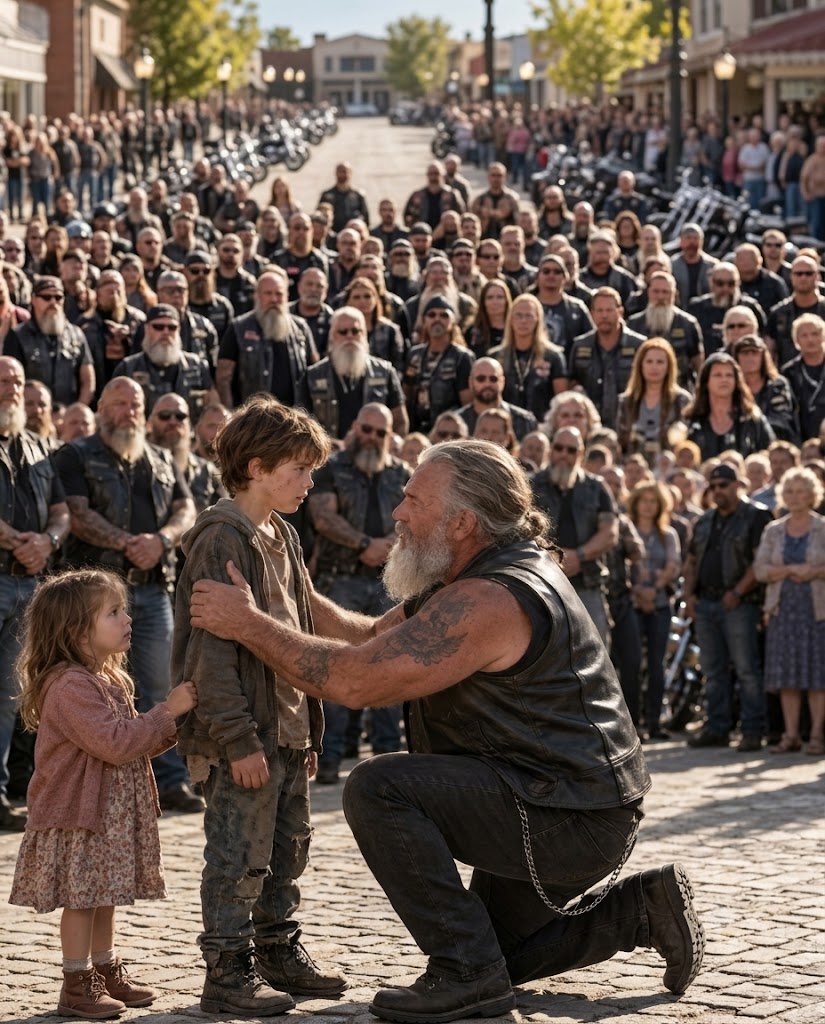
The boy and the girl crossed the bricks, and the bikers on either side stepped back to open a lane without being asked. Gavin did not look at them. He looked at one man only, at the far end, standing beside the bench with his hands open at his sides.
When he reached him, he stopped, and he spoke in a voice he had never used on a grown-up.
“He didn’t take us.”
It came out too quiet. He tried again, louder.
“Nobody took us. I ran away. He never chased us. He left food and a blanket. And he never looked at where we were. And he never told me one thing that wasn’t true. And you put our pictures on poles.”
The big man did not speak. For a moment he seemed unable to. Then he said, in the voice that had once asked a little girl about chrome, “Gavin, may I put my hands on your shoulders?”
Gavin nodded.
Cliff lowered himself onto one knee on the hot bricks and laid both hands on the boy’s shoulders. And for the first time in eleven days, nobody was standing over Gavin Leford.
“You didn’t have to do that,” he said.
“They were going to blame you.”
“I know.”
—
“Get your hands off that boy.”
Pomeroy came across the plaza at a half run, flyers fluttering from his fist, and a dozen others surged behind him. Trent Gaskins took one step, and his shoulders went tight.
“Trent,” Cliff said without turning his head. “Hands down.”
Eighty pairs of arms stayed folded across eighty leather vests. Not a boot moved. All along the sidewalk, phones had come up to record it, and the only sound was the flutter of paper in Pomeroy’s fist and, far below the plaza, the long, low horn of a towboat on the river.
Glenn Tuttle took off his sunglasses.
It was a small thing, and the people nearest him would remember it for years—the first time in a week anyone had seen the sergeant’s eyes. He walked straight between Pomeroy and the kneeling man and stopped there with one palm held out flat.
“Dwight. That’s far enough.”
“Glenn, that man is a gang member—”
“I’ve been waiting all week for that man to give me a reason.” Tuttle’s voice was rough. “He hasn’t. He sat on that bench with a sack of sandwiches for eight days. Everybody back up. Give these kids room.”
The crowd stepped back. Pomeroy stood very still, a pale man in a pressed polo shirt who had never been told no on that street, and the flyers slowly sagged against his leg.
—
A woman came through the press of bodies with her lanyard back around her neck.
“Gavin, I’m Wendy. Nobody here is in trouble.”
“They’ll split us up.” His voice cracked down the middle. “They did before.”
“Not today,” Wendy said, kneeling on the hot brick beside Cliff. “Not if I can help it. Tell me where you want to be.”
Gavin looked at the man whose hands rested on his shoulders.
“With him?”
“He’s a stranger.” Pomeroy’s voice had lost its edge but not its stubbornness. “He has no right—”
“Mr. Rayburn,” Wendy said, clearly enough for the back of the crowd, “has held an active foster care license with my agency for twenty-two months.”
A murmur ran down the sidewalk like wind through grass. Cliff closed his eyes briefly and opened them.
“That boy has a mother somewhere,” Pomeroy said. “Whatever paper you’re holding, he is nobody’s son but hers.”
“You’re right, Dwight.” Cliff did not raise his voice. He did not have to. The plaza was quiet enough to hear the river. “He has a mother. She’s his mother, and nobody here will stand in the way of that. But she isn’t here, and I am.”
He looked down at the boy.
“I told you I wouldn’t lie to you, so I’m saying this in front of everybody so nobody can say later they didn’t hear it.”
Then he lifted his head to the whole street.
“That’s my son now. And that’s my girl. Anyone with an argument about it can take it up with me in a courtroom like grown men.”
—
Gavin’s face was working. “Do you mean it?” he whispered. “Or are you just saying it for them?”
“I have never in my life said a thing I didn’t mean in front of a child.”
The boy’s face broke open. Hazel pressed her cheek against the back of his sweatshirt.
And from the edge of the crowd, one more person was moving.
A small woman in a blue flowered dress and a gray cardigan, with a damp dish towel in one hand and a white paper bag in the other, crossing the bricks toward the children.
Maxine Haskell went down on both knees in front of Hazel Leford, and at seventy-four years old, it was a decision, not a motion.
She did not speak at first. She unfolded the damp towel and wiped the small face in front of her gently, one cheek and then the other, the way she had once done it for children of her own, and a gray smear came away on the cloth.
Then she opened the paper bag. Two cinnamon rolls, still warm, glistening.
“Mine?” Hazel whispered in a voice rusty from disuse.
“Yours,” said Maxine.
She looked up at Cliff, still on one knee with a hand on the boy’s shoulder, and her chin trembled once and held.
“I called the police on you, Mr. Rayburn.”
“You did.”
“I saw a big man in leather on his knees in front of a little girl, and I made up my mind before I finished crossing the street. I’d like it said here in front of everyone that I was wrong about why.”
“Maxine.” His voice was gentle. “You saw a child alone with a stranger, and you picked up the phone. That’s the very thing I’d ask of this whole town. Keep making that call every time, even when you’re sure. You were right to call. You were wrong about me. Those are two different things, and only the second one can be fixed.”
“Fifty-one years behind that counter,” she said, and let him help her up by the elbow. “I’ve sold bread to every kind of man there is, and I still read you off your jacket. A vest can tell you where a man rides. It never could tell you what he’d do for a child on a hot street with nobody watching. I ought to have known that at my age.”
Behind her, a few of the people holding flyers were quietly folding them in half, and then in half again.
—
Wendy made a call from the shade of the statue, her back to the crowd, and it lasted eleven minutes. When she returned, she was holding the legal pad against her chest.
“My supervisor authorized an emergency placement. Hannibal Regional first, to get them checked. Tonight they go to Mr. Rayburn’s home pending a hearing.” She looked at Gavin. “That isn’t a promise about forever. It’s a promise about tonight, and I keep those.”
At Hannibal Regional, a tired young doctor found two children who were underweight and dehydrated, a scraped knee, and in Hazel’s right ear a mild infection already half cleared.
“Who gave her the fever reducer?” the doctor asked.
“I did,” Gavin said. “I followed the chart.”
“You did it exactly right.”
Gavin looked at the floor so nobody would see his face.
—
At seven o’clock, Sergeant Tuttle appeared in the doorway of the hospital room with a cardboard box under one arm. He set it on a chair—a booster seat still in its plastic.
“Missouri law says she needs one until she’s eight,” he said to the wall. “I wasn’t sure of the size.”
Then he turned to Cliff and finally looked him in the face.
“I made up my mind about you in 2009, Rayburn. I spent six days watching you, and I still wanted to be right. I owe you an apology.”
“Accepted,” Cliff said. “Sit down, Glenn. You look like you’ve been standing since Friday.”
Floyd found them in the corridor an hour later with the numbers, and he read them off his phone like a man who didn’t trust them.
“Fourteen thousand two hundred ten dollars with every sponsor gone. The buckets filled by three. And at five minutes to three, someone slipped an envelope into Trent’s bucket with no note and a check for five hundred dollars, signed in the cramped hand of a man who writes on policy renewals.”
Cliff said nothing for a while. “Tell Trent to bank it with the rest.”
Floyd lingered. “Twenty-two months, Cliff. A license. And you never said a word to any of us.”
“Joanne and I started the paperwork in 2018. She died before the home study was done.” Cliff studied the linoleum. “I finished the classes alone, and I kept quiet because I didn’t want a room full of men hoping for something that might never come.”
“Well,” Floyd said, and cleared his throat twice. “It came.”
—
That night, in the farmhouse off Route 79, the children slept in Joanne’s old sewing room. Bobby Joe Kimbell had spent the afternoon hauling a second twin bed up the narrow stairs, and Hazel had gone to sleep with the blue crayon in her fist.
On Sunday afternoon, Gavin found Cliff on the porch.
“Where does the money go?” he asked. “From the ride.”
“Student meal accounts. Kids who owe the cafeteria. The check goes to the district Monday.”
“I owed sixty-three dollars and forty cents.” He said it fast, like pulling off a bandage. “The lunch lady said my name like I’d stolen it.”
“Then you won’t have to carry that anymore.” Cliff looked out across the pasture. “Two hundred sixty-one kids this year. I’d guess yours is in the pile.”
Gavin turned away to hide his face. He had been ashamed of that number for three weeks, and the men he had been afraid of had been paying it down for years without knowing his name.
—
That evening, Wendy called. His mother had been found in the Green County Jail in Springfield, held since August 29th on an old warrant, and she had given the jail a phone number that no longer worked, and nobody had thought to ask about children.
When Gavin heard her voice over the speaker, his shoulders folded in. He told her Hazel was fine. He told her he had followed the chart.
Afterward, he sat on the porch step for a long time. Cliff lowered himself beside him.
“What I said on Main Street was about who would be standing next to you,” he said. “Your mother is still your mother. The judge will decide what comes after, and I can’t promise you the end of it. I can promise you tomorrow and the day after.”
“That’s enough,” Gavin said, which was more than he had said to any adult in a month.
—
On Tuesday, September 19th, at 5:07 in the morning, a yellow school bus slowed at the end of the gravel drive off Route 79.
Pearl Tibbits had driven that route for nineteen years and had honked at more than one motorcycle on that road. She watched a huge man in a leather vest walk down the drive with a kindergartener’s hand in one of his and a lunchbox in the other, and a boy beside them tying a shoelace on the run.
She opened the door. She held it three seconds longer than the schedule allowed while the boy found his seat and the girl was lifted up the steps, and she said nothing at all.
Then, as the door folded shut, she lifted two fingers off the steering wheel—the wave drivers give each other on a county road—and the man in the gravel returned it.
She pulled away at exactly the speed limit, checking her mirror twice.
—
The hearing was set for October. Wendy came by the farmhouse twice that week with forms and a level voice, and on the second visit she stood in the kitchen and looked at the quilt folded at the foot of the bed in the sewing room and had to leave the room for a minute.
Dwight Pomeroy resigned from the council in November, citing family obligations, and the insurance office on North Main stayed open but quiet, and the flyers came down off the lampposts one by one, though not all at once, and not all of them.
Maxine Haskell put a hand-lettered sign in her bakery window that said WE FEED ALL KIDS and meant it, and on Friday afternoons there was a paper sack on the bench by the statue with two rolls in it, and nobody ever saw who left it.
—
The ledger stayed in the back of Gavin’s math notebook for a long time.
He did not throw it away. Some nights he opened it and read the two columns, and the second one was longer than the first, and he thought about how a person could spend eleven days being certain about a man and be wrong in every direction at once.
Then one evening in October, after the dishes were done and Hazel was asleep with the blue crayon on the pillow beside her, Gavin carried the notebook out to the porch where Cliff sat with his boots off and the paperback open on his knee.
He tore out the ledger page, folded it twice, and held it out.
Cliff took it and did not open it. He looked at the boy instead.
“You keep it,” Gavin said. “In case you ever need to remember what it looked like from the other side of the bricks.”
Cliff put the folded page in his vest pocket, over his heart, where it stayed for years—through the hearing, through the custody, through the first day of sixth grade and the first day of high school and a hundred Friday afternoons on a bench in a little plaza with a statue of two boys who never grew up.
And every time someone on North Main Street told the story—and they told it often, the way small towns tell the stories that taught them something—they always ended it the same way.
The boy kept walking anyway.
—
**PART TWO — THE HEARING**
—
The Greene County courthouse in Springfield had been built in 1912 out of limestone that had gone the color of weak coffee, and the radiators in the upstairs hallway clanked like someone hitting a pipe with a wrench, and on the morning of October 12th the hallway smelled like floor wax and rain.
Gavin sat on a wooden bench with his hands flat on his thighs and his sneakers not quite touching the floor.
He had a haircut. Wendy had taken him to a barber on Grand Street two days before, and the barber had asked him what he wanted and Gavin had said, “I don’t know, less,” and the barber had laughed and given him a good one, and Cliff had paid and said nothing about it.
Hazel was at the farmhouse with Floyd Maddox’s wife, Darlene, who had raised four of her own and had brought a bag of crayons and a deck of cards and a firm manner about bedtime.
The door at the end of the hall opened, and Cliff came out in a sport coat that did not fit across the shoulders, with Wendy beside him and a folder under her arm.
“How bad,” Cliff said.
“Not bad,” Wendy said. “Don’t get comfortable.”
—
The courtroom had high windows and a flag and a stenographer who typed like she was trying to beat somebody in a race. The judge was a woman in her sixties named Hargrove with gray hair cut short and reading glasses on a chain, and she had been on the family bench for nineteen years, and she did not smile at anybody.
Gavin’s mother sat on the other side of the room.
She was thirty-one and looked forty, with the kind of thinness that comes from a bad year, and she had a public defender beside her and a paper cup of water she did not drink. She had been released on the old warrant, and she had come to the hearing, and when she saw Gavin she raised one hand halfway and then put it back in her lap.
Gavin looked at the floor.
“Your Honor,” said the public defender, whose name was Ostrander and who had a tie with a stain on it, “my client has completed the required evaluations, has secured a room at a transitional house in Columbia, and has been in contact with the department daily since September 20th. She has never been accused of abuse. She left her children in a situation that she believed—”
“Mr. Ostrander,” Judge Hargrove said, “I’ve read it.”
“Yes, Your Honor.”
“Go on.”
—
Wendy stood up with her folder.
“The department’s recommendation is for continued placement with the current foster resource, with supervised visitation and a reunification plan reviewed at ninety days.” She said it the way she said everything, level and clear. “The children are stable. The youngest is in preschool four days a week and has gained three pounds. The older is in school with perfect attendance since September 19th.”
“Perfect attendance,” Judge Hargrove said, and looked at Gavin over her glasses. “Is that right?”
“Yes, ma’am,” Gavin said. It came out too quiet, and he cleared his throat and said it again.
“Speak up, son. This room has terrible acoustics and I’m not as young as I look.”
“Perfect attendance,” Gavin said, and the stenographer’s fingers flew.
—
Then it was Cliff’s turn.
He stood up and walked to the front of the room and put his hands on the rail, and he did not look at the judge, he looked at Gavin’s mother, which Gavin thought afterward was the bravest thing he had ever seen a man do in a room full of people.
“Mrs. Leford,” Cliff said. “I’m not here to take your children.”
Her chin came up. “You’re the one—”
“I’m the one who sat on a bench.” He said it plainly. “I’m not going to stand here and tell a judge you don’t deserve them. That’s not mine to say. What I’ll tell you is what I told your boy on Main Street. If you get them back—when you get them back—nobody in my house will stand in your way. That’s not a kindness. It’s just true.”
The room was quiet. The stenographer stopped typing for a second and then started again.
“Then why are you here?” Gavin’s mother said, and her voice was not steady.
“Because right now they’re not with you, and they’re with me, and I’d rather be the one telling you that to your face than have it come through a lawyer.”
—
Judge Hargrove took her glasses off and let them hang on the chain and looked at the whole room for a while.
“Mrs. Leford, I’m going to tell you what I tell everybody who comes through that door, and I mean it every time. The State does not terminate parental rights for poverty. It does not terminate for a bad month or a bad decision or a phone that got shut off. It terminates for one reason only, and that reason is the safety of the child.” She put her glasses back on. “That said. Your son spent eleven days in a warehouse loft with a five-year-old and a box of crackers. He didn’t call a single adult because the last time he did, he lost his sister for seven months. I want you to sit with that, ma’am. Not as a punishment. As information.”
“I didn’t know,” his mother said. “I thought—”
“I know what you thought. I read it in the file. I also read that you gave the jail a phone number that was disconnected. I’m not saying that to shame you. I’m saying it because that boy needed an adult and the only adult who showed up was sitting on a bench with a sack of sandwiches.”
—
Then the judge did something that was not in anybody’s script.
She turned her chair and looked at Gavin.
“Son. Come up here.”
Gavin looked at Cliff. Cliff nodded once. Gavin walked up the aisle and stood in front of the bench, and the judge leaned down over it so her voice would carry no further than the two of them, or so he thought, until he realized the whole room could hear her anyway and she knew it.
“I’ve got one question,” she said. “And whatever you tell me, I’m going to write it down and I’m going to think about it. So don’t tell me what you think I want to hear. Tell me what’s true.”
“Yes, ma’am.”
“Where do you want to be?”
Gavin stood there.
He stood there long enough that his mother put her hand over her mouth, and Ostrander started to say something and Judge Hargrove lifted one finger without looking at him, and the stenographer’s fingers hovered over the keys.
And Gavin did something he had never done in front of a judge or a caseworker or a woman with a clipboard and a gentle voice.
He told the truth.
“I want to be with my mom,” he said. “But I don’t want to be with my mom if it means not knowing where Hazel is in the morning. So I want to be where they both are. And if that’s not possible right now, then I want to be where Hazel is, and I want my mom to come there. And if she can’t come there yet—”
He stopped. He started again.
“Then I want to stay where somebody leaves food on a bench and doesn’t look at where I sleep.”
—
The courtroom made a sound that was not quite a murmur and not quite silence.
Judge Hargrove wrote something down. She wrote for a while.
“Mrs. Leford,” she said, without looking up, “do you have a problem with the farmhouse off Route 79?”
Gavin’s mother blinked. “I—Your Honor—”
“Do you have a problem with supervised visitation at a foster home where your son has perfect attendance and your daughter has gained three pounds? I’m not asking you to like it. I’m asking if you have a problem with it.”
“I don’t have a problem with it,” she said, very quietly.
“Mr. Ostrander?”
“No objection, Your Honor.”
“Ms. Brandt, can your department set that up?”
“It can,” Wendy said.
“Then that’s the order.” Judge Hargrove took off her glasses and looked at the whole room one more time. “Continued placement with the current resource, supervised visitation at that resource beginning this weekend, reunification plan reviewed at ninety days, and—” she pointed her glasses at Cliff, “—Mr. Rayburn, I don’t know what you did before you put on that vest, but whatever it was, somebody taught you how to sit still. Don’t stop.”
“No, ma’am,” Cliff said.
—
Outside in the hallway the radiators clanked and the rain had stopped and the limestone had gone the color of afternoon.
Gavin’s mother came down the hall with her public defender and stopped a few feet away with her hands twisted together.
“Gavin.”
He looked up.
“I’m sorry,” she said. “That’s not—I know that’s not enough. I know.”
Gavin looked at her for a long time.
“You can come Saturday,” he said. “Darlene makes a cake on Saturdays.”
His mother’s face did something complicated.
“What kind of cake,” she said.
“Whatever kind Hazel wants. So it’s usually the pink kind.”
“Okay,” she said. “Okay.”
—
**PART THREE — SATURDAYS**
—
Darlene Maddox made the pink cake out of a box mix and a tub of frosting, and she made it every Saturday for three months, and by the third Saturday she had stopped measuring and by the sixth Saturday Hazel had started helping and by the ninth Saturday the pink cake was shaped like a motorcycle, which was terrible, and Hazel loved it.
Gavin’s mother came every Saturday at eleven and left at three, and the first three Saturdays she sat on the porch and did not know what to do with her hands, and the fourth Saturday she helped Hazel with the frosting and the fifth Saturday she asked Cliff if there was anything around the farm she could do, and Cliff said, “The gutters,” and she cleaned the gutters.
By the seventh Saturday she was staying for dinner, and by the ninth she had a job at the diner on Route 79 with the early shift, and by the eleventh she had found a two-bedroom apartment in Hannibal with a lease that Wendy had read over before she signed it, and Judge Hargrove reviewed the plan at ninety days and said, “Keep going.”
—
The Bluff Hawks had a Christmas party every year at the clubhouse on Route 79. It was potluck and a tree and a gift exchange with a twenty-dollar limit and a rule that if you got a bad gift you had to wear it for a full hour.
Cliff brought Gavin and Hazel because they were his now, or as close to his as the law would let them be that winter, and Hazel wore a red dress that Darlene had found at a thrift store and Gavin wore a shirt with buttons.
Floyd Maddox gave a speech that was mostly about the lunch-line ride, which had raised nineteen thousand four hundred dollars that year after the sponsors came back and then some, and the room cheered and Trent Gaskins dropped a five-dollar bill in the bucket for old times.
Then Floyd said, “And we’ve got one more thing,” and he pulled a canvas banner out of a box and unrolled it.
It was the same banner from the back wall, hand-painted by the wives and widows, LUNCHLINE RIDE, SATURDAY SEPTEMBER 16TH, with the number and the date and the total from that first ride, and across the bottom, in newer paint, in a different hand:
FOR GAVIN AND HAZEL. WE’RE GLAD YOU KEPT WALKING.
—
Gavin looked at it for a long time.
Then he did something that surprised everybody in the room, including himself. He walked up to the front and took the microphone, and it squealed, and he held it away from his face the way he had seen people do on television.
“I just want to say,” he said, “that the first day I saw all of you I thought you were going to hurt us. And I was wrong about that. And I’ve been wrong about a lot of things. So.” He looked at the banner. “Thank you for the food. And thank you for not looking at where we slept.”
He handed the microphone back to Floyd and walked back to his seat, and Hazel climbed into his lap and put her arms around his neck, and the room was very quiet for a moment.
Then somebody in the back said, “Cake,” and everybody laughed, and the party went on.
—
**PART FOUR — THE BENCH**
—
The bench stayed where it was.
It stayed through the spring of 2024 and the summer and the fall, and every Friday at five o’clock, Clifford Rayburn walked up Hill Street from a dark red motorcycle with a canvas bag and sat down beside a bronze statue of two boys who never grew up.
Sometimes the bag had sandwiches and water. Sometimes it had apples from the tree in his yard. Sometimes it had nothing at all, because there was nobody left to leave it for, and he sat there anyway with a paperback and read until six-thirty and then went home.
The town got used to him. That was the strangest part.
Dwight Pomeroy nodded at him once, in the spring, across the bricks, and Cliff nodded back, and neither of them said anything, and that was the whole conversation and it was enough.
Maxine Haskell put a second sign in her window that said THANK YOU FOR CALLING, because she believed in the first one and she believed in the second one and she saw no contradiction.
Sergeant Glenn Tuttle retired in June and took a job as a security consultant for the school district, which meant he stood in the hallway at Hannibal Middle School some mornings and said good morning to Gavin, who had stopped being afraid of men in sunglasses.
—
In September, on the anniversary, Gavin walked down to the plaza by himself.
He was twelve now and taller and his jeans were not torn and his sneakers fit.
Cliff was on the bench with his paperback, and he did not look up when Gavin sat down at the far end, and they sat there for a while without talking, the way they had learned to.
“Can I ask you something,” Gavin said.
“Always.”
“Why did you keep coming? The first week. When everybody in town thought you were—” he did not finish it.
Cliff marked his page and closed the book.
“I told you the truth the first day. I’m going to tell you the truth now.” He looked out at the bricks. “I was a security policeman in England in 1986. I stood a perimeter at night and counted airplanes going out and I counted them coming home. One night one of them didn’t come home. And what I learned that night is that waiting is the whole job. Not doing. Waiting. Being there when somebody comes back.”
“And if they don’t come back?”
Cliff was quiet for a moment.
“Then you’re still there,” he said. “And somebody else sees you waiting, and they know that this is a place where a person gets waited for.”
—
Gavin thought about that for a while.
“That’s why you kept coming back after I was safe,” he said. “Not for me. For the next kid.”
“I didn’t know there was going to be a next kid.”
“There’s always a next kid.”
“Yes,” Cliff said. “There is.”
And the next kid came in October, a girl in a too-big jacket who sat on the steps of the library on Fifth Street with a backpack that had everything she owned in it, and she watched the plaza from a distance for four days before she came close enough to see the bag on the bench.
Gavin saw her from the bakery window. He was twelve and he had learned some things.
He walked out with two sandwiches in a paper sack and set it on the bottom step of the library, and he did not look at her, and he walked away, and he sat down next to Cliff on the bench and opened a book of his own.
“Who taught you that?” Cliff said, without looking up.
“You did.”
“That’s not what I taught you.”
“It’s what you did.”
—
**PART FIVE — THE NAPKIN**
—
The folded ledger page stayed in Cliff’s vest pocket for years.
It went through the wash once, by accident, and came out soft and gray, and Cliff dried it on the workbench in the garage and put it back in the pocket of a different vest and did not tell anybody.
Gavin found it when he was fifteen, looking for a flashlight in the garage, and he unfolded it and read the two columns and remembered writing them in the back of a math notebook in a loft in a warehouse with his sister asleep on cardboard.
He folded it up again and put it back where he found it and did not say anything, because some things you leave where they are.
—
Hazel was eight when the call came, and she answered the phone in the kitchen and said, “It’s for you,” and handed it to Gavin with a look that meant something.
It was Wendy Brandt, and she was not calling about a case.
“Your mother finished her program,” she said. “All of it. The housing, the job, the counseling, the whole thing. She’s petitioning for reunification. Judge Hargrove set a hearing for the eleventh.”
Gavin stood in the kitchen with the phone against his ear for a long time.
“Okay,” he said.
“Gavin. You know this doesn’t mean—”
“I know what it means,” he said. “It means she did the work.”
—
The hearing was short. Judge Hargrove was older now and her glasses were thicker and she still did not smile at anybody, but she read the file and looked at the woman in front of her and said, “You did the work, Mrs. Leford. All of it. I’ve been doing this for twenty-three years and I don’t say that very often.”
Gavin’s mother stood with her hands at her sides and her chin up and did not cry until the judge said, “The petition is granted.”
—
Gavin was fifteen and Hazel was eight, and they moved into a two-bedroom apartment in Hannibal with their mother in June, and it was not the farmhouse and it was not the loft and it was somewhere in between, and it had a window that looked out on North Main Street if you leaned.
Cliff helped them move. He carried the twin bed down the narrow stairs himself because he did not trust the boys from the club not to scuff it, and he set it up in Hazel’s new room and put the blue crayon on the pillow and did not say anything about it.
At the door, Gavin’s mother said, “Mr. Rayburn.”
“Cliff.”
“Cliff.” She had gotten better at saying it. “I don’t know how to—”
“You don’t have to.”
“I do.” She put her hand on the doorframe. “You sat on a bench for eleven days.”
“Eight,” he said. “The first three, nobody was watching.”
“Eight days,” she said. “You sat on a bench for eight days and you didn’t look at where they slept. I’ve thought about that every day since October. I don’t know a lot of people who could do that.”
Cliff was quiet for a moment.
“I know a whole club full of them,” he said.
—
He came every Sunday for dinner. That was the arrangement, and it was not written down anywhere, and it held.
He came on Thanksgiving and Christmas and the Fourth of July. He came when Hazel had a school play and sat in the third row and clapped louder than anybody. He came when Gavin got his first job at the hardware store on Broadway and told him to keep his receipts. He came when Gavin turned sixteen and got his license and drove the dark red motorcycle around the block with Cliff on the back, which was illegal and which Cliff allowed for exactly one block.
He came when Gavin turned seventeen and applied to a state university in Kirksville and got in, and he came when Gavin left, and he was at the farmhouse when Gavin came back the first weekend, and there was a bag on the bench on Friday at five o’clock because some things did not change.
—
The girl in the too-big jacket was named Maria, and she was eleven, and she came to live at the farmhouse in the spring and stayed for fourteen months, and then her grandmother got custody and she moved to St. Louis, and she wrote a letter that said THANK YOU FOR THE SANDWICHES AND FOR NOT LOOKING, and Cliff put it in the vest pocket with the ledger page, and it was getting a little crowded in there.
Then there was a boy named Deshawn who came for six weeks and left.
Then there was a brother and sister who came for nine months and were adopted by a family in Columbia, and Cliff went to the adoption and sat in the back and clapped.
Then there was another girl, and another, and another.
—
When Gavin was nineteen and home from college for the summer, he found Cliff in the garage on an overturned bucket with the vest on his knees and the pockets emptied out onto the workbench.
There were the folded ledger page and Maria’s letter and the adoption program and a napkin from the first week, the one that said You are not in trouble. I will not lie to you. I’ll be here at five every day. Take all the time you need. And beneath that, a single word: Cliff.
“You kept it,” Gavin said.
“I kept all of it.”
Cliff picked up the napkin and held it out.
“You should have this now,” he said. “I’ve carried it long enough.”
—
Gavin took the napkin and unfolded it and read it the way he had read it the first night in the loft, twice and then a third time, and the handwriting had not changed and the words had not changed and he had.
He folded it up and put it in his own wallet, behind his license, where it stayed.
“Can I ask you something,” he said.
“Always.”
“Why four things? On the napkin. Why those four things and not something else?”
Cliff thought about it.
“Because somebody told me once,” he said, “that a child who’s been lied to doesn’t need a promise. They need a list. Something they can check. Something that’s the same on Tuesday as it was on Monday. So I gave you a list.”
“Somebody told you that.”
“Her name was Ruth Ellen. She ran the advocacy center in Quincy for thirty years. She taught me everything I know and she died in 2016 and I still think about her every day.”
—
Gavin was quiet for a while.
“I’m going to be a social worker,” he said. “That’s what I came home to tell you. I changed my major.”
Cliff did not say anything for a moment.
“Because of Wendy?” he said.
“Because of Wendy. And because of Ruth Ellen, who I never met. And because of a man who sat on a bench.” He looked at the workbench. “And because there’s always a next kid.”
Cliff picked up the vest and put it back on.
“Yes,” he said. “There is.”
—
**PART SIX — THE FIFTH OF SEPTEMBER**
—
The bench was still there in 2043.
The bronze statue had been cleaned that summer, and Tom and Huck looked a little brighter than they had any right to, and the bricks of the plaza had been re-laid by the city in 2031 and the tar did not stick between them anymore.
Clifford Rayburn was eighty-eight years old and did not ride a motorcycle anymore, and Floyd Maddox had died in 2039 and Trent Gaskins was the president of the Bluff Hawks and there was a plaque on the clubhouse wall with Floyd’s name on it.
But every Friday at five o’clock, an old man in a clean vest walked slowly up Hill Street from a dark red motorcycle that his grandson drove for him, and sat down on the bench beside the statue, and put a canvas bag at the far end.
Sometimes there was nobody to leave it for. Sometimes there was.
—
On the fifth of September, 2043, a boy walked out of the alley behind Haskell’s Bakery—which was called something else now, but the alley was the same alley and the bricks were the same bricks—and every person on that street could see that he had been sleeping somewhere he shouldn’t have been.
Torn jeans. A sweatshirt stiff with dirt. His little sister’s fist wound tight into his sleeve.
He stopped at the mouth of the alley and looked at the plaza and the bench and the old man with the white beard and the canvas bag.
He did not come out that day. Or the next.
On the third day, the old man set the bag on the bench and walked to the far side of the plaza and turned his back to the alley, and he did not look toward it.
Not once.
—
Gavin Leford was thirty-one years old and had been a social worker for nine years, and he was standing in the doorway of the insurance office that used to belong to Dwight Pomeroy and did not belong to him anymore, and he was watching.
He had a lanyard around his neck and a legal pad in his hand, and he had come down to the plaza because Wendy Brandt, who was sixty-two and still working and still keeping her promises, had called him and said, “There’s a boy in Hannibal who needs somebody who knows what a bench means.”
Gavin watched the old man on the far side of the plaza, and he watched the alley, and he did not move.
“He won’t come out while I’m here,” he said to the empty office. “He doesn’t know me.”
So he walked out the back door and around the block and down the alley, slowly, with his hands where they could be seen, and he stopped ten feet from the boy and the girl and he got down on one knee on the warm bricks and he spoke so quietly that the boy had to lean in to hear.
“That’s a lot of bricks, isn’t it,” he said.
The boy nodded once.
“I won’t touch you, and I won’t ask you one question you don’t want to answer.”
—
They sat there for a long time.
Then the boy said, “There’s a man on a bench.”
“There is.”
“With a bag.”
“With a bag.”
“Everybody says he took those kids. Years ago. Everybody says.”
Gavin was quiet.
“Do you believe everything everybody says?” he asked.
The boy looked at the bricks.
“My brother says you can’t trust anybody,” he said.
“Your brother’s not wrong. You can’t trust anybody.” Gavin took the napkin out of his wallet, soft and gray and folded, and held it out. “But you can check. You can make a list. And you can keep it until you know.”
—
The boy took the napkin and unfolded it and read it.
It said: You are not in trouble. I will not lie to you. I’ll be here at five every day. Take all the time you need.
And beneath that, a single word.
Cliff.
—
The boy read it twice.
Then he looked at the man on the far side of the plaza, standing with his back turned, and he looked at Gavin, and he said the first thing he had said to an adult in eleven days.
“Is it true?”
“He’s been doing it for twenty years,” Gavin said.
“That’s not what I asked.”
Gavin almost smiled.
“Yes,” he said. “It’s true.”
—
The boy took his sister’s hand and walked out of the alley.
The street went quiet the way it had gone quiet twenty years before, and the boy crossed the bricks and the old man turned around and got down on one knee, and his hands were shaking, because they were old now, and because he had done this a hundred times and it never got easier.
He spoke so quietly that the boy had to lean in to hear.
“That’s a lot of chrome,” he said.
The boy looked at the dark red motorcycle. “It’s shiny,” he said.
“Shiny.” The old man nodded. “I’ve got two ham sandwiches in this bag I won’t get to. I’ll set them on that bench and walk to the far side of the plaza. They’re not a trade.”
—
Gavin stood in the doorway of the office and watched them, and from the sidewalk across the street an old woman in a blue flowered dress and a gray cardigan, who was ninety-four years old and had come down for a cinnamon roll the way she did every Friday, planted herself on the sidewalk and folded her arms and said, loud enough for the whole street:
“Maxine Haskell says that man’s all right.”
And the street, which had been holding its breath for twenty years, let it out.
—
The old man got up off his knee slowly, with his hand on the bench, and the boy and the girl followed him to the far side of the plaza, and the bag stayed where it was, and the street lights buzzed on.
Gavin watched from the doorway with his hand in his pocket and his fingers on a folded napkin that had gone soft and gray and was still, after all these years, the same four things and one word.
He had been eleven.
Now he was the one watching from the doorway, and the boy was walking anyway, and the old man was kneeling on the bricks, and the story had gotten to the part where it started over.
—
That evening, Gavin drove out to the farmhouse off Route 79 and sat on the porch with an old man in a leather vest who was too tired to read and too stubborn to go to bed.
“Two kids,” Cliff said.
“Two kids.”
“They’ll be here tomorrow.”
“They’ll be here tomorrow.”
The old man was quiet for a while.
“You gave him the napkin,” he said.
“I gave him the napkin.”
“Which napkin.”
“The one you gave me. The first one. The original.”
Cliff turned his head.
“That was the only one I had,” he said.
“I know.”
“I kept it in my vest for thirty years.”
“I know.” Gavin looked out across the pasture. “I’ve got a new one. I wrote it out this morning.”
—
Cliff held out his hand, and Gavin put the new napkin in it, and the old man unfolded it and read it in the light from the porch.
It said four things.
You are not in trouble. I will not lie to you. I’ll be here at five every day. Take all the time you need.
And beneath that, a single word.
Gavin.
—
The old man folded it up and put it in his vest pocket, over his heart, next to the ledger page that had gone soft and gray and the letter from Maria and the program from the adoption and the napkin that had said Cliff.
“Thirty years,” he said. “It goes fast.”
“It doesn’t have to go fast,” Gavin said. “You can sit on a bench.”
—
And he did.
For eight more years, every Friday at five o’clock, an old man in a clean vest walked slowly up Hill Street from a dark red motorcycle that his grandson drove for him, and sat down on the bench beside the statue, and put a canvas bag at the far end, and read a paperback, and waited.
Sometimes there was nobody to wait for.
Sometimes there was.
—
The last Friday was the third of September, 2051, and Clifford Rayburn was ninety-six years old, and he sat on the bench for an hour and read a page of the same paperback he had been reading for thirty years, and when the sun went low he marked his page and stood up slowly and set the bag on the bench.
There was a boy in the alley.
The old man did not look toward it. Not once.
He walked to the far side of the plaza and turned his back to the alley and stood there with his hands at his sides, and after a while he heard footsteps on the bricks, and he did not turn around.
The footsteps stopped at the bag.
Then they came closer.
And a voice behind him, young and thin and careful, said:
“Mister.”
Cliff turned around.
—
The boy was eight or nine, with a sweatshirt stiff with dirt and a scab on his chin and a little sister behind him holding his sleeve, and he was holding a napkin in one hand and a sandwich in the other, and he was looking up at the old man in the leather vest the way a person looks at a light in a window.
“Is it true?” the boy said.
And Clifford Rayburn, who had been waiting on that bench for thirty years, got down on one knee on the warm bricks and put his hands where the boy could see them.
“Yes,” he said. “It’s true.”
—
The bench is still there.
It’s on North Main Street in Hannibal, Missouri, between the bakery and the foot of Hill Street, in the shade of a bronze statue of two boys who never grew up, and there’s a plaque on the back of it that was put there by the Bluff Hawks motorcycle club in 2052, and it says:
CLIFFORD RAYBURN
HE SAT ON A BENCH AND HE DID NOT LOOK
AND THE STREET HAS NEVER FORGOTTEN
—
Gavin Leford is a district supervisor now, and he’s got a lanyard and a legal pad and a woman with a clipboard and a gentle voice who works for him and who kneels when she has to.
Hazel is a kindergarten teacher, and she’s got a blue crayon on her desk that she has never sharpened and will not let anybody touch.
And every Friday at five o’clock, whoever is on that bench—sometimes a social worker, sometimes a club president, sometimes a boy with a bag of sandwiches and a list in his pocket—somebody is always there.
Because that’s the whole thing. That’s the only thing that ever mattered.
The waiting is the job.
And somewhere, right now, on a street like that one, a boy is walking out of an alley anyway.
—
*Author’s Note: This story is a work of fiction. Any resemblance to actual persons, living or dead, or actual events is coincidental. The names, characters, businesses, places, events, locales, and incidents are either the products of the author’s imagination or used in a fictitious manner. This work is intended for mature readers and contains themes of child neglect, food insecurity, and community trauma; reader discretion is advised.*









