Ten Years After Their Divorce, He Returned a Millionaire—Then Found His Ex-Wife Selling Vegetables Beside the Road
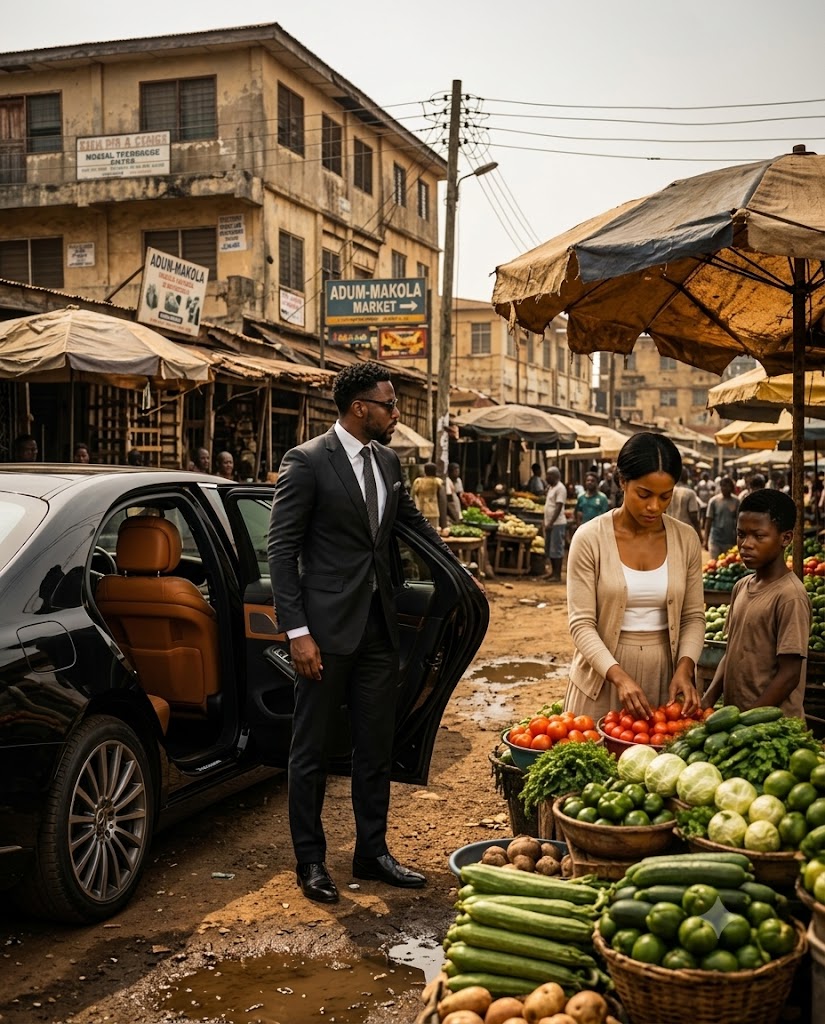
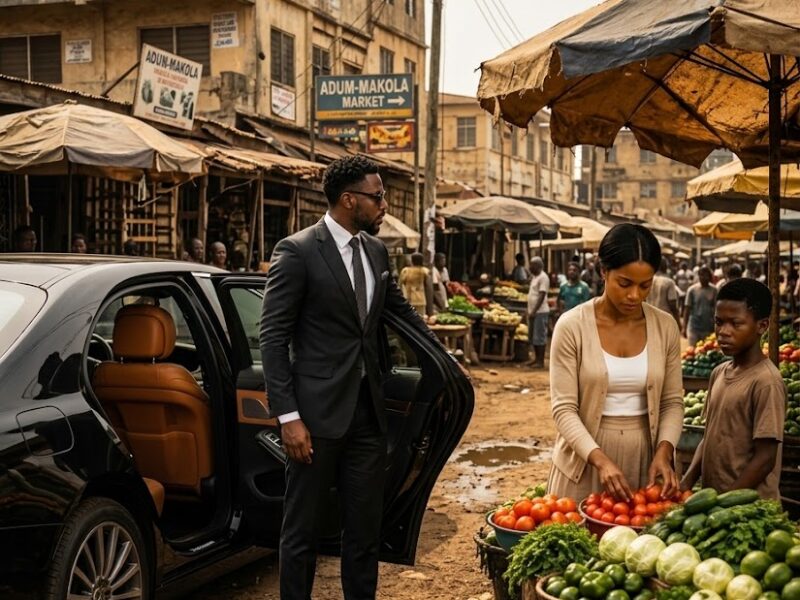
The Brooklyn winter bit through his cashmere coat as Chukwudi Okonkwo stepped out of the black Escalade, his breath fogging in the gray morning air.
He had not seen this corner of Flatbush in a decade—not since the night he’d boarded a red-eye to Lagos with nothing but a duffel bag and a broken heart.
Now he was back, a man worth $47 million, and the market stretched before him like a wound that had never quite healed.
“Fresh peppers! Fresh peppers, madam!”
The cry stopped him cold.
He knew that voice.
—
Adaeze stood behind a wooden stall stacked with tomatoes, peppers, and okra, her hands moving with the same quick efficiency he remembered from another lifetime.
She wore a faded blue apron over a wool sweater, and her hair was wrapped in a bright yellow headwrap that caught the weak winter sun.
She was forty-one now, but she looked older—the kind of older that came from sleeping four hours a night and carrying the world on your back.
A teenage boy sat on a stool beside her, his head bent over a worn textbook.
Chukwudi’s chest tightened.
The boy had his jaw.
—
“How much for the tomatoes?” he asked, his voice barely steady.
Adaeze looked up, and for a moment, her face was a mask of polite customer service.
Then recognition hit her like a freight train.
The tomato in her hand fell back into the basket.
“Chukwudi.”
“Adaeze.”
The boy looked up from his book, curious.
“Mom? Who’s this?”
—
“Kamsi, go inside and finish your reading,” Adaeze said quietly, her eyes never leaving Chukwudi’s face.
“But—”
“Now.”
The boy obeyed, disappearing through a beaded curtain into the cramped back room of the stall.
Chukwudi watched him go, his heart pounding so loud he was sure the whole market could hear it.
“How old is he?”
“Fifteen.”
“Fifteen,” Chukwudi repeated, the number landing in his chest like a stone.
—
“I wrote to you,” Adaeze said, her voice tight. “Twice a week for the first year. Then once a week for the second. Then once a month until the letters started coming back unopened.”
“I never got them.”
“Someone did.”
She reached under the counter and pulled out a battered shoebox tied with twine.
Inside were forty-three letters, all stamped RETURN TO SENDER in red ink.
—
Chukwudi’s hands shook as he opened the first one.
*My dearest Chukwudi, I am pregnant. I have not told anyone yet because I wanted you to be the first to know. I am scared and happy and I miss you so much it hurts.*
The date was March 14, eleven years ago.
He had left for Lagos on March 10.
—
“Your mother came to see me the week after you left,” Adaeze said, her voice flat. “She told me you had already found someone else abroad. She said you wanted a clean break and that I should not embarrass myself by chasing you.”
“My mother.”
“She also said the family would pay for the baby’s care if I agreed to stay silent.”
Chukwudi closed his eyes.
Ten years of believing his wife had abandoned him.
Ten years of believing his son had never existed.
—
“I called your office twice a week for two years,” Adaeze continued. “The number stopped connecting after the first three months. I called your mother’s house. She told me you were unavailable. She told me you would call back. You never did.”
“I called you,” Chukwudi said, his voice cracking. “I called the landline every Sunday for six months. Your mother told me you had moved on. She said you were seeing someone else.”
“My mother died eight years ago, Chukwudi.”
The silence between them was heavy enough to crush bone.
—
“Emeka,” Chukwudi said into his phone, “I need you to find out what happened to the mail my mother handled while I was settling abroad. Start with the housekeeper who worked for her at the time.”
“Sir, that was ten years ago.”
“I know. Start with her.”
He hung up and stared at the shoebox of letters.
Forty-three.
Forty-three attempts to reach him.
Forty-three failures engineered by the one person he had trusted most.
—
The confirmation came three days later.
Emeka stood in the living room of Chukwudi’s penthouse hotel suite, a manila folder in his hands.
“The housekeeper, Mrs. Nkiru, remembers collecting letters addressed to you from a market woman in Brooklyn. She handed them directly to your mother, as instructed.”
“And what did my mother do with them?”
“She says your mother told her they were forwarded. She never saw them posted.”
Chukwudi nodded slowly.
—
“There is more, sir.”
“Of course there is.”
“The housekeeper also mentioned that your mother intercepted calls to the family landline during that period. She told callers you were unavailable. Adaeze’s name came up specifically more than once.”
“She told me Adaeze had moved on.”
“She told Adaeze the same about you.”
Chukwudi stood up and walked to the window.
Forty-seven million dollars.
Three companies.
A merger that would have made him one of the wealthiest Nigerian-Americans in New York.
None of it mattered.
—
“Emeka, I need you to find something else for me.”
“Anything, sir.”
“Find out if Adaeze ever filed for divorce.”
“Sir?”
“I need to know if I was ever legally free to remarry—or if my mother made sure that door was closed too.”
Emeka nodded and left.
Chukwudi stared at the Brooklyn skyline and wondered how many lies one woman could tell before the weight of them crushed her.
—
The answer came the next morning.
“No divorce was ever filed, sir. You are still legally married to Adaeze Okonkwo, née Adaeze Nwosu.”
Chukwudi laughed—a hollow, broken sound.
“My mother managed to destroy my marriage without ever managing to end it.”
“It would appear so, sir.”
“Then it seems I have a wife to see and a son to meet.”
—
The market was quieter on Sunday morning.
Adaeze was closing up her stall when Chukwudi appeared again, this time without the Escalade, without the driver, without the armor of wealth that had protected him the first time.
He wore a simple gray sweater and jeans.
He looked like the man she had married.
“May I walk with you?” he asked.
Adaeze studied him for a long moment.
“Kamsi is at the library. He will not be home for another hour.”
“I did not come for Kamsi. I came for you.”
—
They walked through the quiet streets of Flatbush, past the Caribbean bakery that had been there when they were young, past the park where they had once dreamed of a future that never came.
“My mother has confessed everything,” Chukwudi said. “The letters. The calls. The lies to both of us. She wanted a better wife for me, one with more status than you had. She engineered the silence between us from the very beginning.”
“I know.”
“You know?”
“Your mother came to see me three days ago. She apologized.”
—
Chukwudi stopped walking.
“She did?”
“She said she had wronged me more deeply than any apology could repair. She said she robbed her own grandson of a father for fifteen years out of fear that I was not good enough for your family’s name.”
“And what did you say?”
“I told her I did not need her approval anymore. I needed it ten years ago, and she gave me only lies instead.”
Adaeze paused.
“But I will not deny my son his grandmother if she is willing to earn that place honestly.”
—
Chukwudi exhaled.
“You are a better person than I am, Adaeze.”
“No. I am a mother. That is a different thing entirely.”
They walked in silence for another block.
“Ten years, Chukwudi. Ten years I believed you simply stopped loving me the moment distance gave you the chance.”
“And I believed the same of you.”
“I know.”
“Can you forgive me?”
“I already have. Forgiveness came easily once I understood the truth was stolen from both of us equally.”
—
“And trust?”
Adaeze stopped and looked at him.
“Trust is not always as quick as forgiveness.”
“Then let me rebuild it slowly,” Chukwudi said. “Not with money, not with apologies alone, but with time. The same thing that was stolen from us.”
“Time is the one thing I have learned to be patient with these past ten years.”
“Then prove it slowly, Chukwudi. I have learned patience. I can offer you the same patience now.”
—
The bell above the door of the family home chimed as Chukwudi’s mother, Ngozi, set down her teacup.
“Chukwudi, whatever this is, can it not wait until after dinner?”
“No, Mama. I have a son. Fifteen years old. His name is Kamsi.”
“I—Chukwudi, I did not know.”
“Do not lie to me, Mama. Not today. I have already spoken to Mrs. Nkiru. She remembers collecting Adaeze’s letters. She remembers you telling callers I was unavailable.”
—
Ngozi’s face crumbled.
“I only wanted better for you, my son. Adaeze’s family had nothing. No status, no connections. I feared she would keep you tethered to poverty for the rest of your life.”
“So you destroyed my marriage to save me from a woman you decided was beneath us?”
“I told her you had moved on. I told you she had grown distant. I did not expect either lie to last this long, Chukwudi. I only wanted a small distance between you. Ten years long enough for you to settle abroad and see clearer eyes.”
“Ten years, Mama. Ten years I believed my wife abandoned me. Ten years she believed I abandoned my own child without a second thought. And it was you the entire time.”
—
“I am your mother, Chukwudi. Everything I did, I did because I loved you.”
“Love does not lie to the people it claims to protect, Mama.”
Chukwudi turned away.
“Love does not steal ten years from a child and his father and call it wisdom.”
“I see now how wrong I was. Status did not raise that boy. Adaeze did. Alone. With nothing but her own hands and her own strength.”
“You will have to earn your place in his life, Mama. The same way I will have to earn mine.”
—
The library was quiet when Chukwudi found Kamsi at a corner table, a stack of books beside him.
The boy looked up, his jaw tightening.
“You’re him.”
“I am.”
“My mother told me everything. About the letters. About your mother. About the ten years.”
“I did not know, Kamsi. If I had known, I promise you I would have found a way back to you far sooner.”
“Why did nobody tell you then? Fifteen years and I only find out today that my own father was searching and my grandmother was the reason he never found us?”
—
“I do not have a good answer for that.”
“Everyone in school had a father to talk about. I had nothing because a woman I have never even met decided I was not worth telling him about.”
“Kamsi—”
“I am angry, Chukwudi. Not only at your mother. At you. For not fighting harder.”
“You are right to be angry. I did not fight hard enough. Your mother paid the price for my silence as much as my mother’s lies.”
“I am not asking you to forgive that tonight. I am only asking you to let me start proving slowly that I am not the same man who once accepted silence so easily.”
Kamsi was quiet for a long moment.
“Take your time, Chukwudi. I have already wasted fifteen years of yours. I will not rush you through the years still ahead.”
—
The call came three days later.
“Sir, Tony has moved forward without you. The board voted this morning. The merger has been withdrawn pending a review of leadership stability.”
Chukwudi stood on the balcony of his hotel suite, watching the Brooklyn Bridge glitter in the evening light.
“He followed through.”
“Yes, sir. It is a significant loss. Forty-seven million dollars.”
“Ten years ago, Emeka, I would have called this the worst day of my life. Today, sitting beside a son I only just met, it barely registers as a loss at all.”
—
“You are certain, sir? This was the largest deal of your career.”
“The largest deal of my career, Emeka, is sitting at a vegetable stall right now learning my name for the first time. Draft whatever statement is necessary for the board. I have no intention of chasing Tony’s approval any further.”
“Understood, sir.”
“And Emeka?”
“Yes, sir?”
“Thank you for finding the truth.”
—
The market was closing for the evening when Chukwudi returned the next day.
He walked past the other vendors, past the gossip that followed him like a shadow, past the whispers about the millionaire who had come back for the vegetable seller.
Adaeze was stacking tomatoes into wooden crates, her hands moving with the same quick efficiency he had always admired.
“Adaeze.”
She looked up.
“You heard?”
“I heard.”
“Forty-seven million dollars.”
“It was never worth what it would have cost me to keep hiding you and Kamsi from my investors.”
—
“I told you, Chukwudi. I do not need you to build anything.”
“I know. But I want to build something new together. If you will still have me.”
“Ten years ago I married a young man with big dreams and very little patience for waiting. Who is the man standing before me today?”
“A man who learned the hardest way possible that success without the people who matter most is worthless. A man who was told to choose between his business and his son and did not hesitate to choose his son.”
“That is a better answer than I expected.”
—
“Will you let me prove it is also a true one? Not overnight. Not because Kamsi needs a father or because guilt demands it. But because I am asking you honestly as the same man who once loved you before the world convinced us both otherwise.”
Adaeze was silent for a long moment.
“Prove it slowly, Chukwudi. I have learned patience these ten years. I can offer you the same patience now if you are willing to earn it.”
“I am.”
“Then come back tomorrow. The market opens at six.”
—
Kamsi was sitting on a stool beside the stall when Chukwudi arrived the next morning, a crate of tomatoes in his arms.
The boy raised an eyebrow.
“You’re late.”
“I brought tomatoes.”
“We already have tomatoes.”
“These are from the farmer’s market on Atlantic Avenue. Heirloom. They cost three dollars each.”
“You paid three dollars for tomatoes?”
“I am trying to impress your mother.”
Kamsi laughed despite himself.
—
“Papa, you are terrible at arranging tomatoes. Mama does it much better.”
“Ten years of boardrooms taught me many things, Kamsi. Some skills only a market can teach a man.”
“Then teach me, Adaeze. I have ten years of lost money to make up for, one market stall at a time.”
“You are going to lose money at this rate.”
“I can afford it.”
Kamsi grinned.
“Mama, can we keep him? He is surprisingly good company even if his tomatoes are always crooked.”
“We shall see, Kamsi. We shall see.”
—
Six months later, the stall had doubled in size.
Chukwudi had invested in a small storefront three blocks from the market, and Adaeze had stocked it with vegetables from local farms.
Kamsi helped on weekends, learning the business with the same sharp mind his father had once used to build an empire.
Ngozi visited once a week, bringing homemade bread and a quiet apology she never quite knew how to fully express.
It was enough.
It was more than enough.
—
The evening light was golden when Chukwudi stood outside the storefront, watching Adaeze arrange a display of peppers in the window.
His phone buzzed.
“Sir, the board has reconsidered. They want you back. Tony has been removed as CEO. The merger is back on the table.”
Chukwudi looked at the store, at his wife, at the life he had almost lost.
“Tell them I will think about it.”
“Sir?”
“Tell them I have more important things to do than chase money.”
—
The wedding was small, just family and a few close friends.
Adaeze wore a yellow dress, the same color as the headwrap she had worn the day he found her again.
Kamsi stood beside them, a nervous smile on his face.
“You know this is technically a vow renewal,” he whispered.
“Technically, we were never divorced.”
“I know. That is the wild part.”
“You are not going to cry, are you, Kamsi?”
“I am not going to cry.”
“You are crying.”
“Shut up, Chukwudi.”
—
Ngozi sat in the front row, her eyes wet.
After the ceremony, she approached Adaeze.
“I know I do not deserve your forgiveness.”
“You are right. You do not.”
“But I will spend whatever years I have left earning it properly this time.”
Adaeze nodded.
“That is all I can ask.”
“And Kamsi?”
“He is your grandson. He will decide what he wants you to be.”
“I will wait.”
“You will have to.”
—
The store grew.
They opened a second location, then a third.
Chukwudi sold his shares in the American company and invested the money into the business he had built with his wife.
Within two years, the small vegetable stand had become a chain of markets across Brooklyn and Queens.
They called it Adaeze’s Harvest.
Kamsi worked there on weekends during college, learning the business from his mother, the woman who had built it from nothing.
—
The tomato was perfect.
Chukwudi held it up to the light, examining its deep red skin, its flawless shape.
“Three dollars each,” he said.
“That is too much for a tomato,” Adaeze said.
“These are heirloom. From the farmer’s market on Atlantic Avenue.”
“You know, you have been using that same line for three years.”
“Has it worked yet?”
“No.”
“Then I will keep trying.”
—
Kamsi walked into the storefront, a young man now, with his father’s height and his mother’s steady gaze.
“Papa, the shipment from the farm is late.”
“Did you call them?”
“Twice. They said the truck broke down.”
“Then go pick it up yourself.”
“In what?”
“Take the truck.”
“We have a truck?”
“We have three trucks. You are running the business, Kamsi. You should know these things.”
—
Kamsi grinned.
“You are still terrible at arranging tomatoes.”
“I know.”
“Mama does it much better.”
“I know.”
“But you are getting better.”
“I have been practicing.”
Kamsi laughed and walked out.
Chukwudi looked at Adaeze across the counter, at the woman who had waited ten years for a truth that had almost been lost forever.
“I love you,” he said.
“I know.”
“I should have said it sooner.”
“You did. I just did not hear it.”
“You heard it today.”
“Today is enough.”
—
The music played softly in the storefront as they closed for the evening.
Chukwudi arranged the last of the tomatoes in the display window, his crooked rows a testament to the fact that some skills could not be learned, only practiced.
Adaeze stood beside him, her hand in his.
“Ten years,” she said.
“Ten years.”
“Was it worth the wait?”
“I do not know yet. Ask me in another ten.”
“I will hold you to that.”
“I hope you do.”
—
The shop lights went out, and they walked home together through the quiet streets of Flatbush.
Behind them, the tomatoes gleamed in the window, red and round and imperfect, a promise that had finally been kept.
And in the pocket of Chukwudi’s coat, forty-three letters remained—a reminder of what had been stolen, and what had been found.
He would never let them go again.
—









