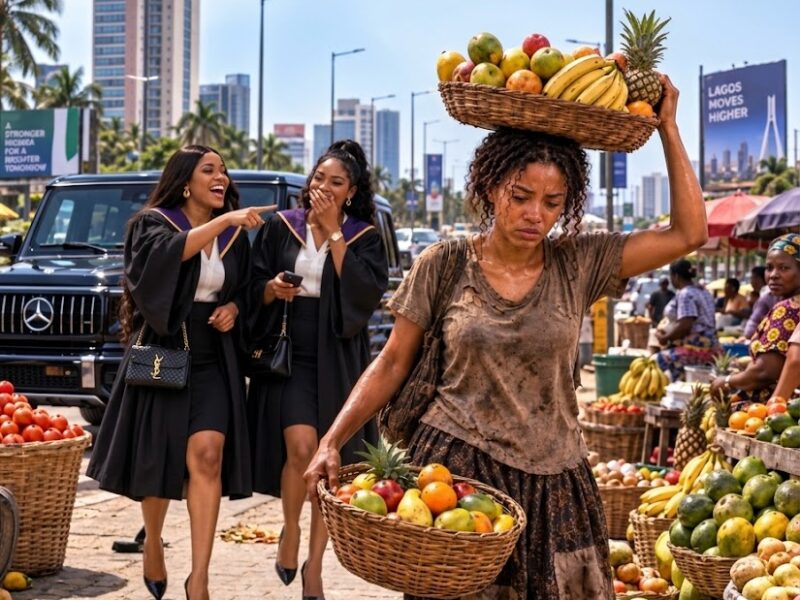
Students Mocked Her for Selling Food on Campus—Then the University President Revealed Who She Really Was
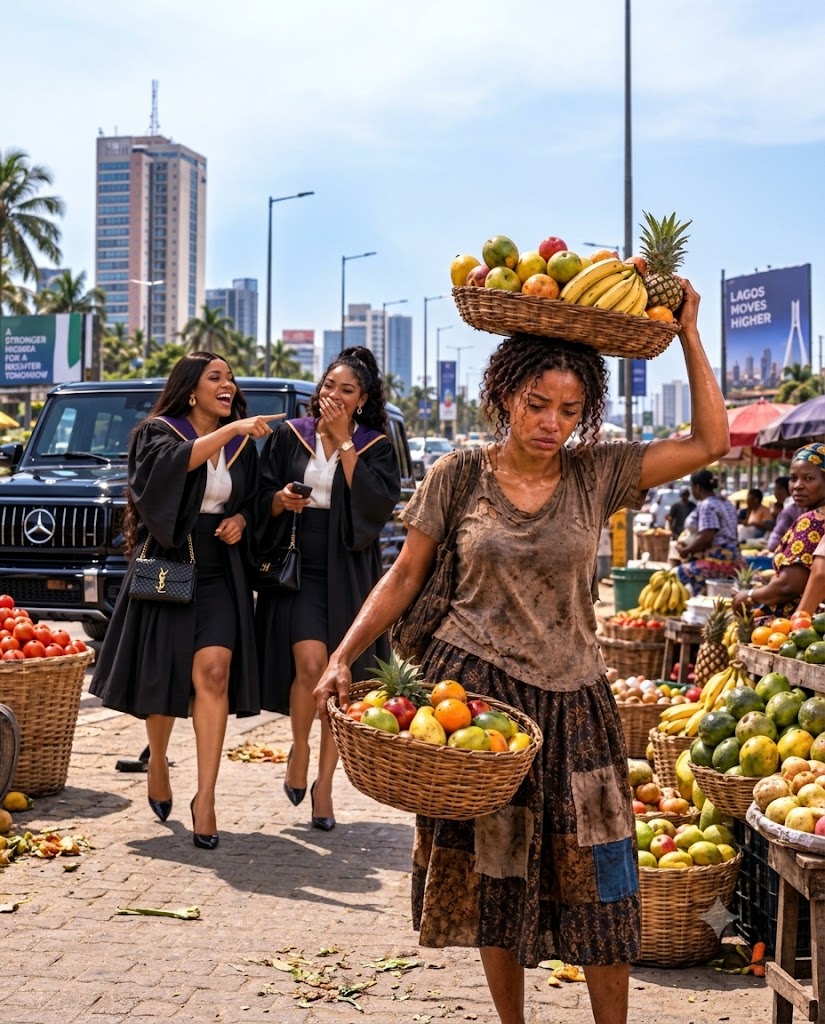
The September sun beat down on the campus of Sterling University like a hammer on hot iron.
Students moved in clusters across the quad, their designer backpacks swinging, their laughter carrying on the dry Texas wind.
At the edge of it all, near the old brick wall that separated the business school from the parking lot, a young woman knelt on a folded towel with a plastic tray balanced on her head.
Her name was Grace Okafor, and she was selling roasted peanuts and cold bottled water to anyone who would spare a dollar.
Most people walked past her like she was part of the landscaping.
Some laughed.
A few threw coins at her feet like she was a fountain in a mall.
She never flinched, never begged, never explained herself.
She simply stacked her dollars, one by one, and thought about her mother lying in a hospital bed forty minutes away.
—
Three years earlier, Grace had been the top economics student in her high school class, the kind of mind that made teachers sit up and pay attention.
She had earned a full scholarship to Sterling University, the most prestigious business school in the state.
Her mother, Neka, had cried when the letter arrived.
They had celebrated with a small cake from the grocery store clearance rack and two cups of instant coffee.
“My little girl,” Neka had whispered, her hands shaking from the early stages of heart disease. “You are going to rise above all of this.”
Grace had promised her mother that day that she would never stop climbing.
She had no idea how steep the mountain would become.
—
The trouble started in her sophomore year, when she caught the attention of a young man named Obina Balogun.
Obina was the sole heir to the Balogun fortune, a family whose name was printed on half the buildings in downtown Houston.
He was quiet, thoughtful, and completely uninterested in the social scene that buzzed around him.
He noticed Grace the first time he saw her standing up to a group of students who had knocked her tray of fruit into the mud.
She had not cried.
She had not screamed.
She had simply picked up her bruised apples, looked them in the eye, and said, “This bread was bought with my mother’s sacrifice. You can buy grades and friends, but your soul is empty.”
Obina had never heard anyone speak like that.
He fell in love with her that day.
—
Their relationship was quiet at first, stolen moments between classes, shared sandwiches on the library steps.
Then it became public, and the whispers started.
“Did you see the Balogun heir with that market girl?”
“She sells food on campus like a street vendor.”
“What could he possibly see in her?”
The loudest voice in that chorus belonged to Vanessa Cole, a wealthy socialite who had been chasing Obina since freshman year.
Vanessa had money, influence, and a mean streak that ran deeper than the Rio Grande.
She had never been told no in her life.
She decided that Grace Okafor needed to be erased.
—
The scholarship exam was the perfect opportunity.
Every year, Sterling University awarded a single full-ride scholarship to the top-performing student in the economics department.
The winner would receive tuition, housing, and a stipend for four years—enough to lift a family out of poverty.
Grace had studied for months.
She had skipped meals, slept four hours a night, and borrowed every textbook she could find.
She was ready.
Vanessa knew she was ready.
That was the problem.
The morning of the exam, Vanessa and her friend Toby slipped a folded cheat sheet into Grace’s backpack while she was using the restroom.
Then they called the proctor.
—
“Someone just reported cheating materials,” the proctor announced, his voice cold as a courtroom gavel. “And they were absolutely right.”
He pulled the cheat sheet from Grace’s bag and held it up like a trophy.
Grace’s face went pale.
“No,” she said. “Those are not mine. I am being framed. I just stepped outside.”
The proctor shook his head.
“Caught red-handed, and you are still blaming someone else. What a shameless fraud.”
The room erupted in whispers.
Vanessa sat in the back row, a small smile playing on her lips.
Grace was escorted out of the building, her reputation in pieces.
She was officially suspended and expelled.
Her academic career was over.
—
That afternoon, Grace sat on the steps of the administration building, staring at the rejection letter in her hands.
Her phone buzzed.
It was a message from an unknown number.
“Come to the Balogun estate. We need to talk.”
She should have ignored it.
She should have run.
But she was young, and she still believed that people could be reasoned with.
She went.
—
The Balogun mansion was a monument to old money, all marble floors and crystal chandeliers.
Grace stood in the foyer, her worn sneakers squeaking against the polished stone.
Obina’s father, Chief Balogun, descended the grand staircase like a king descending to address a peasant.
He did not offer her a seat.
He did not offer her water.
He looked at her the way a farmer looks at a weed.
“I know about you and my son,” he said. “It ends today.”
Grace straightened her back.
“With respect, sir, that is not your decision.”
The Chief laughed, a dry, humorless sound.
“You are a market hawker, Miss Okafor. You sell peanuts on the street. You have no name, no fortune, no future. My son is the heir to an empire. Do you honestly believe you belong in his world?”
“I believe I belong wherever I earn my place.”
“Then let me make this simple for you.”
He pulled out his phone and showed her a photograph.
It was her mother, Neka, lying in a hospital bed, tubes running from her nose and arms.
“She is in a coma,” the Chief said. “Her heart disease is in its final stage. She is alive only because of the ventilator and the life-saving drugs that my money is paying for.”
Grace’s blood ran cold.
“You cannot do this.”
“I can do whatever I want. I am the law in this land.”
He leaned closer, his voice dropping to a whisper.
“Do you want love, or do you want your mother’s life? Choose.”
Grace felt the floor tilt beneath her.
“You are not human,” she whispered. “You are a demon.”
“I am a father protecting his legacy.”
—
She made the choice.
She packed her mother’s belongings, arranged for a medical transport, and left Houston that same night.
She left Obina a letter, one that said she was sorry, that she loved him, that she had to go.
She did not tell him why.
She could not.
If she had, he would have fought his father, and she could not bear the thought of him losing everything for her.
So she disappeared.
She took her mother to a small town in New Mexico, where the air was dry and the rent was cheap.
She found work washing dishes at a diner, then cleaning rooms at a motel, then selling homemade tamales on the street corner.
Every dollar she earned went to her mother’s medicine.
Every night, she studied.
She studied accounting, finance, economics, anything she could get her hands on.
She had no laptop, so she used the public library computers.
She had no textbooks, so she read the same three books over and over until she knew them by heart.
She had lost everything except her mind, and no one could take that away.
—
Five years passed.
Neka’s health stabilized, but she needed constant care.
Grace worked three jobs, slept four hours a night, and never stopped learning.
Then one day, fate intervened.
She was cleaning a hotel room when she found a stack of financial documents on the desk.
She knew she should not look.
But her eyes caught a number that did not make sense.
The depreciation coefficient was wrong.
The cash flow was being funneled through shell companies.
Three million dollars was leaking overseas.
Grace wrote a note, correcting the errors, and left it on the desk.
She did not think anything of it.
She went back to scrubbing floors.
—
The next morning, she was summoned to the hotel lobby.
A man in a tailored suit was waiting for her.
His name was Mr. Adi, and he was the chief financial officer of the Okafor Financial Group, one of the largest investment firms in the country.
“Was it you?” he asked, holding up her note. “Did you write this?”
Grace nodded.
“The depreciation coefficient in column B has been manipulated with extreme sophistication,” she said. “If you cross-reference it with the Q3 corporate income tax bracket, you will see the cash flow is leaking overseas. The person who prepared this report is not incompetent. He is intentionally gutting your corporation.”
Mr. Adi stared at her for a long moment.
“What is your name?”
“Grace Okafor.”
“From tomorrow onward, you no longer need to wash dishes. My corporation is missing a mind like yours.”
—
Grace rose through the ranks faster than anyone could have predicted.
She had a gift for seeing what others missed, for finding the cracks in the armor, for turning chaos into order.
Within three years, she was vice president of the Okafor Financial Group.
Within five, she was the youngest person ever to hold the title.
She never forgot where she came from.
She never forgot the people who had laughed at her, the man who had threatened her, the system that had tried to break her.
She also never forgot Obina.
She thought about him every day, wondered where he was, whether he was happy.
She did not know that he had spent those same five years searching for her.
—
The charity hospital was Grace’s idea.
She had watched her mother struggle for years, had seen the way the poor were treated in underfunded clinics and overcrowded emergency rooms.
She wanted to build something that would last, something that would give people like her mother a fighting chance.
She donated one hundred percent of the construction costs.
She did it anonymously.
She did not want praise.
She wanted change.
The day of the ribbon-cutting ceremony, she stood on stage in a simple blue dress, her hair pulled back, her eyes scanning the crowd.
She saw politicians, businessmen, reporters.
She saw Vanessa Cole and Toby in handcuffs, escorted by police officers, their faces pale with shock.
They had been arrested for embezzlement, for setting up shell companies to siphon assets from the Balogun empire.
The empire itself was on the brink of bankruptcy.
And there, in the back of the crowd, stood Obina Balogun.
He was thinner than she remembered, his hands calloused, his clothes simple.
He was no longer a prince.
He was a man.
—
“Obina,” she whispered.
He turned.
Their eyes met.
“Grace,” he said. “I have been looking for you for five years.”
“I know.”
“I found out what my father did. I smashed his office to pieces. I renounced my inheritance. I threw everything back at him and walked away with nothing but my bare hands.”
“You fool,” she said, her voice breaking. “Why did you have to do that? You lost everything.”
“I did not lose you.”
He stepped closer.
“For the past five years, I have worked as a mason, a lowly engineer, living on my own sweat and tears. I would rather be a poor bricklayer holding my head high than a king sitting on a throne built on your tears and false accusations.”
Grace felt the tears spill down her cheeks.
“I thought you had forgotten me.”
“I could never forget you.”
—
A few minutes later, an old man approached her.
It was Chief Balogun, but he was not the same man she remembered.
His shoulders were stooped, his eyes hollow, his hands trembling.
“Miss Okafor,” he said. “I am here to look for Obina.”
“He is in the garden.”
“I know. I just wanted to say—”
He stopped, his voice catching.
“The Balogun Empire is on the brink of bankruptcy. Toby and Vanessa, the ones you once tolerated, are now in prison for embezzlement and setting up shell companies to siphon assets. Now that I have no heir and no power left, I finally remember the son I once forced to turn his back on his conscience. Karma. This is my karma.”
Grace looked at him for a long moment.
“The sins of the past happened because you were too arrogant, blindly trampling on others,” she said. “You have lost everything.”
“I know. Please, please tell Obina, please forgive this cruel old man. I beg you.”
Grace sighed.
“Hatred only keeps a person trapped in the mud of the past. I forgive you. Not because you deserve forgiveness, but because I want my soul to be free to face the future.”
She pointed toward the garden.
“Go meet him. After all, you are his father.”
—
The Chief walked away, his steps slow, his head bowed.
Grace watched him go, then turned to look at the hospital, the building that would save countless lives, the symbol of everything she had fought for.
Her mother was inside, resting in a private room, her heart finally stable.
Obina was in the garden, waiting for her.
The sun was setting, painting the sky in shades of gold and rose.
Grace smiled.
Finally, her flower had bloomed at its brightest.
No, she thought.
It was them.
Overcoming the storm together.
—
**Part 2**
—
The garden was quiet except for the sound of water trickling from a small fountain and the distant hum of the city beyond the hospital walls.
Grace found Obina sitting on a stone bench beneath a magnolia tree, his elbows on his knees, his head bowed.
He looked up when he heard her footsteps.
“You came,” he said.
“I never left.”
She sat beside him, close enough to feel the warmth of his shoulder.
“I am sorry,” he said. “For everything. For what my father did. For the years I spent searching for you. For the years you spent alone.”
“You did not do anything wrong.”
“I should have found you sooner.”
“You did find me.”
He reached for her hand, and she let him take it.
“I have nothing to offer you,” he said. “No fortune, no name, no future. I am a bricklayer with calloused hands and a broken family.”
Grace laughed softly.
“You think I care about fortune or names?”
“I think you deserve someone who can give you the world.”
“I already have the world.”
She squeezed his hand.
“I have my mother. I have my mind. I have my dignity. And now I have you. That is more than enough.”
Obina looked at her, his eyes shining.
“I love you, Grace Okafor.”
“I love you too, Obina Balogun.”
—
They sat in the garden until the stars came out, talking about the years they had spent apart.
Obina told her about his work as a mason, about the small apartment he rented, about the nights he spent staring at the ceiling, wondering where she was.
Grace told him about her mother’s illness, about the diner, about the night she found the financial documents that changed her life.
“You saved the Okafor Financial Group,” Obina said. “You are a hero.”
“I am not a hero. I am just someone who refused to give up.”
“That is what a hero is.”
Grace smiled.
“Then you are a hero too.”
—
The next morning, Grace visited her mother’s room.
Neka was sitting up in bed, her color better than it had been in years.
“Mom,” Grace said. “I have something to tell you.”
Neka smiled.
“You found him, did you not?”
“How did you know?”
“A mother knows these things.”
Grace sat beside her and told her everything.
Neka listened quietly, her eyes glistening.
“I always knew you would find your way back to each other,” she said. “You have a love that cannot be broken.”
“I was afraid, Mom. I was afraid he had moved on.”
“He never moved on. He was waiting for you.”
Grace wiped her eyes.
“I am going to marry him.”
Neka laughed.
“I know.”
—
The wedding was small, held in the garden of the charity hospital.
Only family and close friends were invited.
Grace wore a simple white dress, her hair adorned with magnolia blossoms.
Obina wore a dark suit, his hands still calloused but his eyes bright.
The Chief attended, his health failing but his heart softer than it had ever been.
He watched his son marry the woman he had once tried to destroy.
He wept.
Grace and Obina exchanged vows, promising to love each other through every storm, to build a life together from the ashes of the past.
When they kissed, the small crowd erupted in applause.
Neka watched from her wheelchair, her heart full.
“My little girl,” she whispered. “You have risen above all of this.”
—
The years that followed were not without challenges.
The Balogun Empire was rebuilt, but not as a monument to greed and power.
It was rebuilt as a force for good, investing in education, healthcare, and community development.
Grace and Obina worked side by side, using their combined brilliance to create something that would outlast them both.
The charity hospital grew into a network of clinics serving the poorest communities in the state.
The scholarship that Grace had once lost was restored, renamed in her honor, and awarded to students who showed the same resilience she had.
Vanessa and Toby served their sentences, but they never recovered their reputations.
They faded into obscurity, a cautionary tale of what happens when envy and cruelty rule your heart.
Chief Balogun passed away a few years later, surrounded by his son and daughter-in-law.
In his final moments, he took Grace’s hand and whispered, “Thank you.”
“For what?”
“For showing me what forgiveness looks like.”
—
Grace never forgot the days she spent selling peanuts on the street corner.
She never forgot the humiliation, the hunger, the fear.
She also never forgot the strength she found in those dark moments, the determination that carried her through.
She kept a small tray in her office, a reminder of where she had come from.
Whenever she felt overwhelmed, she would look at that tray and remember.
She had been mocked, ridiculed, thrown away.
And she had risen anyway.
Not because she had money or connections or luck.
Because she had grit.
Because she had love.
Because she had refused to let the world define her.
—
One evening, years after the wedding, Grace stood on the balcony of her home, looking out at the Houston skyline.
Obina joined her, wrapping his arms around her waist.
“What are you thinking about?” he asked.
“The past,” she said. “And the future.”
“Any regrets?”
“Not a single one.”
She turned to face him.
“I used to think that suffering was a punishment,” she said. “That the world was cruel and unfair and there was nothing I could do about it.”
“And now?”
“Now I know that suffering is a teacher. It taught me who I am. It taught me what I am capable of. It taught me that the only way to truly lose is to give up.”
Obina kissed her forehead.
“You are the strongest person I know.”
“I am the strongest person I am.”
She smiled.
“And I am just getting started.”
—
The wind carried the scent of magnolias through the warm Texas night.
Somewhere in the city, a young woman was selling food on a street corner, dreaming of a better life.
Grace hoped that someday, that woman would find her way.
She hoped that someday, the world would see her not as a victim or a charity case, but as a warrior.
She hoped that someday, everyone would understand what she had learned.
The storm does not destroy the flower.
It makes it bloom.
—
**THE END**
—
*If this story touched you, share it with someone who needs to hear it. Sometimes the greatest victories are born from the darkest moments. And sometimes the people we overlook are the ones who will change the world.*









