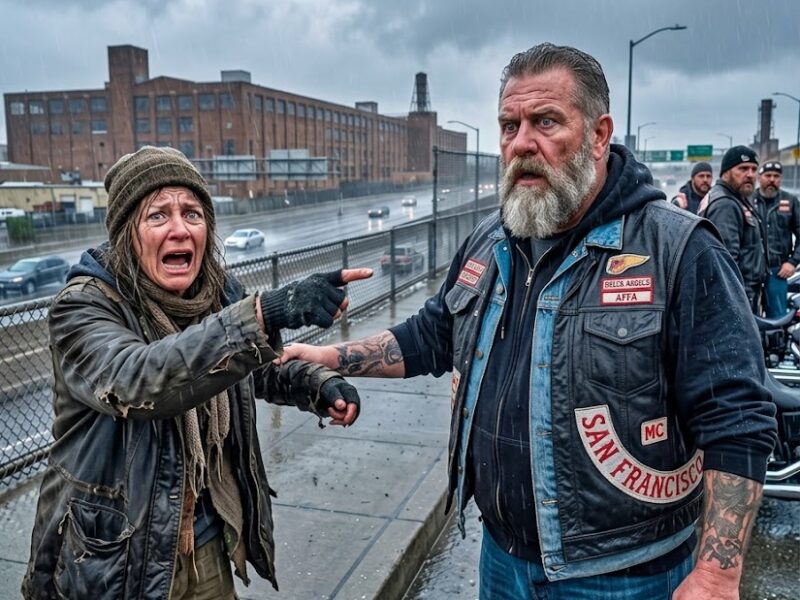
“Stop! It’s a Trap!” a Homeless Girl Screamed—Seconds Later, 22 Hells Angels Saw What Was Waiting Ahead
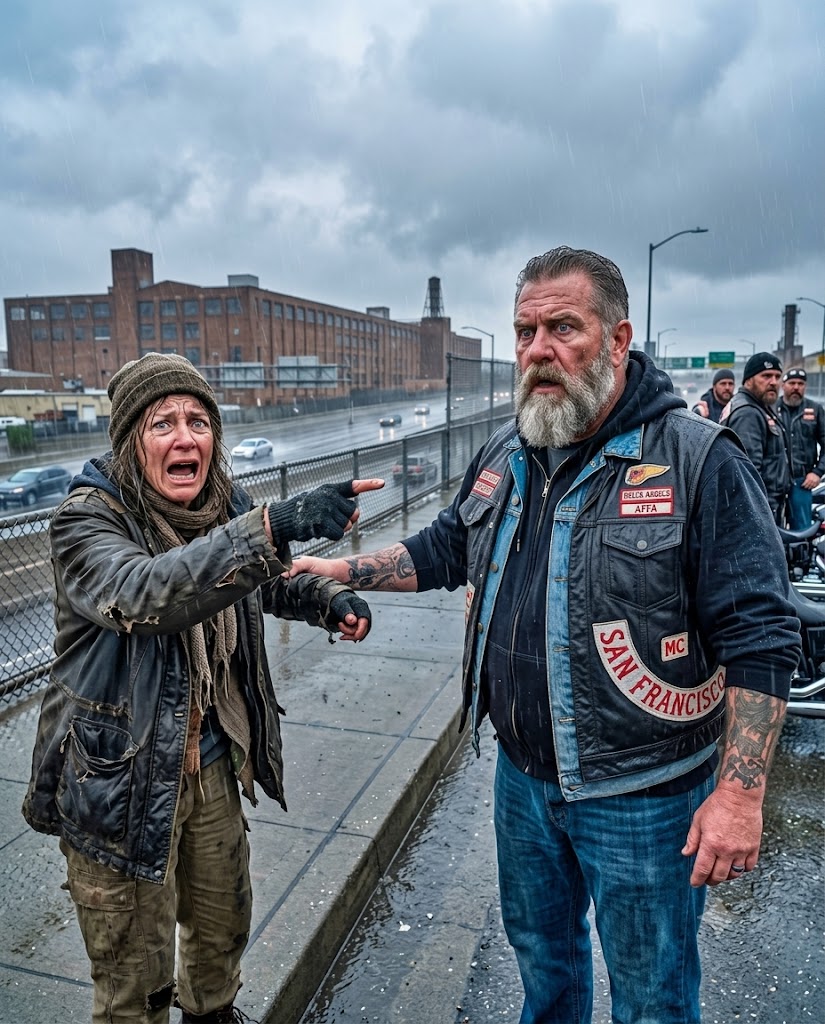
Rain hammered the rusted corrugated steel like a thousand tiny fists demanding entry.
Susan Torres burrowed deeper into her sleeping bag, an ugly patchwork of damp down feathers and heavy-duty duct tape that had long ago lost any pretense of warmth.
She pulled her knees tight against her chest, desperately trying to preserve whatever fragile body heat hadn’t already bled out into the unforgiving concrete beneath her.
It was 2:00 a.m. in the rotting heart of the city’s industrial district, and sleep was a luxury she couldn’t afford tonight.
The cold wasn’t just a temperature—it was a physical presence, gnawing aggressively at her bones like a starving dog.
Down the narrow alley, heavy tires crushed broken glass with a sound that made her blood run cold.
Not the rumble of motorcycles—Susan knew that distinct sound in her marrow from years of surviving on these streets.
This was different. Heavier. Slower. More deliberate.
Three matte black SUVs rolled to a precise stop without headlights, their thick tires slick with oily rain.
Doors clicked open in near silence.
Men poured out, detaching from the shadows like smoke, wearing dark tactical gear with heavy boots laced up over thick canvas.
They moved with a terrifying military precision, communicating only in sharp, jagged hand signals.
No one spoke. No one slammed a door.
Susan held her breath, biting down on her lower lip to keep her teeth from chattering.
Her meager shelter sat tucked perfectly behind a decaying dumpster overflowing with rotted wooden pallets, making her practically invisible to anyone who wasn’t actively hunting for garbage.
She leaned forward, pressing her face close to a small, jagged tear in her blue tarp.
A man with a closely shaved head and a heavy wool trench coat stepped from the lead vehicle, and Susan didn’t know his name, but she recognized the quiet danger radiating off him.
He possessed dead, flat eyes and a rigid, uncompromising posture, moving like a man who calculated human lives on a balance sheet.
He raised a gloved finger, pointing toward the main warehouse entrance.
“Rig the primary support pillars, front and back,” his voice scraped low and raspy, barely carrying over the wet asphalt. “Cover the loading dock with the heavy guns. Nobody leaves.”
The men scattered instantly, heavy black canvas bags hitting the wet ground with dull, heavy thuds as metal clinked sharply against metal.
Susan watched, paralyzed by horror, as two men pulled thick gray blocks of putty from a duffel bag.
They worked quickly, wiring the material directly to the primary load-bearing steel beams of the warehouse.
Explosives. A killbox.
They were actively building a slaughterhouse.
But for who?
—
This specific strip of forgotten urban decay belonged strictly to one group, and everyone on these streets knew it.
Every second Tuesday of the month, the local Hells Angels Charter utilized this very warehouse for a massive regional sit-down.
No weapons. Mostly business. Entirely mandatory.
The local precincts knew it. The rival crews knew it.
But the unwritten law of the street dictated that this turf was an absolute neutral zone, a parley ground where violence was strictly forbidden.
Someone was violently changing the rules.
Susan’s stomach twisted into knots as she watched the mercenaries work with terrifying efficiency.
She wasn’t a hero—you don’t survive five brutal years living on the raw edge of a decaying city by sticking your neck out for anyone.
You survive by keeping your head down, by remaining invisible, by turning a blind eye to the ruthless violence that regularly occurred in the shadows.
But her mind relentlessly flashed back to a freezing night last December.
She had been coughing up thick phlegm, shivering uncontrollably in a recessed, wind-battered doorway downtown.
Pedestrians had stepped directly over her, treating her like she was nothing more than a stain on the concrete.
Then a mountain of a man clad in heavy leather and faded denim had stopped.
He didn’t look at her with pity—pity was cheap on the streets.
He just grunted, stripped off his heavy fleece-lined flannel shirt, and tossed it directly at her face.
“Wrap up, kid. Ain’t no good dying out here.”
Before he kicked his massive Harley into gear and disappeared into the winter night, he had reached into his pocket and dropped a crumpled $50 bill in her lap.
His heavy leather cut had read: Jackson “Bear” Cole, President.
Susan squeezed her eyes shut, fiercely fighting the rising panic in her throat.
She owed Bear.
It was a stupid, hopelessly reckless thought, but the street operated on its own ruthless economy, its own strict debts of honor.
A $50 bill and a warm shirt bought a massive amount of loyalty in hell.
She checked her heavily cracked phone screen.
The battery flashed red at a critical 9%.
2:15 a.m.
The pack always rolled in at exactly 2:30.
She had to move now.
—
Susan slid cautiously out of her sleeping bag, and the freezing rain hit her instantly, plastering her greasy brown hair flat against her skull.
She crept backward on her hands and knees, staying exceptionally low to the ground, dragging her stomach through muddy puddles and discarded syringes.
Every scrape of her worn boots felt absolutely deafening in the quiet night.
Fifty yards away, the trench-coated man was directing two mercenaries as they aggressively set up heavy machine guns behind reinforced concrete barricades.
They angled the black barrels perfectly toward the narrow choke point of the warehouse driveway.
It was a flawless crossfire setup—perfect and utterly lethal.
Once she finally cleared the alley and the line of sight, Susan stood and ran.
Her lungs burned fiercely, drawing in the sharp, exhaust-tainted winter air as she aimed specifically for the old rusted overpass half a mile down the road.
That was the single access route leading into the warehouse district.
She had to intercept them before they took the final turn.
Her legs felt like lead weights, and nutrition wasn’t exactly abundant, so the desperate sprint violently tore at her atrophied muscles.
She tasted copper in the back of her throat, but she kept picturing the heavy flannel shirt that had saved her life.
She pictured the devastating blast of the C4 ripping through flesh and bone.
She ran harder, pushing through the agonizing cramp in her side as concrete ground violently against the worn soles of her boots.
Susan’s chest heaved with every ragged, desperate breath.
The bridge loomed ahead in the dark, a hulking, ugly structure of iron and cracked asphalt suspended over the railyard.
She reached the very center of the overpass and leaned heavily against the rusted guardrail, violently gasping, spitting metallic-tasting saliva onto the wet road.
Then she felt it—a low rhythmic vibration in the soles of her boots.
It traveled slowly up her legs, settling deep into her teeth.
It wasn’t an audible sound yet, just a raw mechanical tremor violently shifting the earth.
Seconds later, the sound hit like a physical blow.
A deep guttural roar echoed aggressively off the distant skyscrapers, bouncing brutally down the long industrial corridor.
Harleys. Dozens of them.
Headlights violently pierced the thick rolling marine layer fog, forming a tight aggressive V-shaped flank of chrome, steel, and roaring engines charging up the steep incline of the bridge.
Twenty-two riders.
They rode tight, highly disciplined, a rolling wave of thunder.
At the very front, straddling a heavily modified matte black Road Glide, was Bear.
Even from a significant distance, his massive frame utterly dominated the motorcycle, his heavy leather vest flapping wildly in the fierce wind.
Susan swallowed hard, forcing down her mounting terror.
She stepped away from the relative safety of the railing and walked directly into the absolute middle of the empty lane.
She threw both arms up, waving them frantically back and forth.
She was just a small, ragged, terrified figure standing directly in the unforgiving path of two tons of speeding, merciless metal.
The lead bikes didn’t slow down.
Not at first.
To men who practically owned the night, she probably looked like just another desperate streetwalker or a tweaking junkie wandering the concrete—a minor annoyance to be swiftly buzzed past.
But Susan held her ground.
She firmly planted her wet boots on the faded yellow dividing line.
She clenched her jaw and closed her eyes, bracing for impact.
“Stop!” she screamed.
The overwhelming roar of the engines swallowed her fragile voice entirely.
She was a ghost shouting into a hurricane.
—
At the last possible fraction of a second, Bear recognized the frantic, desperate waving.
Maybe he recognized the oversized, faded flannel shirt she was still wearing.
Or maybe a deeply buried human instinct just saw a terrified kid about to be pureed by his front tire.
He slammed his heavy boots on the brakes.
The massive Road Glide fishtailed violently, thick tires screeching in pure agony against the wet asphalt, sending up a massive, dirty spray of street water.
Bear aggressively wrestled the heavy bike, physically fighting gravity and momentum, violently forcing it into submission.
Behind him, a devastating chain reaction of pure chaos instantly erupted.
Twenty-one other veteran riders instinctively hammered their brakes to avoid a pileup.
The previously quiet bridge instantly exploded into a deafening cacophony of howling rubber, furious cursing, and heavy boots stomping down hard to stabilize thousands of pounds of sliding motorcycles.
They stopped less than twelve inches from her trembling kneecaps.
The air immediately stank of burnt rubber, hot oil, and noxious exhaust.
“What the hell is wrong with you, girl?” Bear roared, slamming his kickstand down with enough brute force to crack the asphalt.
He stepped off the bike, looking utterly terrifying up close—six-foot-four, a thick graying beard, and cold, dead eyes that had seen far too many bodies.
“You trying to die tonight?”
Several other Angels aggressively pulled up beside him, kicking their stands down.
Huge, heavily scarred men with thick neck tattoos looked genuinely pissed off at the near miss.
Thick, calloused hands drifted instinctively toward waistbands and heavy leather jackets.
“Warehouse!” Susan gasped, doubling over, violently clutching her cramping side. “Don’t go. Killbox.”
Bear paused.
The pure unadulterated rage melted off his weathered face instantly, replaced by a terrifying dead-eyed focus.
He stepped closer, towering completely over her small, shaking frame.
“What did you just say?”
“Black SUVs!” Susan choked out, desperately struggling to pull freezing air into her burning lungs. “Guys in dark tactical gear. They wired the structural pillars. Putty. C4. I think they have heavy guns positioned behind the concrete blocks in the main driveway. They’re waiting for you to pull in. It’s a crossfire.”
An eerie, heavy silence immediately fell over the heavily armed pack, save for the rhythmic low idle chugging of the hot motorcycle engines and the hiss of rain on burning pipes.
A younger Angel with a jagged scar stretching across his cheek sneered, stepping aggressively forward.
“She’s a junkie, Bear. Tweaking out of her damn mind. Kick her to the curb and let’s ride. We’re going to be late.”
Bear held up a single massive leather-gloved hand.
The young rider shut his mouth so fast his teeth audibly clicked.
Bear looked down at Susan.
He studied her intensely, looking past the accumulated dirt and the grime of the streets.
He saw her dilated pupils—not from heroin or meth, but from pure, unadulterated terror.
He saw the thick, wet mud caked deep into the frayed denim of her knees.
He saw the freshly bleeding scrape on her pale cheek from her frantic crawl through the alleyway.
“How many?” Bear asked, his deep voice completely devoid of emotion.
Dead calm.
“Twenty,” Susan swallowed hard, shivering violently in the cold wind. “Maybe more. One guy actively giving orders. Shaved head, long black wool coat.”
Bear turned his head slightly, locking eyes with his Sergeant at Arms, Declan Franks.
A dark, heavy murmur rippled menacingly through the twenty-two bikers.
The name clearly carried immense weight.
Violent, bloody weight.
“The Irish Syndicate,” a massive rider named Tommy muttered, aggressively gripping his handlebars tight. “They’re finally making a major play for the ports. Taking us out in one single swing hands them the entire western seaboard on a silver platter.”
Bear looked back at Susan.
The freezing cold rain was actively washing the dirt down her pale face in long, muddy tracks.
She was shivering uncontrollably now that the initial spike of adrenaline was rapidly bleeding out of her exhausted system.
“You purposefully stood in front of a heavy convoy to tell me this?” Bear asked softly, his tone completely shifting.
“You gave me a shirt,” Susan said, her jaw trembling, her teeth chattering loudly against the chill. “I owed you.”
Bear slowly reached out.
He gripped her thin shoulder.
His hand was remarkably warm, heavy, and incredibly grounding against the freezing night.
“Debt’s paid, kid.”
—
He turned his broad back to her and faced his men.
The atmosphere on the bridge completely shifted.
It was a palpable change in the air pressure.
It was no longer a group of rough men casually riding to a sit-down.
It was a highly organized, lethal military unit preparing for an immediate war.
“Kill the lights,” Bear ordered.
In perfect, disciplined unison, twenty-two blazing headlights snapped off.
The wet overpass was instantly plunged into pitch-black darkness.
“Tommy!” Bear barked into the shadows, his voice a low command. “Take Wrench and Dallas. Go on foot through the old train yard. Flank the loading dock from the rear. Silent approach. If they have eyes on the main road, they likely have thermal. Stay tight behind the rusted boxcars. Don’t engage until I explicitly give the signal. Let’s see if our girl here is right. If she is, we don’t roll into their slaughterhouse.”
Bear reached deep into his heavy leather vest.
He pulled out a massive matte black pistol, racking the slide with a sharp, violently echoing metallic clack.
“We bring the slaughterhouse directly to them.”
—
Tommy dropped low, his heavy leather cut scraping quietly against the rusted iron wheels of a decaying boxcar.
Rain poured in relentless blinding sheets, washing the industrial grime down the tracks and effectively masking the sound of their heavy boots crunching over the loose gravel.
Beside him, Wrench and Dallas moved with the silent practiced grace of men who had spent their entire lives operating strictly outside the confines of the law.
They weren’t just motorcycle enthusiasts.
They were hardened veterans, survivors of brutal, unrecorded turf wars that rarely made the evening news.
They communicated entirely through brief, sharp hand gestures.
Tommy pointed two fingers toward a narrow gap between a line of forgotten freight containers.
Wrench nodded, sliding a suppressed matte black tactical pistol from a concealed shoulder holster.
Dallas unclipped a heavy serrated hunting knife, the dark steel absorbing the faint ambient glow of the distant city lights.
They crept through the maze of decaying infrastructure, the overwhelming smell of wet rust and rotting wood filling their nostrils.
A hundred yards ahead, the rear loading dock of the warehouse loomed in the stormy darkness.
Bear had accurately predicted their enemy’s paranoia.
Two men in heavy tactical gear crouched silently behind a stack of wooden pallets, their night vision goggles casting a faint, sickly green glow against their cheekbones.
They were watching the rear approach, heavily armed with suppressed submachine guns, acting as an early warning system for the main ambush squad up front.
Tommy held up a single thick finger.
Wait.
He watched the two mercenaries carefully.
They were entirely focused on the distant glow of the street lamps, completely unaware of the lethal threat flanking them from the pitch-black train yard.
The relentless drumming of the rain against the corrugated metal roofs provided the perfect acoustic cover.
Dallas tapped Tommy’s shoulder twice.
He pointed to the left flank, then to himself.
He was going to circle around the blind spot.
Tommy gave a short affirmative nod.
Dallas melted into the shadows.
He didn’t walk.
He glided.
Every step was perfectly measured, finding the soft mud instead of the noisy gravel.
It took him three agonizingly slow minutes to close a distance of forty feet.
Tommy and Wrench kept their weapons trained squarely on the mercenaries, ready to unleash a devastating barrage of suppressed fire if Dallas was spotted.
He wasn’t.
Dallas emerged directly behind the first guard like a phantom rising from the wet concrete.
In one fluid, utterly ruthless motion, he clamped his heavy, calloused hand over the man’s mouth and drove the thick handle of his combat knife violently against the base of the mercenary’s skull.
The man went entirely limp, dropping like a sack of wet cement.
The second guard spun around at the muffled thud, violently raising his weapon.
He was fast, but Wrench was already perfectly positioned.
A single suppressed shot snapped through the heavy rain.
The round caught the second mercenary squarely in the chest, punching right through the weak seam of his Kevlar vest.
The man gasped a wet rattling sound before collapsing heavily into the muddy puddles forming on the loading dock.
Tommy jogged forward, staying low.
He immediately began stripping the specialized tactical radios from the downed men, shutting off their transmitters to prevent a dead air alert.
“Clear,” Tommy muttered into his own encrypted earpiece. “Susan called it perfect, Bear. They’ve got the front entirely locked down. C4 on the main struts. Two heavy machine gun nests angled directly at the driveway. They are strictly waiting on the headlights.”
—
Back on the bridge, Bear pressed his thick finger against his earpiece.
The heavy rain still actively washed down his grim, weathered face.
He looked down at Susan.
She was sitting in the sidecar of a custom trike, tightly wrapped in three dry leather jackets, violently nursing a thermos of hot black coffee a prospect had dug out of his saddlebags.
She looked incredibly small, fragile, and utterly exhausted, but her eyes were intensely focused.
“Understood,” Bear growled softly into his radio. “We don’t give them headlights. We give them hell. Wrench, you take the high ground. Snip their detonator wires on the C4 if you can reach them. If you can’t, put a bullet in the trigger man. Dallas, Tommy, breach the rear doors and wait for my push. Nobody leaves that warehouse.”
Bear stepped away from Susan and walked slowly down the long line of idling, darkened motorcycles.
Twenty-one hardened men stared back at him, their faces illuminated only by the faint ambient glow of the city skyline.
There was zero fear here, only a cold, terrifying anticipation.
“They wanted a killbox,” Bear’s deep voice rumbled, easily cutting through the howling wind. “They built one. Let’s make sure they’re the ones buried inside it. Silence is on, blades out. We push strictly on foot through the front alleyway. We hit them from the absolute dark.”
Heavy metal clicked and clacked in rapid deadly succession as twenty heavily armed bikers prepared for immediate war.
—
Declan Franks checked his expensive waterproof chronometer for the fourth time.
2:42 a.m.
The deep jagged scar running down his jawline twitched with growing irritation.
He stood perfectly still behind the reinforced concrete barrier, his dark wool trench coat completely soaked through.
His men were precisely positioned, practically holding their collective breath.
The explosives were perfectly primed.
The crossfire was flawlessly calculated.
The Hells Angels were notoriously punctual when it came to major sit-downs.
They should have ridden blindly into the main driveway exactly twelve minutes ago.
“Status,” Franks barked sharply into his radio, his raspy voice practically vibrating with mounting frustration.
Static hissed violently in his earpiece.
“Rear guard report,” Franks commanded, his dead eyes narrowing into dangerous slits.
More static.
A heavy, sickening feeling suddenly dropped deep into the pit of Franks’s stomach.
He hadn’t survived a decade at the top of the Irish Syndicate by ignoring his instincts.
The trap hadn’t just failed to spring.
It had somehow been discovered.
“Fall back!” Franks suddenly roared, desperately waving his gloved hand toward the men manning the heavy machine guns. “Cut the wires and fall back. We are heavily compromised.”
It was far too late.
—
The main floodlights of the warehouse suddenly shattered in a deafening crescendo of breaking glass.
Wrench had found the main breaker box on the upper catwalk.
The entire loading zone was instantly plunged into an absolute, suffocating darkness.
Panic immediately rippled through the highly trained mercenaries.
Tactical discipline completely broke down as they scrambled to activate their night-vision optics.
But before the green screens could even fully boot up, the heavy steel doors at the rear of the warehouse violently kicked open.
Tommy and Dallas stepped smoothly into the darkness, suppressed submachine guns raising in perfect unison.
*Fut. Fut. Fut. Fut.*
The rear flank of Franks’s squad instantly crumpled.
Heavy rounds aggressively tore through the syndicate soldiers, dropping three men before they could even unholster their sidearms.
Chaos erupted.
The mercenaries wildly returned fire, their unsuppressed assault rifles shattering the quiet night with deafening ragged bursts of flame.
Bullets aggressively chewed into the concrete pillars, sending dangerous showers of sharp masonry spraying across the wet floor.
“Trigger the charges!” Franks screamed, desperately diving behind a forklift as heavy fire rained down from the catwalk. “Blow the pillars!”
The demolition specialist frantically scrambled toward the detonator box resting on a metal drum.
He reached out, his gloved fingers violently grasping for the heavy red switch.
A single suppressed rifle shot cracked sharply from the upper rafters.
Wrench didn’t miss.
The heavy round struck the detonator box perfectly dead center, violently shattering the internal circuitry and sending a shower of useless sparks raining down over the explosives expert.
The C4 was completely bricked.
—
“Front entrance!” a mercenary shouted frantically, turning his heavy machine gun away from the driveway and aiming it blindly toward the pitch-black alleyway.
Out of the pouring rain, twenty massive shadows poured into the warehouse.
The Angels didn’t charge wildly.
They moved with terrifying methodical aggression.
Bear led the vanguard, his heavy boots crunching loudly over the shattered glass.
He raised his matte black pistol, firing precisely, methodically, completely dropping mercenaries with ruthless efficiency.
The syndicate soldiers were firmly caught in a devastating vice grip.
Pinned from the rear by Tommy and Dallas, picked apart from the rafters by Wrench, and aggressively bulldozed from the front by Bear and his heavily armed crew.
The flawless killbox had quickly become a flawless tomb.
Franks fired his weapon blindly over the forklift, his aristocratic composure completely shattered.
He watched in absolute horror as his highly expensive, deeply vetted crew was systematically dismantled by men he had arrogantly dismissed as mere street thugs.
A massive heavy hand suddenly crashed down on Franks’s wrist, gripping it with the crushing force of an industrial vise.
Franks screamed as his wrist bones audibly fractured.
His expensive firearm clattered uselessly onto the wet concrete.
He was violently yanked upward, pulled completely over the top of the forklift by sheer unadulterated brute strength.
Bear slammed the syndicate leader forcefully against a concrete structural pillar.
The impact knocked the wind entirely out of Franks’s lungs.
Bear stepped close, his massive frame completely blocking out whatever faint light remained in the warehouse.
“You deeply underestimated the neighborhood, Declan,” Bear growled softly, the cold barrel of his heavy pistol pressing firmly against the underside of Franks’s quivering jaw.
“You’re dead, Cole!” Franks spat, heavily gasping for breath, coughing up crimson saliva onto his ruined trench coat. “My people will burn your entire charter to the ground. Every single clubhouse. Every single rider.”
Bear’s eyes remained absolutely dead, completely devoid of any human empathy.
“Your people are going to spend the next five years desperately trying to figure out what happened to you tonight. You don’t own these streets. You don’t know the shadows, and you definitely don’t know the people who live in them.”
Bear didn’t hesitate.
He didn’t gloat.
He simply squeezed the trigger.
The heavy thud of the suppressed shot echoed briefly before being completely swallowed by the relentless drumming of the heavy rain outside.
—
Within exactly four minutes, the intense chaotic firefight was entirely over.
The warehouse was thick with the acrid smell of burnt cordite, hot metal, and absolute finality.
Not a single member of the Irish Syndicate remained breathing.
Bear strictly enforced a zero-survivor policy when a threat this severe was made against his family.
“Sweep the bodies,” Bear commanded, smoothly reloading a fresh magazine into his weapon. “Strip their coms, empty their pockets. We dump the hardware in the deep harbor, and let the local rats clean up the meat. We were never here.”
The Angels moved swiftly, expertly cleaning the gruesome scene with practiced, terrifying efficiency.
Bear holstered his weapon and walked slowly back out into the pouring rain.
He walked exactly half a mile back down the dark, abandoned road to the rusted overpass.
The convoy of motorcycles was still sitting there, completely hidden in the darkness.
Susan was fast asleep in the sidecar.
The extreme adrenaline crash had finally taken her, wrapping her firmly in a deep, utterly exhausted slumber.
Bear stood quietly over her for a long moment.
He carefully reached down and pulled the heavy, dry leather jackets tighter around her small shoulders, shielding her face entirely from the biting wind.
“Hey, Bear,” Tommy whispered, jogging lightly up the bridge, his clothes completely soaked and smelling heavily of gunpowder. “Cleanup is done. What do we do with the kid? We can drop her at a shelter downtown. Leave her a fat envelope of cash.”
Bear looked at Tommy, his expression hardening immediately.
“Shelters are temporary. Cash gets stolen,” Bear rumbled softly, looking back down at the sleeping girl who had bravely stared down twenty-two charging motorcycles just to return a simple favor. “She risked her life for the patch tonight. That makes her family. She rides back with us. We set her up in the spare room above the garage. She wants a job sweeping the shop, she’s got it. She wants to go to school, the club pays the tuition.”
Tommy smiled faintly, nodding his understanding.
“You got it, boss.”
—
Bear kicked his massive Road Glide into gear, the heavy engine roaring to life, violently cutting through the stormy silence.
The girl in the sidecar didn’t even stir.
For the first time in five brutal, freezing years, she was finally safe.
She had stood entirely alone in the dark against an oncoming storm.
And instead of being crushed by it, she had found a completely unbreakable shield.
The pack aggressively rolled out, leaving the smoking, violent ruins of the warehouse far behind them, vanishing completely into the cold, unforgiving night.
—
The spare room above the garage smelled like old oil, leather, and something that might have been hope.
Susan stood in the doorway, clutching the flannel shirt that had started everything, watching dust motes dance in the pale morning light filtering through a cracked window.
A real bed. A real door. A real lock.
Bear had grunted something about breakfast being at seven sharp and not to be late, then disappeared into the shop below.
She could hear the rhythmic clang of tools, the low murmur of voices, the occasional burst of rough laughter.
It was the sound of family.
The flannel shirt still hung loose on her thin frame, the sleeves rolled up three times just to free her hands.
She pressed the worn fabric to her face, breathing in the lingering scent of leather and rain and something she couldn’t quite name.
Safety, maybe.
Or belonging.
—
Two weeks later, Susan had learned the rhythms of the clubhouse like she’d known them her whole life.
She swept the floors, organized the tools, learned which bike belonged to which rider.
Tommy taught her how to check tire pressure.
Wrench showed her how to identify a faulty spark plug by sound alone.
Dallas, the quietest of them all, simply nodded at her every morning and left a fresh cup of coffee on the workbench.
She didn’t ask where the money came from.
She didn’t ask what happened in the warehouse that night.
Some debts were paid in blood, and some in silence.
But she saw the way Bear looked at her sometimes—not with pity, but with something that looked almost like pride.
—
The first time Susan saw the news report, she was wiping down the counter in the clubhouse kitchen.
A polished anchor with perfect teeth was talking about a “mysterious disappearance” in the industrial district.
Twenty-two members of a known criminal organization, simply gone.
No bodies. No evidence. No leads.
The police were baffled.
Susan turned off the television and went back to wiping the counter.
—
Bear found her later that evening, sitting on the back steps, watching the sunset paint the sky in shades of orange and red.
“You okay, kid?” he asked, settling his massive frame onto the step beside her.
“Yeah,” Susan said quietly. “Just thinking.”
“About what?”
She was silent for a long moment.
“About how one shirt can change everything.”
Bear didn’t say anything.
He just reached into his pocket and pulled out a crumpled fifty-dollar bill.
“Found this in my jacket,” he said, holding it out to her. “Figure it belongs to you.”
Susan looked at the bill, then at Bear.
That fifty dollars had bought her a shirt and a moment of kindness.
But it had also bought her a family.
She took the bill and carefully folded it into her pocket.
“I’m going to pay this back someday,” she said. “Every penny.”
Bear laughed, a low rumbling sound that seemed to shake the very foundations of the clubhouse.
“You already did, kid. You already did.”
—
The months passed, and Susan grew stronger.
She enrolled in community college, studying criminal justice of all things.
Bear thought it was hilarious.
“Gonna be a cop, kid?” he’d tease. “Gonna arrest me?”
“Somebody’s gotta keep you out of trouble,” she’d shoot back.
The club paid her tuition, just like Bear promised.
She kept the flannel shirt, even though it was threadbare and faded.
She wore it on cold nights, when the wind howled through the cracks in the old garage.
It reminded her that even in the darkest moments, there was always a light.
—
One year after that rainy night on the bridge, Susan stood in front of the clubhouse, her diploma in hand.
The Angels had thrown her a party, complete with barbecue and more beer than she’d ever seen.
Bear stood at the center of it all, a proud grin splitting his weathered face.
“To Susan!” he roared, raising his glass. “The bravest kid I ever met!”
The Angels cheered, their voices echoing off the garage walls.
Susan blushed, but she didn’t look away.
She had earned this.
Not just the diploma, but the family.
—
Later that night, when the party had wound down and the last riders had stumbled home, Susan found Bear sitting alone on the back steps.
She sat down beside him, the flannel shirt wrapped around her shoulders like a cape.
“You know,” she said quietly, “I never thanked you properly.”
“For what?”
“For stopping. That night on the bridge. For listening.”
Bear was silent for a long moment.
“I almost didn’t,” he admitted. “You were just some kid in the road. Could’ve been a trap.”
“But it wasn’t.”
“No,” Bear agreed. “It wasn’t.”
He looked at her, his dead eyes softening just slightly.
“You know why I stopped?”
“Why?”
“Because you reminded me of someone. Someone I couldn’t save a long time ago.”
Susan didn’t ask who.
Some stories were too painful to tell.
“I’m glad you stopped,” she said instead.
“Me too, kid. Me too.”
—
The years rolled on, and Susan graduated from college with honors.
She got a job with the local police department, working in community outreach.
She never forgot where she came from.
She never forgot the night she stood alone on a rusted bridge and stared down twenty-two charging motorcycles.
And she never forgot the fifty-dollar bill that had bought her a second chance.
—
On the fifth anniversary of that rainy night, Susan returned to the old industrial district.
The warehouse was gone, replaced by a gleaming new distribution center.
But the bridge was still there, rusted and forgotten, a relic of a darker time.
She stood at the very center, leaning against the guardrail, watching the sunset paint the sky.
In her pocket, the crumpled fifty-dollar bill.
In her heart, the memory of a man who had stopped when no one else would.
She closed her eyes and listened to the wind.
For a moment, she could almost hear the rumble of motorcycles, the roar of engines, the thunder of hooves.
But it was just the wind.
Just the wind and the rain and the memory of a night that had changed everything.
—
She pulled the flannel shirt tighter around her shoulders and smiled.
Debts paid.
Family found.
And a life worth living.
—
Bear died three years later, peacefully in his sleep.
The entire charter turned out for the funeral, along with riders from across the country.
Susan stood at the front, the flannel shirt wrapped around her shoulders, the fifty-dollar bill clutched in her hand.
She didn’t cry.
Bear wouldn’t have wanted that.
Instead, she told the story.
The story of a homeless girl and a Hells Angel.
The story of a trap and a rescue.
The story of a debt paid and a family found.
And when she was done, twenty-one riders raised their glasses and roared.
“To Bear!”
“To Susan!”
“To family!”
—
The clubhouse still stands, tucked away in a corner of the city that most people never see.
And in a small room above the garage, a flannel shirt hangs on a hook, waiting.
Waiting for the next lost soul who needs a second chance.
Waiting for the next debt to be paid.
Waiting for the next story to begin.
—
Because in the end, that’s what life is.
A series of debts and payments.
A series of chances and choices.
A series of storms and shelters.
And sometimes, if you’re very lucky, you find a family in the most unexpected place.
Sometimes, you find a home.
—
*The End*









