
Steve Harvey’s director stopped taping mid-show and whispered four words to him — and what happened next was never supposed to be seen by anyone.
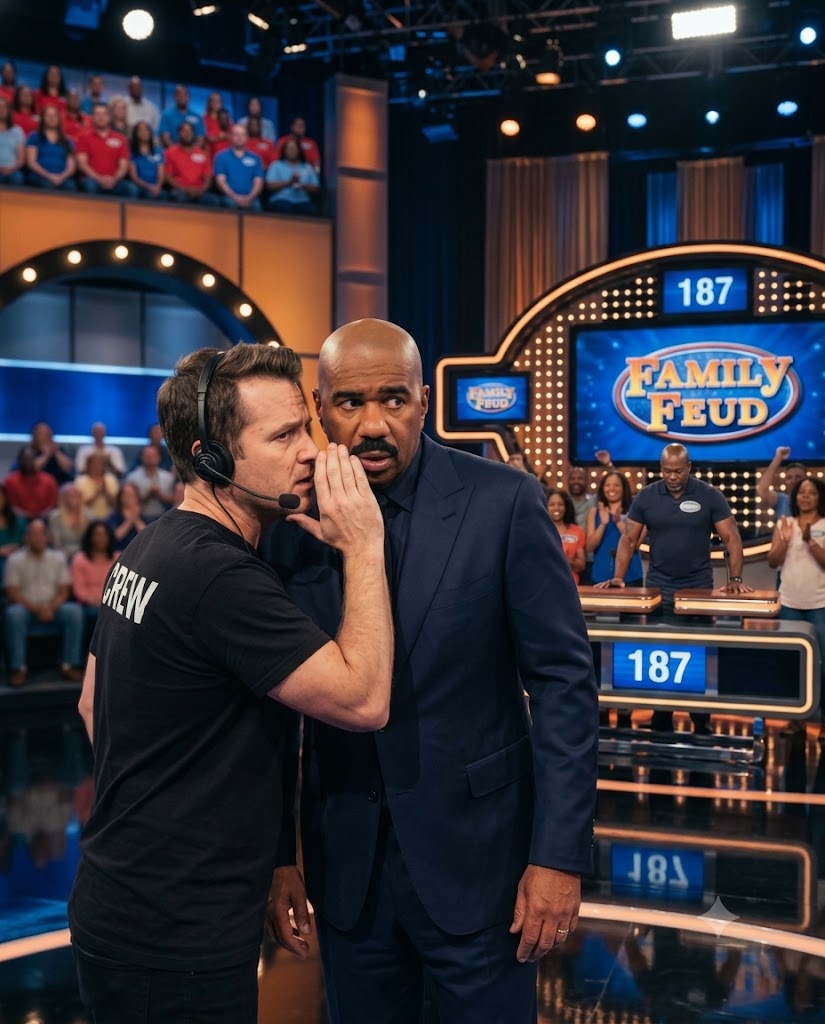
The cameras were still rolling when Family Feud director Paul Kimmel stepped out of the control booth, walked across the studio floor, and whispered four words into Steve Harvey’s ear.
Check on that man.
Steve looked at the contestant standing at podium 2.
Raymond Cole, 53, from Beaumont, Texas, had just scored 187 points on Fast Money, 13 points short of the $20,000 prize, and he hadn’t reacted at all, no disappointment, no frustration, nothing.
He stood completely still with both hands flat on the podium, staring at a point on the floor six feet in front of him, and he hadn’t blinked in over 30 seconds.
The audience was clapping.
His family was hugging behind him.
Raymond Cole didn’t move.
What happened over the next 52 minutes was never aired on television, was never supposed to leave that studio, and only became public 11 months later when a production assistant leaked the unedited footage to YouTube, where it was viewed 470 million times in eight days and became the most shared Family Feud clip in the history of the franchise.
Raymond Cole wasn’t frozen because he lost.
He was frozen because he had just realized that losing meant his twin daughters were going to be separated, and he had promised their dead mother he would never let that happen.
It was June 22nd, 2021, in Atlanta, Georgia.
The Cole family had driven 14 hours from Beaumont in a rented minivan that Raymond had put on a credit card he couldn’t afford.
Raymond was a welder who worked at a shipyard along the Neches River.
His team was his mother Gloria, 69, his cousin Terrence, his childhood friend David, and his oldest daughter Nadia, 19, who had taken the day off from her cashier job at a grocery store in Port Arthur.
The competing family, the Lombardis from Staten Island, had flown in the night before and stayed at a hotel four blocks from the studio.
They were loud and joyful during warm-ups, tossing jokes back and forth with the crew.
Raymond’s family was quiet.
Raymond kept checking his phone.
Every few minutes, he would look at the screen, press his lips together, and slide it back into his pocket.
But nobody in that studio knew what was about to happen.
Raymond Cole married Angela Williams in 2003 in a small ceremony at a Baptist church in Beaumont.
Forty-one people attended.
Angela wore her mother’s dress altered by hand because they couldn’t afford a seamstress.
Their twin daughters, Lily and Rose, were born in 2007.
Angela named them after flowers because her own mother had been a gardener who kept a plot behind their house in Fifth Ward, Houston.
And Angela grew up believing that anything named after something that grows will keep growing no matter what tries to kill it.
Angela was diagnosed with lupus in 2011.
The disease moved through her body in waves.
Some months she could work her receptionist job and drive the girls to school and cook dinner and laugh loud enough to fill every room.
Other months she couldn’t get out of bed.
The medication that controlled her flare-ups cost $1,800 a month.
Insurance covered $1,200.
Raymond covered the remaining $600 from his welding salary, which left the family with almost nothing for anything else.
They managed for six years.
They managed.
In January 2018, Angela’s kidneys began to fail.
The lupus had attacked them slowly and then all at once.
She needed a transplant.
The evaluation, the surgical prep, the immunosuppressive drugs, the aftercare, the total cost was estimated at $192,000.
Their insurance approved the transplant surgery itself but denied the pre-transplant evaluation protocol, the specific immunosuppressive regimen her nephrologist recommended, and the postsurgical monitoring program.
Three separate denial letters arrived in the same week.
Each one cited insufficient documentation of medical necessity as defined by plan parameters.
Raymond’s hands shook when he read them.
He had submitted 61 pages of documentation.
He didn’t know what else they wanted.
Angela died on August 3rd, 2018, waiting for a transplant she was approved for but couldn’t access because every step surrounding the surgery was denied.
She was 37.
The last thing she said to Raymond was not poetic.
It was not cinematic.
She was lying in a hospital bed in Beaumont and she grabbed his wrist and said, “Don’t split them up. Whatever happens, don’t split them up.”
She meant the twins, Lily and Rose.
They were 11 years old.
And that wasn’t even the part that made Steve cry.
After Angela died, the bills consumed everything.
The hospital bills, the funeral costs, the credit card debt from 18 months of $600 monthly medication gaps.
Raymond owed $114,000.
He made $41,000 a year.
Collectors called the house phone every morning at 8:15 and every evening at 6:00.
Lily and Rose answered sometimes.
Rose once told a collector, “My daddy’s in the shower,” when Raymond was actually sitting at the kitchen table with his head in his hands, unable to speak.
Raymond’s mother, Gloria, lived in a two-bedroom apartment in Houston, 90 miles from Beaumont.
In late 2019, Gloria was diagnosed with early-stage dementia.
She could no longer live alone.
Raymond drove to Houston every weekend to check on her, 90 miles each way, burning gas money he didn’t have.
By March of 2020, the trips weren’t enough.
Gloria had left the stove on twice.
She had wandered into the parking lot of her apartment complex at 3:00 in the morning in her nightgown.
She needed full-time care, and the only options were a memory care facility at $4,000 a month or moving her into Raymond’s house.
Raymond’s house had three bedrooms.
He slept in one.
The twins shared one.
The third was Angela’s craft room that nobody had touched since she died.
Her sewing machine was still on the table.
Her fabric was still folded on the shelf.
Moving Gloria in meant converting that room into a bedroom, and it meant something else, something Raymond couldn’t say out loud at first.
The house was too small.
Three bedrooms for four people meant the twins could still share.
But Gloria’s condition was worsening, and the social worker told Raymond that within a year, Gloria would need a room close to the bathroom, which was next to the twins’ room, and the configuration would require one of the twins to move to the living room couch permanently, or Raymond would need to find a larger house he couldn’t afford.
The social worker also told Raymond something else.
She said that given his debt, his income, and his housing situation, the state might determine that he couldn’t provide adequate care for both his mother and his daughters simultaneously.
She said the word placement.
She said it gently, clinically, the way people say terrible things when they’ve been trained to say them.
Raymond heard it as one sentence.
Someone was going to take his daughters.
Steve Harvey would later call what happened next the most important moment of his career.
Raymond applied to Family Feud because $20,000 would cover six months of a memory care facility for Gloria, which would keep the twins in their room, which would keep the family together, which would keep the promise he made to Angela.
The math was that simple and that desperate.
$20,000 equaled six months equaled keeping his family intact.
And when he scored 187 points and the board showed he was 13 points short, Raymond understood instantly what it meant.
The money was gone.
The six months were gone.
The placement conversation was coming.
And the promise he made to his dying wife was about to break.
That was why he froze.
Paul Kimmel had been directing Family Feud for 12 years.
He had seen contestants cry, scream, jump, collapse.
He had never seen a contestant simply stop.
Raymond’s stillness was so complete and so unnatural that Kimmel left the control booth for the first time during a live taping, crossed the studio floor, and whispered into Steve’s ear, “Check on that man.”
Steve walked to podium 2.
The audience was still clapping from the game.
Steve’s mic was live.
He looked at Raymond and said, “Ray. Hey, Raymond.”
Raymond didn’t respond.
Steve put his hand on Raymond’s forearm.
He said quieter, “Where’d you go, brother?”
Raymond’s eyes finally moved.
He looked at Steve.
His mouth opened, but nothing came out.
Then his right hand went to his chest and gripped the fabric of his shirt right over his heart, and he said one sentence.
I just broke my promise.
The studio fell completely silent.
Steve didn’t ask what the promise was.
Not yet.
He turned to the floor manager and said, “Kill the clock.”
The floor manager looked at the control booth.
Kimmel nodded.
The taping clock, which tracked contractual studio time to the minute, was stopped.
In 46 years of Family Feud production, the taping clock had been stopped for technical failures, medical emergencies, and power outages.
It had never been stopped because a host wanted to talk to a contestant.
Steve walked Raymond off the stage, away from the podium, to the edge of the set where two chairs sat behind a fake living room backdrop used for promotional photos.
They sat down.
Steve’s mic was still on.
Every word was captured.
Steve said, “Tell me about the promise.”
Raymond told him everything.
Angela, the lupus, the kidney failure, the insurance denials, the 61 pages of documentation, the promise in the hospital room, the debt, Gloria’s dementia, the social worker, the word placement, the 13 points.
He spoke for nine minutes without stopping.
His voice was flat, mechanical, as if he were reading a police report about someone else’s life.
The only time his voice broke was when he said Angela’s name.
Every time he said Angela, his throat caught, and he would pause, swallow, and keep going.
Steve sat and listened.
He didn’t interrupt.
He didn’t nod encouragingly.
He didn’t offer comfort.
He just sat in the chair and received every word like he was being handed something heavy and fragile and he was not going to drop it.
When Raymond finished, Steve said five words that would be replayed around the world.
You didn’t break nothing, Raymond.
The studio fell completely silent.
Then Steve stood up.
He walked back to center stage.
He looked at his producers.
“How much time do we have left on the studio?”
The producer said, “45 minutes.”
Steve said, “Good, that’s enough.”
He turned to the Lombardi family still standing at their podium.
Maria Lombardi, the team captain, had mascara running down both cheeks.
Her husband Anthony had his arm around their son.
But Steve wasn’t done.
He brought Raymond back to the stage.
He brought Gloria from the audience, walking slowly with Nadia holding her elbow.
He brought Lily and Rose.
The twins stood on either side of their father, each holding one of his hands.
Rose, 14 years old, looked up at Steve and said, “Are they going to take us away from Daddy?”
The studio fell completely silent for the third time.
A sound operator removed his headset and pressed his palms against his eyes.
Two camera operators stepped back from their stations.
The floor director turned away from the stage and didn’t turn back for almost a minute.
Steve knelt in front of Rose.
He said, “Nobody is taking you anywhere.”
Then he stood up, pulled out his phone, and called Tyler Perry live on stage.
It was the second time Steve had made a call like this during a taping, and it violated every production protocol the show had.
The producers didn’t stop him.
They couldn’t.
Tyler Perry answered on the third ring.
Steve explained the situation in under two minutes.
Tyler Perry said, “How much does he need to keep his family together?”
Steve looked at Raymond.
Raymond said the number: $114,000 for the debt, $4,000 a month for Gloria’s care.
Tyler Perry was quiet for three seconds and said, “Tell him it’s done. All of it, the debt, and the first two years of his mother’s care.”
Raymond’s knees buckled.
Nadia caught him.
Gloria, standing six feet away, watched her son collapse and said to no one in particular, “That’s my boy. That’s my Raymond.”
She said it with the clarity that dementia sometimes allows in the moments that matter most, a window of perfect lucidity that opened just long enough to see her son being saved and then closed again.
But Steve wasn’t done.
He looked at Raymond and said, “Let me tell you something. You think you broke a promise because you lost a game show by 13 points. Let me tell you what I know about broken promises.”
Steve paused.
He looked at the audience.
“There was a man who promised God he would be a comedian. And for three years, that man lived in a 1976 Ford Tempo. He slept in parking lots. He ate from gas stations. He washed his face in rest stop bathrooms. And every night in that car, he asked God, ‘Did I make the wrong promise?’ And God didn’t answer. Not for three years.”
Steve turned back to Raymond because the answer wasn’t words.
The answer was this.
“Standing here in this building with you. Because I was you, Raymond. I was 13 points short of everything for three straight years. And the only promise I broke was the one I made to doubt. So don’t you tell me you broke your promise. You drove 14 hours to keep it. You’re standing on this stage to keep it. Your daughters are holding your hands right now. That promise is alive.”
Steve turned to the camera.
He looked directly into the lens.
“Everyone watching at home, if you’re 13 points short of keeping your family together, if someone told you the word placement and you couldn’t breathe, if you made a promise to someone who isn’t here anymore and you’re terrified you’re going to fail them, you haven’t failed. You’re still standing. And that means the promise is still alive.”
He turned to the Lombardi family.
Anthony Lombardi spoke before Steve could ask the question.
He said, “Whatever they were supposed to win, give it to them. We don’t need it. They do.”
Maria Lombardi walked across the stage and hugged Gloria.
She held the 69-year-old woman with dementia and whispered something in her ear that the microphones didn’t catch.
And Gloria smiled and patted Maria’s hand.
Steve announced that both families would receive the full $20,000 prize.
The studio audience stood, every person.
The ovation lasted over two minutes.
Raymond held Lily with one arm and Rose with the other and pressed his face into the space between their heads and didn’t come up for air until the applause stopped.
The footage was never intended to air.
Paul Kimmel made the decision to shelve it because it didn’t fit the show’s format and because the emotional content was too raw for a game show broadcast.
The unedited footage sat on a production server for 11 months until a production assistant whose name has never been made public uploaded the full 52 minutes to YouTube on May 14th, 2022.
Within eight days, it had been viewed 470 million times.
The hashtag #13PointsShort trended in 61 countries for 14 days.
It became the most viewed Family Feud clip ever produced, surpassing every official episode the show had ever released.
The public response was immediate and overwhelming.
A legal advocacy group in Washington, D.C., cited Raymond’s story in a formal petition to the Department of Health and Human Services requesting an audit of insurance denial practices for organ transplant support services.
Eleven state attorneys general opened investigations.
Within six months, two insurance carriers revised their transplant-adjacent coverage policies, affecting an estimated 400,000 policyholders.
In September 2022, Steve Harvey established the 13 Points Foundation, named after the margin by which Raymond lost.
The foundation’s mission was to prevent family separation caused by medical debt and caregiver costs.
In its first three years, the 13 Points Foundation raised $21.4 million and provided direct financial support to over 4,000 families facing placement proceedings tied to poverty, medical debt, or elder care costs.
Gloria was placed in a memory care facility in Houston in July 2022.
Tyler Perry covered the first two years.
The foundation covered the third.
Gloria’s room had a window that faced east.
And every morning the sun came through at 6:15, and the nurses said that sometimes Gloria would sit in that light and hum a hymn she couldn’t name but never forgot.
Raymond paid off his debt in full by October 2022.
He kept his house.
He kept his daughters.
Lily and Rose started high school together in the fall of 2023.
They walked through the front doors of Beaumont High side by side, wearing matching backpacks their grandmother had picked out during one of her clear days.
They shared a locker.
They shared a lunch table.
They were not separated.
They were never separated.
Steve Harvey said in an interview with GQ magazine eight months after the footage went public, “I’ve done television for 30 years. I’ve won awards and lost awards and hosted shows that 100 million people watched. And the most important thing I’ve ever done on camera wasn’t supposed to be on camera at all. It was sitting in a fake living room on a fake set and listening to a real man tell me he broke a promise to his dead wife. That’s the only take that ever mattered.”
Raymond was asked by a reporter what he would say to Angela if he could.
He thought for a long time.
Then he said, “I’d tell her they’re still in the same room, and I’d tell her the promise held.”
In Beaumont, Texas, there is a house with three bedrooms.
In one bedroom, two teenage girls sleep across from each other, close enough that one can reach out in the dark and touch the other’s hand without getting out of bed.
On the dresser between their beds sits a framed photograph of their mother, holding two newborns, one in each arm, named after flowers.
Because a woman who grew up in a garden believed that anything named after something that grows will keep growing no matter what tries to kill it.
The photo has been in that room since 2007.
It has never been moved.
Neither have the girls.
Some people measure a father’s love by what he provides.
But everyone who watched Raymond Cole stand frozen at a game show podium 13 points short of keeping a promise to his dying wife understood something deeper.
A father’s love is not measured by what he wins.
It is measured by what he refuses to let go of even when his hands are shaking and the numbers don’t add up and the whole world is telling him to quit.
The studio lights dimmed that night in Atlanta, but the cameras kept rolling for 52 minutes that the world was never supposed to see.
And when those 52 minutes finally did reach the world, they didn’t just tell a story.
They started a movement.
The 13 Points Foundation now has a slogan that Steve Harvey wrote himself on a napkin during a flight to Chicago.
It reads: “You’re not out. You’re just not there yet.”
Raymond Cole keeps that napkin framed in his kitchen, next to a drawing Lily made when she was six, a stick figure family with four people and a sun in the corner.
He looks at it every morning before he leaves for the shipyard.
He looks at it every night before he checks on his daughters, both of them, in the same room, breathing the same air, holding onto the same promise.
And in the quiet of that house, in the stillness of a Texas night, the promise holds.
It held when the money ran out.
It held when the insurance company said no.
It held when the social worker said placement.
It held when the game show said 13 points short.
And it will hold tomorrow, and the day after that, and every day after that, because some things are not measured in points or dollars or denials.
They are measured in the space between two beds where two sisters sleep, and the photograph of a mother who believed that anything named after something that grows will keep growing no matter what tries to kill it.
The cameras were still rolling when Paul Kimmel stepped out of the control booth.
They were still rolling when Steve Harvey knelt in front of a 14-year-old girl and told her nobody was taking her anywhere.
They were still rolling when a billionaire answered his phone on the third ring and said, “Tell him it’s done.”
The cameras were still rolling for 52 minutes that changed everything.
And somewhere in Beaumont, Texas, in a house with three bedrooms, the promise is still alive.
It never broke.
It never will.
Because a father’s love doesn’t know how to quit.
It only knows how to hold on.









