Steve Harvey KICKED OUT Bigoted Contestant After Disgusting Slur Against Filipino Family
Backstage at the Family Feud Studios in Atlanta on the morning of September 6th, 2018, a woman named Rosalinda Reyes was standing in a hallway beside her daughter and fixing the collar of her husband’s shirt for the third time.
Her husband, Domingo, everyone called him Dom, was 57 years old and laughing at her the way a man laughs when he loves someone and has no better way to say it.
Their daughter, Marisol, 29, was trying to take a picture of both of them on her phone and kept failing because neither of them would stop moving.
Their son, Jerome, 26, was leaning against the wall eating a granola bar and watching them with the expression of someone who has watched his parents perform this exact routine for his entire life and would not trade it for anything.
The youngest, a 19-year-old named Benny, who had gotten his mother’s eyes and his father’s laugh, was pacing the hallway because that was what Benny did before anything that mattered.
They were, from the outside, exactly what they appeared to be.
A Filipino-American family from Daly City, California, dressed in matching sage green and white, ready to play a game show.
They were not, from the outside, a family that had been holding a secret for 11 months.
—
Dom Reyes had come to California from Batangas province in 1989.
He had been 28 years old and he had come with his cousin, a man named Rodel, who had already been in San Francisco for 2 years and who had told Dom on the phone that the work was real if you were willing to show up.
Dom had shown up.
He had worked construction for 7 years, then gotten his contractor’s license in 1996, then built a small company that employed, at its peak, 14 people in the Bay Area.
He had married Rosalinda, a registered nurse from Cebu, who he had met at a community event in Daly City in 1994.
They had built the life the way people build things when they have no margin for error, carefully, slowly, 1 year at a time, never assuming the next year would take care of itself.
In October of 2017, a neurologist in San Francisco had used the words early onset Parkinson’s disease in a sentence directed at Dom Reyes, and Dom had sat very still in the chair across from the doctor’s desk and nodded, because nodding was what his body knew to do when it was trying to absorb something his mind wasn’t ready for.
He had not told Rosalinda that night.
He had told her the appointment had gone fine, that they wanted to run some additional tests, that it was probably nothing.
She had looked at him in the way she had been looking at him for 24 years, the look that said she knew the exact weight of his voice when it was carrying something.
And she had said, “Okay.”
She had gone to the kitchen and made arroz caldo and put a bowl in front of him and sat down across from him and talked about Marisol’s job and Benny’s semester and the repair that needed doing on the back fence, and she had not asked again.
He told her 6 weeks later.
She had held his hand for a long time without speaking.
Then, she had asked him what the doctor said about the progression timeline, what medications they were starting, what they needed to do first.
That was Rosalinda.
She did not collapse.
She assembled a plan.
—
The plan had worked for a while.
The medication managed the early tremors.
Dom kept working.
He managed the company with Marisol helping him with the administrative side, a transition they told clients was just a modernization.
He kept showing up to job sites.
He kept being Dom.
But the plan was also expensive.
Parkinson’s management, the specialist visits, the specific medication combination his neurologist had prescribed, the physical therapy that was slowing the progression, was costing the family $3,800 a month after insurance.
The company had slowed down in 2018 as Dom’s ability to run bids and manage crews became more taxed.
They had dipped into savings.
They had remortgaged.
They had told no one.
—
Benny had noticed something first.
He was 19 and living at home, and he was young enough to pay attention to things that older people learn to look past.
One evening in March, he had come into the living room and found his father sitting in his chair with his hands in his lap.
Just sitting.
Not watching anything.
Not reading.
Just sitting.
And Benny had said, “Papa, are you okay?”
And Dom had looked at him and smiled, the full smile, the one he deployed when he needed it to do work, and said, “I’m just tired, enough, just tired.”
Benny had gone to his room and looked at the ceiling.
—
Rosalinda had applied for Family Feud in January of 2018 before the financial picture had become what it became.
Because Dom had told her once, years ago, that if he ever got on that show, he would make Steve Harvey laugh so hard the man would fall over.
She had filed the application as a gift, a future thing to look forward to.
When the callback came in August, the money was already critical.
But Dom had read the letter three times and then looked at her with something in his face that she had not seen in 11 months, something that was not courage exactly, but was related to it.
And she had said, “We’re going.”
—
The taping was routine until it wasn’t.
The Reyes family had been doing well.
Jerome had gotten a big answer right and the audience had gone loud with it.
And Steve had done his thing, the pivot and the point and the grin, and everything in the studio had been exactly what it was supposed to be.
And then a voice from the audience said something.
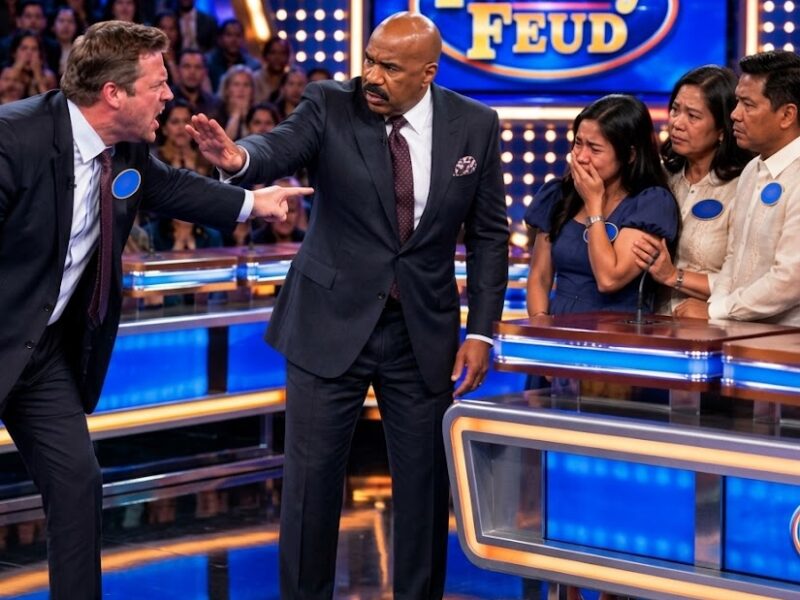
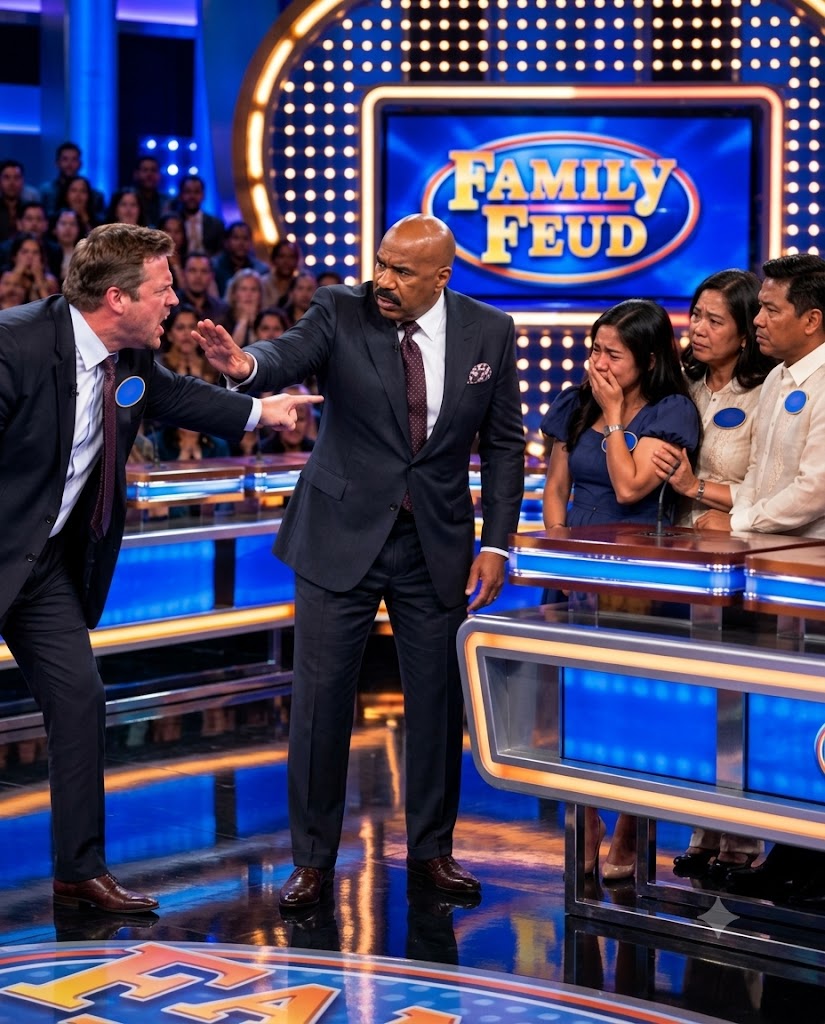
A man three rows back, unprompted, directed at the Reyes family, said something that used a word, a specific, old, ugly word that Filipino people have heard directed at them for over a century and never once deserved.
The studio fell completely silent.
Steve Harvey stopped mid-step.
He had been walking between the two podiums.
He stopped as if the floor had changed beneath him.
His smile did not fade.
It did not fade because it had already gone somewhere else entirely, replaced by something different, something that sat very still in his face.
He turned toward the audience slowly.
He did not look at his producer.
He did not look at the camera.
He looked at the section of the audience where the voice had come from.
And he looked at it with the particular steadiness of a man who has decided exactly what he is going to do.
He walked to the edge of the stage.
The room was completely still.
300 people were not moving.
The camera operators had not moved.
A woman in the front row had both hands pressed flat against her knees.
Dom Reyes at the podium had straightened.
He had already been standing straight, but now there was something different in it.
Something that was not reaction, but was very old and very quiet and very human.
Steve spoke.
His voice was even.
Not raised.
Not theatrical.
Even.
He said that he had been hosting this show for a long time.
He said that in that time he had watched thousands of families walk onto this stage and give everything they had to a game that was supposed to be joyful.
And that every one of those families had deserved to walk in here and be treated with dignity.
He said the word dignity the way people say words they have earned the right to use.
Then he looked directly at the man who had spoken and said five words, “You don’t have to apologize.”
The audience did not move.
Steve continued.
He said, “But I need you to understand something. That family and he gestured toward the Reyes family without looking away from the man did not come here for what you just gave them. They came here to play a game and to be together and to have a good day. And I’m not going to let what you said be the thing they remember about today.”
He turned back to the stage.
He looked at Dom.
Dom was looking at him.
His hands were at his sides.
His jaw was set.
Rosalinda had moved slightly closer to him without appearing to move at all.
The way people who have been married for a long time occupy the same space without deciding to.
Steve walked to the podium and stood close to Dom and said quietly in a voice the cameras caught but that was clearly meant only for Dom.
You good?
Dom said in a voice that was completely steady.
I’m always good.
The audience broke.
It was not the usual applause.
It was louder and longer and it had something fierce in it.
The way an audience applauds when they need to make up for something that was done in their presence.
But Steve wasn’t done.
He raised his hand and the room quieted and he said I want to talk to everyone watching at home.
What you just saw is not unusual.
I need you to understand that.
Families that look like this one and again the gesture toward the Reyes family hear what that man just said more than you know.
More than they tell you.
And I am not going to stand on this stage and pretend that what just happened was an isolated incident.
It wasn’t.
And these people deserve better.
He wasn’t finished.
During the next commercial break a producer came to Steve with something on a clipboard.
The cameras kept rolling on the cutaway feed.
What followed was not planned.
Steve spoke with his team for less than 4 minutes.
When they came back on air, Steve turned to the Reyes family and said he had one more thing to do before they continued.
Rosalinda told a reporter the following year that she had thought he was going to say something kind and then they would play the game and go home.
She had not expected what happened next.
Steve Harvey announced on camera in front of 300 people that the Family Feud production team would be covering the cost of Dom Reyes’ medical care for the next 12 months, a figure that would total $45,600.
He said it plainly, the way you say a fact, not the way you make a moment out of something.
He said, “This man has been carrying something he didn’t tell anybody. And today that changes.”
The studio fell completely silent for the third time that afternoon.
Dom Reyes pressed his hand to his face.
Rosalinda Reyes did not press her hand to her face.
She stood very straight and looked at Steve Harvey and said, “Thank you.” in a voice that was the simplest and most complete thing said in that building all day.
The competing family, the Harmon family from Memphis, had not been told what was happening.
Their captain, a woman named Diane who was 62 and had been watching the whole exchange with an expression that had moved through several different things, crossed the stage without being asked and put her arms around Rosalinda.
The two women stood together for a moment that nobody timed but that nobody forgot either.
—
The episode aired eight weeks later.
The clip, specifically the moment Steve said, “You don’t have to apologize.” and then addressed the camera, was viewed 38 million times in the first five days.
The response came from everywhere.
It came from Filipino communities in California and Hawaii and Texas.
It came from people who had never heard of Family Feud and from people who watched every episode.
It came from people who wrote long messages and people who just shared the clip without adding a single word because they didn’t feel they needed to.
Three months after the taping, Dom Reyes was stable.
The medication combination was working.
The physical therapy sessions, now funded, were happening three times a week.
He was back on job sites two days a week doing the parts he could still do and letting Marisol handle the rest.
A year after the taping, Benny Reyes gave a speech at his community college’s Filipino cultural night.
He talked about his father.
He talked about what it meant to watch a man stay standing when the room gives him a reason not to.
He said he had learned more about dignity in that studio than in any classroom.
200 people gave him a standing ovation.
Today, Dom Reyes still wakes up early.
The tremors are present but managed.
He drinks his coffee at the kitchen table while Rosalinda gets ready for her shift.
And he reads the news on his tablet.
And sometimes Benny comes down and sits with him before class.
The back fence got fixed.
The company is still running.
In an interview the following spring, Steve Harvey was asked about that taping.
He said he thought about Dom a lot.
He said what stayed with him was not what he had done but what Dom had done.
The way that man had stood at the podium and not moved, not flinched, not given the room the satisfaction of watching him fall apart.
He said, “That is what strength actually looks like. Not the loud kind. The kind that doesn’t announce itself.”
There is a photograph on the wall of the Reyes home in Daly City.
It is from the taping.
Dom and Rosalinda are standing at the podium and Dom’s chin is up and Rosalinda is 6 in from his shoulder and they are both looking directly at the camera.
They are not smiling.
They are just there.
They are just standing and if you look at it long enough, you start to understand that some people carry the whole weight of a life and never once let it change their posture.
That is what a game show taught 300 people and then 38 million more on a Thursday afternoon in September.
—
What the clip did not show what the broadcast never caught was what happened in the parking lot after the taping.
The Reyes family had walked out into the Atlanta afternoon and Benny had been very quiet which was unusual for Benny who was almost never quiet.
Marisol had put her arm around him and asked if he was okay and Benny had said yes and then said no and then said he didn’t know.
He said he had been angry in the studio sitting in the audience section watching angry in a way that had no clean place to go.
He said he had watched his father stand there and not move and he had felt something he couldn’t name Something that was pride and grief at the same time.
Something that was love shaped like pain.
Dom had been listening.
He had stopped walking and turned and looked at his youngest son and said something that Benny has repeated in every interview he has given since.
He said, “Every time someone says something like that and we don’t fall down, we are keeping something alive that they are trying to kill. You understand? We don’t fall. Not because it doesn’t hurt. Because something matters more than the hurt.”
Benny had nodded.
They had walked to the rental car.
Nobody said anything else for a while.
Jerome, the middle child, had been the one who called their grandmother in Batangas the following morning.
She was 81 and she had raised Dom partly on her own after his father died young.
And she still woke up at 5:00 in the morning every day out of habit.
Jerome had told her what happened.
He had told her about the man in the audience and about what Steve Harvey did and about the medical coverage and about what Dom had said in the parking lot.
There had been a long silence on the line from the Philippines.
And then his grandmother had said in Tagalog something that Jerome translated later for the reporter as, “Good. Good that he didn’t fall. I taught him that.”
—
The Steve Harvey Foundation expanded its medical gap fund the following year, citing the response to the Reyes episode as the specific catalyst.
The fund has since helped families in 11 states manage the cost of long-term neurological and chronic illness treatment.
The total dispersed in the first 18 months was $1.7 million.
Five years after the taping, Dom Reyes was still working part-time.
He was teaching Benny the contracting business on the days when his hands were steady.
He was still drinking his coffee at the kitchen table in the mornings.
He was still, every morning, there.
That is what it looks like when a family refuses to be reduced, and that is the thing no audience and no slur and no moment of ugliness in a television studio can ever actually take away.
—
The Reyes family never expected to become a symbol.
They had gone to Atlanta for a game show, for a chance to laugh together, for a few hours where the weight of the last eleven months could be set down somewhere and forgotten.
Rosalinda had packed their matching outfits in a garment bag the night before and had ironed every collar twice.
Benny had practiced his buzzer technique in the hotel room using a TV remote and a throw pillow.
Jerome had made a playlist for the flight called “Game Day Energy” that was mostly 90s R&B and one song by Bruno Mars that he insisted was non-negotiable.
Marisol had been the one to coordinate the schedules, to make sure everyone had their IDs, to print out the confirmation email three times because she did not trust phones.
They were a family that had learned, over decades of building something from nothing, that preparation was a form of love.
That showing up on time and dressed right and ready was how you told the world you deserved to be there.
—
The man in the audience was never identified publicly.
His face was blurred in the broadcast.
His voice was edited out of the final cut that aired eight weeks later.
But the people in that studio heard it.
They heard it and they did not forget it and they carried it out into the parking lot and into their cars and into their homes and into the rest of their lives.
A woman named Patricia who had been sitting in the second row told a local news station in Atlanta that she had never heard a room go that quiet so fast.
She said it was like someone had turned off the air conditioning and the lights and the sound all at once.
She said she had been to church her whole life and had never felt a silence like that.
She said the closest thing she could compare it to was a funeral.
But it wasn’t a funeral.
It was something else.
It was the moment before something breaks or the moment before something holds.
And what held, in that studio, was not the furniture or the lights or the cameras.
What held was a family from Daly City who had been holding for eleven months already and had no intention of letting go.
—
Steve Harvey had been doing television for a long time.
He had seen almost everything.
He had seen contestants faint and cry and scream and hug strangers.
He had seen families win $20,000 and families win nothing and families who seemed to forget they were on camera and families who seemed to remember it every second.
He had seen the show create moments that felt like they mattered and moments that felt like they were just television.
But he had never seen a man stand at a podium the way Dom Reyes stood at that podium.
Not stiff.
Not frozen.
Not performing.
Just standing.
Just being there.
Just refusing to give the room the thing it had asked for without asking.
Steve said later, in an interview with a radio station in Los Angeles, that he had felt something shift in his chest when he looked at Dom.
He said he had seen a lot of people try to be strong in his life.
He had seen people flex and shout and make sure everyone knew they were strong.
But Dom had not done any of that.
Dom had just stood there with his hands at his sides and his jaw set and his eyes forward.
And Steve had understood, in that moment, that he was looking at something he did not see very often.
He was looking at a man who had already decided, long before that afternoon, what he was willing to carry and what he was not willing to put down.
—
The decision to cover Dom’s medical care for twelve months did not come from a marketing meeting.
It did not come from a publicist or a brand strategy or a conversation about optics.
It came from Steve sitting in his dressing room during the commercial break and thinking about his own father.
His father had worked hard and had carried things and had not always said what he was carrying.
Steve had thought about that.
He had thought about how many people walk around every day holding something that nobody knows about.
He had thought about how easy it is to look at someone and see only what they show you.
He had thought about Dom Reyes standing at that podium and not falling down and he had thought about the $45,600 and he had thought about the fact that he could do something about it.
So he did.
It was that simple.
It was that complicated.
—
The Harmon family from Memphis had come to Atlanta to play a game.
They had practiced in their hotel room the night before.
They had matching shirts that said “Harmon Family” in a font that Diane had chosen because it looked friendly.
They had a cousin who had been on the show in 2011 and had given them tips about buzzer timing and answer phrasing.
They had been excited.
They had been ready.
And then they had watched a man in the audience say something that made the whole room go cold.
Diane Harmon had been standing at her podium when it happened.
She had heard the word and had felt her stomach drop.
She had looked at the Reyes family and had seen Dom straighten and Rosalinda move closer and Benny go still in the audience and she had thought about her own family and her own children and her own grandchildren and what it would feel like to be them in that moment.
She had not been told what Steve was going to do.
She had not been asked if it was okay.
She had just watched it happen, watched Steve say what he said and then say what he said next, and when the moment came she had crossed the stage without thinking about it.
She had put her arms around Rosalinda because it was the only thing she could think to do.
Because sometimes the only thing you can do is stand with someone.
Because sometimes the only thing that matters is showing up.
—
The clip went everywhere.
It went to Facebook and Twitter and YouTube and Instagram.
It went to group chats and email chains and church newsletters and community center bulletin boards.
It went to the Philippines and to Hawaii and to Alaska and to Florida.
It went to people who had never watched Family Feud and people who had watched it every day for thirty years.
It went to people who had been called that word and people who had never been called anything like it and people who had heard it directed at someone else and had not known what to do.
It went to Dom Reyes’ neurologist in San Francisco, who watched it on a lunch break and then called his office manager and said they needed to talk about how they were going to handle the influx of new patients who were going to see this and think maybe there was help for them too.
It went to a high school in Daly City where a teacher played it for her class and then spent the rest of the period talking about what dignity means.
It went to a family in Texas who had been dealing with a Parkinson’s diagnosis for two years and had not told anyone and who watched the clip and then sat in their living room and cried together for the first time.
—
Benny Reyes had always been the one who talked.
He was the youngest and he was the one who had inherited his father’s laugh and his mother’s eyes and he had always been the one who could fill a room with words.
But after the taping he went quiet for a while.
Not in a way that worried anyone.
Not in a way that felt like something was wrong.
Just in a way that felt like he was thinking.
He was thinking about what his father had said in the parking lot.
He was thinking about the word that man had used and what it meant and where it came from and why it still existed.
He was thinking about his grandmother in Batangas and what she had said and what she had taught his father and what his father had taught him.
He was thinking about the photograph that was going to be on the wall and what it would mean to him in ten years and twenty years and forty years.
He was thinking about how a moment can be small and also enormous at the same time.
He was thinking about how you can be standing in one place and also be somewhere else entirely.
—
A year after the taping, a reporter from the San Francisco Chronicle drove down to Daly City to interview the Reyes family.
She sat in their living room and drank tea that Rosalinda made and looked at the photograph on the wall and asked Dom how he was doing.
Dom said he was doing okay.
He said the tremors were manageable and the medication was working and the physical therapy was helping.
He said he was still working part-time and still teaching Benny the business and still drinking his coffee at the kitchen table every morning.
He said he was grateful.
The reporter asked him what he thought about when he thought about that day in the studio.
Dom was quiet for a moment.
Then he said, “I think about how easy it would have been to fall. And I think about how I didn’t. And I think about why.”
The reporter asked why.
Dom said, “Because my wife was next to me. Because my children were watching. Because my mother taught me that you don’t give people the thing they want when the thing they want is to see you break.”
He said, “That’s all. That’s the whole thing.”
The reporter asked if he had any advice for other families who were going through something similar.
Dom said, “Don’t carry it alone. That’s what I learned. Don’t carry it alone. And don’t let anyone make you feel like you have to.”
—
The Steve Harvey Foundation had been around for years.
It had funded scholarships and community programs and youth initiatives.
But after the Reyes episode, something shifted.
The foundation started getting calls from people who wanted to know how they could help.
They started getting donations from people who had watched the clip and had been moved by it.
They started getting letters from families who had been carrying their own secrets and had decided, after watching that episode, that maybe they didn’t have to.
The medical gap fund expanded.
It went from helping a handful of families to helping dozens to helping hundreds.
It went from one state to eleven.
It went from a small line item to a major program.
And the people who ran the foundation said, over and over, that it had started with one family and one moment and one decision to do something instead of just standing there.
—
There is a version of this story that ends differently.
There is a version where Steve Harvey stays in his lane and says something generic and the moment passes and the Reyes family goes home with their secret still secret and their bills still unpaid and their dignity still intact but still invisible.
There is a version where the audience applauds politely and the clip never goes viral and the foundation never expands and the families in those eleven states never get the help they need.
There is a version where Dom Reyes falls.
But that is not the version that happened.
That is not the version that was taped and aired and shared and remembered.
That is not the version that is sitting on the wall of a house in Daly City.
That is not the version that Benny Reyes talks about when he gives speeches at Filipino cultural nights.
That is not the version that Steve Harvey thinks about when he thinks about what strength actually looks like.
The version that happened is the version where a man stood at a podium and did not move.
The version that happened is the version where a host walked to the edge of a stage and said five words that nobody expected and everybody needed.
The version that happened is the version where a family from Daly City walked into a studio in Atlanta and walked out with something they had not walked in with.
They walked out with a story.
They walked out with proof.
They walked out with the knowledge that sometimes, when you refuse to fall, the whole room falls with you.
And that is the thing that no audience and no slur and no moment of ugliness can ever actually take away.
—
The back fence got fixed.
It took Jerome and Benny a whole Saturday and two trips to Home Depot and a lot of arguing about whether the posts needed to be replaced or just reinforced.
Dom sat in a lawn chair and watched them and gave instructions that were mostly ignored and occasionally followed.
Rosalinda brought out lemonade and then brought out sandwiches and then brought out a hat for Dom because the sun was getting strong.
Marisol took pictures and sent them to the family group chat and everyone responded with heart emojis.
It was a normal Saturday.
It was a good Saturday.
It was the kind of Saturday that nobody would ever make a movie about and nobody would ever share on the news and nobody would ever remember as anything other than what it was.
But that was the point.
That was the whole point.
The point was that after everything, after the diagnosis and the secret and the money and the taping and the word and the silence and the applause and the check, they were still there.
They were still a family.
They were still fixing fences and drinking lemonade and arguing about posts.
They were still showing up.
They were still standing.
—
In the years that followed, the Reyes family got used to being recognized.
Not all the time.
Not everywhere.
But sometimes.
Sometimes someone would stop Rosalinda at the grocery store and say, “Are you the family from that Family Feud episode?”
And she would say yes and they would say something kind and she would say thank you and they would both go on with their day.
Sometimes someone would stop Dom at a job site and say, “I saw you on TV.”
And he would say, “That was a long time ago.”
And they would say, “I still think about it.”
And he would say, “Me too.”
Sometimes Benny would be at a party or a class or a friend’s house and someone would bring it up and he would tell the story and everyone would get quiet and someone would say, “That’s incredible.”
And Benny would say, “It wasn’t incredible. It was just what happened. It was just what we did.”
But he knew that wasn’t quite right.
He knew that what they did was not nothing.
He knew that what they did was something that most people never have to do and most people never get to see.
He knew that standing still when everything in you wants to move is a kind of strength that doesn’t get medals.
And he knew that his father had it.
And he knew that his mother had it.
And he knew that he was learning it.
—
The interview with Steve Harvey aired a year after the taping.
He was on a radio show in Los Angeles and the host asked him about the moment.
Steve said he thought about it all the time.
He said he thought about Dom standing at that podium and not moving.
He said he thought about what that must have taken.
He said, “People think strength is loud. People think strength is a guy on a stage yelling into a microphone. That’s not strength. That’s volume. Strength is a man standing still when the room is trying to knock him down. Strength is a man looking at his kids and not letting them see him break. Strength is a woman holding her husband’s hand and not saying a word because she knows there are no words. That’s strength. That’s the real thing.”
The host asked if he had talked to Dom since the taping.
Steve said he had.
He said they had talked on the phone a few times.
He said Dom was doing okay.
He said Dom had told him that the money had helped but that the thing that had helped the most was knowing that someone had seen him.
Someone had seen what he was carrying.
Someone had seen what he was doing.
Someone had seen him.
Steve said that was the thing.
That was the thing that mattered.
Not the money.
Not the clip.
Not the applause.
Just being seen.
Just having someone look at you and understand what you are carrying and decide to help you carry it.
—
The photograph on the wall of the Reyes home in Daly City was taken by a Family Feud production assistant.
Her name was Kayla and she was 24 and she had been working on the show for two years.
She had taken the photo during the taping, during a moment when the cameras were between cuts and the family was standing at their podiums and the audience was settling down.
She had taken it because she thought they looked beautiful.
She had taken it because she thought they looked like a family.
She had taken it because she thought, for a moment, that she was looking at something that mattered.
She had sent it to the Reyes family a few weeks after the taping with a note that said, “I hope this is okay. I just thought you should have this. I just thought you should see what I saw.”
The Reyes family had printed it out and framed it and hung it on the wall.
And now it was there every morning when Dom woke up and went to the kitchen.
And it was there every evening when Rosalinda came home from her shift.
And it was there when Marisol visited and when Jerome visited and when Benny came down from his room before class.
It was there.
It was always there.
And it said something without saying anything.
It said, “We were here. We stood here. We did not fall.”
—
Five years after the taping, Benny graduated from community college and transferred to a four-year university.
He studied sociology and he studied history and he studied the way communities hold themselves together when the world tries to pull them apart.
He wrote a paper about Filipino-American identity and the way media shapes perception.
He wrote a paper about the psychology of dignity and the way people protect it when they have nothing else.
He wrote a paper about his father.
He did not use his father’s name in the paper.
He did not need to.
He just wrote about a man who had been given a diagnosis and a timeline and a bill and had decided, every day, to keep standing.
He wrote about a man who had been called a word that was meant to make him small and had refused to shrink.
He wrote about a man who had taught him that strength was not about what you could do but about what you refused to let go of.
The professor gave him an A.
The professor wrote in the margin, “This is the kind of work that matters.”
Benny kept the paper.
He kept it in a drawer in his dorm room.
He kept it as a reminder.
He kept it as a promise.
—
The Steve Harvey Foundation medical gap fund kept growing.
It kept helping families.
It kept paying for medication and physical therapy and specialist visits and all the things that insurance didn’t cover and families couldn’t afford.
It kept sending checks to people who had been carrying secrets and had decided, finally, to ask for help.
It kept doing the work that had started in a studio in Atlanta on a Thursday afternoon in September.
And the people who ran the fund kept a picture of the Reyes family on the wall of their office.
It was the same photograph that was on the wall in Daly City.
It was the same moment.
It was the same reminder.
It was there to say, “This is why we do this. This is why it matters. This is what happens when someone decides to help instead of just watching.”
—
Dom Reyes still goes to physical therapy three times a week.
He still takes his medication every morning and every night.
He still works part-time when his hands are steady and rests when they are not.
He still drinks his coffee at the kitchen table and reads the news on his tablet and watches the sun come up over Daly City.
He still wakes up early.
He still shows up.
And every morning, before he does anything else, he looks at the photograph on the wall.
He looks at his wife standing next to him and his chin up and his eyes forward and he remembers.
He remembers the studio and the silence and the word and the applause.
He remembers the parking lot and what he told his son.
He remembers the call from his mother in Batangas and what she said.
He remembers all of it.
And then he gets up and he makes his coffee and he sits down at the kitchen table and he starts another day.
Because that is what you do.
That is what you do when you have decided that you are not going to fall.
That is what you do when you have decided that something matters more than the hurt.
That is what you do when you have decided that you are going to stand.
—
There is a saying in the Philippines that Jerome learned from his grandmother and that he taught to Benny and that Benny now says in his speeches.
It is not a famous saying.
It is not in any book.
It is just something that families say to each other when they need to remember.
It goes, “Hindi tayo babagsak.”
It means, “We will not fall.”
It is not a promise.
It is not a hope.
It is a fact.
It is a fact that has been tested and proven and passed down from generation to generation.
It is a fact that Dom Reyes proved in a television studio in Atlanta on a Thursday afternoon in September.
It is a fact that his family proved in the parking lot and in the months and years that followed.
It is a fact that is written on the wall of a house in Daly City in the form of a photograph.
And it is a fact that will be true for as long as there are people who refuse to be reduced.
For as long as there are people who refuse to fall.
For as long as there are people who stand.
—
The episode aired eight weeks after the taping.
38 million views in five days.
And then 50 million.
And then 100 million.
And then a number that nobody could keep track of anymore because it just kept growing and growing and growing.
The clip was shared in every language and every country and every community.
It was shared by people who had never heard of Steve Harvey and people who had never heard of Family Feud and people who had never heard of the Philippines.
It was shared by people who just saw a moment and felt something and wanted someone else to feel it too.
And in the comments, under the clip, there were thousands of stories.
Stories from people who had been called that word.
Stories from people who had been called worse.
Stories from people who had carried secrets and paid bills and stood still when everything in them wanted to move.
Stories from people who had watched the clip and had decided, finally, to tell someone what they were carrying.
Stories from people who had watched the clip and had decided, finally, to ask for help.
Stories from people who had watched the clip and had decided, finally, that they were not going to fall either.
—
Dom Reyes never watched the clip.
He watched the episode when it aired.
He sat in his living room with his family and he watched the whole thing from beginning to end.
He watched himself stand at the podium and not move.
He watched Steve Harvey walk to the edge of the stage and say five words.
He watched the audience go silent and then go loud.
He watched his wife say thank you.
He watched Diane Harmon cross the stage and put her arms around Rosalinda.
He watched all of it.
And when it was over he turned off the TV and sat for a moment in the quiet.
And then he said, “That was a good day.”
And Rosalinda said, “Yes. It was.”
And Benny said, “Papa, you were incredible.”
And Dom said, “No. I was just standing.”
And Marisol said, “That’s the same thing.”
And Jerome said, “That’s exactly the same thing.”
And Dom said, “Okay. Maybe it is.”
And they all laughed.
And then they had dinner.
And then they went to bed.
And then they woke up the next morning and started another day.
Because that is what you do.
That is what you do when you have decided that you are not going to fall.
—
The photograph on the wall is still there.
It is still in the same frame.
It is still hanging in the same spot.
It will be there tomorrow and the next day and the day after that.
It will be there when Dom is gone and when Rosalinda is gone and when their children are old and their grandchildren are grown.
It will be there as a reminder.
It will be there as a promise.
It will be there as a fact.
It will be there to say, “We were here. We stood here. We did not fall.”
And that is the thing.
That is the thing that matters.
That is the thing that no audience and no slur and no moment of ugliness can ever actually take away.
That is the thing that is written on the wall of a house in Daly City and in the hearts of everyone who ever heard the story.
That is the thing that a game show taught 300 people and then 38 million more on a Thursday afternoon in September.
That is the thing that Steve Harvey saw when he looked at Dom Reyes standing at that podium.
That is the thing that Diane Harmon felt when she crossed the stage and put her arms around Rosalinda.
That is the thing that Benny Reyes talks about when he gives his speeches.
That is the thing that Jerome translated from Tagalog.
That is the thing that Dom said in the parking lot.
That is the thing that Rosalinda said in the studio.
That is the thing that the grandmother in Batangas knew all along.
That is the thing.
That is the whole thing.
That is everything.
—
Hindi tayo babagsak.
We will not fall.
That is the story.
That is the whole story.
That is the only story that matters.
And it is true.
It has always been true.
It will always be true.
For as long as there are people who stand.
For as long as there are people who refuse to be reduced.
For as long as there are people who look at a photograph on a wall and remember what it means.
Hindi tayo babagsak.
We will not fall.
We will not fall.
We will not fall.
—









