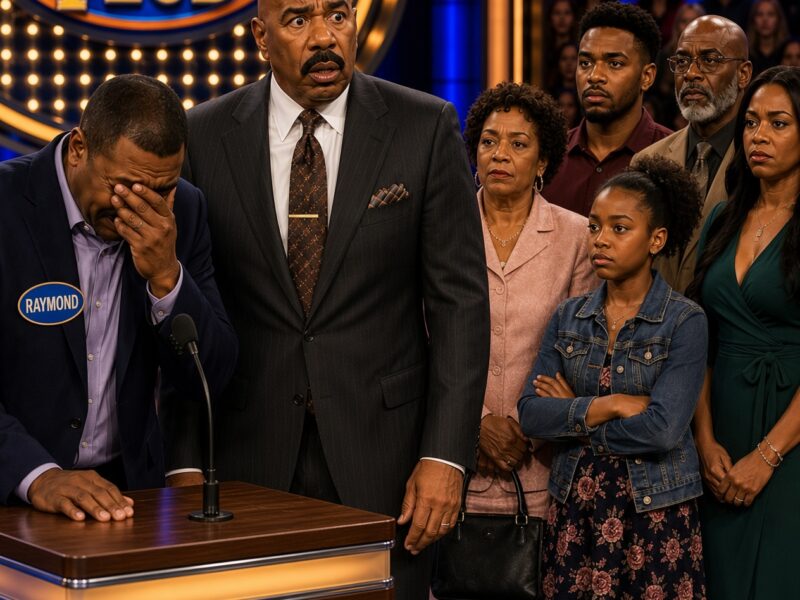
Steve Harvey FREEZES When Contestant’s Wife’s OTHER FAMILY Walks Onto the Stage
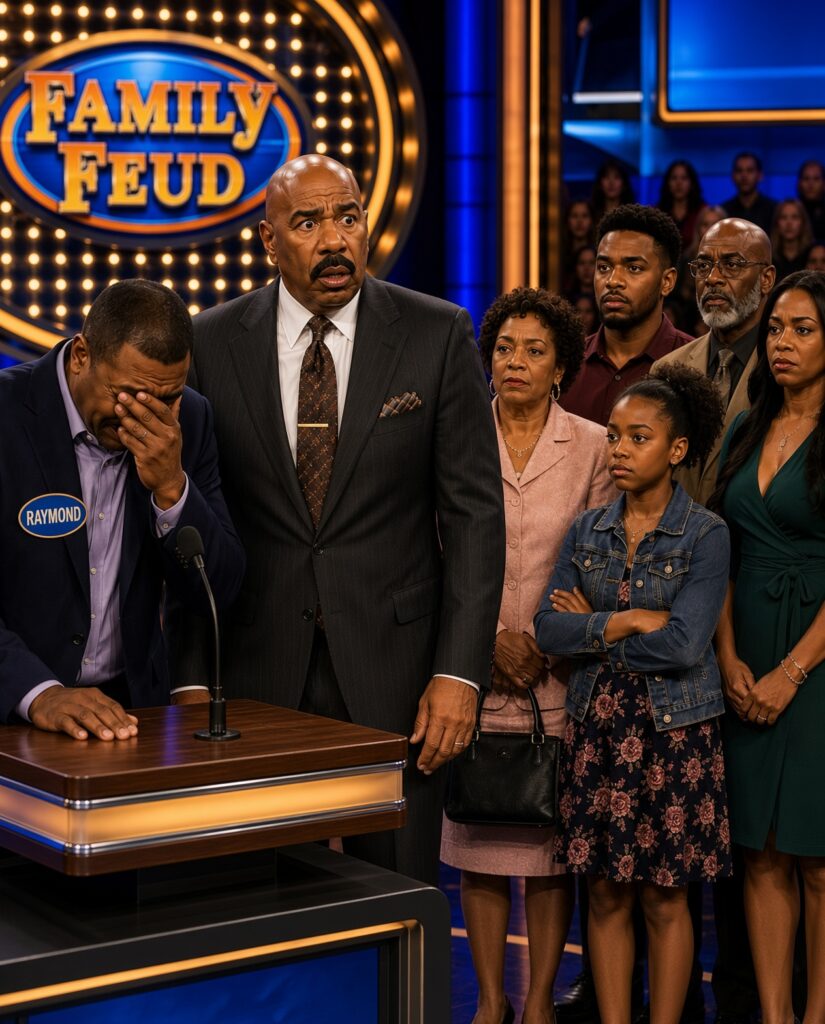
The date was February 18th, 2020, and the lights above the “Family Feud” stage in Atlanta had that particular television warmth that makes everything look like it belongs on a postcard.
Kevin Braxton, 51 years old, a high school football coach from Baton Rouge, Louisiana, stood at the podium with the kind of stillness that comes from 23 years of standing on sidelines in every kind of weather.
He had brought his wife, Diane, 49, their son Terrell, 24, their daughter Kezia, 21, and his assistant coach Marcus, 44, who had been beside him on every sideline for 11 years.
Kevin did not take important days without Marcus.
The studio audience of 300 people had no idea what was about to happen, and neither did Kevin.
Diane had been a bookkeeper, and for the past seven years, she had also been a mother to a nine-year-old boy named Isaiah and a seven-year-old girl named Zoe, who lived in New Orleans with their father, Curtis.
Curtis had been in Diane’s life consistently, if not continuously, since before Kevin.
The children did not know about Kevin, and Kevin did not know about the children.
Curtis knew about Kevin, and he had known for seven years.
On a Tuesday in February, Curtis decided that the knowing was no longer something he was going to carry alone.
He drove from New Orleans to Atlanta, brought Isaiah and Zoe, purchased audience tickets, and told the children they were going to see a television show.
They had been excited, and they had sat in the fifth row.
Isaiah had fallen asleep in the first round, but Zoe had been watching the board very carefully in the specific way of a seven-year-old who is determined to understand what she is looking at.
In the pause between rounds two and three, Zoe stood up in the fifth row and waved at the stage.
She waved the way children wave at people they recognize, and she waved at Diane.
Diane saw the wave, and the studio fell completely silent.
Steve Harvey looked at Diane, then at the fifth row, then at the man with the two children, then back at Diane, and finally at Kevin.
Kevin was looking at Diane.
He said, “Who are those children?”
She said, “Kevin.”
He said, “Diane.”
One word.
She closed her eyes for a moment, opened them, and said, “Mine.”
He said, “Yours.”
It was not a question.
She said, “Yes.”
He said, “How old?”
She said, “Nine and seven.”
He calculated, and then he said, “During.”
She said, “Not the way you think.”
He said, “Tell me the way I should think about it.”
She said, “Not here.”
He said, “Here, because I need to understand what I am looking at.”
She said, “They are mine. I was with Curtis when I met you. I did not end it the way I should have. I thought if I told you…”
He said, “You thought if you told me I would leave.”
She said, “Yes.”
He said, “You were right.”
He said it without anger and without cruelty, the way a coach calls a play, clearly, so everyone on the field can hear the direction.
He looked at Zoe, still standing in the fifth row, still waving, now slightly confused about why nobody was waving back.
He looked at Isaiah, who had woken up and was watching the stage with the expression of a nine-year-old who does not understand what is happening but understands that something is.
He turned to Steve Harvey and said, “Can someone make sure those children are comfortable?”
Steve said, “Yes,” immediately, and signaled to a production assistant who moved to the fifth row.
He looked back at Diane and said, “Are they good kids?”
She said, “They’re wonderful.”
He said, “Good.”
He said it the way he said everything about young people, with a specific warmth that 23 years of coaching had built into him at a cellular level.
Then he said, “We are going to have a very long conversation when we get home, and I don’t know yet what I am going to decide, but those children had nothing to do with any of this, and I want to know they’re comfortable.”
He turned to Steve and said, “Can we keep playing?”
Steve Harvey did not move for a full three seconds.
Then he pressed his handkerchief to his face, took it away, and said five words in a voice that was the quietest thing anyone in that room had heard all day.
“I have to tell you.”
He said it not as a prelude but as a response, as if he was telling Kevin something directly about himself.
“I have to tell you that in 15 years I have never…”
He stopped and tried again.
“You just asked about those children.”
Kevin said, “They’re children.”
He said it the way he had said it every time he said it, about every player on every team for 23 years.
“They’re children, and that is the beginning and the end of how I think about this.”
Steve turned to the camera and said, “I want everyone watching at home to look at this man. He just received something that had been hidden from him for seven years. His first question was whether the children were comfortable. I want you to see what kind of man puts children first even when those children represent the worst news of his adult life. I want you to see him.”
He wasn’t done.
He turned to Kevin and said, “The Steve Harvey Foundation wants to do something for those children. Whatever comes of today for you and Diane, and I am not going to make any assumptions about that, those children are nine and seven, and they should not carry any weight from any of this. We are establishing education accounts for both of them, funded by the foundation, covering through college. Those kids had nothing to do with any adult decision in this room. They deserve a clean shot.”
He said, “And I’m also going to say something to you, Kevin. The foundation wants to put something toward your program, your coaching program. The young men who have come through it for 23 years, we want to fund a scholarship in your name for players who need financial support to attend college, because the kind of man you just showed this room is exactly the kind of man who deserves to have his name on something that helps young people move forward.”
Kevin looked at him for a long moment and said, “The program scholarship.”
He said it the way he said things that mattered, quietly, precisely.
“That’s the one that means something.”
Steve said, “I know.”
Kevin said, “Then thank you.”
Marcus, the assistant coach, who had been standing at the podium through all of this with the expression of a man who has been on sidelines with Kevin for 11 years and thought he had seen everything, put his hand briefly on Kevin’s shoulder.
He said nothing, and Kevin nodded.
It was enough.
The game resumed, and they played.
The Braxton team won the third round on an answer Kevin got so fast that Steve pointed at him and said, “Where did that come from?”
Kevin said, “I coach. I know how to stay focused.”
The episode aired 11 weeks later, and the clip of Kevin saying, “They’re children,” was viewed 55 million times in the first 10 days.
Football coaches across the country shared it, and the phrase was adopted rapidly as a summary of a particular philosophy of priority.
“Their children. And that comes first, regardless of everything else.”
Two sports commentators discussed it at length, but Kevin did not follow any of the coverage.
He was at practice.
Three months after the taping, Kevin and Diane’s marriage ended.
It was handled privately and was finalized within eight months.
Kevin continued coaching, and his players did not know what had happened until the episode aired.
When it did, several of them, former players, current players, players who had graduated years before, reached out to him.
None of them said much.
They said versions of, “We already knew who you were, coach. We just got to see it.”
Isaiah and Zoe’s education accounts were established as planned, and the foundation’s liaison coordinated with Curtis on the administration.
The children have not been told the details, but they will be when they are old enough to understand that sometimes the people who build things for you are people you have never met, and that this is not a failure of connection but an expression of a particular kind of grace.
The Kevin Braxton Coaching Scholarship was awarded for the first time the following fall.
The recipient was a linebacker from Baton Rouge, first in his family to attend college, who told the audience at the small ceremony that his coach had told him four years ago that he was going to college, and that the saying so had made it real before the money did.
Kevin attended the ceremony.
He did not make a speech.
He shook the young man’s hand and said, “This is what comes next. Be ready.”
The young man said, “I’m ready, coach.”
Kevin said, “I know you are.”
Today, Kevin Braxton is still coaching.
He has coached for 26 years now, and he is still on the sideline with Marcus.
The program has sent 43 players to college in the past decade, and the scholarship has now supported three of them through graduation.
The foundation has expanded the fund twice based on the response to the episode and the quality of the program’s outcomes data, which Kevin submits with the same methodical precision he brings to game film review.
He does not talk about February 18th often.
When his players ask, and the younger ones who are too young to have seen the clip when it aired sometimes find it and ask, he says the same thing.
Those were children.
Children come first.
That is all there is to it.
That is all there is to it.
Twenty-six years of coaching, 300 students, 43 college scholarships, and one February afternoon in Atlanta have all said the same thing in the same voice with the same specific warmth.
They are children.
They deserve a clean shot.
That is what Kevin Braxton has been saying his entire career.
The studio just turned on the lights, so the world could finally hear it.
What the cameras never caught was what happened in the parking area after the taping, when Marcus found Kevin standing beside the rental car looking at nothing in particular and stood next to him without saying anything for about four minutes.
Which was four minutes of the particular silence that belongs to two men who have been on sidelines together for 11 years and have developed a vocabulary that does not require words for everything.
Then Marcus had said, “You good?”
Kevin said, “I’ll be good.”
Marcus said, “There’s a difference.”
Kevin said, “I know. I’ll be good. Not yet. I’ll be good.”
Marcus said, “Okay.”
They had stood there for another minute, and then Marcus said, “What you said in there about the children.”
Kevin said, “What about it?”
Marcus said, “My oldest is 10.”
Kevin said, “I know.”
Marcus said, “He didn’t do anything either.”
Kevin looked at him.
Marcus said, “I just mean I understood what you were saying. And I’ve been thinking since I had kids about what that means. That they come first even when it costs you.”
Kevin said, “Especially then.”
Marcus said, “Especially then.”
They had gotten in the car.
Kevin had driven.
They had not talked about it again.
They did not need to.
It had been said, and both of them knew it, and they carried it back to Baton Rouge the way you carry the things that settle in you and become part of how you coach.
Kevin Braxton has been coaching for 26 years.
In those 26 years, he has repeated one version or another of the same thing to every team he has coached at the beginning of every season.
He says, “Whatever happens in that room on Friday night, whatever you bring to that field, whatever difficulty you carried into this week, you are my responsibility. Not just your performance. You. If something is happening that is making the game harder, you tell me. We deal with it together. Nothing you carry has to be carried alone on my sideline.”
He has said this every year for 26 years.
He said it the year he was going through the hardest thing in his life.
He said it the week after the taping.
He said it this year.
He will say it next year.
That is who Kevin Braxton is.
That is who he has always been.
The studio showed 55 million people 11 minutes of it.
Those 11 minutes were accurate.
They were also the smallest possible sample of 26 years of the same thing, said differently on different sidelines to different young men who needed to hear it.
The 11 minutes were just the version with the lights on.
Three years after the taping, the scholarship fund has awarded grants totaling $280,000.
Kevin does not know the exact total.
He does not track it.
He trusts the foundation to track it.
What he tracks is the young men, where they are, what they are doing, whether they are using what the program tried to give them.
He texts former players on their birthdays.
He shows up to their graduations when he can.
He went to three weddings last year.
Two of them were players he had coached more than 15 years ago, which means he coached them when they were children, which means they were his responsibility, which means the relationship does not end when the season ends.
It never ends.
That is what he means when he says they are children.
He means that the responsibility does not come with an expiration date.
He means that what you build in a young person stays built.
He means that on a February afternoon, when the most difficult news of his life arrived in a television studio, the first thing he thought about was two children in the fifth row who were nine and seven years old and who had done nothing and who deserved a clean shot.
He always thinks about that, about the clean shot, about what it takes to give young people the best possible start from wherever they are standing.
He thought about it as a coach long before he thought about it as a man who had been deceived, and he thinks about it now as a man who has come out the other side of being deceived and chosen specifically and deliberately to let the coaching be the thing that defines him rather than the February afternoon.
The February afternoon was 12 minutes.
The coaching is 26 years.
The math is simple.
That is all there is to it.
They are children.
They deserve the clean shot.
He gives it every year.
He will give it next year.
He will give it for as long as he is able to stand on a sideline and say the true thing to a young person who needs to hear it.
That is the story.
The studio just helped the world see it.
Kevin Braxton put them first.
He always has.
He always will.
On his sideline, that is the first rule, the only rule, the rule that governs everything else.
They are children.
They deserve better than the difficulty the adults around them create.
He makes sure of it every season, every year, in every room where a young person is standing and someone has to decide whether to look at them clearly or look away.
Kevin always looks clearly.
He always has.
He always will.
That is the story.
That has always been the story.
The studio just showed it to 55 million people who were glad when the lights came on to finally see it.
55 million people.
One February afternoon.
26 years of the same man on the same sideline saying the same true thing.
The math is always simple.
The children always come first.
Always.
That is Kevin Braxton.
That is who he has always been.
The studio just turned on the lights.









