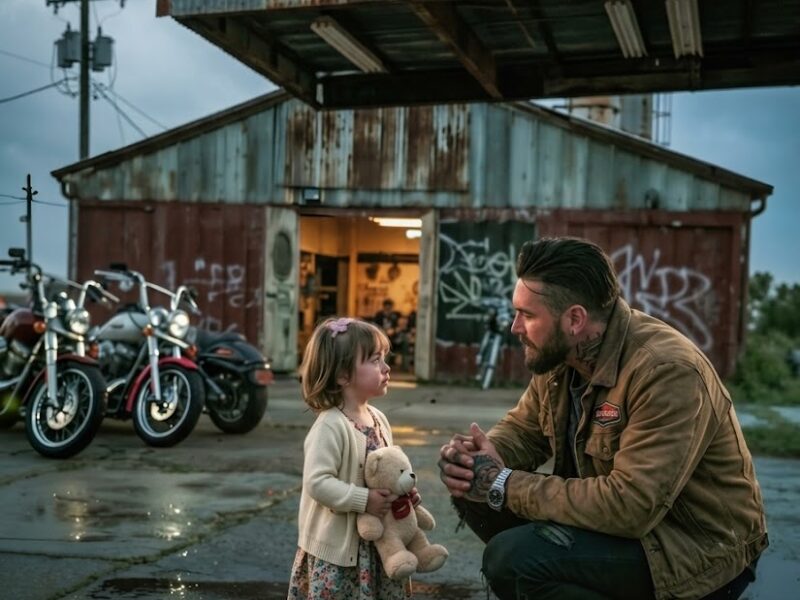
“Someone Hurt My Mom!” the Little Girl Cried to a Group of Bikers—Their Next Move Changed Both Their Lives
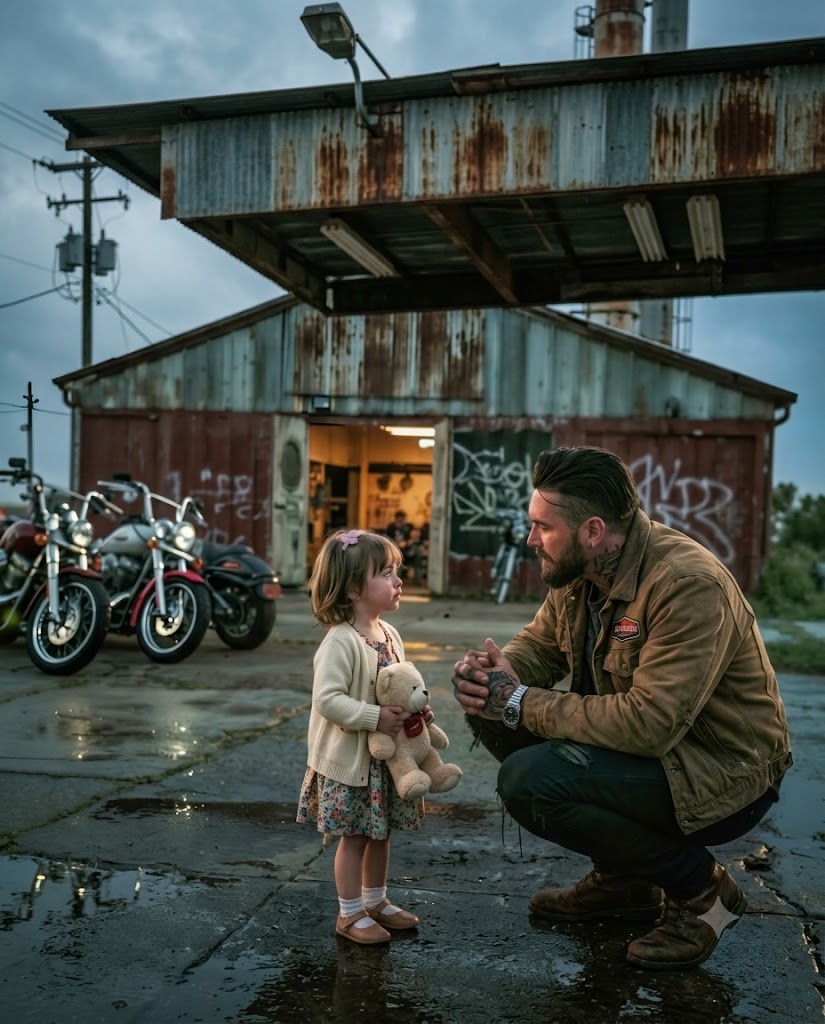
Part 1
The little girl slammed into the diner door, sobbing so hard she could barely breathe.
Every head turned at once. The bell above the door gave one sharp clang, then the room went dead quiet except for the scrape of forks and the child’s ragged crying.
She couldn’t have been older than seven. Her pink sneakers were muddy, one shoelace trailing behind her, and a dark bruise smeared one knee where she had fallen hard somewhere outside.
She stood just inside the doorway, chest heaving, scanning the room with wild, terrified eyes until she saw the line of bikers at the far counter.
Black leather, road-worn denim, heavy boots planted on the cracked tile.
Then she ran straight to them.
“They beat my mom,” she cried, grabbing the sleeve of the nearest man with both hands. “Please. Please help her.”
Coffee stopped halfway to mouths. A waitress froze with a glass pitcher in her hand. Two truckers in a corner booth turned to stare.
The man she had grabbed was Boone. He was the biggest one there, broad-shouldered and gray at the temples, with a beard cut close and a crescent scar near his jaw.
He had been reaching for his mug when the child collided with him, and now he went utterly still, his hand suspended in the air.
Beside him sat Hannah, halfway through wiping syrup from her fingers with a paper napkin. She looked from the girl’s face to the trembling hands locked in Boone’s sleeve, and something in her expression changed instantly.
No hesitation. No confusion. Just focus.
Boone lowered his mug without a sound. “Hey,” he said, voice rough but steady. “Look at me.”
The little girl tried, but panic kept jerking her gaze toward the window.
Hannah slid off her stool first. “What’s your name, sweetheart?” she asked, crouching to bring herself level with the child.
“Lilly.”
“Lilly, I’m Hannah.” She kept her tone calm, even as she clocked every detail. Tear tracks, dirt on Lilly’s coat, the red mark on her wrist, the way she flinched at sudden movement. “Where’s your mom?”
Lilly twisted and pointed with a shaking finger toward the road behind the diner. “At the trailer. He hit her again, and the other man was there.”
That landed hard. Not just one attacker. Two.
Boone was already rising. His stool legs screeched against the floor. The other bikers at the counter straightened with him, instinct moving through them like current, but Boone lifted one hand without looking back.
“Stay.”
That was when Hannah stood and made the decision that changed the moment. She didn’t tell Boone to wait. She didn’t argue.
She turned to the waitress, a red-haired woman in her fifties who had gone pale behind the register. “Call 911 now,” Hannah said. “Tell them possible domestic assault, two adult males, one injured woman, child on scene. Tell them the trailer lot behind Route 16, just past the gas station.”
The waitress snapped out of her shock and grabbed the phone.
Hannah looked back at Lilly. “Can you show us?”
Lilly nodded too fast.
Boone reached for his wallet, peeled off a twenty, and dropped it on the counter out of habit, so automatic it almost looked absurd in the middle of a crisis. Then he turned to Lilly.
“You stay between us,” he said. “No matter what happens, you stay between us. Understand?”
Lilly stared up at him, terrified, but she nodded.
They moved fast. The diner door banged open. Grease and coffee gave way to the sharp stink of gas from the pumps next door and sun-baked asphalt.
Hannah took Lilly’s hand immediately. Boone moved ahead, scanning the lot, the road, the line of rusting trailers beyond a patch of gravel and weeds.
A white pickup sat crooked near the back entrance of the trailer park, driver’s door open. Boone saw that and picked up speed.
Lilly had to half run to keep up, Hannah keeping her balanced as they crossed the gravel.
The rest of the world seemed to shrink into fragments. The hum of highway traffic, the crunch under their shoes, the metallic flap of loose siding somewhere ahead.
Gravel spat out from under heavy boots as the little group cut between two trailers with bent aluminum skirting and sagging steps.
The smell hit first. Old fryer grease, wet dirt, cigarette smoke, and something sharper underneath it like spilled bleach trying and failing to cover rot.
Forty feet ahead, the white pickup leaned at an angle beside a trailer with a plywood panel where one window should have been. Music thumped faintly inside.
A man’s voice rose over it, hard and ugly. Then a crash made Lilly flinch so hard she almost folded into herself.
Hannah tightened her grip on the girl’s shoulder. “Stay behind me.”
Cole did not slow down. He lifted one hand without looking back, a flat warning for the others to hold their line. Not a charge, not yet.
The trailer door stood half open, swinging a few inches with every gust. Inside came the scrape of something dragged across linoleum and a muffled cry that did not sound staged, drunk, or playful.
It sounded like breath being crushed out of somebody.
That was enough. Cole reached the steps in two strides and hit the door with the side of his forearm. It banged inward against the wall.
The room inside was dim even in daylight. Curtains pinned shut with thumbtacks. A lamp lay broken on the floor. Beer cans rolled near a torn couch.
A woman was down on one knee beside a small table, one arm over her head. Blood darkened the collar of her T-shirt.
A man in work boots and a stained tank top had a fist twisted in her hair, hauling her backward to make her look up at him. He turned at the noise and froze.
For half a second nobody moved. The man’s eyes flicked from Cole’s leather vest to the open doorway, then to Hannah and Lilly behind him.
In that half second, Hannah saw the math happen in his face. He wanted to look fearless. He also knew exactly what he was seeing.
“What the hell is this?” he snapped, shoving the woman so she fell sideways against the table. “You people can’t come in here.”
Lilly made a sound so raw it silenced the room more effectively than a shout. “That’s my mom.”
The woman looked up then, dazed, one eye already swelling. Relief broke over her face so suddenly it looked painful. “Lilly.”
The man lunged toward the girl.
Hannah moved first. She stepped into the narrow space beside the couch and caught Lilly around the waist, pulling her back behind her own body before his hand could reach.
It was not graceful. Her heel slipped on a magazine. Her shoulder clipped the wall. But she turned the child out of his grasp, and that single beat gave Cole time to close the distance.
Cole did not swing. He caught the man’s wrist in midair and squeezed until the fingers opened on their own.
“Take one more step toward her,” Cole said quietly, “and this gets worse for you than it already is.”
Men who hit women for a living always seem to believe volume was power. The man bared his teeth and tried to jerk free. “You touch me, I’ll have the law on you. This is my house.”
“Then you’re doing a hell of a job keeping it,” Hannah shot back.
The woman on the floor pushed herself up on shaking arms. “No,” she whispered, too fast, too desperate. “Please. Please don’t make him matter.”
That changed the air in the trailer. It was not just fear talking. It was training. Long-term fear. The kind that had taught her to manage danger instead of escaping it.
Cole felt it at once. So did Hannah. Charging harder could stop one beating and trigger ten worse consequences later. Cops might come and leave. Bruises would fade. She would still be here when the truck drove away.
The man sensed the hesitation and tried to reclaim the room with it. “You hear her? She said stay out of it.” He pointed at Lilly. “And you, running off to strangers, you little liar. Don’t—”
The word cracked through the trailer like a board snapping over a knee. Everything stopped for half a beat.
The man’s finger was still pointed at the little girl. The weak overhead light burst. Somewhere outside, a dog barked twice and fell quiet again.
Hannah had stepped forward before she fully realized she was moving. Her voice had come out low, raw, and steadier than she felt. One arm crossed in front of the little girl without touching her, not shielding like panic, but marking a line.
The man’s eyes shifted to her, and the sneer on his mouth changed shape. It did not disappear. It sharpened. “Now you found your voice.”
His gaze slid past her shoulder toward the doorway, where Cole stood with the others filling the narrow entrance and the small strip of yard beyond it.
Leather, denim, road dust, hard faces. Men built like trouble, carrying the kind of silence most people mistook for violence. That was exactly what he wanted.
Cole saw it in an instant. The man was not drunk enough to be careless. He was scared enough to be dangerous and smart enough to bait a swing.
One punch from the wrong person and the whole thing would turn simple. Simple was what men like that loved. Simple let them become victims in front of witnesses.
So Cole did the one thing Hannah had not expected. He took two slow steps back, not away, just enough to widen the doorway and make his hands visible at his sides.
His voice came out even, almost dull. “Nobody’s here to touch you.”
The man blinked, thrown off balance by the lack of heat.
Another shape appeared behind him then, broader and red-faced, shoving through the short hallway from the rear of the trailer. This one smelled like beer before he even spoke.
“What the hell is this?”
So there were two of them.
The second man looked at the room, at Hannah near the girl, at Cole and the others outside, and grinned with ugly excitement. “You brought bikers to our place.” He barked a laugh toward the first man. “Told you. Little rats always run.”
The little girl flinched. Hannah felt it through the child, though she still had not touched her. Tiny body, tight with terror, holding itself together by force.
Cole kept his eyes on both men. “Step away from them.”
Red Face spread his hands. “Or what?”
That was the question hanging in the sour air. Hannah had assumed ten minutes ago that the answer from men like these would come fast and hard and bloody. A wall hit. A fist. A boot. The kind of explosion people later described with admiration because it looked brave.
Instead, Cole tilted his head slightly toward the yard. One of the bikers near the steps lifted a phone into plain view. Camera light on.
Another had already moved three feet to the left, giving a clear line from the door to the lot. No crowding. No lunging. No excuse.
The first man noticed and swore. “Turn that off.”
“No,” Cole said.
Red Face took one hard step toward Hannah. This time the movement in the doorway changed. Not a rush. A shift. Two men closed the opening with clinical precision. Boots planted, shoulders angled. They did not enter. They simply erased the path. A blockade. Not an assault.
Cole’s voice stayed level. “You move toward them again and every person in this park watches what happens next.”
That landed harder than a threat. Both men looked past him then toward the dim lane between trailers. Doors were open now. Porch lights had clicked on one by one. Shapes stood behind screen doors and on splintered steps, pretending not to stare.
A woman in a robe. A kid holding a bicycle by the handlebars. An old man under a Braves cap. The whole place was listening.
Men who hid in private hated witnesses.
The first man tried to recover with a laugh. “This is family business.”
Hannah answered before Cole could. “Family doesn’t hide bleach over blood.”
Silence hit the room harder than shouting would have. Silence kept its grip for one long breath, and in that breath the balance of the room shifted.
The man nearest the stove looked toward the back hall instead of toward Cole. That tiny glance gave away more than his laugh had. Hannah saw it first. Not fear of a fight. Fear of someone hearing too much.
Her face had gone pale under the yellow trailer light. One cheekbone swollen. A split at the corner of her mouth dark against her skin, but her eyes sharpened. For the first time since Cole had stepped through the door, she was not bracing for the next blow. She was deciding.
“You want family business?” Hannah said, voice rough but steady. “Then let the whole family court hear it.”
The woman in the robe outside shifted closer to the screen door. The kid with the bicycle did not move at all. The old man under the Braves cap lifted his chin.
Witnesses had weighed in places like this. Not always enough to stop a fist. Sometimes enough to stop a lie.
The first man smiled, thin. “You drunk, Hannah?”
“No.” She touched the edge of the counter to keep herself upright, then looked past him toward the back room. “And I’m done covering for men who think they own the oxygen in here.”
That landed harder than Cole expected. The second man muttered a curse. The first one took half a step toward her.
Cole did not move in front of her this time. That was the difference. At the diner, he had answered a child’s panic. At the trailer, he had crossed a threshold and set a boundary. Here, in the sour heat and the listening quiet, the next step belonged to Hannah or it would never belong to her at all.
“Say it,” Cole said, not to the men but to her.
The first man snapped, “Keep your mouth shut.”
Hannah flinched at the volume. Then she straightened anyway. “No.”
The word came out smaller than the one she had thrown a minute before, but it held. She looked toward the open trailer door, toward the faces pretending not to stare. Shame moved across her face like a shadow, then anger burned through it.
“He’s been taking my check,” she said. “My tips, too, when I can hide any. Says rent’s short every month, even when it isn’t.” She pointed at a cracked cabinet by the sink. “Keeps my phone in there when he leaves. Tells people I fall, or I run into doors, or I get mean when I drink.”
Her breath hitched once. “I don’t even drink.”
The robe-clad woman outside let out a sharp sound through her teeth.
The first man lunged with his voice before his hands. “Liar.”
But the word had lost its center. Too many people had heard too much.
Hannah kept going, faster now, like if she stopped she would drown in it. “Last week he made me tell my sister not to come by anymore. Said if anybody asked questions, he’d make sure I never saw—” She cut herself off.
Cole caught that break in the sentence. So did the old man outside. So did the first man, who turned vicious in an instant.
“You say another word,” he said, very low, “and you’ll regret it.”
There it was. Not rage. Control. The kind built over time.
Hannah’s fingers tightened on the counter. “That’s the problem, isn’t it? I already do.”
The room went still again. Even the trailer’s rattling window unit seemed to hush.
Then the robe-clad woman called from the steps. “You need me to call somebody, Hannah?”
The offer shook her more than the threat had. Help, when someone had gotten used to none, could feel almost unbearable. Her eyes filled, but she did not look away this time.
“Yes,” she said.
The first man moved at last, not toward Cole, toward the cabinet. Cole saw it and shifted two feet to the left. Nothing dramatic, just enough to block the line.
The cabinet door never opened. A voice from the porch cut through the room first. Male, impatient, too familiar with the place to knock twice.
“Cole in there.”
That single name changed more than a drawn weapon would have. The men in the trailer stopped looking like hot-headed relatives protecting a lie and started looking like workers waiting on instruction.
Cole did not answer. Neither did Hannah. The silence stretched just long enough for everybody inside to understand the same thing at once. This was bigger than one kitchen, one beating, one terrified child.
Boots thudded on the warped steps outside. The robe-clad woman on the stair landing stiffened and looked toward Hannah. “You know that voice?”
Hannah’s face lost what little color it had left. “Yes.”
Not fear of a husband, not even fear of a house full of people willing to cover bruises with cleaning supplies and excuses. This was older, deeper, worn into her nerves like a groove.
Cole caught it immediately.
The first man by the stove tried to recover some authority. “Ain’t got nothing to do with you.”
Hannah surprised him. “It has everything to do with him now.”
That was the first real choice she had made in front of them. Not shrinking, not apologizing, naming the line they had crossed.
A hard fist hit the trailer door. “Open up.”
Cole kept his voice even. “Who’s asking?”
A laugh came through the thin metal. “Men who think you’re about to make this harder than it needs to be.”
The name landed wrong on purpose, like something people said around town with their mouths half shut. Not a club, not a business, a pressure system. Something everybody knew enough to fear and not enough to challenge.
Hannah closed her eyes for half a second. “They collect for Beating, Cole.”
The room shifted again. Cole looked at her. “Say that clearly.”
Her throat worked before the words came out. “Beating Cole isn’t just him. It’s what they call the debt line attached to him. When he borrows, when he loses, when he can’t pay on time, they put pressure where it hurts. Family first, then job, then car, then the kid.”
Nobody in the trailer denied it. The robe-clad woman whispered, horrified, “They name the debt after him?”
“No,” Hannah said. “After what they do when someone falls behind.”
Even the air seemed to tighten. Cole had walked into plenty of ugly rooms in his life. But this was uglier in a colder way. A beating in rage was one thing. A beating structured like a payment plan was another.
This was not one violent man losing control. This was intimidation turned ordinary. Organized enough to become routine. Familiar enough that half the people in the trailer had learned to live around it.
Another knock, louder now. “Clock’s running.”
The man nearest the stove snapped at Hannah under his breath. “You should have kept your mouth shut.”
“No one will,” she said.
He blinked. “What?”
“No one will help if everybody keeps saying it’s private.” Her voice shook. But it did not break. “That’s how they built this.”
Cole saw the pieces locking together as she spoke. Bruises hidden. Debts passed through favors. Cousins used as watchers. Women taught to call it stress. Kids taught to stay quiet. A whole local web held in place not by one monster, but by a chain of smaller cowards. Each one pretending he wasn’t responsible because somebody else had started it.
“Who’s outside?” Cole asked.
Hannah swallowed. “A collector, maybe two. They come from the garage off Route 9. Fight Smart runs messages through there. If a guy misses a payment, they don’t always take money first. They break windows, slash tires, scare bosses, tell landlords things. If that doesn’t work—” Her eyes dipped to the stains on the linoleum. “Then they make an example.”
The robe-clad woman leaned against the wall as if her legs had weakened. “And everybody knows?”
“Everybody knows enough to stay at a safe distance,” Hannah said.
There it was, the true shape of the trap. Distance was the product being sold. Keep your head down.
A pickup rolled past the trailer slow enough for its tires to grind the gravel instead of crunch it. Not a stop. Not a visit. Just a reminder.
The porch boards carried the vibration through the thin walls, and every person inside felt it. The robe-clad woman closed her eyes for half a second. The man by the stove looked at the floor. Hannah did not move.
Cole watched her instead of the window. Part of him had expected the same thing he had seen in too many trapped people over the years. The retreat, the apology, the instinct to shrink and survive another day.
But something in Hannah had already crossed the line. Fear was still there, plain as the swelling near her eye, but it had changed shape. It was no longer asking whether she was scared. It was asking what she was willing to risk.
“They want everyone separate,” Cole said quietly. “That’s how this holds.”
Hannah lifted her chin. “If I walk out with you, they punish her.” Her eyes shifted toward the robe-clad woman. “If she talks, they punish the next one. If you swing at the wrong man, they call it biker violence and everybody goes back behind their doors.”
That was the first sharp thing anyone had said all morning that did not come from panic. Cole gave one small nod. “So we don’t give them the scene they know how to use.”
The man by the stove frowned. “What does that mean?”
“It means,” Hannah said before Cole could answer, “they win when this stays one trailer at a time.”
The room went still again, but this time not from fear. From recognition.
Hannah pushed herself off the wall and winced when the motion pulled at her ribs. Even hurt, she moved with purpose now. She crossed to the tiny table beside the sink, grabbed a grocery receipt and a dull pen, and flattened the paper with her palm.
“Names,” she said. “Not stories, not rumors. Specifics.”
The robe-clad woman stared at her. “You think writing things down makes us safe?”
“No,” Hannah said. “I think staying quiet has already proved it doesn’t.”
Cole stayed near the cabinet and the front angle of the room, still blocking what needed blocking, but the lead had shifted. That mattered. Hannah was no longer the person being moved around by danger. She was choosing where to put it.
“Who slashed tires?” she asked the man by the stove.
He hesitated.
“Not whoever he thinks,” she said. “Who you saw?”
His jaw worked. “Men who think him and no one well.”
“At the Sinclair place?”
“Three weeks ago.”
She wrote the names.
The robe-clad woman swallowed. “Safe Distance took cash from my cousin outside the feed store. Said it was for protection after her husband got behind on something.”
Hannah wrote that, too.
Another rumble of an engine outside. This one slowed longer, then moved on. Cole stepped to the window edge and looked without showing his full face. Same dark pickup. Same message. Surveillance, not attack. Yet.
“They’re checking whether the porch voice scared everybody back into line,” he said.
“Good,” Hannah answered.
The robe-clad woman looked at her like she had lost her mind. “Good?”
Hannah folded the receipt once. “Because if they think we’re frightened and frozen, they won’t expect us to move first.”
That landed harder than any threat had. Cole turned fully toward her. “What move?”
She looked around the trailer. Not at the people, but at the things. The stained linoleum. The dented fridge. The cheap clock above the sink. Then her eyes stopped on the object everybody had been pretending not to notice.
The cabinet that had drawn the man’s glance in the earlier silence.
“Open it,” she said.
The man by the stove stiffened. “No.”
Cole did not reach for it. “What’s inside?”
The robe-clad woman answered in a whisper. “Books. Envelopes. Some phones. They keep things in houses that look harmless.”
Hannah’s face hardened. “That’s why they came to the porch without knocking. They weren’t checking on me. They were checking on their storage.”
A fist hit the trailer door so hard the thin wall shook around it. The sound did not come with a warning this time. It came like a decision.
Hannah flinched once, then went still. The robe-clad woman by the stove made a broken sound in her throat and backed into the counter hard enough to rattle a chipped mug.
Cole turned his head toward the door, not toward the cabinet, and that tiny choice told Hannah everything. Whoever had come back was not worried about hidden phones anymore. They were here to take control before control slipped.
Another blow landed, then a man’s voice tore through the metal. “Open it now.”
Not loud for the sake of volume. Loud for the sake of ownership.
From the back of the trailer came the fast patter of small feet. Ellie appeared in the narrow hall in mismatched socks and an oversized T-shirt, eyes wide, hair tangled from sleep she had never really gotten.
She looked first at Hannah, then at the door, then at Cole, reading the room with the instinct of a child who had learned danger before cartoons.
The knob jerked hard. Cole crossed the space in two strides and caught the lock as it twisted from outside. The old screws groaned in the frame.
“Back room,” he said, low and sharp.
The robe-clad woman froze. Hannah did not. She moved first. That changed everything.
She grabbed Ellie around the shoulders and shoved her toward the short hallway. Not gently, not cruelly, just fast. “Bathroom. Get in and lock it.”
Ellie stumbled, then planted her feet. “No.”
The word came out small but solid.
A shoulder slammed into the door. The frame splintered near the latch. Cole braced with one forearm against the wall, boots digging into the stained linoleum.
“Now, Ellie.”
The child looked at Hannah instead. That was the worst part of it. Not the impact, not the shouting, the fact that the girl had learned not to obey force, only fear.
Hannah dropped to one knee in front of her, both hands on her face. “Listen to me,” she said, every word shaking and steady at once. “You lock that bathroom door, and you do not come out unless I tell you. Not his voice. Not anyone else’s. Mine.”
Ellie searched her face.
The next hit burst the latch plate halfway out of the jam. She ran. The bathroom door snapped shut in the back with a thin click that sounded too weak to protect anybody.
“Move!” a man shouted from outside. “Take the kid first.”
The robe-clad woman made a terrified noise. “Oh god.”
There it was. No bluff left. No pretense about checking on a tenant. No soft language. The child was the target now, not the secret.
Hannah’s face drained of color, but she did not fold. She pointed at the cabinet. “They know what’s in there,” she said. “If they get those phones back, nobody talks.”
Cole looked at the door, then at the narrow hall. One choice protected evidence. The other protected a life.
He chose the life.
The door burst inward with a crack of dry wood and a spray of old paint. Two men came through hard and fast, not careful enough to be professionals, too sure of themselves to expect resistance.
The first was broad in the shoulders, jaw tight, eyes already tracking the hallway. The second stayed left, scanning the room, reaching for Hannah.
Cole drove into the first man before he could take two steps. The collision sounded like furniture breaking. Both men slammed into the wall beside the table, sending a chair skidding across the floor.
Cole did not swing wild. He crowded him, turned him, pinned one arm, used the trailer’s cramped space against him. Fight smart. No room for clean punches. No room for show.
The second man lunged for the hall anyway. Hannah met him. Not by backing away, by grabbing the cast iron skillet off the stove and bringing it down across his forearm with both hands.
The crack of metal on bone filled the trailer.
The skillet hit had bought only a second, but in a trailer that small, a second was enough to change who controlled the room.
The man in the hall folded around his arm with a curse so sharp it seemed to cut the air. Hannah did not freeze after the blow. That was the difference now. In the earlier months, pain in that space had always led to silence. This time it led to movement.
She drove her shoulder into the narrow doorway and blocked it with her body while Cole slammed the first man chest first into the wall hard enough to rattle the cheap framed print above the table.
Outside, engines. Not one. Three. The sound rolled in low and mean over the gravel lot.
The injured man looked up through his teeth and smiled despite the pain. “Too late,” he said.
That changed the shape of everything. This was not a private attack anymore. It was not one man losing his temper in a trailer and another stepping in. The network Hannah had described had just arrived in broad daylight. Confident enough to come to the property in numbers.
From the back room came a small strangled cry.
“No one will.”
The sound hit Hannah harder than the pounding on the door had. The second man had not made it down the hall, but the crash against the front steps meant somebody else had.
Cole heard it, too. His eyes cut toward her for half a beat, and in that beat, she understood what he could not do. If he left the two men unsecured, the trailer turned into a knife fight in a hallway. If he stayed, the child in the back room could be taken before he crossed eight feet of linoleum.
So Hannah moved first.
She snatched the roll of silver duct tape from the counter where it had been left beside a bag of groceries. Kicked the injured man’s legs out from under him and dropped one knee into his back before he could recover.
He shouted, twisted, tried to rise. She yanked his wrist behind him and wrapped fast. Once, twice, three times, using all the fury she had been swallowing for months.
Not neat. Not gentle. Enough.
Cole saw what she was doing and used the same opening to drive the other man to the floor, wrenched his free arm back, and stripped the keys from his pocket.
A boot hit the front door. The hollow panel splintered near the lock.
“Back room,” Hannah shouted.
Cole did not argue. He vaulted the fallen chair, cleared the tiny kitchen in two strides, and disappeared down the hall just as the front door burst inward.
Sunlight cut a wide slash across the trailer floor, and with it came Men Who Think and Safe Distance, both breathing hard, both expecting fear.
What they found instead was Hannah standing in the middle of the narrow living room with a cast iron skillet in one hand and a cell phone in the other. Not dialing. Recording.
The red light on the screen was visible.
For the first time since they had started using her trailer as a quiet place to scare, store, and pressure, their confidence broke. It was slight, a pause, a flick of the eyes, but it was there.
Men Who Think recovered first. “Put that down.”
Hannah lifted the phone higher so it caught his face clearly. “Say it again.”
He stopped.
Safe Distance moved sideways trying to stay out of frame, understanding faster. That told Cole something too from the back hall. One of them feared exposure more than violence. The product was secrecy. Control depended on nobody outside this dirt patch of lots hearing the whole thing at once.
From the bedroom came the scrape of a window and the quick voice of No One Will, frightened but moving because Cole had told the child exactly what to do. Not hide under blankets. Not wait. Move.
Men Who Think heard it and lunged for the hall. Hannah swung the skillet low, not at his head, but at his knee.
Hannah’s swing landed clean across Men Who Think’s knee, and the sound that came out of him was not anger first. It was surprise.
His leg buckled sideways in the narrow hall. He grabbed at the wall, missed, and crashed shoulder first into the cheap paneling hard enough to rattle the framed calendar hanging by one thumbtack.
The trailer, which had felt a second ago like a trap built for silence, suddenly became too small to hold all the truth trying to break out of it.
Cole did not waste that second. He drove forward, not with another wild hit, but with intent. He shoved Men Who Think down across the floor between the kitchen and the hall, pinning his good arm with one knee while kicking the dropped phone away from his reach.
Fight Smart, bleeding from the lip and breathing hard, snatched the phone before it could slide under the table.
“Speaker,” Cole said.
Fight Smart did it without asking why. The call was still live. Static cracked. Then a dispatcher’s voice came through, thin but unmistakable in the cramped trailer.
“County 911, we have an open line. If you can hear me, make noise and state your address.”
Men Who Think froze under Cole like a man who had just realized the dark around him was full of witnesses. That changed everything. His power had always depended on doors being shut, curtains drawn, neighbors pretending not to hear, and Hannah believing that fear was safer than daylight.
But now his voice, his threats, the child’s crying, the crash of the struggle, all of it had already crossed the boundary he had spent months defending.
No One Will appeared at the bedroom window with one leg over the sill, exactly where Cole had sent the child. Roadside Cry stood outside in the dirt lot below, arms up, ready. The child dropped the last two feet into waiting hands.
Safe Distance, who had stayed by the bikes instead of rushing inside, was already doing the part nobody noticed until it mattered most. He was at the mouth of the lot, standing broad in the wash of the headlights, stopping a pickup from backing out.
Beating Cole had made it three steps toward the driver’s door before Safe Distance planted a hand on the hood and said something low enough not to carry, but final enough to keep the man where he was. No escape. No private version of the story later.
Inside, Hannah stood with the skillet still in both hands, shaking so hard the iron trembled. She looked from Cole to the phone to Men Who Think on the floor, and something in her face changed. Not because she felt brave all at once. Because for the first time, the room did not require bravery in secret. It required one plain thing in the open.
Her voice.
She set the skillet down. The gesture was small, but Cole saw what it meant. She was done surviving this by striking and ducking and denying. Done letting the fight be mistaken for mutual damage.
Hannah stepped toward the table, leaned close to the phone in Fight Smart’s hand, and gave the address clearly, including the lot number. Then she said, just as clearly:
“He’s been using my place to store stolen pills and cash. He hits me when I say no. There’s a child here. I want him removed, and I want the trailer searched.”
The room went still after that. Even Men Who Think stopped cursing. Because violence could be lied about. Bruises could be explained away. But consent withdrawn in front of a recorded line, with named evidence and a request for a search, was a door shutting on him from the other side.
Outside, Roadside Cry crouched in front of No One Will, wrapping the child in a denim jacket too big for those thin shoulders. The child looked toward the trailer, wide-eyed, trying to listen to grown-up sounds through metal and dust and panic.
“You did exactly right,” Roadside Cry said. “You moved when it mattered.”
No One Will swallowed hard. “Is she coming out?”









