Six Retired Military K9s Ignored Every Handler—Until an Old Farmer Whispered One Forgotten Command
It wasn’t just noise, Lieutenant. It was a countdown.
The words spoken by Master Sergeant Cole were nearly swallowed by the pandemonium erupting from the kennel runs at Lackland Air Force Base’s retired MWD section. It was a sound that frayed the nerves, a chaotic symphony of barks, growls, and the percussive clang of powerful bodies hitting chain-link fences.
To Lieutenant Davison, it was a failure of discipline, a problem to be managed with protocols and progressive training schedules. He held a tablet in his hand, its screen glowing with behavioral analytics charts that seemed utterly useless in the face of the raw, untamed sound.
The air, thick with the smell of disinfectant, dog food, and pure canine rage, felt heavy in his lungs. Six individual runs, six maelstroms of fur and fury.
These weren’t just any dogs. They were legends, retired military working dogs, each with a service record that read like a Hollywood action script. They were heroes, and they were breaking.
“Master Sergeant, with all due respect, I see six assets exhibiting extreme stress-induced aggression,” Davison replied, raising his voice to be heard over a particularly vicious snarl from a Belgian Malinois named Titan. “The recommendation from behavioral science is a stepped-up desensitization program.”
“And they’re not assets, sir.” Cole cut in, his voice a low rumble that somehow sliced through the noise. “Not anymore.”
He wasn’t looking at Davison. His eyes, narrowed and weathered, were fixed on the dogs. He saw something the lieutenant’s charts couldn’t quantify.
“They’re soldiers without a war. More than that, they’re soldiers who lost their handler, their partner, their whole world. All six of them in the last eighteen months. It’s grief. You can’t schedule grief away.”
Davison sighed, a puff of condescending patience. Cole was old school, a relic from an era of gut feelings and anecdotal evidence. Davison was the new Air Force, data-driven, efficient, and armed with a master’s degree in organizational psychology.
He believed any problem could be broken down into measurable parts and solved. “Their handlers retired or were reassigned, Master Sergeant. They weren’t killed in action. The bond is strong, I get that, but this level of sustained aggression is unsustainable. Command is talking about humane solutions if we can’t get them adoptable.”
You and I both know what that means.
The threat hung in the air, more chilling than the morning breeze. These dogs who had sniffed out IEDs in the dust of Kandahar, who had run down insurgents in the mountains of the Hindu Kush, who had guarded presidents and diplomats, could be euthanized because they were broken by the peace they had helped secure.
Cole’s jaw tightened. He had known these dogs since they were lanky pups, full of boundless energy and drive. He’d seen them paired with young, nervous handlers and watched them grow into inseparable teams.
Now, seeing them like this, a blur of teeth and tormented energy, was like watching six Medals of Honor being melted down for scrap.
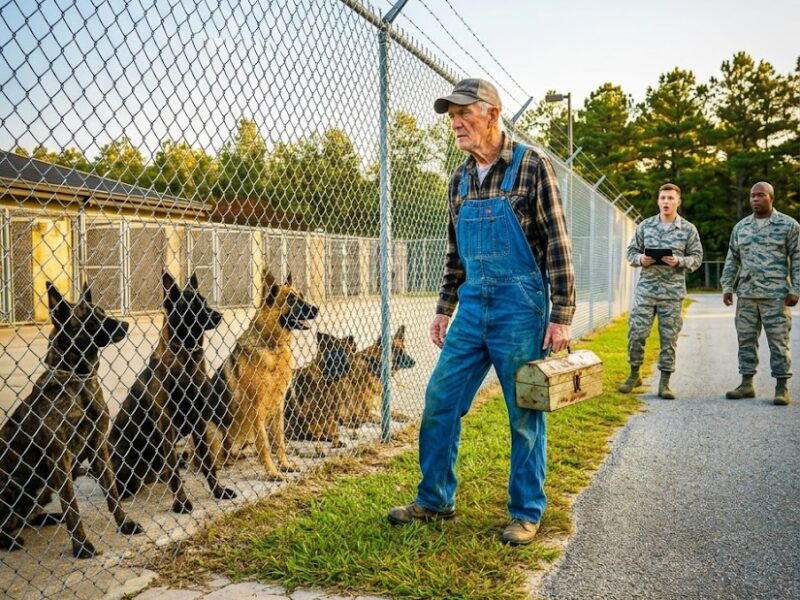
There was Chaos, a Dutch Shepherd who had served with a special forces ODA, now spinning in endless frantic circles in his run. Next to him, Valkyrie, a sleek black Malinois who had done three tours on a protection detail, threw herself against the fence again and again, a repetitive, desperate motion.
There was Ghost, a sable German Shepherd who simply stood in the back of his kennel, head low, emitting a deep, constant growl that was arguably more terrifying than the frantic barking of the others. The remaining three, Rocco, Gage, and Striker, were a chorus of misery and defiance.
The young airmen assigned to care for them were becoming fearful, and mistakes were starting to happen. A feed door left unlatched, a water bowl fumbled and dropped. Small things that could lead to a very big, very bad thing.
“My new protocol,” Davison began, but stopped.
The sound had changed. It wasn’t that it had lessened, it had focused. All six dogs, almost as one, had ceased their individual displays of madness and were now directing their full, concentrated fury toward the access road that ran alongside the kennels.
Their barks deepened, sharpened, becoming a unified wall of aggression aimed at a single point. Both men turned to look.
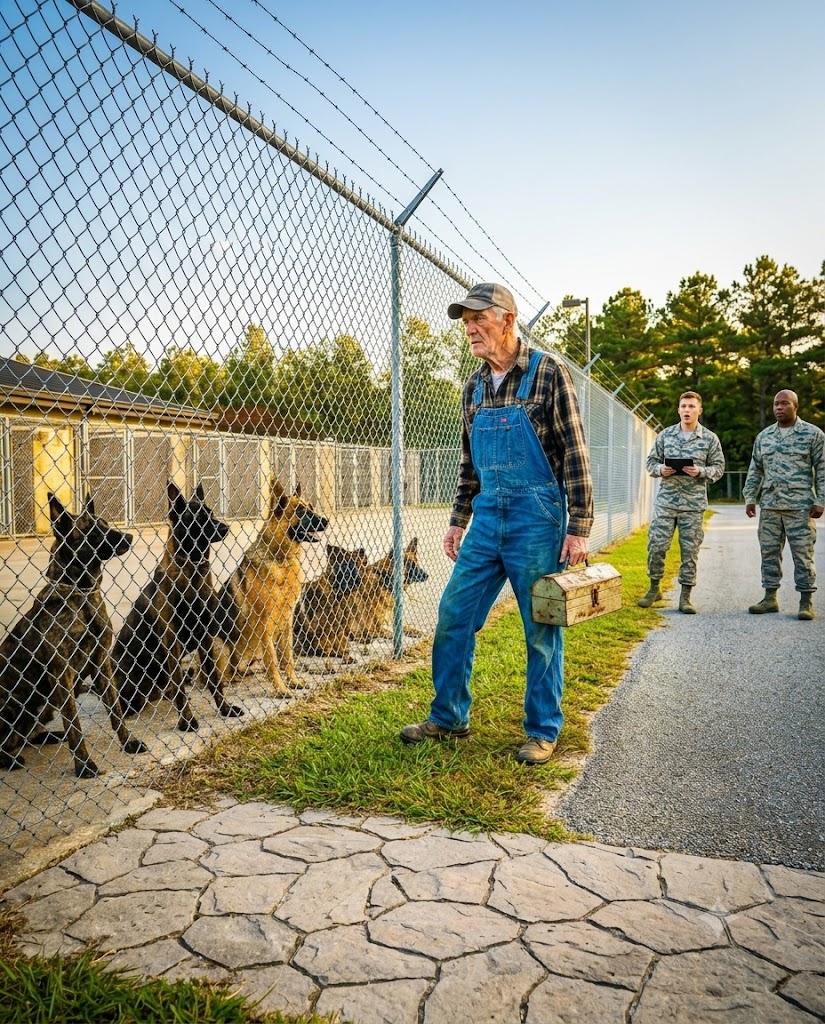
An old man was walking along the road. He was a civilian, that much was obvious. He wore faded denim overalls over a plaid flannel shirt, and a dusty, sweat-stained baseball cap was pulled low on his head.
He walked with the slow, deliberate gait of a man who had spent a lifetime on his feet, his shoulders slightly stooped. In one hand, he carried a small, battered metal toolbox.
He looked like a local farmer or a handyman, someone who might have been contracted to fix a leaky pipe at the community center. He was utterly unremarkable, a piece of rural scenery that had wandered onto a military installation.
He was also, according to base regulations, in a restricted area.
“Hey, civilian!” Davison shouted, his voice sharp with authority. “You’re in a restricted zone. Turn back.”
The man didn’t seem to hear him, or if he did, he paid no mind. He just kept walking, his gaze not on them, but on the fence line.
And then, the impossible happened. As the old man drew parallel to the first kennel, the one holding Chaos, the world fell silent.
It wasn’t a gradual quieting. It was as if a switch had been thrown. One moment, the air was tearing itself apart with noise, the next, there was only the whisper of the wind through the surrounding pine trees and the distant hum of a generator.
The silence was so sudden, so absolute, it was more shocking than the noise it replaced. Six of the most aggressive, highly trained, and deeply traumatized dogs on the planet had gone utterly, completely still.
They weren’t cowering. They weren’t ignoring the man. They were at attention.
The old farmer stopped. He turned his head slowly, his face still shadowed by the brim of his cap. He didn’t look at the two uniformed men standing dumbfounded by the kennel office. His entire being was focused on the dogs.
Chaos, the frantic spinner, was now pressed against the fence, his body rigid, his tail giving a single tentative thump against the metal. Valkyrie was sitting, her posture perfect, her ears pricked forward, a low whine escaping her throat.
Ghost had moved to the front of his run, his head raised, his dark eyes locked on the stranger. Every one of them was utterly transfixed.
The old man took one step off the pavement and onto the grass verge, his worn work boots making no sound. He still hadn’t said a word. He didn’t have to.
The air itself seemed to be holding its breath. Master Sergeant Cole felt a prickle on the back of his neck, the kind of instinctual warning that had kept him alive for twenty-five years.
He was looking at the old farmer, but he was seeing something else entirely. He saw the way the man stood, not stooped anymore, but perfectly balanced, his weight centered. He saw the way his head tilted, an almost imperceptible motion of listening.
This was no farmer. This was something else. Something the dogs recognized, even if they didn’t.
“Sir, I’m going to have to ask you to step away from the fence and present your identification,” Lieutenant Davison said, recovering his composure.
He started walking toward the man, his hand instinctively going to the sidearm on his belt, a gesture of habit more than actual threat. He was annoyed, confused, and his entire data-driven worldview was being shaken by a silent old man in overalls.
The stranger finally turned his head just enough to acknowledge Davison’s presence. His face was a roadmap of wrinkles. His eyes a pale washed-out blue that seemed to hold a profound weariness and an even more profound calm.
He looked at the approaching lieutenant, then back at the dogs and in a voice that was quiet but carried with surprising clarity, he spoke a single word. It wasn’t English. It sounded vaguely Germanic, guttural and soft at the same time.
“Achtung.”
The effect was electric. All six dogs dropped into a perfect synchronized down stay. Paws tucked, heads up, eyes locked forward. Not on the man, but on some invisible point in the middle distance.
It was the kind of precision that took thousands of hours of training to achieve. A discipline that had been buried under months of grief and rage. Now summoned back to the surface by a single command from a complete stranger.
Davison stopped dead in his tracks, his mouth slightly agape. Master Sergeant Cole took a slow breath, his mind racing. He had seen that kind of response before, but only from handlers with their own dogs and an unbreakable bond of trust and respect.
For one man to command six dogs, none of them his, with a single word, it was unheard of. It was impossible.
The old man finally gave Davison his full attention. “They’re not broken, son,” he said, his voice gentle but firm. “They’re just waiting for orders.”
He then turned his gaze to Cole and for the first time a flicker of something passed between them. A shared understanding that transcended rank and uniform. The old man’s eyes weren’t just looking at Cole, they were assessing him, reading him.
“They need a purpose,” he added, more to himself than to anyone else. “A dog without a job is a ghost, and these ones, these ones are haunted.”
Master Sergeant Cole found his voice. “Who are you?” he asked, the question devoid of challenge, filled only with a deep, urgent curiosity.
The old man offered a small, sad smile. “Just a fellow fixing a sink over at the chapel,” he said, hefting the small toolbox as if to prove his point. “Name’s Alister Finch.”
Cole looked from the man’s calm, knowing eyes to his hands. They were resting on the top rail of the fence now. They were farmers’ hands, yes, calloused and stained with work. But Cole saw more.
He saw the ghost-white lines of old scars crisscrossing his palms and wrapping around his wrists, the unmistakable pattern of a lifetime holding a taut leash of a dog pulling against its restraint in a life-or-death moment. He saw the thickened, slightly malformed knuckles on the right hand, the kind you get from a thousand repetitions of a specific grip, of rewarding a dog with a jute tug.
These weren’t the hands of a plumber. These were the hands of a master.
Lieutenant Davison, meanwhile, was struggling to reconcile what he was seeing with what he knew. His protocols, his charts, his entire framework for understanding behavior modification was crumbling.
“How did you do that?” he demanded, his voice a mixture of awe and accusation. “What was that word?”
Alister Finch looked back at the dogs who hadn’t moved a muscle. Their discipline was absolute, a testament to a foundation laid long ago.
“It’s just a word,” Finch said evasively. “It’s not the word that matters. It’s the way you say it. It’s the way you stand when you say it. They don’t listen to your words, Lieutenant. They listen to your heart. They can hear it beating from fifty yards away. They know if you’re scared, if you’re uncertain. Right now, all they hear from this place is fear and uncertainty. So, they’re giving you what you expect. Chaos.”
He ran a gentle hand along the fence just above Chaos’s head. The dog whined softly, a sound of longing, and leaned into the touch as much as the chain link would allow.
“This one,” Finch said, his voice dropping into an intimate observational tone. “He’s got a slight tremor in his back left leg. Old shrapnel wound.”
Cole nodded, stunned. “Yes, sir.”
“From an RPG blast outside Bagram. It’s in his file, but you have to look deep.” Finch nodded slowly. “And her,” he said, gesturing to Valkyrie, “she keeps favoring her right side, checking her six. Protective detail. She lost her principal. She feels like she failed.”
Again, Cole could only nod. The handler she’d been with for five years had retired due to a non-service related medical issue. To the dog, he’d simply vanished.
Finch went down the line, his quiet assessment of each dog a litany of their hidden pains. He saw Ghost’s aversion to loud noises, linking it to his time in clandestine operations. He saw the way Rocco scanned the rooftops, a habit from his urban warfare training.
He saw things that weren’t in the files, things a handler knows not from reading a report, but from sharing a thousand silent moments with their partner. He was reading their souls.
Davison was silent now, the tablet hanging uselessly at his side. He was watching a master at work, a man whose knowledge was so profound it felt like magic. He was witnessing a language he never knew existed.
“Master Sergeant,” Davison said, his voice humbled, all the arrogant certainty gone. “Open the gate.”
Cole didn’t hesitate. He walked to the main gate of the exercise yard, his boots crunching on the gravel, and unlocked it. The heavy gate swung inward with a groan.
“Sir,” Cole said, his voice thick with a respect that bordered on reverence. “The yard is yours.”
Alister Finch gave a slight, almost imperceptible nod. He stepped through the gate, the toolbox still in his hand, and walked onto the dusty ground where six of the most dangerous and heartbroken dogs on Earth were waiting for him, lying perfectly still, holding their breath for a command they hadn’t heard in years, but had never forgotten.
Inside the enclosure, the atmosphere shifted. Alister Finch didn’t stride to the center of the yard and issue commands. He moved with a quiet, unhurried grace that was mesmerizing to watch.
He placed his old metal toolbox on the ground with a soft thud, then walked to the nearest kennel run, the one holding Chaos. He didn’t open the door. He simply stood before it, his body relaxed, his hands held loosely at his sides.
He watched the Dutch Shepherd for a long moment, and the dog watched him back. The frantic energy replaced by an intense, focused stillness.
Finch began to speak, his voice too low for Davison or Cole to make out the words, but the cadence was clear. It was a low, rhythmic murmur, almost a hum. It wasn’t praise, and it wasn’t a command. It was a conversation.
Chaos whined, a high, thin sound of immense emotional release. He crawled forward on his belly until his nose was pressed against the bottom of the chain-link door, his entire body trembling.
Finch knelt, his old knees protesting with a faint crackle, and pressed his forehead against the fence, his eyes closing. He stayed there for what felt like an eternity, just breathing in time with the dog.
Cole watched, his breath caught in his chest. He was witnessing a ritual, something ancient and profound. It was the reestablishment of the pack, the quiet promise from a leader that all was well. Finch wasn’t dominating the dog, he was communing with it.
After a few minutes, he rose and unlatched the kennel door. Chaos didn’t bolt out. He waited. Finch gave a soft click of his tongue and the dog rose and walked calmly out of the run, sitting immediately at Finch’s left side, his shoulder pressed against the man’s leg.
One by one, he repeated the process. With Valkyrie, the proud, powerful female, he was even softer. He spoke to her about her vigilance, his tone acknowledging her burden. When he opened her gate, she came out and leaned her entire body against him, a silent transfer of weight, of responsibility.
He moved to Ghost, the silent, brooding German Shepherd. With him, Finch didn’t speak at all. He just stood there, sharing the silence, until the dog let out a long, shuddering sigh and walked out to join the others, taking a position slightly behind Finch, ever watchful.
Within twenty minutes, all six dogs were out in the yard. There was no fighting, no growling, no chaotic assertion of dominance. They had formed a loose, disciplined semicircle around the old man, a silent honor guard. They sat or lay in relaxed, alert postures, their attention divided between Finch and the world beyond the fence.
The tension that had permeated the kennels for months had simply evaporated, replaced by a deep, resonant calm. It was a stunning, almost unbelievable transformation.
Lieutenant Davison felt as if the ground had been cut out from under him. His entire education, his belief in modern scientific approaches, had been rendered meaningless by a man with nothing more than presence and intuition.
“He’s not training them,” Cole murmured, standing beside the lieutenant. “He’s reminding them. He’s speaking their language.”
“What language?” Davison asked, his voice barely a whisper. “It’s not German, not Dutch.”
“No, sir,” Cole said. “It’s the language of the handler. It’s a language of posture, of breath, of scent, of absolute trust. He’s telling them they have a leader again, that the pack is whole.”
Finch then did something unexpected. He walked over to his toolbox, opened it, and took out not tools, but six worn leather leashes. They weren’t standard-issue military leads. They were old, softened with age and use, the brass clips dull with patina.
He walked back to the dogs and with practiced, economical movements, he began to leash them. He didn’t just clip the leash to their collars. He ran his hands over each dog’s neck and shoulders, a subtle massage, a check for tension. He adjusted their collars, his fingers moving with an ingrained familiarity.
With all six dogs leashed, he gathered the leads in his left hand. Six powerful elite MWDs, any one of which could drag a strong man off his feet, were held effortlessly in the grip of a man well past his prime.
He then looked directly at Davison. “Your turn, Lieutenant.”
Davison froze. “Sir?”
“Take a leash,” Finch said, his tone patient but brooking no argument. “Take Valkyrie. She was a protection dog. She’ll walk at your right, slightly behind. Your job is to be aware of everything around you. She’ll be watching you to see if you’re worthy of protecting.”
Hesitantly, Davison stepped into the yard. The dogs watched him, but made no move. Their cue came from Finch.
The lieutenant’s heart hammered in his chest. He was a desk officer, an administrator. He’d never handled a dog like this in his life. He reached out a trembling hand.
Finch didn’t just hand him the leash. He placed it in his hand, then folded the lieutenant’s fingers over it, adjusting his grip. “Not a fist,” he instructed quietly. “Don’t choke it. Let it rest in your palm. You feel the dog through the leather. It’s not a rope to drag an animal. It’s a connection. You listen with your hand.”
Davison swallowed hard and took the leash. Valkyrie looked up at him, her intelligent eyes seeming to peer right through him, weighing and measuring him. He felt utterly transparent.
“Now, walk,” Finch commanded, “to the far fence and back. Don’t look at her. Look where you’re going. Be the leader. She’ll follow.”
Davison began to walk, his steps stiff and uncertain. Valkyrie, for her part, was perfect. She moved with a liquid grace, her position at his right hip unwavering. He could feel the faint, steady tension on the leash, a living current of information.
He walked to the fence, turned, and walked back. He could feel the immense power coiled in the dog’s muscles, a power held in perfect voluntary check. It was exhilarating and terrifying.
When he returned, Finch gave him a small nod of approval. “Better,” he said.
He then handed another leash to Cole, and then gestured to two of the younger, shell-shocked airmen who had been watching from the office doorway. One by one, he gave them each a dog, offering quiet, specific instructions for each one.
“Chaos pulls a little. Let him. He was a scout dog, always out front. Just be his anchor. Ghost walks wide. Give him space. He doesn’t like anyone in his blind spot.”
Soon, four men were walking four of the dogs around the yard, leaving Finch with Rocco and Striker. The scene was one of impossible, ordered peace. The young airmen, who had been afraid to even approach the kennels that morning, were now handling these legendary animals with a newfound, albeit nervous, confidence.
Finch had not only calmed the dogs, he had empowered the handlers. He had transferred his own quiet authority to them, giving them the tools and the belief to succeed.
After about fifteen minutes of this, Finch called a halt. The men brought the dogs back, and the animals were returned to their runs, again, without any fuss or aggression. They went in willingly, lay down, and watched the old man, their eyes soft and attentive.
Finch closed the last gate and turned to face the small group of men. “They don’t need new protocols, Lieutenant,” he said, his gaze settling on Davison. “They need consistency. They need a job, even if it’s just to patrol around the perimeter twice a day. They need to be groomed every day by the same person. They need to hear a calm, confident voice. They’re grieving. You don’t cure grief. You give it a new purpose. Your purpose is now to be their purpose.”
He picked up his toolbox. “The sink in the chapel is fixed,” he said, as if that had been his only reason for being there. “I’ll be on my way.”
He started to walk away, his shoulders settling back into their familiar, aged slump.
“Mr. Finch,” Cole called out, stopping him. “Wait.”
The Master Sergeant walked up to him, his expression one of deep gratitude and burning curiosity. “I’ve been in this business for twenty-five years. I’ve worked with handlers from every branch, from every allied nation. I have never, ever seen anything like what you just did. That wasn’t just training. That was something else.”
Finch looked at the ground for a moment, then met Cole’s eyes. “The best handlers,” he said softly, “know that the leash works both ways. The dog holds you just as much as you hold him. They kept me grounded for thirty years. I’m just paying back a little of the debt.”
“Thirty years?” Davison asked, stepping forward. “In what unit? Your name isn’t in any MWD handler database. I checked while you were in the yard.”
It was true. As soon as Finch had started his work, Davison, ever the analyst, had pulled out his phone and run the name Alister Finch through every military and federal database he could access. The name returned nothing. No service record, no handler certification, nothing.
Alister Finch, according to the official record, did not exist in their world.
Finch’s faint smile returned. “Some records are kept on paper, Lieutenant. Some aren’t kept at all. It was a long time ago. A different kind of work.”
He was about to turn away again when Cole spoke, his voice low and hesitant, as if he were uttering a blasphemy.
“I once heard stories when I was a young airman at Lackland. Old-timers talking about a special projects unit back in the ’70s and ’80s. A K9 unit that didn’t officially exist. They worked behind the Iron Curtain, in Central America. Places we weren’t supposed to be. They called them the ghost handlers. Said they could communicate with their dogs without a sound. Said their bond was different.”
The air grew thick with unspoken history. Alister Finch’s expression didn’t change, but his pale blue eyes seemed to darken, to look inward at things long past.
He didn’t confirm or deny it. He simply shifted the toolbox in his hand.
“They were good dogs,” he said, his voice distant. “The best. They deserved better than to be forgotten.”
And with that, he turned and walked away, his stride slow and even, heading back down the access road. He didn’t look back.
Lieutenant Davison and Master Sergeant Cole stood side by side, watching him go until he was just a small figure shrinking in the distance.
They turned and looked at the kennels. The silence held. Inside their runs, six legendary warriors were at peace, sleeping in the morning sun, dreaming perhaps of a quiet voice and a steady hand.
The next morning, Lieutenant Davison arrived at the kennels before dawn. He wasn’t carrying his tablet. In his hand was a grooming kit and a heavy leather leash.
He didn’t enter his office. He walked directly to Valkyrie’s run.
The dog, who the day before would have met him with a frenzy of snarling, was sitting, watching him approach, her tail giving a soft thump, thump, thump against the concrete floor.
Davison took a deep breath, trying to emulate the unshakable calm he had seen in Alister Finch. He tried to quiet the frantic analytical voice in his head and just be.
He unlatched her gate and spoke her name, his voice steadier than he expected. “Valkyrie, come.”
The dog obeyed instantly, walking out and sitting at his side.
For the next hour, as the sun began to paint the eastern sky, Davison groomed her, his movements clumsy at first then growing more confident. He was following Finch’s advice. He was making his purpose to be her purpose.
Master Sergeant Cole found him there, running a brush through Valkyrie’s sleek black coat. The other young airmen were already at work, quietly cleaning the other runs, speaking to the dogs in low, reassuring tones.
The entire culture of the place had shifted overnight. The fear was gone, replaced by a quiet, focused respect.
Cole leaned against the fence, a cup of coffee in his hand. “He’s not in any system, sir,” Cole said quietly. “I pulled every string I have. It’s like Alister Finch never wore a uniform.”
“Maybe he didn’t,” Davison replied, not looking up from his work. “Maybe the uniform wore him.”
He paused, feeling the strong, steady rhythm of the dog’s breathing against his leg. “Everything I learned in my master’s program, it was about systems, processes, metrics. I was trying to manage their grief. He shared it.”
Cole nodded, taking a sip of his coffee. “He gave you the key, sir. But you’re the one turning it in the lock.”
A few days later, a package arrived at the kennel addressed to the MWD section OIC. It was a simple cardboard box with no return address, postmarked from a tiny rural town a hundred miles away.
Inside there was no letter. There was only a stack of old, worn books. They weren’t military training manuals. They were books on animal husbandry, on wolf pack behavior, on instinct and intuition.
Tucked inside the cover of the top book was a single faded photograph. It was a black and white photo from at least forty years ago. A much younger Alister Finch, lean and hard-faced in a sterile uniform with no insignia, stood with a large German Shepherd. The dog looked almost identical to Ghost.
The man and the dog weren’t posing. They were looking at each other, and in that shared gaze was a universe of trust and understanding.
On the back of the photo, written in a steady, neat hand, were just three words.
Listen with your hands.
Lieutenant Davison placed the photograph on his desk where his analytical charts used to sit. It became a new kind of guide.
He and Cole implemented a new routine for the retired dogs, one based not on desensitization, but on purpose. Every day began with grooming and a long patrol of the base perimeter. They set up scent detection games in the exercise yard using old, decommissioned training aids to give the dogs a job to do.
They weren’t just being exercised, they were working, and it was healing them.
The transformation was remarkable. The aggression melted away, replaced by the quiet confidence of professionals. They were still warriors, but they were no longer at war with themselves.
Months passed. The story of the old farmer became a quiet legend at the kennels, a story Cole told to every new airman who came through.
The six retired dogs, once on the verge of being euthanized, became the heart of the unit. They became mentors, in a way. The young handlers, working with the new generation of MWDs, would watch how Davison and Cole worked with the old veterans, learning the subtleties of the handler’s language.
Davison himself was a changed man. He still collected data, but he now understood it was only a small part of the picture. True leadership, he’d learned, was an act of empathy, of connection.
One afternoon, a staff car pulled up to the kennels. A bird colonel, the base security forces commander, got out. He had come to see the miracle dogs he’d been hearing about in reports.
Davison met him and, with a quiet pride, led him to the exercise yard. The six dogs were there, working through a search pattern with a couple of young handlers. They were focused, obedient, and content.
The colonel, a man not easily impressed, watched them for several minutes in silence. “Last I heard this program was a failure, Lieutenant,” the colonel said, turning to Davison. “The recommendation was to terminate. What changed?”
Davison looked at the dogs, then at the small, faded photograph now framed on his office wall, visible through the window. He thought of the quiet old man with the plumber’s toolbox and the master’s hands.
He could have told the colonel the official story: new protocols, enhanced enrichment, a data-driven turnaround. It was the kind of answer the colonel would understand, the kind that looked good in a report.
But it wouldn’t have been the truth.
“We changed, sir,” Davison said simply. “We stopped trying to manage them and started trying to understand them. We learned to listen.”
The colonel raised an eyebrow but didn’t press. He just nodded, a flicker of genuine respect in his eyes. As he was leaving, he paused. “Whatever you’re doing, Lieutenant, keep doing it. You’re not just saving dogs here, you’re building better airmen.”
That evening, as the sun set, Davison took Ghost for a final walk around the perimeter. The old dog moved with a quiet dignity, his senses still sharp, his presence a comforting weight at the end of the leash.
They stopped on a small hill overlooking the base, the lights twinkling on below them. Davison knelt and ran his hand through Ghost’s thick fur, feeling the steady beat of the dog’s heart.
He thought about Alister Finch, the ghost handler who had appeared and disappeared, leaving behind a legacy of quiet wisdom. He wondered where he was, what other broken things he was mending.
He looked down at his own hands, no longer the soft hands of an administrator. They were becoming calloused, learning to read the subtle language of the leash.
He hadn’t just saved six dogs. Alister Finch and the dogs themselves had saved him. They had given him a new purpose, a mission that no charter graph could ever measure.
And in the peaceful silence of the twilight, he finally understood. The leash truly did work both ways.
—
The weeks that followed brought a rhythm Davison had never anticipated. He woke before his alarm, the weight of the leash already a phantom presence in his palm. Valkyrie greeted him each morning with the same steady gaze, her trust a responsibility he felt in his bones.
The other airmen noticed the change in him before he did. He walked differently. He spoke with a calm that had nothing to do with rank. He listened more than he talked.
Master Sergeant Cole watched from a distance, a knowing smile occasionally crossing his weathered face. He had seen this transformation before, in young handlers who finally understood that the dogs weren’t tools or weapons or even pets.
They were partners. They were mirrors. They reflected back whatever you brought to them.
One morning, a young airman named Specialist Rivera approached Davison with a problem. Her assigned MWD, a three-year-old Belgian Malinois named Duke, had started showing signs of stress during training. He was refusing commands, losing focus, becoming skittish around loud noises.
The other trainers had recommended a stricter regimen, more repetitions, less reward. Rivera was hesitant. She had seen what Davison had done with the retired dogs, and she wanted to understand.
Davison listened to her describe the symptoms without interruption. When she finished, he didn’t immediately offer a solution. Instead, he asked a question.
“What was Duke doing before he came to you?”
Rivera blinked. “He was with a handler who deployed to the Middle East. The handler was injured. Duke came back alone.”
“And how long has he been with you?”
“Three months.”
Davison nodded slowly. “He’s grieving,” he said. “He lost his person. He doesn’t understand why. He’s waiting for someone who isn’t coming back.”
Rivera’s eyes widened. “But he’s a working dog. He’s supposed to be tough.”
Davison almost smiled. “Tough doesn’t mean heartless. These dogs, they give everything to their handlers. Everything. When that bond is broken, they don’t just move on. They carry it.”
He thought of Alister Finch, of the quiet understanding in those pale blue eyes. “What Duke needs isn’t more discipline. He needs to know you’re not going anywhere. He needs consistency, patience, and a reason to trust again.”
Rivera looked at him with a mixture of confusion and hope. “How do I do that?”
Davison reached into his pocket and pulled out a small notebook. He wrote three words on a page and tore it out, handing it to her.
Listen with your hands.
“What does that mean?” she asked.
“It means stop trying to control him,” Davison said. “Start trying to understand him. The leash is a conversation, not a command. Feel what he’s telling you.”
Rivera folded the paper carefully and tucked it into her pocket. She thanked him and walked away, a new determination in her step.
Davison watched her go, feeling the weight of the moment. He was passing it on, the gift that Alister Finch had given him. The knowledge that true leadership wasn’t about dominance. It was about connection.
That afternoon, a call came into the kennel office from the base hospital. A retired handler, a man named Sergeant First Class Marcus Webb, had been admitted for a routine procedure that had gone wrong. He was stable, but he would be in recovery for weeks.
Webb was the former handler of Titan, the Belgian Malinois who had been one of the six original retired dogs. Titan had been adopted by a family in the nearby town, but the news of Webb’s hospitalization was concerning.
Davison took the call personally. He knew from Titan’s file that the bond between the dog and his handler had been exceptionally strong. If Webb was in trouble, Titan would feel it.
He drove to the family’s home that evening, a small ranch house on the outskirts of town. The family, a young couple with two children, greeted him warmly.
Titan was in the backyard, lying near the fence, his head resting on his paws. He didn’t rise when Davison approached. He barely lifted his head.
“He’s been like this for two days,” the wife said, her voice worried. “He won’t eat. He won’t play with the kids. He just lies there.”
Davison knelt beside the dog, running his hand gently along Titan’s back. The dog’s fur was coarse, his muscles tense beneath the skin.
“His handler is in the hospital,” Davison explained. “Titan knows something is wrong. He’s waiting.”
The wife looked at him with concern. “What can we do?”
Davison thought for a moment. “Does he have something that belonged to Webb? A piece of clothing, a blanket, anything with his scent?”
The wife nodded and went inside, returning a few minutes later with an old sweatshirt. It was faded and worn, clearly something Webb had left behind during a visit.
Davison took the sweatshirt and held it near Titan’s nose. The dog’s nostrils flared, and for the first time in days, his tail gave a weak, hopeful wag.
He placed the sweatshirt on the ground beside Titan. The dog curled around it, pressing his nose into the fabric, his breathing slowly evening out.
“He needs to know Webb is still there,” Davison said. “The scent will help. But he also needs reassurance. Someone who can be calm for him. Someone he can trust.”
The wife knelt beside Titan, her hand resting on his head. “I can do that,” she said softly.
Davison nodded. “Then you already know what to do. Just be present. Be patient. He’ll come back.”
He stayed for another hour, watching the family sit with Titan, their quiet presence a balm to the dog’s anxious heart. By the time he left, the dog was sleeping, the sweatshirt still pressed against his nose.
The drive back to base was quiet, the dark road stretching ahead of him. Davison thought about the connections that bound these dogs to their handlers, the invisible threads that stretched across distance and time.
He thought about Alister Finch, the man who had walked into their lives with a toolbox and a quiet command, and had changed everything. He thought about the six dogs who had been saved, not by science or protocol, but by understanding.
And he thought about the words on the back of the photograph, the simple instruction that had become his guiding principle.
Listen with your hands.
The next morning, Davison arrived at the kennels to find Specialist Rivera already there, working with Duke. The young airman was kneeling beside the dog, her hand on his chest, her voice low and steady.
Duke, for his part, was calm. His ears were relaxed, his breathing even. He leaned into Rivera’s touch, his eyes half-closed.
Davison watched from a distance, not wanting to interrupt. He saw the connection forming, the trust beginning to rebuild. It was a small thing, a quiet moment, but it was everything.
Master Sergeant Cole appeared beside him, a cup of coffee in each hand. He offered one to Davison, who accepted it gratefully.
“She’s got it,” Cole said, nodding toward Rivera.
“Yeah,” Davison agreed. “She does.”
They stood in comfortable silence, watching the sun rise over the kennels. The dogs were stirring now, their barks and whines a familiar morning chorus. But it was different now.
It wasn’t the sound of chaos. It was the sound of purpose.
The sound of a pack, whole and content.
Weeks later, a letter arrived at the kennel office. It was addressed in a neat, steady hand, the kind of handwriting that belonged to a different era.
Davison opened it carefully, his heart beating a little faster. There was no return address, but he knew who it was from before he even unfolded the paper.
The letter was short, just a few lines. But the words carried the weight of a lifetime.
Lieutenant,
I heard about Titan. You did good. The hardest part of this work isn’t the training. It’s the letting go. It’s trusting that they’ll be okay without you. You’re learning.
The dogs are lucky to have you.
Keep listening.
A.F.
Davison read the letter three times, each pass revealing something new. He folded it carefully and placed it in his desk drawer, alongside the photograph of Alister Finch and the German Shepherd.
He didn’t know where Finch was, or what other broken things he was mending. But he knew one thing for certain.
The leash worked both ways. And he would spend the rest of his career proving it.
The six retired dogs lived out their days in peace, surrounded by handlers who understood them. They patrolled the perimeter, played scent games in the exercise yard, and slept in the sun.
They were heroes, still. But more than that, they were family. And they were loved.
Alister Finch had shown them that. And Davison would never forget it.
—
**MIDPOINT: THE SOCIAL CONSEQUENCES**
The story of the six retired K9s didn’t stay confined to Lackland Air Force Base. Within a few months, word spread through the military working dog community, a network of handlers and trainers scattered across the country.
The tale of the old farmer who had calmed six traumatized warriors with a single word became a legend, told and retold with increasing wonder. Some versions had him whispering ancient commands in forgotten languages. Others claimed he had a mystical connection to animals, a gift passed down through generations.
The truth, as always, was simpler and more profound.
Davison received emails and phone calls from handlers and kennel masters across the country. They wanted to know how it had been done. They wanted the protocol, the schedule, the technique.
He told them the truth. There was no protocol. There was only presence. There was only connection.
Some understood. Others didn’t. But the ones who did began to change their approach.
The ripple effects spread slowly, then all at once. A kennel in Virginia adopted the grooming-first routine. A training facility in Texas began incorporating scent games into their daily schedule. A handler in California started a support group for retired MWDs and their families.
The philosophy spread, quiet and persistent, like water finding its way through stone.
By the end of the year, the military had revised its guidelines for retired working dogs. Euthanasia was no longer the default solution for behavioral problems. Instead, programs were developed to help these dogs transition to civilian life, to find new purposes and new partners.
The six dogs who had been on the verge of termination became the catalyst for change. Their story, their survival, became a testament to what was possible when compassion replaced protocol.
Davison was asked to speak at a conference on military working dog welfare. He stood at the podium, looking out at a room full of handlers, trainers, and administrators.
He didn’t talk about data or metrics or behavioral analytics. He talked about a man with a toolbox and a quiet voice. He talked about six dogs who had lost everything and found their way back.
He talked about the leash, and how it worked both ways.
When he finished, there was silence. Then, slowly, the applause began.
It wasn’t thunderous. It was respectful, thoughtful. The kind of applause that came from people who had been given something to believe in.
Davison stepped down from the podium and was immediately surrounded by handlers with questions. He answered as many as he could, always returning to the same core principle.
Listen with your hands. Understand before you command. Connect before you correct.
The conference lasted three days. By the end, Davison was exhausted but fulfilled. He had planted seeds that would grow in ways he couldn’t predict.
On the final day, as he was packing his bag, a woman approached him. She was older, her hair gray, her eyes sharp and knowing.
“You’re the one from Texas,” she said. “The one with the six dogs.”
“Yes, ma’am,” Davison replied.
She studied him for a moment, then nodded. “I knew Alister Finch,” she said quietly.
Davison’s heart stopped. “You did?”
She smiled, a sad, knowing smile. “We served together. A long time ago. In places that don’t exist on any map.”
She reached into her pocket and pulled out a small, worn photograph. It was similar to the one Davison had received, but different. This one showed a group of handlers, men and women, standing in front of a helicopter. Alister Finch was in the center, younger, harder, his eyes already carrying that distant, knowing look.
“He was the best of us,” she said. “The dogs loved him. They would have followed him into hell.”
Davison looked at the photograph, his mind racing. “Where is he now?”
She shrugged. “Somewhere. Nowhere. He comes and goes. He finds broken things and fixes them. It’s what he does.”
She handed him the photograph. “Keep this. Remember what he taught you.”
Davison took the photograph carefully, his fingers tracing the edges. “I will.”
She nodded and turned to leave, then paused. “One more thing,” she said. “The word he used. Achtung. It wasn’t German.”
Davison frowned. “It wasn’t?”
“It was the word his first dog responded to. A dog named Shadow. A dog he lost in a place called Firebase Falcon. He never used another command after that. It was their word. Their bond.”
She walked away, leaving Davison standing alone, the photograph in his hand.
He looked at the image of Alister Finch, the man who had changed his life. He thought about the weight of loss, the burden of memory, the quiet strength of those who carried on.
And he understood, finally, the true depth of the lesson.
The leash worked both ways. But so did the grief. So did the love.
—
**PART TWO: THE LEGACY**
The years passed, as they always do, carrying with them the small moments and the large ones. Davison rose through the ranks, eventually becoming the chief of the military working dog program for the entire base.
He never forgot the lessons he had learned. He never forgot the six dogs who had taught him what it meant to lead.
The retired K9s lived long, full lives. Chaos, the frantic Dutch Shepherd, became a therapy dog for veterans with PTSD. Valkyrie, the proud Malinois, spent her final years as a demonstration dog for new handlers. Ghost, the silent German Shepherd, passed away peacefully in his sleep, his head resting on Davison’s lap.
Each loss was a wound. Each memory was a gift.
When the last of the six, a gentle old soul named Striker, finally passed, Davison buried him beneath a pine tree on a hill overlooking the base. He placed a simple stone marker, no name, no rank, just three words.
Listen with your hands.
He stood there for a long time, the wind whispering through the trees, the sun setting over the base. He thought about the journey that had brought him here, the man he had been, the man he had become.
He thought about Alister Finch, wherever he was, whatever broken things he was mending.
And he thought about the leash, the simple leather strap that connected human and dog, heart and heart.
It worked both ways. It always had. It always would.
He turned and walked back down the hill, toward the kennels, toward the new generation of dogs and handlers waiting for him.
The work was never done. But that was okay.
He had learned to listen.
—
**EPILOGUE: THE VISITOR**
Many years later, when Davison was old and gray and retired himself, a young lieutenant arrived at his doorstep. The young man was nervous, eager, full of questions.
“I heard about you,” the lieutenant said. “They say you knew a man named Alister Finch.”
Davison smiled, the memories flooding back. “I knew him. For a brief time. He changed my life.”
The lieutenant leaned forward. “What was his secret? How did he do it?”
Davison looked at the young man, seeing himself in those eager eyes. He thought about the answer he could give, the technical explanation, the step-by-step process.
But that wasn’t the truth. The truth was simpler. The truth was harder.
He reached into his pocket and pulled out a small, worn photograph. It showed a young man with a German Shepherd, their eyes locked in perfect understanding.
On the back, in a steady hand, were three words.
Listen with your hands.
“Take this,” Davison said, handing the photograph to the lieutenant. “And remember. The leash works both ways.”
The lieutenant looked at the photograph, then at Davison. “I don’t understand.”
Davison smiled. “You will. It just takes time.”
The young man nodded and left, the photograph clutched in his hand. Davison watched him go, a sense of peace settling over him.
The legacy would continue. The lesson would be passed on. And somewhere, perhaps, an old man with a toolbox was still walking the roads, finding broken things and fixing them.
The leash worked both ways. And so did the love.
That was the secret. That was the truth.
And it was enough.









