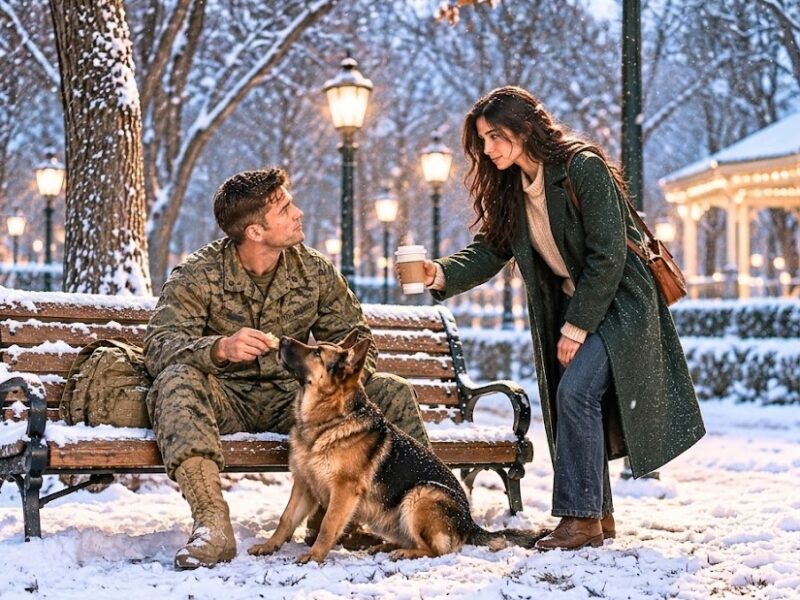
She watched a Marine kneel in the snow and give his last meal to his K9. Then she did something that left him speechless.
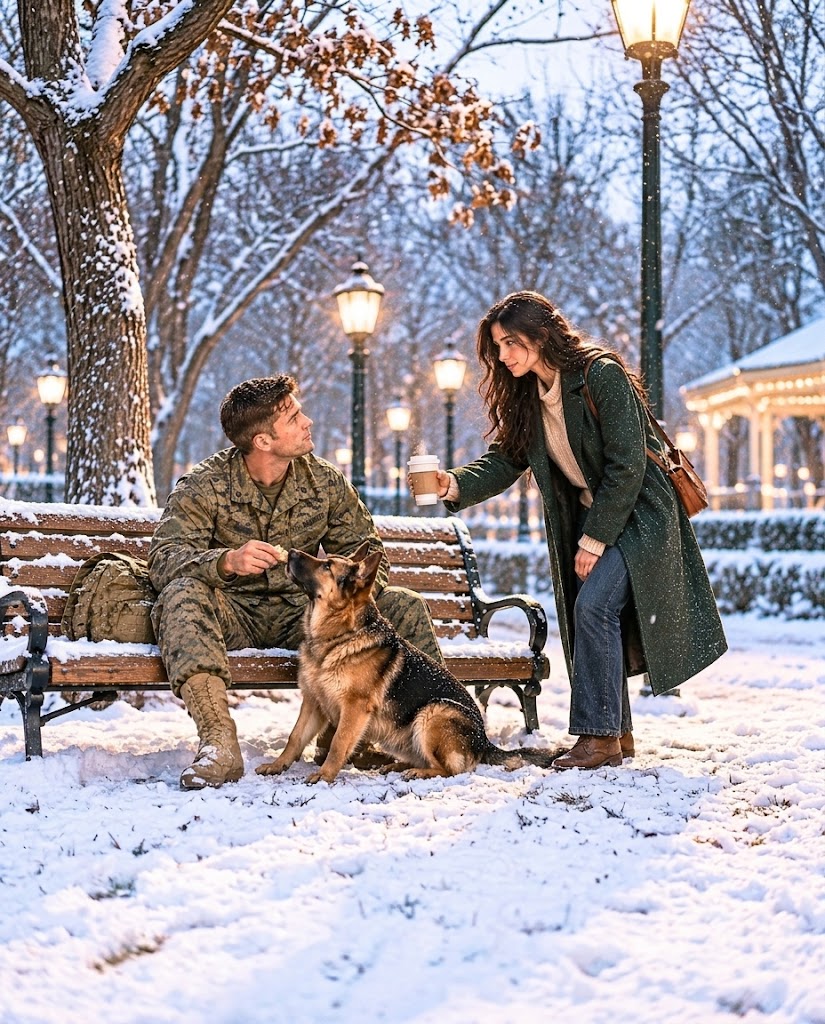
The cold bit through Staff Sergeant Silas Hartwell’s canvas jacket like it had a personal grudge.
He sat on a wooden bench in downtown Boseman, Montana, shoulders hunched, breath fogging in the blue-gray evening air.
Beside his boots lay Orson, a six-year-old black-and-tan German Shepherd with intelligent amber eyes and a pale scar beneath his left ear.
Silas reached into his worn bag and pulled out one small wrapped portion of food.
His stomach ached, but he set it down for the dog anyway.
“Don’t start,” Silas muttered when Orson hesitated.
Only then did the Shepherd eat.
Across the park, Clara Voss noticed the way the man watched his dog.
Not with ownership—with gratitude.
She had just finished her shift at a small bookstore, her gloved hand wrapped around a paper cup of hot coffee.
Twenty yards past them, she stopped.
Nearly three years earlier, her husband Nathan had died on an icy highway.
Since then, Clara had built a functioning life around an empty center.
She turned around.
Silas saw her coming and straightened, eyes assessing her approach.
Clara stopped at the far end of the bench and set the coffee beside him.
“It’s still warm.”
He looked at the cup, then at her. “I’m not asking for anything.”
“I know,” she said, and there was no pity in her voice.
She turned to leave, but Orson rose and stood watching her, ears forward.
Clara slowly turned back.
“Why’d you come back?” Silas asked.
She stared across the snow-covered path. “Because everyone else kept walking.”
A faint, sad smile touched her mouth. “Sometimes people keep walking because stopping hurts more.”
Then she walked away.
Later that night, Silas opened the passenger door of his aging pickup.
Everything he still owned fit behind the seat. The fuel gauge showed enough to leave Boseman before morning.
“Up,” he said.
Orson didn’t move. The Shepherd stood in the snow, staring back toward the park.
Silas followed his gaze toward the distant glow of the park lamps.
For reasons he could not explain, he thought of a woman walking away through the falling cold.
He turned the key. The engine died.
In the sudden silence, Orson finally looked at him.
Tonight, for the first time, Silas stayed.
Morning came clear and brutally cold. By eight, Silas and Orson were back at the same bench.
He told himself Orson needed exercise. The lie lasted until he saw Clara approaching with her work bag and a small paper sack.
She slowed, and for half a second looked almost amused. “You stayed.”
Silas glanced at Orson. “Apparently, I lost the vote.”
She held out the sack—several pieces of plain cooked chicken she had brought for the dog.
“Can he have this?”
Silas checked it, then nodded. “A little.”
Clara crouched, offering Orson one piece from her palm. He accepted it carefully, then sat waiting for the next installment.
Silas shook his head. “Traitor.”
For the first time, Clara smiled without sadness behind it. She offered to buy him breakfast.
“No,” he said, his expression closing immediately.
Clara straightened. “All right.”
The absence of argument surprised him. Most kindness lately had come with questions, advice, or the quiet insistence that strangers knew what he needed better than he did.
Over the next several mornings, their paths crossed again.
Silas never told her everything, but eventually she learned enough.
He had lost his civilian job after one bad moment following too many sleepless nights.
His savings disappeared with humiliating speed. First came late bills, then the apartment went.
Now everything he owned fit inside a pickup parked several blocks away.
He was still a Marine—transferred into the Selected Marine Corps Reserve, still reporting for drill, still wearing the uniform when required.
But between drill weekends, the rest of his life had quietly come apart.
Then one Thursday, Clara mentioned that the bookstore needed temporary help in receiving and storage.
“It pays,” she said.
Silas looked at her. “I assumed jobs usually do.”
“That was me making sure you understood I’m not offering you a favor.”
That earned the faintest movement at one corner of his mouth.
The bookstore occupied an old brick building two blocks from the park.
Its owner, Walter Brener, was a stocky sixty-one-year-old man with thinning silver hair, heavy eyebrows, and square reading glasses that constantly slid down his nose.
His greatest objection was Orson.
“This is a bookstore, not a kennel.”
“He stays in receiving with me,” Silas said evenly. “Not on the sales floor. He’s retired, trained, and he won’t bother anyone.”
Walter studied Orson, who sat motionless beside Silas. “You say that until he eats a first edition.”
“He has standards.”
Walter stared for a beat, uncertain whether the Marine was joking. Clara coughed to hide a laugh.
Walter finally pointed toward the back. “One week, temporary. If the dog causes trouble, he’s out. If you cause trouble, you’re both out.”
“Fair enough.”
Silas started that afternoon. The work was ordinary, physical, and exactly what he needed.
Boxes had destinations. Shelves either stood level or they didn’t. At the end of an hour, he could look behind himself and see something completed.
He arrived early, lifted without complaint, repaired a warped storage rack Walter had intended to replace, and reorganized incoming shipments so the narrow receiving aisle could be walked through again.
Orson remained on a folded blanket near Silas’s work area, calm enough that after three days, Walter stopped checking on him.
A rhythm emerged. Clara would appear through the rear doorway each morning carrying two coffees and leave one on Silas’s worktable without ceremony.
Orson learned the sound of her steps before Silas did.
During breaks, the dog sometimes rested his head on Clara’s knee while she sat on an overturned crate reading inventory sheets.
“You’re spoiling him,” Silas said one morning.
Clara scratched beneath Orson’s jaw. “He’s easier to talk to than you.”
Silas laughed before he could stop himself. It was brief and rusty, almost unfamiliar even to him.
Clara looked up. “What?”
“Nothing. You’re staring.”
“I’ve just never heard you do that.”
“Do what?”
“Sound like you don’t hate being alive.”
The smile disappeared from Silas’s face, but not because he was angry. The words had landed too close to something he had no intention of examining.
Clara seemed to understand. She returned to her paperwork.
That restraint was becoming the thing he trusted most about her.
But Clara noticed things, too.
Silas never sat with his back to the receiving door. A delivery cart banging against a metal frame could make his shoulders lock. If someone entered without announcing themselves, his eyes found their hands before their face.
He recovered quickly each time. So quickly that most people missed it.
Clara didn’t.
The incident happened late Friday afternoon.
Silas was moving cartons when a poorly stacked column shifted behind him. Four heavy boxes struck the concrete almost simultaneously.
The sound cracked through the storage room.
Silas froze. For one sharp instant, his body reacted before thought returned.
Evan Cole, a twenty-two-year-old bookstore employee with a narrow build and curly blond hair, hurried over. “Hey man, you okay?”
Silas didn’t answer. Evan reached him from behind and put a hand on his shoulder.
Silas spun. His hands seized Evan’s wrist. The other caught his forearm. One turn would have driven the younger man against the worktable.
Then Silas saw his face. Not an enemy. A frightened kid in a bookstore.
Silas stopped.
Orson was already moving. The Shepherd stepped firmly between them, pressing against Silas’s leg.
Silas released Evan immediately.
No one spoke. Clara stood in the doorway.
Evan backed away, rubbing his wrist. Silas’s stomach turned.
“You scared him,” Clara said quietly.
“I know.”
“Then apologize.”
Silas looked at Evan. “I’m sorry. You didn’t do anything wrong.”
Evan swallowed. “Okay.”
“No, it wasn’t okay.” Silas forced himself not to look away. “I shouldn’t have grabbed you.”
Walter appeared moments later. He listened to Evan, then Silas, then Clara. His expression hardened.
“One more incident,” he told Silas, “and I can’t keep you here.”
Silas nodded.
“Understood?”
Walter waited, perhaps expecting an excuse. None came.
That evening, Silas stood beside his pickup with the keys in his hand. The old instinct arrived immediately. Leave before Walter changed his mind. Before Evan became afraid of him. Before Clara saw anything worse.
Orson sat beside the truck, watching him.
Silas opened the driver’s door. Then he looked through the bookstore’s rear window.
Inside, the fallen boxes still lay where everyone had left them. One shelving bracket remained unfinished on his workbench.
Silas closed the truck door. He walked back across the lot. Orson followed.
Inside, Walter looked up as Silas entered. “I thought you left.”
Silas removed his coat and reached for the first fallen box. “I wasn’t finished.”
Walter said nothing. Neither did Clara, but from the doorway she watched Silas return to the work he could have abandoned.
The first time, a dog had made him stay in Boseman.
This time, Silas Hartwell stayed because he chose to.
February settled over Boseman in long white mornings and brittle blue evenings, but the worst cold had begun to loosen.
Weeks passed, measured less by storms now than by work shifts, drill weekends, shared coffee, and the steady rhythm of ordinary days.
Nothing about that rhythm cured Silas Hartwell. He still woke some nights with his heart racing before he knew what had frightened him.
He still checked windows without thinking and occasionally went silent when a sound reached somewhere deeper than memory.
But the bookstore gave his day structure, and structure gave him enough ground to stand on.
His wages eventually allowed him to rent a modest furnished room where Orson could sleep beside the bed instead of curled against a pickup seat.
Silas continued reporting for his reserve obligations, keeping his uniform pressed and his difficulties mostly private.
He was functioning again. That wasn’t the same as healing, but it was more than he had possessed a month earlier.
Clara changed, too. Hers was the quieter transformation.
She began waiting for Silas when the bookstore closed. Sometimes they walked Orson through the park where they had first met. Sometimes they said almost nothing.
The silence between them gradually stopped feeling empty.
Two coffees appeared each morning instead of one.
Orson developed the shameless habit of positioning himself beside Clara whenever she sat down, and Silas accused him of abandoning years of loyalty for anyone willing to scratch behind his ears.
“He has excellent judgment,” Clara said.
“He used to,” she laughed.
Silas discovered he liked being responsible for that sound. That realization frightened him enough that he tried not to examine it.
Something was forming between them anyway. Not in declarations, but in small acts of expectation.
Clara knew how Silas took his coffee. Silas learned she rubbed her thumb against the edge of a book when anxious.
She could tell when he needed conversation and, more importantly, when he needed silence.
Yet whenever a moment became too personal, Clara found a reason to move away.
A walk ended early. Her hand withdrew. A question became a joke.
Silas never pushed.
One evening after closing, they stood outside the bookstore while Orson investigated a snowbank.
Clara reached up to adjust her scarf, and the street lamp caught something Silas had somehow failed to properly register before.
A wedding ring.
He stared for half a second too long. Clara lowered her hand.
The next morning, there was still coffee waiting for her on his worktable, but Silas no longer lingered when she arrived. He stopped waiting after closing.
Their conversations became courteous and short.
By the third day, Clara cornered him near receiving. “What happened?”
“Nothing.”
“You’re terrible at nothing.”
Silas continued sorting invoices.
“Silas.”
He finally looked at her. “Does your husband know you’re spending this much time with me?”
Clara went completely still.
Silas immediately understood he had stepped into something much larger than jealousy.
“My husband is dead.”
The words were quiet.
Silas set the invoices down. “Clara—”
“His name was Nathan.”
She looked toward the darkened sales floor instead of at him.
Nathan Voss had been twenty-nine when he died. A lean, warm-faced man with sandy brown hair, hazel eyes, and an easy smile that made strangers comfortable around him.
He had grown up in Montana and carried the patient temperament of someone who rarely needed to be the loudest person in a room.
He and Clara had known each other when they were young, fallen in love before either had learned to be cautious, and married, believing time was something they had plenty of.
Nearly three winters earlier, Nathan had driven home on an icy highway. He never made it.
After the funeral, Clara left his winter coat beside the front door because moving it felt impossible.
Then one week became a month. A month became a year.
His clothes remained in their closet. His favorite mug stayed in the kitchen. The wedding photograph stayed where they had always been.
And the ring stayed on her hand.
“There were people afterward,” Clara said. “Men who asked me to dinner. One who was actually patient enough to ask twice.”
Silas said nothing.
“I always said no.”
“Because you still love him.”
Clara finally met his eyes. “Because I can still love anyone.”
That answer struck harder.
Her voice tightened. “If I couldn’t feel anything, maybe this would be easier. But I can. And every time I start to—” She stopped. “It feels like I’m admitting my life kept going when his didn’t.”
Silas looked at the ring. Clara covered it instinctively with her other hand.
“I’ve thought about taking it off.”
“You don’t have to.”
She frowned.
“Then don’t take it off, Clara. Not until taking it off means you’re ready to live. Not that you’re ready to forget him.”
Clara stared at him.
Silas heard his own words after they were spoken. Ready to live.
Something bitter moved through him. He had spent months carrying names from a deployment as though survival were a debt he could never repay. Men he could not save. Moments he could not undo.
He was telling Clara that continuing to live did not betray the dead while treating his own survival like evidence against him.
The hypocrisy was impossible to miss.
That night, Silas walked Clara home. Orson padded quietly beside them.
At her steps, Clara hesitated as though expecting something.
Silas simply said, “Good night.”
No kiss. No reaching for her hand. He waited until she was inside before leaving.
Clara stood alone in the entryway. Nathan’s dark winter coat still hung from its hook.
She touched its sleeve, then looked at her wedding ring. For a moment, her fingers closed around it.
She left it exactly where it was.
Four days later, after the bookstore closed, Clara found Silas fastening Orson’s collar.
“Do you want coffee?”
Silas looked toward the café down the street. “They’re closing.”
“I know.”
“Then where?”
Clara hesitated. “I have some at home.”
Silas became very still. He didn’t know precisely what the invitation cost her, but he knew enough not to make it heavier.
“All right.”
Clara’s house was small and quiet, with pale walls and a narrow porch half buried in old snow.
At the front door, she paused before unlocking it. Orson entered first. Silas followed.
He understood almost immediately.
A wedding photograph stood on a shelf. Clara, younger, radiant, beside the sandy-haired man she had described.
Nathan’s coat hung beside the door. A pair of men’s gloves remained in a small basket beneath it.
Nothing felt like a shrine. Somehow that made it more intimate. This had simply been a shared life interrupted in the middle.
Silas asked no questions.
He didn’t ask when she would pack the coat away. He didn’t ask whether she still slept on the same side of the bed. He didn’t try to prove there was room for him.
Clara went into the kitchen and reached automatically for two mugs, then stopped. One was dark blue. Nathan’s.
Her hand hovered. Silas saw it and quietly looked away.
Clara chose another mug.
When she returned, Orson settled at her feet. She rested one hand against his neck while Silas sat across from her.
For a long time, neither spoke.
Clara’s wedding ring remained on her finger. Nathan’s photograph remained on the shelf. His coat remained beside the door.
Nothing had been erased.
But as Clara looked at Silas sitting inside the home she had protected from change for nearly three years, she understood that something had changed anyway.
The door was open.
March brought longer afternoons to Boseman. Winter still held the streets beneath dirty banks of snow, but the light lingered later now, exposing patches of pavement that had been hidden for months and suggesting cautiously that seasons could change.
After the night Clara invited Silas into her home, neither of them named what had changed. They didn’t need to.
Some evenings, Silas and Orson walked her home and stayed for coffee.
Other nights, Clara sat beside Silas while he finished work in receiving, reading quietly without demanding conversation.
Silas had begun to possess something he hadn’t realized he missed: a place he wanted to return to.
Clara had gained something more frightening: someone she could lose.
The crash happened on a Tuesday afternoon.
Silas was repairing a loose bracket in the back room when tires screamed outside. Then came the impact.
Metal folded against metal with a violent grinding shriek. Glass exploded. Someone screamed from the sidewalk.
The screwdriver slipped from Silas’s hand.
In receiving months earlier, falling boxes had startled him. His body had reacted before his judgment, but he had still known where he was.
This was different.
The bookstore disappeared.
For several terrible seconds, Silas was somewhere else entirely. Heat where there was cold. Dust where there should have been snow. A broken vehicle shouting. A voice he remembered but had spent months trying not to hear.
His breathing turned shallow. His eyes stopped seeing the room.
Evan came through the doorway, pale from what he had witnessed outside. “Silas.”
Silas turned toward him. Something in his expression made Evan stop.
“Hey, it’s me.”
Silas didn’t hear him. His body shifted, weight settling instinctively, hands ready for a threat that did not exist.
Then Orson moved.
The German Shepherd crossed the room quickly and pressed the full length of his body against Silas’s leg.
Silas moved away once. Orson followed and pressed harder, maintaining contact.
Clara appeared behind Evan. She saw Silas’s face and stopped herself before reaching for him.
“Look at him.”
Nothing.
“Silas, look at Orson.”
Orson pushed his shoulder against Silas’s knee. Silas’s eyes dropped. There—black and tan fur, a familiar scar beneath one ear.
“Orson, now look at me.”
His gaze rose. Clara stood several feet away, hands visible, voice steady despite the fear in her face.
“Boseman.”
Silas swallowed.
“Bookstore.”
His breathing caught.
“You’re here.”
The room returned piece by piece. Shelves. Boxes. Clara. Evan. Orson against his leg.
Silas stepped backward and leaned against the worktable.
Outside, sirens approached. No one touched him. That mercy almost broke him.
Silas left early.
By evening, shame had rewritten the event into something worse than it had been. He no longer remembered that he had returned to the present. He remembered only the seconds when he had left it.
He sat alone in his rented room while Orson watched from the floor.
What if it happened during drill? What if someone approached at the wrong moment? What if next time Orson wasn’t there?
For the first time, Silas allowed himself to consider leaving the reserve.
No commanding officer had threatened him. No Marine had questioned his place. The judgment came entirely from inside him.
Maybe a man who could lose Boseman inside a bookstore no longer deserved to stand beside other Marines.
Then he thought of Clara. Her open front door. Nathan’s photograph. The trust it had cost her to let him inside.
And Silas became afraid of what would happen if she trusted him more.
By nightfall, his bag was packed. He carried it to the pickup and opened the passenger door.
“Up.”
Orson remained on the pavement.
Silas closed his eyes. “Not tonight.”
Orson didn’t move.
“Get in the truck.”
The dog stared at him.
“You don’t get to do this every time.”
“He probably thinks he does.”
Silas turned. Clara stood at the edge of the parking lot, coat pulled tight around her. Her face was pale with cold and anger.
“How did you know?”
“Walter told me you left. I went to your room.”
Silas looked away. Clara saw the bag.
“So that’s it.”
“You should go home.”
“No.”
“Clara, you don’t get to decide when I walk away.”
His jaw tightened. “You saw what happened.”
“I did.”
“I didn’t know where I was.”
“And then you came back.”
“What if I don’t next time?”
“We deal with next time when it exists.”
Silas laughed once without humor. “You don’t understand.”
“Then explain it.”
He looked at her, and everything he had spent weeks refusing to name finally became impossible to hide.
“I love you.”
Clara stopped breathing for a moment.
Silas’s voice lowered. “That’s why I have to go.”
Her eyes filled, but she didn’t look away.
“You already buried one man you loved.” He forced himself to finish. “I’m not going to make you survive another one.”
The words struck Clara harder than anger could have.
“Nathan died.”
Silas said nothing.
“I didn’t.” Her voice broke. “But I’ve been living like I did.”
Silas stared at her.
“For almost three years, I thought if I didn’t love anything enough, nothing could be taken from me again. I thought that was surviving.”
She wiped angrily at a tear. “It wasn’t. It was just losing everything early.”
“Clara, I can’t promise you won’t hurt me. I can’t promise you won’t die before I do. I couldn’t promise Nathan that either.”
She stepped closer but did not touch him. “I’m done losing people before they’re even gone.”
Silas looked at Clara, then at Orson. The Shepherd remained beside the open passenger door, refusing to move.
Silas’s hand tightened around the bag.
For months, leaving had felt like control. If he disappeared first, no one could reject him. If he kept moving, no one could discover how badly he was struggling. If he loved no one, perhaps no one would have to pay for loving him.
But Clara was standing in front of him, refusing the protection he had never been asked to provide.
Slowly, Silas lowered the bag. It touched the pavement.
Orson sat down.
Silas almost laughed. Clara did, through tears.
The next morning, Silas did not drive out of Boseman.
He did not skip his reserve responsibilities, and he made no decision about leaving the Marine Corps while shame was making decisions for him.
Instead, sitting in his truck with Orson beside him, Silas made a call he had postponed for months.
He asked for professional help.
The words were harder than he expected. He told the truth about the sleepless nights, the hypervigilance, the memories, the bookstore, the moments when the past stopped feeling like the past.
For once, Silas did not measure himself by how much pain he could hide.
He answered every question without minimizing it, even when admitting the truth made his hands tighten around the phone.
Somewhere between one answer and the next, he realized asking for help had required more courage than disappearing ever had.
When the call ended, nothing around him had magically changed. He was still afraid. Nathan was still dead. Clara still carried grief. Silas still carried his own.
Orson rested his head against Silas’s arm.
Clara had not saved him. Neither had the dog.
They had simply given Silas something he had almost forgotten a man could possess while hurting: a reason to believe his life was still worth fighting for.
By late spring, Boseman had finally left the worst of winter behind.
Snow survived only in thin white traces high along the distant mountains, while downtown trees carried new leaves and morning sunlight warmed sidewalks that winter had once made nearly empty.
Staff Sergeant Silas Hartwell was still a Marine.
On drill weekends, he still buttoned his uniform, checked himself in the mirror, and reported to his Selected Marine Corps Reserve unit.
The difference was no longer visible in the uniform. It was in the man wearing it.
Silas had not become who he had been before deployment. He had stopped believing that was the goal.
Professional treatment had given names to reactions he had once understood only as personal failures.
He had learned grounding techniques, learned to recognize when his body was responding to memory instead of present danger, and—more difficult than either—learned to tell someone when he was struggling.
Some nights were still bad. Sometimes a sharp metallic sound tightened his shoulders before reason caught up.
Healing had not removed the past. It had begun teaching Silas that the past did not deserve command of every moment that followed it.
He still worked at the bookstore. What had begun as temporary labor had become steady employment after Walter discovered that Silas could repair almost anything in the building and organized receiving better than anyone he had hired in years.
The wages were modest but dependable. Silas had moved from his rented room into a small apartment with enough space for a proper bed, a narrow kitchen table, and an oversized dog bed Orson ignored whenever the couch was available.
The old pickup remained. Silas could afford to replace it eventually. He simply wasn’t ready to.
One Saturday morning, Clara stood in his apartment while Silas prepared for drill.
Orson sat beside her, watching Silas with the solemn attention he usually reserved for food.
Silas finished fastening his uniform and looked toward the mirror.
There had been a time when wearing it had made him afraid of being discovered. As though every Marine around him might somehow see the sleepless nights, the flashbacks, the uncertainty, and decide he no longer belonged.
Now he saw something different. Not a healed man. A man doing the work.
Clara stepped closer and straightened the edge of his collar. “You okay?”
Months earlier, Silas would have answered yes before she finished asking. This time he considered it.
“Getting there.”
Clara smiled. “So am I.”
She was. Her progress looked different from his.
Over the months, Clara had begun changing the house in small, almost invisible ways.
Some of Nathan’s clothes were folded carefully into memory boxes instead of hanging untouched in the closet. A few ordinary belongings had been donated.
The important photographs remained. His dark winter coat still hung beside the front door.
Some evenings Clara talked about him. Sometimes she laughed. Sometimes she cried.
The first time tears came while Silas was beside her, she apologized. He had looked genuinely confused. “For what?”
Clara couldn’t answer.
Silas never asked her to love Nathan less. He never treated a dead man as competition.
Gradually, Clara understood something she had once believed impossible.
Making room for Silas did not require emptying the place Nathan had occupied.
Love did not have to replace love.
A week later, Silas and Orson arrived at Clara’s house to take her to breakfast.
Silas waited outside while Orson investigated the spring grass beside the porch.
Inside, Clara stood in the living room. Morning light fell across the wedding photograph on the shelf.
Nathan was smiling in it. So was she.
For a long moment, Clara studied the woman she had been that day. She did not feel embarrassed by her anymore. She did not pity her for believing she had decades ahead. She simply remembered how completely that younger woman had loved.
Clara lowered her eyes to her left hand. The ring was still there.
She touched it with her thumb.
Nearly three years earlier, removing it had felt like abandoning Nathan somewhere he could not follow. Later, keeping it had become less about marriage and more about refusing to cross a line she could never uncross.
Now Clara understood what Silas had meant. Not ready to forget. Ready to live.
Slowly, she pulled the ring from her finger.
Her hand looked unfamiliar without it. For several seconds, grief rose so suddenly that Clara pressed the ring into her palm.
“I loved you,” she whispered.
The room gave no answer. It didn’t need to.
Clara opened a small wooden box beside the wedding photograph and placed the ring inside.
She did not hide the box in a drawer. She left it there beside Nathan’s picture—a part of her life, not all of it.
At the door, Clara reached for her coat and stopped.
Nathan’s winter coat still hung beside it. She touched the worn sleeve.
Once that coat had been evidence that she could keep the past unchanged if she refused to move anything.
Now it was simply his coat.
Clara left it hanging.
Then she opened the door.
Silas stood near the pickup, hands relaxed at his sides. He looked up as she stepped onto the porch.
His eyes dropped briefly to her left hand. He noticed. Clara knew he noticed.
Silas asked nothing. That kindness mattered more than any question could have.
Orson saw her and came running across the yard. The six-year-old German Shepherd had begun showing the first faint silver around his muzzle now, though nothing about his enthusiasm suggested retirement.
Clara crouched as he reached her, wrapping both arms around his neck. “You’re ridiculous,” she murmured.
Orson leaned his entire weight against her.
Silas smiled. “You created this problem.”
“I remember someone accusing me of that.”
“You denied it.”
“I was wrong.”
“That should probably be written down.”
Clara laughed and stood.
For a moment, the three of them remained there beneath a clear Montana morning.
Silas remembered a winter night in a park. One portion of food. An empty stomach. A warm cup sitting between two strangers.
Clara remembered walking past him.
Orson apparently remembered only that breakfast had been mentioned.
Silas opened the passenger door but then looked at Clara. “Where do you want to go?”
She glanced toward the street. For nearly three years, not knowing what came next had terrified her. Now the uncertainty felt almost like freedom.
“I don’t know.”
Silas smiled.
Clara took his hand.
“Good.”
Neither moved toward the truck. Instead, Clara started down the sidewalk, and Silas went with her.
Orson trotted between them for several steps before moving ahead, nose lowered eagerly toward the spring grass.
Nathan remained part of Clara’s life. The people Silas had lost remained part of his. And Orson carried a history neither of them could see completely in the old scars beneath his fur.
None of them had escaped the past. They had simply stopped mistaking survival for standing still.
Silas tightened his hand gently around Clara’s.
Ahead of them, Orson kept walking.
This time, they followed.
Sometimes miracles do not arrive with thunder, bright lights, or answers to every prayer.
Sometimes they arrive quietly—a warm cup of coffee on a freezing night, a faithful dog refusing to leave, or a stranger who chooses to turn around when everyone else keeps walking.
Silas, Clara, and Orson remind us that healing does not mean forgetting the people we have lost or becoming the person we used to be.
It means finding the courage to carry our scars without letting them decide where our lives must end.
In our own lives, we may never know when a small act of kindness becomes the miracle someone desperately needed that day.
So be gentle. Stop when others keep walking. Listen when someone is hurting.
And when life gives you a reason to stay, have the courage to stay.









