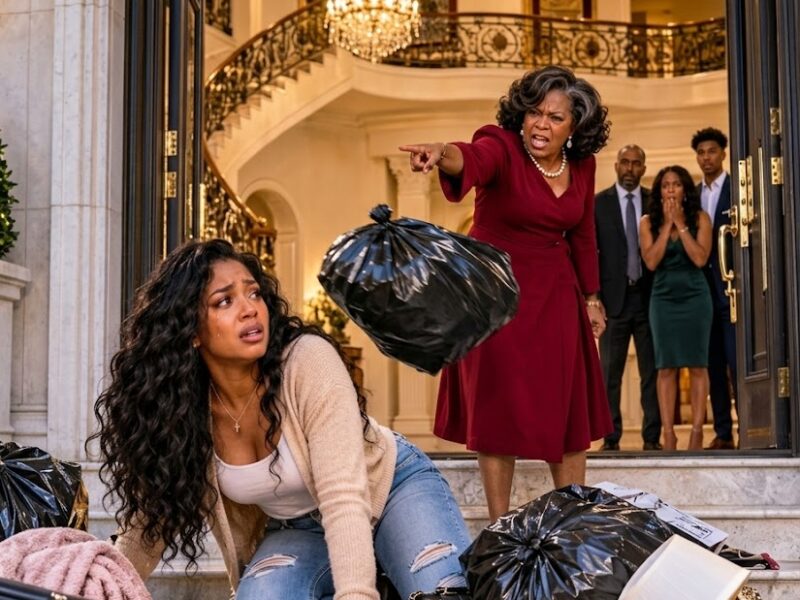
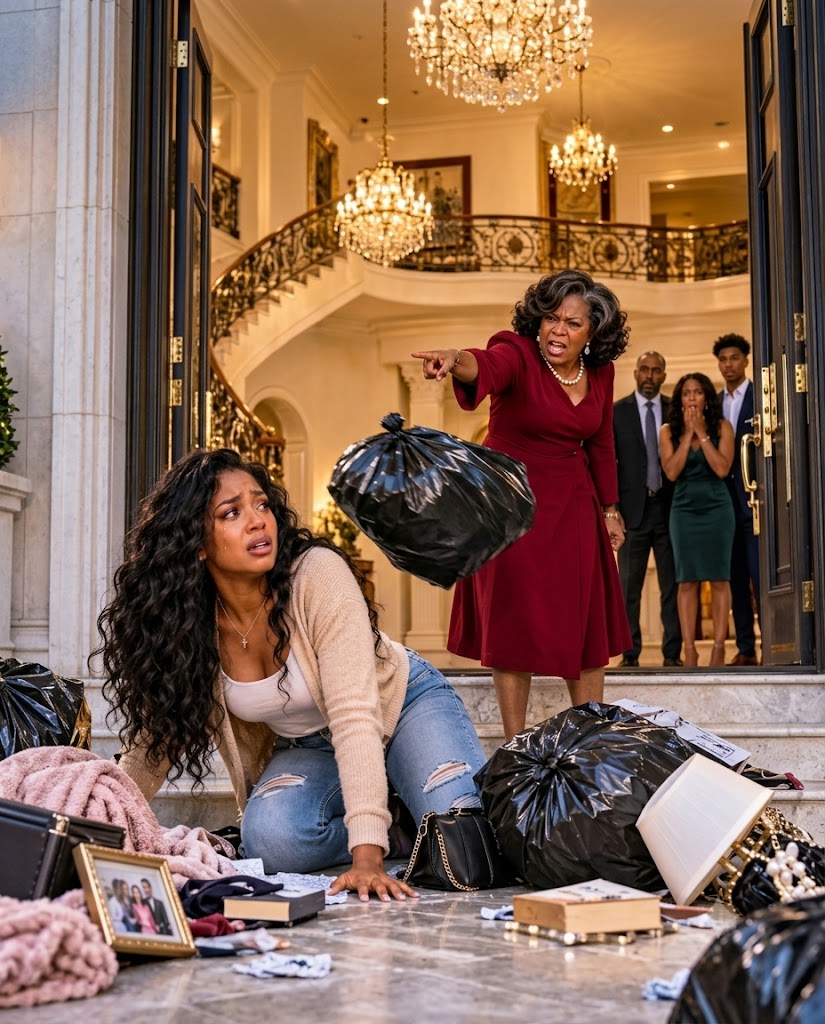
She threw me out with trash bags when I was 16. Years later, at my wedding, she stood up and called herself my “loving mother.” Then I took the microphone.
The rain tapped against the bay windows like fingers asking to be let in, and I can still smell the lemon polish on the hardwood floors of that house outside Savannah.
I was seventeen when my stepmother, Celeste, decided I no longer lived there.
She didn’t yell—that would have been easier. She spoke in the calm, elegant voice she used at charity luncheons, the voice that made people believe she was incapable of cruelty.
“I’ve decided this household needs stability,” she said, standing beside the fireplace with one hand resting on the mantle. “And you are not part of that stability anymore.”
Her children, Julian and Amara, were sprawled across the sectional behind her, pretending to watch television. Julian was fourteen. Amara was twelve. Both had already learned that the safest way to stay on their mother’s good side was to treat me like I was contaminated.
Julian smirked into his phone. Amara kept eating chocolate-covered almonds from a silver dish without looking at me.
“This is my home, too,” I said.
My voice sounded embarrassingly small.
—
My father had been stationed in South Korea for nearly five months. He was an Army logistics officer and had left believing Celeste and I were finally getting along.
She had spent the two years since marrying him carefully performing patience whenever he was home.
The second he deployed, everything changed.
“Your father owns the house,” Celeste replied. “That doesn’t mean you’re entitled to disrupt everyone living in it.”
“I haven’t done anything.”
“You exist in a constant state of resentment. You make the younger children uncomfortable. You reject my authority. And frankly, I’m tired of pretending we’re one happy family.”
She pointed toward the mudroom.
“Your bags are there.”
—
I stared at her because my brain refused to understand the sentence.
She had packed my life into four black contractor bags—my jeans, school uniforms, toiletries, a handful of books, my mother’s old knitted scarf, my sketchbook, everything Celeste considered mine enough to throw away.
Everything valuable had been left behind.
The pearl earrings my mother had wanted me to wear at graduation were missing. So was the cedar box containing her letters. My grandmother’s gold bracelet was gone, too.
“I want Mom’s things,” I said. “They’re family property. They’re mine.”
Celeste glanced at the wall clock.
“You have forty-five minutes before I call security and tell them an unstable teenager is refusing to leave my property.”
I remember looking at Julian and Amara. Neither defended me. Neither even looked surprised.
That was when I understood this had been discussed before I entered the room.
—
I spent my first night parked behind a self-service laundromat off Highway 80 because it stayed open twenty-four hours and the owner never checked the back lot.
I curled across the rear seat of my eleven-year-old Toyota Corolla with my backpack under my head and cried so quietly that nobody walking past could hear me.
Four trash bags suddenly represented my entire life.
I used the laundromat bathroom to wash my face before school. I changed clothes in a stall. I charged my phone beside a vending machine. At night, I did homework under the yellow parking lot lights because my car battery couldn’t handle keeping the interior lamp on for hours.
The next morning, a woman named Mrs. Evelyn found me asleep with my forehead against a folding table.
She managed the laundromat on weekdays and had silver braids, reading glasses on a chain, and the kind of expression that made lying feel disrespectful.
“You waiting on somebody, sweetheart?”
“Yes, ma’am. Since last night.”
I looked away.
She didn’t ask another question. Instead, she unlocked the employee room and handed me half of a turkey biscuit wrapped in foil.
“Eat.”
“I’m not hungry.”
“That wasn’t a question.”
—
That biscuit was the first thing I ate after Celeste threw me out.
Mrs. Evelyn never forced me to explain everything. She simply began leaving the back office unlocked on cold nights and pretending she didn’t notice when my school books appeared on the desk after midnight.
My routine became almost mechanical. Wake up before dawn. Wash in the laundromat bathroom. Drive to school. Pretend I had gone home the night before. Work after class. Eat whatever I could afford. Sleep somewhere nobody would notice me.
My guidance counselor, Dr. Perez, knew something was wrong. Teachers kept asking why I was exhausted and why I had stopped bringing lunch, but I was terrified of child services contacting my father through official channels.
Celeste had already shown me how far she would go.
She kept me on the family phone plan, which seemed generous until I realized it gave her access to call records. The first week after I left, she texted me only once.
*Don’t embarrass your father with unnecessary drama. He has enough pressure overseas.*
Meanwhile, her social media looked like a luxury family catalog. Weekend brunches, beach trips, new furniture, matching Christmas pajamas.
One photograph showed Celeste between Julian and Amara beneath the caption: *My whole heart in one picture.*
I stared at it from the break room of a supermarket where I had started bagging groceries.
Apparently, her whole heart had exactly two children in it.
—
By the end of junior year, I was working thirty-five hours a week.
I stocked shelves before school twice a week, worked afternoons at a frozen yogurt shop, and spent Saturdays cleaning vacation rentals near Tybee Island. My fingers were constantly dry from disinfectant. My shoulders hurt from carrying laundry bags.
I learned which convenience stores discounted sandwiches after midnight. I could make twenty dollars last five days if nothing unexpected happened.
The most humiliating part was listening to classmates talk about ordinary teenage inconveniences.
“My dad won’t let me upgrade my phone until Christmas.”
“My mom says I can only spend five hundred dollars on homecoming.”
“My parents are forcing me to drive my sister’s old Lexus.”
I would sit there wearing thrift store sneakers held together at the sole with superglue and wonder what it felt like to have problems that didn’t threaten your survival.
So I turned school into war.
Every A was proof Celeste hadn’t destroyed me. Every scholarship application was another brick in the bridge I was building out of her reach.
She had once told me during one of her quieter attacks that girls from unstable backgrounds usually repeated their mothers’ failures.
That sentence stayed with me because my mother, Renee, had not failed anyone.
She had been a respiratory therapist. She died from complications after an aggressive autoimmune illness when I was thirteen.
—
For nearly a year after her funeral, my father barely functioned outside work.
Then he met Celeste at a military family support fundraiser. She was warm, organized, beautiful, and extraordinarily good at making damaged people feel rescued.
I still blamed myself for not realizing sooner that rescuing vulnerable men might have been her specialty.
“You could get out of Georgia with this essay,” my literature teacher, Mrs. Kolahan, told me one afternoon.
She had been helping me apply to universities. My personal statement was about displacement, although I carefully avoided saying exactly where I slept.
“You’ve been accepted to Northwestern,” she said, smiling so hard her eyes filled with tears. “And they’re offering you a full financial aid package.”
I read the letter three times. Tuition, housing, meal plan, books.
For the first time since Celeste pointed at that door, survival was not going to depend on whether my car started.
That same week, Julian posted a photo posing beside a brand-new Mercedes his mother had given him for his fifteenth birthday.
I laughed when I saw it. Not because it was funny—because sometimes your body does strange things when the alternative is screaming.
—
Chicago felt like another planet.
My dorm room was tiny. My winter coat came from a church donation bin. I still worked twenty hours a week at the student recreation center.
But I had a bed. A real bed. A door that locked. Hot showers. Meals I didn’t have to calculate by the dollar.
My roommate, Claire, came from Connecticut and treated three-hundred-dollar boots like basic necessities.
“You never come anywhere,” she complained one Friday while getting ready for a party. “Just ask your dad for spending money.”
I stared at the sociology textbook in my lap.
How could I explain that my father was sending money—just not to me?
He had always transferred part of his military pay into the household account with instructions that my expenses be covered. Celeste had simply kept it.
At least that was what I later learned.
At the time, all I knew was that every attempt to reach him disappeared. Emails went unanswered. Messages sent through relatives somehow came back with responses that didn’t sound like him.
I called an administrative office and asked how to send a private letter to a deployed service member.
Two days later, Celeste texted me.
*Stop trying to create problems.*
Then another message appeared.
*He is finally doing well. If you love your father, leave him alone.*
I hated myself for obeying. But when you spend years being told your existence causes pain, part of you begins wondering whether disappearing might actually be an act of love.
—
College did give me one thing I hadn’t expected.
Malcolm Reed.
We met during an economics discussion section because he borrowed a pen and forgot to return it. He was tall, soft-spoken, endlessly observant, and the kind of person who remembered what everyone ordered after hearing it once.
At first, we were simply study partners. Then he started bringing two sandwiches to the library.
“I accidentally ordered an extra,” he said every Thursday for six months.
He never embarrassed me by admitting he knew I was hungry. That mattered more than he understood.
Celeste’s online life flourished during those same years. She launched a lifestyle page called *Building Brilliant Families*. Within two years, she had thousands of followers.
She posted advice about blended families, discipline, emotional safety, and loving children through difficult transitions.
Her profile description said: *Proud mother of three.*
Three.
Every time I saw it, something inside me twisted.
During my sophomore year, she posted a long article about helping stepchildren heal after losing a parent. She included an old photograph of me.
I nearly vomited.
—
Then during my senior year, everything changed.
I was studying alone in a campus building one snowy evening when my phone rang. Unknown number. International routing code.
I almost ignored it. Then I answered.
“Nia? Baby, is that you?”
My father.
His voice was rougher than I remembered.
“Dad.”
There was silence on the line. Then I heard him crying.
I walked straight out of the building into freezing wind without grabbing my coat.
“Where have you been?” he asked. “I’ve been trying to get your new number for months.”
My knees nearly gave out.
“My new number?”
“Celeste said you changed numbers when you transferred schools.”
“I never transferred.”
Another silence. Then he said something I will never forget.
“What?”
He had returned to the United States after injuring his shoulder during a vehicle accident at a base in Germany. He was recovering at a military medical center in Virginia and had finally borrowed another officer’s phone after realizing Celeste kept making excuses about why I couldn’t speak.
“She said you were doing internships,” he told me. “She said you spent last summer in Boston.”
I closed my eyes.
Last summer I had cleaned hotel rooms six mornings a week.
“Dad, there’s something you need to know.”
Before I could continue, I heard Celeste in the background. Then her voice came through the phone, bright and honey-sweet.
“Nia, darling, what a surprise!”
My entire body went cold.
“Your father has been so eager to catch up,” she continued. “I was telling him how busy you’ve been.”
I said nothing.
“Why don’t you visit us next weekend? We can all sit down together like adults.”
The warning was obvious. She wanted control of the conversation.
After the call ended, I sat on the concrete steps outside the economics building while snow gathered in my hair.
Four years.
She hadn’t merely thrown me out. She had rewritten my entire life for my father. She had invented schools, vacations, internships, friends, even photographs.
She had made him believe I was thriving without him while convincing me he had chosen not to care.
—
Malcolm found me there twenty minutes later.
He took off his coat and wrapped it around my shoulders.
“Who called?”
“My dad.”
“That sounds like it should be good.”
“It might be.” I looked at him through tears that were beginning to freeze on my cheeks. “But first, I think I have to destroy a lie that’s been growing for four years.”
I spent the next week collecting everything.
Lease records from a room I had rented briefly after turning eighteen. Pay stubs. School correspondence. Photographs from the laundromat. Messages from Celeste. Screenshots of her public posts.
Statements showing deposits my father had labeled for my tuition, clothing, school expenses, and transportation.
I even contacted Mrs. Evelyn, who wrote a signed statement describing how she had found me sleeping behind the laundromat at seventeen.
I put everything inside a blue accordion folder.
Then I flew to Virginia.
—
My father looked smaller than the man I remembered.
Colonel Andre Bennett had always seemed indestructible to me. Now he sat in a rehabilitation room with gray at his temples, one arm supported by a brace, and exhaustion carved into his face.
But when I entered, his expression changed instantly.
“There she is.”
He opened his good arm.
For a few seconds, I became thirteen again. I ran to him. He held me so tightly I could barely breathe.
“My girl,” he whispered. “Look at you.”
Then he pulled back and smiled.
“Celeste said you were thinking about law school.”
I stared at him. I had never mentioned law school.
“I’m applying to graduate programs in social work.”
His smile faded. “Oh.”
I placed the blue folder on the bed.
“Dad, we need to speak alone.”
Celeste was sitting by the window. She immediately stood.
“Andre’s exhausted.”
“I need five minutes.”
“This isn’t the time for whatever emotional grievance—”
“Celeste.”
My father’s voice changed. I remembered that tone from childhood. The officer. The commander. The man who expected to be obeyed.
“Please leave us.”
She froze, then smiled. “Of course.”
But she looked at me before walking out. And for the first time in years, I saw fear.
—
I opened the folder.
“Don’t interrupt me until you’ve read everything.”
My father started with the financial statements, then the photographs, then Celeste’s texts. His hands began shaking around page six. By page twelve, his face had drained of color.
By the time he reached Mrs. Evelyn’s statement, he was crying. Not quietly. He covered his mouth with his hand like the sound horrified him.
“She told me you wanted independence,” he whispered.
I didn’t answer.
“She said you were living with classmates during high school because their house was closer to some academic program.”
“I was sleeping in my car.”
He looked up sharply. “What?”
“She threw me out at seventeen.”
His eyes moved to the photograph clipped inside the folder. My Corolla behind the laundromat, blankets visible through the rear window.
“She said only her children deserved peace in the house.”
He stared at me for a long time.
“I sent money. Every month. I sent money for you.”
“I know.”
“I never—” He bent forward as if someone had struck him in the chest. “Oh, God.”
I wanted to hate him in that moment. Part of me had rehearsed hating him for years. But watching him break made that impossible.
He had failed me. But he had also been deceived by someone who understood exactly where his grief made him weak.
—
Twenty minutes later, Celeste returned.
She walked in carrying coffee and froze. The evidence covered my father’s bed. Photos, bank statements, her own words.
Andre sat perfectly still.
“Sit down,” he said.
She smiled nervously. “What’s going on?”
” Sit down.”
She did.
My father lifted a printed screenshot.
“You told my daughter to sleep in her car rather than infect this family with her bitterness.”
Celeste swallowed. “I can explain the context.”
“Explain it.”
“Andre—”
“Explain those words.”
“She was extremely hostile after Renee died.”
I felt my fingers curl.
“She was a child.”
“You weren’t home. You have no idea what I dealt with.”
“I know what you dealt with now.” His voice remained terrifyingly calm. “A grieving seventeen-year-old.”
Celeste’s eyes filled with tears on command. “I tried everything.”
“You stole the money I sent for her.”
“I used household funds for household expenses.”
“You told me she was attending summer programs that never existed.”
“I was protecting you.”
“You blocked her communication with me.”
“You were deployed. You were under pressure.”
“You forged emails.”
That was the first moment her performance cracked. Only slightly. But I saw it. Dad saw it, too.
“What kind of woman manufactures messages from a child to her father?”
“Andre, please.”
“What kind of woman photographs herself preaching about blended family love after forcing that child to live behind a laundromat?”
“She hated me from the beginning.”
His hand slammed against the bedside table. “She was seventeen.”
Celeste flinched. So did I. My father rarely raised his voice.
“Get out.”
Her face changed. “Andre—”
“Get out of this room.”
“You’re injured. You’re emotional. She’s manipulating you.”
He stood despite the brace. “Nia is my daughter.”
“I’m your wife.”
“For now.”
That sentence landed harder than shouting would have.
—
Celeste stared at him, then at me. Her expression became something ugly.
“This is what you wanted, isn’t it?”
I said nothing.
“You’ve spent years trying to punish me because your father moved on.”
My father stepped between us.
“No.” His voice was suddenly quiet. “You don’t get to do that anymore.”
Celeste’s mouth tightened.
Julian and Amara were waiting outside. Both were adults by then. They watched hospital security escort their mother down the corridor. Neither spoke to me.
But Julian’s face told me something important. He had known more than he ever admitted.
My father filed for divorce within a month. It was not elegant. Celeste fought everything—the house, accounts, personal property. She claimed I had fabricated evidence out of jealousy.
Then my father’s attorney produced years of financial transfers and metadata from emails she had altered.
After that, negotiations became much less dramatic.
A portion of the settlement reimbursed money that had been intended for my support. Dad insisted on giving it directly to me.
The amount was more than forty thousand dollars.
I stared at the cashier’s check.
“I don’t want this to become the apology.”
“It isn’t.” His eyes filled. “There isn’t enough money in the world to buy back what I missed.”
I put the check down and hugged him.
“I wanted you to believe me.”
“I do.”
“No, I mean back then.”
His face crumpled.
—
That was the beginning of our real reconciliation.
Not some perfect movie reunion. We had arguments, long silences, therapy sessions, questions that neither of us liked answering.
I told him how abandoned I had felt. He admitted that after Mom died, he had rushed into another marriage because the silence in our house terrified him.
“I thought I was giving you a family again,” he said once.
“You gave someone else control of ours.”
I know that honesty helped more than excuses would have.
I graduated with honors and entered a master’s program in clinical social work.
Malcolm stayed beside me.
What started as friendship slowly became something steadier. He had dreams of his own that I hadn’t fully understood when we met. He studied economics because his parents expected something respectable.
But what he loved was filmmaking.
During senior year, he auditioned for an independent drama being shot in Chicago. He got a supporting role, then another. Then a streaming series cast him as the younger brother of a famous political family.
The show became a surprise hit.
Suddenly, Malcolm Reed—the guy who used to accidentally order extra sandwiches for me—had fan accounts. He did interviews, magazine shoots, festival premieres. Women screamed his name outside hotels.
I found the whole thing absurd.
“So, apparently you’re one of the internet’s favorite fictional husbands,” I told him while showing him a headline.
He groaned. “Please don’t read comments.”
“They’ve ranked your forearms.”
“I’m begging you.”
Success never made him cruel. That was what mattered.
He still called Mrs. Evelyn on her birthday because she had become important to me. He still drove my dad to physical therapy when I was busy. He still knew exactly when I was pretending to be fine.
—
Three years after college, he proposed.
Not on a red carpet. Not in Paris. Not during some publicity stunt.
He proposed in our apartment while I was heating canned tomato soup. I had eaten so much cheap soup while homeless that I avoided it for years, then eventually reclaimed it as comfort food.
Malcolm walked into the kitchen carrying a tiny velvet box.
“Nia Bennett.”
I laughed. “Why are you saying my whole name?”
“Because I’m nervous.”
Then he dropped to one knee.
The ring contained a small emerald set between two diamonds. The emerald had come from my grandmother’s bracelet—the jewelry Dad had recovered after Celeste withheld it during the divorce.
Malcolm had asked permission to reset the stone.
“You survived people teaching you that love leaves,” he said. “I want to spend the rest of my life showing you that it doesn’t have to.”
I didn’t even let him finish properly.
“Yes.”
—
Wedding planning became complicated almost immediately.
Malcolm was famous enough that every detail created gossip. His management team suggested a sponsored destination wedding. We said no. A magazine offered an absurd amount for exclusive photographs. We said no.
We wanted something small. Friends, family, people who had actually been part of our lives.
One night while we were reviewing invitations, Malcolm looked at me.
“What about Celeste’s kids?”
“No. Not even Amara.”
I shook my head.
“I wish them well, but they watched what happened and never reached out afterward.”
He nodded. “And Celeste?”
I looked at him.
He raised both hands. “Just confirming.”
I had not spoken directly to her in almost six years.
Dad occasionally heard updates. Celeste had remarried quickly after the divorce. Her new husband, Graham Lyle, was a wealthy defense consultant who apparently believed every version of her past.
She told him she had also rebuilt her social media brand.
That should have been irrelevant.
Then my friend Simone called me.
“You need to look at Celeste’s page.”
“I would rather eat drywall.”
“I’m serious.”
She sent a screenshot.
Celeste had posted a photograph from one of Malcolm’s premieres. Not a photograph she took—a press photograph of Malcolm and me.
The caption read: *So proud watching our girl step into this beautiful new chapter. From the shy teenager at our kitchen table to the remarkable woman she is today, motherhood has been my greatest privilege.*
I read it twice. Then again.
*Our girl.*
Simone sent another. Then another.
For months, Celeste had been sharing articles about Malcolm. She called me her daughter. She wrote that she had always encouraged my education. She described herself as thrilled to welcome Malcolm into the family.
In one comment, someone asked whether she helped me survive the early days of Malcolm’s acting career.
Celeste answered: *Those two always had my full support.*
I actually laughed. It was either that or throw my phone.
Then Simone sent the worst one.
An old picture of me at seventeen, taken at a church fundraiser three weeks before Celeste threw me out. I was standing beside her in a yellow dress, visibly uncomfortable.
Her new caption read: *My beautiful Nia. We have walked through so much together. Can’t wait to celebrate your wedding soon.*
“She’s telling people she’s invited,” Simone said. “She isn’t. She’s also calling herself Malcolm’s future mother-in-law.”
I felt physically ill.
—
Then things became stranger.
Our coordinator received a call from a woman claiming to be the bride’s mother asking for the venue address. A florist received another call asking about security. Someone contacted Malcolm’s publicist requesting family seating information.
Every time, the caller identified herself as Celeste Lyle.
That was when we realized she wasn’t just rewriting history online. She intended to physically insert herself into the wedding.
Malcolm’s cousin Adrian happened to be hosting an engagement celebration three days before our ceremony. It would be held at a private estate outside Atlanta. Many of Malcolm’s friends, relatives, producers, managers, and industry colleagues would attend both events.
Celeste apparently discovered that through social media.
“We should send security her picture,” I said.
Malcolm leaned back on the sofa. “We can.” Then he looked at me. “Or we can stop protecting her from consequences.”
I understood exactly what he meant.
—
Adrian’s engagement party looked like something from a film.
Outdoor chandeliers hung from ancient oak trees. A jazz quartet played beside the terrace. Nearly two hundred guests moved between gardens and candlelit tables. Actors, attorneys, doctors, producers, family, friends.
I wore a dark green silk dress and kept my hair in a simple braided updo. For once, I felt peaceful.
Then Simone grabbed my arm.
“Nia.”
I followed her stare.
Celeste had arrived.
She wore a silver gown with a dramatic train and enough jewelry to attract light from across the lawn. Graham was beside her. Julian and Amara followed. All four had somehow gotten through the front entrance during a rush of guests.
My stomach dropped.
Malcolm came up behind me. “That’s her?”
I nodded.
Celeste moved through the party like she had rehearsed it. Within ten minutes, she was introducing herself as Malcolm Reed’s future mother-in-law.
I watched her place one hand over her heart while speaking to a group near the bar.
Someone asked whether she had always known Malcolm and I would marry.
Celeste smiled. “Oh, absolutely. Nia has always had such a good heart. I raised her to recognize good character.”
Malcolm nearly choked on his drink.
“That is impressive,” he murmured.
“What?”
“The confidence. That’s how she survives.”
Celeste told another group how difficult it had been raising a grieving teenage stepdaughter. She said patience and prayer had helped them build an unbreakable bond.
People listened. Why wouldn’t they? Celeste was excellent at warmth, excellent at vulnerability, excellent at becoming whatever a room wanted.
Then she saw me.
Her face lit up.
“Nia!”
Dozens of heads turned.
She swept across the terrace with her arms open. “My beautiful girl.”
I didn’t move.
Celeste hugged the air in front of me before realizing I wasn’t going to participate. Her smile tightened.
“You look stunning.”
“Hello, Celeste.”
“And Malcolm.” She turned toward him as though greeting a beloved son. “At last. I feel like I already know you.”
Malcolm gave her a polite smile. “I’m sure you do.”
Several guests nearby were watching. Phones were already coming out.
Celeste lowered her voice. “I know there’s been distance between us, sweetheart. But a wedding is about healing families.”
“Which family?”
She blinked. “What?”
I smiled. “We don’t have one.”
Her face stiffened. “Nia—”
“You’ve been posting about me.”
“Because I’m proud of you.”
“You’ve been telling strangers you raised me.”
“I did raise you.”
That sentence unlocked something. Not rage exactly. Clarity.
“Did you raise me in the laundromat?”
Celeste stopped breathing.
Malcolm stepped closer to me. Nobody around us spoke.
I continued. “Because that’s where I slept after you threw me out.”
Her eyes widened.
“You told me your real children deserved a peaceful house. You packed my clothes into garbage bags.”
She gave a nervous laugh. “Oh, sweetheart. You were seventeen. Teenagers remember emotional moments in exaggerated ways.”
More people turned toward us. Celeste noticed. Her voice softened.
“Why don’t we discuss this privately?”
I almost admired the instinct. Even cornered, she still tried to control the room.
“Privately like when you blocked my messages to Dad?”
Her smile vanished.
“Or privately like when you took the money he sent for me?”
Graham slowly turned toward her. “What money?”
Celeste looked at him. “Nothing.”
I understood then. He didn’t know. Not really. Maybe he had heard some sanitized divorce story. But not this.
Julian muttered something under his breath. Amara stared at the floor.
Celeste took my wrist. “This is inappropriate.”
“What was inappropriate was posting parenting advice while I was sleeping in a Toyota.”
“Nia—”
“What was inappropriate was telling my father I was doing internships while I cleaned hotel bathrooms.”
Her face was losing color.
Malcolm looked at me. “You have the messages?”
I did. Years earlier, Dad’s attorney advised me to keep everything.
I opened a folder on my phone.
Celeste whispered, “Don’t.”
I read the first one. “If you come back here, I’ll call the police and tell them you’re unstable.”
People began murmuring.
I read another. “Your father finally has peace. Don’t ruin that because you can’t accept your place.”
Celeste glanced around frantically. “Nia was deeply troubled after her mother died.”
A woman beside us frowned. “She was seventeen.”
Celeste ignored her.
I read another message. “The only reason you still have phone service is so your father believes I’m supporting you.”
Graham looked at Celeste. “What the hell is that?”
“It’s out of context.”
I turned the screen toward him. “It has the date.”
He read it. His expression changed.
I continued. “Try contacting his command again, and I’ll make sure he thinks you’re having another breakdown.”
My father had never been told I had any breakdown. That was Celeste preparing an explanation if I ever reached him.
A man near Malcolm’s manager stepped forward. He introduced himself as Daniel Wu, a juvenile court attorney.
“Mrs. Lyle, did a minor child live outside the home without a guardian after you removed her?”
Celeste’s eyes flashed. “This is none of your business.”
“No,” he said. “But you’re making factual claims in a room full of witnesses.”
“I did not abandon anyone.”
Mrs. Evelyn’s statement was still saved on my phone. So were photographs.
I showed Malcolm first, then Graham.
A photo of seventeen-year-old me sleeping across the backseat of my car. Another of my school books spread across a laundromat folding table at two in the morning.
Graham stared at the screen. “You told me she went to boarding school.”
Celeste looked at him sharply.
My mouth fell open. Boarding school? That was a new lie, apparently. Every husband received a customized edition.
Celeste’s breathing became shallow. “This is malicious.”
“No,” I said. “It’s documented.”
“You’re humiliating me.”
“You walked into this party telling people you raised me.”
Her eyes filled with tears. “You are trying to destroy my marriage.”
“I didn’t know your husband was here until you brought him.”
That was true. And apparently it was the sentence that broke whatever control she had left.
Celeste began swaying.
Amara grabbed her arm. “Mom.”
Celeste touched her chest. “I can’t breathe.”
For one second, I thought it was another performance.
Then her knees buckled.
—
Graham caught her before her head hit the stone terrace.
Someone called 911. The entire party shifted into chaos. Guests backed away. Malcolm’s security team cleared space. A physician who happened to be attending checked Celeste while we waited.
She regained consciousness within a minute but remained pale and disoriented.
The ambulance arrived quickly. Paramedics concluded she was experiencing a severe panic episode complicated by dehydration and possibly low blood sugar.
“She’ll be all right,” one of them told Graham as they lifted her onto the stretcher.
Celeste saw me. Her voice was barely audible.
“Nia.”
I stepped closer. Not because I forgave her—because I wanted to know what she would say.
She gripped my fingers. “Please stop.”
I looked down at her.
“My husband knows nothing,” she whispered. “If he leaves me because of this—”
She couldn’t finish.
For a moment, I saw the woman who had controlled my childhood, now terrified of losing her own security. I felt no triumph. Just distance.
“You should have told him the truth.”
“Nia, please.”
“I’m not protecting your lies anymore.”
I pulled my hand free.
Julian glared at me as they rolled her away. “This was unnecessary.”
I looked at him. “You watched her throw me out.”
He opened his mouth. Nothing came out.
Amara was crying silently. She didn’t defend Celeste. She didn’t apologize either.
They followed the ambulance.
—
The music eventually resumed, but everything felt different.
People approached me carefully afterward. Some offered sympathy. Some told me their own stories about abandonment, foster care, abusive stepparents, or parents who cared more about appearances than children.
Daniel Wu, the juvenile court attorney, handed me his card.
“You’re studying social work?”
“I finished my degree last spring.”
“Have you ever considered youth advocacy?”
“I have.”
“Call me.”
Malcolm’s publicist, Renee Carter, looked far less horrified than I expected.
“I thought tonight would become a disaster,” she admitted.
“It did.”
“No.” She shook her head. “A disaster would have been Malcolm yelling. Security dragging her out. Tabloids inventing the rest. What happened was different.”
“How?”
“People watched him support you while you told the truth.” She looked toward the driveway where the ambulance had disappeared. “That matters.”
By midnight, video clips were already circulating. Not because I posted them. Guests had filmed parts of the confrontation.
The internet did what it always does. It removed context, added dramatic captions, slowed down Celeste’s collapse, and turned private trauma into entertainment.
I hated that part.
—
The next morning, my phone had forty-six missed calls.
Celeste had messaged me repeatedly.
*Please answer. You misunderstood so much of what happened. I was under enormous pressure when your father was deployed. I made mistakes, but I loved you.*
Then the tone changed.
*You had no right to expose private family matters.*
Then again.
*Graham has left the hotel. This could destroy everything.*
Then anger.
*My attorney says your accusations may be defamatory.*
Then guilt.
*Your mother would never want you behaving this way.*
That message almost got a response. Almost.
Instead, I opened our old conversation and sent her one screenshot.
*You were never really mine to care about.*
She had written that sentence when I was seventeen.
I sent nothing else.
She replied six minutes later. *That was taken out of context.*
I blocked her.
—
Our wedding happened three days later.
It was small, warm, real. My father walked me down the aisle beneath a canopy of magnolia branches. He cried before we even reached the first row.
“Sorry,” he whispered.
“For what?”
“Everything.”
I squeezed his arm. “Then keep showing up.”
“I will.”
Malcolm’s vows were simple. He promised never to confuse love with possession. Never to disappear when life became inconvenient. Never to ask me to shrink so he could feel bigger.
When he said, “Home is wherever nobody makes you earn the right to stay,” I lost whatever control I had over my tears.
—
During our honeymoon, I deleted every bookmarked page that let me check Celeste’s social media.
That mattered more than blocking her number. For years, part of me had monitored her life as if understanding her could somehow change the past.
I finally accepted that I didn’t need to understand her.
I needed to stop carrying her.
Eight months later, Malcolm and I opened a transitional housing program for teenagers facing family abandonment.
We named it the Open Door Project—not because every door should remain open. Some doors absolutely should be closed forever.
We chose the name because every teenager deserves at least one safe door that opens when the rest of the world shuts them out.
We started with six beds, then twelve, then an education fund. Daniel helped us build legal partnerships. My father began volunteering at veteran family workshops, speaking openly about parental responsibility during deployment and how easily distance can be manipulated.
Mrs. Evelyn became our unofficial grandmother. She still calls me sweetheart. She still tells everyone I was too stubborn to disappear.
Malcolm funds an emergency meal program through his production company. I run counseling services and case management.
Sometimes I meet girls who arrive carrying garbage bags.
Every time, I remember the mudroom, the four black bags, Celeste checking the clock—and I make sure those girls hear something I desperately needed someone to say to me at seventeen.
*You are not disposable.*
—
As for Celeste, Graham filed for divorce less than a year after the engagement party incident.
From what Dad later heard through mutual acquaintances, the confrontation prompted him to investigate other things she had told him. Apparently, I wasn’t the only chapter of her life she had rewritten.
Her lifestyle page disappeared, then reappeared briefly under another name, then vanished again.
Julian moved to Arizona. I only know because Amara told me.
Amara wrote me a letter two years later. She said she had been young, frightened, and ashamed that she never said anything. She did not ask for forgiveness.
I appreciated that.
I answered once. I told her I hoped she built a kinder life than the one we grew up inside. We haven’t spoken since.
—
People sometimes ask whether exposing Celeste publicly was revenge.
Maybe part of it was. I’m not going to pretend I felt nothing when people finally saw behind the image she had spent years manufacturing.
But I didn’t invite her to that party. I didn’t introduce her as my mother. I didn’t force her to claim credit for a life she tried to derail.
She walked into that room carrying a story she expected me to protect. I simply stopped protecting it.
For years, Celeste counted on one thing: my shame.
She assumed the homeless girl would always be too embarrassed to tell anyone she had slept behind a laundromat. She assumed the abandoned daughter would remain silent because telling the truth might embarrass her father.
She assumed survival would make me grateful for scraps instead of angry about what had been stolen.
She was wrong.
—
I am not ashamed of that girl anymore.
I’m proud of her. She went to school exhausted. She worked until her hands split. She studied beside washing machines. She believed in a future she had absolutely no evidence would arrive.
And somehow she carried me here.
To a husband who knows the difference between attention and love. To a father who learned that apologies mean nothing without changed behavior. To work that turns my worst memories into someone else’s second chance. To a family built from people who stay.
Sometimes late at night, I still think about that silver gown and Celeste reaching toward me as if we were about to perform some beautiful mother-daughter reunion for a crowd.
A younger version of me might have played along. She might have smiled, accepted the hug, protected the peace.
But peace built on silence is not peace. It is permission.
And I had already given Celeste enough years of mine.
—
Yes, I told the truth. Yes, people heard it. Yes, her carefully constructed image collapsed in front of everyone she had hoped to impress.
And no, I don’t regret refusing to help her rebuild it.
Sometimes the best revenge is success. Sometimes it is forgiveness. And sometimes it is simply reaching the point where the person who hurt you no longer gets to decide which parts of your story are allowed to be spoken aloud.
I chose the truth.
What would you have done?









