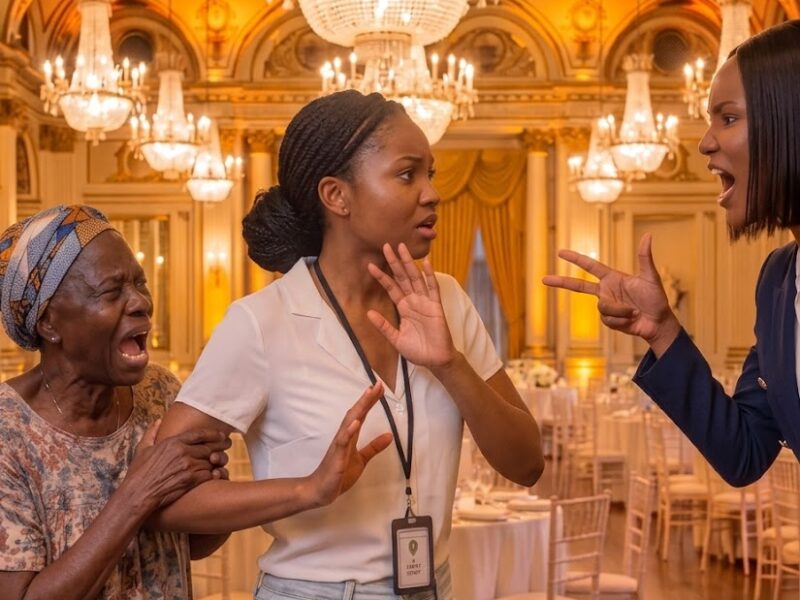
She stood up for an old woman everyone else was mocking — with no idea the woman she defended was the groom’s grandmother.
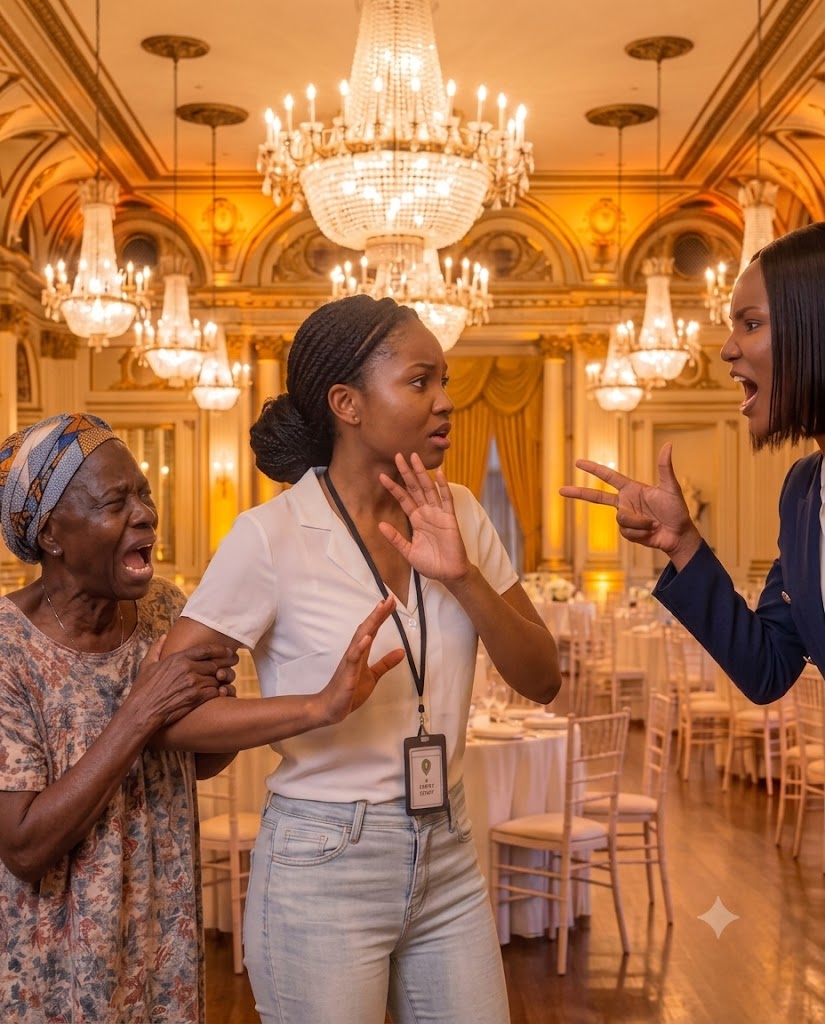
The kitchen smelled like burnt butter and broken dreams, but Adwoa kept her chin up anyway.
She was twenty-three years old, working sixteen-hour shifts at a catering company in Atlanta that paid her $11.50 an hour, and she had exactly $247.83 in her savings account.
The rent was due in six days. It was $1,400 for her studio apartment on the south side, and she was already $200 short.
But none of that mattered tonight, because tonight was the biggest wedding of the year, and she was determined not to mess it up.
The Vanderpuye family had rented out the entire Grand Hyatt ballroom, flown in flowers from Amsterdam, and hired a twelve-piece orchestra that cost more than Adwoa’s annual salary.
And here she was, in the back kitchen, arranging hors d’oeuvres on a silver tray like her life depended on it.
“Move faster,” a sharp voice cut through the chaos.
Adwoa looked up to see Patience Mensah, the catering manager, standing in the doorway with her arms crossed.
Patience was a tall woman with a permanent scowl and a talent for making everyone around her feel small.
“This is not your village kitchen,” Patience hissed. “Every detail must be perfect tonight.”
“Yes, madam,” Adwoa said, her hands trembling slightly as she adjusted the tray. “Right away.”
Patience narrowed her eyes at the tray. “Hm? That tray is not for the family table. Watch yourself.”
“Yes, madam. Yes, madam. I only want to do my work well.”
Adwoa had learned long ago that the best way to survive people like Patience was to agree with everything and keep her head down.
But tonight, something felt different.
Maybe it was the way the candlelight flickered against the crystal chandeliers, or the sound of laughter drifting in from the ballroom.
Or maybe it was the old woman who walked through the service entrance, looking lost and tired.
—
The old woman wore a simple cotton dress, faded and worn at the edges, and carried a small woven bag over her shoulder.
She didn’t look like she belonged at a wedding where the average guest had spent more on their outfit than Adwoa made in a month.
But she walked in like she had every right to be there, her back straight, her eyes scanning the room.
“So many faces I do not know tonight,” the old woman murmured, more to herself than anyone else.
Patience spotted her immediately.
“Who let her in here?” Patience demanded, her voice rising above the clatter of plates. “This area is for family and special guests only.”
The old woman turned slowly. “I am here for the wedding, my dear. I only wish to sit and rest a little.”
“Old woman, this is not a market bench.”
The words hit Adwoa like a slap.
She watched as Patience gestured toward a security guard, her face twisted with contempt.
“Someone come and remove her from here. People like you do not belong at this table.”
The old woman didn’t flinch. She just stood there, her hands clasped in front of her, her eyes calm.
“There is no need to pull me, my daughter,” she said softly as the guard approached. “There is no need to pull me.”
Adwoa’s heart pounded in her chest.
She knew she should stay quiet. She knew speaking up could cost her the job, the reference, the tiny foothold she had in a city that didn’t care if she existed.
But she couldn’t just stand by.
“This is too much,” Adwoa said, stepping forward before she could stop herself. “Someone must help her. We cannot just stand by.”
The kitchen went silent.
Patience turned to her, eyes blazing. “And who asked the kitchen girl to speak?”
Adwoa swallowed hard. “I am only asking you to treat her with respect.”
The old woman looked at Adwoa, and something passed between them—a flicker of recognition, of gratitude, of something deeper than words.
“Thank you, my daughter,” the old woman said.
Patience’s face hardened. “This is not over.”
But she stepped back, and the security guard hesitated, and somehow, the moment passed.
Adwoa guided the old woman to a quiet corner near the service station, pulling out a chair and helping her sit.
“Please, sit here,” Adwoa said. “Let me bring you something to eat.”
The old woman smiled, and her eyes crinkled at the corners. “What is your name, my daughter?”
“My name is Adwoa.”
“Adwoa,” the old woman repeated, as if tasting the name. “A good name. A strong name.”
Adwoa hurried to the kitchen and returned with a plate of food—rice, grilled chicken, roasted vegetables—the same meal being served to the guests in the ballroom.
The old woman ate slowly, savoring each bite, and Adwoa stayed with her until she was finished.
“You have a good heart,” the old woman said. “Never lose it.”
And then she was gone, disappearing into the crowd like a ghost.
—
The rest of the night passed in a blur.
Adwoa worked until her feet ached and her hands were raw, cleaning up after the guests, stacking chairs, wiping down tables.
Patience didn’t speak to her again, but the look in her eyes promised consequences.
By the time Adwoa got home, it was nearly 2 a.m., and she collapsed onto her bed without even taking off her shoes.
The next morning, she woke to a text from her landlord.
*”Rent is due Friday. Don’t be late again.”*
Adwoa stared at the message for a long time, her chest tight.
She had $247.83 in her savings account and a paycheck coming on Thursday for $460—barely enough to cover the rent, let alone groceries or the bus pass she needed to get to work.
One day, my own shop will stand somewhere, she thought, the words a familiar mantra.
One day.
—
At work the next week, Adwoa kept her head down and her mouth shut.
She scrubbed pots, chopped vegetables, and tried not to think about the old woman or the look on Patience’s face.
But then, on Thursday afternoon, a man walked into the kitchen.
He was tall, well-dressed, with the kind of quiet confidence that came from money and good breeding.
“Good afternoon,” he said, his voice smooth. “I am looking for the young woman who helped an elderly guest at a wedding recently.”
The kitchen staff exchanged glances.
Adwoa’s heart stopped.
“That would be Adwoa,” one of the cooks said, pointing.
The man turned to her, and his eyes softened. “You are Adwoa?”
“Yes,” she said, her voice barely above a whisper. “That’s me.”
“I am Kwame,” he said. “Kwame Vanderpuye.”
The name hit her like a thunderbolt.
Vanderpuye. The family whose wedding she had worked. The family whose grandmother she had defended.
“I wanted to thank you,” Kwame said. “My grandmother told me what you did. She said you stood up for her when no one else would.”
Adwoa shook her head. “I only did what anyone should do.”
“That is not true,” Kwame said. “And my grandmother would like to meet you. Properly, this time.”
—
The meeting took place at the Vanderpuye estate, a sprawling mansion in Buckhead with more rooms than Adwoa could count.
She wore her best dress—a simple navy blue shift she had bought at a thrift store for $12—and tried not to feel out of place.
The old woman was waiting for her in the garden, sitting on a wrought-iron bench beneath a magnolia tree.
She looked different now—not in a faded cotton dress, but in a elegant silk gown, her gray hair swept up in a neat bun.
But her eyes were the same—warm, knowing, kind.
“Adwoa,” she said, rising to embrace her. “My daughter.”
“I don’t understand,” Adwoa said. “At the wedding—”
“I dressed simply that day,” the old woman said. “Not to deceive, but because I forgot my shawl that morning. And I wanted to see the wedding from the perspective of an ordinary guest.”
She paused, her eyes twinkling. “I did not expect to be thrown out.”
Adwoa’s face burned. “Madam, I did not know who you were.”
“That is exactly the problem, my daughter. Kindness should not depend on who is watching.”
The words hung in the air, heavy with meaning.
Adwoa thought of all the times she had been treated like she was invisible, like she didn’t matter, like her only value was in what she could do for others.
“I was only doing my job,” she said quietly.
“Your job was never to insult the people who serve you,” the old woman said. “And I have seen how that woman—Patience—treats those beneath her. It is time someone held her accountable.”
—
The truth came out slowly, like water seeping through cracks in a dam.
Kwame had done some digging, and what he found was worse than anyone expected.
Patience had been embezzling from the catering company for years—small amounts at first, then larger and larger sums.
She had stolen over $47,000, funneling the money into a secret account and covering her tracks with fake invoices and inflated expenses.
And she had done it all while treating her employees like garbage.
“I have the evidence,” Kwame said, spreading a folder of documents across the table. “Bank statements, receipts, emails. It is all here.”
Adwoa stared at the papers, her mind reeling.
“Why are you doing this?” she asked.
“Because you did something good,” Kwame said. “And because my grandmother asked me to.”
The old woman smiled. “Kindness is rare in this world, my daughter. When I find it, I hold onto it.”
—
The confrontation happened at the next company meeting.
Patience sat at the head of the table, her face smug, her eyes cold.
She had no idea what was coming.
Kwame walked in with two attorneys and a police officer, and the room went silent.
“Patience Mensah,” Kwame said, his voice calm but firm. “You are being terminated for embezzlement and theft. The police have been notified.”
Patience’s face went white. “What? That is ridiculous. I have done nothing wrong.”
The officer stepped forward. “Ma’am, you have the right to remain silent. Anything you say can and will be used against you in a court of law.”
Patience looked around the room, her eyes wild. “This is a mistake. I am innocent.”
But the evidence was undeniable, and within an hour, she was in handcuffs, being led out of the building.
The staff watched in stunned silence.
Many of them had felt her cruelty for years—the insults, the threats, the way she made them feel like they were nothing.
And now, finally, she was gone.
—
The company was in chaos.
With Patience gone, there was no one to run the catering operation, no one to manage the events, no one to keep the business afloat.
Kwame called a meeting the next day.
“I want to offer a real partnership,” he said, looking directly at Adwoa. “Your own catering business, under your name.”
Adwoa’s jaw dropped. “What?”
“You heard me. You have the talent, the work ethic, and the heart. I want to invest in you.”
Adwoa shook her head. “I do not want people to say I only rose because of your family’s money.”
“This is not charity, my daughter,” the old woman said, stepping forward. “It is your kindness returning to you.”
Adwoa thought about her empty savings account, her overdue rent, her dreams of one day owning her own shop.
She thought about the old woman, thrown out of a wedding for being in the wrong place at the wrong time.
She thought about Patience, and all the people she had hurt.
And she thought about the words the old woman had spoken: *Kindness should not depend on who is watching.*
“Then I accept,” Adwoa said, her voice steady. “With a grateful heart.”
—
The new business was called *Adwoa’s Kitchen*, and it opened six months later in a small storefront on the west side of Atlanta.
The sign above the door was hand-painted, the tables were reclaimed wood, and the menu featured recipes Adwoa had learned from her grandmother back in Ghana.
On opening day, the line stretched around the block.
Kwame and his grandmother were there, sitting at a table near the window, watching with proud smiles.
“I never thought my name would sit at the top of anything,” Adwoa said, looking at the menu, at the sign, at the life she had built from nothing.
“Money is not the problem,” the old woman said. “Pride is not the problem. A closed heart is the only true poverty.”
Adwoa nodded, the words settling into her bones.
“Treat the ones who cannot help you the way you would treat family. That is the real wealth.”
The first month, *Adwoa’s Kitchen* made $19,500 in revenue.
The second month, it made $27,000.
By the end of the first year, Adwoa had hired twelve employees, all of them paid a living wage, all of them treated with dignity and respect.
She had paid off her debts, moved into a bigger apartment, and started a scholarship fund for young women who wanted to pursue careers in the culinary arts.
And every Sunday, she closed the restaurant early and invited her staff and their families to a free dinner.
Because kindness, she had learned, was not a weakness.
It was the greatest strength of all.
—
The old woman died two years later, peacefully, in her sleep.
Her funeral was attended by hundreds of people—family, friends, and the countless lives she had touched with her quiet wisdom.
Adwoa sat in the front row, holding Kwame’s hand, tears streaming down her face.
After the service, Kwame handed her a small velvet box.
“She wanted you to have this,” he said.
Adwoa opened the box.
Inside was a simple gold bracelet, engraved with three words: *Kindness is wealth.*
She wore it every day after that, a reminder of the old woman who had changed her life.
A reminder of the night she had stood up for a stranger, not knowing who she was.
A reminder that the smallest acts of courage can ripple outward in ways we can never predict.
—
*Adwoa’s Kitchen* expanded to three locations over the next five years.
Adwoa was featured in *Atlanta Magazine*, *Southern Living*, and eventually *Forbes*, which called her “one of the most inspiring entrepreneurs of her generation.”
But she never forgot where she came from.
She never forgot the old woman in the faded cotton dress.
She never forgot the words that had changed everything: *Kindness should not depend on who is watching.*
And every night, before she locked up the restaurant and went home, she stood in the kitchen and whispered a quiet prayer of gratitude.
Because one day, this kitchen had been a dream.
And now, it was hers.
—
The bracelet caught the light as Adwoa raised her hand to wave goodbye to the last customer of the evening.
A young woman, maybe nineteen or twenty, with tired eyes and a worn-out coat.
“Excuse me,” the young woman said. “Are you hiring?”
Adwoa smiled.
“Come in,” she said. “Let me bring you something to eat.”
And the cycle of kindness continued.
—
**THE END**









