She Sheltered a Freezing Stranger in Her Bakery—Unaware the Former Navy SEAL Had Been Searching for Her
The sleet hit like tiny glass beads, sharp enough to sting the back of Matt Rowan’s neck before he even registered the cold. He’d walked out of the Front Range Veterans Foundation meeting hall without his coat, without his wallet, and without his phone—a trifecta of stupidity that would’ve gotten him laughed out of any operational debrief. Duke, his eight-year-old German Shepherd, lifted his nose toward the wind and didn’t look impressed either. The dog had retired from service two years ago, but nobody had told his posture. He still walked tight against Matt’s left leg, steady and alert, like the world might still require him to make a decision.
Matt stopped on the sidewalk and checked his pockets for the third time. Nothing. He looked back toward the meeting hall, where his coat hung over a folding chair with everything he owned inside it. Less than a mile back. He could’ve turned around. Instead, he looked down West Colorado Avenue and saw a square of amber light glowing through the front windows of a small bakery. Callahan Hearth, painted in modest cream lettering above the awning. The open sign was still on.
” We ask nicely, we pay tomorrow, and this never becomes part of my permanent record,” Matt said to Duke. The dog started toward the bakery before Matt did.
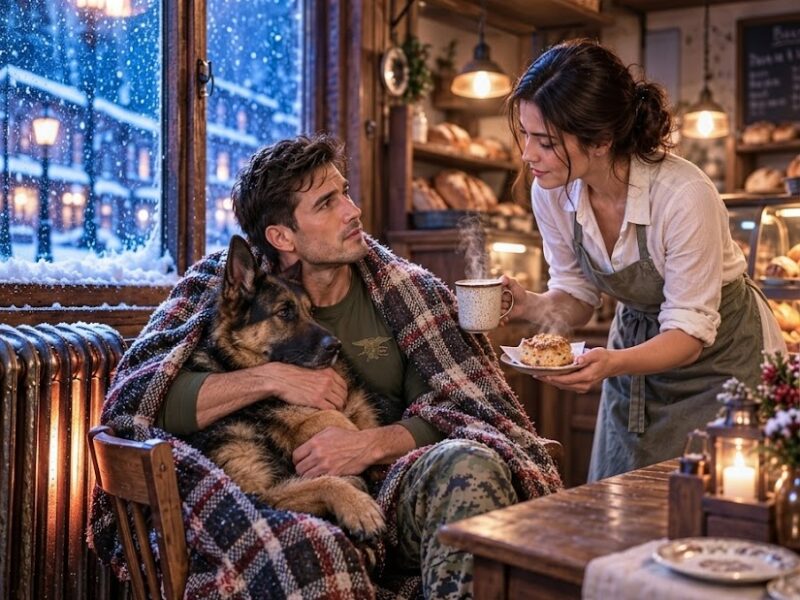
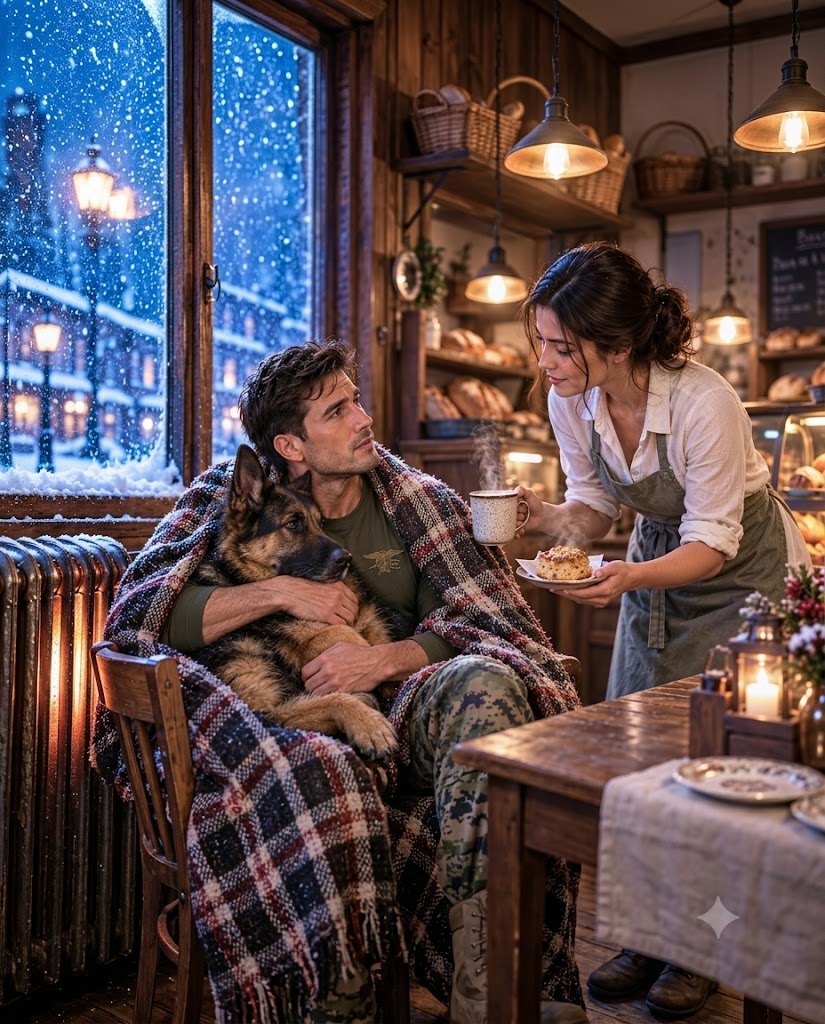
The bell over the door gave a soft brass chime when they stepped inside. Warm air hit first, followed by the smell of bread, butter, apples, and something faintly spiced. The bakery was small enough that Matt could take in most of it with one sweep—five wooden tables, a glass pastry case with only a handful of items left, an old cast-iron radiator beneath the front window, and a narrow doorway leading toward the kitchen. A young woman behind the counter had been stacking clean trays. She looked up for half a second. Her attention went to Duke. Then she noticed the sleet darkening Matt’s sweater and the water beginning to gather along Duke’s back.
She didn’t ask what happened. She set the trays down. ” There’s a towel by the door for him.”
Her voice was calm, practical. Matt found a folded old towel on a hook and ran it over Duke’s shoulders and back. Duke tolerated the indignity with the solemn patience of a dog who believed such things were beneath him. The woman came around the counter carrying a stainless steel bowl of water. She placed it several feet from Duke rather than pushing it beneath his nose. Matt noticed. Most people who liked dogs moved toward Duke too quickly. People who feared him moved away too quickly. She didn’t do either.
Duke sniffed the bowl, drank, then settled beside Matt. ” You two were out walking.”
Matt nodded longer than planned. She glanced at his thin sweater. ” That part I figured out.”
There was no performance in her concern and no curiosity sharpened into interrogation. Matt found that unexpectedly relaxing. ” My wallet and phone are in my coat,” he said. ” My coat is somewhere I’m not. I can head back out. I just thought I’d ask if we could warm up for a few minutes.”
The woman looked toward the radiator. ” You can explain your financial situation after your hands stop shaking.”
Matt looked down. They weren’t shaking badly, but she had made her decision. He sat at the table nearest the radiator while Duke lowered himself beside the chair. The old iron unit gave off uneven heat and clicked every few seconds as though arguing quietly with its own pipes. The woman disappeared into the kitchen and returned with a heavy ceramic mug.
” Pear and ginger,” she said. ” It’s what’s left in the pot.”
Matt wrapped both hands around it. The warmth worked quickly. ” I’ll come back tomorrow and pay for this.”
” Then come back tomorrow.”
He waited for something more. Nothing came. She had already returned to wiping the counter. Matt took a drink. The pear was mild, the ginger stronger at the end. It tasted homemade rather than perfected, which somehow suited the room. After a few minutes, she brought over a small plate. The biscuit on it was rough-edged and slightly uneven, with bits of apple visible through the brown surface.
” We make these when it gets cold.”
Matt looked at it. ” I should warn you. My current balance is still zero.”
” That’s unfortunate.” She placed the plate down anyway. A faint smile touched the corner of her mouth. ” My grandmother used to say nobody should have to prove they own a wallet before they’re allowed to sit somewhere warm.”
Matt looked up. The woman had already turned away. Something about the sentence stayed with him. He broke the biscuit in half. Duke raised his head immediately. ” No.”
Duke continued watching. ” This has cinnamon.”
The dog’s expression suggested that Matt’s concerns were unnecessary. The woman noticed from behind the counter. ” I have a plain one for him.”
Matt looked over. ” You keep dog biscuits?”
” I keep biscuits before I ruin them with everything people like.” She brought a small unglazed piece from the kitchen. Waited for Matt’s nod, then placed it near Duke rather than feeding him by hand. Duke sniffed it carefully. Then it disappeared. Matt stared at him. ” Strong principles.”
The woman laughed softly and went back to closing work. Matt took his first bite. He slowed. The taste itself was simple. Oats, apple, buttermilk, a little cinnamon, nothing that belonged behind glass in a luxury restaurant. For a few seconds, he was eleven years old again. Wet gloves on a radiator. Schoolbooks dropped beside the kitchen chair. His mother standing at the counter in an old blue cardigan, cutting apples too thick because she said thin slices were for people with unnecessary free time. Helen had made something close to this whenever the weather turned hard. Matt had forgotten that, or perhaps he had trained himself not to remember it very often.
He looked down at the biscuit until the room returned to its proper size. The young woman was pulling a cloth over the pastry case. ” Who taught you to make these?”
She glanced up. ” My grandmother. Rose Callahan.” Matt nodded toward the sign outside. ” Her place originally.”
There was affection in the answer along with something heavier that Matt did not yet understand. ” She believed fancy food had its place,” Emily continued while gathering the day’s receipts. ” But cold people usually wanted something they could hold with both hands.”
Matt looked at the biscuit again. ” That sounds about right.”
Only later did he realize she had finally told him her own name while explaining the receipt envelope. Emily Callahan. She was twenty-eight, though Matt would not learn that until another evening. For now, she was simply the woman who had given Duke water before asking Matt a single question. The conversation remained scattered while she closed. A few sentences about the bakery. One about Duke’s age, another about the radiator, which Matt could hear knocking slightly out of rhythm. Then Emily asked where he worked.
Matt answered automatically. ” I was in the Navy. Senior chief. I was the team lead during Black Canyon.”
The words stopped. Emily looked over. Matt felt the familiar door opening in front of him. Recognition, questions, the careful change in someone’s voice once they connected his name to the story. He closed it. ” I work on trucks.”
Emily waited. Duke lifted his head. Matt looked down at him. ” What?”
Duke blinked. Matt returned his attention to Emily. ” Diesel, mostly.”
A small crease appeared between her eyebrows. ” That’s quite a career transition.”
” Very gradual.” That was technically true. He nodded toward the radiator. ” That pipe’s knocking because the valve probably isn’t opening cleanly.”
Emily glanced toward it. ” So you really are a mechanic.”
” Occasionally.”
By the time she turned the front sign to closed, the sleet had softened into a thin, wet snowfall. Emily disappeared into the back room and returned with a dark wool scarf. Matt started to refuse. She held it out anyway. ” Bring it back tomorrow.”
There was nothing sentimental in the gesture. It was simply the obvious solution to a cold walk. Matt accepted it. Outside, Duke stepped carefully onto the wet sidewalk. Matt wrapped the scarf once around his neck and looked back through the bakery window. Emily was already turning off the lights over the pastry case. She had no idea who Matt Rowan was supposed to be. Strangely, that was the first thing about the evening that had made him want to come back.
The next morning arrived bright and sharp, the kind of Colorado cold that made every distant ridge look closer than it was. The sleet from the night before had frozen along the shaded edges of the sidewalks, while old snow near the curb softened into gray channels beneath the sun. Matt returned to Callahan Hearth a little after ten. This time he had his coat, his wallet in one pocket, his phone in another, and the dark wool scarf Emily had loaned him folded neatly over his arm. He had washed it the night before, although the faint smell of bakery smoke and ginger had somehow survived. Duke walked beside him with the easy confidence of a dog returning to a place he had already approved.
The brass bell sounded as Matt pushed open the door. Emily was behind the counter arranging loaves on a wooden shelf. She looked up, recognized him immediately, then glanced at the scarf. ” You actually came back.”
Matt placed it on the counter. ” I try to return borrowed property before people report me.”
Emily picked it up, inspected the careful fold, and smiled. Matt took out his wallet and laid enough cash on the counter to cover the drink, biscuit, and more. Emily separated part of it and pushed the rest back. ” You ate one biscuit and the drink.”
” That too, and heat.”
She looked toward the old radiator. ” If I start charging by the degree, we’re both in trouble.”
Matt put the extra money away. Duke had already found the spot near the front window where he had rested the night before. Emily noticed. ” He remembers.”
” He remembers food.”
Duke settled down. Matt glanced toward the kitchen doorway. ” Anything around here need fixing before I leave?”
Emily looked at him for a second, then reached beneath the counter and produced a broom. Matt stared at it. ” You planned that.”
” You said mechanic. I’m starting with a lower-risk test.”
He took the broom. It should have been ten minutes. Instead, while sweeping near a storage shelf, Matt noticed one corner sagging slightly. The lower hinge had pulled away from the frame, leaving two screws loose enough to move with a fingertip. He crouched. Emily looked over from the register. ” That thing’s been leaning since Christmas.”
Matt pressed the shelf gently, watched the movement, then reached for the compact multi-tool he carried in his coat. The screws were worn rather than stripped. He tightened what he could, then found two better replacements in an old coffee tin Emily kept with spare hardware beneath the sink. When he finished, the shelf sat square against the wall. He went back to sweeping. Five minutes later, the delivery cart near the back door caught his eye. One wheel sat at a slightly different angle from the others. Matt pushed it once. The cart pulled left. He turned it over and found a bent bracket. Emily stood in the doorway now, arms folded.
” Is this still part of sweeping?”
” Technically.”
” Interesting definition.”
Matt straightened the bracket in the small maintenance vise beside the utility sink and reset the wheel. Then he heard the mixer. It was an old commercial unit sitting on the prep counter, large enough to have survived several generations of bakers and stubborn enough to sound proud of it. A faint irregular clatter appeared every few rotations. Matt stopped. Emily kept working. He listened again. ” That always sound like that?”
Emily glanced toward the mixer. ” For the last year.”
” That wasn’t the answer I hoped for.”
The machine had no obvious failure. The sound came from a loose guard plate and a worn mounting bolt rather than anything deep inside the motor. Matt tightened the plate, replaced the bolt, and cleaned flour buildup from the area around the housing. When Emily restarted it, the mixer settled into a smooth mechanical hum. She watched it for several seconds. Then she looked at Matt. ” So you really do work on things occasionally.”
That seemed to settle something for her. Matt left around noon. He returned three days later, then again two evenings after that. There was no schedule at first. He showed up when he had finished at Red Rock Fleet and Diesel, or when the rest of his evening held nothing he particularly wanted to go home to. Sometimes he bought coffee. Sometimes he stayed long enough to help carry fifty-pound flour sacks from the back entrance into storage. Once, on a morning when the temperature had fallen overnight, Emily’s small delivery van turned over reluctantly and refused to hold an idle. Matt stood in the alley with the hood open while Duke watched from the doorway. The problem was simple enough—a tired battery connection and corrosion around one terminal that had become worse in the cold. Matt cleaned the connection, tightened it, and told Emily the battery would still need replacing soon. She wrote the warning on a piece of receipt paper and taped it to the dash.
” You know, phones have reminders.”
” I lose paper less often.”
Matt thought about the coat he had left behind. He decided not to argue. By the end of the first week, Duke had developed a routine of his own. Emily never called him over. She never reached toward his head while he was lying down, and she never treated the absence of growling as permission to touch him. She set a stainless steel water bowl behind the counter on Matt’s third visit, filled it when Duke arrived, then continued working. Duke noticed everything. On the fourth visit, he walked directly to the bowl before Matt had removed his coat. By Friday, he had begun stopping beside Emily for a moment on his way back to Matt, close enough for his shoulder to brush lightly against her knee. Emily did not react beyond looking down. That seemed to matter. Matt noticed the change without commenting on it. He had spent enough years around working dogs to understand that trust built more reliably when nobody announced it.
The bakery changed too, depending on the hour. In the mornings, it was flour, dust, trays, orders, and customers who knew exactly what they wanted before reaching the counter. By late afternoon, the rush thinned. Evening brought another version of the place entirely. The lights softened, the pastry case emptied. The smell of coffee lingered longer than the people who had ordered it. Matt began liking that version best. One Tuesday evening, Emily was in the kitchen portioning dough while Matt repaired the latch on a lower cabinet. Duke rested near the counter. A drawer above Matt stuck halfway open. He pulled gently, freeing it, and found an old clothbound ledger underneath a stack of supplier receipts. Its corners were rounded from years of use. The first pages held ordinary numbers. Flour, butter, taxes, repairs, wages. Farther in, the writing changed. Coffee for Frank, paid. Bread for Tuesday group. Miriam short today, next week. Three rolls, no charge. Matt turned another page. A line near the bottom simply read, ” Keep the soup hot.”
Emily came out carrying a tray. She saw the ledger in his hand. ” That was Rose’s.”
Matt closed it carefully. ” I wasn’t digging.”
” She would have said the drawer opened because it wanted attention.”
Emily set the tray down. Matt nodded toward the ledger. ” She kept unusual books.”
” That was her polite version of accounting.”
Emily wiped flour from her hands and sat for a moment at the end of the counter. Rose Callahan, she explained, had never liked the word charity inside the bakery. She thought it made one person stand above another. If someone needed coffee, bread, or a quiet place until the bus arrived, she wrote it down the same way she wrote everything else. Sometimes the person paid later. Sometimes they never did. The ledger never recorded the difference. Emily still kept parts of the habit. Twice a week, usually Tuesday and Friday, she boxed the bread rolls that were still fresh, plain biscuits from the morning, and whatever coffee cake would not hold well through the next day. She drove them a few blocks to Pikes Peak Veterans Renewal Center. Matt looked toward the boxes already stacked beside the kitchen door. He had assumed they were returns.
” You do that every week?”
” Most weeks.”
” The bakery doing that?”
Emily smiled faintly. ” Depends which bill you ask.”
That answer stayed with him. He knew small businesses well enough to recognize the truth behind it. The mixer had been kept running a year with a bad mount. The delivery van needed a battery. The shelving had been repaired with mismatched screws long before he arrived. There was no surplus here pretending to be generosity. Emily saw him looking at the boxes. ” It’s not much.”
Matt leaned against the counter. ” Why the veteran center?”
She took a moment before answering. Rose had started bringing food there years earlier when the building had still been smaller and less organized. Emily continued because the common room always seemed easier to enter when there was coffee on the table. ” Some people don’t want someone asking if they need help,” she said. ” But they’ll sit down if there’s bread.”
Matt looked at the old ledger again. Emily returned to the kitchen before the silence could turn into anything larger. For a while, Matt stayed where he was. After Black Canyon, strangers had asked him every version of the same question. What was it like? Were you scared? How did you know what to do? Did you feel like a hero? Helen had never asked any of them. The first time he came home after the rescue, she had opened her kitchen door, looked at the weight he had lost, and asked if he wanted eggs. He had thought about that more often than he admitted.
Duke rose and stretched. Matt put the ledger back exactly where he had found it. A few evenings later, he was sweeping the front floor while Emily finished shaping bread for the morning. Duke was asleep directly in his path. Matt changed direction. Duke shifted. Matt changed direction again. Duke moved once more and settled across the next section. Matt stopped. The bakery had more than seven hundred square feet of usable floor. Duke had selected approximately four of them. All four belonged to Matt’s broom.
Matt rested both hands on the handle. ” You have an entire building.”
One ear lifted.
” You’re retired. You don’t need to control territory anymore.”
No response. Emily looked out from the kitchen. ” He seems comfortable.”
” He’s obstructing an active work area.”
” He has good instincts.”
Matt stared at her. Emily went back to the dough. Duke remained exactly where he was. Matt swept around him. That became part of the routine, too. By the end of the second week, Matt no longer needed the excuse of returning a scarf, checking a mixer, or making sure the van started. Some evenings, he arrived and there was nothing broken. He stayed anyway. He swept. He carried flour. He drank coffee that usually went cold before he finished it. Duke slept near the counter while Emily worked. Outside, late winter kept changing its mind. Inside Callahan Hearth, the evenings began to feel strangely dependable. Matt had spent years thinking peace would arrive when life finally became quiet. He was beginning to suspect he had misunderstood it. Peace, at least here, had sounds. A mixer turning. A broom on old wood. Emily moving trays in the kitchen. Duke’s collar shifting when he rolled onto his side. Nothing remarkable. That was why Matt kept coming back.
By the middle of the following week, the weather had softened again. Wet snow fell in slow, heavy flakes, sticking to parked cars and darkening the sidewalks before melting into the seams. It was the kind of afternoon that made people stay indoors longer than planned. Callahan Hearth was quieter than usual. Emily stood behind the counter with a delivery invoice in one hand and a mug of coffee in the other. Though Matt had already learned the coffee was mostly decorative, she had poured it twenty minutes earlier and had not taken a drink since. Matt was near the back table replacing a cracked rubber foot on one of the bakery’s smaller prep racks. Duke slept beside the counter.
The brass bell rang, and three older veterans from Pikes Peak Veterans Renewal Center came in with wet shoulders and folded newspapers. Emily started coffee before any of them ordered. One of them, Harold Pike, set a local veterans newsletter on the counter while removing his gloves. The front page carried a black-and-white photograph under an anniversary headline about the Black Canyon Flood Rescue. Nine years earlier. Matt saw it from across the room. He stopped. The photograph had been taken late in the rescue, after portable lights had turned the rain white. A younger Matt stood near the edge of the flood channel, one hand wrapped around a safety line while county rescuers guided stranded adults across a temporary crossing. The picture had followed him for years. Matt looked back down at the rubber foot.
The small television above the pastry shelves happened to be tuned to the local afternoon news. A few minutes later, the same anniversary appeared there, too. Old footage showed muddy water pushing past road barriers, emergency vehicles, volunteers carrying blankets, firefighters moving through rain. Then Matt saw himself again. Shorter hair, leaner face, different eyes. Harold nodded toward the television. ” Black Canyon. Hard to believe that was nine years ago.”
Another veteran gave a low sound of agreement. ” That Rowan fellow was something. Navy SEAL, if I remember right.”
Matt reached for a wrench and tightened a bolt that did not need tightening. Duke opened one eye. Emily glanced up at the screen, but only briefly. She set three mugs on the veterans’ table and went back behind the counter. Matt waited until the conversation drifted elsewhere. ” You remember that story?”
Emily looked over. ” Black Canyon? Yeah, a little. I was nineteen and getting ready to leave for Denver. I probably cared more about bus schedules and apartment deposits than local news.”
Matt nodded. That should have been enough. It was not. ” What did you think of him?”
Emily’s eyebrows lifted. ” Of Rowan?”
Matt turned the rubber foot between his fingers. ” Just curious.”
She glanced at the television. The footage had changed to an aerial view of the flooded road. For several seconds, she said nothing. Then she set her untouched coffee down. ” Tired.”
Matt looked up.
” He looked tired.” Emily watched the screen another moment. ” People remember what someone does when everything goes wrong. They don’t think much about what happens after.”
Matt stayed still.
” Everybody gets to tell the brave part. The person in the story still has to go home afterward.” Her gaze returned to the invoices. ” If every stranger already thinks they know the most important thing about you before you say hello, that sounds lonely.”
Then she picked up her coffee, discovered it had gone cold, and made a face. The conversation ended there. Emily poured the coffee out and returned to work. Matt remained beside the rack longer than necessary. Duke raised his head and looked at him. For years, people had told Matt what Black Canyon meant. Courage, leadership, service. He had stood at dinners while strangers thanked him. He had posed for photographs beside people he had never met. He had listened while others described a night he remembered mostly in fragments. Rushing water, radios, mud, rope burn, exhaustion, decisions made too quickly to feel heroic. Very few people ever wondered what came after the lights went away. Helen had never asked him either. That was the difference. She had never needed the story. The first time Matt returned home after the rescue, she had looked him over from the kitchen doorway, noticed how thin he had become, and told him to remove his wet shoes before he ruined her floor. Then she put eggs in a pan. He had loved her for that more than he knew how to explain.
Later that afternoon, the veterans left one by one. Harold forgot the newsletter. Emily folded it and placed it near the register in case he returned. Matt did not look at the photograph again. When Emily began another batch of apple oat biscuits, the scrape of the mixing bowl carried into the front room. ” My mother used to make something close to those.”
Emily glanced over her shoulder. ” The famous mechanic had a mother.”
Against all available evidence, she smiled. Matt told her only a little. Helen made the biscuits on cold afternoons when he came home from school with wet cuffs and snow packed into his boots. She wore an old blue cardigan every winter until one elbow became too thin to repair. She had a rule about shoes. Emily looked down at his boots. ” That sounds promising.”
” Nothing wet crossed the kitchen floor.”
” And you listened. Eventually.”
Emily laughed. Matt glanced toward the damp marks customers had left across the bakery floor. ” To this day, if I walk into a house in bad weather, I can hear her telling me to wipe my feet.”
” You’re almost fifty.”
” I’m aware. And she still wins. Every time.”
The exchange lasted less than a minute, but afterward, Matt felt he had placed something small and private between them. Emily did not reach for it. She let it stay. Her own history came out even more gradually. A few evenings later, Matt noticed an old Denver bakery logo on one of the storage containers she was labeling. Emily explained that she had left Colorado Springs at nineteen, completed a pastry program, then spent several years doing prep work in a busy Denver bakery where mornings started long before sunrise. She liked the pace. She liked having a life that belonged entirely to her. Then Rose began missing appointments. At first, Emily came home for weekends, then every other weekend, then for a month. Eventually, she packed up her Denver apartment and told herself the move was temporary. It was not. Rose lived long enough to teach Emily the parts of the business no recipe book held. Which supplier gave better apples in October. Which customer always forgot to ask for decaf. How long the front window leaked after a hard north wind. After Rose died, Emily stayed. Matt did not ask why. She supplied the answer while stacking clean containers. ” Some days I’m not sure if I kept the bakery because I love it or because leaving would feel like losing her twice.”
Matt looked at her. Emily gave a small shrug, then returned to labeling flour. That was how they learned each other—not through long conversations, but through things left open for a few seconds at a time. Matt learned Emily forgot her own coffee until it was cold. Emily learned Matt checked the rear lock twice every night, even after she had already tested it. Matt learned she counted trays by touching each corner with one finger. Emily learned he always put tools back in the same order. Duke learned something more practical: if he sat beside the prep table long enough and maintained a serious expression, eventually one of the two humans would drop something. Never anything unsafe, but occasionally a small piece of plain biscuit reached the floor with suspicious regularity. One evening, Emily caught Matt breaking a dog-safe piece in half beneath the counter. ” I saw that.”
Matt looked up. ” You saw nothing.”
Duke swallowed the evidence. Emily stared at them. ” Very professional.”
Matt returned to wiping the counter. Outside, the wet snow had turned to rain. Inside, the radiator clicked. The mixer hummed, and Duke settled between them as if he had already decided where the evening belonged. Matt still had not told Emily who he was. But for the first time, keeping the secret no longer felt like hiding. It felt like being allowed to arrive without a story attached.
By the first week of March, winter had become less dramatic and more inconvenient. Cold blue mornings hardened the slush along the curbs. By noon, sunlight melted the same snow into thin streams that ran beneath parked cars and across alley entrances. Then night came, temperatures dropped again, and the city repeated the process as if unable to decide which season it belonged to. Callahan Hearth had settled into that rhythm. Boot prints near the door, wet mats, coffee steaming against cold windows, Duke sleeping in whichever part of the floor Matt most needed to cross. That afternoon, Matt was in the rear service area repairing a steel storage rack Emily had been meaning to replace for months. One lower support had pulled away from the wall, and the entire thing leaned just enough to bother him. He had learned that once he noticed something crooked, he could not stop seeing it. Duke lay near the open kitchen doorway, chin resting between his paws. Emily was checking an order sheet when the rear gate rattled.
She looked up. Two men stood outside the enclosed service yard. Both wore reflective work jackets marked with the logo of Mesa Ridge Community Development. One carried a folded site map. The other had a measuring wheel and a bundle of orange marking stakes tucked beneath one arm. Emily wiped her hands and stepped outside. Matt kept working. At first, the exchange sounded ordinary. The men said they were there to confirm measurements along the rear property line. Emily explained that no one had contacted her about entering the enclosed yard. One of them unfolded the site map and pointed toward the back wall of the bakery. The other looked past her toward the loading area. Emily asked them to wait while she called the project office. That should have ended it. Instead, one of the men reached for the gate. Matt stopped tightening the bracket. Emily stepped slightly in front of him.
” I just need a few minutes to confirm it.”
The man gave the gate another pull. ” We’re already behind schedule.”
His tone was not loud, but it had changed. Emily stayed where she was. Matt knew that tone. Not danger. Not yet. Just someone deciding that being inconvenienced gave him the right to stop listening. The gate opened. The man stepped into the yard. Duke stood. The movement was immediate but controlled. His body lowered slightly. His weight shifted forward. His chest tightened. Ears upright. Eyes fixed on the unfamiliar man. No barking, no lunging, no teeth. Just a tension. Matt set the wrench down.
” Duke, hold.”
The German Shepherd froze in place. The man noticed him. His confidence changed by a fraction. ” Call your dog back.”
Matt stepped out from beside the rack. ” He is back.”
The man looked at Duke again. The dog had not moved. That seemed to make the answer worse somehow. Emily remained between the two men and the rear door. ” I asked you to wait.”
The second worker glanced at his coworker. He seemed less interested in proving anything. ” We can come back after the office confirms.”
But the first man had already committed himself to being offended. He looked at Matt. ” And just who do you think you are?”
The answer came from somewhere old. ” Former Senior Chief Matt Rowan, United States Nav—”
Matt stopped. Emily turned her head. Duke’s ears flicked toward him. The words hung there. Matt looked at the man. ” Mechanic.”
Silence. The worker stared at him. ” Mechanic.”
” Mostly diesel.” Behind him, Emily lowered her face as if checking something on the order sheet. Her shoulders moved once. Matt knew she was trying not to laugh. The worker was not amused. ” This has nothing to do with you.”
Matt nodded toward the gate. ” Correct. It has to do with the property owner.” He glanced at Emily. ” She asked you to wait.”
The man tightened his grip on the marking stakes. Matt did not step closer. He did not need to. Years earlier, he had learned that people usually revealed more when nobody rushed to fill the space around them. Duke remained beside the doorway, still watching. Matt pointed toward the folded map. ” You have written authorization to enter this section?”
The second worker checked the packet in his hand. There was a pause. Matt saw the answer before anyone said it. They had a survey order for the exterior corridor and public alley access. Nothing listed the enclosed service yard. The second worker folded the page. ” We’ll verify it.”
Emily nodded. ” That’s all I asked.”
The first man looked as though he wanted one more argument. Then Duke shifted his weight barely an inch. Matt gave a quiet cue. ” Stay.”
Duke did. The worker looked at the dog, then at Matt. Whatever satisfaction he had expected from the confrontation had disappeared. He turned toward the building. ” This isn’t finished.”
Duke gave one short, deep bark. The sound bounced once against the brick walls. The man spun too quickly. The bakery’s rear glass door had been polished that morning. He walked directly into it. The impact was more embarrassing than painful. A flat, hollow knock, then stillness. The second worker looked at the door, then at his coworker. ” The opening is about six inches to your left.”
Emily made a sound that was half cough, half laugh. Matt pressed his lips together. Duke tilted his head. The man found the doorway, stepped through it, and kept walking. Nobody stopped him for several seconds after the gate closed. The yard remained quiet. Then Emily turned toward Matt. She folded her arms. ” Former Senior Chief Matt Rowan, United States Nav, mechanic.”
Matt picked up his wrench. ” It’s a long job title. Very specialized. Mostly trucks.”
Emily looked toward Duke and him. ” Quality control.”
Duke sat down. Emily finally laughed. The tension left the yard. By evening, the whole incident had become smaller than it had felt while it was happening. Matt finished the storage rack. Emily locked the rear gate. Duke returned to his usual spot near the counter, apparently satisfied that human beings had resumed behaving normally. Matt did not explain the unfinished Navy introduction. Emily did not ask. Not yet.
Three days later, an envelope arrived. It was thick, official, and addressed to Emily Callahan as the registered owner of the bakery property. She opened it standing behind the counter. Matt was replacing a worn weather strip along the front door when he noticed she had stopped moving. The paper remained in both her hands. He waited. Emily read the first page again, then the second. The expression on her face did not become frightened. It became still. Matt set down the strip. ” What is it?”
Emily handed him the packet. The notice came from Mesa Ridge Community Development on behalf of the Front Range Veterans Foundation. Pikes Peak Veterans Renewal Center had received approval for a major expansion. The plan was substantial. Additional short-term transitional rooms, a physical rehabilitation gym, expanded peer support space, a vocational workshop designed to help veterans move into civilian trades. The kind of project Matt would normally have supported without hesitation. Then he unfolded the site map. A shaded section ran along the western side of the existing center, through the service lane, across the adjoining parcel, straight through Callahan Hearth Bakery. Matt looked up. Emily had already understood it.
” They need the lot.”
He read further. The bakery property had been identified for acquisition as part of the preferred expansion footprint. Negotiations would begin soon. The timeline was not immediate, but it was close enough that the language already assumed relocation would be simpler than redesign. Matt stared at the map. The orange line on the page passed directly through the room where Duke’s water bowl sat, through Rose’s old prep area, through the radiator, through the table where Matt had first eaten the apple oat biscuit. Emily pulled out a chair and sat. For once, she did not touch the coffee beside her. Matt expected anger. It did not come. Instead, she looked through the front window toward the direction of the veteran center. ” I knew they were talking about expanding.”
” You knew about this?”
” Not the bakery.” She folded the first page carefully. ” They’ve needed more room for years.”
Matt looked again at the list of additions. Emily knew people who used those rooms. She had carried bread there twice a week. She had watched men and women walk into that building looking uncertain and come out months later standing a little straighter. That made the letter harder, not easier. ” At least they’re not tearing this place down for luxury apartments.”
Matt leaned against the counter. ” That doesn’t make it fine.”
” I didn’t say it did.” Her voice remained steady. She looked around the bakery—the flour marks on the old prep table, Rose’s handwritten labels inside the cabinet doors, the narrow shelf Matt had repaired, the radiator knocking faintly beneath the window. Then she looked back at the plans. ” Those rooms will help people.”
Matt understood what she meant. That was exactly what bothered him. If the project had been careless, greedy, or useless, the problem would have been simpler. There would have been someone to blame. A clean line. A bad decision on one side and something worth defending on the other. But this was not that. The veteran center did good work. So did the bakery. One offered formal programs, housing support, rehabilitation, and structure. The other offered coffee without questions, bread on a table, a chair near the radiator, and a place where someone could sit for ten minutes before deciding whether they were ready to walk through the center’s doors. Matt looked at the site map again. A straight line had been drawn through the middle of both truths.
Emily gathered the papers into one stack. ” We’ll figure out what happens when they contact me.”
She carried the envelope into the kitchen. Matt stayed behind. Duke rose and moved beside him. Matt rested one hand lightly against the dog’s shoulder while staring toward the back wall. For most of his life, problems had been easier when the right direction was obvious. This one was not. Something good was coming. It was simply preparing to erase something good that was already there.
Emily did not stop making the Tuesday boxes. Matt noticed that first. Three days after the redevelopment notice arrived, the bakery still smelled of bread before sunrise. The same stainless steel bowl still waited behind the counter for Duke, and two cardboard boxes still sat near the kitchen door with bread rolls, plain biscuits, and slices of coffee cake packed inside. The labels on top read, ” Pikes Peak Veterans Renewal Center.” Matt stood beside the boxes longer than necessary. Emily was tying one with kitchen twine. ” You’re still taking those over?”
She looked at him as though the question had an obvious answer. ” They still have people eating over there.”
Then she lifted the first box. That was all. She did not mention that the same expansion might eventually take the building her grandmother had left her. She did not reduce the amount she gave. She did not tell anyone at the center what the project was doing to her. Matt carried the second box without being asked. They walked a few blocks together, Duke moving steadily at Matt’s side while thin morning cloud hung low over the west side of the city. Snow remained only in shaded strips now, packed gray along curbs and beneath parked cars. Emily entered through the side door of the veteran center, set the food in the common room, checked the coffee pot, and left before anyone could make much of it. Matt understood something on the walk back. Her kindness did not depend on whether the other side deserved it that week. That mattered.
It was also what finally made him unfold the site plan again. He spread it across one of the bakery tables after closing that night. The preferred expansion pushed west because west was simple. The bakery parcel sat beside the current center. The access route was already known. Demolition would create a clean footprint for the new vocational wing and loading area. Clean on paper. Matt had spent too much of his life learning that the cleanest route was often the one nobody had questioned. He traced the eastern edge of the property instead. Across the service road sat a nearly unused municipal maintenance lot. Behind it stood an old concrete block garage with three wide bays, cracked windows, and a faded city equipment sign still bolted above one door. The access lane on that side was narrower. It would need work, but it existed. Matt folded the map.
The next morning, he drove to Red Rock Fleet and Diesel. Dean Walker was beneath a utility truck when Matt arrived. Only his boots were visible. Matt waited. Dean rolled out on a creeper, wiped one hand on a rag, and looked from Matt to the site map. ” You bring me a truck problem or a paper problem?”
” Paper.”
Dean frowned. ” Worse.”
Dean had known Matt long enough not to ask unnecessary questions. He was in his early fifties, broad through the middle, permanently marked by grease around the fingernails, and deeply suspicious of anyone who described a repair as easy. Matt spread the plan over a workbench. He pointed east. Dean studied it without speaking. The old municipal garage had once serviced snowplows and park vehicles. Dean knew the building. He had bought surplus tools there years earlier when the city consolidated operations. The structure was ugly, but ugly and useless were not the same thing. Dean tapped one of the bays. ” Floors thick enough for equipment.”
Matt nodded. ” Vocational shop could be.”
” The roof would need inspection. Electrical work would almost certainly need updating. The lane would have to be widened near the loading point.”
None of that made the idea impossible. It only made it a real project. Dean gave Matt the name of a local commercial contractor he trusted. Sarah Keane, who had renovated two older industrial buildings on the west side rather than tearing them down. Matt called her that afternoon. He did not tell her Black Canyon. He told her there was an old garage, a proposed veterans expansion, and a bakery that might disappear because west had been easier than east.
Sarah walked the site with him the next morning. She took measurements, photographed the garage bays, looked at drainage, utility access, and the narrow lane. Matt mostly stayed quiet. He asked questions. Could the old garage be adapted? Probably. Could the loading entrance move east? Likely, with changes. Would the pedestrian route still connect cleanly to West Colorado Avenue? Yes. Would it be cheaper? Not necessarily in every category. Would it be reasonable enough to deserve comparison? Absolutely. That was all Matt needed. He was not designing the building. He was proving there was another question to ask.
Over the next several days, the bakery began telling him the rest. Harold Pike came in one afternoon carrying the same local newsletter he had forgotten before. Matt sat with him near the radiator. Harold had served in the Navy decades earlier and now used the renewal center mostly for physical therapy and the woodworking group. When Matt asked what Callahan Hearth meant to him, Harold looked embarrassed by the question. Then he looked toward the pastry case. His wife, June, had made apple oat biscuits on snow days for nearly forty years. She had died six winters earlier. The first time Harold ate one of Emily’s, he had gone home and sat in his truck for twenty minutes before starting the engine. He did not call the bakery healing. He did not use a grand word at all. He said it smelled like his old kitchen. Matt asked if he would write that down. Harold did. The letter was less than half a page. ” The center helps me keep moving forward. This bakery sometimes reminds me what I was moving forward from.”
Matt read it twice. Denise Harper came in the following morning. She was sixty-eight, former Air Force, with silver hair cut short and a habit of stirring coffee long after the sugar had dissolved. Matt had seen her many times but had rarely heard her speak more than a few sentences. Months earlier, Denise had begun sitting alone near the window three mornings a week. She always ordered coffee and nothing else. Emily never asked what was wrong. Eventually, she mentioned almost casually that the renewal center had a peer support group on Thursday afternoons and that nobody was required to talk the first day. Denise went. Then she went again. Now she helped set up chairs before the group started. Her letter said something Matt had not expected. ” Callahan Hearth was the place where I became willing to walk across the street.”
Another veteran, Lewis Grant, wrote that he sometimes arrived ten minutes early for appointments and sat in the bakery first because he disliked walking into the center feeling like a file with a name attached. At Callahan Hearth, he could be a man having coffee. Then he could go be a patient, a client, a veteran, whatever the schedule required. By the time Matt had gathered four letters, the pattern was obvious. The bakery was not merely near the center. It was part of the approach to it. Not officially, not on any grant application, not on any architectural drawing, but in practice, it had been helping people long before anyone drew the expansion line.
Sarah Keane prepared a simple preliminary estimate and a rough alternative sketch. Nothing polished, nothing pretending to be final engineering. The concept was enough. Renovate the old eastern garage for the vocational workshop. Shift deliveries toward the existing service lane after widening the entry. Keep rehabilitation and peer support additions within the current primary footprint. Preserve Callahan Hearth. Create a pedestrian connection between the bakery side of West Colorado Avenue and the center. Matt put everything into one folder. He did not tell Emily the full plan. She knew he was asking questions. She also knew pushing him for details would probably produce fewer details. So she let him work.
The meeting with the Front Range Veterans Foundation took place on a Thursday afternoon in a conference room at the existing center. There were no dramatic entrances, no lawyers, no speeches. Matt sat across from five board members with the folder in front of him. Paul Granger, the foundation director, listened while Matt explained the East Side option. Matt kept his language plain. The Western plan worked. He did not dispute that. But it destroyed a business that had already become an informal part of the support network around the center. He showed them Sarah’s preliminary estimate. The site photographs. The access lane. The old garage. Then the letters. Harold’s. Denise’s. Lewis’s. Another from a former Army medic who wrote that Emily had been setting aside decaf for him for nearly a year because his medication made regular coffee difficult.
Matt did not ask the board to save a sentimental building. He asked them to compare two workable choices. One removed something useful. The other might preserve it. The room stayed quiet for several minutes after he finished. Paul turned the sketch around. One board member asked about the garage utilities. Another asked about the service lane. Matt answered what he knew and said plainly when he did not know. Sarah’s notes answered the rest. That helped more than pretending certainty would have. Eventually, the board agreed to pause the bakery parcel acquisition while the alternative received a proper feasibility review. No victory announcement followed. No applause. Just a motion recorded in meeting notes. A temporary hold. Enough time to look again.
Matt gathered his folder. As the room emptied, Paul remained by the window. He watched Matt for several seconds. Then something in his expression changed. ” Rowan.”
Matt stopped. Paul looked more closely. ” Black Canyon Rowan.”
For the first time that afternoon, Matt looked uncomfortable. ” Not today.”
Paul understood faster than Matt expected. He lowered his voice. ” You could have said something.”
” That’s why I didn’t.” Matt nodded toward the plan still on the table. ” If the East option is better, keep the bakery because it’s better.” He picked up the letters. ” Don’t keep it because you recognize my name.”
Paul gave a slow nod. Matt left. When he reached Callahan Hearth that evening, Emily was wiping down the pastry case. Duke immediately went to his water bowl. Matt hung his coat on the back of a chair. Emily looked at him. ” Well?”
Matt glanced toward the kitchen, where several empty cardboard boxes waited for the next delivery to the veteran center. ” Give me a few more days.”
She studied him for a moment. Then she nodded. Matt did not tell her the parcel acquisition had been paused. Not yet. For once, he wanted the next thing he handed her to be more than hope.
The flurries returned two days before the deadline. They were light now, soft enough to disappear when they touched the sidewalk. Nothing like the hard February cold that had first pushed Matt and Duke through the bakery door. Spring was close enough to feel in the longer afternoons, but winter had not completely let go. Emily began packing anyway. She did it carefully, not because she had accepted losing Callahan Hearth, but because she could not bring herself to wait until the final morning and discover that hope had cost her the time to say goodbye properly. Rose’s recipe books went into the first box. Their covers were stained with butter and flour. Pages softened at the corners by years of hands turning them. Some recipes were written carefully. Others were little more than ingredients followed by notes that made sense only if someone had once stood beside Rose long enough to understand them. ” More apples if it’s snowing.” ” Never rush the second rise.” ” Frank likes less sugar.”
Emily ran her thumb across the handwriting before closing the box. From a nail beside the prep table, she removed an old measuring spoon with its markings almost worn away. She held it for several seconds, then wrapped it in a dish towel. The faded aprons came next. One still carried a repaired pocket Rose had stitched herself because she had considered buying a new apron a waste of perfectly good money. Emily folded that one last. Duke sat near the front counter watching her move between the kitchen and the boxes. Matt had left him with her for part of the afternoon while he handled what he had called an errand. Emily had learned by then that Matt’s errands often involved trucks, tools, forms he did not explain, or people whose names he mentioned only after they became relevant. She taped another box closed. ” Your friend is going to walk in and tell me I packed this wrong.”
Duke’s ears shifted.
” I know.” He remained still. ” He’ll probably reorganize everything according to weight distribution.”
Duke looked toward the door. Emily smiled despite herself. ” Exactly.”
The bakery had stayed open through lunch, though business had been slow. Harold Pike occupied his usual table near the radiator with a newspaper folded beneath one elbow. Another older veteran sat two tables away, finishing coffee. Nobody spoke much. The room felt suspended between ordinary life and departure. Emily carried another box toward the front. That was when the brass bell rang. She looked up. Matt stepped inside. For a moment, the clothes were what confused her. No work jacket. No faded shirt with grease near the cuff. He wore a dark navy blazer over a clean white shirt. A small service pin rested near the lapel, understated enough that Emily might not have noticed it if she had not spent weeks watching the details of him. Behind Matt came Paul Granger. Emily recognized him from the veterans center. Two members of the Front Range Veterans Foundation followed. Matt closed the door behind them.
Duke got up and crossed the room. He did not rush. He simply walked directly to Matt, pressed briefly against his leg, then stood beside him as though some part of the room had returned to its proper arrangement. Harold looked up from the newspaper. His expression changed. Slowly, he stood. ” Senior Chief Rowan.”
The room went still. Matt’s shoulders tightened almost imperceptibly. The veteran at the other table turned. He looked at Matt, then at the small pin. Recognition moved across his face. ” Black Canyon Rowan.”
Emily did not understand at first. Then several things returned at once. The local newsletter. The old television footage. The younger man standing in flood water with the rescue line. Matt asking what she thought the man in the story had been like. The unfinished sentence behind the bakery. ” Former Senior Chief Matt Rowan, United States Nav—” She looked at him, then at Duke, then back at Matt. ” Black Canyon.”
Matt held her gaze. ” Yeah.”
That one word changed the room more completely than any speech could have. Emily stared at him. ” You let me think you repaired trucks.”
” I do repair trucks.”
Her expression did not change. ” Matt—”
He exhaled. There was nowhere left to redirect the conversation. No radiator to inspect. No loose hinge. No diesel engine waiting conveniently nearby. Paul Granger quietly motioned the two foundation members toward a table, giving Matt and Emily a little space. Matt looked around the bakery. The boxes. The folded aprons. Rose’s old measuring spoon, no longer hanging from its nail. His eyes returned to Emily. ” Most people who know Black Canyon meet that version of me first.”
Emily stayed behind the counter. Matt continued carefully. ” They hear the story. They decide I was brave. They decide I know what to do. Sometimes they decide I’m supposed to have something meaningful to say about it.” He glanced toward Harold. None of the veterans interrupted. ” They usually know who I’m supposed to be before I know their name.”
Matt looked at Duke, then back at Emily. ” The first night I came in here, I didn’t have my wallet. I didn’t have my phone. I’d forgotten my coat. And I was standing outside explaining my bad planning to a dog.” The corner of Emily’s mouth moved despite her effort to remain annoyed. Matt noticed. ” You didn’t know anything else.” He paused. ” You still let us in.”
Emily looked toward Duke’s stainless steel bowl behind the counter. Matt did, too. ” My mother was the last person who fed me without caring what I’d done before I showed up.” The sentence came more quietly. ” Helen never asked me what it felt like to be called a hero. She asked whether I’d eaten.”
Emily did not move. Matt’s gaze drifted toward the kitchen. ” Then you gave me that apple oat biscuit.”
The bakery remained so quiet that the radiator’s small metallic click carried across the room. ” I didn’t keep my name from you because I was testing you.” Matt looked directly at her. ” I kept it because you weren’t testing me.”
Emily’s eyes lowered. That landed differently. Matt had worried for days that the truth would make the weeks before it feel dishonest. Perhaps part of them had been. But there was also relief in finally placing the whole story in the room. Paul stepped forward only after the silence had settled. He carried a narrow folder. ” Emily.”
She looked over. Paul placed the folder on the counter. Inside was a formal notice from the Front Range Veterans Foundation confirming that the Callahan Hearth parcel had been removed from the immediate acquisition schedule while the East Side alternative moved into detailed review. Emily read the first page once, then again. Her fingers tightened slightly along the edge. Paul explained that the feasibility work had progressed faster than expected. Sarah Keane’s preliminary layout had led to a full inspection of the old municipal garage. The basic structure was usable. The eastern service access could be improved. Preliminary cost comparisons were close enough that the foundation board had agreed there was no reason to continue treating the bakery parcel as the preferred option. One of the representatives added that the board’s current recommendation was to keep Callahan Hearth outside the final expansion footprint. The formal design still required completion, but they were no longer planning around the assumption that the bakery would be taken.
Emily looked at the boxes behind her. Then back at the papers. ” So you’re saying—”
Paul nodded. ” We don’t intend to acquire the bakery.”
She sat down. Not dramatically. Her knees simply seemed to decide before the rest of her did. Duke moved closer to the counter. Emily placed one hand over her mouth. She did not cry immediately. Instead, she looked around the room as though seeing everything again after already saying goodbye to it. Rose’s prep table. The mixer. The window. The place where the measuring spoon had hung. The water bowl. Only then did her eyes fill. Matt stayed where he was. He did not reach for her. This was her moment before it was his. After a while, Emily looked down at the folder. ” How did this happen?”
Paul glanced toward Matt. ” That answer was enough.”
Emily looked at him. ” You did this?”
Matt shook his head. ” Not alone.” He explained the east side garage, the access lane, Sarah’s inspection, Dean’s knowledge of the property, and the letters from Harold, Denise, Lewis, and others. He kept himself out of the center of the explanation. Emily noticed that, too. ” You could have told them who you were from the beginning.”
Matt looked toward Paul. ” I could have.”
” Would it have made things easier?”
” Probably.”
” Then why didn’t you?”
Matt considered the question. ” Because the answer mattered. If the bakery stayed because people were impressed by Black Canyon, then the argument would disappear the next time somebody more important wanted the land.” He nodded toward the foundation folder. ” It needed to stay because the other plan made sense.” Then he looked around the bakery. ” And because people needed to understand this place was already doing work nobody had put on a blueprint.”
Emily glanced at Harold. He looked down at his newspaper, suddenly very interested in the weather page. She knew then there had been letters. Stories. People speaking for the bakery while she had been packing it away. Her gaze came back to Matt. ” Why did this matter so much to you?”
Matt could have answered with planning. The veteran center. Rose’s ledger. The route across the east lot. All of those things were true, but not complete. He rested one hand against the back of a chair. ” The first night I came here, you gave me something warm before you knew whether I could pay for it.”
Emily shook her head slightly. ” That was a biscuit.”
” It wasn’t.” Matt looked at her. ” You gave me somewhere I could walk into without bringing Black Canyon through the door with me.” His voice stayed quiet for a while. ” I got to be the guy who fixed the shelf.”
Emily looked down. Matt added one last thing. ” I hadn’t realized how much I needed that.”
The words were simple enough that nothing needed to follow them. Outside, the flurries continued drifting past the front window. Inside, the boxes remained packed, but for the first time all afternoon, they no longer looked like goodbye.
Five months later, Colorado Springs had gone green. The last dirty strips of winter had disappeared from the shaded edges of West Colorado Avenue. Cottonwoods along the side streets had filled out, and the mountain air carried the dry warmth of early summer instead of the hard metallic cold Matt had first walked through months earlier. Across from Callahan Hearth, construction fencing surrounded the eastern side of Pikes Peak Veterans Renewal Center. The old municipal service garage no longer looked abandoned. Its cracked windows had been removed. Two of the bays stood open beneath new steel framing, and crews were working through the interior where the vocational workshop would eventually take shape. The access lane had been widened just enough for delivery vehicles, while fresh stakes marked the route of a pedestrian walkway that would eventually connect the center more directly with the neighborhood. The bakery remained exactly where it had always been. Mostly.
Matt had repaired the front door twice. Emily had replaced one pastry case. Duke had claimed increasingly large portions of the floor. Every Thursday afternoon, a small wooden table appeared near the front window. Emily called it the warm table. There was no sign explaining who it was for. No donation jar. No campaign logo. Just coffee, bread, and a plate of biscuits. Anyone walking over from the veteran center could sit down. Some stayed ten minutes. Some stayed an hour. Some took coffee and left. Emily never asked why. That was the point. Matt had watched the table become part of the week in the same quiet way Duke’s water bowl had once become part of the bakery. No announcement. No ceremony. Just repetition.
Harold Pike usually arrived first. Denise Harper usually arrived second and complained that Harold made the coffee too strong. Harold argued that weak coffee was simply brown water with ambition. Denise had informed him more than once that this was why the Air Force had never trusted the Navy with kitchens. Neither appeared interested in ending the argument. Matt liked listening to them. He did not always join in. That was another thing that had changed. Once, silence had been something he used to keep distance. Now he could sit inside it without disappearing. He still worked several days a week at Red Rock Fleet and Diesel with Dean. Some mornings began beneath the hood of a delivery truck. Some under a diesel generator that refused to behave. Some with Dean standing beside a machine saying it had been making a sound, as if that were a complete diagnosis. Matt liked the work. He still turned down most dinners where someone wanted him to speak about Black Canyon. He still disliked the nickname.
Once in a while, someone recognized him in the bakery. He no longer automatically left the room. If they wanted to shake his hand, he let them. If they wanted the story, he kept the answer short. Then he returned to whatever he had been doing. Sometimes that meant carrying flour. Sometimes fixing a drawer. Sometimes losing an argument with Duke over floor space. The distinction mattered. Black Canyon was something he had done. It was no longer the only room he knew how to live inside.
On a Thursday in June, Emily decided he was ready for baking. Matt disagreed. She ignored him. The bakery had closed for the afternoon rush, though the warm table remained occupied near the front window. Voices carried softly from the other room while Emily cleared a section of the kitchen counter. She set out oats, flour, buttermilk, grated apple, baking powder, cinnamon, and a bowl. Matt stood beside them with the cautious expression of a man inspecting unfamiliar equipment. ” You can rebuild a diesel fuel pump.”
” That has tolerances.”
” So does baking.”
” Engines don’t ask me to fold anything gently.”
Emily handed him a spoon. Matt looked at it. ” This is your tool.”
” I’ve had more convincing briefings.”
Duke lay beneath the prep table. His eyes were open. Matt pointed the spoon at him. ” You’re not helping.”
Duke remained where he was. Emily began with the dry ingredients and made Matt measure them himself. He leveled every cup too carefully. She watched him redo one measurement because a little flour had fallen over the side. ” You know, Rose never measured that precisely.”
” That explains a lot.”
Emily stopped. Matt looked at her. ” What?”
” You’ve been eating her recipe for months.”
” I’m building consistency.”
” You’re making biscuits.”
” Exactly.”
The first batch took longer than it should have. Matt overworked the dough. Emily noticed. She said nothing. He cut the biscuits too evenly, arranging them on the tray in rows that looked more suitable for inventory control than breakfast. When they came out of the oven, they looked good. That gave Matt confidence for approximately thirty seconds. Emily waited until they cooled enough to handle. Matt picked one up, broke it. The inside looked dry. He took a bite, chewed, then kept chewing. Emily leaned against the counter. ” Well?”
Matt considered the question seriously. ” Tactical.”
Emily blinked. ” That is not a food description.”
Matt looked down at the biscuit. ” It could stop a door.”
Emily laughed. The sound carried into the front room. Harold called something from the warm table that neither of them understood. Matt ignored him. Emily had prepared a separate small biscuit from dough set aside before the cinnamon and other additions, simple enough for Duke to taste safely. She placed it on Matt’s palm. ” This is your second opinion.”
Matt crouched. Duke lifted his head. ” Be objective.”
The dog sniffed the biscuit. He looked at Matt. Then he turned his head away. Emily folded her arms. ” Too bad reviews.”
Matt stared at Duke. ” Years of loyalty.”
Duke yawned.
” Gone.”
Emily took the biscuit from Matt and set it aside. ” He has standards now.”
” He has been corrupted by this place.”
Duke settled his chin back onto his paws. Matt stood. From the front room, Denise called that the coffee was too strong again. Harold immediately disagreed. Emily shook her head. ” They’ve been having that argument since March.”
” Maybe it’s keeping them healthy.”
” Spite is underrated.”
The second batch went better. Emily stopped Matt before he worked the dough too far. She showed him how little pressure it actually needed, how the mixture should remain slightly rough, how trying to make every biscuit identical usually made them worse. Matt listened. That was something he had always been good at—when he finally accepted somebody else knew more. The next tray went into the oven. While they waited, he stood near the counter with his arms folded. The smell began slowly. Warm oats first, then apple. Then the faint sweetness of buttermilk browning at the edges. Matt’s expression changed before he noticed it. The kitchen around him softened. For a moment, he remembered Helen. Not the hospital. Not the final months. Not the date on the calendar he had spent years trying not to anticipate. He remembered wet gloves beside the radiator. His school backpack on the floor. His mother’s blue cardigan. The sound of a knife moving through apple on a wooden cutting board. She would tell him the biscuits were still hot. He would eat one anyway, then complain, then eat another. The memory hurt, but it did not empty the room. That was new.
Emily was beside him, checking the oven through the glass. Duke shifted beneath the table. Beyond the kitchen doorway, Harold and Denise were still disagreeing about coffee while someone else laughed. A hammer sounded faintly from the construction site across the street. Work on the veteran center continued. So did everything else. Emily opened the oven. The second batch came out uneven. One leaned slightly. Another had split along the top. Matt looked suspicious. ” They’re supposed to look like that.”
” They look like biscuits.”
” That answer lacks precision.”
She handed him one. He waited this time, then took a bite. The difference was immediate. Soft center. Apple. Oats. Enough cinnamon to bring back winter without tasting like it. Matt chewed slowly. Emily watched him. ” Well?”
He looked at the biscuit, then toward the front room. ” Better.”
” That’s all I get?”
” It’s significantly less useful as a doorstop.”
” I’ll take it.”
She reached for another tray. Their hands touched briefly at the edge of the counter. Neither moved quickly away. Matt looked at her. Emily met his eyes for a moment, then picked up the tray. Nothing needed to be said. That had become true more often between them. They brought the fresh biscuits to the warm table. Harold took one and immediately declared the second batch acceptable. Denise asked what had happened to the first. Matt told her there had been a structural issue. Emily told the truth. Duke received his plain biscuit and ate it this time. Matt pointed at him. ” Convenient.”
Duke licked a crumb from the floor. By late afternoon, sunlight filled the front windows. The bakery was louder than it had been the first night Matt entered, but the noise no longer felt like something he needed to escape. He stood near the counter while Emily refilled coffee. Duke lay beneath the warm table with one paw resting beside Harold’s shoe. Across the street, workers moved through the old garage. A section of the future walkway had already been poured. Matt looked toward the radiator beneath the window. It had been turned off for summer. The old pipe no longer knocked. He remembered sitting beside it with wet sleeves, no wallet, no phone, and no idea why being anonymous for one evening had felt like such relief. He had spent a long time believing home was something a person returned to. A house. A family address. A place that existed before you needed it. Callahan Hearth had taught him something different. Sometimes home was built afterward. A water bowl behind a counter. Someone saving the last decent cup of coffee. A woman who remembered which biscuit reminded him of his mother. A dog asleep where people had learned to step around him. A table where nobody had to explain why they had come inside.
Matt looked toward Emily. She was laughing at something Denise had said. There was flour on one side of her sleeve. Rose’s old measuring spoon hung again from its nail in the kitchen. Matt understood then that belonging had very little to do with being admired. It was quieter than that. It was being expected. And for the first time in years, Matt no longer wondered where he was supposed to go when everyone stopped applauding. He already knew.
What stays with me isn’t Black Canyon, the construction plan, or even the moment Matt’s name was finally revealed. It’s the ordinary things. A bowl of water kept behind a bakery counter. Coffee that somebody always forgot to drink before it went cold. A dog stretched across the exact piece of floor someone needed to sweep. And later, a batch of biscuits so dry that even Duke wanted nothing to do with them. I think life becomes meaningful in places like that. Not because everything painful has been fixed, but because eventually there may be a room where we don’t have to explain the hardest years of our lives before we’re allowed to belong. I’ve come to believe that being remembered in small ways can sometimes mean more than being admired for something big. This story is fictional, but grief, loneliness, and the quiet relief of finally feeling at home are very real parts of life. If this reminded you of a person or place that once made you feel welcome, I’d be glad to hear about it below. And if these grounded human and K-9 stories mean something to you, you’re welcome to like or subscribe. May God bless you with good people, a little peace, and a place where your presence is simply expected. And maybe somewhere nearby, a water bowl already waiting by the counter.









