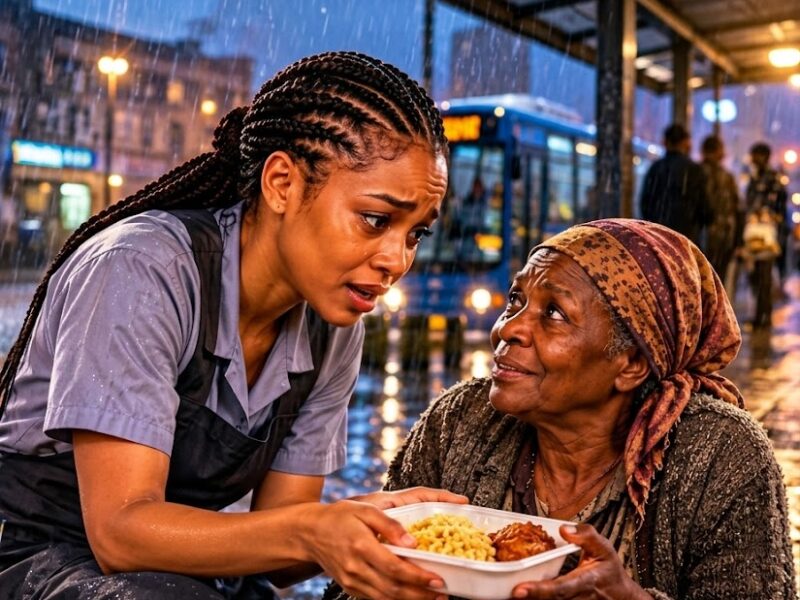
She Shared Her Last Meal With a Homeless Woman—By Morning, a Billion-Dollar Secret Was at Her Door
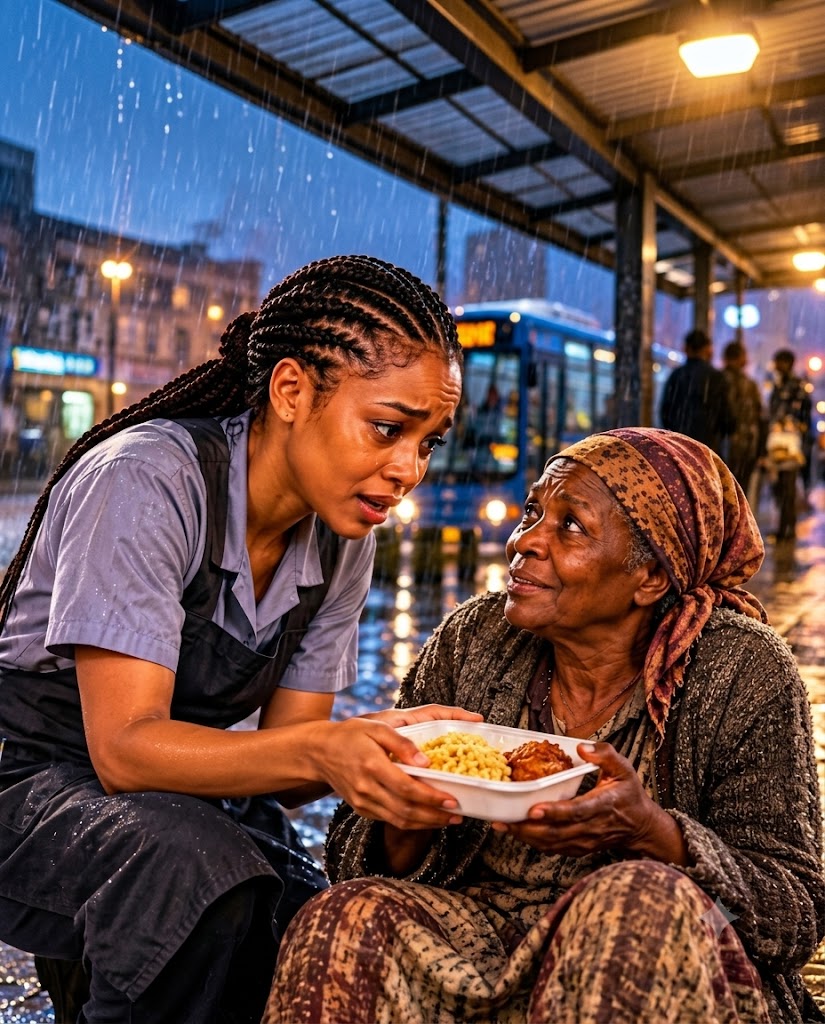
The rain had turned the bus stop into a shallow lake of reflected neon and broken umbrellas.
Amara Ez stood under the fractured shelter, clutching a brown paper bag that held her entire dinner—two pieces of fried plantain and a scoop of jollof rice she’d stretched from yesterday.
She was 90 seconds late for her shift, and her badge already felt like a noose around her neck.
Across the street, a woman sat on a cardboard box, her gray hair plastered to her skull, her eyes fixed on nothing and everything.
Amara looked at her food.
Then at the woman.
Then at her food again.
She crossed the street.
—
“Excuse me, ma’am,” Amara said, her voice nearly lost to the rain.
The woman looked up, and something in her gaze was sharp—too sharp for someone who’d been forgotten by the world.
“Have you eaten?” Amara asked.
The woman tilted her head. “You look hungrier than I am.”
“That’s obvious,” Amara said, and she meant it. “Keep your food, my child. Hunger has visited me before. We know each other.”
Amara knelt on the wet pavement, ignoring the water soaking through her slacks.
“Then tonight hunger can visit both of us.”
She split the rice in half with the plastic spoon.
“You don’t have enough yourself,” the woman said.
“Exactly,” Amara replied. “So don’t ask for too much meat.”
—
The woman laughed—a sound like gravel and bells.
“What would you do if someone gave you $10 million tomorrow?” she asked.
Amara didn’t hesitate. “Sleep. Sleep for one whole day. Poor people are tired, mama.”
“And after sleeping?”
“Send my brother back to school. He’s smarter than he thinks.”
“And for yourself?”
Amara looked at the rain. “Open a restaurant. Small, good food, no fancy nonsense.”
“Why a restaurant?”
“Because hungry people remember who fed them. And I cook better than I clean.”
The woman studied her. “What if it was $50 million?”
Amara froze, spoon halfway to her mouth.
“Mama, now you’re becoming dangerous. Finish your rice first.”
But the woman waited.
“If I had that kind of money,” Amara said slowly, “my brother wouldn’t have to worry about school again. And I’d still open the restaurant.”
“Still?”
“Money should change problems, not personality.”
“You trust yourself with money?”
“No.” Amara shook her head. “No. That’s why I’d write everything down.”
—
The woman reached out and touched Amara’s wrist.
“Someone taught you that,” she said.
“Life is a very patient teacher.”
“You don’t know me,” the woman said.
“No. And you still shared your dinner.”
“I didn’t need your biography to know you were hungry.”
—
From a black sedan parked across the street, a man in a suit watched through binoculars.
“Madam,” he said into his earpiece, “should I keep watching?”
“Yes,” came the reply. “I want to know who she is when kindness costs her something.”
—
Amara arrived at Cole Meridian headquarters 90 seconds late.
The executive floor smelled like lemon polish and old money.
She swiped her badge at the service entrance—the one cleaners used, the one that led to the basement locker room.
“You’re late by 90 seconds,” a voice said.
She turned.
Adrien Cole stood there, his tie perfectly knotted, his eyes unreadable.
“Your grandmother would call that a crisis,” he said.
“Your grandmother built the empire. One day, you’ll be the one protecting it.”
“Grandmother hasn’t said anything about stepping down.”
“She doesn’t have to. Everyone eventually chooses what comes next.”
“Yes. Not yet.”
—
Amara changed into her uniform—gray slacks, gray shirt, gray life.
She mopped the executive corridor, her footsteps leaving faint marks on the marble.
“Excuse me,” a man said behind her. “Yes, you forgot something.”
She turned.
Richard Cole—Evelyn’s son, Adrien’s father—pointed at the floor.
“The mark on the floor, sir. Your footprints.”
“Relax. I’m not asking you to clean it.”
“That would have been an unusual request.”
“But memorable.”
He walked away.
—
Amara found the envelope in the executive conference room at 11:47 PM.
It was thick, unmarked, and heavy in a way that made her stomach drop.
She opened it.
Inside: $500,000 in cash.
She stared at the bills for a long time.
Then she zipped the envelope, walked to the security desk, and handed it over.
“I found this in the executive conference room,” she said.
The guard blinked. “Did you open it?”
“Yes.”
“You could have walked out with this.”
“I know. That’s why I brought it here.”
—
The next morning, Evelyn Cole—founder of Cole Meridian, billionaire, legend—summoned Amara to her office.
“You found this?” Evelyn asked, holding the envelope.
“Yes.”
“You opened it.”
“Yes.”
“And you still brought it back.”
“It wasn’t mine.”
“$500,000 for your honesty.”
“No.”
“You’re refusing $500,000.”
“I returned your money. I didn’t sell you honesty.”
“Everyone has a price.”
“Maybe you just haven’t found mine.”
—
Evelyn smiled.
“You found it,” she said.
“Someone else did. Your cleaner is interesting.”
“Amara,” Evelyn said. “You remember her?”
“She made sure I would.”
—
Three months earlier, Amara had shared half her dinner with a stranger.
Now, that stranger sat across from her, holding the keys to an empire.
“You told Adrien about love,” Evelyn said. “About stopping someone before they ruin themselves.”
“I remember.”
“Remember what you said about your brother? About how you’d help him face it, not hide it?”
“Yes.”
“Hiding wrong doesn’t make it right. Even if telling the truth hurts him—especially then. Sometimes love is stopping someone before they ruin themselves.”
Amara’s hands trembled.
“I found something,” Evelyn said. “And I need you to help me understand it.”
—
The files were spread across the conference table.
420 families.
Relocation plans.
Approvals that didn’t match.
“These families were left out of the summary,” Evelyn said. “The board approved an incomplete picture.”
“Why wasn’t this in the board packet?”
“Because it complicated the decision.”
—
Amara spent the next week in the field.
She interviewed 37 residents.
She documented everything—names, dates, concerns, evidence.
“Most said relocation plans were unclear,” she reported to the project committee.
“What percentage oppose the current plan?” someone asked.
“I didn’t calculate it that way.”
“Then what are we deciding from?”
“I don’t have the percentage. That’s my mistake. But I can tell you exactly what we still haven’t asked them.”
—
Adrien watched from the back of the room.
“You understand people better than most people in that room,” he said afterward. “Now learn how to make them hear you.”
“Again,” Amara said to the committee. “16 residents said the proposed relocation would increase travel costs. 11 said the new rent would exceed what they can sustain. So, we redesign before we relocate.”
“That was better.”
“Careful. Compliments might damage your reputation.”
“You earned that one.”
—
The transport problem changed everything.
“Most of them work this side of the city,” Amara said.
“How long does your commute take now?” Adrien asked a resident.
“About 40 minutes.”
“From the proposed site?”
“Nearly 2 hours.”
“Relocation isn’t just rent. It’s time, transport, everything connected.”
“Put that in the recommendation,” Evelyn said.
“Our recommendation.”
“Yours.”
—
The board approved the redesign.
Adrien walked Amara to her bus stop.
“You’re different outside that building,” he said.
“How?”
“Less like a spreadsheet.”
“That might be the nicest thing you’ve said to me.”
“Waiting for Adrien?”
“Not anymore.”
—
Vanessa Cole—Adrien’s wife—watched from her car.
“Everything all right?” she asked.
“Of course.”
“Why are you smiling?”
“I’m not.”
—
The old accounts surfaced three weeks later.
Transfers.
Approvals.
Richard Cole’s name.
Adrien’s name.
“Evelyn is asking questions,” Richard said.
“About what?”
“Old transfers.”
“When? Why now? How far back?”
“Far enough.”
—
“Don’t touch anything,” Richard said. “Not yet.”
“Evelyn reopened the old accounts.”
“Then we have a problem.”
“Tell me exactly what Evelyn could find.”
“Transfers, approvals, my name—and Richard’s.”
“His too.”
—
Amara’s brother, Chitty, received a scholarship notification.
$19,500.
“Show me the scholarship message,” Amara said.
“I didn’t send that,” Chitty said. “This message shows my account. I never wrote it.”
“Don’t delete anything. We verify first.”
—
The timestamp was wrong.
“You were in the field when this was sent,” Adrien said.
“So you believe me?”
“I believe this doesn’t fit.”
—
“There’s another message from my account,” Chitty said. “I didn’t send this either.”
“I need the original access records, not the summarized version.”
“Adrien is checking the access logs.”
“Let him. He’ll find the inconsistencies.”
“That is exactly what he should find.”
—
Amara was suspended pending investigation.
“Until this is resolved, you’ll need to answer some questions,” Adrien said.
“There are several inconsistencies.”
“Then investigate them.”
“We need temporary access restrictions.”
“Temporary—until we know what happened.”
“Do you believe I did this?”
“I believe the evidence is incomplete.”
“That wasn’t my question.”
“I have to protect the company.”
“From me. That’s what you’re saying.”
—
“Leave the building today,” Adrien said.
“You brought me here.”
“I know.”
“You said character mattered.”
“It does.”
“Amara—”
“Don’t. Not until you know which side you’re on.”
—
Chitty called her 29 times.
She didn’t answer.
“She lost everything because of me,” he said.
“No,” Amara said finally. “I lost a job. I did not lose you. Don’t make me chase another boss today.”
“I can carry it.”
“I know.”
“I’m still sorry.”
“Good. Stay sorry at home.”
—
The session didn’t begin from Amara’s workstation.
“Where?” Adrien asked.
“Executive Network.”
“No.”
“You knew something was wrong. You let Amara leave anyway.”
“I needed whoever did this to believe the plan worked.”
“The original approval came from his office.”
“My father.”
—
Adrien traced the original approval.
It came from Richard’s office.
“I built this company, too,” Richard said.
“That wasn’t permission.”
“Your grandmother always intended everything for you.”
“What was I supposed to inherit? I took what should have been mine.”
“And Amara? She became useful.”
“Love doesn’t make you innocent.”
—
“I helped them,” Adrien said. “Not because of Amara. My father helped Richard years ago. I thought I could protect him. I kept telling myself family loyalty made it different.”
“It didn’t.”
“I know that now.”
“You should tell Evelyn everything.”
—
“You believed me,” Amara said. “Then why send me away?”
“Because I needed them to believe they had succeeded.”
“You used me.”
“Yes. And I was wrong to believe the result justified it. I am sorry.”
“I’m not ready to forgive you.”
“You shouldn’t pretend to be.”
—
Evelyn Cole addressed the board one final time.
“No call will inherit this company automatically. Control will answer to governance, not blood. And a major share will support housing, education, training, and small businesses.”
—
Amara returned to campus.
“Study,” Adrien said.
“Bossy.”
“Dinner tomorrow.”
“Is that a meeting?”
“A date?”
“Tomorrow.”
—
The restaurant was small, good food, no fancy nonsense.
Amara cooked.
Adrien ate.
“You know,” he said, “you never told me what you’d do with $50 million.”
“I told you. Open a restaurant. Send Chitty to school. Write everything down.”
“And what about the rest?”
She looked at him.
“Money should change problems, not personality.”
—
Outside, the rain had stopped.
A woman sat on a cardboard box across the street.
Amara walked out with a plate of food.
“Have you eaten?” she asked.
The woman looked up.
“You look hungrier than I am,” she said.
“That’s obvious.”
—
**Character is who you are when kindness costs you something.**
—









