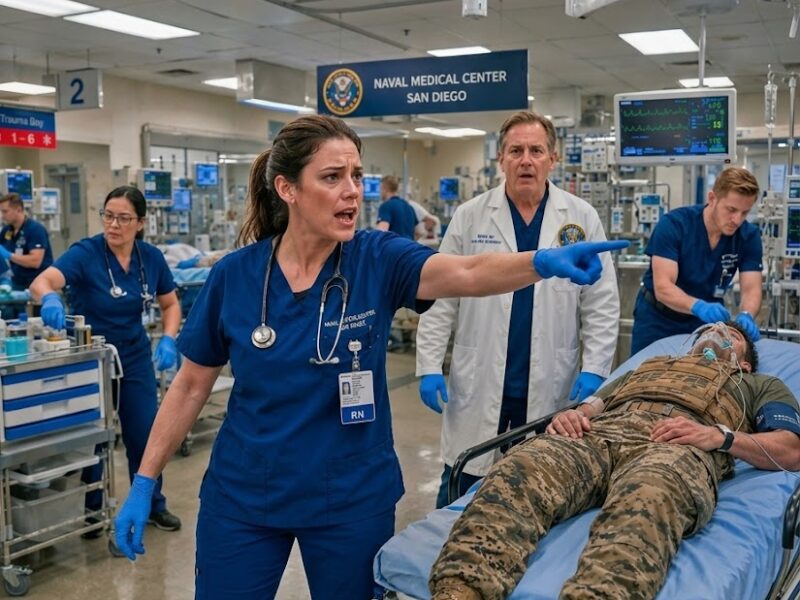
She Saved 10 Patients During One Chaotic Hour—Then a SEAL Admiral Called Her “Phoenix” Before Everyone
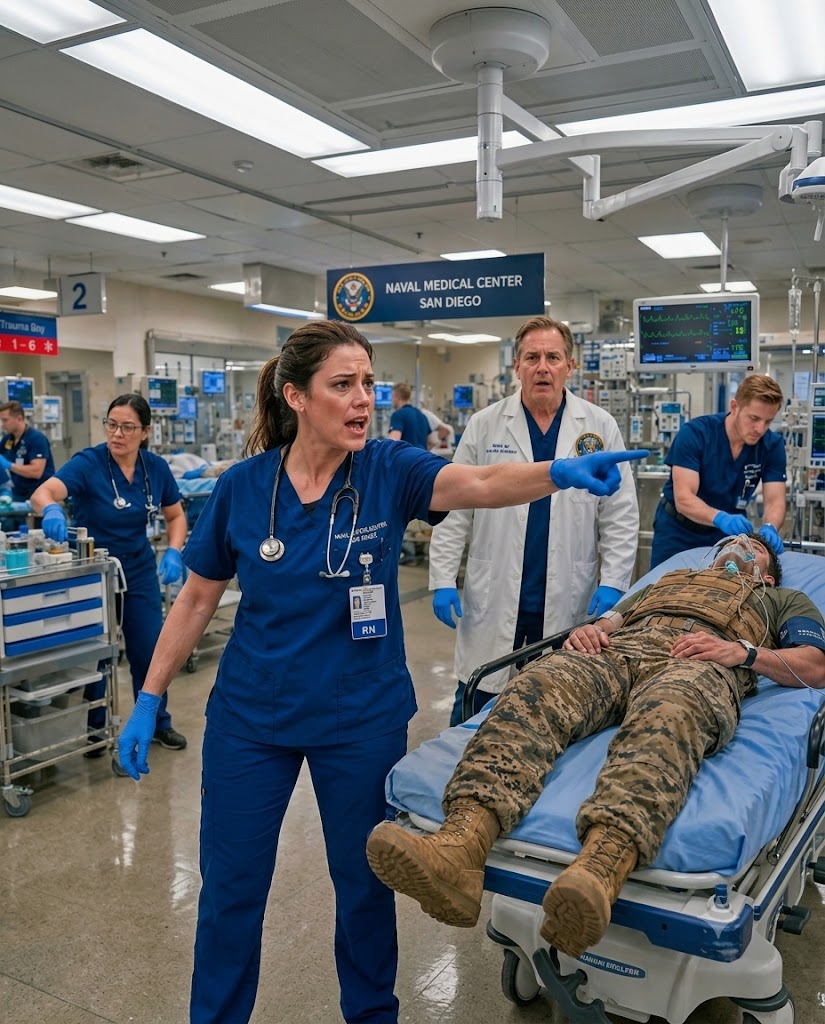
Blood pooled on the sterile linoleum, slipping beneath her sneakers as the alarms of ten critical monitors screamed in unison.
They told her to wait for the doctors.
They told her to follow protocol.
But in the next sixty minutes, nurse Megan Riley didn’t just break the rules—she shattered them.
It was exactly 10:15 a.m. on a brisk Tuesday morning at the Naval Medical Center San Diego, affectionately known as Balboa Hospital by the locals.
The fog rolling off the Pacific had just begun to burn away, revealing a pristine blue sky over the sprawling military medical complex.
But inside the cramped, windowless office of the director of nursing, the atmosphere was suffocatingly tense.
Megan Riley, a thirty-one-year-old civilian trauma nurse, sat with her spine rigid, her hands folded tightly in her lap.
Her scrubs were still slightly wrinkled from a grueling twelve-hour night shift, and the lingering scent of antiseptic and stale coffee clung to her.
Across the desk sat Brenda Collins, a woman who treated hospital protocol like holy scripture.
Standing beside Brenda, arms crossed in defensive arrogance, was Dr. Richard Klein, the chief of trauma surgery.
“You overstepped your bounds, Nurse Riley,” Brenda said, her voice dropping to a dangerous icy register.
She pushed a single sheet of paper across the desk.
It was an official reprimand, stamped in stark red ink.
“You countermanded a physician’s order in the middle of a critical resuscitation.”
The resident froze.
Megan fired back, refusing to break eye contact.
“Petty Officer Miller was in ventricular fibrillation. The resident, who is three months out of med school, hesitated on the defibrillator and told me to wait for Dr. Klein. Miller didn’t have time to wait for Dr. Klein to finish his golf swing on the back nine. I pushed the epinephrine, and I shocked him. His heart is beating this morning because of it.”
“You are a civilian contractor,” Dr. Klein snapped, leaning forward.
His impeccably pressed white coat seemed to mock Megan’s sweat-stained scrubs.
“You do not practice medicine in this hospital. You follow orders. If you want to play cowboy, go back to the trauma wards in Chicago. Here, we operate with a chain of command.”
Megan bit the inside of her cheek until she tasted copper.
She had spent five years in the blood-soaked ERs of Cook County Hospital before transferring to San Diego seeking a change of pace.
She knew trauma.
She knew the golden hour.
Most importantly, she knew the difference between following the rules and saving a life.
“I saved his life,” Megan repeated, her voice low and steady.
“You got lucky,” Brenda countered, tapping a manicured fingernail against the reprimand.
“Effective at noon today, you are suspended without pay for two weeks pending a full medical board review. Clear out your locker, Megan. You’re done for the day.”
Megan stared at the paper.
Two weeks without pay.
A permanent black mark on her record.
A review board that would almost certainly terminate her contract.
She swallowed the lump of hot anger rising in her throat, stood up without a word, and walked out of the office.
She navigated the bustling corridors of the ER feeling the sympathetic and sometimes judgmental glances of her colleagues.
Word traveled fast in a hospital.
By 10:40 a.m., Megan was in the staff locker room aggressively throwing her stethoscope, her extra scrubs, and her worn copy of a pocket medical guide into a cardboard box.
She glanced at the digital clock on the wall.
10:44 a.m.
One hour and sixteen minutes until her suspension officially took effect.
She zipped her jacket, grabbed her box, and turned toward the exit.
Then, the world shattered.
It didn’t sound like a bomb.
It sounded like the earth itself was tearing apart.
A deafening, low-frequency roar vibrated through the concrete foundation of the hospital.
The locker room walls bowed inward for a fraction of a second before the shock wave hit.
Fluorescent lights flickered, popped, and rained sparks down onto the linoleum.
Medical trays in the adjacent hallway crashed to the floor with a terrifying clatter.
Megan dropped her box.
Her instincts, forged in the fires of inner-city trauma centers, instantly overrode her shock.
She burst out of the locker room and sprinted toward the main floor of the emergency department.
Through the large reinforced windows of the ambulance bay, a massive pillar of thick, oily black smoke was rising over the horizon, directly originating from the direction of Pier 32 at Naval Base San Diego.
The emergency radio on the main desk crackled to life.
The dispatcher’s voice, frantic and distorted by static, cut through the chaos.
“Code triage. Code triage. Massive explosion at Pier 32 dry docks during a joint SEAL training exercise. Multiple casualties. Severe trauma. ETA of first transport ASAP. Right now.”
The ER doors blew open.
The wail of sirens was deafening.
The first vehicle to arrive wasn’t an ambulance.
It was a military flatbed truck, tires screeching as it slammed to a halt in the ambulance bay.
Half a dozen soot-stained sailors jumped out, pulling bodies off the bed of the truck.
Chaos erupted in the ER.
The sheer volume of blood and catastrophic injury was overwhelming.
Medical personnel scrambled, shouting over one another.
Doctor Klein emerged from his office, his face pale as he took in the carnage.
For all his textbooks and protocols, Klein was a peacetime surgeon.
He stared at a sailor whose leg was a mangled mess of shrapnel and bone, and for three crucial seconds, the chief of trauma froze.
Megan looked at the clock.
10:51 a.m.
She was still technically on the clock.
She ripped off her jacket, threw it onto the nearest chair, and grabbed a handful of colored triage tags from the trauma cart.
“Listen up!” Megan roared, her voice cutting through the panic like a scalpel.
She pointed at two junior corpsmen.
“You two, grab gurneys! Klein, snap out of it. Take trauma bay one!”
She didn’t wait for permission.
She moved to the first two patients being dragged through the doors.
10:55 a.m. Patients one and two.
Two Navy mechanics peppered with shrapnel from what looked like a ruptured pressure valve.
One was screaming, the other was silent.
Megan tagged the screaming man with a yellow tag.
He was loud, which meant his airway was clear.
She dropped to her knees beside the silent one.
His chest was barely rising.
“Sucking chest wound,” Megan diagnosed instantly.
“Corpsman, Asher valve, now! Tape it down on three sides.”
She guided the trembling corpsman’s hands, sealing the wound before moving on.
11:02 a.m. Patient three.
A young man wearing shredded tactical gear was wheeled in.
His face was unrecognizable, covered in grease, soot, and blood.
His lips were turning a terrifying shade of blue, and his neck veins were bulging.
“He can’t breathe!” a frantic EMT shouted.
“Airway is clear, but he’s fighting for air.”
Megan placed her stethoscope on his left chest.
Silence.
“Tension pneumothorax,” Megan said.
The blast wave had popped his lung, trapping air in the chest cavity and crushing his heart.
She looked around.
“I need a doctor for a chest tube.”
“Klein is maxed out in bay one,” a nurse yelled back.
The soldier’s eyes rolled back.
His heart monitor let out a continuous flatline squeal.
Megan didn’t hesitate.
Protocol dictated she wait for a surgeon.
Protocol would kill this man in thirty seconds.
She snatched a massive fourteen-gauge angiocath needle from a supply cart.
Finding the second intercostal space on his collarbone, she drove the needle deep into his chest.
A loud hiss of trapped air escaped.
The monitor immediately blipped back to a rhythmic rhythm.
The soldier gasped, his chest rising freely.
“Secure that needle and get him on oxygen,” Megan barked, already running to the next gurney.
11:15 a.m. Patients four, five, and six.
Three civilian contractors caught in a flash fire caused by the explosion.
Their skin was blistering, peeling away in horrific sheets.
They were in profound hypovolemic shock, their blood pressure crashing as their bodies lost fluids at a massive rate.
“We need IV access, but their veins are collapsed,” a junior nurse cried, holding a needle uselessly over a burned arm.
“Don’t go for the arms. Go for the bone,” Megan instructed.
She grabbed an intraosseous drill.
With practiced precision, she drilled the needle directly into the shin bone of the first patient, establishing a direct line into the marrow.
She did the same for the second and third.
“Hang lactated ringers wide open. Push fentanyl for the pain.”
11:28 a.m. Patient seven.
The ER floors were slick with blood.
A young sailor was bleeding out from a deep laceration to his femoral artery.
A first-year surgical resident was pressing a handful of gauze against the wound, completely panicked, tears streaming down his face as blood jetted past his fingers, hitting the ceiling tiles.
“I can’t stop it,” the resident sobbed.
“I don’t know what to do.”
Megan shoved him aside.
Gauze wouldn’t stop an arterial bleed of this magnitude.
She bypassed the sterile gloves, shoving her bare hands directly into the gaping wound, pushing through muscle and tissue until her fingers found the severed, pulsing tube of the femoral artery.
She pinched it shut with her index finger and thumb.
The geyser of blood instantly stopped.
“Clamp!” Megan demanded quietly.
The resident stared at her, dumbfounded.
“I said clamp!” she roared.
The resident fumbled, handed her a hemostat, and she clamped the artery shut.
“Get him to the OR. Now.”
11:40 a.m. Patients eight and nine.
The volume of casualties was climbing.
The hospital was running out of O-negative blood.
Megan coordinated a massive transfusion protocol, acting as the conductor of a terrifying orchestra.
She managed two patients simultaneously, one with severe head trauma requiring immediate intubation, the other with a crushed pelvis.
She pushed paralytics, guided a terrified respiratory therapist through the intubation process, and packed the pelvic wound with hemostatic dressings to buy the patient time.
She was covered in blood up to her elbows.
Her breathing was ragged.
She glanced at the wall clock.
11:51 a.m.
Then, the tenth patient arrived.
He was brought in on a standard canvas military litter, carried by two men in heavily armored tactical gear, who refused to leave his side.
The patient was a massive man, muscular, but his torso was a mess of torn flesh and embedded metal.
A piece of jagged steel rebar had pierced straight through his upper right quadrant.
“Who is this?” Megan demanded, rushing over with the trauma shears.
“Classified,” one of the tactical operators growled, his hand resting on his sidearm.
“Save him! I don’t care if he’s the Pope, I need a blood type,” Megan yelled back, cutting away the shredded remnants of his uniform.
There were no dog tags, no identifying markers, just a strange, intricate tattoo of an eagle clutching a trident on his left shoulder.
“Blood pressure is tanking, sixty over forty,” the bedside monitor warned.
The rebar was acting as a plug, but internal bleeding was drowning his organs.
Megan realized with a sickening drop in her stomach that the steel rod was resting directly against his inferior vena cava, the largest vein in the body.
If it shifted even a millimeter, he would bleed out internally in seconds.
“Klein!” Megan screamed across the room.
“I need you here, now!”
Dr. Klein jogged over, wiping sweat from his forehead.
He took one look at the rebar and went pale.
“We have to pull it out and pack the liver.”
“No!” Megan grabbed Klein’s wrist before he could touch the metal.
“It’s resting on the vena cava. If you pull it, you open the floodgates. He’ll die on this table.”
“I’m the chief of trauma,” Klein snarled, trying to shake her off.
“Let go of me, Riley. Look at the ultrasound.”
Megan reached over with her free hand, slapping the portable ultrasound probe against the man’s abdomen.
The screen lit up, showing a massive pool of black blood and the bright white reflection of the metal rod pressing dangerously against the pulsing vein.
Klein stared at the screen, swallowing hard.
He realized she was right.
If he had pulled it, the man would have died instantly.
“What do we do?” the chief of trauma whispered, deferring to the civilian nurse.
“We move him to the OR as is. We open his chest, bypass the vein, and pull it from the top down,” Megan said, her voice dead calm.
11:59 a.m.
Megan kept her hands clamped firmly around the base of the rebar, holding it perfectly still as they carefully navigated the gurney through the crowded ER toward the surgical elevators.
The tactical operators flanked them, eyes locked on Megan’s bloody hands.
The elevator doors opened.
They pushed the gurney inside.
Megan looked at the clock above the nurse’s station just as the doors slid shut.
12:00 p.m.
Her suspension had officially begun.
In the span of exactly one hour, Megan Riley had touched, triaged, and single-handedly stabilized ten critical patients who would have otherwise left in body bags.
As the elevator began its ascent to the operating rooms, a heavy silence fell over the main floor of the ER.
The immediate rush of patients had ceased.
The medical staff stood amidst the wreckage of discarded gauze, blood-soaked wrappers, and overturned trays, catching their breath.
But the quiet didn’t last.
At 12:05 p.m., the glass doors of the ER didn’t just open—they were held open.
Heavy combat boots echoed against the linoleum.
Two dozen heavily armed Navy Masters at Arms flooded the waiting room, forming a perimeter.
Behind them, walking with a terrifying slow deliberation, was a man in immaculate Navy service dress khakis.
The silver stars of an admiral gleamed on his collar.
He bypassed the triage desk, ignoring the frantic protests of Brenda Collins, who had finally emerged from her safe office.
“Where?” Admiral James H. Atwood demanded, his voice echoing through the silent, bloody trauma ward, “is the nurse who just treated the man with the rebar?”
The silence in the emergency department was so absolute that the slow, steady drip of an overturned IV bag hitting the floor sounded like a metronome ticking down to an explosion.
Admiral James H. Atwood did not look like a man who asked questions twice.
His face was a map of deep-set lines carved by decades of wartime command.
Behind him, the perimeter of armed Masters at Arms stood like statues, their hands resting on their rifles.
The hospital staff, still trembling from the adrenaline of the past hour, parted for him like the Red Sea.
Brenda Collins, smoothing her immaculate skirt, stepped forward.
She plastered on a practiced diplomatic smile, clearly attempting to reassert her authority over her chaotic domain.
“Admiral Atwood, I am Brenda Collins, the director of nursing for Balboa,” she said, her voice dripping with artificial professional warmth.
“I understand there has been a catastrophic incident, but this area is restricted to—”
“I did not ask for a tour, Ms. Collins,” Atwood interrupted, his voice a low, gravelly rumble that barely carried over the ambient hum of the hospital, yet demanded total obedience.
“I asked for the name of the nurse who dragged my man off the transport and kept a steel rod from shredding his vena cava.”
Dr. Richard Klein, still pale and visibly shaking, stepped out from behind the nurse’s station.
He saw an opportunity to save his own skin and seized it.
“Admiral, her name is Megan Riley, but you must understand she is a civilian contractor. She acted entirely out of turn. She circumvented the chain of command, assaulted a surgical resident, and—”
Brenda interjected, her eyes flashing with vindictive triumph.
“She was officially suspended from duty at exactly 1200 hours today for severe insubordination. Whatever she did to your man, she did it without the legal backing of this hospital. We take no liability for her rogue actions.”
Atwood slowly turned his head to look at Brenda, then at Klein.
His eyes were like chips of flint.
“Liability,” he repeated softly, testing the word on his tongue as if it tasted like ash.
Before the admiral could dress them down, the heavy metal doors of the surgical elevator chimed and slid open.
Megan Riley walked out.
She looked like she had just walked through a slaughterhouse.
Her blue scrubs were stained entirely crimson and dark brown.
Her hair was matted to her forehead with sweat, and her hands were violently shaking as the pure, unadulterated adrenaline of the last sixty minutes finally began to crash.
She was wiping her forearms with a sterile towel, staring blankly at the floor.
“Riley,” Klein barked, his voice cracking slightly.
“Get over here.”
Megan looked up.
She stopped dead in her tracks, taking in the wall of heavily armed military police, the terrified faces of her colleagues, and the imposing figure of Admiral Atwood staring directly at her.
She had left the tenth patient, the massive tattooed man, in the capable hands of Dr. Aris, the chief cardiothoracic surgeon, just seconds before the clock struck 12:03 p.m.
She had held the rebar perfectly steady while they opened his chest, only letting go when the vascular clamps were securely in place.
She had done her job, but looking at the admiral and seeing the smug satisfaction on Brenda’s face, Megan knew what this was.
She was going to be arrested.
“Nurse Riley,” Brenda said, her tone dripping with mock pity.
“I told you to clear out your locker at 10:40 a.m. You defied a direct order, and now you’ve assaulted federal personnel. The military police are here to escort you off the premises.”
Megan didn’t look at Brenda.
She didn’t look at Dr. Klein.
She walked straight toward Admiral Atwood, stopping two feet away from him.
She squared her shoulders, ignoring the way the guards tightened their grips on their weapons.
“The patient is in OR three,” Megan said, her voice raw and hoarse, stripping away all titles and formalities.
“Dr. Aris is performing the extraction from the superior approach. His blood pressure stabilized at one-ten over seventy before I left the room. We pumped six units of O-negative into him. The rebar didn’t pierce the vein. It was just compressing it. He’s going to make it.”
Atwood stared at her.
He looked at her blood-soaked hands, then up to her exhausted, bloodshot eyes.
“Are you the one who performed a needle decompression on a tension pneumothorax in bay two?”
“Yes,” Megan said flatly.
“Did you drill into the shin bones of three burn victims when their veins collapsed?”
“Intraosseous infusion. Yes, they were crashing.”
“Did you shove your bare hand into the thigh of Petty Officer Miller to clamp a ruptured femoral artery?”
“The resident was using gauze,” Megan replied, a hint of defensive anger finally leaking into her tone.
“Gauze doesn’t stop an arterial geyser, Admiral. Action does.”
Dr. Klein stepped forward, pointing an accusing finger.
“She bypassed protocol. She is a liability to this institution. Admiral, I demand she be removed immediately before she causes a malpractice suit that sinks this entire hospital.”
Atwood didn’t even look at Klein.
He simply raised one large, calloused hand.
The gesture was so commanding that Klein’s mouth snapped shut instantly.
The Admiral took a slow step closer to Megan.
The entire ER held its collective breath.
Brenda’s smile widened.
She was waiting for the verbal execution.
“The man you pushed into that operating theater, Nurse Riley,” Atwood began, his voice dropping to a whisper that carried immense, devastating weight, “is Commander David Hayes. He is the leader of a highly classified maritime strike team. He is also my son-in-law.”
Megan swallowed hard, but she didn’t break eye contact.
“At 10:45 a.m.,” Atwood continued, turning slightly so his voice carried across the silent triage floor, “a prototype hyperbaric generator detonated during a classified loading exercise at Pier 32. Ten men were caught in the blast radius. Ten of the most elite, highly trained operators in the United States military. Men who have survived deployments in places that don’t exist on any map.”
Atwood finally turned his terrifying gaze onto Brenda Collins and Dr. Klein.
“I was in the command center,” Atwood said, his voice rising, filling the room with the crackling authority of a warship captain.
“I listened to the comms. I heard the medical dispatch. I arrived here expecting to be handed ten body bags because the trauma alerts indicated catastrophic non-survivable injuries.”
He walked slowly toward Dr. Klein.
The chief of surgery shrank back against the desk.
“I reviewed the security footage from the ambulance bay while I was in transit, Dr. Klein,” Atwood snarled, his face inches from the terrified doctor.
“I watched you stand over a bleeding sailor and freeze. I watched a civilian nurse order you to do your damn job while she ran this floor like a combat general. You didn’t save my men today. Your protocol didn’t save my men.”
Atwood turned to Brenda, who was suddenly looking incredibly small in her designer suit.
“And you, Ms. Collins?” Atwood said, his tone laced with absolute disgust.
“You suspended the only person in this building who remembered what a hospital is actually for. You care about liability? Let’s talk about liability. If my son-in-law had died because this nurse waited for your chief of surgery to find his courage, I wouldn’t have sued this hospital. I would have had it leveled to the foundation.”
Brenda opened her mouth, stammering, “Admiral, the rules. The guidelines of the medical board. The—”
“The medical board does not outrank the United States Navy in a federal facility during a mass casualty event,” Atwood roared, the sound echoing off the tile walls.
The admiral turned his back on the administrators, dismissing them entirely, and walked back to Megan.
The heavy, intimidating aura around him softened just a fraction, replaced by something that looked remarkably like profound reverence.
He reached into his breast pocket and pulled out a crisp, white envelope.
“They told me you were reckless, Nurse Riley,” Atwood said quietly, for her ears alone.
“They told me you were a pariah who didn’t respect the chain of command. But when I looked at the footage, when I look at you right now, covered in the blood of American heroes you refused to let die, I don’t see a pariah.”
He paused, looking at the crimson stains on her scrubs.
“I don’t see a pariah,” the admiral said, his voice thick with emotion.
“I see a phoenix rising from the smoke, the chaos, and the fire to bring my men back from the ashes.”
Megan felt a sudden sharp sting behind her eyes.
After an hour of holding back death through sheer force of will, the acknowledgement broke through her hardened armor.
A single tear cut a clean line down her soot-stained cheek.
Atwood held out the envelope.
Megan hesitated, then took it with shaking hands.
“What is this?” she whispered.
“A transfer order,” Atwood replied loud enough for the entire room to hear.
“Effective at 12:00 p.m. today, you are no longer a civilian contractor for Balboa Naval Hospital. Therefore, Ms. Collins cannot suspend you.”
Brenda gasped in the background, but Atwood ignored her.
“Effective at 12:01 p.m.,” Atwood continued, “you were drafted by executive military authority into the Department of Defense Special Operations Medical Command. You are now the lead clinical instructor for Joint Tactical Trauma Training. You will carry the equivalent rank of a major. You will not answer to hospital bureaucrats. You will answer directly to me, and you will teach my medics how to fight the reaper and win exactly the way you did today.”
The ER was so quiet you could hear the distant wail of a police siren miles away.
“Your starting salary has been tripled, Major Riley,” Atwood added with the ghost of a smile.
“And your first order is to go home, take a shower, and sleep for twenty-four hours. My driver is waiting outside to take you.”
Megan looked from the envelope to the admiral.
She looked back at Dr. Klein, whose jaw was practically resting on the floor, and Brenda, whose face had flushed a deep humiliating crimson.
The suspension paper Brenda had been waving around twenty minutes earlier now meant absolutely nothing.
Megan slowly folded the envelope and slipped it into her scrub pocket.
She stood a little taller, the exhaustion momentarily wiped away by a surge of overwhelming vindication.
“Thank you, Admiral,” Megan said, her voice steady and clear.
“No, Major,” Atwood replied, rendering a crisp, textbook military salute to the blood-soaked nurse.
“Thank you.”
As the Admiral’s hand dropped, the two dozen heavily armed Masters at Arms surrounding the perimeter simultaneously snapped to attention, rendering salutes of their own to Megan.
Megan Riley didn’t pack her box.
She didn’t look back at the locker room or the director’s office.
She simply walked out through the automatic doors of the ER, walking past the saluting guards, past the shattered protocols, and out into the bright San Diego sun.
She had walked in that morning as a nurse on the verge of being fired.
She walked out as the Phoenix.
—
The parking lot of Balboa Naval Hospital stretched out before her like a sun-bleached runway, heat shimmering off the asphalt in invisible waves.
Megan stood at the edge of the automatic doors for a long moment, her cardboard box still clutched against her hip, the envelope with her new orders burning a quiet hole in her scrub pocket.
The world outside the ER felt impossibly normal.
A groundskeeper trimmed hedges near the flagpole, the American flag snapping in a gentle offshore breeze.
Two corpsmen jogged past her on the sidewalk, earbuds in, oblivious to the massacre she had just waded through.
She looked down at her hands.
They were still trembling, fine motor shudders that came from the adrenaline debt every trauma nurse eventually paid.
Under her fingernails, dried blood had crusted into dark crescents.
She could still feel the phantom resistance of the rebar against her palms, the way the steel had vibrated with the man’s heartbeat, millimeters from catastrophe.
A black Suburban with tinted windows idled at the curb, its engine purring with the quiet authority of government money.
A driver in a dark suit stepped out and opened the rear door for her without a word.
Megan hesitated.
She had spent her entire career answering to people who wore suits and carried clipboards, people who measured lives in liability percentages and reimbursement codes.
But the man holding the door for her wasn’t a hospital administrator.
He was a shadow, a silent extension of the admiral who had just saluted her in front of everyone.
She climbed in.
The leather seats were cool and smelled faintly of gun oil and coffee.
The driver closed the door and returned to his position behind the wheel.
As they pulled away from the hospital, Megan watched the sprawling medical complex recede in the rearview mirror.
Somewhere on the fourth floor, Dr. Aris was still wrist-deep in Commander Hayes’s chest, coaxing a shattered man back from the edge.
Somewhere in the ICU, nine other sailors were clinging to life because of decisions she had made in the span of sixty impossible minutes.
And somewhere in a windowless office, Brenda Collins and Dr. Richard Klein were staring at the wreckage of their carefully constructed authority.
Megan leaned her head back against the headrest and closed her eyes.
She didn’t sleep.
Every time she tried, she saw the blood again, the flatline, the geyser of arterial spray hitting ceiling tiles.
She saw the silent soldier with the tension pneumothorax, his veins bulging, his eyes rolling back.
She saw the burned contractors, their skin sloughing off in sheets like wet paper.
She saw the rebar, that jagged finger of steel, resting against the vena cava of a man whose name she hadn’t even known until the admiral spoke it.
Commander David Hayes.
A SEAL team leader with a classified strike team and a father-in-law who commanded the entire Pacific Fleet’s medical operations.
She had saved him with her bare hands and a refusal to let go.
The Suburban glided through the streets of San Diego, past palm trees and taco stands and tourists in flip-flops who had no idea that ten miles away, a bomb had nearly rewritten the history of naval special warfare.
Megan’s phone buzzed in her pocket.
She pulled it out and saw a string of text messages from her colleagues.
The first was from a fellow ER nurse, a woman named Patricia who had worked the floor with her for two years.
*”Girl, the whole hospital is talking about you. Brenda looks like she swallowed a lemon. Klein won’t come out of his office. What the hell happened??”*
The second was from a corpsman she had guided through the chest tube procedure.
*”Ma’am, I just wanted to say thank you. I was so scared I couldn’t think. You saved those men. You saved me too.”*
The third was from an unknown number.
*”Major Riley, this is Commander Hayes’s executive officer. He wanted you to know that the Commander is out of surgery and expected to make a full recovery. He also wanted you to know that he owes you his life. He doesn’t say that to anyone. Thank you.”*
Megan stared at the screen until the words blurred.
She typed back a single word to the unknown number.
*”Good.”*
Then she put the phone down and watched the Pacific glitter on the horizon.
—
Her apartment was a small one-bedroom in a complex called Sunset Cove, a beige stucco building with a dying palm tree in the courtyard and a mailbox that never quite latched.
Megan let herself in, dropped the cardboard box on the kitchen counter, and stood in the middle of her living room for a full minute without moving.
The silence was deafening after the chaos of the ER.
Her ears still rang with the ghost of alarms and shouting.
She peeled off her scrubs, which were stiff with dried blood, and stepped into the shower.
The water ran pink for a long time.
She scrubbed her hands until they were raw, until the smell of antiseptic and iron finally faded.
When she stepped out, wrapped in a towel, she caught her reflection in the bathroom mirror.
She looked older than she had that morning.
The lines around her eyes seemed deeper, the set of her jaw more resolute.
She had walked into Brenda Collins’s office expecting to be fired.
She had walked out with a promotion, a new rank, and the respect of an admiral who commanded fleets.
But the thing that stayed with her, the thing that made her chest tighten with something she couldn’t quite name, was the memory of those ten men.
Ten strangers who had been caught in the wrong place at the wrong time, who had been hauled through the doors of Balboa on flatbeds and gurneys, their bodies broken, their futures uncertain.
She had touched all of them.
She had made split-second decisions that would determine whether they lived or died.
And they had lived.
All ten of them.
She pulled on a pair of sweatpants and an old Navy sweatshirt she had bought at the exchange years ago.
She made a cup of coffee, black, and sat on her small balcony, watching the sun climb higher over the city.
The fog had burned off completely now, leaving a sky so blue it looked painted.
Her phone buzzed again.
This time, it was a call from a number she didn’t recognize, with a Virginia area code.
She answered.
“Major Riley?” The voice on the other end was crisp, professional, female.
“This is Lieutenant Commander Sarah Chen, Admiral Atwood’s aide. The Admiral wanted me to confirm that your transfer orders have been processed. You are expected at Joint Base Pearl Harbor-Hickam in seventy-two hours for orientation.”
Megan blinked.
“Pearl Harbor?”
“Yes, ma’am. The Joint Tactical Trauma Training facility is located there. You’ll be working with SEAL teams, Marine Recon, and other special operations units. The Admiral has also requested that you be made available for a debriefing on today’s events at your earliest convenience.”
Megan took a sip of her coffee.
“Tell the Admiral I’ll be there.”
“Very good, ma’am. Your flight information will be emailed to you within the hour. Welcome to Special Operations Medical Command, Major.”
The line went dead.
Megan set the phone down on the balcony railing and stared out at the ocean.
Seventy-two hours.
Three days to pack up her life in San Diego and start a new one in Hawaii.
Three days to process the fact that she had gone from a suspended civilian contractor to a major in the Department of Defense in the span of a single morning.
She laughed, a short, sharp sound that surprised her.
It wasn’t a happy laugh.
It was the laugh of someone who had stared into the abyss and watched it blink first.
—
The next morning, Megan woke at 6:00 a.m. out of habit, her body still tuned to the rhythm of twelve-hour shifts.
She lay in bed for a long moment, listening to the distant hum of traffic and the occasional cry of a seagull.
Then she got up, made coffee, and started packing.
She didn’t have much.
A few clothes, some books, a framed photograph of her parents on their wedding day.
Her mother had been a nurse too, a surgical nurse at a small hospital in Ohio.
She had died when Megan was sixteen, a heart attack that came out of nowhere and took her in the middle of a shift.
Megan had been the one to find her, slumped over a chart in the break room, her pen still in her hand.
That was the day Megan had decided to become a nurse.
Not because she wanted to save people, though she did.
But because she wanted to understand why some people lived and some people died, why the universe dealt its cards the way it did.
She had spent fifteen years looking for that answer.
She still didn’t have it.
But she had learned something else along the way.
She had learned that the difference between life and death was often a single decision, made in a fraction of a second, by someone who refused to wait for permission.
She packed the photograph carefully, wrapping it in a t-shirt and placing it at the top of her suitcase.
Then she sat down at her kitchen table and opened her laptop.
She had emails to answer, forms to fill out, a life to dismantle and rebuild.
But first, she wanted to know more about the man she had saved.
Commander David Hayes.
She typed his name into a search engine and found almost nothing.
A few vague references in declassified documents, a mention in a Pentagon press release about a training exercise, a photograph of a tall, broad-shouldered man in a dress uniform receiving a medal from a four-star admiral.
He had eyes like flint and a jaw that looked like it had been carved from granite.
He looked exactly like the kind of man who would lead a classified strike team into places that didn’t exist on any map.
Megan closed the laptop.
She didn’t need to know more.
She had held his life in her hands, felt his heartbeat against her palms, made the decision that kept him on this side of the dirt.
That was enough.
—
The flight to Honolulu was five hours and forty minutes, most of which Megan spent staring out the window at the endless blue of the Pacific.
She had been to Hawaii once before, as a child, on a family vacation that she barely remembered.
Her father had taken her to Pearl Harbor, to the USS Arizona Memorial, and she had stood on the observation deck, looking down at the rusting hull of a battleship that had been sunk before she was born.
She remembered feeling small, insignificant, a single speck in the vast sweep of history.
She felt that way again now, watching the islands rise out of the sea like green jewels on a necklace of turquoise.
But there was something else too, something she hadn’t felt in a long time.
Purpose.
She had spent years patching up broken bodies in crowded ERs, fighting for scraps of funding and respect from administrators who saw her as a cog in a machine.
Now she was being asked to teach.
To pass on everything she had learned in fifteen years of trauma nursing to the men and women who would carry the fight to the enemy’s doorstep.
It was a different kind of mission.
But it was a mission nonetheless.
—
Joint Base Pearl Harbor-Hickam was a sprawling complex of runways, hangars, and administrative buildings, all baking under the Hawaiian sun.
Megan’s driver, a young ensign with a buzz cut and an inexhaustible supply of cheerful small talk, dropped her off at the entrance to the Special Operations Medical Command building.
It was a low, unassuming structure, painted the same beige as every other building on base, with a single flagpole out front flying the Stars and Stripes.
If you didn’t know what it was, you would drive right past it.
Megan walked through the front doors and into a lobby that was surprisingly modern, all glass and steel and polished concrete.
A receptionist in a Navy uniform looked up from her computer and smiled.
“Major Riley?”
“That’s me.”
“Welcome. Admiral Atwood is expecting you. I’ll take you to the briefing room.”
The briefing room was on the second floor, a windowless space with a long conference table, a projector screen, and a dozen chairs.
Admiral Atwood was standing at the head of the table, his hands clasped behind his back, studying a map of the Pacific that covered the entire wall.
He turned as Megan entered.
“Major Riley,” he said, his voice warm but formal.
“Thank you for coming so quickly.”
“I didn’t have much of a choice, Admiral.”
Atwood smiled, a rare expression that softened the hard lines of his face.
“No, I suppose you didn’t. Please, sit down.”
Megan took a seat at the table.
The Admiral sat across from her, his eyes studying her with the intensity of a man who had spent his entire career evaluating people under pressure.
“I’ve read the after-action reports from Balboa,” he said.
“All ten of your patients are expected to make full recoveries. Commander Hayes is already asking when he can return to duty. The other nine are in various stages of rehabilitation, but none of them suffered permanent damage.”
Megan let out a breath she hadn’t realized she was holding.
“That’s good to hear.”
“It’s more than good,” Atwood said.
“It’s a miracle. A miracle that you made possible. I’ve been doing this job for thirty-five years, Major. I’ve seen more mass casualty events than I care to count. And I have never—never—seen a single nurse stabilize ten critical patients in the span of an hour. What you did in that ER was unprecedented.”
Megan looked down at her hands.
“I did what needed to be done.”
“That’s exactly what I mean,” Atwood said.
“You didn’t follow protocol. You didn’t wait for permission. You saw a problem and you solved it. That’s the kind of thinking we need in special operations. That’s why I want you here.”
He slid a folder across the table.
Megan opened it.
Inside were photographs, diagrams, and training schedules.
“The Joint Tactical Trauma Training program is designed to prepare special operators for the kind of catastrophic injuries they’re likely to face in the field,” Atwood explained.
“Explosive blasts, gunshot wounds, burns, crush injuries, traumatic amputations. The stuff you saw in that ER yesterday is what these men and women face every day on deployment. And too often, they die because the people treating them don’t have the skills or the experience to save them.”
“You want me to teach them,” Megan said.
“I want you to show them what it looks like to fight for a life,” Atwood corrected.
“I want you to show them that protocol is a guideline, not a religion. I want you to show them that the difference between a body bag and a medal ceremony is often a single person who refuses to give up.”
Megan closed the folder.
“Why me?”
Atwood leaned back in his chair.
“Because you’re the only person I’ve ever met who took on the entire chain of command of a major military hospital and won. Because you saved my son-in-law with your bare hands. Because when everyone else in that ER was frozen, you moved. You’re a phoenix, Major. And I want you to teach my people how to rise from the ashes.”
—
The training facility was located on a remote corner of the base, a series of low-slung buildings and outdoor simulation areas that looked like something out of a war movie.
Megan spent her first week observing, learning the rhythms of the operation, meeting the instructors and the trainees.
The trainees were a different breed from the nurses and residents she had worked with in Chicago and San Diego.
They were all special operators, SEALs and Recon Marines and Air Force Pararescuemen, men and women who had been through hell and come back to tell the tale.
They didn’t complain.
They didn’t hesitate.
They followed orders without question and moved with a precision that was almost frightening.
But they also had gaps in their medical knowledge.
They could patch a bullet wound and set a broken bone, but they had never managed a tension pneumothorax or clamped a severed femoral artery.
They had never held a life in their hands and felt it slipping away.
That was what Megan was there to teach them.
She started small, with lectures and demonstrations, walking them through the fundamentals of trauma care.
But it didn’t take long for her to realize that lectures weren’t enough.
These people learned by doing.
So she built simulations.
She created scenarios that mimicked the chaos of a real mass casualty event, complete with screaming alarms, fake blood, and actors playing the role of panicked patients.
She threw them into situations that tested not just their skills, but their judgment, their decision-making, their ability to stay calm under pressure.
And she pushed them.
Hard.
—
On the third week of training, Megan stood in the observation booth of the simulation lab, watching a team of SEALs work through a scenario she had designed.
The scenario was simple on its surface: a training accident had resulted in multiple casualties, including one patient with a tension pneumothorax and another with a severed femoral artery.
The team had seven minutes to stabilize both patients and prepare them for transport.
The clock was ticking.
The SEALs were fast, efficient, and technically proficient.
But they were also tentative.
The team leader, a grizzled chief petty officer named Ramirez, hesitated when it came time to perform the needle decompression.
He looked at the patient, then at his teammates, then at the clock.
“Chief, you’re losing him,” Megan said over the intercom.
“His O2 saturation is dropping. You need to act.”
Ramirez looked up at the observation booth, his jaw tight.
“Protocol says I need a doctor to authorize a needle decompression.”
“Protocol says a lot of things,” Megan replied.
“But protocol isn’t here right now. You are. And if you don’t do something in the next thirty seconds, this man is going to die. What are you going to do, Chief?”
The silence stretched for a long, agonizing moment.
Then Ramirez grabbed the angiocath needle and drove it into the patient’s chest.
The simulation monitor beeped, indicating a successful decompression.
The patient’s vital signs stabilized.
“Good,” Megan said.
“Now get him on oxygen and move to the next patient.”
After the scenario was over, Ramirez approached her, his expression a mix of frustration and respect.
“You threw me under the bus in there,” he said.
“I pushed you,” Megan corrected.
“There’s a difference. You knew what to do. You just needed someone to remind you that you had the authority to do it.”
Ramirez shook his head.
“In the field, I don’t always have that authority. There’s a chain of command. There’s protocol.”
“I know,” Megan said.
“And I’m not telling you to ignore it. But I am telling you that when someone is dying in front of you, the only protocol that matters is the one that keeps them alive. You’re not just a SEAL, Chief. You’re a first responder. And first responders don’t wait for permission.”
Ramirez was silent for a long moment.
Then he nodded.
“I hear you, Major.”
—
The weeks turned into months.
Megan threw herself into her work with a ferocity that surprised even her.
She designed new training scenarios, developed new techniques, and pushed her students to their limits and beyond.
She watched them grow, watched them learn to trust their instincts, watched them become the kind of medics who could save lives in the most impossible circumstances.
And slowly, she began to heal.
The nightmares didn’t stop entirely.
She still woke up in a cold sweat some nights, the phantom smell of blood in her nostrils, the ghost of alarms ringing in her ears.
But the nightmares came less often now, and when they did, she was able to push them aside and focus on the day ahead.
She had a mission.
She had a purpose.
And she had a family of sorts, a community of warriors who respected her not because of her rank or her title, but because of what she had done.
Because of the ten men she had saved.
Because of the phoenix she had become.
—
Six months after the explosion at Pier 32, Megan received an invitation to a ceremony at Naval Base San Diego.
It was a private event, closed to the public, honoring the men who had been injured in the blast and the medical personnel who had saved them.
Megan almost didn’t go.
She had moved on, built a new life, put the trauma of that day behind her.
But something pulled her back, a need to close the loop, to see the men she had saved with her own eyes.
She flew to San Diego on a Thursday afternoon, checked into a hotel near the base, and spent the evening staring at the ceiling, her mind racing.
The next morning, she put on her dress blues—the uniform of a major in the Department of Defense Special Operations Medical Command—and drove to the base.
The ceremony was held in a large auditorium, filled with sailors in dress uniforms and civilians in suits.
Megan took a seat in the back, hoping to remain unnoticed.
But Admiral Atwood spotted her from across the room and waved her over.
“Major Riley,” he said, his voice warm.
“I’m glad you came.”
“I wasn’t sure I should,” Megan admitted.
“Nonsense. You’re the guest of honor.”
“I thought this was about the men who were injured.”
“It is,” Atwood said.
“And about the people who saved them. You’re the reason they’re all here today, Major. You deserve to be recognized.”
The ceremony was long but moving.
Admiral Atwood spoke about the bravery of the men who had been injured, the sacrifices they had made, the missions they had completed.
He spoke about the importance of medical care in special operations, the critical role that first responders played in saving lives.
And then he called Megan to the stage.
“Major Megan Riley,” he said, his voice echoing through the auditorium.
“A civilian nurse who, on the morning of October 15th, saved ten lives in the span of a single hour. A woman who refused to follow protocol when protocol would have killed her patients. A phoenix who rose from the ashes of chaos and brought our men back from the brink.”
Megan walked to the stage, her heart pounding in her chest.
She wasn’t used to this, the attention, the applause.
She was a nurse, not a hero.
But as she looked out at the audience, at the faces of the men she had saved, she realized that maybe, just maybe, she had been wrong about that.
Admiral Atwood handed her a medal, a small gold cross on a ribbon of blue and white.
“The Navy and Marine Corps Achievement Medal,” he said.
“For exceptional bravery and heroism in the face of overwhelming odds.”
Megan accepted the medal, her hands steady, her eyes clear.
She looked out at the audience one more time, at the men and women who had been touched by her actions, and she smiled.
“Thank you,” she said, her voice carrying through the auditorium.
“But I didn’t do anything special. I just did my job.”
—
After the ceremony, Megan found herself standing on the balcony of the auditorium, looking out at the Pacific.
The sun was setting, painting the sky in shades of orange and pink and gold.
She heard footsteps behind her and turned to see Commander David Hayes walking toward her.
He was taller than she had imagined, his shoulders broad, his face still bearing the faint scars of the explosion.
But his eyes were clear and strong, and he walked with the easy confidence of a man who had faced death and won.
“Major Riley,” he said, his voice low and gravelly.
“I’m David Hayes. I don’t know if you remember me.”
Megan smiled.
“I remember you. You’re the man with the rebar.”
Hayes laughed, a short, sharp sound.
“That’s one way to put it. I’m also the man whose life you saved. I wanted to thank you in person.”
“You don’t have to thank me,” Megan said.
“I was just doing my job.”
“That’s what you said in there,” Hayes said.
“But I know better. I’ve read the reports. I’ve seen the footage. You didn’t just do your job. You broke every rule in the book to save me and my men. You put your career on the line. You put everything on the line.”
Megan looked out at the ocean.
“I couldn’t let you die,” she said quietly.
“Why?”
“Because you were in front of me. Because you needed help. Because that’s what nurses do.”
Hayes was silent for a long moment.
Then he reached into his pocket and pulled out something small and shiny.
It was a challenge coin, a tradition in the military, a symbol of respect and camaraderie.
He pressed it into her hand.
“This is from my team,” he said.
“We had it made after the explosion. It’s a phoenix rising from the flames. We wanted you to have it.”
Megan looked down at the coin.
On one side was the image of a phoenix, its wings spread wide, rising from a bed of fire.
On the other side were the words: “For those who refuse to let us die.”
She felt tears prick at the corners of her eyes.
“Thank you,” she whispered.
“No,” Hayes said, his voice thick with emotion.
“Thank you, Major. Thank you for being the kind of person who runs toward the fire instead of away from it. Thank you for saving my life. Thank you for saving all of us.”
Megan closed her hand around the coin, feeling its weight, its meaning.
She had walked into Balboa Naval Hospital that morning expecting to be fired.
She had walked out as a phoenix.
And now, standing on a balcony overlooking the Pacific, with the sun setting behind her and a hero at her side, she realized that she had found something she hadn’t even known she was looking for.
She had found her purpose.
She had found her family.
She had found herself.
—
If Megan’s incredible courage and refusal to back down inspired you, don’t let her story end here.
Hit that like button to honor real-life heroes who put lives over rules.
Share this video with friends to spread the ultimate story of karma and justice, and make sure to subscribe to our channel and ring the bell so you never miss another thrilling, true-to-life drama.
What would you have done in Megan’s shoes?
Let us know in the comments below.
Hi, my name is Tram Tang, the owner and manager of Noble Tales.
After watching the video, she saved ten patients in one hour, then a SEAL Admiral called her Phoenix before everyone.
I’d really like to know what you think.
How did this story make you feel?
What stayed with me was the courage and calm shown in a moment of intense pressure.
It’s a reminder that strength can look quiet, simply focusing on the person who needs you most.
Have you ever had to stay calm when others were counting on you?
What part of this story stayed with you?
Maybe we can carry that lesson into our own lives by being more present when someone needs help.
If this story meant something to you, feel free to share your thoughts, like the video, or subscribe to Noble Tales.









