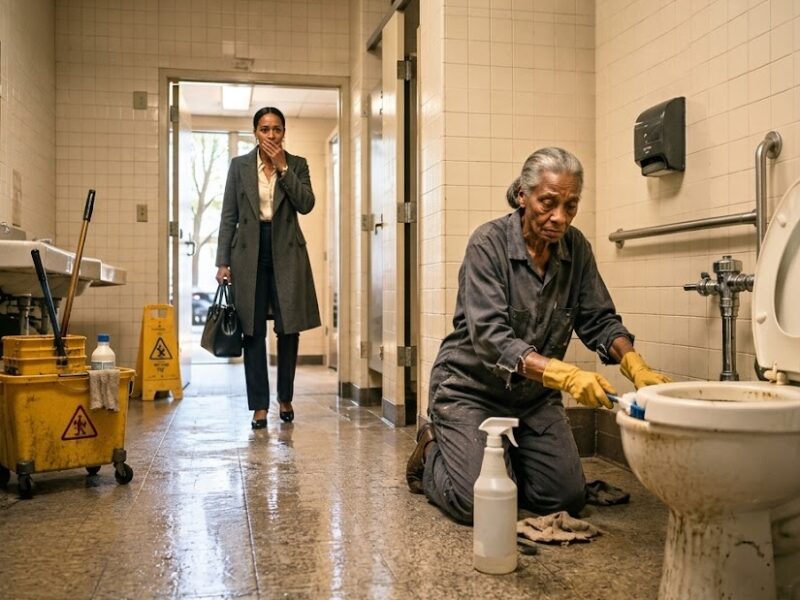
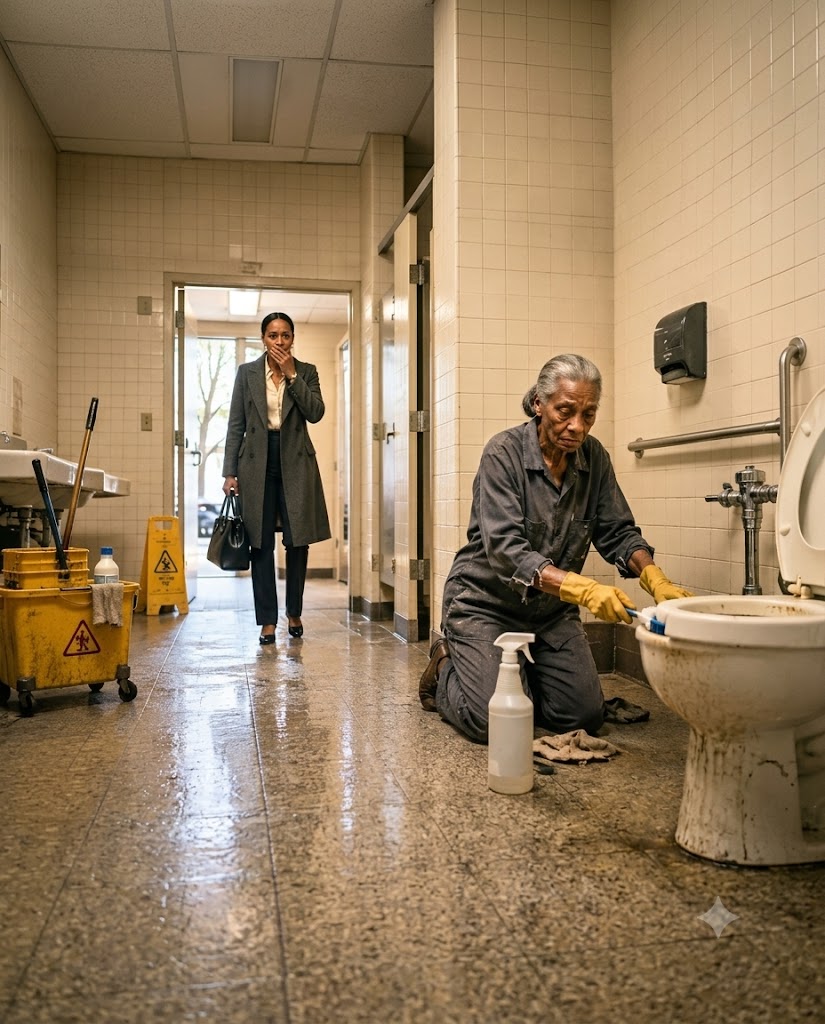
She Returned From Abroad Without Warning—Then Found Her 75-Year-Old Mother Cleaning Toilets to Survive
The text message arrived at 3:00 a.m. London time. Five words from a neighbor she had known since childhood: *Your mom is cleaning bathrooms.*
Elena Reeves did not sleep for the next eight hours. She sat in her flat with the windows that did nothing against the January cold, reading the message again and again.
She had left Aendale, Pennsylvania, at twenty-eight, telling herself she would be back in two years. That was how these things worked, she thought. You went somewhere for a season, and the season extended itself, and then one day you looked up and a decade had passed. The place you came from had kept going without you, in ways you had chosen not to examine too closely.
She had called her mother, Ruth, every Sunday. She had sent money on the third of every month, one thousand two hundred dollars, because that was when her paycheck cleared. It felt right that her mother’s transfer should follow hers by an hour.
She did this from a flat in London with windows that did nothing against the January cold. She did it from hospital corridors that smelled like disinfectant. She did it from a life she had built entirely on the premise that Ruth Reeves, seventy-two miles from where she grew up, was comfortable and taken care of and fine.
She was wrong.
The flight home was eight hours. Elena did not sleep once. She had called Ruth every Sunday. She had sent money on the third. She had visited twice a year for the first four years, then once a year, and then the past two years, once. The last time she had stood in Ruth’s kitchen on Clover Street in Aendale, Pennsylvania, everything had looked the way she expected it to look. The same curtains. The same hook by the door where Ruth’s reading glasses hung. The heating vent in the hallway that had always rattled in the cold months.
She had not looked closely enough.
The cab from the airport dropped her at the curb at 8:00 in the morning. The house was quiet. The curtains on the front window were still drawn. A notice from the utility company was tucked into the gap between the doorframe and the mailbox, folded in thirds, the kind of paper that does not arrive unless something is already overdue. Elena stood on the front step for a moment before she knocked.
Ruth opened the door in a gray uniform shirt. The kind that came with a name badge loop on the chest, now empty. She was smaller than Elena remembered. Not thinner, just smaller, the way people get when something has been pressing on them for long enough that it starts to show in their posture. She looked at Elena in the doorway and her face did several things at once. Relief. Embarrassment. The particular expression of someone who has been caught doing something they know they shouldn’t have needed to be doing.
“Patrice shouldn’t have messaged you,” Ruth said.
“She absolutely should have,” Elena said. She came inside.
The house was cold. Not dramatically cold, but the kind of cold that meant the heat had been set low and kept there. The kitchen table had a folder on it that Ruth moved to the counter without comment. A fruit bowl sat nearby, empty except for two oranges, and beneath it, tucked so only the edge showed, was a stack of papers that had the look of bills. Elena set her bag down and turned to look at her mother.
“Tell me,” she said.
Ruth went to the kettle and filled it. She kept her back to Elena while she did. “I picked up a little cleaning work. Just a few mornings. They needed people at Mercy General and I needed something to do.”
“Mom.”
“It’s not as dramatic as Patrice made it sound. She always did catastrophize.”
“She told me exactly what she saw.”
The kettle was already full, but Ruth kept her hand on it. Then she set it on the base and turned it around. She didn’t look at Elena directly. She looked at the window above the sink and pressed her mouth flat.
“The account the money goes to,” Elena said. “Show me the statements.”
Ruth went to the utility drawer by the refrigerator without arguing. She pulled out a folder and set it on the table and sat down. Elena sat across from her and opened it. The statements were for the past eighteen months. She went through them quickly, first scanning for the deposits she sent. They were there, every one of them, the third of every month, twelve hundred dollars, as reliable as a clock.
And then she looked at what happened after each deposit. Within forty-eight hours of every transfer, the money was moved. Not spent. Gradually moved. A single transaction each time, out to the same payee. Three letters and a period.
*Dr. E.*
Elena looked up. “Who is Dr. E?”
Ruth was quiet for a long moment. The kettle clicked off and she didn’t move toward it. “About two years ago, I had some chest pain,” she said. “They kept me in the hospital for a few days. Nothing serious, but while I was there, Dennis offered to handle things. He said I shouldn’t be worrying about bills when I wasn’t feeling well. I gave him the account information so he could manage the payments.”
Dennis. Your cousin. My brother James’s boy. Elena had met Dennis four or five times over the years. A man in his mid-forties, cheerful in a surface-level way, always ready with a reason why whatever he needed was reasonable. She had no specific memory of disliking him. She had no specific memory of thinking about him at all.
She went back to the statements. Every single transfer from the account she wired to had gone directly to Dr. E within forty-eight hours for twenty-three months. Twelve hundred dollars a month. Twenty-three transfers. The balance remaining in Ruth’s account was forty-one dollars. She put the folder down on the table.
“How have you been paying the heating bill?” she asked. Ruth said nothing. “The groceries.” Ruth looked at her hands.
Elena looked at the orange in the fruit bowl. She looked at the utility notice still sitting where she’d set it when she came in. She looked at her mother in a gray cleaning shirt sitting across a table with forty-one dollars in her account because someone had been reaching in and taking everything every month for almost two years.
She stood up very carefully and went to make the tea herself.
Dennis Reeves lived in Powi, twenty minutes west of Aendale. Elena drove out the next morning after Ruth had taken her medication and eaten breakfast, and the color had come back into her face the way it sometimes did before the tiredness settled in again. She had not told Ruth where she was going. She had said she needed to run an errand and left before Ruth could ask a follow-up question.
The drive gave her time to think through what she was going to say and then discard most of it. Dennis’s address was a renovated townhouse on a quiet street with mature trees and a shared parking area. She pulled in at 9:15 and sat in the car for a moment. There was a new truck in the space marked with his unit number. A dark gray pickup, current model year, the kind that cost more than most people’s monthly rent. His front steps had a new railing. The door had been recently painted a deep green. She rang the bell.
He answered after about ninety seconds, and his expression when he saw her was very carefully managed. Warm, slightly surprised. The warmth was on the surface. Beneath it, something ran a quick calculation.
“Elena,” he said. “I didn’t know you were in town.”
“No,” she said. “You wouldn’t.”
He stepped back and held the door open. “Come in. Let me make coffee.”
Inside, the kitchen had been recently upgraded. New appliances, marble-look countertops, the kind of renovation that a contractor would price at thirty-five thousand dollars minimum. The living room had new furniture, a television mounted on the wall that was larger than any television Elena had ever owned. She stood in the center of the living room and let herself look at it without commenting.
Dennis came out of the kitchen with two mugs. He was a broad man, easy in his body, in the way people are when they have usually gotten what they wanted. He set her coffee on the side table and sat across from her with his own.
“So,” he said. “Is this about your mom?”
“I looked at her bank statements.”
He nodded slowly. He took a sip of his coffee. He did not look like someone who had been caught. He looked like someone who had been waiting and had prepared. “She asked me to help manage things,” he said. “After her hospital stay. It got complicated, honestly. The utilities, the medical billing, the pharmacy coordination. There were months where I was juggling a lot on her behalf.”
“The statements show twelve hundred dollars in on the third, transferred out to you within forty-eight hours, every month for twenty-three months.”
“It went to expenses. Things she needed done. The boiler was on its last legs. There was a pipe issue.”
“She has a two-month overdue heating bill.”
A brief pause. He took another sip. “Timing issue. Everything got backed up at once.”
“I want receipts.”
“They’re around somewhere. I’d have to dig.”
“How long would that take?”
He smiled at her. It was a practiced smile, the kind men used when they thought the conversation would be more manageable than it was turning out to be. “Give me a week and I’ll get you whatever you need. Honestly, Elena, I’ve been putting a lot of time into helping her. That doesn’t come free. My time, my truck, the running around. I’ve been there for her when you’ve been three thousand miles away.”
Elena looked at him for a moment. Then she stood up. She was about to take her coffee cup to the kitchen when she noticed the bookshelf beside the television. There were a few books, a small collection of things that people keep because they have them rather than because they love them. And in the middle shelf, framed, a photograph. Dennis on a lawn, standing next to a man she didn’t recognize. Behind them, a stone house. Large, pale stone, tall narrow windows, the kind of construction that implied a very old family and a very significant amount of land. The man beside Dennis was older, sixties, wearing a sport coat. The photograph looked recent. The grass was summer green and the trees in the background were full.
She left without saying anything else about the photograph.
On the drive back, she turned it over in her mind. The house in the back was not the kind of house you got invited to casually. It wasn’t a country club, wasn’t a public event. Whoever that man was, Dennis knew him well enough to be photographed on the grounds.
She called Ruth from the car. Ruth answered on the second ring. Her voice was careful. “How did it go?”
“He says it went to expenses. He couldn’t produce receipts. He’ll have them somewhere.”
“Dennis is organized. He’s always been helpful.”
“Elena, I know it looks—”
“Mom.” Elena kept her voice steady. “He has a new truck and a renovated kitchen. I just want you to hear what I’m saying.”
Ruth was quiet for a moment. Then she said, “I hear you.”
Elena drove in silence for a stretch of road. Then she said, “When I got there and he saw me at the door, before he had time to arrange his face, he looked like he’d already known I was coming.” Not surprised. Braced. She paused. “Did you tell him I was home?”
“I may have mentioned it.”
Ruth said, “I called him yesterday to ask about the account situation before you went over.” So Dennis had known she was coming. He’d had eighteen hours to prepare. That was why he had been so calm. He had already run his version of events and decided he was safe.
“All right,” Elena said. “I’m almost home.”
She pulled up to the house on Clover Street. Ruth had the door open before she was fully out of the car. The curtains in the front window were open now, the gray morning light coming through. Elena gathered her coat and her keys and walked up the path. Ruth stood in the doorway waiting.
“He said something when I was leaving,” Elena said. “He said there are things about our family that I don’t know. He said I should ask you what you’ve been holding on to.” She watched her mother’s face. “He said it like it was a weapon.”
Ruth gripped the door frame. Not dramatically, just once, briefly. The way you hold on to something when you need to keep your balance. “Come inside,” Ruth said quietly. “Come sit with me.”
Elena followed her in. They sat at the kitchen table the way they had a thousand times. Ruth with her hands around her mug, Elena across from her. The bill folder was still on the counter. The utility notice was still tucked in the door.
Ruth looked at the table for a long moment. Then she said, “Go to my bedroom closet. Under the winter coats on the bottom shelf, there’s a metal box. Bring it to me.”
The box was exactly where Ruth said it would be. Elena pushed aside the winter coats, a heavy wool one that had been there since Elena could remember, a newer fleece she didn’t recognize, and found it on the bottom shelf behind a pair of boots. Dark green metal, the size of a shoe box, small key lock on the front, old enough that the paint at the corners had worn through to bare metal underneath. She brought it to the kitchen table and set it down.
Ruth had not moved from her chair. She watched Elena set the box on the table and then she reached into her cardigan pocket and came out with a small key on a plain ring. She held it for a moment before setting it on the table between them.
“I’ve moved this box seven times in thirty-two years,” Ruth said. “Every time I thought Dennis was getting close to it, I moved it. Last year, I put it under those coats and kept the key in my pocket.” She looked at the box. “He found it anyway.”
“How?”
“He asked me what was in it. He was over one afternoon helping me sort some things in the closet and he found it behind a suitcase. I told him it was old letters. He believed me. Or he pretended to.” She pressed her hands flat on the table. “That was two and a half years ago.”
Elena looked at the box, then at the key, then at her mother. “Do you want me to open it?”
“I want to tell you what’s in it first.”
Elena waited. Ruth was quiet for a moment, in the way she went quiet before she said something she had been rehearsing for a long time. Her hands stayed flat on the table. Outside, a car moved slowly down Clover Street. The refrigerator cycled on and the kitchen felt suddenly very still.
“I was twenty-three years old when I took the job at Harford House,” Ruth said.
The Harford estate sat outside Kennet Square in Chester County. Old stone construction. Private lane. Grounds that went on far enough that you couldn’t see the property line from the house. The kind of estate that had been in the same family for over a century. Ruth had come up from central Pennsylvania with a reference from a placement agency and a willingness to work that had gotten her hired over several other candidates she never met.
The family was three people in residence. Edmund Harford, the elder son, who ran the estate’s business affairs with the kind of reserve that came from believing that clear expectations were more respectful than warmth. His younger brother, Grayson, who was loud and entitled and moved through every room as though it existed primarily for his convenience. And a rotating staff of domestic workers, cleaners, cooks, groundskeepers, people who came and went through the service entrance and were paid without ceremony.
She paused. She turned her coffee cup in both hands. “Three months before I started, a woman named Faith Harmon came to work there from Calhoun, Georgia. Twenty-one years old. She was fast and funny, and she made every room feel more awake somehow. She was the first person at that house who treated me like a friend instead of just another worker.”
Elena said nothing.
“By winter,” Ruth said, “I noticed Faith was quieter. She wasn’t finishing her meals. She stopped writing her letters home on Sundays. She used to do that every week without fail. One morning she told me the truth.”
Ruth stopped. Her jaw tightened briefly. “Grayson Harford. She had not gone to him willingly.”
Elena kept her hands still on the table.
“I believe you,” Ruth said. “Those were the two words I said to her. I believe you. There was nothing else.” She looked up briefly. “She went to Edmund because everyone said he was different from his brother. He was. But not by enough. He told her it would be handled. It wasn’t. When she made clear she was going to go to the county police, the house changed. She was isolated. Her duties were rearranged to keep her working alone. Staff were told not to speak to her.”
Ruth’s voice had gone very low. “I kept showing up. Every day I kept showing up.”
She stopped again. Elena let the silence hold.
“Faith gave birth in a hospital two counties away. A girl. Small and healthy.” Ruth’s hands tightened around the mug. “The family wanted the child placed immediately. They had the connections and the attorneys to make it happen. Faith held her daughter in that hospital and would not let go.” A breath. “She called me from the hospital room on the second night. I drove out.”
Ruth stood up from the table and went to the kitchen window. She stood with her back to Elena, the same way she had stood thirty-two years ago when she had gone to a hospital in the middle of the night because someone she trusted asked her to come.
“She was sitting up in the bed when I got there. She’d been crying long enough that her face had stopped showing it. She told me what was coming. The family would take the child through whatever legal mechanism cost them the least. She had no money, no family nearby, and she had already lost.”
Ruth paused. “She asked me to take the baby and run.”
Elena felt something happen in her chest that was not quite sound, not quite thought. She looked at her mother’s back and at the gray morning light coming through the window and did not speak.
“She put her in my arms,” Ruth said. Her voice went very low and stayed there. “She said, ‘Don’t let them erase her the way they are going to erase me. Give her a name nobody in Chester County will recognize. Take her somewhere they won’t think to look.'” Ruth paused. “And then she said, ‘Tell her I loved her before I ever knew her face.'”
The kitchen was perfectly still.
“Before I left that hospital,” Ruth continued, “Faith asked me to find Edmund Harford and tell him she was refusing his help and refusing his family’s name. She wanted it on record that she was taking nothing from them. And then she went back anyway. Because she had nowhere else to go.”
Ruth turned from the window. Her face was dry. She had used up whatever tears she had for this story a long time ago. “Four months later, August 1993, a missing person’s report. Last seen at a private residence in Kennet Square.” She sat back down at the table. “It was never solved.”
Elena looked at the metal box on the table. “You ran with me,” she said.
“I had a bag packed since February. I walked out of that hospital at 2:00 in the morning and did not stop moving for four days. Three bus changes. A cousin in Harrisburg for two weeks. Then I kept going until I got here.” Ruth looked at her hands. “I gave you her middle name because I needed you to carry a piece of her. Sable. The name of the river near where she grew up. She said it was a private name, one her family used at home. No one in Chester County would connect it to anything.”
Elena reached forward and picked up the key from the table. She held it for a moment. Then she unlocked the box.
Inside, one sealed envelope, cream paper gone the color of old bone, intact. A photograph in black and white. A young woman laughing at something off camera, full of the kind of joy that doesn’t perform itself. Three folded letters tied with a rubber band gone brittle with age.
Ruth picked up the photograph. She held it the way you hold something that cost everything. “That’s her,” she said.
Elena looked at the woman in the photograph. Her laugh, the angle of her chin. Something in the way she occupied the frame that felt familiar in a way Elena couldn’t immediately name. “What’s in the envelope?” Elena asked.
Ruth set the photograph down. “I don’t know,” she said. “It was brought to my door in November of 1993 by a woman who didn’t give her name. She said to keep it safe. Said someone would come looking one day.” She looked at Elena directly. “I was afraid to give it to you when you were younger. And then you left for London and I thought, when she comes back. And the years kept going.” She paused. “Dennis asked me what was in it. I told him it was old correspondence. I don’t know if he believed me.”
Elena looked at the sealed envelope. On the front, in careful handwriting: *For the child Faith asked me to protect.* She looked up. Ruth nodded once.
Elena opened it.
The envelope held two things. A handwritten letter on state letterhead and a folded legal summary stapled together at the corner. Elena unfolded the letter first. The paper was formal stationery. *Harford House, Kennet Square, PA* in engraved type across the top, the kind that ordered in batches of five hundred and used for a generation. The handwriting was deliberate and careful, the letters of a man who had been taught to write by hand and had done it all his life. Dated November 12th, 1993.
She read it through once without speaking.
Edmund Harford had written to the child Faith asked him to protect. He wrote it in those words, formal and direct. He wrote that he had known what Grayson did. He had not believed it immediately, and by the time he understood the full scope of what had happened to Faith, she had already been isolated, and it was already too late to correct it in any way that mattered. He had tried after the fact to find the child. He had hired investigators. He had found nothing. He was writing this letter sick, running out of time, believing there was a chance the child might surface someday, that someone might find this envelope and know enough to look.
He wrote, *”I cannot give back what my family took from your mother. I cannot make what happened to her right. What I can do is make sure that what she was owed does not disappear with me.”*
The letter was signed *Edmund Harford*. Below his signature, in different handwriting, smaller, written later, maybe by a different hand: *She deserved everything this family denied her. God forgive us.*
Elena set the letter down and unfolded the legal summary. It was a trust instrument executed through a private attorney in Westchester, Pennsylvania, dated October 1993, weeks before Edmund’s death. The beneficiary line read: *”The surviving biological child of Faith Harmon of Calhoun, Georgia.”* Not a name. A relationship. Because Edmund had not known who or where the child was. He had only known the connection.
The trustee was listed as *Margaret L. Wills, Esq.*, with a Westchester address and a phone number. The note at the bottom of the instrument read: *”In the event that a verifiable biological match to the named beneficiary relationship is established, distribution is to be executed immediately upon verification. No conditions. No waiting period. Immediate.”*
Elena sat with the papers in front of her and looked at them for a long moment. Ruth was very still across the table.
“He set up a trust,” Elena said.
“He was a better man than his brother,” Ruth said. “Not a good man. Not enough to do the right thing when it would have cost him something. But better.”
Elena looked at the trustee name. She pulled out her phone. The number was over thirty years old and she did not expect it to work. She dialed it anyway. It rang twice.
A woman’s voice answered. Clear. Unhurried. The voice of someone who had been doing the same work for long enough that nothing surprised her about incoming calls. “Margaret Wills.”
Elena said, “My name is Elena Reeves. I’m calling about a trust instrument executed in October 1993. Edmund Harford established it. It names a Margaret Wills as trustee. I have the original document in front of me.”
A short silence. Not a surprised silence. A silence like the pause between realizing something is finally happening and deciding how to respond to it. “Where are you right now?” Margaret Wills asked.
“Aendale. My mother’s house.”
“Can you come to my office tomorrow morning? Bring the envelope. Bring everything in it.” A pause. “And Ms. Reeves, before you come, don’t call your cousin Dennis.”
Elena looked up. Ruth was watching her from across the table, both hands around her coffee cup, waiting. “How do you know about Dennis?” Elena said.
“I’ll explain tomorrow,” Margaret said. “Bring everything. Come early.” She ended the call.
Elena set the phone on the table. She looked at the trust document with its thirty-two-year-old phone number that was still connected to the same woman. She looked at the letter from Edmund Harford. She looked at the photograph of Faith that Ruth had set to the side of the box.
Then she thought about the timing. Dennis had found the metal box two and a half years ago. He had started diverting the money two and a half years ago. Within weeks of finding it.
She looked at Ruth. “When Dennis found the box, what exactly did he say?”
“He asked what it was. I said it was old correspondence. He asked who from. I said old friends from before I moved here.” Ruth paused. “He didn’t push. He just looked at it. And then he put it back and we moved on. He was very casual about it.”
“Did you notice anything change after that? With how he treated you? What he offered to help with?”
Ruth thought for a moment. “He became more present,” she said slowly. “More visits. More offers to help. He was the one who suggested taking over the account management. I thought he was being kind.” She looked at the table. “I was relieved. Honestly. I’d been managing everything alone for years.”
Elena turned the legal summary over in her hands. Margaret Wills had been waiting for this call for thirty-two years. And the moment she heard Elena’s name, she already knew about Dennis. She had been watching. Somehow she had been watching long enough to know who Dennis was and why Elena should not call him first. Dennis had found the metal box. Two weeks later, the money transfers started. And somewhere in that gap, he had made contact with someone who made it worth his while to keep quiet.
Elena looked at the photograph of Faith Harmon again. The laugh, the way she held herself in the frame. And something she had noticed when she first looked at it. The angle of the chin. The line of the jaw. Something she had filed away without naming it. She held the photograph up beside the kitchen window and looked at it in the gray morning light.
Ruth watched her without speaking. “She’d have been twenty-one in this picture,” Ruth said.
Elena was thirty-nine. She looked at a twenty-one-year-old woman in a black and white photograph and felt something she did not have a word for yet. She set the photograph down carefully and put everything back in the metal box. She closed the lid.
“I’ll go to Margaret’s office tomorrow,” she said. Ruth nodded.
“I need you to do something tonight,” Elena said. “Lock this box and put it somewhere Dennis doesn’t know about. Not under the coats. Somewhere else.”
Ruth looked at her. “You think he’ll come?”
“He knows I went to his house yesterday. He knows I saw the account statements. He knows I came home angry.” She looked at the box. “If he’s been tracking this for two years, he knows we’re at the part of the story where the box matters.”
Ruth was quiet for a moment. Then she stood up, picked up the box with both hands, and carried it toward the back of the house without saying where she was taking it.
Elena sat alone at the kitchen table. Outside, the gray morning had gone grayer. The street was quiet. The utility notice was still in the door. She read Edmund Harford’s letter one more time. *What I can do is make sure that what she was owed does not disappear with me.* It had been in a metal box under winter coats for thirty-two years. It had not disappeared.
Margaret Wills’s office was on the third floor of a brick building on High Street in Westchester. The name on the frosted glass door was in plain gold lettering. No flourish. *M.L. Wills, Esq.* Inside, the reception area was small and organized. A single chair, a low table with nothing on it, a window that looked out over the street below. It smelled like old paper and the kind of coffee that had been brewed strong and kept warm.
Elena arrived at 8:45. She was shown in immediately. The woman who came out from behind the inner office door was sixty-eight years old or thereabouts and moved with the purposeful energy of someone who had never once accepted the suggestion that she might want to slow down. White hair kept short and practical. Reading glasses on a cord around her neck. She looked at Elena when she stepped into the room and said nothing for a moment. Then she said, “You have your mother’s jawline.”
Elena went still.
“You knew Faith Harmon from her file,” Margaret said. “Edmund gave me everything he had. Come in.”
She sat behind her desk and folded her hands on top of it. The desk was neat in the way that serious people kept things. Not sterile, but organized. Every item present for a reason. She looked at Elena steadily, without the slight discomfort people sometimes showed when a conversation was about to be difficult.
“Edmund Harford came to me in September 1993,” she said. “He was already sick. He told me everything. What Grayson had done. What the family had allowed to continue. What most likely had happened to Faith by the time he spoke with me.” She paused. “He said he had searched for the child since the summer. His investigators found nothing. He wanted to establish a mechanism that would function after his death. One that could not be dismantled by the family and could not be easily blocked by legal obstruction.”
“The trust,” Elena said.
“The trust. Edmund was precise about the beneficiary language. *The surviving biological child of Faith Harmon.* Not a name. Not an age. Not a physical description. A relationship. So that if the child was ever found, or found this herself, the legal pathway was open. He structured the assets carefully. Kept them separate from the family estate. Placed them in a private instrument under my custody.” She looked at the papers Elena had set on the desk. “He told me he wasn’t certain anyone would ever claim it. But he wanted it there regardless.”
Elena picked up the legal summary and slid it across the desk. Margaret examined it briefly, confirming what she already knew. “What’s in the trust?” Elena asked.
“Four hundred and twenty thousand dollars in 1993 terms. Managed through a private investment account for thirty-two years. Growth has been conservative and consistent. The total current value is closer to nine hundred thousand.” She said this without drama, as though she had rehearsed saying it to someone for a very long time. “Edmund was a careful man. He was just three decades too late in being careful about the things that actually mattered.”
Elena sat with that number for a moment. She set it aside. “You knew about Dennis,” she said.
Margaret leaned back slightly. “Three years ago, Philip Harford, Grayson’s son, now in his mid-sixties, became aware that the trust was still active. He’d been unaware for decades. Edmund had kept the arrangement private, and after his death, it simply sat. Philip couldn’t access the trust directly. Edmund had structured it specifically to prevent that.” She opened a folder on her desk and slid it toward Elena. “So he found a different approach.”
Inside the folder were printed records. Bank transfers from an LLC registered to Philip Harford’s business interests, going to an account in Dennis Reeves’s name. Quarterly payments labeled *consultancy services*. The first one was dated thirty-one months ago. The last one was seven weeks before Elena came home.
“I filed an estate monitoring request years ago,” Margaret said. “Any financial activity connected to the Harford family’s holdings that touched the records of anyone connected to this trust triggers a notification. When Dennis Reeves’ name appeared in a Harford LLC transaction, I began watching.” She looked at Elena directly. “Dennis was being paid to monitor your mother and ensure she did not surface any connection to Faith Harmon or this trust. He was Philip’s eyes in Aendale.”
Elena looked at the payment records. Thirty-one months of quarterly payments. The first one arrived three months after Dennis found the metal box in Ruth’s closet. “He found the box,” she said slowly, “and then he called Philip Harford. Or someone connected to Philip.”
“Yes. Dennis may not have known who Edmund Harford was, but he knew what was in that box was significant. And he went looking for who cared about it.” Margaret let that settle. “The money he diverted from Ruth was his own initiative. Philip’s payments were for monitoring and suppression. Taking your remittances was something he decided to do for himself once he had access and believed he could manage it.”
Elena thought about Dennis sitting across from her in his renovated kitchen, perfectly calm, the new truck in the driveway outside. He had been receiving payments from Philip Harford and taking her money simultaneously for almost three years. He had been positioned in Ruth’s life for exactly this purpose, and he had exploited the position comprehensively.
“What happens next?” Elena said.
“You submit a DNA sample. We work with a certified lab under legal chain of custody. The results will need to match against a biological relative of Faith Harmon. I have been in contact with a genealogical tracing organization that may be able to locate someone in Faith’s family who is willing to test.” Margaret picked up a pen. “Philip’s attorney will file a challenge. I expect it within the week. He’s been waiting for someone to surface. We move faster than he does.”
She looked at Elena steadily. “I need to tell you what Philip will argue. He will say Edmund lacked mental capacity when the trust was established. He will say the beneficiary language is ambiguous. He will say there’s no verified connection between you and Faith Harmon.” She set the pen down. “He’s wrong on all three counts. Edmund’s treating physician certified competence in writing one week before the trust was executed. The beneficiary language is precise. And once the DNA is in, his legal standing effectively collapses.” A pause. “The payments to Dennis complicate his position further. They are documented proof that the Harford family had knowledge of a potential beneficiary and actively worked to prevent her from claiming. That transforms what would otherwise be a civil trust dispute into a question of bad faith interference.”
Elena’s phone rang in her pocket. She pulled it out. Unknown number. Pennsylvania area code. She answered.
A man’s voice. Measured. Formal. The voice of a professional who had been given a specific task. “Ms. Reeves, my name is Aldrich. I represent the Harford family interests. I understand you’ve been meeting with Margaret Wills this morning. I’d like to discuss the items you recovered from your mother’s home before this proceeds any further.”
Elena looked at Margaret across the desk. Margaret shook her head once. Small. Deliberate. Elena said, “Have your client’s attorney contact Margaret Wills directly.” She ended the call. She put her phone on the desk between them.
Margaret looked at it. “He’ll file within the week,” she said. “Probably sooner now that he knows you came here.”
“Good,” Elena said.
Margaret looked at her for a moment. Then something shifted very slightly in her expression. Not warmth exactly, but recognition. The particular satisfaction of a long preparation meeting its moment. “I’ll have the lab paperwork ready by tomorrow morning,” she said.
Elena did not call Aldrich back. She forwarded his number to Margaret and put her phone face down on the kitchen table that evening and did not pick it up again until morning. She had been in Aendale for four days. She called the hospital in London, spoke to her supervisor, arranged emergency leave. She walked to the corner pharmacy and bought a legal pad and a set of pens and sat at Ruth’s kitchen table and wrote down everything she knew in the order she had learned it. The money transfers. Dennis’s renovation. The photograph on Dennis’s shelf. The metal box. Edmund’s letter. Margaret’s office. The quarterly payments from the Harford LLC.
Then she went to the newspaper archives. The *Chester County Daily Local News* had been digitizing its back catalog over the past decade. She worked through it for two hours before she found what she was looking for. August 1993. A four-line entry, the kind that print papers used to run between the police blotter and the community calendar. *Woman reported missing in Kennet Square area. Faith Harmon, 21, last seen at a private residence off Route 926. Anyone with information asked to contact township police.* No description. No photograph. No follow-up.
In the days after, she found one more item. September 1993. Three lines, buried. *No new leads in Kennet Square missing person’s case. Authorities say investigation is ongoing.* And then nothing. Whatever investigation there had been had produced nothing on record.
She sat with those two entries for a long time. Faith Harmon had disappeared in August 1993. She had gone back to Harford House because she had nowhere else to go. Four months after giving her daughter to Ruth and watching her walk out of a hospital in the middle of the night, she had returned to the only place she knew. And then she was gone.
Elena called the genealogical tracing organization Margaret had mentioned. They were based out of Philadelphia, specialized in family location, legal chain of custody on DNA. She gave them Faith Harmon’s full name, birth location as Calhoun, Georgia, last known residence Chester County, Pennsylvania, circa 1993. They said they would start immediately.
She drove back to Dennis’s townhouse the next morning. Not to talk. She was done talking to Dennis. She wanted to see whether Aldrich had been to him yet. She sat in the car across the street. After about twenty minutes, a car she didn’t recognize pulled into the parking lot. A man in a suit went to Dennis’s door and was let in quickly. Aldrich, or someone like him, coordinating with Dennis directly. She took a photograph on her phone and sent it to Margaret.
Margaret replied within the hour. *Confirmed. Aldrich filed a motion this morning. Emergency injunction to freeze trust assets pending review of Edmund’s capacity. The assets can’t be moved, but distribution is stayed until a hearing. Date assigned: six weeks out.*
Six weeks. Elena drove back to Clover Street. Ruth was at the kitchen table when she came in, reading. She looked up and Elena told her what had happened. Ruth listened with both hands in her lap and said nothing for a moment when Elena finished.
“Dennis is working with them,” Ruth said finally. It was not a question.
“He went looking for Philip Harford when he found that box,” Elena said. “Three years ago. He’s been on their payroll since.”
Ruth was quiet. She turned to the window. “He was at my brother James’s funeral,” she said. “He helped carry the coffin. He drove me to the reception afterward and held my arm on the ice.” She stopped. “I thought he was family. He used that. I know he used it.” She turned back. “That’s what I’m telling you. It’s not that I trusted him blindly. It’s that he was exactly who I needed him to be for long enough. Until he wasn’t.” She looked at her hand. “I don’t know which of those things is worse.”
Elena did not answer that because there was no answer. It was both.
Her phone buzzed. The genealogical service. Faster than she had expected. They had located a Vera Harmon in Mon, Georgia. Sixty-two years old. Annual missing persons inquiries filed with Chester County authorities every year since 1994. She had never stopped looking. Her relationship to Faith Harmon: older sister.
Elena dialed the number before she had time to overthink it. It rang three times. Then a woman’s voice, alert and careful. “Hello?”
“Is this Vera Harmon?”
“Yes. Who is this?”
“My name is Elena Reeves. I’m calling from Pennsylvania. I found you through a genealogical tracing service.” A breath. “I’m looking into the disappearance of Faith Harmon. I have reason to believe Faith had a daughter in April 1993. I’m that daughter.”
The silence on the other end was absolute. Then: “Say that again.”
Elena said it again. Another silence, longer this time. When Vera spoke, her voice had changed. It had gone lower and slower, the way voices went when someone was trying very hard to hold themselves together.
“How do I know this is real?”
“I have a document given to my mother by Edmund Harford in November 1993. A legal trust instrument. My mother was the person Faith asked to take me from the hospital.” Elena paused. “My middle name is Sable.”
On the other end, Vera Harmon went very quiet. Not silent. Elena could hear her breathing. Just completely still, the way people went still when something they had stopped letting themselves hope for suddenly became possible.
“Sable,” Vera said. It was barely above a whisper. “Yes. Faith told me.” Vera’s voice cracked slightly and then steadied. “She called me in the spring of 1993. I didn’t know—she didn’t tell me exactly what was happening, just that things were difficult. But she said if she ever had a daughter, she was going to name her after the river. The Sable River. It runs near where we grew up.” Vera stopped. “She said it was a code. She said, ‘If I can’t get a message to you any other way, that name will tell you everything you need to know.'”
Elena looked at the legal pad on the kitchen table. The notes she had made the night before. Ruth’s coffee cup, still warm, sitting beside it. “I want to do this properly,” Elena said. “DNA verification. Legal chain of custody. My attorney is handling the process.” She paused. “Would you be willing to submit a sample?”
“I’ve been filing a missing person’s inquiry every year since 1994,” Vera said. “Thirty-two years. Every single year.” Her voice was very steady. “Tell me where to go and what to bring. I’ll be there.”
Elena ended the call and sat for a moment without moving. Then she looked up. Ruth was watching her from across the table. “Her sister,” Elena said. “Faith’s older sister. She’s been looking for thirty-two years.”
Ruth closed her eyes briefly. She pressed her hand over her mouth and held it there for a moment. Then she said, “Tell me her name.”
“Vera.”
Ruth nodded. She kept her hand over her mouth for another second. Then she moved it and said very quietly, “Faith would have liked that. That someone kept looking.”
Elena’s phone buzzed again. Margaret. The message was brief. *Philip’s attorney requested an emergency hearing acceleration. Motion denied. Six weeks stands. But be ready. Aldrich is going to keep pressing.*
Elena set the phone down and looked at Ruth. “We have six weeks,” she said.
Ruth looked back at her. “Then we’ll use them.”
Elena submitted the DNA sample three days after her call with Vera. Margaret arranged it through a certified lab in Philadelphia that handled legal-standard chain of custody testing. Vera Harmon flew in from Georgia and submitted her sample the same afternoon, driving from the airport directly to the lab without stopping. They did not meet in person that day. Elena had suggested it and Vera had said, “Let’s wait until we know. I want to be sure of what I’m bringing to that meeting.” Elena understood.
In the six weeks that followed, she was not idle. She returned to the newspaper archive and expanded her search. She found a real estate filing from December 1993, showing that Harford House had been restructured into a limited trust, removing it from direct family control. Edmund’s final act, she understood now. A legal wall between whatever remained of the estate and Grayson’s descendants. Philip Harford had inherited Grayson’s interests, but not Harford House. That was part of why he had been watching. Edmund had blocked him from the estate directly, which meant the trust money was the only remaining piece he couldn’t reach.
She found a record from a Pennsylvania domestic worker advocacy organization. They maintained complaint files going back to the 1980s. Two complaints had been filed against Harford House between 1989 and 1993. Both settled confidentially. No names in the public record. But the pattern was there. Documented. Filed away.
She filed a police report for elder financial abuse against Dennis Reeves. She brought the bank statements, the account transfer records, the documentation of his management agreement with Ruth, and a written statement from Ruth describing the arrangement. The detective who took her report was not optimistic, but noted it was a strong paper trail. He said they would be in touch.
Dennis called her once. She let it go to voicemail. He left a message that was calm on the surface and careful about every word. The voice of someone who knew it might be recorded. He said he wanted to resolve things directly. He said some of what had happened was a misunderstanding about expectations. He said Elena should think about what was best for Ruth before she escalated things that would be hard to come back from. She did not call back. She forwarded the voicemail to Margaret and to the detective handling the elder abuse case.
Vera called her twice in that six-week stretch. Not about logistics, but just to talk. The first call was mostly Vera asking questions about Ruth, about where Elena had grown up, about London, about what Elena did. The second call was mostly Vera talking, unprompted. She told Elena about Faith before Pennsylvania. Faith had been the younger one, the one in the family who was going to go somewhere. She had wanted to be a teacher. She had gotten a job at Harford House to save money for school, planning to be there two years maximum and then enroll. She wrote letters home every week without fail. She called on Sundays. She was funny and stubborn and she had a way of walking into an argument and immediately finding the exact angle that dismantled it. She made people feel taken seriously. Vera said, “Even when she was disagreeing with you, you felt like she actually heard what you said first.” She paused. “She was twenty-one. She had plans.”
Elena listened and took every word and held it. She had a photograph of Faith, now the one from Ruth’s metal box. She had studied it carefully. A young woman in black and white, laughing at something just outside the frame. She looked at it the way you looked at something that was asking you to recognize it. And she let herself recognize it. The angle of the chin. The jawline Margaret had noticed immediately in her office. The way Faith occupied the frame. Not performed. Not careful. Just there.
Four days before the hearing, Dennis made one more move. His attorney contacted Margaret with an offer. Dennis would sign a full confession to the financial crimes and return the money in its entirety in exchange for a signed letter from Elena stating she would not pursue the Harford trust connection and would withdraw any statements made in connection with the Harford estate from the court record. Margaret called Elena and read her the offer.
Elena said no immediately. Margaret said, “I expected that. I wanted you to hear it anyway.”
“Is it worth anything to him? The offer. What does he gain if I take it?”
“If the Harford connection is withdrawn from the record, the evidence of his consultancy payments to Philip becomes far harder to use. Philip’s attorney has presumably told him that if those payments go into the court record, Philip has a significant problem. This offer benefits Philip more than it benefits Dennis.” A pause. “Dennis may not fully understand that. He understands he’s been positioned.”
“He just thinks he can still manage it,” Elena said.
“Yes,” Margaret said. “He does.”
That evening, Elena drove out past Kennet Square. She took Route 926 as dusk came in and turned onto the private lane that the old records had on file for Harford House. The oak trees that lined the lane were massive and old, their branches crossing overhead in the way they would have looked thirty-two years ago and a hundred years before that. The estate itself was no longer the Harford family’s. It had been sold through the limited trust Edmund established and converted to private use by its current owners. She drove to where the gate would have been and stopped the car.
Through the iron fence, she could see the house. Pale stone, narrow windows, the wide front porch. Renovated now. The grounds tended. A new roofline where the old one had been. But the bones of it were the same. The same building where Faith Harmon had worked and where Ruth had worked and where a young woman had gone back to in August 1993 because she had no other place to go.
She sat there for a while. Then she turned the car around and drove back to Aendale.
Her phone lit up with a message from an unknown number as she pulled onto Clover Street. She sat in the car and read it. Three words. *He’ll destroy everything.*
She stared at the screen. No name. No context. Someone warning her, or someone trying to make her afraid. She couldn’t tell which. She called Margaret.
Margaret said, “Document it. Screenshot. Send it to me, then ignore it. We’re ready.”
She went inside. Ruth was asleep. Elena sat at the kitchen table with the legal pad and went through her notes one more time. Everything she had was organized, documented, time-stamped, in order. She put the pad down. She thought about Faith Harmon at twenty-one, who had plans and called home every Sunday and walked back into Harford House because she had nowhere else to go. She thought about Ruth at twenty-three, walking out of a hospital with nothing but a bag and a newborn and not stopping moving for four days. She thought about Margaret Wills, sixty-eight years old, who had answered a thirty-two-year-old phone number on the second ring and said she had been waiting.
She turned off the kitchen light and went to bed.
Tomorrow morning, she and Ruth would drive to Westchester. Ruth was awake before Elena in the morning. When Elena came downstairs at 7:00, the kettle was already on and Ruth was sitting at the kitchen table in her good coat, her purse in her lap.
“I’m coming,” Ruth said before Elena could say anything.
“I know,” Elena said. “I was going to ask.”
She made the tea and they sat together for a few minutes without talking. The house was quiet. The heating had been fixed. Elena had called a contractor within three days of coming home, and she had paid for it out of her own savings without saying anything about it. The vent in the hallway no longer rattled.
“Tell me something,” Elena said. She held her cup in both hands. “Were you ever afraid I’d resent you for not telling me?”
Ruth looked at her mug. “Every day,” she said. “Every year it went on longer. Every year I thought, this is the year she’ll go looking and find out some other way, and then she’ll know I kept it.” She paused. “And then I thought, what would finding out some other way even look like? There was nothing to find. Your name, your birth certificate, your history in this country, all of it was clean. I’d been very careful. But the metal box. The metal box was the one thing I couldn’t get rid of.”
Ruth looked at her hands. “Edmund’s letter. The trust document. The photograph of Faith. The letters she wrote me in those months.” She shook her head slightly. “I tried once, about fifteen years ago. I picked the box up and I held it over the trash can.” She stopped. “I put it back. I couldn’t do it.”
Elena thought about that. The fifteen years in between. When Ruth had carried the box, moved it seven times, kept the key in her pocket. The weight of holding something you couldn’t bring yourself to destroy and couldn’t bring yourself to give away.
“You were going to give it to me,” Elena said. “When I was old enough. That’s what you told me. The woman at the door said—” She paused. “She said old enough. I decided that meant eighteen.”
Ruth looked up. “You were eighteen. And I looked at you and I thought, not yet. She’s just beginning. I’ll wait until she’s settled somewhere.” A dry pause. “You left for London at twenty. And I thought, she’s just settled. I’ll wait until she comes back.” She met Elena’s eyes. “And then I was seventy-five and cleaning bathrooms at Mercy General. And your neighbor sent you a message.”
Elena looked at her mother for a long moment. Seventy-five years old, sitting in her good coat at a kitchen table that Elena had sat at a thousand times, holding a mug that had been in this house since before Elena’s memory started.
“Were you afraid I’d feel like less than yours?” she asked. “If you told me.”
Ruth put her mug down. She did not answer immediately. “I was afraid,” she said finally, “that you would understand everything and be generous about it and love me exactly the same. And that somewhere quietly, something would shift. That you’d look at me and see a woman who took in someone else’s child and not the mother you believed I was.” She pressed her mouth flat. “I know that’s not rational.”
“No,” Elena said. “It’s exactly what you’d think.”
They sat in the quiet kitchen for another minute. Then Elena stood up, picked up both cups, and took them to the sink. “We need to leave in twenty minutes,” she said. Ruth nodded and adjusted the strap of her purse.
They drove west on Route 30 with the morning sun coming in low through the windshield. Ruth had the seat pushed back slightly more than usual. Elena drove without the radio on. The road moved through the kinds of towns that Chester County held. Old stone buildings, iron fences, pharmacy windows with hand-lettered signs, a diner with a parking lot full at 8:00 in the morning.
“She would have loved you,” Ruth said somewhere between the second and third town.
Elena glanced over.
“Faith,” Ruth said. “She would have thought you were exactly right. The way you’ve handled this.” She looked out the window. “She was like that, too. She didn’t panic. She organized. When things went wrong, she got very still and then she started working out what came next.” She paused. “She already did love you, actually. You just didn’t know each other yet.”
Elena said nothing for a stretch of road. Then she said, “Tell me something else about her. Something you remember from before all of it.”
Ruth thought for a moment. “She laughed at things that weren’t supposed to be funny,” she said. “Not mean-spirited. Just—she could see the absurdity in something and she’d name it. And once she named it, you couldn’t unsee it. The way certain things worked in that house, the rules about which doorways you were supposed to use. She’d look at you and she’d say exactly one thing about it, and then she’d go back to work and you’d spend the rest of the day trying not to laugh in the wrong room.” Ruth smiled briefly at the window. “I hadn’t thought about that in a long time.”
The Westchester courthouse was a ten-minute drive from High Street. Margaret had asked them to come to her office first and they went up the brick stairs at 9:15. Margaret was already in full preparation. Papers, ordered documents sealed in labeled folders, notes on her desk. She looked at Ruth when she came in and said, “Ruth Reeves,” and nodded once, as though she had been expecting this meeting for a long time.
Ruth looked back at her steadily. “You’ve been keeping that trust for thirty-two years,” Ruth said.
“Edmund asked me to.”
“He was a careful man,” Margaret said.
“He just was careful about the wrong things first,” Ruth said.
Margaret said nothing for a moment. Then: “Yes. That’s right.”
They went through the documents together. Margaret walked them through the structure of the morning. The trust distribution challenge. Aldrich’s arguments. The response on each count. She had the DNA results in a sealed envelope from the lab, received the previous day, and she had not opened them. She would open them in front of both of them now. She slit the envelope with a letter opener and unfolded the document. She read it once, then laid it on the desk so Elena could see.
The match was confirmed. Elena Reeves, born April 1993, was identified as a first-degree biological relative of Vera Anne Harmon, consistent with the relationship of niece. Consistent with the named beneficiary designation: biological child of Faith Harmon.
Elena looked at the document for a long moment. Margaret picked it up and placed it in the court folder. “Shall we go?” she said.
The courthouse in Westchester was an old stone building at the center of town, the kind of public building that had been doing serious work for long enough that it felt settled into its purpose. Elena and Margaret walked in together. Ruth insisted on coming as far as the corridor and sat on a bench outside the hearing room doors. She had her good coat buttoned to the collar and her purse in her lap. And she sat the way she had sat through thirty-two years of keeping a secret. Upright. Composed. Privately carrying everything.
“I’ll come out when it’s done,” Elena told her. Ruth nodded once.
Philip Harford did not appear in person. His attorney, Aldrich, was already at the respondent’s table when Elena and Margaret entered the hearing room. A compact man in his fifties, tailored jacket, the controlled composure of someone paid to be composed. He did not look at Elena. He arranged his papers and waited.
The judge came in at 10:00 sharp and brought the room to order without ceremony. Aldrich presented the challenge. His case had three prongs. First, Edmund Harford’s mental capacity at the time of the trust’s establishment was questionable, given that he was critically ill and under significant personal and family stress. Second, the beneficiary language—*surviving biological child of Faith Harmon*—was imprecise and not legally binding under current Pennsylvania trust standards. Third, the claimant’s connection to the named beneficiary relationship had not been established through legally recognized means.
The judge listened. She made one note. Then Margaret presented the response. She was methodical. She moved through each point in order with the calm of someone who had been preparing this argument for thirty-two years and had no tolerance for inefficiency.
On capacity, she entered a signed certification from Edmund Harford’s treating physician, dated November 1993, one week before the trust was executed. The certification affirmed Edmund’s full mental competence, his understanding of the nature and consequences of the instrument he was establishing, and his explicit capacity to enter into a binding legal agreement. The physician’s name was in the record. His medical license and board certification had been verified by Margaret’s office.
On the beneficiary language, she cited three precedents under Pennsylvania trust law in which beneficiary relationships defined by biological connection rather than name had been upheld, including one case from 1998 that was directly analogous. The language was precise. The relationship was definable. The verification mechanism was built into the instrument itself.
On verification, she entered the DNA results. Certified lab. Legal chain of custody. Fully documented. Elena Reeves, born April 1993, confirmed as a first-degree biological relative of Vera Anne Harmon, consistent with the niece relationship. The trust language named the biological child of Faith Harmon. Vera Harmon was Faith Harmon’s full sister. The math was exact. She paused and let that settle.
Then she said she had one additional submission. She set a folder on the judge’s desk. Inside the folder were copies of the quarterly payments from a Harford-affiliated LLC to an account in the name of Dennis Reeves. Thirty-one payments over thirty-one months, beginning three months after Dennis Reeves gained access to a personal document held by Ruth Reeves. The document in question was a sealed envelope containing the original trust instrument. The payments were labeled *consultancy services*. No consultancy services were documented, contracted, or delivered. The payment records established that the Harford family—specifically the family interests now represented by Philip Harford, the son of Grayson Harford, who was the direct cause of the harm this trust was intended to address—had known of a potential beneficiary and had taken active, financially compensated steps to prevent that beneficiary from surfacing.
She set the final page of the folder on top. “This is not a civil dispute over the precision of trust language,” Margaret said, addressing the judge directly. “This is a thirty-two-year attempt to suppress a legal instrument established specifically because a member of the Harford family did irreparable harm to a young woman and died before he could make it right. The trust is valid. The beneficiary is identified. The challenge before this court is not made in good faith. It is made in the same spirit that led Philip Harford’s father to harm Faith Harmon and his uncle to spend his final months trying to correct what couldn’t be corrected.”
Aldrich objected. The judge noted the objection and dismissed it. The judge asked Aldrich if he had a response to the payment documentation. Aldrich requested a brief recess. They waited fourteen minutes. When Aldrich came back, he spoke to the judge in the formal language that attorneys use when they have received instructions that have fundamentally changed what they are there to do. He said his client had authorized him to withdraw the challenge to the trust’s validity and distribution. He said this without looking at Elena.
The judge made a note. She looked over the record for a moment. Then she said, “The challenge to the trust established by Edmund Harford in October 1993 is hereby dismissed. Distribution of the trust assets to the verified beneficiary, Elena Reeves, is authorized to proceed immediately.” The court further notes that the documentary evidence of deliberate interference with the named beneficiary’s ability to claim this trust has been entered into the permanent record of these proceedings and may form the basis of future proceedings at the discretion of the relevant parties. She closed the folder. “This hearing is adjourned.”
She stood and the room stood with her and then she left. Elena sat for a moment after the judge had gone. The room was very quiet. Aldrich was gathering his papers at the respondent’s table. He finished quickly and left without looking at her. Margaret closed her own briefcase and turned to Elena. “It’s done,” she said.
Elena stood. She picked up her coat from the back of the chair. She walked out of the hearing room and into the corridor. Ruth was on the bench where she had left her. She looked up when Elena came through the doors. The fluorescent light in the corridor was flat and institutional, and Ruth’s face in it was tired and old and entirely present. Elena walked toward her. Ruth looked at her and waited. Elena nodded once.
Ruth put her hand over her mouth and held it there. Her eyes filled. She did not look away. Elena sat down on the bench beside her. For a moment, neither of them spoke. The corridor was empty. Somewhere down the hall, a door opened and closed.
Ruth lowered her hand. Her voice was steady. “Is it over?”
“It’s over,” Elena said.
Ruth nodded. She looked straight ahead at the opposite wall of the corridor. Then she said, “She would have wanted you to know that she tried.”
Elena did not need to ask who she meant. “I know,” she said.
They sat on the bench together for a little while longer. Then Elena helped Ruth to her feet and they walked toward the exit, and the heavy doors opened onto the November morning—cold and clean and full of light.
The trust distribution processed within ten days of the hearing. Margaret called Elena on a Tuesday afternoon to confirm that the transfer had cleared. The original four hundred and twenty thousand, plus thirty-two years of managed growth, in an account in Elena’s name. She said the number carefully and clearly, the way you said things that needed to land without distortion. Elena thanked her and held the phone for a moment after the call ended.
She was sitting at Ruth’s kitchen table. It was the same table where Ruth had pushed the bank statements toward her six weeks ago. The same fruit bowl, now with something actually in it. The heating vent in the hallway was quiet. She started with the bills. Every overdue account, every outstanding balance, every flag on Ruth’s record from the past two years. She paid them in order, smallest to largest, working through the folder she had built up over the past weeks. Medical co-pays. Utility arrears. The pharmacy account that had been carrying a balance because Ruth had been quietly stretching out the intervals between refills.
Then she called a home health aide agency and arranged for someone to come three mornings a week. Someone to drive Ruth to appointments, help with the groceries, be there in the morning. Ruth objected mildly when Elena told her. “I don’t need a minder,” Ruth said.
“I know,” Elena said. “You need someone on Tuesday, Thursday, and Friday mornings so you can read your book without worrying about the grocery list. That’s different.”
Ruth considered this. “Three mornings,” she said.
“Three mornings.”
Ruth said nothing more about it. Elena called a contractor and had the house properly insulated. She had noticed in her first week home that the cold came through the walls in the evening, the kind of cold that settled in slowly and that you stopped noticing—not because it went away, but because you adjusted to it. Ruth had been adjusting to it for years. She had never mentioned it once in eleven years of Sunday phone calls.
She filed the paperwork to reinstate her Pennsylvania nursing license. She filed it and then she went back to work on the other things because the license would take time and the other things needed doing now. Dennis was charged with elder financial abuse. The case was straightforward. The paper trail was complete. The transfers were documented. Ruth’s written statement was clear. His attorney was already negotiating. The detective called Elena to say they expected a guilty plea and a full repayment order. She thanked him. She did not feel satisfaction exactly. Something more like the absence of uncertainty, which was its own kind of quiet.
She called Mercy General’s cleaning roster and removed Ruth’s name from it. She told the coordinator that Ruth Reeves was retiring from the position. The coordinator said she was sorry to lose her. Elena thanked her. She told Ruth that evening. Ruth was at the kitchen table with her book when Elena came in and sat across from her and said it was done. Ruth set the book down. She looked at the table for a moment. Then she said, “I was starting to hate Thursdays.”
Elena said, “I know.”
Ruth looked up. “How long have you known?”
“Two days.”
Ruth almost smiled. “You could have said something.”
“I wanted to be able to actually fix it first,” Elena said.
Ruth looked at her daughter for a moment. This woman who had flown home from three thousand miles away with nothing but what she knew about numbers and the particular stubbornness that Elena had apparently inherited from someone. And did not say what she was thinking. She picked up her book and went back to her page.
Elena drove to Georgia on a Friday in late November. Mon was a seven-hour drive. She left before dawn and arrived in the early afternoon under a sky that was still warm enough to be surprising after weeks of Pennsylvania November. Vera Harmon’s house was brick, single-story, with a garden that had been put to bed for winter but that you could tell in the growing season would be serious and deliberate. A porch with two rocking chairs. A dog somewhere behind the house that announced Elena’s arrival.
Vera came to the door before Elena reached the steps. She was sixty-two, with the particular stillness of someone who had spent decades waiting for something and had learned to hold that waiting without letting it eat the rest of her life. She had Faith’s eyes. Elena knew that from the photograph, and seeing it confirmed in person was a different kind of knowing. She stood in the doorway and looked at Elena with an expression that was not quite recognition and not quite surprise and not quite anything Elena had a word for.
She said, “Come here.”
She took Elena’s face in both hands on the porch and looked at her for a moment. The jawline. The way her chin sat. The particular angle of something Elena had never been able to see in herself because it had always just been her face. Then Vera said very quietly, “She would have loved you so much.”
Elena could not speak. She nodded. They sat on the porch for three hours. Vera brought out tea and then forgot to drink it. She talked. Elena listened to every word and took every moment as it came, the way you handled something you had waited for without knowing you were waiting.
Faith had been two years younger than Vera. She had been the one in the family who argued about everything and was right more often than was strictly comfortable. She had a laugh that came from somewhere real, not performed. She could outrun everyone she knew until she was seventeen. She called home every Sunday and wrote letters in purple pen. She had been saving for school when she went to Chester County. She was going to be a teacher. She had plans. Specific ones, with specific steps. The kind of plans that people make when they believe completely that the world intends to accommodate them.
The world had not accommodated her.
Vera talked for three hours and Elena listened for three hours, and the winter afternoon went pale and thin and then went dark, and they brought the chairs inside and kept talking. “She filed the missing person’s report herself,” Vera said near the end. “Every year. I told them every year that my sister had not walked away, that she had been trying to do something right and someone had stopped her. Nobody ever found anything. Nobody ever tried very hard.” She looked at her hands. “After the first ten years, I stopped expecting anything. But I kept filing. Because if I stopped filing, it would mean I’d given up. And I wasn’t going to give up.”
Elena thought about Edmund Harford writing a letter in November 1993 to a child he couldn’t find, hoping the document would outlast him long enough to reach her. She thought about Margaret Wills answering a thirty-two-year-old phone number on the second ring. She thought about Ruth moving a metal box seven times, keeping the key in her cardigan pocket. Everyone keeping something alive until it reached the place it needed to reach.
She drove back to Pennsylvania the next morning.
The fund took shape over the following weeks. Elena worked with an attorney—not Margaret, who had done enough—to establish a legal aid foundation in Faith Harmon’s name. It was set up to provide legal resources for domestic workers in Pennsylvania. Employment abuse, wage theft, wrongful termination. Representation for people working in private household employment who had no union, no safety net, and nowhere to fight from. She named it clearly. Not after herself. Not after Ruth. *Faith Harmon Legal Aid.* Registered with the state. Operating out of Philadelphia. With an advisory board that included two domestic worker advocacy groups and a legal clinic at a Philadelphia law school.
She wrote a press release. Brief and factual. She described what the fund was for. She mentioned Faith Harmon by name, her age, where she was from, what had happened to her, and what had happened since. She said a trust established in 1993 by the man who knew he had failed was being used to fund something that might help people who would otherwise be failed in the same way.
The story got out the way truths got out. Slowly, then in a series of phone calls and articles and messages from people she didn’t know. A journalist picked it up. Then several more. Other women. Other families. People who had worked in private household employment across Pennsylvania for decades and carried their own versions of what happened when you had no protection and no one watching out for you when something went wrong.
Elena answered what she could. She forwarded the rest to the fund’s intake coordinator. She was not trying to represent anything except what had happened to one specific woman who was twenty-one years old and had plans.
On a Sunday evening in December, Elena sat beside Ruth on the couch in the living room on Clover Street. The heat was working. Ruth had a blanket across her legs. Neither of them spoke for a while. Elena thought about the mornings she had spent in London wiring money at 7:00 a.m. because the time difference made it the sensible hour, thinking about this house, thinking Ruth was fine. She had been sending money faithfully for eleven years. She had called every Sunday. She had done, she thought, what she was supposed to do. She had not looked closely enough. And looking closely had turned out to matter more than anything she had done from three thousand miles away.
She took Ruth’s hand in both of hers. Ruth looked over at her. “You saved my life,” Elena said. “Twice. Once when I was three days old. And once every day since.”
Ruth was quiet for a moment. Her eyes filled slowly. She did not look away. “I should have told you sooner.”
“You told me when you could,” Elena said.
“I was afraid,” Ruth said. “I was afraid you’d feel like you weren’t mine.”
Elena looked at this woman who had made two cups of tea every morning and left one at the right temperature. Who had taken on debt before she let Elena’s path narrow. Who had carried a grief with no name on it for thirty-two years and never once let it fall on the person she was raising. She looked at her and thought about the metal box under the winter coats and the key in the cardigan pocket and the seven times she had moved it to keep it safe.
“I am yours,” Elena said. “That is not a biology question. That is thirty-two years of showing up.”
Ruth closed her eyes for a moment. When she opened them, she looked at the window at the dark December night outside. And she was quiet in the way that people were quiet when they had been holding something for a very long time and had finally, at last, been allowed to set it down.
The heat ran steadily through the house. The street outside was still. Elena kept her mother’s hand in both of hers, and they sat like that together, and neither of them needed to say anything else.









