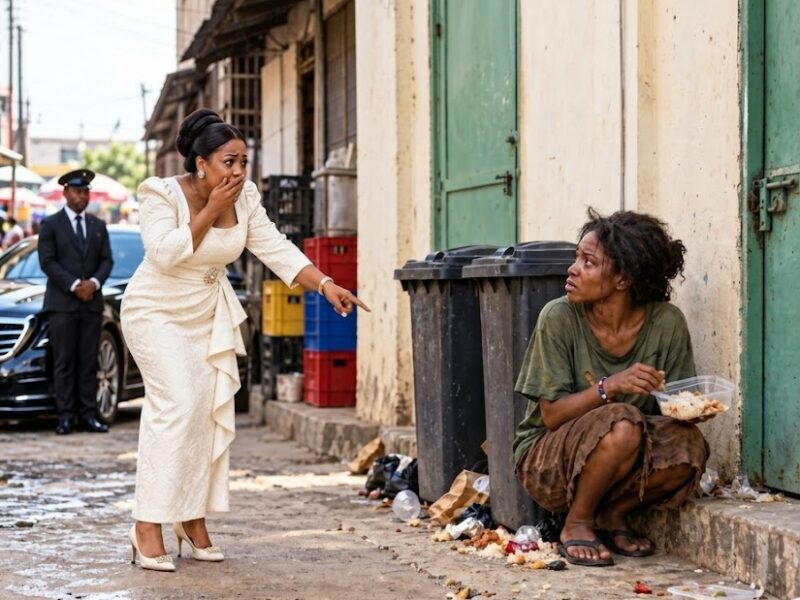
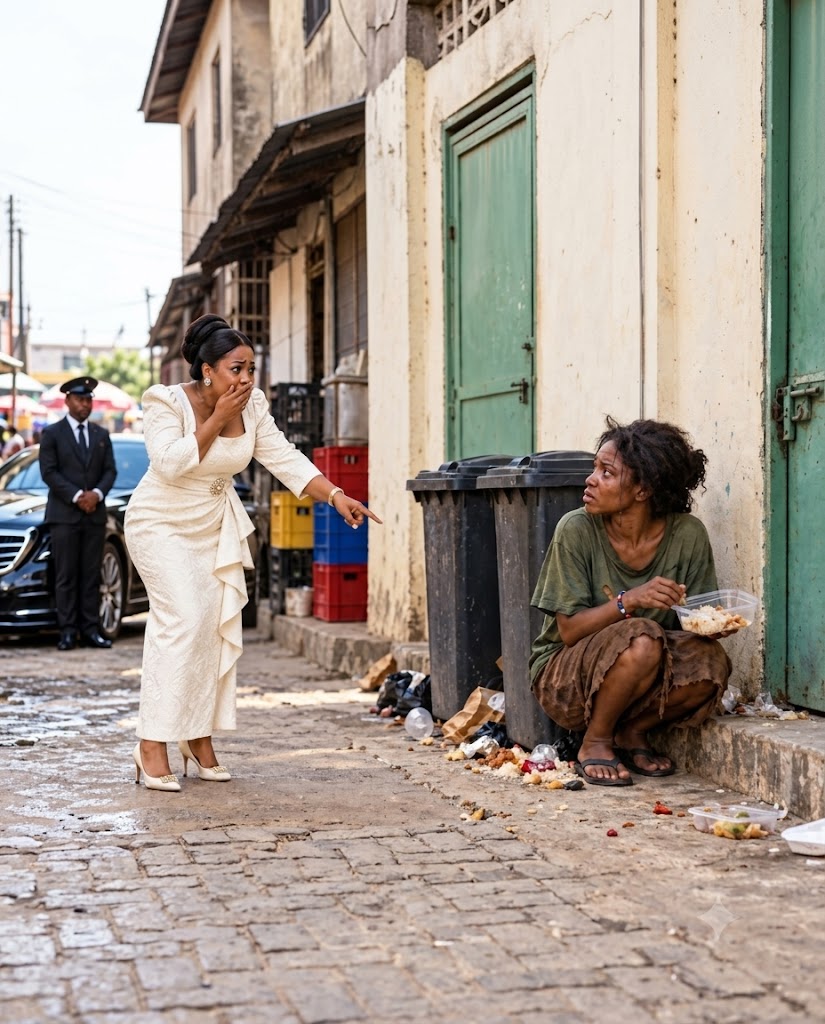
She returned from abroad after 10 years and found her daughter searching for food in the trash. What she discovered next made her blood run cold.
The taxi’s air conditioning hummed against the Lagos heat as I pressed my forehead to the window, watching familiar streets blur past like a life I’d rented but never owned.
“Ma’am, we’re almost there,” the driver said, his voice gentle, like he could sense I was holding my breath.
“How far is the old neighborhood from here?”
“Not far, ma’am. Traffic is light. We can reach there before eight.”
I nodded, my fingers gripping the leather seat. Ten years. Ten years of video calls that never connected, letters that never arrived, money that disappeared into a void I couldn’t name. Ten years of building a life in London while the life I’d left behind crumbled into something I wouldn’t recognize.
“Good. I want to surprise my daughter before anyone tells her I’m back.”
The driver’s eyes met mine in the rearview mirror, curious but polite. “After ten years, that will be some surprise.”
We turned onto a narrow street lined with shops, their metal shutters half-raised like tired eyelids. The smell of frying oil and diesel seeped through the vents. Then I saw her.
“Tunde, slow down. What is that girl doing behind those shops?”
He squinted. “Looking for leftovers, I think.”
My heart stopped. A girl in a faded yellow dress was crouched behind a row of stalls, her hands sorting through a black plastic bag. She pulled out a container, opened it, sniffed, then tucked it under her arm like treasure.
“Not again,” a woman’s voice barked from a nearby shop. “I told you yesterday, stay away from these bins.”
The girl didn’t flinch. “The food is already being thrown away.”
“Pull over,” I said.
“Ma’am, this lane is too narrow.”
“Then stop here. I’ll walk.”
I was out of the car before Tunde could argue, my heels clicking against cracked pavement. The woman running the shop stepped forward, arms crossed, her face a mask of exhausted authority.
“Move away,” she snapped at the girl. “Customers see this and think my kitchen is dirty.”
“I only wanted the rice you were throwing out.”
“Excuse me,” I said, my voice steadier than I felt. “How much is one fresh plate of rice?”
The woman blinked at me, taking in my linen pantsuit and leather bag. “Two thousand naira.”
“Give her one.”
The girl’s head snapped up. Her eyes, dark and guarded, met mine for a fraction of a second before dropping to the ground. “I didn’t ask you to buy me anything.”
“I know. I just don’t want you eating from there.”
“Then don’t watch.”
She started to walk away, and that’s when I saw it. A thin gold bracelet on her wrist, tarnished but unmistakable. A tiny heart charm dangled from the clasp.
“Where did you get that bracelet?”
She stopped. “Why?”
“Because I made one exactly like it for my daughter.”
Her shoulders tensed. She turned slowly, and for the first time, I saw her face fully. The angle of her jaw, the shape of her eyes, the small scar above her left eyebrow from when she’d fallen off a bicycle at seven.
“Dami.”
“Don’t call me that.”
“Look at me. It’s me. It’s Mom.”
“My mother doesn’t know what I look like anymore.”
The words hit like a physical blow. “Damola, please. I came home to see you.”
“Ten years late.”
“Why are you here like this? Let me take you somewhere safe.”
“Safe with you?” She laughed, a hollow sound. “Yes.”
“With me? You are still a stranger.”
She reached into her pocket and pulled out a crumpled bill, pressing it into my hand. “Take this for today. Keep it. You need food.”
“I needed a mother.”
“I sent money every month.”
“That is all you know how to send.”
“What does that mean?”
“Ask your sister.”
I stood frozen as she turned and walked toward a rusted gate at the end of the alley. “Dami, leave this place. I kept food for you.”
A voice called from inside the gate. “I’m coming, Mama.”
A woman appeared, older, her face weathered by years of sun and worry. She looked at me with open suspicion. “Who are you?”
“Someone who stayed.”
Dami disappeared through the gate, and I moved to follow, but the woman stepped into my path. “Why are you following me?”
“Because you’re my daughter.”
“That didn’t stop you leaving.”
“Exactly. I went away to provide for you.”
“Then why was I sleeping behind her stall?”
“Enough,” the older woman said. “Let the girl eat.”
“Dami, please tell me what happened.”
“Not today.”
“Then let me at least sit here.”
She hesitated, then nodded toward a plastic chair. “Sit. Don’t pretend we’re family.”
I sat. The older woman brought out a container of rice and set it in front of Dami, who stared at it without touching it.
“Give me that old container and eat properly,” I said.
“I’m not hungry anymore.”
“Please eat. I won’t ask another question.”
She picked up the spoon. The older woman sat across from me, arms folded.
“You’re really going to stay quiet if that’s what she needs?”
“For once, yes.”
“Who are you to her?”
“Her mother.”
The woman’s expression didn’t change. “She first came to me when she was sixteen.”
Sixteen. The word carved itself into my chest. “Sixteen?”
“Mama, please,” Dami said, her voice small.
“Exactly. I won’t question you. But was Bisola there?”
“She put my bag outside.”
“Let her eat.”
“Modupe,” Dami whispered, and I realized the older woman’s name for the first time.
“She slept behind this stall for three nights,” Modupe said.
“You don’t have to tell her.”
“Somebody does.”
“Why didn’t anyone call me? I tried the numbers I had. They worked.”
“Not for me. I called home almost every week.”
“Who answered?”
“Bisola. She always said you were busy.”
“Of course she did. She said you were doing well at school.”
“Which school?”
“The university she enrolled you in.”
Dami set down her spoon. “That’s almost funny.”
“She told me you stopped sending anything.”
“I never stopped. Not even once.”
“So where did all the money go then?”
“Where did it go? I sent everything through Bisola.”
“Then start asking your sister questions.”
The gate creaked open, and a woman stepped through. She was younger than me, sharper, her eyes calculating even before they landed on me.
“Dami, you missed the registration meeting.”
“Modupe. So you finally came home.”
“I landed this morning.”
“And you’ve already found what everyone hid from you.”
“You knew she was leaving like this?”
“I knew she needed help.”
“Why didn’t you tell me?”
“How?”
“Don’t turn me into an argument. I’m trying to understand.”
“Then listen instead of defending yourself.”
I took a breath. “She studies evenings at our center and works whenever she can.”
“For how long?”
“Long enough to stop waiting.”
“You could have found me somehow.”
“I didn’t have your number or address.”
“Neither did I. She asked me twice if I knew where you lived in London.”
“Dami,” Modupe said softly.
“She deserves to know that.”
“You were looking for me once, then twice. Twice. Why did you stop?”
“I learned to.”
“I never knew you were trying to find me. That’s the problem. I trusted what I was told.”
“Exactly.”
“When they stopped letting you speak to your daughter, why didn’t you come home?”
“I thought she was safe.”
“You thought—”
“You’re right. I should have come.”
“Where are you going?”
“To hear what Bisola says to my face.”
“She won’t tell you the truth.”
“Then I’ll know by how she lies.”
“Don’t underestimate her.”
“You don’t have to come.”
“I wasn’t going to.”
“I understand.”
“Do you?”
The question hung in the air as I walked away.
—
Bisola’s house sat behind a wrought-iron gate in a neighborhood that had grown too expensive for the people who’d built it. I rang the bell and waited, my heart pounding against my ribs.
The door opened. Bisola stood there in a silk robe, her hair wrapped in a towel, her expression shifting from irritation to recognition to something I couldn’t name.
“Modupe. You should have called before coming.”
“I’ve been away ten years.”
“Exactly. Ten years.”
“Sister, you didn’t even tell me you landed.”
“Where is my daughter?”
“What kind of greeting is that?”
“Dami is at school. Where else would she be?”
“Try again.”
“What are you talking about?”
“I found her searching trash for food.”
“You found Damola.”
“Now answer me.”
“She ran away. Modupe, at sixteen. She became impossible. I tried everything.”
“Impossible? How?”
“She skipped school, broke rules, took money. And your answer was throwing her out?”
“I never threw that child out.”
“She said you put her bag outside.”
“Then she lied.”
“Femi,” I said, turning to the man who had appeared in the doorway. “Were you here?”
“There were arguments,” he said, his voice careful.
“Femi, that wasn’t my question. What school is Dami attending now?”
“Lagos Metropolitan University.”
“Which department?”
“Business. Something business related.”
“I paid her fees every year. I managed everything here.”
“Then show me the receipts.”
“Receipts?”
“After I raised your child for ten years, I asked where the money went and I heard accusation.”
“You left. I handled school, sickness, everything. I paid for everything you asked.”
“Money wasn’t parenting. You want someone else to carry your guilt.”
“My guilt doesn’t explain her hunger.”
“Neither does mine. Tomorrow, show me school records and what you did with my transfers.”
“No. Tonight we’ll settle this with the family.”
“Bring whoever you want.”
“You should hear what Damola put us through.”
“She’ll speak for herself.”
—
The family meeting took place in Bisola’s living room, under the cold gaze of relatives I hadn’t seen in a decade. Mama Tola, our eldest aunt, sat in the center like a judge, her walking stick propped against the chair.
“Why have you called us urgently?” she asked.
“Modupe came home blaming me,” Bisola said. “She blames me for Damola’s choices.”
“For ten years, I was the one here,” I said.
“That much is true,” Mama Tola said. “Then let’s discuss what happened here.”
“So you finally decided to come,” Bisola said.
“Mama Tola asked me to.”
“She came to speak, not be judged.”
“Tell your mother why you ran away,” Bisola said, looking at Dami, who stood in the corner, silent.
“I didn’t run.”
“Then what do you call disappearing?”
“You put my clothes outside the gates. You threatened to leave. You told me never to return.”
“Femi, is that what happened?”
“It was a terrible night. That isn’t an answer.”
“Ask her how often she skipped school.”
“After you stopped paying, there was always money for school.”
“I sent school fees every year.”
“I never saw them.”
“Because children don’t manage household money. I sent school fees.”
“Modupe, when did you last see this girl?”
“Before today. Before I left Nigeria. Ten years ago.”
“Yet today you arrive and call me a failure.”
“I asked for the truth. I asked for the truth after ten years of absence.”
“Both of you keep talking about yourselves,” Dami said, her voice cutting through the noise. “Nobody asks what those years were like for me.”
“We did our best with you.”
“Don’t.”
“I’m telling the truth.”
“You are telling your version. Stop fighting over who failed me more.”
She turned and walked toward the door.
“Please don’t leave.”
“I already learned how.”
“Give us space.”
“I will.”
“So now you believe strangers,” Bisola said.
“I believe I need facts.”
—
The next morning, I sat in the administrative office of Lagos Metropolitan University, a stack of papers in front of me.
“These are her registration forms and attendance records,” the clerk said.
“How far back?”
“Almost two years.”
I flipped through the pages. “Look at her emergency contact.”
“It says none.”
“She said she had nobody she could call.”
“Did she ever tell you about university?”
“She said she started once and stopped. She couldn’t afford to continue.”
“Bisola told me Dami was still enrolled.”
“Then call the school.”
I pulled out my phone and put it on speaker. “I want you to hear every word.”
The line rang twice before a voice answered. “Records office.”
“I’m calling about Damola Adeyemi. Was she ever enrolled there?”
“Yes, I can see an old admission record.”
“Is she still a student there?”
“No, she left after her first year.”
“Was her first-year tuition paid?”
“Yes. The account shows payment before she resumed.”
“Why did she stop attending?”
“I can’t discuss the full record by phone. Bring identification tomorrow.”
“I’ll be there tomorrow morning. Thank you.”
I hung up and looked at Dami, who had been sitting silently across from me.
“Do you believe me now?”
“I should have believed you before the records.”
“Then tell her that.”
—
I found Dami at Modupe’s center that evening, helping sort donated clothes.
“You came back,” she said.
“I said I would.”
“People say many things.”
“The school confirmed you left after first year.”
“So now I’m believable.”
“You were believable yesterday. I should have come home.”
“Even if Bisola lied, especially when she stopped letting me speak to you.”
“Then why didn’t you?”
“I thought money meant you were protected.”
“Money can’t notice when you’re gone.”
She was quiet for a moment. “That night, Bisola gave me ten minutes to leave.”
“What did you take?”
“Whatever fit in this bag.”
She reached into her pocket and pulled out an old phone, cracked and dead. “This was mixed with my things. Bisola’s phone. Her old one.”
“It stopped working years ago.”
“Why did you keep it?”
“I don’t know. Maybe because throwing things away became difficult.”
“May I have someone check whether anything remains on it?”
“You won’t give it to Bisola?”
“Never.”
“If you find something, I hear it first.”
“Before anyone else.”
“Then take it.”
—
The technician called me two days later.
“Mrs. Adeyemi, I found the transfer history. Can you come tomorrow morning?”
“Yes. They found something.”
“The transfer history.”
“So tomorrow we find out who was lying.”
“Anything from that phone yet?”
“Only that some files may still be recoverable.”
“I hear them first.”
—
The bank records spread across the table like a map of my years away. Every month, without fail, I had sent money. Every month, Bisola had taken it.
“I verified the transfers from your overseas account,” the banker said.
“Were they regular?”
“Very regular. Payments continued across the entire period we reviewed.”
“Even after I left Bisola’s house.”
“Yes.”
“Where did the transfers go?”
“To the account details you were given for Damola’s care.”
“Bisola controlled it.”
“Your references say school fees, books, accommodation, birthdays.”
“She told me nothing was coming. I sent all of it.”
“How much did she get?”
“Enough that I recommend you review this with your lawyer.”
“We will. These copies are for your records.”
“Thank you. I want to see the school file next.”
—
That evening, the family gathered again. This time, I had documents.
“Damola enrolled and completed part of her first year,” I said. “Then her enrollment stopped. Did this school receive later tuition payments?”
“Not under Damola’s student account,” the clerk had confirmed.
“So money marked for my school kept coming.”
“Yes, but not here.”
“Keep the bank and school records together.”
“I will. There is still the phone.”
“You promised I would hear it first.”
“You will. One old voice message was recovered.”
I pressed play. My own voice filled the room, tinny and desperate.
“Please tell Dami I love her. I sent her school fees this morning.”
The room was silent.
“What is the date on that recording?” Mama Tola asked.
“That message is from the year you said she forgot me.”
“One message proves nothing.”
“Then explain the money. The bank confirmed ten years of transfers.”
“Money came for the household.”
“The references say Damola. School fees, books, accommodation, and birthdays were specifically marked.”
“Families share expenses.”
“Not without accounting.”
“I knew money was coming,” Femi said quietly.
“Femi, don’t.”
“I didn’t know how much, but I knew enough.”
“I used some to build something for this family.”
“With money meant for my child.”
“I plan to replace it.”
“Money is the smallest thing you stole.”
“Then what did I steal?”
“Ten years. And you gave her those years because you never came to check.”
“You’re right. One woman’s absence does not excuse another woman’s deception.”
“Auntie, enough.”
“There will be a formal accounting of every transfer meant for Damola.”
“You want to destroy me.”
“I want the truth recorded.”
“I’m leaving for a while.”
“You’re leaving me now?”
“I stayed silent too long already.”
—
Dami walked me to the gate. The sun was setting, painting the sky in shades of orange and pink.
“Knowing you sent the money doesn’t give me my childhood back.”
“I know.”
“Good.”
“What do you want next?”
“To finish school. Then we’ll start there.”
“I don’t want to be taken to England.”
“Then you won’t be.”
“No arguments.”
“No arguments.”
“I won’t ask you to forgive me tonight.”
“Good.”
“I’ll give you reasons to trust me instead.”
—
Three months later, I stood in Modupe’s kitchen, flipping pancakes while Dami sat at the small table, scrolling through her phone.
“You’re doing too much again.”
“It’s breakfast with you.”
“Breakfast has become a project.”
“What time is your lecture?”
“Nine. You’ll make it.”
“I’ve made every class this month.”
“London called again. The office did.”
“Are you going back?”
“Sometimes not disappearing is the answer.”
“Am I too early for her breakfast operation?” Modupe asked, appearing in the doorway.
“Never. Ignore her.”
“I’m leaving before both of you become awkward.”
“We were doing fine.”
“You really weren’t. Try having one normal conversation while I’m gone. Go to school.”
“She’s definitely your daughter.”
“So, are you staying?”
“For now.”
“And after that?”
“I’ll decide when guilt isn’t deciding for me.”
“You know, I can feed myself now.”
“I know.”
“Good.”
“Mom?”
“Yes.”
“I’ll be late tonight.”
“Thank you for telling me.”
—
The bracelet sat on my nightstand, polished and restored. I had offered to buy Dami a new one, something gold and unbroken, but she had shaken her head.
“This one has a story,” she said. “I want to keep it.”
I understood. Some things couldn’t be replaced. Some things had to be carried, tarnished and imperfect, as proof that we had survived.
The next morning, I found her at the kitchen table, the bracelet clasped around her wrist, a textbook open in front of her.
“Breakfast?” I asked.
“Breakfast,” she said, and for the first time in ten years, it sounded like a beginning.
—
Six months passed. The leaves outside my rented apartment turned brown and fell, and Dami’s first semester ended with grades she taped to the refrigerator like a child’s drawing.
“Principles of Accounting: A,” she read aloud. “Microeconomics: B-plus.”
“I’m proud of you.”
“I know.”
“Do you?”
“I’m learning to.”
The doorbell rang. Modupe stood on the porch, holding a covered dish.
“I brought food. You two need to eat more.”
“We eat.”
“Not enough. You’re both too thin.”
Dami laughed, a sound I was still learning to recognize. “Mama Modupe, you sound like a grandmother.”
“Someone has to.”
—
The letter from Bisola arrived on a Tuesday. I opened it in the kitchen while Dami was at class.
*Modupe,*
*I have started the process of selling the house. The lawyer says the accounting will take time, but I want to do this right. I don’t expect forgiveness. I only want you to know that I understand now what I took from both of you.*
*The money will be returned. All of it. With interest.*
*Tell Dami I’m sorry. Tell her I was afraid of losing what I had built, and I let that fear become cruelty.*
*I don’t know if she’ll ever want to see me again. I don’t deserve to ask.*
*But I’m asking anyway.*
*Bisola*
I folded the letter and placed it in a drawer. Some conversations could wait. Some couldn’t.
That night, I told Dami about it over dinner.
“She wants to see you.”
“And what do you want?”
“I want you to have what you need. If that’s distance, I’ll respect it. If that’s closure, I’ll be there.”
Dami was quiet for a long time. “I don’t know what I want yet.”
“Then you don’t have to decide today.”
“This is what it should have been like from the beginning.”
“What?”
“Someone asking me what I want instead of telling me.”
—
The restaurant was small and quiet, tucked away on a side street. Bisola sat at a corner table, her hands folded in front of her, her face older than I remembered.
Dami walked in first. I stayed by the door.
“Hi,” Bisola said.
“Hi.”
“I didn’t think you’d come.”
“I didn’t either.”
They sat in silence for a moment. Then Dami spoke.
“I don’t forgive you.”
“I know.”
“But I’m tired of being angry. It takes too much energy.”
“I understand.”
“Do you? Because I don’t think anyone understands what it’s like to sleep behind a stall, wondering if anyone is looking for you.”
“I wasn’t looking. I was hiding.”
“From what?”
“From the fact that I had stolen from you. From the fact that your mother trusted me and I betrayed her.”
“You could have stopped.”
“I know.”
“You could have told her the truth.”
“I know.”
“So why didn’t you?”
Bisola’s eyes filled with tears. “Because I was afraid. Because I had built a life with money that wasn’t mine, and I couldn’t imagine giving it up. Because I told myself you were fine, that children are resilient, that you would find your way.”
“I was sixteen.”
“I know.”
“I almost died.”
The words hung in the air. I felt my heart stop.
“There was a night,” Dami continued, “when I hadn’t eaten in three days. I sat behind Modupe’s stall and thought about just… stopping. Just closing my eyes and not waking up.”
“Dami—”
“But Modupe found me. She gave me rice and told me I was worth something. She didn’t know me, and she stayed.”
Bisola sobbed, her composure breaking. “I’m sorry. I’m so sorry.”
“I know. But sorry doesn’t change what happened.”
“No.”
“It just means you see it now.”
“I see it.”
“Then maybe that’s a start.”
Dami stood up. “I’m not ready to forgive you. But I’m willing to try. Someday.”
“Thank you.”
“Don’t thank me. Thank Modupe. She’s the one who taught me that staying is a choice.”
—
I drove Dami home in silence. When we pulled up to the apartment, she turned to me.
“You were listening.”
“I was.”
“You didn’t interrupt.”
“I wanted you to speak.”
“That night I mentioned—”
“You don’t have to tell me.”
“I know. But I want to.”
She told me about the three nights behind the stall, about the hunger that gnawed at her insides, about the moment she had decided to give up. She told me about Modupe’s hand on her shoulder, the way a stranger’s kindness had pulled her back from the edge.
“I should have been there,” I said.
“You should have. But you’re here now.”
“For as long as you need me.”
“That might be a long time.”
“I have a long time.”
—
The bracelet gleamed in the moonlight as we walked to the door. Dami touched it, a habit she had developed, a way of grounding herself.
“Mom?”
“Yes.”
“I’m glad you came back.”
“I’m glad you let me stay.”
—
One year later, Dami graduated with honors. She walked across the stage in a borrowed cap and gown, her smile wide and unguarded. Modupe sat beside me, clutching a program, tears streaming down her face.
“She did it,” Modupe whispered.
“She did.”
“You did too.”
“I just paid the bills.”
“You stayed.”
The reception afterward was small, held in Modupe’s center, surrounded by the women who had helped her build it. Dami gave a speech, her voice steady.
“I want to thank my mother,” she said, looking at me. “Not because she was perfect. But because she came back.”
I felt the tears before I could stop them.
“And I want to thank Mama Modupe, who found me when I was lost and gave me a reason to keep going.”
Modupe waved her hand, embarrassed. “Enough of that.”
“And I want to thank myself,” Dami continued, “for surviving. For not giving up. For believing that someday, things would be different.”
The room erupted in applause. I clapped until my hands hurt, until my heart felt like it might burst.
—
The bracelet sat in a small display case in Dami’s new apartment, a reminder of where she had been and how far she had come. She had refused to let me replace it, even when I offered to buy her something new.
“This one has a story,” she said. “I want to keep it.”
I understood. The story was messy and painful and imperfect. But it was hers.
And now, finally, it was ours.
—
The old neighborhood looked different in the daylight. The shops were still there, the stalls still crowded, but the alley behind them no longer felt like a place of shadows. Dami walked beside me, her arm linked through mine.
“Do you ever think about what would have happened if Modupe hadn’t found you?”
“Sometimes.”
“And?”
“I think I would have become someone else. Someone harder.”
“You didn’t.”
“Because someone stayed.”
I squeezed her arm. “I’m sorry I didn’t stay sooner.”
“You’re here now. That’s what matters.”
We stopped in front of the stall where Modupe had first found her. A young girl was sitting there now, eating a bowl of rice, her eyes wary.
Dami knelt down. “Hey. Are you hungry?”
The girl nodded, her mouth full.
“Come with me. I know a place that gives free meals.”
The girl looked at her, suspicious. “Why?”
“Because someone did it for me once.”
—
The center had grown. What had started as a small operation in Modupe’s shop had become a full-fledged nonprofit, serving meals to children and teenagers who had nowhere else to go. Dami volunteered there every weekend, her accounting skills put to use in ways she had never imagined.
“You’re good with them,” Modupe said, watching her interact with a group of teenagers.
“I remember what it was like.”
“That’s why they listen.”
“Sometimes I wonder if I should have done more.”
“You’re doing it now.”
—
The letters from Bisola came every month, updates on the sale of the house, the repayment of the money, the slow unraveling of a lie that had held us all captive. Dami read them but didn’t respond. Not yet.
“She’s trying,” I said.
“I know.”
“Are you ready?”
“Not yet. But I’m getting there.”
—
The sun set over Lagos, painting the sky in shades of gold and crimson. Dami and I sat on the balcony of her apartment, watching the city come alive with lights.
“I used to think I would never have this,” she said.
“Have what?”
“A home. A family. Someone who stays.”
“You have it now.”
“I know.”
“Are you happy?”
She considered the question. “I’m learning to be.”
“That’s enough.”
“Is it?”
“It has to be.”
—
The bracelet caught the last light of the day, glinting like a promise. Dami touched it, the way she always did, and smiled.
“Mom?”
“Yes.”
“Thank you for coming back.”
“Thank you for letting me.”
—
Two years later, Dami stood at the front of a classroom, teaching a group of teenagers about financial literacy. I watched from the back, my heart swelling with pride.
“Money is a tool,” she told them. “It can build or destroy. It can protect or betray. The choice is yours.”
A girl in the front row raised her hand. “How do you know which choice to make?”
“You learn. And if you’re lucky, someone teaches you before it’s too late.”
—
The old neighborhood was gentrifying, slowly but surely. New shops were opening, their windows clean and bright. The alley behind Modupe’s old stall had been paved, the trash bins replaced with recycling containers.
Dami walked through it, her heels clicking on the new concrete. She stopped in front of the spot where she had once slept.
“I used to think this place was cursed,” she said.
“And now?”
“Now I think it’s just a place. The curse was in the people, not the ground.”
—
The family meeting was smaller this time. Just Mama Tola, Modupe, Dami, and me. Bisola had been invited but hadn’t come.
“She’s selling the house,” Mama Tola said. “The papers are almost ready.”
“And the money?” I asked.
“It will be divided according to the accounting. Damola will receive her share.”
“I don’t want it,” Dami said.
“Then what do you want?”
“I want to use it for the center. To help other kids like me.”
Mama Tola nodded slowly. “That can be arranged.”
—
The night before Dami’s graduation from her master’s program, we sat in her apartment, surrounded by boxes and packing tape. She was moving to a new place, bigger, closer to the center.
“Are you nervous?”
“About moving? No.”
“About what comes next?”
“A little. But I’m used to starting over.”
“This time is different.”
“How?”
“You’re not alone.”
She smiled. “No. I’m not.”
—
The bracelet was the last thing she packed. She held it for a long moment, tracing the tiny heart with her finger.
“I used to hate this thing,” she said.
“Why?”
“Because it reminded me of you. Of what I didn’t have.”
“And now?”
“Now it reminds me that I survived. That I’m still here.”
—
The graduation ceremony was held outdoors, under a canopy of white tents. Dami walked across the stage with the same confidence she had shown at her first graduation, but there was something different about her now. A steadiness. A peace.
“I want to thank my mother,” she said in her speech, “for coming back. For staying. For proving that love isn’t just a word you say, it’s a choice you make every day.”
I cried. Modupe cried. Even Mama Tola dabbed at her eyes with a handkerchief.
“And I want to thank the girl I was,” Dami continued. “The one who slept behind a stall and thought she had no future. She didn’t give up. She kept going. And now she’s here.”
—
The center had become her life’s work. She had expanded it, added programs for job training and counseling, created a network of volunteers and donors who believed in the mission.
“We’re changing lives,” she told me one afternoon, her eyes bright with purpose.
“You are.”
“Because someone changed mine.”
—
The letter from Bisola arrived on a rainy Tuesday. Dami opened it in the kitchen, her hands steady.
*Dear Dami,*
*I know you don’t owe me anything. I know I don’t deserve your time or your attention. But I wanted to tell you that I’m proud of you. I’ve been following the work you’re doing at the center, and it’s remarkable.*
*I’m not asking for forgiveness. I’m not asking for anything. I just wanted you to know that I see you now.*
*I see the woman you’ve become. And I’m sorry I wasn’t there to see you become her.*
*Bisola*
Dami folded the letter and placed it in a drawer.
“Are you okay?”
“I am. For the first time in a long time, I am.”
—
The old neighborhood was almost unrecognizable now. The shops had been replaced by cafes and boutiques, the stalls by farmers’ markets. But the alley was still there, a narrow strip of pavement between buildings.
Dami stood at the entrance, the bracelet glinting on her wrist.
“Do you want to go in?”
“No. I just wanted to see it.”
“To remember?”
“To let go.”
—
The last time I saw the alley, it was from the window of a car, ten years ago. Now I stood in it with my daughter, and the shadows no longer felt threatening.
“Mom?”
“Yes.”
“I’m ready to forgive her.”
“Bisola?”
“Yes.”
“Are you sure?”
“I’m not doing it for her. I’m doing it for me. I don’t want to carry this anymore.”
—
The meeting was small, just the two of them. I waited outside, watching through the window as they talked. There were tears, and silences, and words that I couldn’t hear.
When Dami came out, her face was calm.
“Are you okay?”
“I am. It’s done.”
“Do you feel better?”
“I feel free.”
—
The bracelet caught the light as we walked away from the cafe. Dami touched it, the way she always did, and smiled.
“Ready to go home?”
“Yes.”
“Mom?”
“Yes.”
“Thank you for not giving up on me.”
“Thank you for not giving up on yourself.”
—
The years passed, as they always do. Dami grew the center into a national organization, her name becoming synonymous with hope and resilience. I stayed in Lagos, close enough to see her, close enough to be there when she needed me.
The bracelet remained on her wrist, a constant reminder of where she had been and how far she had come. She never took it off.
“It’s part of me now,” she said. “The good and the bad. I don’t want to forget either.”
—
The old neighborhood was gone, replaced by something new and shiny. But the memories remained, etched into the pavement, whispered in the wind.
Dami stood at the edge of it, her daughter at her side.
“Was this where you used to live?”
“No. This is where I survived.”
“What’s the difference?”
“Someday, I’ll tell you.”
—
The end was not an ending. It was a continuation, a story that kept unfolding, a life that kept growing. The bracelet, the alley, the rice—they were all part of it, threads in a tapestry that was still being woven.
And somewhere, in the heart of a city that had seen so much pain and so much joy, a mother and daughter walked together, their steps in sync, their hearts finally whole.
—
The final scene was a photograph, framed and hung in the center’s main office. It showed Dami, Modupe, and me, standing in front of the stall where it had all begun. We were smiling, arms around each other, the past behind us and the future ahead.
Underneath, in Dami’s handwriting, were the words:
*”She returned from abroad after 10 years and found her daughter searching for food in the trash. But she stayed. And that made all the difference.”*
—
The bracelet was still on her wrist when she held her own daughter for the first time. A new generation, a new story, a new chance to get it right.
“What are you going to name her?” I asked.
“Modupe,” she said. “After the woman who saved me.”
“And what will you tell her?”
“I’ll tell her that she is loved. That she is worthy. That no matter what happens, someone will always come looking for her.”
—
The circle was complete. The wound had healed, not perfectly, but enough. The old neighborhood was a memory, but the love that had grown there was eternal.
And in the end, that was enough.









