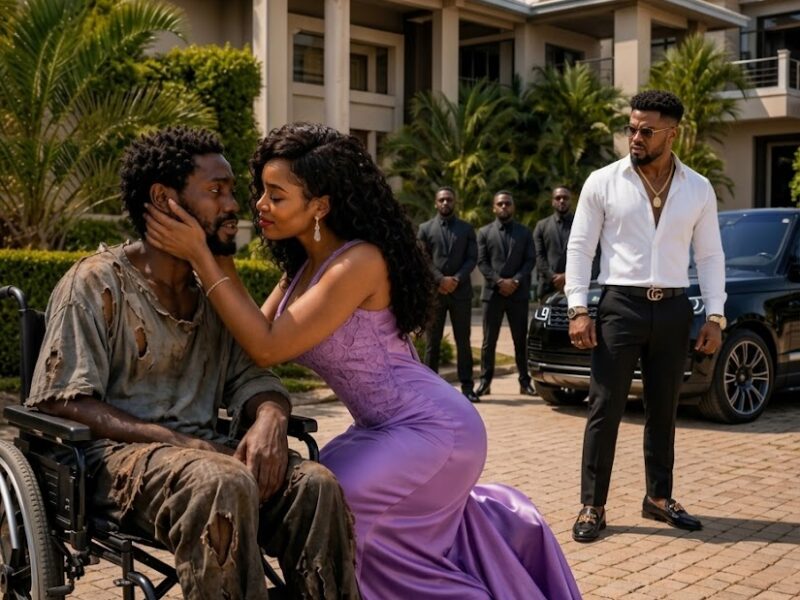
She Rejected a Billionaire’s Son for a Struggling Man in a Wheelchair—Then One Document Silenced the Room
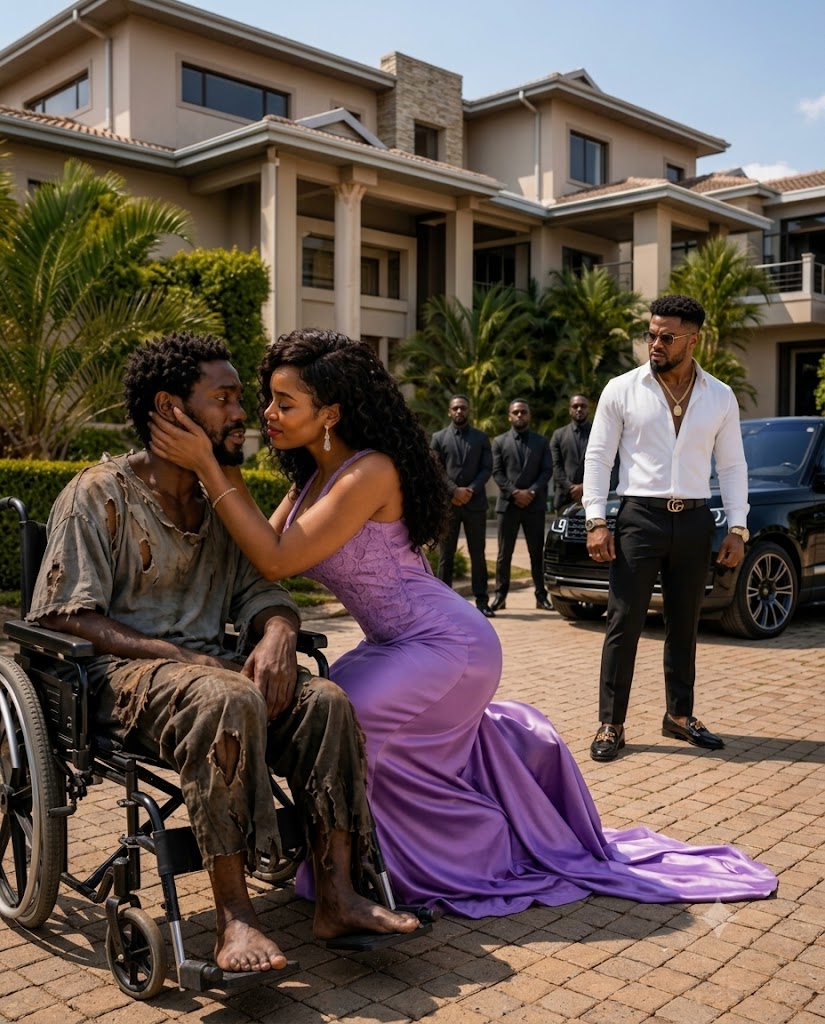
Go back inside. Marry the man your father chose for you.
I’m a Ugotchi. He wouldn’t want you to marry someone like me.
Don’t do this. Not now. Not after everything.
You’re the one I love, not him.
Then why are you sending me back to him?
You heard him. The man doesn’t want you.
This has nothing to do with you.
It has everything to do with me.
You’re not my husband.
I’m the man you’re supposed to marry. The man you’re begging has already told you to leave. How much more humiliation do you need?
Just look at me. Look at me and tell me you don’t love me.
Go.
Three weeks earlier, in the dining room of Chief Ofori’s mansion, the room fell silent when the chief put down his spoon.
Across the long mahogany table, Ugotchi looked up from her plate. Her father rarely stopped eating in the middle of dinner.
“What is it, Papa?”
Chief Ofori wiped his mouth slowly with a white napkin and placed it beside his plate. “There’s something we need to discuss.”
Ugotchi glanced toward the staff standing near the doorway. “Can we have some privacy?”
Chief Ofori gave them a small nod. The staff quietly left the room. The heavy doors closed behind them.
Ugotchi looked back at her father. “You’re making this sound serious.”
“It is.” He leaned back in his chair. “I spoke with Chief Namdi this afternoon.”
“About what?”
“About you. Namdi and I have agreed that you should marry his son.”
Ugotchi stared at him, certain she had misheard. “I’m sorry?”
“Uche. I know who Uche is.”
“Then you know his family. Our families have worked together for years. He’s educated, responsible, understands the business.”
“Papa, you will marry him.”
She gave a short, disbelieving laugh. “You’ve already decided.”
“I’m telling you now.”
“You’re telling me you didn’t ask.”
“I’m asking you to trust my judgment.”
“That isn’t the same thing.” She pushed her plate away. “My marriage isn’t a business agreement.”
“I never said it was.”
“You didn’t have to.”
Chief Ofori studied her for a long moment. “Is there someone else?”
She didn’t answer. That was answer enough.
His expression shifted, not to anger, but to something quieter, concern, and beneath it, something older and harder to name. “Who?” he asked.
She said nothing.
“Ugotchi, who is he?”
“I’m not ready to tell you.”
“Then you understand why I’m worried.”
“Why would you be worried about a man you’ve never met?”
He didn’t answer. There was something about the question he couldn’t explain even to himself. A feeling that had no evidence yet, only instinct.
She stood and walked out. Chief Ofori sat alone staring at the closed doors, and after a long while reached for his phone.
“Get someone to look into my daughter’s movements,” he said. “And don’t let her know.”
The following afternoon, Ugotchi had her driver take her past the office and onto the foundation clinic. No appointment, no explanation.
Beneath the mango tree out front, a young man in a faded blue shirt sat at a wooden table covered in recharge cards, fighting with a broken radio.
“Don’t embarrass me today,” he muttered to it.
“Are you talking to the radio?”
He looked up and smiled. “It’s the only thing here that listens.”
“You’re still here.”
“Some of us have jobs.”
“This is a job? Very profitable. Ask my radio.”
She laughed. And for the first time since the dinner with her father, something in her chest loosened.
His name was Amecha. He liked old Nigerian music, hated people who played videos loudly in public, and thought her hatred of papaya was a personal betrayal of the fruit kingdom.
When a little girl brought him a school bag with a broken zipper, he took it without being asked and told her to come back tomorrow.
“You fix children’s bags, too?”
“Sometimes.”
“Why?”
“Because I can.”
The answer had nothing impressive in it. And somehow that was what stayed with her.
Her phone rang. Her father’s name lit the screen. She turned it face down.
“Everything okay?” Amecha asked.
“Not really.”
He didn’t press. He only handed her the dead radio. “Try talking to it. Might work better for you.”
She smiled despite herself. “I’ll see you again tomorrow, maybe.”
Neither of them knew that an ordinary afternoon beneath a mango tree had just become the beginning of something two families would spend years trying to bury a second time.
She kept coming back.
Monday, she brought the radio, still broken. “You said talking to it might help, and it still doesn’t work.”
“Then you’re a terrible mechanic.”
“I never said I was a mechanic.”
Tuesday, she brought foundation paperwork. She was meant to review quarterly clinic reports and read three pages in an hour while he sold recharge cards and pretended not to notice she hadn’t turned a page in twenty minutes.
“You’re not reading that,” he said finally.
“I am.”
“You’ve been on page four for twenty minutes.”
“It’s a complicated page.”
“It’s a table of vaccine stock numbers.”
She closed the folder. “Fine. I’m not reading it.”
“Then why did you bring it?”
“Because if I didn’t bring something, this would just be me sitting under a tree talking to a stranger who sells recharge cards.”
“And that would be a problem.”
“It would be honest,” she said. “Which is worse.”
He laughed at that longer than the joke deserved, and she found she liked being the reason for it.
Wednesday, she brought jollof rice in a plastic container.
“You’re trying to make me dependent on you,” he said, eyeing it with suspicion.
“You haven’t eaten.”
“I can feed myself.”
“Prove it.”
He took it anyway, ate half in silence, then slid the rest back across the table without a word. She didn’t ask why. She just took it.
The following Friday, she came without an excuse at all. No paperwork, no food, nothing to justify the drive. She sat down, and he raised an eyebrow but said nothing about it, which she noticed and appreciated more than she let on.
“No radio today,” he said.
“No rice, no clinic reports.”
“I ran out of reasons.”
“You didn’t need one.”
“I know,” she said. “That’s the part I’m still getting used to.”
One quiet afternoon, he asked about her mother carefully, gently, the way a man asks about something he suspects is a wound and doesn’t want to press too hard against.
She told him briefly. An illness years ago, before the foundation existed, before her father had learned to fill silence with business instead of grief.
Amecha listened without offering the sympathy she’d learned to expect and deflect from everyone else. He just listened and let it sit there unfixed, which was somehow the kindest thing anyone had done for her in months.
“You’re good at that,” she told him, surprised by how much she meant it.
“At what?”
“Not trying to make it better. Everyone else always tries to make it better, and it never actually helps.”
“Some things don’t need fixing,” he said. “They just need somebody willing to sit with them a while without rushing them toward being okay before they’re ready.”
There were small things she noticed and didn’t think much of.
In the weeks that followed, he never quite said where he’d grown up, and changed the subject so smoothly each time that she only noticed the pattern in hindsight.
Once, reaching for a fallen recharge card, his hand moved with an ease that seemed to forget itself entirely before he caught himself and settled back into the slower, careful motions she’d grown used to.
A thin chain sometimes showed at his collar when he leaned forward, and he’d tuck it away without comment, as if the gesture were older than their friendship.
When she mentioned her father’s old business dealings in passing, a name, a company, nothing specific, his jaw tightened for exactly as long as it took him to change the subject. And then he was laughing again, as though nothing had happened at all.
None of it meant anything on its own. She wasn’t looking for meaning. She was looking for an excuse to keep coming back, and he kept giving her one, week after week, until the mango tree had become less a location and more an appointment she kept with herself.
The following week it rained. They sat pressed together under the narrow veranda, her shoulder nearly against his, watching the yard turn to mud.
“You’ve never asked why I keep coming back,” she said over the noise.
“I assumed you’d tell me when you wanted me to know. And if you never do, then I’ll enjoy the company while it lasts.”
She studied him. “What’s the hardest thing you’ve ever had to do?”
He looked at the rain. “Start again.”
She waited for more. He didn’t give it.
“And you?” he asked instead.
“Disappoint my father.”
“Are you going to?”
“I already have.”
“Because of the marriage?”
“You knew?”
“You look unhappy. Every time your phone rings, you notice too much.”
“Occupational hazard.”
“You don’t have an occupation.”
“Exactly.”
She laughed. And in the space right after it, before either of them decided anything, he reached over and wiped a drop of rain from her cheek.
Neither of them moved. It lasted only seconds. It changed something anyway.
“I’m sorry,” he said.
“Don’t be.”
She came home late that night. Chief Ofori was waiting.
“Where have you been?”
“The clinic.”
“Until this hour.”
“Yes.”
He’d already received the photographs. His daughter under a mango tree, laughing with a man he’d never seen.
“Who is he?”
She said nothing.
He placed his phone on the table, the photograph facing up. “Who is the man?”
“Someone I know.”
“How long does it matter?”
“It matters to me.”
His phone rang before she could answer. Namdi. He stepped away to take it, and she heard fragments. Merger documents. Almost finalized. Don’t let the boy become a problem.
When he hung up, his face had changed in a way she hadn’t seen before.
“What merger?” she asked.
“You don’t need to involve yourself.”
“Then why did Chief Namdi just say my marriage could affect it?”
His silence answered more than his words could have. She walked away. Alone.
Chief Ofori sat with the photograph a long time. Something about the young man’s eyes unsettled him in a way he couldn’t name. He had learned long ago that some memories were safer left undisturbed.
He picked up his phone and called Okoye, a man he hadn’t needed in twenty years.
“Find out who he is.”
By Monday, a file sat on Chief Ofori’s desk. A photograph of Amecha on top. No surname that held, no employment history, no university record. His birth date shifted depending on which document you trusted.
“That’s impossible,” Chief Ofori said.
“We checked everywhere,” Okoye said. “One record places him in Lagos, another in Ibadan. Nothing matches.”
“Who is he?”
“We’re still establishing that.”
“Don’t tell Ugotchi. Don’t approach the man. Just find out where he came from.”
That evening, Chief Ofori confronted her.
“You had someone follow me,” she said.
“I was protecting you.”
“From what?”
“Someone I don’t know.”
“You don’t know him because you haven’t spoken to him.”
“I don’t need to meet every stranger who approaches my daughter.”
“He didn’t approach me for my money.”
“You don’t know that.”
“I know how he treats people.”
“You’re seeing what you want to see.”
“And you’re seeing what you fear,” she said, and the words landed heavier than either of them expected.
“What exactly do you know about him?”
“Enough,” she said, and left before he could ask what that meant.
His phone rang minutes later. Okoye again.
“We found an old photograph. There’s another name attached to it.”
“What name?”
“I’m not certain yet.”
“Find out.”
Across town, Amecha noticed the black sedan parked across from the clinic. It had been there an hour. His phone buzzed.
They’ve started looking into you.
Who?
He typed.
Ofori’s people.
He locked the phone and sat very still. Then Ugotchi’s face came to mind, and something in him went quiet with worry that wasn’t for himself.
“Not yet,” he whispered.
He reached beneath his shirt and closed his hand around a small metal pendant on a thin chain. And for the first time, something in his expression looked less like a man hiding and more like a man waiting.
The message came the next morning from a number she didn’t know.
You asked about Dr. Kenneth. I have something your father doesn’t want you to see. Come alone. 11 a.m.
She hadn’t asked about anyone named Kenneth. Not yet. But the address led her to a small office above a pharmacy in Yaba, where a man in his sixties introduced himself as Okoye.
“A different Okoye,” he clarified when she flinched at the name. “One who used to work for Zenith Global.”
“Your father didn’t tell you much about Dr. Kenneth, did he?”
“No. I’ve never heard the name in my life until this morning.”
“He wouldn’t have told you. Nobody in that house would.”
He laid out a company registration document yellowed at the corners, the ink gone soft with age. Among the listed names, Chief Ofori, Chief Namdi.
“My father said they were partners.”
“They were more than partners. They were the reason Zenith Global existed at all. In the beginning, Kenneth had the vision. Your father and Namdi had the money and the connections. For a few years, it worked beautifully.”
“What changed?”
“Success,” Okoye said with no humor in it. “The company grew faster than any of them expected, and a company that size attracts people who’d rather own the whole thing than share it.”
He slid a second folder across the desk. Bank statements, transfer records, property documents. Several carried signatures she recognized instantly, the same careful, slanted hand she’d watched sign school forms and dinner bills and business contracts her entire life.
“These are his,” she said quietly.
“Keep looking.”
Then a newspaper clipping, brittle at the folds. Businessman Dr. Kenneth Adel arrested for massive fraud.
She read it twice. Assets frozen within days. The company gone within weeks. Its offices stripped. Its staff scattered. The sentence at the bottom that stopped her breath entirely.
Dr. Adel died in police custody before standing trial.
“Died?” she said.
Okoye nodded slowly. “They said it was suicide. They said. Some of us never believed it. Kenneth had already hired lawyers by then. He was fighting the charges hard. He had documents, he said, proving exactly where the money had gone and who had moved it there. He wasn’t a man who sounded like he was preparing to die.”
“What happened to the documents?”
“They disappeared.” He hesitated, choosing his next words with visible care. “And somebody is looking for the same documents now, asking the same questions I used to ask years ago before I learned it was safer to stop.”
Ugotchi felt something cold settle low in her stomach. She thought unwillingly of a thin chain disappearing under a collar, of a jaw that tightened at the mention of business she hadn’t even specified. She pushed the thought away before it could finish forming into something she wasn’t ready to hold.
“What happened to his family?” she asked instead.
“There was a fire that night at the house. His wife died in it.”
“And the child?”
Okoye looked away, out toward the window, as though the answer lived somewhere out there in the traffic noise rather than in the room with them.
“That’s where it gets complicated,” he said. “Officially, there was no child, not in any record that survived the fire. But I remember him. A boy, maybe ten. I only saw him a handful of times at company functions, standing very straight next to his father in a little gray suit he clearly hated wearing.”
“What happened to him?”
“Nobody knows. Some people say he died in the fire with his mother. Some people say he didn’t.” Okoye met her eyes for the first time since the question. “I hope, for his sake, that whoever he became learned to be very patient.”
She went to the clinic that afternoon without the answer she wanted and asked the only question she had.
“Have you ever heard of Dr. Kenneth Adel?”
Amecha went still. Less than a second. She caught it anyway.
“It’s an old name,” he said.
“How do you know it?”
“Ugotchi, please leave this alone. Some things are safer buried.”
The answer chilled her more than a denial would have. “Then tell me what you’re hiding.”
He said nothing. She left, and only when she was gone did he reach for the pendant, and then a small key from his pocket, and sit with both in his palm for a long time, turning them over as though weighing exactly how much longer he could keep them a secret before the cost of keeping them outweighed whatever he’d told himself he was protecting by staying silent.
She brought the documents to her father’s study that night.
“You knew,” she said, laying the pages down. “You knew exactly who he was.”
Chief Ofori lowered himself into his chair. “Where did you get these?”
“That doesn’t matter.”
“It matters very much.”
“Why? Because you don’t understand what you’re touching.”
“Then explain it.”
“Kenneth was a dangerous man.”
“That isn’t what the documents say.”
“You weren’t there.”
“Neither were you, apparently, when it mattered.” She stepped closer. “Did you help destroy his company?”
Silence.
“Did you?”
“No.” Quick. Too quick. Then quieter: “I made mistakes.”
“Did you know his family was hurt?”
He closed his eyes. “I didn’t know what would happen.”
She watched him, and something colder than anger settled over her. “You’re afraid of him. Of a man you’ve never met. Why won’t you say it?”
He couldn’t answer. And in his silence, she understood something worse than anything in the file. Her father wasn’t only afraid of losing her. He was afraid of a man he had never met.
The clinic was quiet the next morning when she arrived. No Amecha at the table. She waited ten minutes, twenty. A nurse she recognized passed by, carrying a tray of medication, and gave her a small, curious look, as if she wanted to say something and thought better of it.
Then Ugotchi saw him coming from the narrow passage behind the clinic. Walking. Walking, not limping, not favoring one leg the way she’d seen him shift and adjust in the chair a hundred times before. Walking easily, the way anyone walks who has never had a reason to think about how their legs carry them.
The bag slipped from her hand and landed in the dirt. Neither of them moved to pick it up.
“You can walk.”
He stopped where he stood, several feet away, close enough to see and too far to reach.
“Ugotchi.”
“How long?” Her voice was very steady, which was somehow worse than if it had shaken. “How long have you been pretending?”
He said nothing, and the silence answered before he could.
“Since before I met you,” she said, understanding arriving faster and colder than she wanted it to. “Everything. The chair, the clinic, the little girl’s school bag, the recharge cards, the radio you pretended not to be able to fix because it was easier than admitting you could do anything at all. Was any of it real?”
“I needed people to underestimate me.”
“Why? Who are you hiding from?”
“That’s not something I can explain standing here.”
“Try.”
He was quiet a moment too long. “There are people who look past a man in a wheelchair. They say things in front of him they wouldn’t say in front of anyone they thought mattered. It’s not a disguise. It’s an advantage.”
“An advantage for what?”
“For finding out what I needed to find out.”
“Was I one of the people you were watching?”
“At first,” he admitted, and it cost him visibly to say it. “You were part of a question I needed answered.”
“What question?”
“I can’t tell you yet.”
“You still can’t. After all of this. The rain, the rice, the radio, sitting there every single day while I pushed your chair over ground you could have walked yourself. You still can’t.”
“Not everything. Not yet.”
“Then everything between us was a lie.”
“No.” His voice cracked on the word. “That part wasn’t.”
“Which part? Show me the line. Show me exactly where the lying stopped, because I can’t find it anymore.”
“The way I felt about you,” he said. “That was never part of any plan. I didn’t build that. It happened to me the same way it happened to you, and I didn’t know what to do with it. So I kept showing up every day and let myself have it a little longer than I should have.”
“That’s not an answer, Amecha. That’s a confession dressed up as one, and I am tired of slowly unwrapping things you should have simply handed me plainly from the very start.”
He didn’t argue with that. There was nothing left in him to argue with.
She looked at him for a long moment, at the man standing where the chair used to be, at the ease in his shoulders now that he no longer had to perform anything. And then she picked up her bag from the dirt and walked away without another word, because there was nothing left to say that wouldn’t come out as something she would regret by evening.
He sat down where he stood, not in the chair he no longer needed, but on the ground, and put his face in his hands, because for the first time since he’d begun this, the truth felt less like justice and more like a debt he hadn’t known he’d have to pay in her.
She learned the rest in pieces over the following days, the way a wound reveals its full depth only after the first shock passes.
Amecha Adel. Son of Dr. Kenneth Adel, owner once of Zenith Global. A company emptied from the inside. A police report quietly amended. Cause of death changed from suspicious injuries to suicide four days after the arrest. A fire that took his mother. A boy who disappeared from every official record afterward because disappearing was the only way to survive long enough to come back.
She confronted her father with what remained of it.
“You knew Kenneth was innocent.”
Chief Ofori didn’t deny it this time. “I knew the report was changed. I didn’t order it. I didn’t light the fire. I didn’t decide he should die.” He sat down heavily. “But I knew enough to stop it, and I was too afraid of Namdi to try.”
“That isn’t an answer.”
“No,” he said. “It isn’t.”
Her phone rang. Namdi. “The wedding is in three days,” he said without greeting. “Your father has agreed.”
“I never agreed.”
“This isn’t about agreement anymore.”
The line went dead. She looked at her father.
“What have you done?”
He had no answer for that either.
She went to Amecha one last time before the wedding, and neither of them smiled when they sat down at the same wooden table.
“They’re moving the wedding to three days,” she said.
“I heard.”
“Did you come into my life to destroy my father?”
“I came looking for the truth.”
“That wasn’t my question.”
“At first, I wanted justice. And now, now I don’t know how to get it without hurting you.”
“He’s still my father.”
“I know that, too.”
She reached across the table and stopped just short of his hand.
“If you expose everything, we lose everything. I understand. And if you don’t, then my father dies twice.”
The words silenced her.
“I won’t ask you to forgive him,” she finally said. “And I won’t ask you to protect him. I just need to know, was I ever part of the plan?”
“At the beginning. You stopped being part of it long before I let myself admit it.”
“I don’t know if that’s enough.”
“It may not be.”
She stood to leave, and at the door, she looked back.
“If you’re going to tell the truth, tell all of it.”
He opened the folder his lawyer had built over eighteen years and rested his hand on the first page for a long time before he picked up his phone.
“Release everything,” he said.
“Are you sure?”
He looked toward the road she’d gone down. “No. But it’s time.”
The Ofori estate was white flowers and gold chairs and relatives smiling as though nothing were wrong. Ugotchi stood in front of her mirror, feeling none of the beauty her maid kept insisting was there.
Chief Ofori knocked and entered. “You don’t have to do this.”
“Then stop it.”
“I don’t know how.”
“That is the problem.”
“Whatever happens today,” he said, “I want you to know I love you.”
“I know. But loving me doesn’t mean you get to decide my life,” she said. And it was the first time he had ever heard that sentence land in his own house and known it was true.
“I understand that now.”
“Then tell the truth today, Papa.”
“I will.”
Outside beneath the canopy, Uche adjusted his agbada while his father surveyed the grounds like a man checking a fortress.
“Does she even want this?” Uche asked.
“She’ll understand eventually.”
“That’s not what I asked.”
“This marriage protects both families.”
“From what?”
“Don’t ask questions you aren’t prepared to hear the answers to.”
The ceremony began. Ugotchi walked the aisle on her father’s arm. The pastor opened his Bible.
Then the estate gate opened.
No wheelchair. No faded shirt. A man in a simple black suit walked through it. A lawyer at his side. Two witnesses and an older man carrying a leather folder behind them.
The music stopped.
“Who allowed this man inside?” Namdi demanded, and security started forward until the lawyer raised a hand.
“Before anyone touches him, I’d listen. My client has no intention of disrupting this ceremony beyond what the truth is about to disrupt on its own. He’s come to tell you who he is.”
“Then tell us and leave,” Namdi snapped. “Whoever you are, this is a private family event.”
“It became a family event the moment your family decided mine wasn’t worth keeping alive,” Amecha said. And something in his voice made even the caterers near the tent stop moving. “You’ve been waiting twenty years for me to disappear the way my father disappeared. I’m sorry to disappoint you again.”
“I don’t know you,” Namdi said, but his face had already lost its color, as though some part of him had recognized the shape of this moment long before the name arrived.
“My name is Amecha Adel. Son of Dr. Kenneth Adel. He owned Zenith Global before the two of you decided it should belong to someone else.”
A murmur moved through the guests, chairs creaking as people turned to look, phones lowering from where they’d been recording the vows.
“Your father was a criminal,” Namdi said, louder now, playing to the crowd the way he played to boardrooms his whole life. “Convicted. Disgraced. I won’t stand here and let a stranger rewrite that history at my son’s wedding.”
“He was never convicted,” the lawyer said calmly. “He died before the trial. That distinction is the entire case.”
He opened the folder and began laying documents on the small table beside the altar, one at a time, unhurried, as though he had all the time in the world and intended to use it. Financial records from Zenith Global’s final operating year. Transfers made from company accounts into private holding companies controlled by Chief Namdi and Chief Ofori.
He turned the last page toward Chief Ofori. “These are the signatures authorizing them.”
Chief Ofori looked down at his own name in his own hand, twenty years younger and steadier than it was now.
“Fabricated,” Namdi said immediately.
“These are archived banking records pulled from the institution’s own retained files, not from anything my client produced,” the lawyer replied. “You’re welcome to have your own forensic accountants examine them. I suspect they’ll reach the same conclusion mine did.”
The older man who had walked in behind Amecha stepped forward then, holding his hat in both hands like a man arriving at a funeral rather than a wedding.
“My name is Okafor. For six years I worked in Kenneth Adel’s accounts department. In his final year I was ordered to alter the books, to move losses that belonged elsewhere onto his ledgers and to move gains that belonged to him elsewhere.”
“By whom?” the lawyer asked, though everyone in the garden already knew the shape of the answer.
“By his people,” Okafor nodded toward Namdi without looking at him directly. “I lied about it for twenty years. To my wife, to my children, to myself. Today, I have nothing left to protect by lying, so I’d rather stop.”
One more document went onto the table.
“The original police report,” the lawyer said, and beneath it, the amended version filed four days later. Cause of death changed from suspicious injuries sustained in custody to suicide. “The handwriting on the amendment doesn’t match the officer who signed the original.”
“Did you know?” Ugotchi asked her father, and her voice was the only quiet thing left in the whole garden, cutting through the noise more sharply than any shout could have.
Chief Ofori didn’t look at Namdi. He looked only at his daughter.
“I knew the report had been changed. I never asked who ordered it changed because I was afraid of what the answer would cost me if I knew it for certain.”
“Enough of this,” Namdi shouted, motioning again for security. But the guests themselves had gone still in a way that made it clear nobody was moving anyone anywhere.
“No,” Amecha said, and for the first time his voice carried the full length of the compound, past the canopy, past the rows of gold chairs, out toward the gate he’d walked through.
He reached into his jacket and drew out an old photograph, worn soft at the corners from twenty years of handling. A boy standing very straight beside a man in a gray suit. A woman’s hand resting on the boy’s shoulder, just out of frame.
“My father.” His thumb moved across the boy’s face. “Me.”
Every scattered piece Ugotchi had been carrying for weeks. The clinic. The chair he never needed. The pendant he kept tucking under his collar. The reason a stranger had first sat down beside her under a mango tree and made her laugh before she’d told him her surname.
Arrived in her all at once, arranging themselves into a shape she finally recognized.
“You knew from the beginning,” she said. “Who I was. Whose daughter I was.”
“I knew who you were before you ever told me your name.”
“And you still came to me. You still let me push that chair. You still let me bring you food.”
“I expected to find exactly what I’d been told to expect. A woman who would defend her father no matter what he’d done, because his money had always been the only truth she needed. Instead, I found someone who sat beside me under a tree in the dirt when she thought I had nothing to offer her at all.”
His voice broke on the last words.
“I lied about the chair. I lied about where I grew up, about my family, about almost everything that could have led anyone back to my father’s name. I never once lied about how I felt sitting across that table from you.”
“Love,” Namdi scoffed, the word curling with contempt. “Is that what we’re calling this performance?”
Amecha turned on him with a coldness that hadn’t been in his voice even a moment before. “You wouldn’t recognize it. You’ve never had to love anything that cost you something.”
Then back to Ugotchi, quieter. “I thought if I finally had the truth in my hands, revenge would feel like enough. It doesn’t. It never did. Not once I knew you.”
Chief Ofori stepped forward from where he’d been standing, frozen beside the altar, looking, in the space of a few minutes, considerably older than he had that morning.
“Ugotchi, I helped destroy Kenneth’s company. I told myself for twenty years that I was only following Namdi’s lead, that the choices were his and not mine, that staying quiet wasn’t the same as participating.”
He turned finally to face Amecha directly, the first time he had looked the younger man fully in the eye.
“I didn’t light the fire. I didn’t order the report changed. I didn’t decide your father should die in that cell. But I knew enough soon enough to have stopped some of it. And I was too afraid of the man standing beside me to try. I am sorry. It will never be enough. And I’m saying it anyway.”
The pastor slowly lowered his Bible, no longer certain what ceremony he was meant to be officiating. Nobody moved to pick up where the vows had left off.
Somewhere in the last several minutes, without anyone deciding it consciously, the wedding had stopped being a wedding and had become something closer to a courtroom held under white flowers. A reckoning conducted in the open air in front of witnesses who could no longer pretend not to have seen it, where no amount of money or influence could bury the truth a second time.
Authorities arrived within the hour, summoned by filings the lawyer had already lodged that morning, and Chief Namdi was taken from the estate in front of the same guests who had come to watch his son marry a chief’s daughter.
Uche stood apart from all of it, watching his father get led toward a waiting car with a stillness that suggested he had suspected on some level for longer than he’d ever admitted even to himself. He didn’t look at Ugotchi as she passed him on her way back into the house. He didn’t need to. Whatever they might have built together had ended before it had ever truly begun, and both of them seemed to understand that fact at exactly the same moment, without needing to say it aloud to each other.
By sunset, the ground stood empty. The flowers stayed where they’d been arranged. The chairs stayed in their careful rows, facing an altar no one had used. Nobody moved them, as if moving them would mean deciding finally whether the day had been a wedding or something else entirely, and no one left in the house that evening had the strength or the desire to make that decision.
Chief Ofori sat alone in his study beneath his late wife’s portrait, Kenneth’s photograph resting on the desk before him, where he’d set it down and hadn’t picked it up again when Ugotchi found him there.
“I thought your mother would hate me for this,” he said without turning around.
“She’d have asked why you were so afraid instead of asking why you did it. Fear was always easier for you to admit to than choice.”
“I don’t know how I would have answered her.”
“You’d have told her the truth eventually. The way you told it today. Twenty years too late, in front of two hundred people instead of just her.”
Ugotchi pulled a chair close to the desk and sat closer to him than she had in weeks.
“That’s the part I keep circling back to, Papa. Not that you were afraid. Everyone is afraid of something. It’s that you let the fear decide for you for twenty years and called it protecting people.”
“I don’t have a defense for that.”
“I’m not asking for one.”
He looked at her properly then, for the first time since the ceremony had ended. “What are you asking for?”
“I don’t know yet,” she admitted. “Not forgiveness. Not today. Maybe not for a long time. But I’m still here. And I came to find you instead of leaving. And I think that has to mean something, even if neither of us knows exactly what.”
Ugotchi reached across the desk, not to forgive him, only to let him know she was still there, in the room, in his life, in whatever came after this.
“You can’t change what happened, but you can stop hiding it. That’s the only version of atonement that was ever actually available to you, and you’ve spent twenty years avoiding it.”
“I will,” he said. “I promise you I will.”
He kept that promise fully without wavering, even when it would have been far easier not to. When the case reached court weeks later, Chief Ofori testified against Namdi himself, laying out in careful, unflinching detail exactly what he had known and when he had known it. A decision his lawyers advised against, and his oldest friends never forgave him for, one that cost him his reputation, most of his remaining business relationships, and the quiet, comfortable version of his life he had spent two decades protecting.
He made the decision anyway. And when it was over, he told Ugotchi it was the first thing he had done in twenty years that let him sleep without dreaming of a fire he hadn’t lit, but hadn’t stopped either.
Before Amecha left Lagos, he and Ugotchi stood once more outside the clinic beneath the same mango tree where a broken radio and a plate of jollof rice had quietly become the beginning of everything that followed.
“You’re leaving,” she said.
“For a while. There are pieces of this that still need finishing. My father’s name to clear properly in the places that matter, not just in a garden full of wedding guests. Okafor’s testimony to protect. People who helped me who deserve better than being forgotten now that the hardest part is done.”
“Where will you go first?”
“I don’t know yet.”
She smiled faintly despite everything. “That sounds like you. No plan, just movement.”
“I deserve that.”
A silence passed between them, easier than the ones that had come before it, worn smooth by everything they’d already survived saying to each other.
“I loved you,” she said. “Before I knew any of it. Before the chair, before the truth, before any of the reasons I probably should have loved you less. I still do. I don’t think that part of it was ever going to change, whatever else did. I don’t know if I can trust you again. Not the way I did before, when I didn’t know there was anything to distrust.”
“You shouldn’t have to trust the version of me that lied to you,” he said. “Only the version standing here now, if he’s worth trusting at all.”
He didn’t reach for her this time. He’d learned finally not to ask for more than she was ready to give.
She reached for him instead, her hand finding his, and he let it stay there.
“Then this time, Amecha,” she said, tightening her fingers around his, “start with the truth. All of it. From the beginning. Whenever you’re ready to give it to me.”
He nodded once, like a promise being sealed rather than spoken.
And beneath the mango tree, where their story had begun, where a radio had refused to work, where rain had once fallen without warning, where a woman with everything had chosen, for reasons neither of them could fully explain, to keep sitting beside a man who seemed to have nothing at all, neither of them said another word.
They didn’t need to.
For the first time since any of it had started, the silence between them belonged to no one but the two of them, and it asked nothing further of either.









