She Poured Champagne on Her Black Mother-in-Law at the Gala—Then the CEO Bowed and Called Her “Chairwoman”
## Part 1
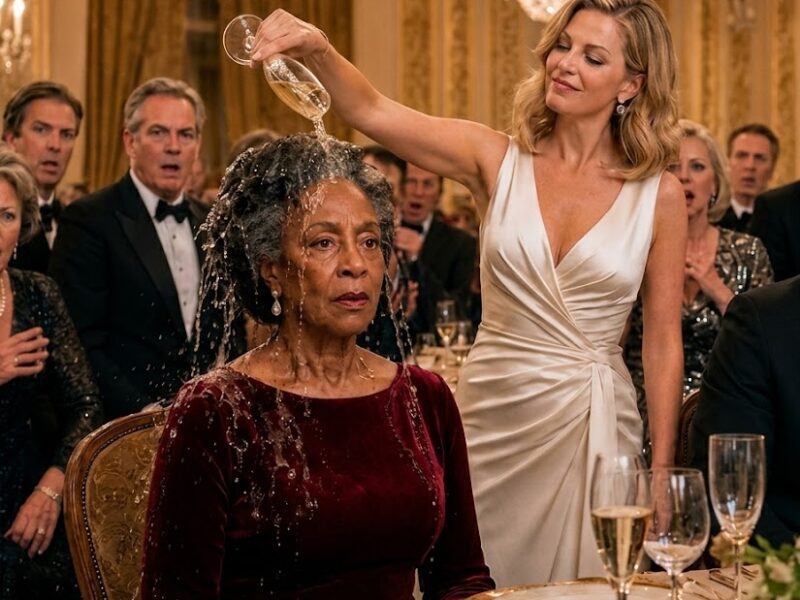
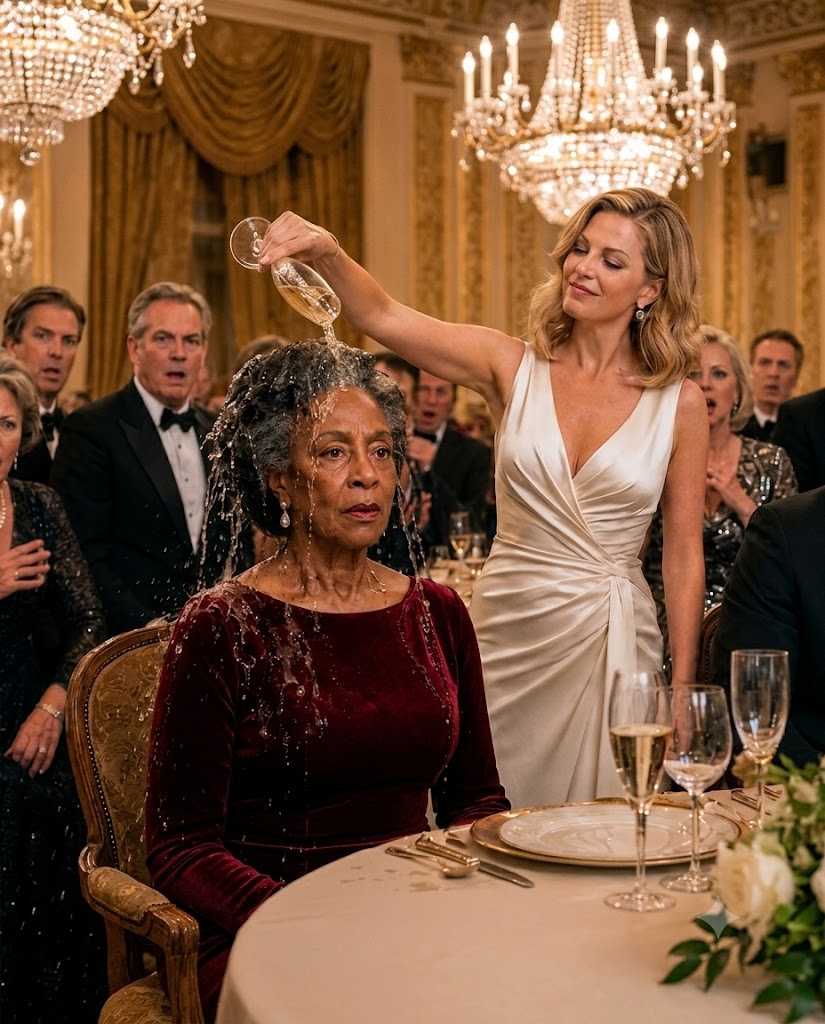
The champagne hit Dorothy Harmon at the crown of her silver-streaked hair.
Cold, immediate, undeniable — it ran down her temple, soaked through her collar, and spread dark across the shoulders of her burgundy dress in a stain that smelled like something meant to celebrate and was being used instead as a weapon.
Three hundred and fifty people heard the silence that followed.
The string quartet stopped mid-phrase, and then Cesily Harmon set the empty flute down on the white linen gently, precisely, like a period at the end of a sentence she had been writing for three years.
—
Some events just aren’t designed for everyone, Cesily had said earlier that evening, her eyes moving over Dorothy’s burgundy dress with the slow assessment of someone pricing a secondhand item.
And some people, no matter how hard they try, just aren’t designed for events like this.
Dorothy had said nothing then.
She said nothing now.
—
The Meridian Civic Foundation annual gala was the kind of event that Washington DC produced with the same reliable efficiency it produced policy papers and carefully cultivated ambition — precisely on schedule, meticulously staged, and designed to make every person in attendance feel they had arrived somewhere that genuinely mattered.
The Hamilton Hotel’s Grand Ballroom held 350 guests on this particular Thursday evening in November.
Crystal chandeliers hung from the vaulted ceiling like captured constellations, casting warm gold light across tiers of round tables dressed in ivory linen.
Each place setting featured gold-rimmed china, three crystal glasses, and heavy silverware that caught and released the light with every movement.
A string quartet played near the east wall — softly, never intrusively, just enough music to fill the precise gap between names being exchanged and reputations being quietly assessed across the rims of wine glasses.
—
The programs had been printed on thick card stock with gold embossed lettering.
Centerpieces were white orchids arranged in low crystal bowls.
The waitstaff moved in pressed dark uniforms with the practiced invisibility that expensive events demanded, appearing at elbows and disappearing again before guests could form a full thought about them.
Everything about the room communicated one fundamental truth without needing to say it aloud.
This was a space with standards, with history, and with the particular gravity that only existed in rooms where real power had been present long enough to stop feeling the need to introduce itself.
It was, in other words, precisely the kind of room designed to make certain people feel they belonged entirely — and to make certain others understand without a single word spoken that their presence was merely tolerated.
—
Marcus Harmon arrived at 7:15 with Cesily on his arm and the smooth, rehearsed ease of a man who had recently made partner at one of the city’s most respected corporate finance firms.
He was 34, lean, careful-looking, with his mother’s steady brown eyes and a handshake that communicated reliability before a single word left his mouth.
People gravitated toward Marcus naturally.
He had cultivated the quality of seeming genuinely interested in whoever stood before him, even when he was not.
It was a useful gift in rooms like this one, and tonight it was fully deployed — every watt of it directed outward, away from the one conversation he did not want to have.
—
Cesily walked beside him in ivory silk she had selected three weeks in advance and had altered twice since.
Her boutique PR firm handled three of the city’s most prominent nonprofits, which meant she did not experience rooms like this the way ordinary guests did.
She experienced them architecturally.
She knew which board members drove real decisions and which ones were decorative.
She knew which donors required warmth and which required careful distance.
She had mapped her movement through this evening before she left the house — who to approach during cocktail hour, which table clusters to avoid, and precisely where to seat Dorothy to ensure minimum interference with everything Cesily had decided this night would be.
—
Dorothy arrived at 7:30.
She came alone, as she had come to most important things in her life — without announcement, without an escort, without the performance of arrival that this room seemed to require of everyone else.
She wore a simple burgundy dress with a modest neckline and clean, unhurried lines.
Pearl earrings, small and real.
Sensible heels she had owned for eleven years because they fit correctly, and she had never understood the logic of discarding something that still served its purpose well.
Her silver-streaked hair was pinned back with quiet precision, and she moved through the entrance with the particular stillness of a woman who had long since stopped measuring her worth by the speed at which a room decided to acknowledge her.
—
The moment Dorothy crossed the threshold, Cesily’s smile tightened by exactly one degree.
It was not a visible change to anyone who did not know Cesily’s face intimately, but Dorothy had been cataloging that face for three years.
She noted the flicker without expression and filed it in the long, careful internal record she had been keeping without writing a single word down.
The seating arrangement was Cesily’s design.
Dorothy found her place at the far end of table seven — a position chosen with the specific deliberateness of someone who understood that where you placed a person communicated everything about how you had decided to value them.
The chair faced partially away from the stage.
—
The guests on either side were pleasant but peripheral — a junior associate from a downtown firm who spent the cocktail hour on his phone, and a city planning official whose attention was fixed on the table beside them all evening.
During cocktail hour, Cesily steered Dorothy briefly toward a city council member near the bar.
And this, she said, moving through the introduction with the clipped efficiency of someone crossing an item off a checklist, is Marcus’s mother.
She’s from Baltimore.
Not Dorothy’s name.
Not a single word about thirty years of work that had helped finance the very foundation hosting this evening.
Just a city — offered the way people offer a detail they consider mildly interesting and entirely unremarkable.
—
The council member nodded courteously and turned back to Cesily.
Dorothy held her glass of sparkling water and said nothing.
What she did instead was watch — because watching was what Dorothy had always done best.
This room, for all its chandeliers and embossed programs and careful architecture of prestige, was not so different from every other room she had ever quietly learned to read.
She noted which guests gravitated toward the head table.
She noted the unhurried conversation between the foundation’s executive director and a man in a dark tuxedo who had arrived recently, accompanied by a small, efficient-looking staff.
His name was printed in the program she held: William Donovan, CEO, Donovan Capital Group — the evening’s honored guest.
She had not seen him in four years.
She would have known him anywhere — not by his face, but by what they had built together when he was 28 years old and the world had not yet made its decision about him.
—
She did not cross the room.
She did not raise her hand.
She sat down at the far end of table seven with her sparkling water and her patience, and allowed the evening to proceed at its own pace.
Across the ballroom, William Donovan’s assistant leaned close and spoke quietly into his ear.
He turned slowly and began scanning the room.
—
To understand what happened in that ballroom on a Thursday evening in November, you first have to understand who Dorothy Harmon was before anyone in that room had the chance to decide who she wasn’t.
She was born in West Baltimore in 1962 — the second daughter of a woman named Evelyn, who worked double shifts as a hospital aide at Sinai Hospital five days a week and still managed to be sitting at the kitchen table with a cup of coffee every morning when Dorothy left for school.
Evelyn Harmon did not have money.
She did not have connections.
She did not have the kind of credentials that opened doors in rooms like the Hamilton Hotel’s Grand Ballroom.
What she had was a specific and unshakable conviction that her daughters would not inherit her ceiling.
And she transmitted that conviction the way other mothers transmitted recipes — daily and deliberately, until it became part of the architecture of Dorothy’s thinking.
—
Dorothy graduated from Morgan State University in 1984 summa cum laude with a degree in urban planning and a scholarship she had maintained across four years of night jobs, early mornings, and secondhand textbooks with other students’ notes already penciled in the margins.
She turned down a corporate consulting offer from a firm in downtown Baltimore that had paid well and promised comfort.
She took a position instead with the Urban Heritage Foundation — a small, underfunded nonprofit working in community development finance — because a professor whose opinion she trusted had told her quietly, “The work that matters is never the work that pays best at the beginning.”
That was 1985.
She was 23 years old.
—
What followed was not a dramatic rise.
It was something more durable than dramatic.
It was a steady, methodical accumulation of competence and credibility that took place almost entirely out of public view — in conference rooms, at community hearings, across tables and neighborhoods where the decisions being made about housing and investment and infrastructure would determine whether families stayed or were displaced, whether businesses could take root or were quietly priced out before they drew a single breath.
Dorothy was a program analyst for six years, a senior program officer for nine, deputy director for five, executive director for seven — and then at 51, after a unanimous vote by a board that had watched her work for two decades, chairwoman of the Urban Heritage Foundation.
—
The organization’s grants had shaped community development across three Mid-Atlantic states.
Her record stated plainly: fourteen major community development projects approved and funded under her direct leadership.
Forty-seven million dollars in federal grants directed to underserved neighborhoods across Maryland, Virginia, and Pennsylvania.
Board seats at two historically Black universities.
Three congressional testimonies on affordable housing policy — each delivered without notes, because she had written the relevant legislation herself in previous years and did not need to be reminded of what it said.
She built things that outlasted the people who underestimated her.
That was not a metaphor.
It was a literal description of her career.
—
The most important thing Dorothy had ever done — the one thing she would never have called the most important thing, because that was not how she thought about her work — happened on a Tuesday afternoon in March, twenty-two years ago.
In a small conference room on the fourth floor of a building on North Charles Street in Baltimore, a young man named William Donovan had been sent to meet her by a mutual colleague who described him in the referral email as brilliant, broke, and about six weeks from giving up entirely.
He was 28.
He had a concept for a community land trust that he believed could stabilize homeownership in three of Baltimore’s most at-risk neighborhoods.
He had a twenty-page proposal, a laptop with a cracked screen, and the specific, exhausted focus of someone who had been told no enough times to be afraid of what another no might do to him.
—
He sat across from Dorothy and delivered his presentation in seventeen minutes.
Most of what he heard in response from people at his level of development was encouragement dressed up as advice — the kind of support that sounded warm and delivered nothing.
Dorothy was not interested in that.
She asked him four questions.
They were not gentle questions.
They were the questions of someone who was deciding whether to trust something with weight, and who needed to know if it could bear the load.
He answered all four without flinching.
—
Dorothy opened a folder, wrote two names on a notepad, tore the page out, and slid it across the table.
“The first name will get you a room,” she said.
“The second name will get you taken seriously in it. Call them in that order. Tell them I sent you.”
Two months later, William Donovan had his first meeting with a federal housing grant officer.
Four months after that, the Community Land Trust had seed funding.
Within three years, his work had expanded beyond Baltimore into a broader model for community investment finance.
Within a decade, Donovan Capital Group had offices in four cities, two federal partnerships, and a reputation in the community development world that people spoke about the way they spoke about foundations — as something structural, load-bearing, essential.
—
Dorothy had never asked for equity.
She had never asked to be mentioned.
She had never inserted herself into William’s story in any form, public or private.
She had given him a room and a name and sent him forward the way she had sent dozens of people forward across thirty years of work.
That was her pattern.
Help, then let go.
Build the bridge and allow other people to name it after themselves if they needed to.
The bridge still held weight regardless of whose name was on it.
—
What Cesily had never understood — what Marcus had stopped explaining to her early in their marriage — was that Dorothy’s silence about her own accomplishments was not evidence of their absence.
It was discipline.
And it was about to become something else entirely.
—
Marcus Harmon had once been a man who led with his mother when he wanted to establish who he was.
In the early years of his career — before Cesily, before the partnership, before the particular kind of success that sometimes made people revise their personal histories into cleaner, less complicated narratives — Marcus had spoken about Dorothy the way people spoke about the thing that had shaped them most fundamentally.
He talked about her at law school dinners.
He mentioned her at firm events when senior partners asked about his background.
He had a story he told about a woman who worked thirty years in community development finance, with the kind of quiet precision that moved policy without ever appearing on the news.
And he told it with the genuine, unguarded pride of someone who understood that the foundation he stood on had a name, and the name deserved to be spoken aloud.
—
That was before Cesily Harmon decided — slowly and methodically — to reclassify Dorothy Harmon as a liability.
It did not begin with cruelty.
The most effective erosion never does.
It began with small linguistic adjustments offered gently, framed as concern.
Your mother is very traditional, Marcus, Cesily said after a dinner party where Dorothy had declined to compete for attention in a room full of people competing loudly.
She doesn’t really understand the circles we’re moving in now. And that’s okay. She doesn’t have to. But it does create a kind of friction.
Marcus had disagreed the first time.
The second time, he explained.
The third time, he went quiet — which was the moment Cesily understood she had found the right approach.
—
What followed was not a dramatic campaign.
It was a sustained, patient process of redefinition — the way water reshaped stone, not through force, but through repetition and time.
Cesily was too intelligent for overt attacks.
She worked instead through omission and framing.
She stopped asking about Dorothy’s work.
She began prefacing Dorothy’s attendance at events with quiet reservations.
I just want tonight to go smoothly, Marcus.
Until Marcus began hearing his own mother’s presence as a source of potential disruption rather than a source of pride.
—
Within eighteen months of their marriage, Marcus had stopped leading with Dorothy when he wanted to establish who he was.
He started instead with Cesily’s family — the Callaways.
Old money.
Georgetown address.
Patricia Callaway’s photograph on three charity boards and a hospital wing.
That was the story Marcus now entered rooms with.
Not the woman from West Baltimore who had moved forty-seven million dollars through the machinery of community development finance with the steady hands of someone who had been doing necessary, unglamorous, essential work since before Marcus was old enough to understand what work meant.
—
Dorothy watched the shift happen the way she had watched most difficult things in her life — with clear eyes, without theatrics, from a position of stillness that people sometimes mistook for acceptance.
It was not acceptance.
It was patience.
There was a difference, and she knew it precisely.
—
The deterioration accelerated in the second year of the marriage.
Cesily began managing Dorothy’s presence at social functions — which events she attended, where she sat, how she was introduced.
The introductions were always the most revealing instrument.
Cesily had developed a formula: state the city, omit the career, close the door.
Marcus’s mother, she’s from Baltimore.
Five words that transformed thirty years of professional life into a geographic footnote.
—
Then there was the fundraising dinner six months before the gala — a prominent event, a senator in attendance who Dorothy had in fact testified before in a congressional housing subcommittee three years earlier, though Cesily did not know this because she had never asked and Marcus had stopped volunteering the information.
Cesily made the introduction across a cluster of guests near the event bar.
She was moving quickly, managing multiple conversations, clearly in her element.
She gestured toward Dorothy with the casual brevity of someone pointing out furniture.
And this is the help. I’m kidding, I’m kidding.
A bright laugh, a hand on the senator’s arm.
This is Marcus’s mom. She’s from Baltimore.
—
The senator smiled politely.
The cluster moved on.
The moment dissolved as quickly as it had formed.
Marcus laughed.
It was a short, nervous laugh — the kind that wanted to signal that the joke was harmless.
But it was a laugh.
Dorothy did not respond.
She held her glass and kept her expression entirely composed, which took considerably more work than it appeared to take, because something had just shifted inside her in a way that would not shift back.
—
She said her goodbyes at 9:30 that evening.
She drove home alone on I-295 North, the city lights running past the windows like punctuation in a sentence she was still deciding how to finish.
She pulled into her driveway.
She turned off the engine.
She sat in the dark for twenty-two minutes.
Then she went inside, called Sandra, and said three sentences.
It’s getting worse. I need to start paying real attention. And I need you to start keeping notes.
—
Sandra had been Dorothy’s closest friend since their Morgan State days.
She was now a senior coordinator in civic event management, which meant she had access to guest lists, program schedules, and the logistical details of Washington DC’s nonprofit and civic calendar with a comprehensiveness that most people would have found surprising.
She understood what Dorothy was asking.
She did not require elaboration.
I’ll start tonight, Sandra said.
—
In the months that followed, Dorothy continued attending the events Cesily permitted her to attend.
She sat in the chairs she was assigned.
She accepted the introductions as they were given.
She said little and observed everything, building a picture with the same methodical patience she had applied to every difficult problem in her professional life.
And when the gala invitation arrived — Marcus insisting, Cesily acquiescing with a smile that did not reach her eyes — Dorothy accepted it without hesitation.
She had already understood by then that the invitation was not a peace offering.
It was a stage.
Cesily had already written the scene she intended to perform on it.
—
What Cesily had not accounted for was the possibility that Dorothy had been writing a different scene entirely — and had been writing it for considerably longer.
—
The lunch was Patricia Callaway’s suggestion, as most of the consequential decisions in Cesily’s adult life had been.
They met at the Whitmore Club on a Tuesday afternoon, twelve days before the gala — a members-only establishment off Wisconsin Avenue in Georgetown, where tables were spaced far enough apart for genuinely private conversation, and the staff had been trained above every other professional skill in the discipline of selective hearing.
Patricia arrived first, as she always did, because in her philosophy, arriving second to anything was a form of concession that refined women simply did not make.
She was 71 years old and looked 62 by considerable and deliberate design.
Her silver hair was cut with surgical precision.
Her jewelry was old and significant — not performatively so, but significant in the way that comes from having owned things long enough to stop thinking about their value and start thinking only about whether you still loved them.
—
She had been part of Washington’s civic social infrastructure for four decades.
Her name was on a hospital wing in Chevy Chase.
Her photograph appeared, background-positioned, in the documentation of three administrations’ charity events.
Her private number lived in the personal contacts of people who made decisions affecting thousands of individuals who would never learn her name.
Cesily sat across from her with a glass of sparkling water and the specific, contained tension she permitted herself to show only in front of her mother.
She is becoming a problem, Cesily said without preamble.
Patricia did not ask who.
She had been following the Dorothy situation for months with the attentive patience of a woman who considered her daughter’s marriage a long-term investment that required active monitoring.
She lifted her menu.
Define problem.
—
She came to the Whitmore dinner in September. Marcus insisted.
Cesily set her glass down with slightly more force than she intended.
She sat at the end of the table and said almost nothing the entire evening, and afterward three different people pulled Marcus aside to ask about her.
Not about the firm. Not about us. About her.
Someone recognized her from somewhere, and I still cannot determine from where, and that is precisely what concerns me.
Patricia lowered the menu fractionally.
What did Marcus say?
He said she used to work in nonprofit finance.
A pause, measured and deliberate.
He said it as though it explained something meaningful.
Did it?
It explained nothing useful to me.
—
Cesily smoothed the napkin across her lap.
She sits at the end of whatever table I put her at, in her sensible heels and her grandmother’s pearls, and she says almost nothing, and somehow the room still turns toward her.
I cannot manage someone I cannot read.
I cannot keep Marcus building the life we have if he keeps turning his eyes back toward where he came from.
Patricia was quiet for a moment.
Her silences were never empty.
They were the compressed interval that preceded precision.
The problem with women like Dorothy Harmon, she said finally, is not that they make scenes.
Scenes are manageable.
The problem is that they don’t.
They sit quietly in their assigned places, and they make everything you have carefully arranged around them look thin.
—
She folded her hands on the tablecloth.
What you need is not a confrontation.
You need a clarification — a public, unambiguous clarification that establishes for the room where she fits in your story and where she does not.
Cesily said nothing.
She was listening with the total, focused attention she reserved for her mother’s most actionable counsel.
The gala is a stage, Patricia said simply.
You have always understood stages.
She did not specify the method.
She never needed to.
She provided the direction.
Cesily had always been capable of designing the execution herself.
—
In the days that followed, Cesily moved with methodical calm.
She contacted the Hamilton Hotel’s event coordinator and submitted a revised seating request — repositioning Dorothy from a central placement at table seven to the far-end seat, the one that faced partially away from the stage and placed her beside guests who had no meaningful connection to the room’s real centers of influence.
A small logistical adjustment that cost nothing and communicated everything to anyone who understood how these rooms worked.
She researched William Donovan with the thoroughness she applied to every client she took on — corporate history, foundation connections, public record.
She found early references to Maryland-based nonprofit funding in his company’s origin story but could not trace the specific thread backward to its source.
She decided it was peripheral.
Donovan was being honored for his current standing, his current achievements, his current relevance.
His attention, like every honoree’s attention at every event like this one, would be directed forward — toward the future, toward the people who mattered to him now.
—
That was her second consequential error of the evening.
The first had been underestimating who Dorothy was.
The second was assuming that a man who owed the architecture of his entire career to one specific person would spend an evening focused on anything other than finding that person in the room.
—
Ninety minutes before guests arrived, Cesily stood at the ballroom entrance and surveyed the arrangement with the calm, professional clarity of a woman in her element.
Table seven’s positioning was correct.
The sight line from the head table was clean and unobstructed.
The string quartet’s placement would create enough ambient sound to absorb a localized, table-level incident without distributing it to the far end of the room.
She had designed it as a nudge — a tipped glass, an accident with plausible geometry, a line delivered in the register that sounded like mild exasperation and read to anyone paying attention as precisely calibrated contempt.
Then, during cocktail hour, she saw it.
William Donovan’s assistant — composed, dark blazer — standing near the head table entrance, raised her hand in a small, unmistakable wave directed across the ballroom toward Dorothy.
Cesily followed the gesture to its destination.
Something cold and specific moved through her chest and did not move back out.
The nudge became a pour.
She had spent three years erasing Dorothy from every foreground she entered.
She had not once stopped to consider what would happen when the eraser failed and the woman she had been erasing stepped forward into full, irrevocable light.
—
The evening unfolded with the specific, practiced smoothness of events designed by professionals who understood that the appearance of effortlessness was itself a demanding form of labor.
Guests arrived in clusters between 7 and 7:30.
The cocktail hour spread across the ballroom’s north end — champagne and sparkling water on silver trays, a raw bar along the west wall, clusters of important people performing the particular social choreography of appearing relaxed while remaining comprehensively alert to every entrance and every exit.
Names were exchanged.
Business cards were not — that would have read as too eager.
Phone numbers were offered under the polite pretense of following up on things that did not actually require following up on.
Connections were made and measured and filed.
—
Cesily Harmon moved through it all with the fluid precision of someone conducting an orchestra with no visible instrument.
She knew which board members to intercept before they reached the head table.
She knew which donors needed warmth now so they felt sufficiently primed for the evening’s formal ask later.
She stationed herself near the east entrance for the first twenty minutes, deploying her handshake and her smile with the calibration of a professional — brighter for the major donors, more collegial for the board members, coolly respectful for the people whose opinion she didn’t require but couldn’t afford to alienate.
And with the same quiet, practiced efficiency, she kept Dorothy away from anyone who might find her interesting.
—
This was not difficult.
Dorothy sat at her assigned position at the far end of table seven and made no visible effort to circulate.
To someone who didn’t know better, she might have appeared simply private — a woman content to observe an evening without inserting herself into it.
Cesily registered this as cooperation and allowed herself a measured loosening of tension in her shoulders that she should not have permitted.
What she missed — because she was too occupied managing the room’s main currents to watch its quiet edges — was the ten-minute conversation taking place between Dorothy and the young woman seated immediately to her left.
—
Her name was Brianna Cole.
Twenty-four years old.
First-generation college graduate.
Six months into a law school internship with an underfunded housing nonprofit that operated on a budget so thin it threatened to snap every quarter.
She had come to the gala on a ticket her supervisor had given her as a reward for six months of unpaid overtime, and she had spent the cocktail hour standing at the edges of conversations she couldn’t quite enter, holding a glass of water and feeling precisely as peripheral as the room’s architecture intended her to feel.
She sat down at table seven early, relieved to be still, and found herself beside a woman in a burgundy dress who looked at her with the specific, unhurried attention of someone who was genuinely interested in what she might say next.
—
They talked for ten minutes.
By the end of it, Brianna had the name of a scholarship program she hadn’t known existed, the title of a federal grant application her organization had been eligible for across two years without realizing it, and a contact name at the Urban Heritage Foundation — offered from memory, with the instruction to mention Dorothy’s name when she called.
Dorothy asked for nothing in return.
She did not explain who she was.
She did not present a card.
She gave Brianna three specific things that could quietly reshape the next two years of her professional life.
And then the ballroom lights shifted to indicate the transition from cocktail hour to seated dinner, and the conversation ended as cleanly as it had begun.
—
That was who Dorothy was.
Even here.
Even tonight.
Even with what was coming still fifty minutes away.
—
Across the room, William Donovan had arrived at the head table at 7:40 with two members of his team and the unhurried composure of a man who had attended enough of these evenings to have stopped being impressed by their pageantry.
He was 51, broad-shouldered, with close-cropped gray at his temples and the particular settled authority that came not from performance but from having built something real over a long period of time.
He shook hands with the foundation’s executive director.
He exchanged a brief word with the mayor’s chief of staff.
He accepted sparkling water and declined champagne — a preference his assistant noted in the quiet, ongoing inventory she maintained of the details that mattered to him.
Then he turned to her and said, at a volume no one else could hear, “Is she here?”
—
The assistant had received one email six days ago.
Brief.
From a name she hadn’t recognized.
Subject line reading: Please confirm keynote speaker for Meridian Gala — personal matter, urgent.
She had confirmed the speaker, forwarded it to Donovan as routine correspondence, and thought nothing further of it — until he had called her into his office and sat across from her with an expression she had never seen on his face in four years of working beside him.
Not exactly emotion, but something that lived in the territory adjacent to it.
Something that belonged to a chapter of his history he had never fully narrated to her.
“If she is in that room,” he had told her, “I need to know the moment you see her.”
—
Now the assistant raised her hand in a small, clean wave toward the far end of table seven.
Donovan followed the line of her gesture.
His eyes found the table.
Found the far end.
Found a woman in a burgundy dress with pearl earrings and silver-streaked hair, sitting with the composed, self-contained stillness of someone who had made peace long ago with being underestimated — and was waiting, with a patience that had no bottom, for the moment that peace was no longer required.
He went very still.
—
Marcus Harmon, meanwhile, had reached his third glass of wine and was conducting the evening’s ongoing, exhausting negotiation between his wife’s performance and his mother’s silence with progressively diminishing success.
He had looked at Dorothy twice across the table and turned away both times before she could meet his eyes.
He told himself this was because the evening was moving quickly.
He understood, in the part of himself he had been carefully avoiding for approximately three years, that it was because he was ashamed of himself in a way that wine was not adequately managing.
Then Cesily’s hand moved toward the champagne flute.
—
The table conversation slowed.
Someone reached for their water glass and stopped midway.
The woman beside Marcus drew a small, nearly inaudible breath.
And then the pale gold liquid left the glass in a slow, deliberate arc.
—
Dorothy Harmon had been prepared for many things that evening.
She had been prepared for the seating — she had expected to be positioned at a disadvantage and had arrived without complaint.
She had been prepared for the introductions — the abbreviated and weaponized versions of her identity that Cesily deployed with the smooth efficiency of someone who had been rehearsing the maneuver for years.
She had been prepared for Marcus’s silences, for the particular quality of Cesily’s smile, and for the low, persistent discomfort of occupying a room in which every structural element had been arranged to remind her that she was tolerated rather than welcomed.
She had not been fully prepared for how cold the champagne would be.
—
It struck her at the crown of her head with a physical immediacy that momentarily erased everything else.
The temperature.
The sound of liquid against hair.
The immediate wet spread of it across her scalp and down along her temples.
It ran in cold threads along her jaw, soaked through the collar of her burgundy dress, spread dark and heavy across her shoulders and down her back in a stain that carried the smell of something meant to celebrate and was being used instead as a weapon.
The string quartet stopped mid-phrase.
The note they abandoned hung briefly in the air and dissolved.
—
Cesily set the empty flute down on the white linen with the gentle, deliberate placement of someone completing a task they had thought through carefully in advance.
She looked at Dorothy with an expression of calibrated regret — the expression of a woman performing an apology she did not feel, for an audience she was comprehensively aware of.
“I’m so sorry, Dorothy,” she said, at a volume that reached three tables.
“You know how these evenings get. All this excitement.”
A pause, measured precisely.
“Maybe Marcus should take you home. You’ve had a long evening.”
—
A fork struck the edge of a china plate somewhere to Dorothy’s left.
The sound was startlingly sharp in the silence that had descended over the surrounding tables.
Nobody moved.
Not the city council member two seats to Dorothy’s right.
Not the foundation board member who had shaken Dorothy’s hand during cocktail hour.
Not the junior associate from the downtown firm who had been on his phone all evening and had now placed it face down on the table.
Not Brianna Cole, the young law student who was looking at Dorothy with an expression of stricken, helpless fury that Dorothy noted and acknowledged with the smallest possible movement of her eyes.
And not Marcus, who sat close enough to reach across the tablecloth and take his mother’s hand — and did not.
—
Dorothy did not cry.
She did not rise from her chair.
She did not look at Cesily, and she did not look at her son.
She understood, with a clarity that was not new but was more complete than it had been before this moment, that there was no comfort available from either direction.
And she released the expectation of it — the way you release a breath you have been holding too long.
She took her napkin from her lap, pressed it once, carefully, without hurry, against the side of her neck, and set it down on the table with the evenness of a woman choosing, in real time, to hold something together through the force of a decision rather than the absence of pain.
Then she straightened in her chair by one precise degree and lifted her eyes across the ballroom.
—
William Donovan had not moved from the head table.
His right hand, which had been resting at the edge of the table, had closed into a loose, quiet fist.
The glass of sparkling water in front of him had not been raised in several minutes.
His attention — entirely, completely, without remainder — was fixed on the far end of table seven.
He recognized her from the moment his assistant had pointed.
He recognized her now more fully.
He recognized the pearl earrings, the silver-streaked hair, the particular quality of stillness that he had first encountered in a conference room on North Charles Street in Baltimore twenty-two years ago.
The stillness not of a woman who was passive, but of a woman who understood precisely when to apply force — and was gauging, with the precision of long practice, whether this was that moment.
—
He stood.
It was not a dramatic movement.
It was simply a man who had made a decision and was now executing it with the unhurried certainty of someone who had already calculated the cost and determined it was worth paying.
He said a brief, quiet word to his assistant.
He did not look at the foundation’s executive director, who was watching him from the next chair with visible confusion.
He moved away from the head table and crossed the ballroom.
—
The crowd did not part for him consciously.
It parted the way space arranges itself around people moving with genuine, unperformative purpose — because something in a room senses the difference between a man walking toward a destination and a man walking toward a reckoning.
He reached table seven in twelve steps.
He looked at Cesily once.
It was a brief look and entirely devastating — not because it was hostile, but because it was accurate.
It appraised, found wanting, and moved on in the same motion, without residue, without apology, without the slightest interest in her response.
Then he turned to Dorothy.
—
“Chairwoman Harmon.”
Two words.
Not a greeting.
Not a pleasantry.
A correction — public, precise, delivered in a voice that carried clearly to the four nearest tables, including the one where the city council member sat, who had received a five-word introduction to Dorothy forty-five minutes earlier.
The table went still in a way that had not seemed geometrically possible but happened.
Cesily blinked.
Her smile, which had been performing a very specific kind of satisfied regret, shifted into something uncertain and unsteady.
“I’m sorry. I don’t think we’ve—”
“William Donovan.”
He said his own name while still looking at Dorothy.
“I have been looking for you since I walked through that door.”
He extended his hand.
—
Dorothy looked at it for one measured moment — not with hesitation, but with the specific, composed deliberateness of a woman receiving something significant and intending to receive it with the full awareness it deserved.
She placed her hand in his.
The room watched.
Every table.
Every set of eyes that had been fixed on china plates sixty seconds ago was now fixed on the far end of table seven, where a woman in a champagne-stained burgundy dress was being greeted by the evening’s honoree with the unmistakable warmth of a debt long owed and now publicly and irrevocably being repaid.
Cesily’s smile had not moved, but every trace of color had left her face in the slow, graduated way that color leaves a face when the architecture of a carefully constructed evening begins quietly and without ceremony to fall.
—
William Donovan did not release Dorothy’s hand as he walked her toward the front of the ballroom.
It was a deliberate choice — not theatrical, but the specific deliberateness of a man who understood that some gestures were statements, and intended this one to be read without ambiguity.
He moved with the unhurried assurance of someone who had made a decision and was no longer in the process of weighing it.
The foundation’s master of ceremonies — a careful professional in his late fifties who had managed civic events across Washington for two decades — registered Donovan’s movement toward the stage and made the only sensible decision available to him.
He stepped aside.
You did not interrupt William Donovan mid-motion on the evening he was being honored.
You stepped away from the podium and you waited.
—
The lights came up as Donovan reached the stage.
Dorothy stood beside him — not behind him, not positioned in the differential half-step that others might have taken.
Directly beside him, with the champagne stain still visible across the shoulders of her burgundy dress, the pearl earrings still in place, and the particular, unperformative composure of a woman who had long since stopped requesting permission to occupy space.
Donovan did not open with emotion.
He was not a man who led with emotion when documentation would carry further.
He opened instead with facts.
—
“The Meridian Civic Foundation,” he said, “was established eleven years ago with a founding grant of $2.3 million from the Urban Heritage Foundation’s Community Development Initiative.”
He paused — not for effect, but to allow the factual weight to settle before he continued.
“The woman who served as chairwoman of the Urban Heritage Foundation’s board at the time that grant was approved — the woman who reviewed the application, championed the allocation against internal opposition, and signed the final authorization — is standing beside me right now.”
The room did not erupt.
It did the specific thing rooms do when something genuinely true is stated plainly.
It went very quiet.
And the quality of that quiet was different from the quiet of shock.
It was the quiet of 350 people simultaneously reassessing the room they believed they were sitting inside.
—
“Her name,” Donovan said, “is Dorothy Harmon.”
He turned to the foundation’s executive director, Carol Ree, who had been sitting at the head table with a mounting, complicated expression for the past several minutes.
“Carol, will you confirm that for the room?”
Carol Ree stood immediately.
She was sixty years old, and she had worked in community development finance with the specific, unglamorous integrity of someone who understood that the work mattered more than the recognition.
Her confirmation was immediate and unequivocal.
“Every word,” she said.
“The Meridian Foundation exists in its present form because of a grant decision Dorothy Harmon made twelve years ago at a board meeting in Baltimore. Our founding board has known this. I have known this. And I am ashamed that it has required an evening like this one to say it aloud in this room.”
—
The sound that moved through the ballroom was not applause yet.
It was something that preceded applause — a collective shift, an audible recalibration, the subtle atmospheric change that occurs when a large group of people revises simultaneously the story it believed it was attending.
Then the first guest stood.
The city council member from table three — who had received a five-word introduction to Dorothy during cocktail hour — rose with the unhurried deliberateness of a man who understood the weight of a public statement.
“She connected me with the federal housing liaison who shaped our district’s affordable housing policy in 2021,” he said.
“My — I did not know until this moment who made that introduction possible. I should have known. I should have said thank you long before tonight.”
—
The Howard University dean stood next.
“The Urban Heritage Foundation funded our community entrepreneurship program in 2018. Dorothy Harmon personally advocated for that allocation at a board meeting where the vote was divided three to two. Forty-three students have graduated from that program.”
A federal housing official from the left side of the room.
A nonprofit founder whose organization had received its first significant grant through a chain that traced back, link by documented link, to a phone call Dorothy had made seven years ago.
Each voice adding one more thread to the picture assembling itself before the room — a picture that was, in its completed form, the undeniable portrait of a woman whose work had been foundational to an evening designed to diminish her.
—
Marcus Harmon had both hands flat on the tablecloth.
His wine glass was untouched.
He was looking at his mother with the expression of a man who has understood something he had, for a long time and with considerable effort, chosen not to understand — and was experiencing the full, uninsulated weight of that choice for the first time.
Patricia Callaway sat with rigid stillness two tables away.
Her face was entirely unreadable, which was itself a form of reading.
Patricia’s face was unreadable only when she had already absorbed the full scope of a damage and was calculating, in real time, what fragments could possibly be salvaged.
—
Cesily had not moved.
Her hands were folded in her lap.
The ivory silk of her dress still caught the chandelier light precisely the way it had at the beginning of the evening, but the geometry of the room had changed entirely around her in a way that ivory silk could not address and social management could not reverse.
Donovan waited for the final speaker to finish.
Then he looked out at the ballroom with the settled composure of a man who had said what needed saying and had one remaining thing to add.
“I want this room to understand something,” he said.
“Many of the connections this foundation celebrates tonight — the donor relationships, the institutional partnerships, the board histories — did not originate where the printed programs say they did. They originated with a woman who built infrastructure that other people walked across and called their own achievement.”
He turned to Dorothy.
“That ends tonight. It ends tonight because she is here, and I am not leaving this stage without saying her name correctly.”
—
The ballroom held its silence for a long, suspended moment.
Then Carol Ree spoke again from the head table, fully turned toward the room now, not the stage.
“I want to add one thing,” she said.
“In twelve years with this foundation, I have been in rooms where Dorothy Harmon’s work was described, her strategy referenced, her connections utilized — and her name was not spoken. Tonight, I want the record corrected permanently.”
A murmur moved through the ballroom.
Not disagreement.
The uncomfortable, honest sound of recognition — people understanding that they had been participants in a long and ordinary erasure, and that ordinary was not the same word as innocent.
—
Donovan let the murmur settle.
Then he looked at Dorothy and said the thing that no one in the room, including Dorothy, had anticipated.
The announcement came with the quiet certainty of something that had been prepared carefully and was now being delivered at the precise moment it would carry maximum weight.
“Donovan Capital Group,” William said, “is establishing an endowed chair in community development finance, effective immediately.”
He paused one measured beat.
“We are naming it the Dorothy Harmon Chair. It will be housed at Howard University — the institution that trains the next generation of people who will do what she did. Quietly. Precisely. And for the people who need it most.”
—
The room absorbed this in the same held-breath silence it had maintained since Donovan first stepped away from the head table.
The silence was not emptiness.
It was the sound of people understanding that the evening had moved past the point of being managed and into the territory of being documented — and that their presence in this room meant their names were now part of that documentation.
“I also want to say something specific about this foundation,” Donovan continued.
His voice remained level.
It was a voice that had never required elevation to be heard, and he knew it.
“Donovan Capital Group has been in final discussions with the Meridian Foundation’s board regarding a community investment partnership valued at $4.8 million. Those discussions have been ongoing for several months.”
—
He looked out at the room — not at Marcus, not at Cesily, but at the assembled board members and donors and city officials who were the actual institutional body of the evening.
“That partnership has always been contingent on one condition. The organizations we work with must reflect the values that made community development finance worth building in the first place. Accountability. Integrity. The accurate attribution of work to the people who performed it.”
He did not elaborate.
He did not need to.
Every person in that room understood precisely what had just been communicated.
The partnership was real.
The condition was real.
And the events of the past thirty minutes had become part of the institutional calculus in a way that no amount of post-event management, no amount of carefully worded public statements, and no amount of Patricia Callaway’s remaining social capital would undo.
—
Donovan turned to Dorothy and gestured quietly toward the microphone.
She considered it for a moment with the same composed, measuring attention she had given his outstretched hand at table seven.
Not hesitation.
The specific deliberateness of a woman who chose her actions with intention — and was choosing this one carefully.
She stepped forward.
Three hundred and fifty people were entirely, absolutely still.
“I am not going to be long,” Dorothy said.
Her voice was clear and unhurried, carrying the particular quality of a voice that had spent thirty years in rooms where precision was not optional.
“I came to this evening knowing what it was. I sat where I was placed. I accepted the introduction I was given.”
A brief pause — not for drama, but because what came next required its own space.
“None of that surprised me. What surprises me — and I want to be honest about this — is standing here.”
—
She did not look at Marcus.
She did not look at Cesily.
She looked at the room — at the people who had watched what happened at table seven and had stayed in their seats, and who were now standing or leaning forward with the posture of people experiencing in public something that bore a resemblance to conscience.
“But my mother used to tell me,” Dorothy said, “that the work does not need your name on it to be real. I believed that. I still believe it.”
She touched the small pearl at her left ear briefly — a gesture so small that most of the room missed it.
Donovan did not miss it.
“But tonight, I am grateful my name was spoken. And I am grateful for every young person in this room who is watching this and learning that quiet and powerless are not the same word.”
She stepped back from the microphone.
—
The applause began at the back of the room — from the tables farthest from the stage, where the people sat who had no particular stake in managing the politics of the moment.
It spread sideways, then forward, and within ten seconds the entire ballroom was on its feet.
Not the measured, scheduled applause of a civic event’s choreographed appreciation moment.
The spontaneous, full-contact applause of people who had been carrying something without naming it and had just been given permission to set it down.
Dorothy accepted none of it with hunger.
She inclined her head once toward Donovan, once toward the room, and then stepped away from the stage and began walking back through the ballroom with the same measured, unhurried pace she had carried into the room three hours earlier.
—
She did not look at Marcus as she passed table seven.
It was not a performance of indifference.
It was something more precise — the choice of a woman who understood that she had, for years, organized her expectations around a person who had not yet earned them, and who was choosing, beginning now, to stop carrying that weight on his behalf.
He would have to learn to carry it himself.
That was not cruelty.
That was the only form of respect that had anything real in it.
—
Cesily left through the side exit before the applause had finished.
She did not say goodbye to Dorothy.
She did not say goodbye to Marcus.
She did not stop for her evening bag.
She did not touch a single guest she had spent three weeks cultivating for this evening.
She simply stood from her chair, walked, and the sound of her heels on the marble corridor outside was the last thing she contributed to the room — measured, deliberate footsteps moving through a space that no longer belonged to her in the way she had designed.
—
Marcus remained at table seven, alone now.
He looked at the champagne-stained linen where his mother had sat.
He looked at the side exit through which his wife had just disappeared.
He sat with the specific, weighted stillness of a man who did not yet know what to do, but was beginning — slowly, and without the comfort of excuses — to understand the full shape of what he had permitted.
Dorothy, meanwhile, had found a quiet space near the east wall, not far from the string quartet, which had resumed playing gently, carefully, as though the room itself needed to be handled with some delicacy.
—
Brianna Cole found her there twenty minutes later.
She had watched the entire sequence — the champagne, the silence, Donovan crossing the room, the podium, the standing ovation — with the expression of someone experiencing something they would carry for the rest of their life.
She did not say anything elaborate.
She was twenty-four and had not yet acquired the vocabulary for moments of this particular magnitude.
She simply stood beside Dorothy and said, “I’m going to make that call on Monday.”
Dorothy looked at her.
“Good,” she said.
“Tell them I said hello.”
—
The weeks after the Meridian Gala did not unfold the way a scandal unfolds.
They unfolded the way a reckoning does — which is quieter, more thorough, and considerably more permanent.
The Meridian Foundation’s board convened an emergency meeting four days after the event.
The official subject was institutional accountability, though everyone seated around the conference table understood that the specific catalyst was table seven.
A formal review was opened.
Two board members who had been present at the gala submitted detailed written accounts of what they had witnessed, unprompted, within forty-eight hours.
A third submitted hers a week later, with a brief written apology for the delay that nobody had requested but that everyone understood.
—
Donovan Capital Group’s partnership with the foundation was restructured over the following six weeks.
The final agreement included a community accountability clause requiring all grant attributions to be accurately documented and publicly acknowledged — language written in terms that traced its origins visibly and deliberately to the grant conditions Dorothy had established during her tenure as chairwoman.
The clause would govern the foundation’s operations for the next decade.
Within a year, three peer organizations in the region had adopted versions of it as policy.
—
Cesily’s PR firm began losing clients within two weeks of the gala.
Not dramatically.
Not with public statements or announced departures.
In the quiet, specific way that business withdraws when trust is revised — an email answered two days late, a contract renewal quietly declined, a referral that simply did not materialize.
Washington’s nonprofit and civic community was a world where reputation moved through relationships, and relationships had long and precise memories.
Three clients were gone within the first month.
A fourth was in active conversations with another firm by the end of the second.
—
Patricia Callaway made phone calls.
Most were returned with the particular, measured warmth of people who had quietly revised their position but were too experienced to say so directly.
One older colleague told her plainly, “A woman who applauds while another woman is humiliated should not be surprised when the applause becomes the story.”
Patricia did not call that colleague again.
—
Marcus called Dorothy seven times before she answered.
The first call came the morning after the gala, at 6:47 — early enough that she understood it was not a composed call.
She did not answer.
The second came that evening.
The third and fourth came across the following two days, each leaving a voicemail she listened to once, completely, without returning.
The fifth call came on a Sunday afternoon, and she listened to the voicemail three times.
He was not bargaining in it.
He was not explaining.
He said her name twice, and then he was quiet for a long moment, and then he said, “I know what I did. I know what I didn’t do. I’m not calling to explain it. I just need to know that you’re there.”
—
She called him back on a Wednesday evening.
She listened to everything he said without interrupting, because she had learned a long time ago that comfort offered before a person had finished was a way of letting them off a hook they needed to remain on long enough to understand its full shape.
When he finished, she said, “I know you love me, Marcus. I have never doubted that. But love without courage is only a feeling. It is not a choice. It is not a protection. It is not the thing I needed from you on that evening, and it is not the thing I need from you now.”
She paused.
“I need to see what you choose — not what you feel. What you choose, over time, with your actual behavior.”
She did not close the door.
But the door now had conditions attached to it — and the conditions were not negotiable, and were not going to become negotiable through the application of sufficient emotion or sufficient time.
—
Cesily filed for divorce six weeks after the gala.
She provided no public explanation.
None was required.
There are marriages that cannot survive the full revelation of what they were built on — and a marriage constructed substantially on the diminishment of a woman who turned out to be the most consequential person in the room cannot survive the room finding out.
—
Marcus, working slowly and without any guarantee of outcome, began showing up on Thursday evenings at the Urban Heritage Foundation’s youth entrepreneurship program in Northeast DC.
It had been Dorothy’s suggestion — offered once, plainly, without pressure, as a direction rather than a demand.
He came the first Thursday because she had suggested it.
He came every Thursday after that because of the seventeen-year-old from Deanwood who was trying to fund a community garden and needed someone to explain municipal grant applications without condescension.
He was not good at it at first.
He became better.
—
Six months after the gala, Dorothy was appointed to the National Advisory Board for Community Investment — a federal body she had been approached about twice before and had declined, because the timing had not been right and she had not yet been sufficiently free from the accumulated weight of her marriage to carry something new.
Now she was free.
Now she was ready.
—
The endowed chair was formally established in a ceremony at Howard University on a bright Saturday morning in March.
The room was full of students she had not yet met.
Donovan was there.
Carol Ree was there.
Brianna Cole was there — three months into a scholarship application she had every reasonable expectation of winning, and already in conversation with two program directors whose names Dorothy had given her.
Dorothy stood at the front of the room in a clean ivory blouse and her pearl earrings.
She accepted the recognition with the composure she had carried into every room in her life — without hunger, without performance, without the residual tension of a woman who has spent years justifying her presence somewhere.
—
That evening, she sat on the porch of her house in Silver Spring as the light went long and golden across the yard.
Tea beside her.
A new notebook open on the small table, half full of names and dates and introductions and the small, specific, necessary work of connecting people to the opportunities they deserved.
Her phone rang eleven times after the ceremony.
She answered seven of them.
A program director in Philadelphia.
A board member with a grant question.
A former colleague’s daughter applying to law school.
And Brianna, who called simply to say that the scholarship committee had asked her to come in for an interview.
Dorothy answered each call the way she had always answered calls — unhurriedly, fully, as though the person on the other end of the line was the only thing that mattered at that moment.
Because in that moment, they were.
—
The work, as it had always been, was ahead of her.
And for the first time in a very long time, so was everything else.
—
The quietest person in the room is not always the one with the least to say.
Sometimes they are the one who built the floor everyone else is standing on — in grant approvals, in phone calls, in conference rooms where no one thought to write down their name.
Dorothy Harmon did not raise her voice to reclaim her story.
She waited for the room to get quiet enough to hear the truth.
And when it did, there was nothing left to argue with.
—
If this story reached something in you, tell me what part landed hardest.
Drop it in the comments and subscribe — because the stories that outlast silence are the ones worth staying for.









