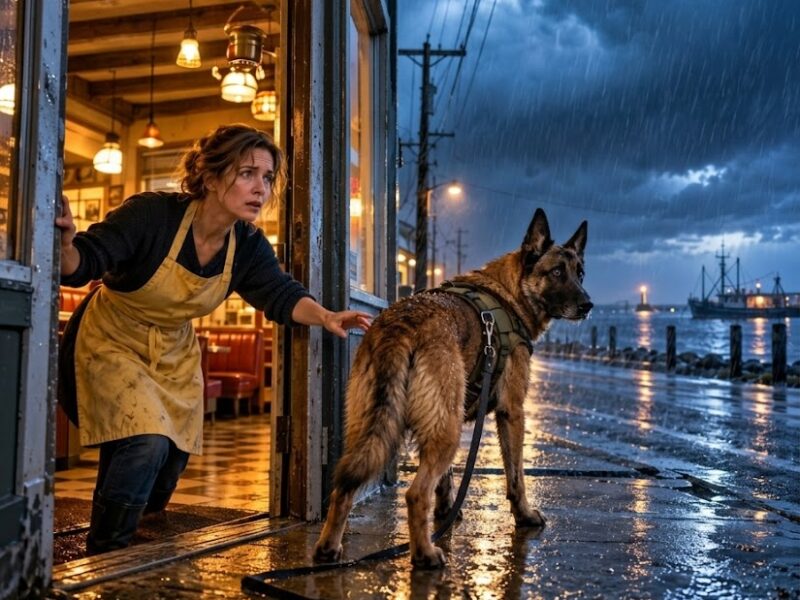
She only asked him one simple question — “Have you eaten?” — and by 4 A.M., his K9 came back alone.
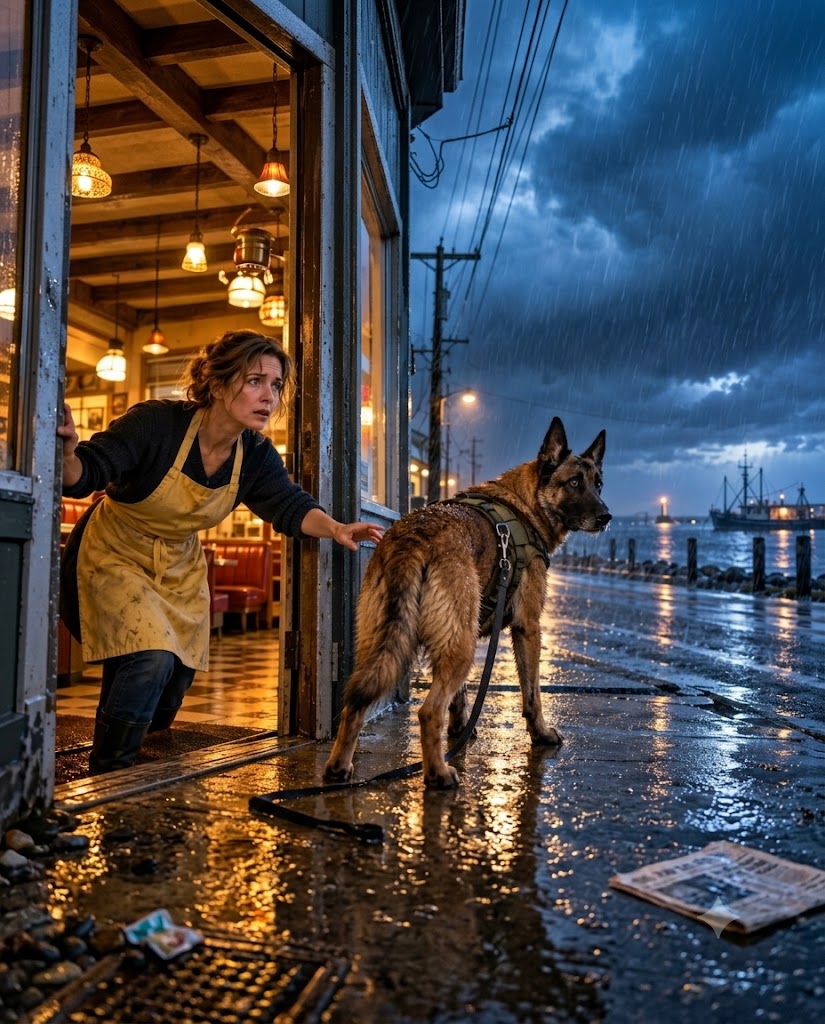
At 4:17 on a stormy morning, a retired military dog appeared at the locked door of a seaside diner.
His leash dragged through the rain.
The man who had never gone anywhere without him was missing.
Hannah Veil opened the door and Rook stepped inside just far enough to press his wet head against her knee.
Then he turned back toward the dark road.
For three weeks, Hannah had asked his owner the same small question.
Have you eaten?
Daniel Ward had always found a reason to come back and answer it.
The evening before, they had parted without saying goodbye.
Now Hannah had to decide whether the dog was trying to tell her where Daniel had gone or whether she was only hearing what fear wanted her to hear.
Three weeks earlier, nobody in Cedar Key had any reason to remember the man in the dark blue truck.
He had come to the North Carolina coast for a temporary job at a boatyard.
He had taken a room behind an old fishing supply store and left most of his belongings in the truck.
By February, he told himself he would know where he was going next.
He was 44, had spent much of his adult life as a Navy SEAL, and was tired of meeting people who expected him to explain what that meant before they would ask what he liked for breakfast.
Rook was easier to introduce.
The Belgian Malinois had once worked beside him in the military.
He was retired now, 10 years old, careful on his left hind leg when the weather turned damp, but still alert to every door that opened and every change in Daniel’s voice.
He had a fresh collar, a worn green harness, and the settled judgment of a dog who no longer needed to prove he could do difficult things.
Daniel could leave a town without much ceremony.
Rook remembered the places where he had been welcomed.
On their second morning in Cedar Key, Daniel followed a hand-painted sign off the main road.
Tide Road Diner, breakfast from five.
The building stood on slightly raised ground beside the narrow road to the working harbor.
There were three booths inside, six counter stools, and a covered porch with two weathered tables.
Fishing crews came before dawn.
School staff stopped for coffee.
People with nowhere urgent to be appeared later and made one biscuit last an hour.
Daniel tied Rook’s leash to the porch railing where the dog could see him through the window.
The diner was warm enough to fog the glass.
A woman in a faded yellow apron stood behind the counter, turning off one burner and checking another without ever seeming to hurry.
Her hair was pinned up with a pencil.
She looked at his empty hands, his wet sleeves, and then through the window at the dog.
“Is he comfortable out there?”
“He will be.”
Daniel lifted a hand to Rook.
The dog sat facing the door.
The woman set a clean bowl of water on the porch before she brought Daniel a menu.
She did it without being asked.
He studied the short list until she returned.
“Coffee,” he said.
She waited.
“That is all.”
“Have you eaten?”
Daniel had eaten half a protein bar while unlocking the boatyard gate in the dark.
He could have called that breakfast.
He had called thinner things breakfast in harder places, but she was looking directly at him, and something about her expression made the answer feel foolish.
“Not really.”
“Eggs are on the grill. I can put yours on now.”
“I was only stopping for coffee.”
“Then you can stop for coffee and eggs.”
Daniel almost smiled.
“What if I say no?”
“Then I will bring the coffee and you can spend the next ten minutes smelling somebody else’s breakfast.”
He ordered eggs and toast.
She introduced herself as Hannah when she set down the plates.
He gave his name.
Neither of them explained anything further.
When Daniel went back outside, Rook stood slowly, as if reluctant to leave a place he had visited for less than half an hour.
Hannah noticed the dog’s left leg and did not ask for its history.
She brought out a dry towel for the porch boards so he would not slip.
Daniel looked at the towel, then at her.
“You are going to spoil him.”
“He looks capable of surviving it.”
That was the first morning Hannah owned the diner, although most of Cedar Key behaved as if it belonged to anyone who had ever needed somewhere to sit.
Six years earlier, she had used her savings to buy the failing place from a couple retiring inland.
She knew kitchens.
She had managed one at a large hotel and another at a hospital.
She wanted a room where people were fed well and addressed by name, even if they could pay only for coffee that day.
She had learned the price of that choice in long hours and thin margins.
She had also learned she could not imagine doing anything else.
Ines Moreno worked with her in the mornings.
Ines was 62 and quick enough at the register to make indecisive customers feel personally responsible for holding up the sun.
She had known Hannah since Hannah first came to town.
She could tell the difference between a busy day and a bad one by the way Hannah stacked clean mugs.
The morning Daniel arrived, Ines watched him through the kitchen pass.
“That one is going to come back.”
“He said people come back for breakfast.”
“I wasn’t talking about breakfast.”
Hannah slid a plate under the warmer.
“His dog liked the water bowl.”
“His dog has better instincts than he does.”
Hannah chose not to answer.
Daniel worked at Reed Marine, a small boatyard on the opposite side of the harbor.
Amos Reed restored working skiffs, repaired docks, and made honest money slowly enough to complain about it every Friday.
He had hired Daniel for the season after seeing how carefully the man rebuilt a rotten section of pier without being told to save the good boards.
Daniel liked work where a completed repair could be seen without a briefing.
He liked Amos, who cared less about his years in uniform than whether he put his tools away at night.
On Friday, Rook led him back to the diner.
That was how Daniel later described it, though the dog had been in the truck and had not touched the steering wheel.
Daniel ordered lunch to take away.
Hannah handed him a paper bag and told him the porch was dry if he wanted to eat there.
He sat with Rook at his feet.
The dog accepted one piece of unseasoned chicken from his own food.
Hannah watched through the window while scrubbing a pan, then looked away before Daniel saw her.
On Monday, Daniel returned an empty glass jar.
Hannah had sent him home with chowder the previous evening after a long boatyard shift.
She had told him to return the jar whenever it was convenient.
Cedar Key was small.
Her diner was not on his route from the boatyard to his room.
He came in with the jar washed and the lid polished almost bright.
“You could have kept it,” Hannah said.
“Then I would have needed another excuse for a moment.”
He looked as startled by his own words as she felt.
Ines appeared from the kitchen carrying a tray of cornbread.
She took in the jar, Daniel’s expression, and Hannah’s, then put down the tray without comment.
She held that silence for almost thirty seconds, which for Ines amounted to remarkable self-control.
By the end of the first week, Hannah knew that Daniel drank his coffee plain, that he always checked Rook’s bowl before his own cup, and that he went quiet when someone called the dog a weapon.
Rook had been trained for serious work, but he was an aging animal who disliked slick floors, enjoyed pieces of crust, and leaned into a scratch just behind his right ear.
Hannah knew more about the dog because Daniel made it easy to talk about him.
About himself, Daniel offered pieces only when the conversation naturally required them.
He had grown up mostly in Virginia.
He had lived in several states since leaving the Navy.
His mother called on Sundays and asked what town he was in, a question he answered honestly only after he had been there long enough to learn the street names.
He had never married.
There had been chances at a settled life that he had let expire while telling himself another chance would come along.
That was as close as he came to explaining the truck with its carefully packed boxes.
At the diner, Hannah was learning a different kind of calculation.
She knew every regular’s favorite meal, but the sums in her blue folder still would not settle.
Her bills sat in a blue folder beneath the counter.
The refrigerator had begun making a low grinding sound after its motor started.
The roof over the storage room leaked when rain came from the east.
The county had posted a notice that repairs to the causeway would send harbor traffic along a temporary road for several weeks.
For a diner that counted on the morning line of trucks, several weeks was a long time.
Hannah had read the notice three times, each time putting it back into the folder as if its meaning might change while the paper rested.
One of the regulars, Walter Pike, noticed the folder when she paid a supplier by phone.
Walter had spent forty years running harbor equipment and now spent almost every morning pretending the diner was on his route to somewhere important.
“You need anything?” he asked.
“More people hungry for biscuits.”
He understood the evasion.
He also understood that forcing the subject would get him no further.
He paid for his breakfast, left an extra few dollars, and took the harbor road toward his small cottage past the boatyard.
Daniel came in ten minutes later with a bent metal thermostat.
Hannah reached for it.
“Something wrong with the lid?”
“Nothing. I thought I left it here.”
“You didn’t.”
“I see that now.”
He put it back in his coat.
Ines was at the far end of the counter facing the cash drawer.
Hannah could tell from her shoulders that she was laughing silently.
Daniel took a stool and ordered lunch.
The man who had faced rooms full of people without blinking now seemed unable to admit that he liked one particular lunch counter.
Hannah was hardly better.
She could have asked him to stay after he finished.
Instead, she spent fifteen minutes describing the day’s specials in more detail than the day’s specials deserved.
If anyone has ever asked whether you had eaten at exactly the moment you needed someone to notice, you might remember how long that question stayed with you.
Hannah thought she was offering Daniel a meal.
She had no idea that he had already begun measuring his days by whether he would see her again.
Two evenings later, Daniel returned after the dinner customers had gone.
Rook lay on the porch mat while Hannah counted the drawer.
Daniel held a paper bag with two cinnamon rolls from the bakery across the harbor.
“They gave me an extra one,” he said.
The bag has two separate receipts.
The clerk was very thorough.
Hannah took the bag and finally laughed.
She brought him tea, took one roll, and sat where she could see the harbor lights through the rain.
Neither of them mentioned the receipts again.
Halfway through, she told him about the causeway closure, the failing refrigerator, and the way she had begun multiplying every slow morning by six weeks.
She did not ask him to solve it.
Daniel did not offer a quick solution he could not guarantee.
“I can listen,” he said when she paused.
“I can also help you make a list of what actually needs doing first. Those are different offers.”
Hannah stared at the cinnamon roll in her hand.
“Listening,” she said. “Tonight, just listening.”
So he listened.
When she had finished, he helped put the chairs up without rearranging the dining room to suit his ideas.
Rook stood when Daniel did, then waited beside Hannah’s knee as she locked the front door.
She gave the dog one gentle scratch.
Daniel watched him lean into it.
During the next few days, Daniel found his own reasons to make the drive.
On Monday, he had a sandwich order for two men at Reed Marine.
On Tuesday, Amos had forgotten his scarf at the diner, though Amos later swore the scarf had never belonged to him.
On Wednesday, Daniel arrived with no order and no forgotten property.
He stood beside the door, looked at Hannah, and said, “I wanted to see how your day was going.”
Hannah put down the towel in her hands.
That simple admission unsettled her more than the invented errands.
The day had been difficult.
The refrigerator repairman had quoted a price she could not comfortably pay, and one of the suppliers had raised prices again.
She had spent the afternoon smiling at customers while subtracting from an amount that was already too small.
“Long,” she said.
Daniel nodded.
“Would you like company after closing?”
“Yes.”
The answer came before she had time to dress it as a joke.
Ines walked past with a tray and pretended to be deeply interested in the napkin dispenser.
Rook was outside on the porch, asleep with his muzzle resting on Daniel’s old canvas jacket.
He opened one eye when the last customer left, then shut it again.
He had begun to trust this place as much as his owner did.
That evening, Hannah counted three possible repairs before Daniel stopped her.
“Which one keeps the diner open tomorrow?”
“The refrigerator. The technician can keep it going a little longer, but I can’t keep guessing.”
“Then that’s first.”
He said it without implying that the money was easy to find.
Hannah wrote the number on a sheet of paper.
They talked through what food she could order in smaller amounts during the detour, what hours might actually cover the cost of being open, and which of her regulars could be told plainly about the road changes.
Daniel did not turn the diner into an engineering exercise.
He only gave Hannah room to speak the problems aloud until they became separate problems rather than one large shadow over every meal she served.
When he left, Ines found the sheet on the counter.
It held three numbers, two phone calls to make, and one note in Hannah’s handwriting.
Ask for help before it is urgent.
“That last one is ambitious,” Ines said the next morning.
“I can cross it out.”
“You can leave it where you will see it.”
Hannah tucked the paper beside the register.
All day she felt slightly exposed by the fact that someone else knew she was worried.
She also slept better that night than she had in weeks.
The detour began on a gray Monday.
By seven, the usual trucks had turned inland.
Four counter stools sat empty through the morning rush.
A new sign at the junction sent drivers away from Tide Road before they could see the diner.
Hannah took a photograph of the nearly empty room for a notice she planned to post online, then deleted it because it felt too much like asking for sympathy.
At noon, Daniel appeared with Amos and two boatyard workers.
He had called ahead for four lunches and paid for them before arriving.
Hannah brought the plates while Amos studied the empty booths.
“You ought to tell people the harbor road is still open from the south,” he said.
“I put it on the window.”
“The people who need it are getting turned around before they reach the window.”
He was right.
Ines borrowed Hannah’s phone and dictated a short message for the town page.
The diner was open.
The south approach was clear.
Coffee was hot.
Hannah approved the wording after deleting three exclamation points Ines had added for emphasis.
By two, the first customer who had seen the post came through the door.
It was not a miracle.
It was a plate sold on a day when plates mattered.
The second week, Hannah started a supper table twice a week.
Customers could reserve a seat by the afternoon, and she cooked one simple meal in a quantity she could afford.
It was an idea Ines had suggested months ago.
Hannah had dismissed it because she believed good hospitality meant having every possible choice ready all the time.
The first supper was chicken and rice.
The room filled.
People who had been eating alone at home talked across the booths and stayed for coffee.
Hannah made enough to pay the day’s staff and the ingredient bill.
With a little leftover, the small amount felt more solid than a promise that everything would somehow work out.
Daniel sat at the porch table with Rook during the second supper.
The night was cold enough that Hannah brought his plate inside and pointed to the empty booth by the window.
“I can watch him from here,” she said.
“Rook has worked in worse weather.”
“He is retired.”
“So are a few of the people inside who used to work in worse weather. They still get chairs.”
Daniel looked at Rook.
The dog was sitting squarely on the thick mat Hannah had placed beneath the table.
His ears turned toward her.
Daniel moved to the booth.
Through the window, he watched Rook fall asleep before the food arrived.
“What did he do when he retired?” Hannah asked.
“At first, he checked every new place like somebody was going to grade him.”
Daniel turned his fork between his fingers.
“Then one morning, he stopped waiting by the door for work. He wanted a walk, a meal, and a patch of sun. I was slower to catch on.”
Hannah waited.
The sounds of other diners covered the pauses.
Daniel glanced across the room, then back at her.
“After I got out, I thought I had to keep moving to prove the next part belonged to me. I could choose any town, so I never chose one twice.”
“Maybe choosing to return is still a choice,” she said.
He looked through the glass at Rook.
He could not remember the last time anyone had put it that way.
An offer came from Norfolk that Friday.
A former colleague wanted Daniel for a steady job with a company that trained security teams.
The pay was good.
The work was familiar.
He could start at the beginning of December.
On paper, it solved several questions he had been postponing.
It also meant ending his season at Reed Marine early and asking an aging dog to settle into another new place.
Daniel did not answer at once.
He took Rook down to the beach after work.
The tide had left shells and narrow streams in the sand.
Rook walked ahead until a gull rose from behind a line of grass.
He watched it, decided no action was needed, and came back to Daniel’s side.
Daniel had spent years assuming movement meant possibility.
Watching Rook choose to come back made the thought feel incomplete.
That afternoon he told Amos about the offer.
Amos continued sanding a piece of cedar before setting it down.
“Can you give me the same hours year-round?”
“I can give you work through January. After that, I have to see what comes in.”
Amos brushed dust off his sleeve.
“You know I won’t promise a year on the strength of a good month.”
“I know. If you take Norfolk, I won’t hold it against you.”
Daniel nodded.
He liked Amos more for saying it.
A grown man could weigh an honest short contract against a certain long one.
He had not expected the harder question to be where he wanted to go when nobody else decided for him.
Hannah learned about the offer from Daniel himself.
He came at closing with Rook, waited until Ines had gone, and sat while Hannah wiped down the counter.
“There’s work in Virginia,” he said.
“Someone asked me to come in December.”
“Is it good work?”
“Probably.”
“Then you should think about it.”
“I am.”
She kept wiping the same clean place.
Daniel could see it from where he sat.
He waited for her to ask what the job meant for him, for Rook, for the evenings at the diner.
Hannah asked none of those things.
She wanted to say that she would miss him.
She was afraid it would sound like an argument against an offer he had earned.
“You always said the boatyard job was temporary,” she said at last.
“I didn’t.”
Daniel heard the care in her voice and mistook it for distance.
He stood.
“I should let you finish.”
“You can stay.”
He was already pulling on his coat.
“I don’t want to make promises while I’m deciding what I can keep.”
Hannah’s expression changed.
“I didn’t ask you for a promise.”
“I know.”
Daniel looked at her, then toward Rook.
“That might be the problem.”
He left before she could ask him what he meant.
He had spent years mastering exits.
The familiar ease of this one made him ashamed before he reached the truck.
The next morning, Daniel drove past the diner without turning in.
Rook stood on the back seat watching the porch disappear.
Daniel told himself Hannah needed space and he needed time to think.
At the boatyard, he worked through lunch.
Amos handed him a sandwich without asking why a man who normally knew the best meal on Tide Road had forgotten to bring one.
For a day and a half, the quiet between Daniel and Hannah was theirs to fix.
Then the weather forecast changed.
A coastal storm was expected to push water into the harbor at the same time as high tide.
The county announced that the low road near Walter Pike’s cottage would close if water crossed the marker at the boatyard bend.
People had time to move vehicles, bring in loose equipment, and go somewhere dry.
Time did not guarantee they would use it.
On Saturday afternoon, Hannah closed the diner early to move supplies away from the storage room leak.
Ines came to help, and so did two regular customers.
Daniel arrived with a box of heavy plastic covers from Reed Marine.
He placed it on the counter and asked where Hannah wanted the clean bags.
She pointed to a shelf.
They worked near each other for nearly an hour without discussing the conversation they had left unfinished.
At dusk, Ines went home to her family.
Hannah checked the windows while Daniel carried a last crate of dry goods upstairs to a small office.
Rook waited on the porch, ears pricked at the window.
“I am sorry I walked out,” Daniel said when he came down.
Hannah looked at him across the dim dining room.
“I know you have a decision to make. I don’t—I should have said I was frightened of making it.”
She rested one hand on the counter.
“I don’t want to stand here pretending I won’t notice if you leave. But I can’t decide for you, and I can’t spend another month acting like tomorrow doesn’t matter because you might be gone.”
Daniel accepted that he had asked for honesty from her and given her uncertainty in return.
He wanted to tell her what he was leaning toward.
He was not ready to make his words carry weight they had never had before.
“I will call you after the storm,” he said.
Hannah’s voice stayed gentle.
“Call if you want to talk. Please don’t call just because you think you owe me an answer.”
He nodded.
Outside, Rook was turning in a slow circle on his mat.
Daniel lifted the mat, shook rain from its edges, and carried it to the truck.
Hannah turned off the front lights.
Neither meant to make the departure sharp.
Yet when his taillights disappeared, she realized they had not said goodbye.
By midnight, the wind was loud enough to rattle the diner sign.
Hannah was staying in the upstairs office.
It was higher than the surrounding street and had served as an overnight refuge during an earlier storm.
She had bread, a working phone, and a flashlight on the desk.
She had promised she would leave if the county told people on Tide Road to evacuate.
Until then, there were first responders and boatyard workers passing by who might need hot coffee.
At Reed Marine, Daniel and Amos had secured everything they could.
Amos went home once the last boat was tied down.
Daniel stayed to watch the water rise against the lower pier.
He would have been safer at his rented room, but he knew Walter Pike lived farther along the low road.
Amos had called Walter earlier.
The old man said he was leaving.
His truck was still in the driveway when Daniel checked from the upper bend.
That did not prove Walter was inside.
It proved that someone needed to find out before the road disappeared.
Daniel called the county’s emergency line.
A volunteer responder named May Collins met him at the boatyard gate.
They agreed to approach Walter’s cottage from the high service lane.
May had the radio.
Daniel knew the latch on the service gate, which he had repaired that week.
Rook rode in the truck, calm despite the wind, while Daniel drove only as far as the lane remained clear.
They left the vehicle above the water line and walked the short final stretch.
Rook stayed close on his leash.
Nobody expected the dog to rescue anyone.
Daniel simply did not want to leave him alone in a dark truck while the storm moved in.
Walter had left his cottage.
He had gone to the old bait shed on higher ground behind it to collect a box of photographs and documents he had stored there.
The shed door had jammed when a loose panel blew against it.
He could hear May calling but could not force it open from inside.
Daniel and May freed the door together, and Walter came out with the box pressed against his chest.
He was angry at himself, embarrassed, and cold.
May guided him toward the service lane.
The wind struck hard as they cleared the shed.
A heavy limb came down across the path between Daniel and May.
The sound made Rook jump.
Daniel’s hand closed around the leash, then slid as wet fabric pulled through his grip.
Rook broke away uphill.
Daniel called him once.
The dog paused beneath the rain, but another branch cracked nearby and sent him running.
Daniel did not chase him into the dark.
May had Walter to steady, and the limb had blocked the narrow path.
Daniel shouted that he would work around the back of the shed and meet them at the truck.
May heard enough to nod.
She moved Walter toward the safer lane while Daniel followed the rear path.
He had covered only a few yards when a section of old decking shifted beneath him.
He fell into a shallow drainage channel behind the shed, striking one leg and losing his phone in the water.
He could still stand with help, but the bank was slick and higher than it looked.
He called out.
The wind carried his voice away.
He tried a different place along the edge, found more loose boards, and stopped before turning a painful delay into something worse.
May reached her vehicle with Walter and called for assistance.
She could no longer see the rear of the shed.
The radio carried part of her message and lost the rest.
A fallen tree held up the first truck sent to them.
Another crew was approaching from the north when the same limb that had frightened Rook cut power along the harbor road.
May called Daniel’s name until she had to turn her attention to getting Walter into a dry vehicle.
She reported Daniel missing near the bait shed.
Help was coming.
The storm was making every short distance longer.
Rook had not followed the road toward Daniel’s rented room.
He had taken the lane past Reed Marine, then the high shoulder that led to the diner.
He arrived just after four.
Water darkened his harness.
His leash trailed behind him, and he had scraped one paw on the broken edge of the service gate.
He stood at the door and struck it with his forepaw until a light appeared upstairs.
Hannah came down carrying a flashlight.
She expected a neighbor or a stranded driver.
When she saw Rook without Daniel, she opened the door at once.
The dog walked in, touched her knee, and turned toward the road.
Hannah checked the harness.
Nothing on it told her what had happened.
She called Daniel.
His phone went straight to the recorded message.
She tried again, then called the emergency line and gave her name, her location, and the fact that Daniel’s dog had arrived alone.
The person on the line told her May had reported a missing volunteer near Walter Pike’s bait shed.
A search crew was going there.
Rook was shivering.
Hannah dried him with the towel she had left by the porch table and set down water.
The dog drank once, then returned to the door.
She wanted to take her truck and follow him.
The low road was closed, and one more stranded person would draw the crews away from Daniel.
She stayed on the phone, repeated the description of his truck, and told them Rook had come by the high shoulder.
Then she waited with the flashlight in her hand while the wind pressed against the glass.
The search crew reached the bait shed from the service lane.
Rook had not seen Daniel fall and could not tell them which side of the building to search.
May could.
She showed them the path Daniel had meant to take.
A responder called his name from the rear fence.
This time the wind eased long enough for an answer.
They found him standing in the drainage channel with one hand braced against the bank, angry at the lost phone and at his own leg for refusing to do what he asked of it.
He was cold and in pain.
He was able to speak.
Two people helped him up to firm ground, where an emergency medical crew checked him before taking him in.
Hannah received the call just before dawn.
She listened to every word, asked the location twice so she would remember it, and looked down at Rook.
The dog had finally curled up on the porch mat she had dragged inside.
He raised his head when she said Daniel’s name.
“You were right to come here,” she told him.
Whether he understood the words did not matter.
She had needed to say them.
When the roads reopened, she made sure the small scrape on his paw was checked and cleaned.
Walter was safe with May and his box of photographs.
By morning, the storm had moved inland.
The roads were still littered with branches, and the diner had lost power, but water had stayed below the front steps.
Hannah waited for word that the road to the clinic was open.
Ines arrived with a thermos of hot coffee and found Hannah at the counter still wearing the same yellow apron she had put on the night before.
“Have you slept?” Ines asked.
“Not yet.”
Ines set a mug in front of her.
“Then sit. You can worry while sitting.”
When Daniel was allowed home, Amos drove him to the diner.
He moved carefully, following the advice he had been given, and stopped at the entrance when he saw Rook asleep inside by the door.
The dog woke at the sound of his voice.
For one suspended second, neither moved.
Then Rook came across the room and placed his head against Daniel’s thigh.
Daniel rested his hand there.
Hannah stayed behind the counter to give them the moment.
“I am sorry,” Daniel said when he looked up.
“For the storm. I mean, for making you worry, and for leaving the other night the way I did.”
“You can tell me about all three after you sit down.”
He obeyed.
Ines brought broth she had warmed on a small burner outside after the power outage.
Hannah set a bowl in front of him.
Daniel looked at it, then at her.
“Have you eaten?” she asked.
“No.”
His voice was rough.
“I was hoping you’d ask.”
Hannah sat across from him while he ate.
They spoke of Walter and May, of Rook’s muddy arrival, and of the crews still clearing the road.
When there was space between sentences, Hannah reached across the table and put her hand over Daniel’s.
He did not make a promise out of that touch.
He turned his hand and held hers.
The storm left more work than anybody had planned.
Tide Road was passable in stages.
The diner’s roof had leaked through the storage room, and food from the refrigerator had to be thrown out after the outage.
Hannah could no longer pretend that one good supper crowd would cover every cost.
She closed for two days, called the repairman, and showed Ines the blue folder.
Together, they wrote down what the diner earned, what it owed, and what would have to change if it was going to stay open.
Some hours were losing money.
They shortened them.
The twice-weekly suppers were paying their way.
They kept them.
Walter came by as soon as the road allowed.
He paid in advance for four suppers and asked for no special treatment.
Other regulars did the same after Ines explained that advance reservations would help Hannah plan the food.
Amos arranged boatyard lunches on work days.
A few neighbors helped dry the storage room and repair the roof, taking directions from Hannah rather than taking over.
None of it erased the bills.
It gave her a workable month in which to meet them.
One evening, Hannah looked at the reservation list and felt an unfamiliar mixture of relief and discomfort.
People had helped because the diner mattered to them.
She had spent years imagining that accepting help would turn every meal she had ever given into a debt.
It had not.
The same hands that had reached across her counter for warm plates had reached back when she needed them.
If someone you cared about insisted on carrying every burden alone, would you tell them to accept help, or would you wait until they were ready to ask?
Hannah learned that making room for people also meant letting them make room for her.
Daniel made his decision separately.
He called Norfolk and thanked the man who had offered him the job.
Then he told Amos he would finish the winter season and stay for whatever work they could agree on afterward.
It was less certain money.
It was work he wanted to wake up and do.
On a clear morning, he rented a small cottage inland with enough yard for Rook to lie in the sun.
He put his shirts in drawers on the first day instead of leaving them folded in the truck.
Rook inspected the porch, found a warm patch beside the door, and settled there without waiting for instructions.
Daniel did not present his choice to Hannah as proof of love.
He told her where he would be living and why he had taken the work.
Then he said the part he had spent several weeks hiding beneath errands and forgotten thermoses.
“I want to keep coming here. I would like to come because I want to see you. If you want that too.”
Hannah looked at the old porch table through the window.
Rain had washed it clean.
She had missed him even on days when he had been only a few streets away.
“I want that.”
She said, “You can call first if the diner is closed.”
“What if I have a perfectly good excuse?”
“Then tell me the excuse after you get here.”
Their first real date took place two weeks later on a Sunday when Hannah had kept her day off.
Daniel brought groceries to her apartment above the diner.
He could repair a boat motor without a second look at the manual but needed her to point out where she kept the colander.
The pasta came out slightly overcooked.
He had made too much of it.
Rook waited by the kitchen doorway and received his own dinner at the proper time.
No one needed to go anywhere afterward.
When Daniel reached to clear the plates, Hannah caught his sleeve.
“Have you eaten enough?” she asked.
“I have.”
He looked at her nearly untouched plate.
“Have you?”
She shook her head and picked up her fork.
He sat back down.
Outside, the harbor road had gone quiet.
The diner would open again before sunrise.
Bills and all.
His work was still uncertain beyond winter.
They had not solved every part of each other’s lives.
They had found something smaller and more durable to begin with.
Tomorrow, each of them knew where to find the other.
Sometimes a person comes back for the coffee, the dog bowl, or a thermos he never lost.
Sometimes after enough ordinary evenings, he can finally say why.
If this story brought someone to mind, tell me about a meal or a simple question that made you feel welcome.
Thank you for spending this time with Seal K9 Stories.









