She Mocked Me for Mopping Hospital Floors—Then a Wealthy Patient Heard My Last Name and Froze
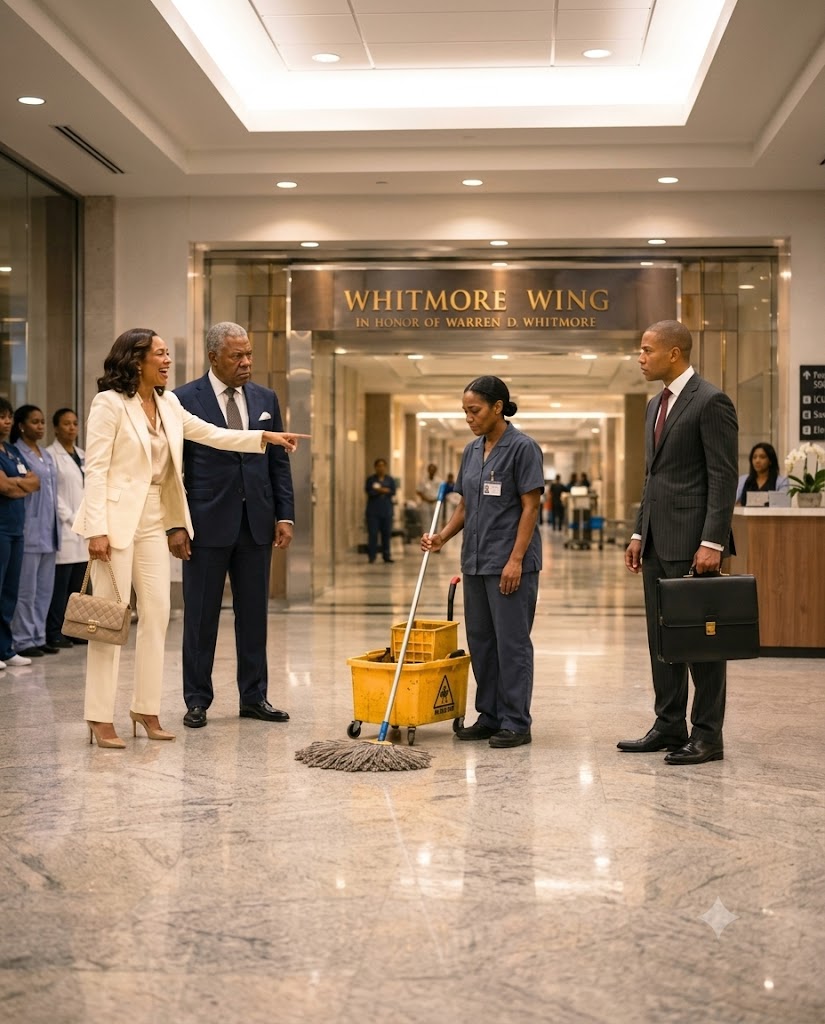
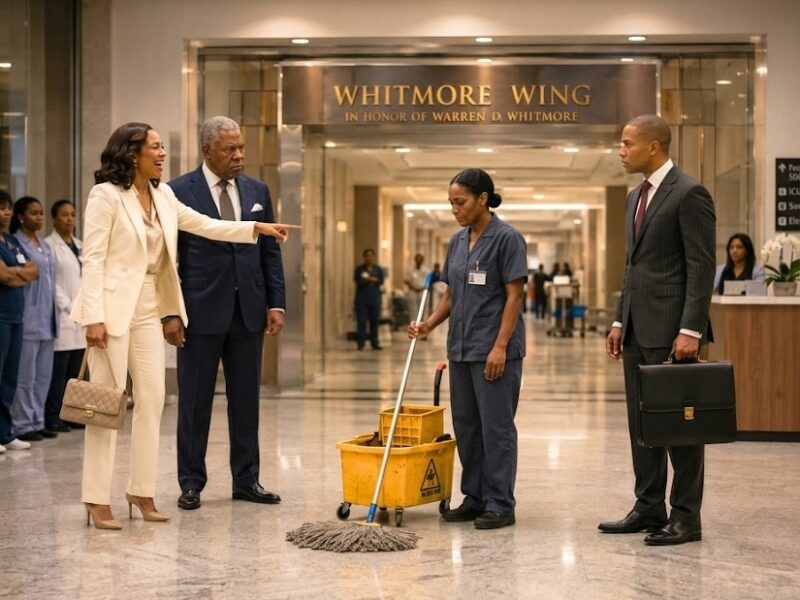
The floor was still wet when she walked past.
Norah heard the laugh before she saw the face—a bright, cutting sound that carried across the corridor like something meant to be heard. She kept her head down and her mop moving.
That was the job. Keep moving. Don’t meet eyes. Don’t give anyone a reason.
She had done everything right for seven years. And it had earned her exactly this: a corridor, a mop, and a woman in a silk blazer reading the name on her ID badge out loud.
“Whitmore,” the woman said to the man beside her. “Can you believe that? A Whitmore mopping hospital floors.”
The laugh that followed was the kind that doesn’t need an audience because it already knows it’s right.
Norah didn’t look up. She didn’t stop. She moved the mop in slow, even strokes across the linoleum, watching the wet trail catch the fluorescent light and then fade as it dried.
The woman’s heels clicked past her—expensive shoes, the kind that made a particular sound on hospital floors. The man with her said something Norah didn’t catch, and the woman laughed again, softer this time, already losing interest.
They were heading toward the private wing on the west end of the corridor, which meant they were visiting someone expensive. Norah had learned to identify the families by their coats.
She didn’t know the woman’s name. She filed the laugh in the same drawer she filed everything. Done. Moved on. Not worth carrying.
What she did not notice—could not have noticed, because she had already turned back to the baseboards—was the man standing near the elevator who had heard the whole thing.
He was tall, in a dark gray suit that fit correctly, holding a folder against his side. He had been waiting for the elevator for three minutes, and he had seen the woman read the ID badge, and he had watched the whole thirty-second performance with an expression that was hard to read.
When the laugh ended, he did not move immediately. He looked at the woman’s back as she turned the corner toward the private wing. Then he looked at the custodial worker, who was already back at her mop, unhurried, as if nothing had happened.
He pulled a card from his jacket pocket and held it in his fingers.
The elevator came. He didn’t get on.
—
Norah had reached the end of the corridor and was turning her cart around when she heard footsteps behind her. Deliberate, not rushing, but closing the distance with intention.
She stopped and turned. The man in the gray suit was three feet away. He held up one hand—not to stop her, but to signal that he wasn’t a threat.
“I’m sorry to bother you,” he said. His voice was level. “My name is Marcus Webb. I’m here for a meeting with hospital administration. I’m an outside auditor.”
He paused. “I heard what that woman said to you. I’m not here because of that. But I heard your name.”
Norah looked at him without expression. “Whitmore,” she said.
“Yes.” He held out the card. “I think there’s something you should know about your family. Not tonight. When you’re ready, if you want to know.”
She looked at the card for a moment before she took it. The name was printed cleanly: *Marcus Webb, Independent Audit Services.* And below the organization name, a client line: *Whitmore Family Foundation, Nashville.*
She looked up at him. He said nothing else. He gave her the space to process it.
“I’ll think about it,” she said.
“That’s all I’m asking,” he said.
She put the card in her apron pocket and turned back to her cart. She heard him walk away, then the soft sound of elevator doors opening and closing.
She finished the corridor. She clocked out at 3:15. She took the bus home.
—
That night, she set the card on her kitchen table and made herself eat dinner before she looked at it again. When she picked it up, she turned it over. He had written three words on the back in clean, careful print: *Call me. Important.*
She sat with it a long time. Then she set it face down on the table and went to bed.
She did not sleep well.
—
Priya was already in the break room when Norah got in the next morning, both hands wrapped around a paper cup of coffee, staring at the middle distance the way she always did before her second cup.
Priya Nair had worked the same shift as Norah for four years. She was thirty-six, practical, funny when she wanted to be, and she had a talent for knowing when not to ask questions.
She looked up when Norah set her bag on the hook. “You look like you didn’t sleep.”
“I didn’t really.”
Priya waited.
“Weird encounter yesterday,” Norah said. She opened her locker, pulled out her work shoes. “Nothing serious. Just someone stopped me in the hall, wanted to talk.”
“A patient?”
“No. An auditor. He said something about my family.” She said it the way you say something you’re still processing—flat, with the feeling underneath it not yet surfaced. “I don’t know. Probably nothing.”
Priya nodded and didn’t push. That was the thing about her. She gave room.
They walked out to start their respective sections. And Norah spent the first two hours of her shift doing what she always did, moving through the Whitmore wing with her cart, earbuds in, working methodically from west to east.
The wing was named for a family. She had known that for years, in the vague way you know things you don’t think about. The way you know a street name without knowing its history.
She had pushed her mop through this corridor enough times that the linoleum patterns were familiar to her the way a face becomes familiar. She had never read the dedication plaque on the wall near the elevator lobby. It was just part of the wall.
She read it that morning.
She stopped her cart and stood in front of it for the first time. A bronze plaque, not large, mounted at eye level. A list of donors and their contributions to the construction of the wing, dated twelve years ago.
At the bottom, set apart from the others: *In memory of Warren D. Whitmore, who believed that the dignity of care is owed to every person.*
Warren.
Her father’s name was Warren.
She stood there long enough that Dale walked past and said, “Everything okay?” And she said, “Yes. Just reading.” And he gave her a look that said that was a strange thing to do, but moved on.
She finished her shift. She clocked out. She took the bus home.
—
And this time, she didn’t wait until after dinner. She sat at her kitchen table and opened her laptop and typed: *Whitmore Foundation Nashville.*
The page loaded immediately. A clean website, dark green and ivory, with a photo of a building—a building she recognized because she mopped its floors.
*The Whitmore Family Foundation, established 1961, dedicated to medical philanthropy and community health access in Middle Tennessee.*
Current endowment not listed. But she found a financial report in the press section dated two years ago that mentioned a managed portfolio in excess of sixty million dollars.
Sixty million.
She read it twice. She sat with that number.
The current trustees were listed on an about page. Chairman: Gerald Whitmore. The photo showed a man in his late sixties, silver-haired, tan in the way people get from outdoor fundraisers. He looked like the kind of man who had a firm handshake and remembered your name.
She scrolled through the history section. Photos going back decades. A 1989 Nashville Society page photo caught her eye, reprinted in a gallery of the foundation’s early history.
She almost scrolled past it. She didn’t.
A young man, twenty-something, smiling at the camera, next to an older man who the caption identified as Edmund Whitmore, Foundation founder. The young man’s caption: *Warren Whitmore, Edmund’s eldest son, at the 1989 Spring Gala.*
Her father. Young, alive, smiling in a room that cost more per plate than her mother had made in a month.
She had never seen a photo of her father from before he got sick. Her mother had not kept many. The ones she had were from after Norah was born. A tired man on a couch. A man with his eyes half closed in a snapshot at Christmas.
She had not known what he looked like when he was happy.
He looked like her, a little, around the jaw. The way he held his head.
She closed the laptop. She opened it again. She read the foundation page a second time, looking for any mention of Warren after 1990.
There was none. As if he had simply stopped existing.
—
She picked up Marcus Webb’s card from the table where she had left it. She turned it over. She dialed the number.
He picked up on the second ring, his voice alert as if he had been awake.
“Marcus Webb.”
“It’s Norah,” she said. “Norah Whitmore. You gave me your card.”
A brief pause—not surprise, more like he had been holding space for this call. “Yes,” he said. “Thank you for calling.”
“I looked up the foundation,” she said. “I found a photo of my father.”
Another pause. Then: “I think we should meet in person. Somewhere quiet. I have some things I can show you.”
She looked at the time. It was 9:40 at night. “Tomorrow?”
“Tomorrow,” he said. “Wherever you’re comfortable.”
She named a coffee place near her apartment. He said he knew it. She said 10:00. He said he’d be there.
She hung up and sat in the kitchen for a while with the lights on.
—
She thought about her father—what she remembered, which was not much. His hands. A specific smell, like pine and something chemical she had never identified. The way he used to say her name when he was calling her to dinner, not loud, just enough to reach the next room.
He had been in those rooms. He had smiled in those photos. And then he had been gone.
And her mother had worked until she broke. And no one from that world had ever come to find them.
She went to her closet and pulled a plastic storage box from the top shelf. Her mother’s papers. She had carried them through three apartments, never opened them.
She set the box on the kitchen table and looked at it. She put it back.
Not tonight, she decided. One thing at a time.
She went to bed. This time she slept, though she dreamed about a corridor that didn’t end.
—
The coffee place was a small one, not a chain, with wooden tables that wobbled and a barista who didn’t look up when you ordered. Norah got there five minutes early and took a table in the back.
She had changed out of her work clothes—jeans, a gray pullover—but she still felt like herself, which she decided was fine. She wasn’t trying to be anything else.
Marcus Webb arrived at exactly 10:00. He ordered at the counter, brought his coffee over, and sat across from her. In the daylight, he was clearer than he had been in the hospital corridor. He was forty-something, she guessed, with a face that looked like it had done a lot of listening.
He set a folder on the table between them, but didn’t open it yet.
“Thank you for coming,” he said.
“You said it was important.”
“It is.” He wrapped both hands around his cup. “I want to be careful about how much I can tell you, because I’m constrained by the scope of my engagement. What I’m doing for the foundation is a financial audit, initiated by two board members who raised concerns about irregular trust distributions going back about thirty years. I can share findings that are documented in my audit record. I can’t make legal claims on your behalf or advise you on what to do with what I tell you.”
Norah nodded. She could work with that.
“What do you know about your father?” he asked.
“He died when I was nine. My mother said he had health problems. She didn’t talk about his family much. I knew his last name was Whitmore. I knew they weren’t close. I didn’t connect it to the foundation until last night.”
Marcus opened the folder. He turned it so she could see.
“In the original Whitmore estate documents filed after Edmund Whitmore died in 1993, Warren Whitmore is listed as a co-beneficiary alongside his brother, Gerald. He would have received approximately forty percent of the estate’s managed assets.”
Norah looked at the page—her father’s name printed in the clean type of a legal document.
“A few months after the estate was filed,” Marcus continued, “a document was submitted to the estate’s trustee. A relinquishment. Warren voluntarily surrendering his share of the inheritance.”
He turned to another page. “On its face, it looked straightforward. But when I was reviewing the documents, I flagged two anomalies.”
He pointed to the signature on the relinquishment. “First, the notary seal on this document belongs to a notary whose license was suspended eighteen months before the date on this document. The seal should not have been valid.”
“Second—” He turned to another sheet, a letter on hospital stationery dated three years before Warren died. “This is Warren’s signature on a completely unrelated document. A consent form.”
Norah looked at the two signatures. She didn’t need to be told.
The one on the hospital form was her father’s. She recognized it from birthday cards, from the few papers her mother had kept. The looping R in *Whitmore*, slightly tilted. The careful, old-fashioned way he connected the W and the H.
The signature on the relinquishment had no loop. The letters sat separately.
“That’s not his signature,” she said.
Marcus looked at her steadily. “I have engaged an independent handwriting analyst as part of the audit. The formal finding isn’t complete yet. But I wanted you to have this information, because you were the person directly affected. If this document was not legitimately signed, then Warren Whitmore’s share of the estate was transferred without his consent, and no one told you.”
Norah looked at the table for a moment.
“Sixty million,” she said. “That’s the current endowment.”
“The value of the estate at the time of transfer was considerably less. But it has grown substantially under the foundation’s management.”
“Gerald has been managing it.”
“Gerald has been the sole trustee for thirty years.”
“Yes.”
She was quiet for a moment. She wasn’t thinking about the money. Or she was. But that wasn’t the loudest thought.
The loudest thought was: *Someone erased my father.*
Someone took his name off a document and put a fake signature on it and then let him die without a word. And no one—not a lawyer, not a notary, not anyone—made sure he actually signed.
“What do I do with this?” she asked.
“That’s your decision entirely,” Marcus said. “I can tell you that my audit findings will be submitted to the foundation’s independent ethics board, which has jurisdiction over trustee conduct. They can act on what I find. But the board’s process is separate from anything you might choose to pursue personally.”
She nodded slowly. She was thinking about calling a lawyer. She was thinking about how much that would cost. She was thinking about how Gerald Whitmore had looked in that website photo—confident, established, a man who had never worried about whether something was going to work out.
She looked up. “Thank you for telling me.”
“I thought you deserved to know.” He paused. “What you said about the signature. The loop on the R. How did you know that?”
“He signed my birthday cards,” she said simply.
Marcus looked at her for a moment. Then he nodded. He closed the folder.
She picked up her coffee. They sat for a few more minutes without saying much, which felt right. Some information needs space after you put it down.
—
She was walking back to the bus stop when her phone buzzed with an unknown number. A text.
*You should stop asking questions about the Whitmore estate. For your own good.*
She read it twice. She took a screenshot. Then she kept walking.
—
She thought about it for three days.
She went to work. Did her shift. Came home. She ate dinner and watched television and went to bed and woke up and did it again.
She thought about what Marcus had told her. She thought about the fake signature with its missing loop. She thought about sixty million dollars sitting in a foundation named for her family, run by a man she had never met.
And she turned the whole thing over, the way you turn a stone you’re not sure you want to look under.
On the third evening, she made herself take the storage box off the shelf.
It wasn’t heavy. That was the first thing she noticed—how light the evidence of a life could be.
Her mother’s papers from the final year. She had been thirty-one when her mother died, and she had packed this box herself after the hospital and the service and the week of silence that followed. And she had taped it shut and carried it with her because she could not throw it away and could not open it.
She cut the tape with her kitchen scissors.
Bills. A lot of bills. Medical, utilities, pharmacy. Her mother’s handwriting on the envelopes, noting when she’d paid and how much was left. Lists in the margins. A discipline of documentation that broke Norah’s heart a little, because it looked like someone who was always afraid of losing track. Always braced for the math to stop working.
Prescriptions. A prescription renewal that was marked *price not approved* in red stamp.
A letter.
She almost missed it because it was at the bottom of a stack of billing statements—a plain envelope with the foundation’s logo in the upper left corner. She had to read the return address twice before her hands understood what she was holding.
*The Whitmore Family Foundation Charitable Care Fund.*
She opened it.
*Dear Miss Whitmore,*
*Thank you for your application for charitable care assistance submitted on November 4th. After careful review, we regret to inform you that your application does not meet the qualifying criteria for our fund at this time. We wish you well in securing alternate assistance.*
At the bottom, a signature she recognized now from the foundation’s website.
*Gerald Whitmore, Chairman of the Board.*
She looked at the date. November of the year her mother died.
Her mother had applied. Had gone through the process of asking for help, of gathering documentation and filling out forms, of asking the Whitmore family for the help they advertised.
And Gerald had signed the denial himself.
—
She looked up the charitable care fund’s qualifying criteria online. Income threshold. Medical necessity. Tennessee residency.
Her mother had met every single condition. She had copies of her mother’s tax returns from that year, still in the box. The income was well within the qualifying range.
She laid the denial letter next to the returns and looked at them side by side for a long time.
Her mother had applied three months before she died. The hospital bills from that period were in the box, too. She added them to the table. She built a small landscape of paper on her kitchen table and she sat with it.
She thought about her mother standing over the kitchen counter eating dinner fast because there was another job to get to. She thought about prescriptions denied and bills unpaid and a box of papers kept in careful order by someone who knew she was losing ground and kept the documentation anyway, because that was what you did when you were afraid that no one would believe you.
Gerald Whitmore had seen her mother’s name on a form. He had a signature—his actual signature, she was sure, not a forged one. He had looked at a form from a woman named Whitmore with an income that qualified and medical bills that qualified and a need that qualified, and he had signed the denial.
She sat in the kitchen for a long time. Then she picked up her phone and called Marcus.
“I found something,” she said when he answered.
“My mother applied to the foundation’s charitable care fund. Gerald denied it personally. Three months before she died.”
Silence on the other end. Not the silence of someone who didn’t know what to say. The silence of someone who did know and was being careful about it.
“I’m sorry, Norah,” he said quietly.
“I want to pursue this,” she said. “Whatever it takes. I’m not walking away.”
“I understand.” Another pause. “I need to tell you something. I’ve been tracing the original estate documents, the attorneys who were involved. There was a woman named Sylvia Marsh who handled the Whitmore estate filing when Edmund died. She’s retired now, but I found an address. She may have information about how the relinquishment was processed.”
“Can we go see her?”
“I think we should.”
“When?”
“I can arrange it for Saturday.”
“If that works for you, it works.”
She hung up and stayed at the table. She looked at the denial letter one more time. Then she put everything carefully back in the box—the bills, the prescriptions, the letter—and put the lid on. She set it on the counter where she could see it.
She was not going to carry this alone anymore.
—
Sylvia Marsh lived in Franklin, Tennessee, in a house that had once been white and was now a faded cream. The yard was tidy, recently raked, a small garden along the front walk that someone had put effort into.
Marcus parked at the curb and they sat for a moment before getting out.
“She agreed to speak with you,” he said. “I called ahead and explained who you were. She knew immediately.”
“What do you mean, she knew immediately?”
He looked at the house. “She said she’d been waiting a long time for someone to come find her.”
They walked up the path. Sylvia Marsh answered the door before they knocked. She must have been watching from the window.
She was seventy-one, slight, with white hair cut practically short and eyes that assessed you quickly and accurately. She looked at Norah first, and whatever she saw there seemed to be what she was expecting.
“Come in,” she said. “I’ll make coffee.”
—
The living room was full of books, organized by no system Norah could identify—shelved and stacked and arranged with the logic of someone who read constantly. A cat was asleep on the couch. Sylvia moved it without ceremony and gestured for them to sit.
She came back from the kitchen with three mugs and set them on the coffee table and sat down in the armchair across from them. She looked at Norah again.
“Warren’s daughter,” she said. “You have his jaw.”
Norah said nothing. She didn’t trust herself to speak.
“I was thirty-eight when I handled the Whitmore estate,” Sylvia said. “Young, but experienced. I’d been practicing estate law for twelve years. I was careful. I thought I was careful.”
She wrapped her hands around her mug.
“Gerald came to me in February of ’94. He said Warren had signed a relinquishment and needed it notarized and filed. He said Warren was traveling, unable to come in himself. He said it was a family matter and that Warren had agreed to everything. He just couldn’t be there in person.”
“And you notarized it without Warren present,” Marcus said. It wasn’t a question.
Sylvia met his eyes. “I did. I have regretted that decision for thirty years.”
She paused.
“Gerald was convincing, and I was intimidated. The Whitmore family was a significant name in Nashville at that time. Edmund had just died. I told myself it was a formality.”
“Did Warren ever contact you?” Norah asked.
“Not at the time. But later—about six months after the filing—I received a package. In the mail. No return address, but I knew the handwriting from the estate documents.”
She rose and went to a bookshelf on the far wall. She came back with a manila envelope, old but intact, and she held it for a moment before she set it on the table.
“Inside this envelope is a letter Warren wrote to Gerald, and my copy of the relinquishment document, which I pulled from my own file after Warren died. I kept them together because I believed that eventually someone would come asking the right questions.”
Norah picked up the envelope. Her hands were steady, which surprised her. She opened it.
The letter was two pages, handwritten on plain paper in the same careful script she had recognized on her birthday cards. It began without salutation.
*Gerald,*
*I know what you did. I know the document you gave Marsh was not signed by me, and that you arranged the notarization without my presence or consent. I am writing this so there is a record that I refused.*
*I will not sign anything that removes me or my daughter from what our father intended.*
*I am not going to a lawyer right now because I am sick, and because the fight would take longer than I may have. But I am telling you directly. I know.*
*And when my daughter is old enough to understand what this family is and what was done to us, I will tell her. That is a promise I am keeping.*
*Warren*
—
Norah read it twice. She read it a third time.
*When my daughter is old enough to understand.*
He had meant to tell her. He had written it down to make it real, to make it a promise. And then he had died before he could keep it.
She set the letter down carefully.
Sylvia was watching her. “I’m sorry,” the older woman said. “I’m sorry I didn’t do more. I was afraid, and I made the wrong choice, and I have carried that.”
“Would you testify?” Marcus asked. “If this reaches a formal hearing—the ethics board, or a legal proceeding.”
“Yes,” Sylvia said without hesitating. “That’s why I’ve kept everything. I’m seventy-one. I’m not going to wait any longer.”
—
They drove back to Nashville in near silence. The late afternoon light came through the windshield at a low angle. Norah held the envelope in her lap.
Halfway back, Marcus’s phone rang through the car speaker. He glanced at the screen and answered. His assistant’s voice.
“Marcus, I just got a call from Robert Vance. He’s the Witmore Foundation’s outside counsel. He’s requesting a meeting to discuss the scope of the current audit. He said it was urgent.”
Marcus kept his eyes on the road. “Tell him I’ll be in touch. Don’t confirm any details about the current phase.”
He ended the call.
Norah looked at him. “Someone told Gerald.”
“It would appear so.”
Neither of them said anything else for a while. The road went on ahead of them, and the city came up slowly, and somewhere in the middle of it was a hospital with a corridor that held her father’s name and thirty years of what had been taken.
—
Gerald Whitmore met with Robert Vance on a Monday morning in a conference room in the foundation’s offices on West End Avenue. The room had a view of the trees below and a table that reflected the light in a way that made it look like money.
Gerald liked this room. He had sat at its head for thirty years.
Vance was thorough and measured and had represented Gerald in various capacities for over two decades. He laid out what he knew.
The audit had expanded beyond routine financial review. Marcus Webb had submitted a request for an independent handwriting analysis of the estate’s relinquishment document. Two board members had signed off on the expansion.
“Who initiated this?” Gerald asked.
“Webb. He flagged the document as part of his initial review.” Vance looked at his notes. “And the girl—Norah Whitmore, hospital employee. She and Webb met at the hospital. Appears to have been incidental. She hasn’t filed anything. Hasn’t retained an attorney, as far as we can determine.”
Gerald was quiet for a moment. He was not a man who panicked. He had managed this situation for thirty years by being methodical and by not allowing the question to be asked.
The question was now being asked.
“We need to neutralize it before it becomes formal,” he said.
“The ethics board cannot review what isn’t in front of them.”
“The handwriting analysis may already be in motion.”
“We can’t stop that.”
“Then we reframe the narrative.” Gerald leaned back. “The girl is making claims about a family connection. She approached the auditor. She’s seeking financial benefit by fabricating a relationship with the Whitmore family.”
He paused. “My daughter is well connected at that hospital. Have her reach out to the administration.”
Vance wrote something down without commenting on the instruction.
—
Cassandra came to the hospital on a Tuesday afternoon. She had done this kind of thing before—quiet conversations that arranged outcomes without looking like arrangements.
She asked for Diane Pollson by name and was shown to the administrator’s office with the ease of someone who knew how to move through institutions.
She was gracious. She expressed concern. She explained that a hospital employee had been representing herself as a member of the Whitmore family to hospital donors and staff, and that this had come to the foundation’s attention because several people had mentioned it at a recent event.
She framed it as concern for the hospital’s reputation and the foundation’s partnership. She left a card.
She did not use Norah’s name. She didn’t have to.
—
Diane Pollson was a competent administrator who had navigated fifteen years of hospital politics. She knew what this kind of visit meant, and she knew what would happen if she ignored it.
She also, to her credit, did not make a decision immediately. She pulled Norah’s personnel file—seven years of clean performance reviews, not a single complaint. She sat with that for a day before she did anything.
On Wednesday, she asked Norah to come to her office.
Norah arrived in her work clothes, unhurried the way she arrived at everything. She sat in the chair across from Diane’s desk and waited.
Diane chose her words carefully. “It’s been brought to our attention that you’ve been speaking with people about a personal connection to the Whitmore family—including in the context of the hospital and the foundation.”
Norah looked at her. “I spoke to Marcus Webb,” she said. “Who contacted me first. I haven’t said anything to patients or donors or staff about my family.”
“There’s been a concern raised.”
“Who raised it?”
Diane was quiet for a moment. “I’m not at liberty to say.”
Norah nodded slowly. She understood exactly what had happened. The speed of it told her how frightened Gerald was.
“I’ve done nothing that violated any hospital policy,” she said. “I’d like that on the record.”
Diane said she would note it. She asked Norah to take a few days off with pay while she looked into the situation. She said it carefully, as if the careful phrasing made it less of what it was.
Norah understood. She went back to her section, finished her shift, and clocked out at 3:00.
On her way out, she passed the Whitmore wing. She didn’t stop, but she looked at the dedication plaque as she went by.
She walked to the bus stop. On the bus, she forwarded the anonymous text she’d received—*You should stop asking questions*—to Marcus with a note: *Gerald knows.*
—
When she got home, she found a thick envelope in her mailbox. Certified mail. She had to sign for it with the building’s front desk. They’d left a notice.
She sat down at her kitchen table and opened it.
Letterhead she didn’t recognize: *Vance & Associates, Legal Counsel.*
Inside, a formal complaint submitted to Vanderbilt Mercy Medical Center’s human resources department, alleging that Norah Whitmore, employed as a custodial worker, had engaged in conduct damaging to the hospital’s partnership with the Whitmore Family Foundation—specifically by making false claims of family membership and approaching foundation-affiliated donors with those claims.
She read it twice. She read it a third time to make sure she hadn’t misunderstood.
She picked up her phone and called Marcus.
“They filed a defamation complaint with the hospital,” she said when he answered. “Against me. They’re saying I’ve been making false claims to donors.”
Silence.
“I’m going to read you the first line,” she said.
“I did see it.”
“Marcus,” she said. His voice was steady. “Send me a photo of the document. And Norah—don’t respond to them directly. Don’t sign anything from the hospital about this until you speak to someone.”
“Okay,” she said.
“This is what happens when people are cornered,” he said. “It means we’re close to something true.”
She looked at the letter for another moment. Then she took a photo and sent it.
Outside her window, Nashville was doing what it always did in the evening. Traffic and the fading light and the particular sound of a city that doesn’t stop.
She had lived here for twelve years. She had never felt more like an outsider than she did right now. And more certain, at the same time, that she was exactly where she was supposed to be.
—
The HR meeting was in a small conference room on the second floor, which Norah had never been in before despite seven years of working in the building.
Diane Pollson was there, along with a woman from HR named Sherry who took notes and didn’t make eye contact.
The complaint was laid on the table between them—a physical document—and Norah was asked to respond to each allegation. She did.
She had prepared the night before, writing out what she had and had not said, to whom, and when. She had the screenshot of Marcus Webb’s card, proof he had contacted her first. She had the text message from the unknown number telling her to stop asking questions. She had a brief written account of every conversation she’d had that touched on the Whitmore family, in chronological order.
She put all of it on the table across from the complaint.
The specific allegations in the filing—that she had told hospital staff she was a member of the Whitmore family, that she had made this claim to foundation-affiliated donors while on duty, that she had described herself to patients as having a significant pending claim against the foundation—none of it was true. None of it had witnesses, because she had said none of it.
She pointed this out calmly and specifically. Sherry continued taking notes. Diane listened with an expression that Norah had learned to read over the years—not hostile, but burdened. The look of someone navigating competing pressures and not loving any of their options.
At the end of the meeting, Diane said she was placing Norah on administrative leave with pay while the hospital conducted its own review. She said it was standard procedure. She said it carefully again.
Norah said, “I understand.”
She did understand. Diane was not a villain. She was a person who had received a document from a prominent foundation’s law firm and was doing the safe thing. Safe things were easy to understand. They weren’t always right, but they were understandable.
—
She cleaned out her locker, which didn’t take long because she kept almost nothing in it. She texted Priya: *Hospital stuff. I’m fine.*
Priya responded within two minutes: *Coming over tonight.*
Norah started to text back that it wasn’t necessary. She stopped. She put the phone in her pocket and went home.
—
On the work front, Marcus moved quietly and efficiently. He submitted a formal request through the audit structure for an independent handwriting analysis of the relinquishment document—a request that fell within the defined scope of his engagement and required no additional board approval.
He chose the analyst carefully: a forensic document examiner with twenty years of experience and a record of expert testimony in Tennessee courts. He explained the timeline. Analysis and report within ten business days.
Ten business days. Norah counted them on her calendar. She circled the outer limit in pencil.
—
Priya arrived at 7:00 that evening with a container of biryani from a place two blocks away and sat at Norah’s kitchen table without being invited to, and ate without asking if Norah was hungry. She knew Norah was hungry. She also knew that Norah would not eat if she was left alone with it.
They ate mostly in silence. Priya was good at silence. It had weight with her, a comfortable kind.
Finally, Priya said, “What’s actually happening?”
Norah told her. Not everything—she was still figuring out how to say everything—but the shape of it. Her father’s family. The foundation. The forged document. Gerald’s complaint.
She said it plainly, without performance. Priya listened without interruption.
When Norah finished, Priya said, “What do you want out of this?”
Norah thought about it. She looked at the storage box still on her counter where she’d left it after the night she opened it.
“I want them to know that what they did to my mother was real,” she said. “And what they did to my father was real. I don’t want it to just disappear because it’s inconvenient for them.”
Priya nodded. “Okay,” she said, as if that settled it.
That was the night Norah understood what it meant to be believed by someone who had nothing to gain from it. No money, no connection to the case, no reason except that they showed up and brought food and said, “Okay.”
—
Before Priya left, Norah’s phone rang. It was Marcus.
“I have an update,” he said. “The handwriting analysis is in process. Results should be in approximately ten days.”
“Good.”
“There’s something else. I reached out to Sylvia Marsh today through the audit’s official channels. I needed her statement on record as a potential witness.” A pause. “She received a call from Robert Vance, Gerald’s attorney, this afternoon. He asked her if she’d had any recent visitors. She told him she wasn’t sure what he was referring to.”
Norah was quiet.
“She held,” Marcus said. “She wants to testify. She told me she’s been waiting for someone to ask her directly in a formal setting. We’re ten days from having what we need.”
After she hung up, Priya looked at her from the door. “Good news?”
“The right people are doing the right things,” Norah said.
Priya nodded as if this were obvious. She said good night and left.
And Norah stood in her kitchen for a few minutes, looking at the storage box on the counter and the card on the table and the calendar on the wall with a circle on a date ten days out. Then she washed the dishes and went to sleep.
—
Cassandra had lunch at Josephine’s on a Thursday—the kind of restaurant where the food was secondary to the sightlines. She had been coming here for fifteen years and always sat at the same table, which gave her a view of both the room and the door.
She was meeting Clare Hensley, who chaired the Nashville Children’s Hospital Auxiliary and whose husband was on the boards of three organizations that intersected with the Witmore Foundation’s donor base. In other words, someone who heard things.
They ordered. They talked about the auxiliary’s fall gala. They talked about a renovation underway at the symphony hall.
Then Clare set down her fork and said, in the tone of someone offering information rather than gossip: “I heard the foundation’s audit has gotten complicated.”
Cassandra kept her expression neutral. “Where did you hear that?”
“Mark Ellison mentioned it at the Barrett dinner last week. Something about a document review that’s expanded in scope.” Clare tilted her head. “Is everything all right with your father?”
“Everything is fine,” Cassandra said. “It’s always looked complicated from the outside.”
She smiled. Clare smiled. They changed the subject.
But on the drive back to her office, Cassandra sat in traffic on West End and thought about what it meant that Mark Ellison, who sat on a different foundation board entirely, already knew that the Whitmore audit had expanded. Information like that didn’t travel casually. It traveled because someone was positioning.
—
She went back to her office. She closed the door. She had a copy of the Witmore Foundation’s governance documents in a drawer in her credenza. She had received them years ago when her father appointed her to the advisory committee. She had read them then and filed them without much thought.
Now she pulled the estate section.
She had seen the relinquishment document before. Her father had shown it to her once, ten or twelve years ago. Part of what he’d called “understanding the family legacy.” He had described it as Warren’s decision, freely made. Warren hadn’t wanted the responsibility of the foundation. Warren had been sick and tired and wanted things to be simple.
She had accepted this version without question, because it was easier, and because her father had always been authoritative about the past, and because she had learned early that there were things in this family you were not supposed to ask about directly.
She looked at the signature on the relinquishment.
Now she had Warren’s other signature available. She had found it once in an old file and kept it without fully understanding why—a consent form from the hospital where Warren had been treated in his final years, bearing a signature that was clearly the same hand as the other documents she’d seen from him.
The two signatures were not the same.
She had known this. In the way you know something you have never allowed yourself to say. She had seen the document before. She had noticed the difference and filed the noticing in a drawer in her mind labeled: *Not my business. Not right now. Not ever, if it can be avoided.*
She closed the file. Her phone rang. Her father.
She let it ring three times before she answered.
“Cassandra,” he said. “I need you at the ethics board hearing.”
“What hearing?”
“They’ve set a date. Webb has submitted his findings. I need you there as a character witness. Your presence—your standing in this community—it matters.”
She looked out her office window. The trees on West End were beginning to turn. Just beginning. The first orange creeping into the green.
“When is it?”
“Thursday. Eleven o’clock.”
She was quiet for a moment.
“Dad,” she said, “I’m not going to be there.”
A pause. When he spoke, his voice had the quality of a door closing. “Excuse me?”
“I’m not going to testify. I’m not going to be present at the hearing.” She kept her voice even. “I’ve retained my own attorney as of this morning. I’m advising you of that now.”
“You’re abandoning your family.”
She thought about the two signatures in her drawer. The one that was wrong. The years she had spent not asking.
“I’m protecting myself,” she said. “That’s not the same thing.”
“If you’re not there—”
“Dad.” She took a breath. “I’ve seen the document. I’ve always seen it.”
The line was very quiet.
“I have to go,” she said. “I’ll have my attorney contact Vance.”
She ended the call. She sat at her desk for a long time.
She thought about the woman she had laughed at in the hospital corridor three weeks ago—the custodial worker with the ID badge. The name she had said out loud to her husband like it was a joke.
She had not thought about that moment since it happened. It had felt like nothing. A passing observation about the incongruity of a name.
Now she thought about it carefully.
She thought: *I didn’t know who she was.*
Then she thought: *I didn’t want to know.*
She picked up her phone and texted her attorney: *I need to discuss the Witmore Foundation matter today if possible.*
Then she put her phone down and went back to work, because there was nothing else she could do right now except wait and hold herself together—which was something she had always been good at.
—
In a different part of the city, Marcus received the call he’d been waiting for.
The forensic document examiner had completed the preliminary review. He was clear about the finding: the signature on the relinquishment document was not consistent with the authenticated signatures of Warren Whitmore. The full written report would be ready within the week.
Marcus thanked him and ended the call. He texted Norah one word: *Confirmed.*
And across town, Norah Whitmore—on administrative leave, sitting on her couch with a cup of tea and her mother’s denial letter on the coffee table—felt her phone buzz. She looked at the screen. Then she set down her tea and sat up straight.
She was ready.
—
She went to the hospital on a Sunday evening, when the corridors were quieter and the administrative floors were mostly empty. She still had her badge. Nobody had deactivated it—an oversight, probably. Or maybe Diane had held back deliberately. Norah did not think too hard about which one it was.
She went in through the east entrance and took the service elevator to the second floor.
The Whitmore wing was still. The patient rooms had their doors half closed, and the light was the flat, steady kind that doesn’t change between day and night. A nurse passed her without comment. Norah was in civilian clothes, but she moved with the posture of someone who belonged here—which she had earned—and no one stopped her.
She had been down this corridor a thousand times. She could have walked it with her eyes closed and known every turn, every stretch of baseboard, every slight variation in the linoleum pattern. But she had always moved through it with purpose, with the focus of work, and she had never stopped to read anything on the walls.
She stopped now.
The dedication plaque was near the elevator lobby, at eye level, just as she’d seen it the morning she first read it. She stood in front of it and let herself take it in fully. The way you look at something when you’re not in a hurry.
The names were arranged in columns. Donors, grant recipients, foundation contributors. The design was conventional—the kind of bronze plaque you found in hospital corridors across the country. Permanent. Authoritative. Designed to say: *This is settled. This is the record. This is history.*
At the bottom, set apart by a small space, in a different font: *In memory of Warren D. Whitmore, who believed that the dignity of care is owed to every person.*
She read it once. Then again.
She had mopped this floor for seven years. She had pushed her cart past this plaque in the mornings and in the afternoons and on occasional evening shifts, and she had never read it. She had been moving too fast, or the plaque was just part of the wall, or she had learned early not to look too long at things that weren’t hers.
His name had been here the whole time.
She took out her phone and took a photo. She stood in front of the plaque and did not move for a while.
She heard the elevator and turned. Marcus stepped into the corridor. She had texted him an hour ago: *Hospital. Whitmore wing.* He had come.
He walked down the corridor and stopped beside her. He looked at the plaque.
“The grant that funded this wing,” he said quietly, “was part of the original estate allocation. A charitable fund Warren was supposed to co-administer. After he died, Gerald redirected it into the foundation’s building initiative. He named the wing for Warren to make it look like a tribute.”
He paused. “The money that was supposed to be Warren’s to direct ended up building a corridor that his daughter mops.”
Norah said nothing. She was still looking at the plaque.
“The handwriting report is complete,” Marcus said. “The signature on the relinquishment is definitively not Warren’s. The analysis compared seven authenticated samples. There is no doubt.”
She turned to look at him. He held her gaze.
“We have the report,” he said. “We have Sylvia’s testimony and the letter. We have your mother’s denied application—which, incidentally, I was able to cross-reference against the fund’s approval records. There were twelve other applicants that year with comparable or higher income levels who were approved. Your mother’s application was the only one denied.”
She felt something move through her that she couldn’t name exactly. Not anger. Not grief, though it was related to both. It was closer to clarity—the particular feeling of understanding something completely, without any remaining room for doubt.
“The ethics board confirmed the hearing date,” Marcus said. “Thursday at eleven. Sylvia has agreed to appear. The forensic report will be submitted as part of my audit findings.”
He paused. “You’ll have the opportunity to speak, if you want to.”
“I want to,” she said.
“I thought you might.”
They stood in front of the plaque a little longer. The corridor was quiet. Somewhere deeper in the wing, a call light chimed and was answered.
“He never knew I was here,” Norah said. Not sadly. Just as a fact she was setting down.
“He put his name on the thing he believed in,” Marcus said. “That’s something.”
She looked at her father’s name one more time. Then she put her phone in her pocket and turned from the plaque.
They were walking toward the elevator when she noticed the camera mounted at the corner of the ceiling, angled toward the elevator lobby and the plaque. It had probably caught her standing there. She almost mentioned it. Then she decided it didn’t matter.
She was in a hospital she had worked at for seven years. She had the right to stand in a corridor. Let them watch.
She pressed the elevator button. “Thursday,” she said.
Marcus agreed. They rode down together in silence.
And when the doors opened at the ground floor, Norah walked out through the east entrance into the Nashville evening, and she didn’t look back.
—
Gerald received the audit findings by formal delivery on a Monday morning—a sealed packet from Marcus Webb’s office, submitted simultaneously to the Whitmore Foundation’s ethics board.
He opened it at his desk, alone, and read it without changing expression. Then he read it again.
The handwriting analysis was twenty-three pages. He read the summary and the conclusion. The conclusion was clear.
He called Robert Vance. Vance came to the foundation’s offices that afternoon. They sat across from each other at the conference room table, and Gerald explained what the report said, and Vance listened with the particular stillness of a lawyer processing information he’d hoped not to receive.
“Can we challenge the analyst?” Gerald asked.
“We can retain our own expert,” Vance said. “But a twenty-three-page analysis based on seven authenticated samples is difficult to refute in good conscience. A competing analysis that reaches the opposite conclusion will be scrutinized very carefully.”
“Then we challenge the authenticated samples. We argue the baseline comparisons are flawed.”
Vance made a note. “That’s possible. It would require our own forensic expert’s independent review.” He paused. “I need to ask you a direct question, Gerald. Did Warren sign the document?”
Gerald looked at him. “The document was properly filed and recorded.”
Vance was quiet for a moment. He was a precise man who had practiced law for over thirty years, and he knew what it meant when a client answered a direct question with a procedural statement.
“I’ll need to review our options carefully,” Vance said.
—
Gerald moved to the second issue: the expanded defamation filing. He had drafted language that added Marcus Webb to the complaint alongside Norah, alleging that the audit had been improperly influenced by Webb’s personal relationship with the claimant and constituted a conflict of interest.
Vance reviewed the draft.
“Filing this,” he said slowly, “will draw more attention to the audit findings, not less. The ethics board may interpret an attack on the auditor as a pressure campaign, which could be characterized as sanctionable conduct under the board’s own charter.”
“Then don’t file it as an attack. File it as a factual challenge to the audit’s independence.”
“Gerald—”
“Draft it,” Gerald said.
Vance drafted it.
—
That evening, Gerald called Cassandra. He needed to hear her voice. He told himself it was to understand where she was.
She answered on the fourth ring, which was unusual. She almost always picked up immediately.
He told her he needed her to be present at Thursday’s hearing.
“I told you,” she said. “I’m not going.”
“Cassandra. The ethics board will see a family unified—”
“Dad.” Her voice was even. “I’ve retained my own attorney. I’m stepping back from the foundation’s governance entirely while this matter is under review. That’s all I’m in a position to say.”
“You’re doing this because you’re protecting yourself.”
“Yes,” she said simply.
“Over your own father.”
She was quiet for a moment. Then: “I’m protecting myself from something you did. Those are different things.”
The line had a quality of finality that Gerald recognized. He had heard it once before, decades ago, in a conversation with Warren—a conversation where Warren had said something irreversible and Gerald had known, hearing it, that there was no going back from that moment.
He stayed on the line for a few more seconds. Then he ended the call.
He sat in his office with the city below him. He was sixty-eight years old, and he had managed this family’s name and this family’s money and this family’s story for thirty years.
And in thirty years, he had never had a Thursday on his calendar that made him feel uncertain in his stomach. He had been the kind of man who knew what would happen because he was the one who arranged what happened.
He did not know what was going to happen on Thursday.
He called Vance back. He told him to file the expanded complaint in the morning. Vance said he would.
—
On Tuesday, the ethics board received the filing. The board chair reviewed it with the board’s own legal counsel. The counsel noted that a challenge to the auditor’s independence, filed two days before a scheduled hearing on that auditor’s findings, could be read as an attempt to impede the process.
She recommended the board note the filing but proceed with the hearing as scheduled. The board chair agreed.
On Wednesday, Cassandra’s attorney contacted Vance formally. Cassandra was resigning from the foundation’s advisory committee, effective immediately. She would not be present at Thursday’s hearing. She would not be providing any statement.
Gerald read the formal letter in his kitchen on Wednesday evening. He ate dinner alone. He had been eating alone for many years, ever since his wife had died, and he had not remarried, and his daughter’s visits had become less frequent gradually—until they were mostly phone calls, until they were mostly silence.
He thought about Warren. He thought about Warren in their father’s study the night Gerald had told him what the relinquishment meant. Warren had been thirty-four. He’d been sick already. The diagnosis was recent, the prognosis grim.
And he had looked at Gerald with an expression that wasn’t angry exactly, but was the expression of someone who understood something fully and was not going to pretend otherwise.
“You think this makes it yours?” Warren had said.
Gerald had said that it made things simpler for everyone.
Warren had said: “I know what you did, and I won’t sign it. You’ll have to do what you’re going to do without my help.”
That conversation was thirty years ago. Gerald had thought about it less and less over the years—the way you think about things that are settled.
It seemed less settled now.
He cleared his dinner plate. He went to bed. Thursday was coming.
—
The Witmore Foundation’s boardroom was on the fifth floor of the West End Avenue building, and it was designed to feel permanent. The table was long and dark and reflected the light. The chairs were high-backed. The walls held photographs of Edmund Whitmore at various stages of his philanthropic career, and there was a portrait at the far end that showed him in his sixties—dignified and certain.
Gerald looked at that portrait on the way to his seat. He did not look long.
The ethics board had five members, independent of the foundation’s governance structure, appointed by the oversight committee that had originally engaged Marcus. The chair was a woman named Dr. Ellen Forsythe, a former federal judge in her mid-sixties who had the manner of someone accustomed to patience and finished with pretense.
She arranged her papers without hurry and waited for the room to settle.
Vance sat beside Gerald. Across the table: Marcus, his audit file, and the forensic report. Beside Marcus: Sylvia Marsh, in a gray blazer, with a folder on the table in front of her.
And at the far end of the table, in a chair that was slightly away from the main arrangement—as if she had been placed there deliberately, or placed herself there—Norah Whitmore.
She wore the same gray pullover she’d worn to meet Marcus at the coffee shop. She had not dressed for performance. She sat with her hands in her lap and her posture very straight.
Diane Pollson was present as well, on behalf of the hospital—a gesture of institutional presence that she had arranged on her own initiative the previous day, after contacting the board chair directly.
Dr. Forsythe opened the proceedings without ceremony. She explained the scope: the board was convening to review findings submitted by the foundation’s outside auditor regarding potential trustee misconduct. She noted that a defamation complaint against the auditor had been filed by the trustee’s legal counsel, and that the board had reviewed this filing and found it without merit for today’s purposes.
She read this latter finding from her notes without inflection and moved on.
—
Marcus presented first. He was precise and measured, and he had twenty-three years of practice at presenting difficult findings to people who had interests in the outcome.
He walked through the audit chronologically—the initial engagement, the financial review, the flagging of the relinquishment document, the subsequent expansion of scope. He described the anomalies: the notary discrepancy, the signature inconsistency. He presented the handwriting analyst’s report as a formal exhibit.
The analyst’s conclusion was read aloud: *The signature on the relinquishment document of February 1994 is not consistent with the authenticated signature of Warren Whitmore.*
The conclusion was stated in the language of forensic certainty—the kind of phrasing that closes off ambiguity by design.
Vance submitted a counterargument: that a single forensic analysis was insufficient to draw conclusions, that the authenticated samples used for comparison were themselves unverified, that the audit’s findings were colored by the auditor’s relationship with a party who stood to benefit financially.
Dr. Forsythe listened without expression. She asked Vance two questions. He answered both. She thanked him and turned to Sylvia.
—
Sylvia identified herself and her history with the Whitmore estate. She described the circumstances of the relinquishment filing in careful, specific detail. She said that Gerald Whitmore had told her Warren had signed the document privately, and that she had processed the notarization without Warren’s physical presence.
She said she had known this was wrong. She said she had been afraid, and young, and intimidated by the family’s standing. She said she had kept her copy of the file. She said that after Warren died, she received a letter in the mail that she believed was from him.
She produced it. The letter was authenticated by the same handwriting analyst’s secondary analysis—a fact Marcus noted for the record.
Sylvia read a passage aloud: *”I know what you did, and I won’t sign it. You’ll have to do what you’re going to do without my help.”*
The room was very quiet.
Vance said the letter cannot be verified as Mr. Whitmore’s.
Dr. Forsythe said, with the particular tone of someone who has said a name once and means it to land: “Mr. Vance. You will have the opportunity to respond. Please wait.”
Vance sat back.
Dr. Forsythe looked at Norah. “Ms. Whitmore, you have been offered time to speak.”
—
Norah stood. She hadn’t prepared notes. She had decided notes would make her read instead of speak. And she wanted to speak.
She looked at the table, at the board members, at Sylvia. She looked briefly at Gerald. He was looking back at her. His expression was controlled and still. He looked like a man who had been practicing stillness for a long time.
“My father died when I was nine,” she said. “My mother worked two jobs until she died at fifty-six. Before she died, she applied to the Whitmore Foundation’s charitable care fund for medical assistance. She qualified. The application was denied.”
She paused. “The denial was signed by Gerald Whitmore.”
The room said nothing.
“I found out three weeks ago that my father’s family was the Whitmore family. That he had a share of this estate. That a document was filed claiming he voluntarily gave it up.”
She held the letter—Warren’s letter—in her hands.
“He didn’t give it up. He refused. He wrote that he would tell me the truth when I was old enough. He ran out of time.”
She unfolded the letter. “He wrote: *’When my daughter is old enough to understand what this family is and what was done to us, I will tell her.’* He meant me.”
She folded the letter again and set it carefully on the table.
“I’m not here to claim anything today. I’m here because my father left a record, and because thirty years is long enough for a record to be ignored.”
She looked at Gerald again. “He knew you would do this. He knew, and he said so in writing. He was just too sick and too tired to fight it alone, and he thought he had more time.”
Gerald said evenly, “Your father made his choices.”
Dr. Forsythe turned to him. “Mr. Whitmore, you are not currently recognized to speak.”
Gerald said nothing more.
Norah sat down. She was breathing carefully, the way you breathe when you have said what you came to say and now have to let it sit.
—
The board deliberated for forty-five minutes. They did not leave the room. They asked the other parties to step into the corridor.
Norah stood by a window and watched the trees outside. Marcus stood beside her and said nothing.
When the board called them back, Dr. Forsythe read from her notes.
The board found sufficient cause to warrant a full investigation of the relinquishment document and the circumstances of its filing. Effective immediately, the board was suspending Gerald Whitmore’s trustee authority pending the outcome of the investigation. An independent trustee would be appointed within seventy-two hours. The matter of the forged document would be referred to the district attorney’s office.
She read this without inflection, as if reading a weather report. Then she set her notes down.
“You may collect your materials.”
—
Gerald stood. He picked up his folder. He did not look at Norah. He did not look at Sylvia. He walked out of the boardroom with Vance beside him, and the door closed behind them with the ordinary sound of a door.
Norah exhaled.
Sylvia reached across the table and covered Norah’s hand briefly with her own. No words. Just the weight of a hand.
Marcus gathered his materials with quiet efficiency. Diane Pollson approached Norah as the room was clearing. She stood for a moment with an expression that carried a fair amount of information—regret, and relief, and something like the beginning of a different understanding.
“I’d like you to come back to work,” she said.
Norah looked at her. “Thank you.”
—
Outside on West End Avenue, Nashville moved around them the way it always did—indifferent to individual outcomes, busy with its own ongoing business. Norah stood on the sidewalk for a moment and let the air be what it was.
Cassandra had submitted her resignation that morning. The board had it in front of them before the hearing began.
Everything Gerald had built—thirty years of careful control—had been referred to a DA’s office in a sentence read without inflection by a former federal judge who had moved on to the next item before the door finished closing.
Norah felt something she hadn’t expected. Not triumph. But a particular kind of quiet. The quiet of a thing that had been waiting too long and had finally been set down.
She put Warren’s letter in her jacket pocket and walked to her car.
—
She went back to work on a Tuesday, two weeks after the hearing. Dale had left a message on her phone the previous Friday—brief, professional, the way Dale communicated everything.
*We’ve got you on the schedule starting Tuesday. See you then.*
She had played it twice. Not because she needed to hear it again, but because the normality of it was something she wanted to sit with for a moment.
She arrived at the same time she always had: 6:55, a few minutes before the shift technically started, because she had always found that the extra five minutes made the morning easier.
She changed into her work clothes in the locker room, assembled her cart, and pushed it out to the elevator. The hospital smelled the way it always smelled. The morning light came through the east windows at the same angle it always came. She had been away for nearly three weeks, and everything was exactly as she had left it.
Priya was waiting for her in the supply room, pretending to check the cleaning product inventory. She looked up when Norah pushed the cart in.
“There she is,” Priya said.
“Here I am,” Norah agreed.
Priya looked her over—not searching for anything specific, just doing what she always did, which was make sure Norah was actually okay before deciding to treat her like she was. Apparently, she was. Priya nodded and went back to the inventory sheet.
—
Norah started with the west section, which was her usual section, and she moved through it with the same methodical attention she’d always brought to it. Baseboards. Ceiling. Door frames. The particular corners that accumulated overnight.
It was good work. She had always known it was good work, even when other people had not seen it that way.
She was coming out of the elevator near the private wing when she saw her.
The woman was with an older man—not her husband this time, a different man, perhaps a brother or a family friend—and she was moving toward the private wing exit with the particular hurry of someone who has finished a visit and wants to be done with it.
She was wearing a coat the color of caramel. She had not changed.
She saw Norah at the same moment Norah saw her. Something moved across the woman’s face—a recognition, and then something more complicated underneath it. Her steps slowed.
She looked as if she might say something. Her mouth opened slightly.
Norah met her eyes. She held them for a full second. Not aggressively. Just clearly. The way you look at someone when you’re not pretending they’re not there.
Then she turned her cart and kept going. She did not hear whether the woman said anything. She was already around the corner into the next section, moving at the same pace she always moved.
—
In her break, she sat in the break room with Priya and ate the sandwich she’d brought from home and talked about nothing much. A show Priya was watching. A construction project that was making the morning commute worse. Whether the hospital was going to repaint the break room this year, the way they’d been saying for three years.
Normal things. Finite things. The kind of conversation that was not about anything except itself, and was therefore very good.
After her shift, she texted Marcus: *Done for the day. Want to stop by the hospital?*
He replied within a few minutes: *On my way.*
She waited in the lobby, still in her work clothes, and he came through the main entrance at 4:15 and crossed the lobby and stopped beside her. He looked like himself—the same careful suit, the same expression that didn’t perform ease but had it.
“How was it?” he said.
“Like going back to work,” she said.
He nodded.
—
They walked together toward the Whitmore wing. The audit’s findings were now part of the public record—submitted to the ethics board, referred to the DA’s office, summarized in a brief press notice that had appeared in the business section of *The Tennessean* three days after the hearing. The notice had described the ethics board’s action in four sentences. It had mentioned a thirty-year irregularity in the Whitmore Foundation’s trust administration. It had named Gerald Whitmore as the suspended trustee. It had not named Norah.
The independent trustee appointed to manage the foundation had contacted Marcus. There was a legal process underway. It would take months, possibly longer. And Norah had retained an attorney—a woman recommended by a legal aid organization who had told her directly, “This is real. This is a valid claim, and it will take time.”
Norah had said, “I understand.” And meant it.
She was not in a hurry. She had been waiting her whole life without knowing she was waiting. She could wait with the knowledge now.
—
Gerald was home, under the terms of his suspension. Vance had advised him to make no public statements.
Cassandra had issued a brief statement through her attorney. She was cooperating with the ethics board’s investigation and had resigned from all foundation-related positions.
Sylvia Marsh had called Norah the morning after the hearing. She had said, “I slept through the night for the first time in a very long time.” Norah had said, “Me, too.” They had stayed on the phone for a few minutes without much to say, which was its own kind of thing.
—
Norah and Marcus stopped in front of the plaque. She read her father’s words: *The dignity of care is owed to every person.*
She had read them before. She had read them three times now. The first time alone, the second with Marcus, and this third time in the ordinary flow of a Tuesday afternoon, with the corridor sounds around them, and the shift ending, and the day being what it was.
She traced her father’s name with her fingertip. The bronze was cool. The letters were permanent.
“He was right,” she said.
“About what?”
“About what he wrote.” She looked at it. “Every person. Not just the people with money. Not just the people whose names end up on the walls.” She paused. “He knew that. He just didn’t know his daughter would end up mopping the floor under his name.”
“He’d have had feelings about that,” Marcus said.
“He’d have had a lot of feelings,” she agreed.
She stood there another moment. Then she lifted her hand from the plaque and looked at Marcus. He was watching her with an expression that was not complicated. It was simply the face of someone paying attention—which was its own kind of thing, and which she had been learning to accept.
“I have to clock out,” she said.
“I know.”
“And then I’m going home and eating actual food.”
“That sounds right,” he said.
—
She picked up her cart and wheeled it toward the service elevator. She pressed the button and waited for the doors to open. Behind her, the corridor was quiet. The plaque was on the wall where it had always been, in the building where she worked, with her father’s name on it in letters that would still be there long after both of them were gone.
The doors opened. She pushed the cart in. The elevator closed.
And she went back to work.









