She Missed the Interview That Could Save Her Family to Help an Elderly Stranger—Then He Entered the Boardroom
The alarm didn’t go off. That was the first thing Evelyn Carter registered when her eyes snapped open at 8:47 AM—thirteen minutes before the biggest interview of her life, thirty-seven minutes before she was supposed to be sitting in a chair at Greystone Holdings explaining why she deserved a chance.
The second thing she registered was her mother’s breathing, shallow and labored from the bedroom across their cramped one-bedroom apartment on Miller Road, and the empty pill bottle on the nightstand that had been empty for three weeks.
Three weeks. Twenty-one days of watching her mother pretend the pain wasn’t getting worse, of watering down soup to make it stretch, of lying about whether she’d eaten so Mama would finish her portion.
Evelyn threw back the thin blanket and hit the floor running.
The bathroom mirror showed her what she already knew—dark circles under brown eyes that had seen too many sleepless nights, hair that needed washing two days ago, a white blouse that had been ironed and re-ironed until the collar was shiny. She’d picked it out a week ago, hung it on the back of the door like a promise.
“Evelyn?” Her mother’s voice drifted from the bedroom, weak but alert. “Is it time?”
“Go back to sleep, Mama.” She was already pulling the blouse over her head, hopping on one foot to get into her skirt. “It’s early.”
“You’re lying to me. You always talk faster when you’re lying.”
Evelyn paused, one shoe on, one shoe off, and looked at herself in the mirror. Twenty-six years old. Top of her class at Westfield Community College. Three years running inventory and scheduling at a convenience store that was perpetually understaffed, doing the work of three people for the pay of one, because rent was due and her mother needed medicine and there was no room in her life for pride.
“You raised me to be honest,” she called back, forcing lightness into her voice. “I’m not lying. I’m just… economizing my words.”
“Economize less. Come here first.”
The minutes were bleeding away. Every second she stood in that apartment was a second she wasn’t on the bus, wasn’t walking through the doors of Greystone Holdings, wasn’t proving to the woman in HR that she was more than the sum of her circumstances.
But she went.
Her mother sat propped against pillows that had lost their fluff a decade ago, wearing a housedress that hung loose on a frame that had once been strong enough to carry both of them through the worst years. Her hands were folded in her lap, the way they always were when she was about to say something important.
“I prayed for you all night,” Mama said. “I didn’t sleep.”
“You say that every time.”
“Because it’s true every time.” She reached out, and Evelyn took her hand, felt the papery thinness of skin over bones that seemed more fragile each day. “This job, Evelyn. This is the one. I feel it.”
“The last four were also ‘the one.'”
“The last four didn’t have you wearing that blouse.”
Evelyn laughed despite herself, despite the clock, despite everything. “What’s wrong with my blouse?”
“Nothing. That’s how I know.” Mama squeezed her hand. “When you wear the white blouse, you mean it. Go. Don’t let me make you late.”
“I’m already late.”
“Then be later. God will forgive you. I’ll forgive you. Just…” She closed her eyes, and for a moment she looked every one of her fifty-seven years, every hard year, every sacrifice etched into the lines around her mouth. “When you get the job—”
“When I get the job.”
“—first thing, before you even come home, you go straight to that pharmacy. You hear me?”
Evelyn’s throat tightened. “Mama—”
“Three weeks, Evelyn. Three weeks without my medicine. I’m managing, but—”
“You’re not managing. You’re suffering, and you’re pretending you’re not so I won’t feel guilty about it.” The words came out sharper than she intended, and she watched her mother’s face shift, not with hurt but with something worse—resignation. “I’m sorry. I didn’t mean—”
“You meant it. That’s why it’s true.” Mama released her hand, waved toward the door. “Go. Get the job. Buy the medicine. Come home and yell at me for not taking care of myself. That’s the deal.”
Evelyn bent down, pressed a kiss to her mother’s forehead, breathed in the familiar scent of soap and old cotton and the faint, sour undertone of illness that she pretended not to notice.
“That ends today,” she said. “I’m not coming home without it. I promise you. May God be my witness.”
“Don’t make promises you can’t keep.”
“I’m not.” She straightened, grabbed her bag, her folder of documents, her one good pair of shoes that pinched but looked professional. “I’ll see you tonight, Mama. With medicine. And good news.”
She was out the door before her mother could respond, before the tears that had been building could fall, before the weight of the promise could crush her.
—
The 9:15 bus was late.
Of course it was late. Because the universe had a sense of humor, and Evelyn Carter was its favorite punchline.
She stood at the stop, watching the minutes tick away on her phone, doing the math in her head. If the bus came by 9:20, if traffic was light, if she didn’t have to wait for the transfer, she could be at Greystone by 9:45. The interview was at 9:00. She’d be forty-five minutes late to the most important opportunity of her life.
She’d be lucky if they let her in the building.
“Come on,” she muttered, shifting her weight from one pinching shoe to the other. “Come on, come on.”
The bus arrived at 9:22.
The driver was a heavyset man with a perpetual scowl and a name tag that read “Gary.” Evelyn had ridden his route enough times to know he drove like he was being paid by the minute and hoped to finish early.
“Mornin’,” he grunted as she swiped her card.
“Morning.” She found a seat near the front, checked her phone again. 9:23. “Excuse me—how long to Fifth and Broad?”
Gary shrugged. “Twenty minutes. Maybe thirty. Depends on traffic.”
“Can you—” She stopped herself. Asking him to hurry was pointless. Gary didn’t hurry for anyone. “Never mind.”
The bus lurched forward, and Evelyn gripped the seat in front of her, her mind already racing ahead to the interview. She’d rehearsed the answers a hundred times. Why do you want to work at Greystone? Because I believe in the power of second chances. What’s your greatest weakness? I care too much. What are your qualifications?
That last one was always the killer.
Westfield Community College. No fancy internship. No connections. Three years as a cashier who also handled inventory, scheduling, and vendor relations because her manager was too busy drinking in the back room to do his job. A resume that screamed “not good enough” in a world that only listened to people who shouted their credentials from ivory towers.
But she had something else. Something she couldn’t put on paper.
She had the memory of her mother’s face on the night her father left, the way she’d looked at six-year-old Evelyn and said, “It’s just us now. We take care of each other.” She had fifteen years of doing exactly that, of working double shifts, of skipping meals, of wearing the same shoes until they fell apart.
She had grit. And grit didn’t show up on a resume, but it showed up in every other part of her life.
The bus stopped at Fifth Street. Evelyn stood, smoothed her blouse, and prepared to make the best impression of her life.
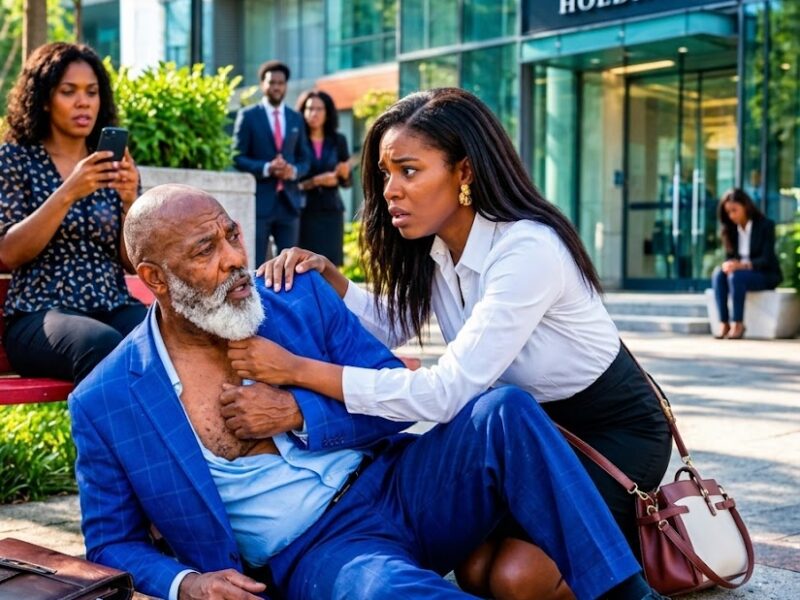
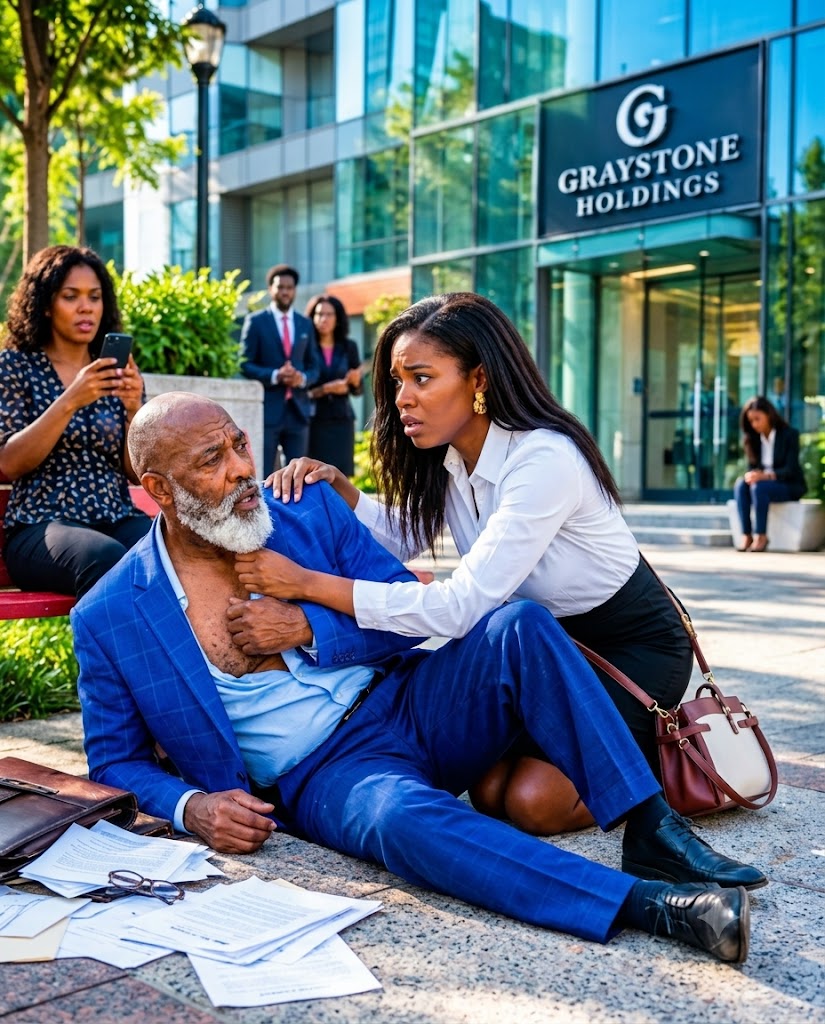
At 9:47 AM, she stepped off the bus onto the corner of Fifth and Broad, and saw the man collapse.
—
He was old. That was the first thing she noticed—the silver hair, the expensive suit that couldn’t hide the way his shoulders curved inward, the cane that clattered to the pavement as he went down.
The second thing she noticed was that no one stopped.
People walked past like he wasn’t there. A woman in a business suit stepped around his outstretched hand without breaking stride. A teenager with headphones turned up the volume and kept walking. A man in a construction vest glanced down, then looked away.
Evelyn’s feet stopped moving before her brain caught up.
*I don’t have time for this. I’m already late. Someone else will help him. Someone always helps.*
But no one was helping.
The old man was on his back now, one hand clutching his chest, his face a terrible shade of gray. His mouth moved, but no sound came out. His eyes were wide, desperate, fixed on the sky like he was already seeing something beyond it.
*It’s not my problem. I have nine minutes. Maybe less. If I stop now, I lose everything.*
Evelyn looked at the man. Looked at her watch. Looked at the doors of Greystone Holdings, visible just two blocks away, the glass and steel monument to everything she’d been working toward.
Then she looked back at the man.
“Sir?” She was already moving, dropping her bag, her folder, everything. “Sir, can you hear me?”
His eyes found hers. His lips moved again, and this time she heard it—a thin, rattling whisper. “Help…”
“Okay. Okay, I’m here.” She knelt beside him, her knees hitting the dirty pavement, her one good skirt soaking up God knew what. “I’m here. I’m not going anywhere.”
He wasn’t breathing.
The realization hit her like a physical blow—the stillness of his chest, the way his eyes were starting to glaze over, the absence of the rise and fall that meant life. He wasn’t breathing, and if she didn’t do something right now, he was going to die.
“Help!” she shouted, her voice cracking. “Somebody call 911!”
Around her, the world kept moving. People kept walking. A man on the sidewalk glanced over, then kept going. A woman pulled out her phone, but Evelyn couldn’t tell if she was calling for help or recording.
“He’s not breathing!” Evelyn yelled. “Somebody call 911! Please!”
She didn’t wait for an answer.
Her hands found his chest, positioned themselves over the sternum the way she’d learned in a CPR class she’d taken three years ago on a whim. Thirty compressions. Two breaths. Repeat. She’d practiced on a plastic dummy, never imagining she’d need it in real life.
“Come on,” she muttered, pressing down. “Come on, come on.”
One. Two. Three. Four. Five.
The old man’s body jerked with each compression, but he didn’t respond. His eyes were closed now, and his skin was cold, and Evelyn felt something hot and desperate building in her chest.
“You’re not dying,” she told him. “Do you hear me? You’re not dying on me.”
Ten. Eleven. Twelve.
Her arms were burning. Her blouse was stuck to her back with sweat. Somewhere in the distance, she heard the wail of a siren—or maybe she imagined it, maybe she wanted it so badly that her mind had conjured the sound.
“I need you to breathe,” she said, tilting his head back, pinching his nose. “On three. One, two—”
She exhaled into his mouth, watched his chest rise, felt it fall again. Then again.
Nothing.
“Come on!”
She went back to compressions, her rhythm faster now, more frantic. The siren was definitely real. Someone had called. Someone was coming.
But would they be in time?
“Don’t you dare,” she whispered. “Don’t you dare leave. You have people waiting for you. You have—”
She didn’t know what he had. She didn’t know who he was. But he was someone’s father, someone’s friend, someone’s person. And she wasn’t going to let him die while she was still alive to save him.
Thirty compressions. Two breaths. Repeat.
Her arms screamed. Her lungs burned from the effort of breathing for two people. And somewhere in the crowd that had finally gathered, someone was saying, “Why is she bothering? If it’s his time, it’s his time.”
Evelyn looked up, found the face of a man in a gray beanie, and said, “Then move. Move or call somebody. But get out of my way.”
The man stepped back.
The ambulance arrived four minutes later. Four minutes that felt like four hours, like four days, like a lifetime compressed into the space between heartbeats.
Two paramedics rushed toward them, a man and a woman, efficient and calm in their navy uniforms.
“Ma’am, we’ll take it from here,” the woman said, dropping to her knees beside Evelyn.
“His pulse—I couldn’t find it. He wasn’t breathing. I did CPR—”
“You did great. We’ve got him now.”
Evelyn sat back on her heels, her hands shaking, her knees stinging, her whole body vibrating with adrenaline. Around her, the crowd was dispersing, their curiosity satisfied, their consciences clear.
The man was alive. She’d kept him alive.
“Excuse me, miss?” The male paramedic looked at her. “Did you see what happened? Did he have any identification?”
“I don’t know. I didn’t—I just saw him fall. I didn’t look for ID.”
“No worries. We’ll figure it out. You should stick around, though. They’ll have questions.”
Evelyn looked at her watch.
9:58 AM.
The interview had been over for almost an hour.
—
She didn’t stick around.
She wanted to—God, she wanted to know if he’d made it, if the ambulance had gotten him to the hospital in time, if her four minutes of CPR had been enough. But the paramedics had said the police would have questions, and questions meant time she didn’t have, and somewhere in the fog of what had just happened, she remembered her promise.
*I’m not coming home without it.*
Her mother. The medicine. The interview.
Evelyn grabbed her bag, her folder—now smeared with street grit—and walked the two blocks to Greystone Holdings, her one good skirt stained with grime, her white blouse no longer white, her hair a disaster.
She walked through the glass doors at 10:03 AM.
The lobby was everything she’d imagined—marble floors, a waterfall feature that trickled down a wall of green plants, a receptionist who looked up with a practiced smile that faltered the moment she saw Evelyn.
“Can I help you?”
“I’m here for the 9:00 interview. My name is Evelyn Carter.”
The receptionist—a young woman with perfect makeup and a nameplate that read “Diana”—glanced at her computer screen, then back at Evelyn. “The 9:00 interview started over an hour ago.”
“I know. I’m sorry. Something happened on the way.” Evelyn took a breath, tried to steady her voice. “There was a man on the street. He collapsed. He wasn’t breathing. I had to—”
“Ma’am, you’ll have to speak to Mrs. Rebecca. Have a seat.”
The receptionist gestured toward a row of chairs that looked like they cost more than Evelyn’s entire apartment. She sat, her hands trembling, her heart still racing from the CPR, from the run, from the fear that she’d just thrown away the best chance of her life.
Ten minutes passed. Fifteen. Twenty.
At 10:27, a woman appeared—impeccable in a navy suit, silver hair pulled back in a severe bun, eyes that missed nothing. She looked at Evelyn the way someone might look at a stain on an expensive rug.
“Evelyn Carter?”
“Yes. That’s me.” Evelyn stood, offered her hand. “Good morning, ma’am.”
Mrs. Rebecca didn’t take her hand. She looked at Evelyn’s dirty skirt, her ruined blouse, her disheveled hair, and something flickered in her eyes—not quite disgust, but close.
“You’re twenty-five minutes late.”
“I know. I’m sorry. There was an accident. An old man collapsed on the street. I had to help him. I performed CPR until the ambulance came. That’s why I’m late.”
“CPR.” Mrs. Rebecca’s eyebrow arched. “You were doing CPR on the street.”
“Yes, ma’am. He would have died if I—”
“And you didn’t have time to clean up.”
“I didn’t have time to do anything except get here. I ran the whole way. I—”
“Let me be clear with you.” Mrs. Rebecca’s voice was ice. “We interview 200 people a month. We don’t wait. We don’t reschedule. And we don’t take walk-ins who show up looking like they were dragged here.”
Evelyn felt the blood drain from her face. “I know how it looks. But I’m telling you the truth. I can do this job. Ten minutes is all I’m asking.”
“Ten minutes for what? For you to convince me that someone who can’t manage her own time is going to manage a department?”
“I manage plenty. I—”
“Where did you go to school?” Mrs. Rebecca interrupted.
“Westfield Community College.”
“Community college.” The words dripped with disdain. “I was a cashier, but I also handled inventory and scheduling—”
“Look around.” Mrs. Rebecca gestured at the lobby, at the people in their expensive suits and their confident postures. “These people went to real schools. They held real positions. They got here on time, dressed properly. That’s the standard. That’s the minimum.”
“I meet the requirements for the job. On paper—”
“Paper doesn’t mean anything when the person holding it can’t show up.”
“I saved a man’s life this morning.” The words came out before Evelyn could stop them, sharp and raw. “That’s the truth. And I don’t regret what I did.”
Mrs. Rebecca’s expression didn’t change. “That’s a lovely story. This is a business, not a charity.” She turned toward the receptionist. “Who’s next? Mr. Thomas. Send him in.”
Evelyn stood frozen, her folder clutched to her chest, her heart pounding so loud she could hear it in her ears.
“You can leave your documents at the desk if it makes you feel better,” Mrs. Rebecca added, already walking away. “But I’ll be honest—nobody’s opening them.”
The words hit like a slap.
Evelyn looked at Diana, who wouldn’t meet her eyes. Looked at the folder in her hands, filled with three years of hard work, of late nights, of doing the jobs nobody else wanted to do.
She set the folder on the desk.
“Nobody is going to open that,” she said, more to herself than to Diana. “I already know it.”
Then she turned and walked out of Greystone Holdings, her head high, her eyes dry, her promise to her mother crumbling to dust in her hands.
—
She made it to the bus stop before she cried.
The tears came hot and fast, streaming down her cheeks, blurring the world into a watercolor smudge of gray buildings and gray sky. She pressed her fist to her mouth to muffle the sobs, but they escaped anyway, ugly and raw.
*What am I going to tell Mama?*
The thought was a knife in her chest. She’d promised. She’d looked her mother in the eyes and promised medicine, promised good news, promised that today would be the day everything changed.
And instead, she was standing at a bus stop with dirty knees and an empty folder and nothing to show for the most important morning of her life except the memory of an old man’s eyes, wide and desperate, fixed on hers as she pressed her hands to his chest and begged him to live.
*Did he make it?*
She didn’t know. She’d never know. She’d walked away before she could find out, and now she was walking away again, and the universe was laughing at her, and her mother was at home waiting for medicine she couldn’t afford.
The bus arrived. Evelyn got on. Gary the driver glanced at her tear-streaked face and said nothing.
She found a seat in the back, pressed her forehead against the cold window, and watched the city slide past—the glass towers, the expensive stores, the people who had everything and the people who had nothing and the vast, unbridgeable distance between them.
*Sometimes the road gets lonely,* she thought. *Sometimes nobody sees.*
But someone had seen. Someone had seen her on her knees on that dirty street, and someone had seen her walk into Greystone Holdings with her head up, and someone had seen her walk out with her heart breaking.
The question was: did it matter?
—
Her mother was asleep when Evelyn got home.
She stood in the doorway of the bedroom, watching the slow rise and fall of Mama’s chest, the way her hands twitched in her sleep like she was reaching for something just out of grasp. The pill bottle was still empty on the nightstand, a reminder of everything Evelyn had failed to provide.
She should wake her. She should tell her the truth—that the interview had been a disaster, that the job was gone, that the medicine would have to wait another day, another week, another eternity.
But she couldn’t. Not yet.
Instead, she went to the kitchen, filled a glass with water, and drank it standing at the sink, her eyes fixed on the window and the gray sky beyond.
*Mama thinks they’re going to call. She thinks something good is coming.*
The thought was unbearable.
Evelyn set down the glass, walked back to the bedroom, and stood over her mother’s bed. Mama looked smaller in sleep, more fragile, like something that could be blown away by a strong wind.
*I stood here this morning and promised her I’d buy her medicine.*
*And I failed.*
She didn’t cry. She was too tired for tears, too hollowed out, too empty.
*Tomorrow,* she told herself. *I’ll find the money tomorrow. I always find it.*
But even as she thought it, she knew it wasn’t true. There was no money to find. There was no job waiting. There was only the endless grind of survival, day after day, until one day the grind would win.
*God will close one door just to lead you somewhere.*
That’s what Mama always said. That’s what Mama believed.
Evelyn wasn’t sure she believed it anymore.
—
The hospital room was quiet except for the beeping of monitors and the soft hum of fluorescent lights.
Daniel Greystone sat in the chair beside his father’s bed, watching the old man sleep. Aaron Greystone looked diminished in the hospital gown, his silver hair mussed, his face pale against the pillow. But he was alive. That was the miracle.
The doctors had said it was a close call. Another minute without oxygen, another two minutes without CPR, and Aaron Greystone would have been gone. But someone had kept his heart beating, someone had breathed air into his lungs, someone had refused to let him die.
A stranger. A young woman who had disappeared before anyone could get her name.
“I spoke to the paramedics last night,” Daniel said when his father’s eyes finally opened. “Both of them. They confirmed it. A young woman did CPR on you at the scene and stayed until they arrived. Their words were, ‘You’d be dead otherwise.'”
Aaron blinked, processing. His voice was hoarse when he spoke. “What’s her name?”
“They asked if she was family. She said no, she was just passing. Then she left.” Daniel leaned forward. “They were busy keeping you alive, so nobody stopped her.”
“What about the cameras?”
“There’s a pharmacy at Broad and Fifth, forty meters from where you went down. Camera facing the sidewalk. The owner’s pulling the footage this morning.”
“Good.” Aaron closed his eyes, then opened them again. “What else?”
“There’s something else.” Daniel hesitated. “I wasn’t looking for it. It came up while I was making calls.”
“Go on.”
“When I called the front desk to tell them you were in the hospital, the receptionist mentioned a woman who came in for the 9:00 interview—twenty-five minutes late, dirty clothes. She said she was late because she stopped to do CPR on an old man who collapsed on the street.”
Aaron went very still.
“Say that again.”
“She came here yesterday morning for an interview. Here. To your building.”
“She was coming to interview at my company.” Aaron’s voice was barely a whisper. “And the reason she was late is she was on the ground saving my life.”
“Yes, sir.”
“What happened when she got here?”
Daniel’s jaw tightened. “Rebecca was running the interviews. She turned her away. Wouldn’t interview her. Told her to leave.”
The silence stretched, thick and heavy.
“This girl,” Aaron said slowly, “stops in the middle of the road, puts her hands on a stranger’s chest, and brings him back. Then runs here—dirty, late, out of breath—and tells the truth about why. And Rebecca sent her home.”
“That’s what the receptionist said.”
“Did anybody get her name?”
“She left her documents. The receptionist filed them. I pulled the application this morning.” Daniel glanced at the folder in his hands. “Evelyn Carter. Twenty-six. Westfield Community College. Last job, cashier. She applied for the junior operations role.”
“Evelyn Carter.” Aaron said the name like a prayer, like a promise. “She was two streets away. She could see the front door.”
“She could, sir.”
“And she didn’t know who I was. She couldn’t have. No company ID on me. I was just a man on the road.”
“No, sir.”
Aaron was quiet for a long moment. When he spoke again, his voice was different—harder, more decisive.
“I want to see everything. The pharmacy footage, the lobby cameras from yesterday—from the second she walked in to the second she left.”
“James can pull the lobby footage in twenty minutes. The pharmacy tape should be here within the hour.”
“Then get James now.” Aaron’s hands clenched the hospital blanket. “She lost that interview because of me. She didn’t know it, but she did.”
“I know, sir.”
“I don’t forget things like that.”
—
The lobby footage was grainy but clear.
Aaron watched from his hospital bed, his son beside him, as a young woman in a white blouse and dark skirt walked through the glass doors of Greystone Holdings at 9:14 AM. She was out of breath, her hair disheveled, her skirt stained with dirt. She approached the reception desk and spoke to Diana, her hands gesturing as she explained something.
“There she is,” Daniel said. “Is there audio?”
“No, sir. Lobby cameras are video only.”
Aaron watched as Diana picked up the phone, as Rebecca appeared, as the two women spoke. He couldn’t hear the words, but he could read the body language—Rebecca’s imperious posture, the way she looked down her nose at the young woman, the way she gestured at the lobby, at the other candidates, at everything and nothing.
And he could see Evelyn—her shoulders straight, her chin up, her hands clasped in front of her like a shield.
“She’s frightened,” Daniel said.
“Wouldn’t you be?”
The footage continued. Rebecca walked away. Evelyn stood alone for a moment, then set her folder on the desk and walked out. The whole thing took six minutes.
“Play it again,” Aaron said. “The whole thing.”
They watched it twice more. Each time, Aaron’s expression grew darker, his jaw tighter.
“James,” he said finally. “Put both of those on a drive for me. This and the pharmacy tape when it comes.”
“Yes, sir.”
“And get me Rebecca. In the boardroom. One hour.”
“Sir?”
“Don’t tell her why. Just say the CEO wants to see her.” Aaron’s eyes were fixed on the frozen image of Evelyn Carter walking out of his building, her head high, her eyes dry. “And Daniel?”
“Yes, sir?”
“That girl walked into this building and told the truth. And what did she get for it? She got laughed at. In my building. Under my name. By somebody I gave authority to.”
He turned to look at his son.
“Find her.”
—
The boardroom was silent.
Rebecca sat at one end of the long table, her posture perfect, her expression carefully neutral. Around her sat the other witnesses—Diana the receptionist, the three candidates who had been in the lobby that morning, and a few others who had been present for the interview process.
Aaron Greystone sat at the head of the table, still pale, still weak, but very much alive.
“Thank you for coming on short notice,” he said. “Some of you don’t even work here. You were candidates yesterday. I appreciate you coming back.”
He paused, letting the silence stretch.
“I’m going to ask a few questions. I’d like honest answers. That’s all.” He turned to Diana. “Yesterday morning, a young woman came here for the 9:00 interview. She was late—about twenty-five minutes. She spoke to the front desk, then to HR.”
“Yes, that’s correct,” Diana said.
“You were at the desk.”
“Yes, sir. Around 9:15, she said her name was Evelyn Carter. She said she was late because she helped somebody on the street—a man who collapsed.”
“And what did you think when she said that?”
“I didn’t really think anything, sir. I called Mrs. Rebecca.”
“You didn’t believe her?”
“It wasn’t my place to believe her or not. I followed the process.”
Aaron nodded, then turned to one of the candidates—a young man in a gray suit who had been sitting in the lobby that morning.
“You were sitting right there. What did you see?”
The young man shifted uncomfortably. “She came in looking rough, out of breath. She went to the desk and explained herself. Then Mrs. Rebecca came out and spoke to her.”
“Spoke to her how?”
“Directly, sir.”
“Directly. That’s one word for it.”
The young man hesitated. “She was cruel to her.”
“Such as?”
“Sorry, but she was. She made comments about how the girl looked, her school, where she’d worked—things that didn’t need to be said in front of—” He stopped, glanced at Rebecca. “She asked where she went to school. The girl said community college, and Mrs. Rebecca repeated it back at her like a joke. Then she pointed at the three of us and said something like, ‘These people went to real schools, real positions.'”
“And what did the young woman do?”
“Nothing. She stood there. She didn’t shout. She didn’t cry. At the end, she said she’d saved somebody’s life that morning and she wasn’t ashamed of how she looked. Then she was told to leave.”
Aaron leaned back in his chair. “I want to ask all of you one thing. Think before you answer. When you saw that happening, did anybody say anything? Anybody at all?”
Silence.
“Nobody. That’s the answer.” Aaron’s voice was quiet, but it carried. “And I’m not blaming you for it. You were applicants. You were guests in a building where you wanted a job. You were afraid it would cost you. I understand that. Fear is real. And you followed the process. I understand that, too.”
He turned to Rebecca.
“Rebecca, you’ve been quiet. I’ve been waiting for you to ask me.”
“I’ve been waiting for you to ask me,” she said.
“I’m asking. Yesterday morning. Evelyn Carter. What happened?”
“She was twenty-five minutes late. She came in unpresentable. I told her the window had closed and that we hold everyone to the same standard.”
“And her explanation—that she stopped for a man who was dying on the street?”
“With respect, sir, I hear explanations every day. My car broke down. There was traffic. I can’t verify every story that walks through the door. If I made an exception for every sad story, we’d never finish a schedule.”
“So you didn’t believe her.”
“It wasn’t about belief. It was a judgment call.”
“A judgment call.” Aaron’s voice was flat. “When you made this judgment call, did you ask her one question about her qualifications?”
“She was late. At that point, the qualifications aren’t relevant.”
“Did you read them?”
“I didn’t need to. The decision was already—”
“Did you open the documents?”
Rebecca’s jaw tightened. “I told the receptionist—”
“So that’s a no.”
“No, sir.”
“You decided about a human being without reading one page, without asking one question, without giving her sixty seconds in a chair.”
“Sir, I have run HR here for six years. Thousands of interviews. I know when somebody is wasting our time.”
“Do you?” Aaron leaned forward. “Because from where I’m standing, the only person whose time got wasted yesterday was hers.”
He nodded to Daniel, who dimmed the lights and started the projector.
“I want to show you all something. Lobby footage from yesterday morning. No editing, no sound. All of it.”
The footage played. Six minutes of Evelyn Carter walking into Greystone Holdings, explaining herself, being humiliated, and walking out with her head high. The room was silent.
When it ended, Aaron turned to Rebecca.
“That’s what this company did to a woman who walked through our doors telling the truth. Five minutes ago, you sat in that chair and told me you explained the standard, that you couldn’t accommodate her. You made it sound routine.” He paused. “Does that look routine?”
“Sir, there’s no audio—”
“I don’t need audio. I have eyes. So does everybody in this room. You saw it yesterday, and you just saw it again.” He looked around the table. “Am I wrong?”
“No, sir,” someone murmured.
“Now, something none of you know except Daniel.” Aaron’s voice was steady, but there was something underneath it—something raw. “Two days ago, I collapsed on the sidewalk. Broad Street, near Fifth. My heart stopped. I couldn’t breathe. I went down on the concrete in front of—I don’t know how many people. Not one of them stopped. They walked past. They stared. One woman recorded on her phone.”
He paused, letting the words sink in.
“And I’m lying there, looking at the sky, thinking, ‘This is it. I’m going to die on the ground while strangers watch.’ Then a young woman came out of nowhere, dropped everything she was carrying, got on her knees, put her hands on my chest, and pushed. Over and over. Breathed air into me. Shouted at people until the ambulance came.”
He turned to Rebecca.
“That woman is the woman in this video. Evelyn Carter. The one you turned away. The one you called unpresentable. She was dirty because she was on her knees on a road, bringing me back from the dead. She was two streets from this building. She could see the front door. She knew exactly what it was going to cost her, and she turned around anyway. Then she came here and told you the truth, and you laughed at her school, her clothes. You lined her up against strangers to make her small. And you sent her out.”
“Sir, I had no way of knowing—”
“That’s exactly the problem.” Aaron’s voice cracked like a whip. “You had no way of knowing. And it shouldn’t matter. If she’d saved a taxi driver, a street sweeper, nobody at all—it still wouldn’t give you the right to treat a human being like that. She looked like somebody you could step on without it costing you anything.”
He stood, slowly, his body still weak but his presence filling the room.
“The only reason you’re shocked right now is that the man she saved turned out to be me. And that tells me everything I need to know about you.”
He looked at Daniel. “Would you take everyone out, please? Except Rebecca.”
The room emptied. The door closed.
—
“Sir, I know how this looks, and I know you’re angry, but hear me out.” Rebecca’s composure was cracking, just slightly. “Six years I’ve given this company. I built that hiring process from nothing. When I came, the department was a mess.”
“I’m listening.”
“I made it work.”
“This company asked you to humiliate people?”
“This company asked me to keep a standard.”
“There’s a difference between a standard and cruelty. You don’t seem to know where the line is.”
“I was firm. That’s not cruelty.”
“You mocked her school. You mocked her clothes. You waved your hand at her body like she was something rotting in a room full of strangers. That’s not firm. That’s somebody enjoying power over a person who can’t fight back.”
“If I had known she’d saved your—”
“Stop.” Aaron’s voice was ice. “Stop right there. You keep going back to that. ‘If I had known.’ As if treating her like a person was only required if the man on the road turned out to be important. What if it had been nobody? A homeless man? Would that make it fine? You’d have done exactly the same thing. And you’d have slept well. Because to you, she wasn’t a person. She was a problem. A late applicant with dirty clothes and a school you didn’t like.”
He walked toward her, slowly, each step deliberate.
“You see that? Let me fix it.”
“How?”
“That girl went home yesterday believing this company decided she wasn’t worth ten minutes. You don’t take that back with an apology. Words like that stay. Trust me. They stay.”
“What are you saying?”
“I’m saying this isn’t about one bad morning. It’s about who you are when you have power and nobody’s watching. I watched you walk into that lobby. You didn’t walk in to interview a candidate. You walked in to punish somebody. And you enjoyed it.”
“That’s not fair—”
“What’s not fair is a girl doing CPR on a stranger, running here with dirt on her knees, telling the truth, and being thrown out like rubbish.” Aaron’s voice was quiet, final. “You’re done here, Rebecca.”
“You’re firing me.”
“Effective immediately.”
“Over one candidate? After six years?”
“If you did that to one person in front of a camera, I have to ask myself what you’ve done when there wasn’t one. How many Evelyns walked through that door and met you? Six years is a long time. And I should have been paying closer attention. That part is mine. I’ll carry it. But this ends today.”
He turned to Daniel, who had re-entered the room.
“Have security walk Miss Rebecca to her office for her things. Final paperwork by close of business.”
“Sir—”
“I built this place to give people a chance. Not to take them away. It’s done.”
—
The application was thin—three pages, neatly typed, no typos. Daniel had read it twice.
“Westfield Community College, top of her class,” he said, sliding it across the desk to his father. “Cashier for three years, but she was running inventory, ordering, and staff scheduling. Volunteering at a community clinic on her days off.”
Aaron took the file, reading slowly.
“She wasn’t qualified for that junior role, Daniel. She was overqualified.” He looked up. “And nobody opened the envelope.”
“What do you want to do?”
“Find her. Today, not tomorrow.”
“I have an address from the application. East Side, 14 Miller Road, Unit 7.”
“Send somebody. No—send two. Somebody from the office and the driver. I want them there within the hour.”
“What do they tell her?”
“That the CEO of Greystone would like to meet her personally. And that there’s a car whenever she’s ready.”
“And if she asks why?”
“She will. Of course she will. The last time she was in this building, she was told she wasn’t good enough. She’s going to be frightened. Tell them to be gentle. Don’t rush her. Don’t push. Just say the CEO wants to see her, and she’s not in any trouble.”
“I’ll send Marcus and the driver. Marcus is good with people.”
“Good. And Daniel—tell them to wait. If she needs an hour, they wait an hour. She’s not going to believe this is real.”
—
The knock came at 2:37 PM.
Evelyn was sitting on the floor of the living room, folding laundry that didn’t need folding, trying to figure out how to tell her mother that the interview had been a disaster. Mama was awake, propped up in bed, watching a soap opera with the volume turned low.
“Evelyn?” Mama called. “Someone’s at the door.”
“I’ll get it.”
She stood, smoothed her skirt—a different skirt now, an old one, because the good one was ruined—and opened the door.
A man stood on the landing. He was tall, well-dressed, with kind eyes and a smile that seemed genuine.
“Good afternoon. Are you Evelyn Carter?”
“Who’s asking?”
“My name is Marcus. I work at Greystone Holdings. I’m here for the CEO, Mr. Aaron Greystone.”
Evelyn’s heart stopped.
“Greystone?”
“Yes, ma’am.”
“Did something happen? Am I in trouble?”
“No, nothing like that.” Marcus’s voice was gentle. “He’d like to meet you personally. He sent us to ask and to drive you over, if you’re willing.”
“The CEO wants to meet me.”
“Yes.”
“Me?”
“That’s right.”
“I don’t understand. I was there yesterday for an interview. They sent me away. The HR woman told me not to come back. She said nobody would even open my file.”
“I don’t know anything about yesterday, ma’am. I only know he asked me to come here and tell you he’d like to see you. And to say there’s no rush. Take whatever time you need.”
“People like that don’t send cars to a place like this.”
“I know how it sounds. All I can tell you is the car’s downstairs, and the invitation is real. Whatever you decide is fine.”
“Evelyn?” Mama’s voice again. “Who’s that?”
“Nobody, Mama. One minute.”
She looked at Marcus—at his kind eyes, his patient smile, his perfectly pressed suit. She thought about the empty pill bottle on the nightstand. She thought about the promise she’d made that morning. She thought about the old man on the street, his eyes wide and desperate, his heart stopping under her hands.
“Give me ten minutes,” she said.
“Take your time.”
She closed the door and leaned against it, her heart pounding.
*This is probably nothing. They’ve got the wrong person. I’m going to sit in that building and feel small all over again.*
But then she thought about her mother. About the medicine. About the promise.
*But I made my mother a promise.*
She walked back to the bedroom, where Mama was watching her with sharp eyes.
“Who was that?”
“A man from Greystone Holdings. The company I interviewed with yesterday.”
Mama sat up straighter. “They want you to come back?”
“The CEO wants to meet me. Personally.”
“The CEO?” Mama’s eyes widened. “Why?”
“I don’t know. He sent a car.”
“A car?”
“I know. It doesn’t make sense.”
Mama was quiet for a moment. Then she smiled—a slow, knowing smile that Evelyn hadn’t seen in years.
“Go,” she said.
“Mama—”
“Go. Find out what he wants. And Evelyn?”
“Yeah?”
“Whatever it is, remember who you are.”
—
The car was black, sleek, and impossibly clean.
Evelyn sat in the back seat, her hands clasped in her lap, watching the city slide past. Marcus sat up front with the driver, occasionally glancing back at her with that same kind smile.
“You okay?” he asked.
“I don’t know what I am.”
“That’s fair.”
They pulled up to Greystone Holdings at 3:15 PM. The building looked different in the afternoon light—less intimidating, somehow, or maybe Evelyn was just too numb to be afraid.
Marcus led her through the lobby, past Diana the receptionist, who looked at her with wide eyes. They took the elevator to the top floor, where the doors opened onto a quiet hallway with thick carpet and soft lighting.
“He’s expecting you,” Marcus said, gesturing toward a door at the end of the hall. “Go on in.”
Evelyn walked to the door. She took a breath. She opened it.
And stopped.
The man behind the desk was old. Silver hair, a suit that looked expensive even from across the room. He was pale, thinner than he should have been, but his eyes were the same—wide, desperate, fixed on hers as she pressed her hands to his chest and begged him to live.
“It’s you,” she whispered.
“It’s me.” Aaron Greystone stood, slowly, leaning on a cane. “You’re the man on Broad Street. You were on the ground. You were—”
“I was dying.” His voice was gentle. “Yes.”
“And you didn’t let me.”
“I—” Evelyn’s legs felt weak. “But this is—this is your—oh my God. I was coming here to you. And you were the man on the—”
“Sit down, Evelyn. Please. Take a minute. It’s a lot.”
She sat, her body moving on autopilot, her mind spinning. “I didn’t know, sir. I swear to you, I didn’t know who you were. I didn’t—”
“I know you didn’t. That’s the whole reason we’re sitting here.”
“Are you all right? Your heart—are you okay?”
“Because of you. Yes.”
“I didn’t know. When they closed the ambulance, I didn’t know if you—I kept thinking about it on the bus home. Did he make it? Is he breathing?”
“Don’t apologize. Not to me. Not ever.” Aaron sat down across from her, his movements slow, careful. “Can I tell you what happened after you left that road? I woke up in a hospital, and I didn’t know where I was. The first thing I remembered wasn’t the doctors. It was your face, looking down at me, telling me to stay. I asked who you were. Nobody knew. You didn’t leave a name. You didn’t wait to be thanked. You just went, like it was an ordinary thing you did on the way to somewhere else.”
“I was late. I had to get to the interview.”
“Yes. And that’s what I found out next.” He paused. “My assistant told me a young woman had come into this building that same morning. Late. Dirty clothes. Saying she’d stopped to do CPR on an old man.”
“And they turned me away.”
“Rebecca.”
“She said I was wasting her time. She said nobody would look at my documents.”
“I know. I watched it.”
“You—”
“The security footage. Every second. I saw you come in. I saw you explain yourself, politely, honestly. I saw her mock your clothes and your school in front of a room full of people. And I saw you stand there and take it. You didn’t shout. You didn’t cry. You put your documents on that desk, and you walked out of my building with your head up.”
“I wanted to cry. I nearly did. I waited till I was on the bus.”
“But you didn’t give it to her. That’s not a small thing.” He picked up a folder from his desk—her folder. “I read this. All of it. Including the last line.”
“I wrote that because I didn’t know what else to put. I don’t have big degrees. I don’t have titles. I just wanted them to know I’d try.”
“That’s more than most people who walk through that door can say.” He set the folder down. “Evelyn, I need to tell you something. And I need you to actually hear it. Rebecca is gone. I let her go this morning. Not only because of what she did to you—although that was enough. Because of what she’s been doing to people like you for years.”
“You fired her.”
“In front of the people who watched it happen and said nothing.”
“I didn’t come here for that. I didn’t want anybody losing their job because of me.”
“I know. That’s not why I did it. What happened in that lobby was wrong. It was not your fault. And it will not happen in this building again.” He leaned forward. “Now. The real reason you’re here.”
“Okay.”
“I’m not doing this because you saved my life.”
“Sir—”
“I need you to hear that, because I know what you’re sitting there thinking. That this is a thank-you. That the old man is paying you back, and you wonder whether you should take it. It isn’t. I started this company at twenty-three. Borrowed money. A room above a printing shop. No investors, no connections, no family name opening doors for me. And I never lied. Not once. Not even when lying would have been easier. That’s what built this place. Not money. Character. What a person does when nobody’s watching and there’s nothing in it for them.”
“I almost kept walking, too.”
“I know. You told me just now. And you didn’t have to. That’s the part that matters. You almost did. And you turned around anyway, knowing what it was going to cost you. That’s not instinct. That’s a choice.”
He picked up her file again.
“I read your file. Top of your class. You were running inventory and scheduling at a shop that was understaffed three times over. Volunteering at a clinic on your days off. And doing all of it while nursing your mother at home.”
“How do you know about my mother?”
“You wrote it under the gap in employment. Your words: ‘I took time away from work to care for my mother, who is ill. She is my priority and always will be.’ Most people leave that part out. They think it makes them look unreliable. You put it down because it’s true.” He set the file down. “I’d like to offer you a position here.”
“A position?”
“Not the junior operations role. Something higher. Executive support, working directly with department heads. I need somebody I can trust when things get difficult.”
“Sir, I—I’ve never worked in an office like this. I don’t have the experience—”
“You don’t have experience in a corner office. That’s true. You have experience in every single thing that actually matters. And I’m not offering it because you saved my life. I’m offering it because in thirty seconds on a road, you showed me more about who you are than most people show me in thirty years. I’d be a fool to let you walk out of this building twice.”
“Sir, this—this figure—”
“Is fair for the role and for the person filling it.”
“It’s more than I’ve made in three years put together.”
“Then you’ve been underpaid for three years. That’s not something to be ashamed of. It’s something to fix.”
“Why me? Honestly, there are thousands of people with better degrees, better experience—people who’d walk in here knowing exactly what to say. And most of them would have stepped over me.”
“I know. I knew before you came through that door.”
He stood, extended his hand.
“Welcome to Greystone, Evelyn.”
She took his hand, her eyes wet, her heart full.
“Thank you,” she whispered. “Thank you for looking for me. Thank you for stopping.”
—
The first day was a blur.
Evelyn arrived at 8:45 AM, wearing a new blouse—white, because Mama had insisted—and a skirt that didn’t pinch. She walked through the lobby, past Diana, who smiled and said, “Good morning, Miss Carter.”
“Good morning.”
She took the elevator to the top floor, where a desk was waiting for her. On the desk was a nameplate: EVELYN CARTER, EXECUTIVE SUPPORT.
She sat down, ran her fingers over the letters, and thought about the empty pill bottle on her mother’s nightstand—now full, thanks to the advance on her first paycheck.
*Last time I stood here, I thought it was the worst day of my life. And I walked out of those doors thinking I’d never see the inside of this place again.*
She looked out the window at the city below.
*And now it’s mine.*
—
The soup had too much pepper.
“It has the correct amount of pepper,” Evelyn said, setting the bowl in front of her mother.
“So after all the expensive medicine, pepper is what will finish me.”
“Mama, eat.”
“I’m eating. I’m only saying—next time, less.” Mama took a spoonful, then set it down. “Evelyn. Come sit with me.”
Evelyn sat on the edge of the bed, and Mama took her hand.
“You remember what I said to you that morning?”
“You said a lot of things that morning.”
“I said, ‘May God go before you.'”
“I didn’t know he was going to lie down on the road to do it.”
Mama laughed, then coughed, then laughed again. “I’m serious. Let me tell you something. When your father left, when it was just the two of us, I used to lie awake and think, ‘What will happen to this girl? What am I going to give her?’ I had nothing.”
“Mama—”
“Let me finish.” She squeezed Evelyn’s hand. “I used to pray every night. Not for money. Not for a house. One thing. I said, ‘God, just make her good. I don’t mind if she’s rich. Just give her a heart that does the right thing when nobody’s looking.’ And look what being good gave you. Not because you cheated somebody. Not because you climbed on anybody’s head. Because you stopped on a road for an old man who couldn’t breathe. So my prayer worked. That’s all I wanted to say.”
Evelyn blinked back tears. “I’m going to take care of you properly now. No more counting tablets. No more lying to you about whether I’ve eaten.”
“You’ve always taken care of me, my girl.” Mama picked up her spoon. “Now finish your soup.”
“Too much pepper.”
“Then next time, less.”
—
That night, Evelyn stood at the window of their apartment—the same apartment, but different now, lighter, full of possibility. She thought about the old man on the street, his eyes finding hers in the crowd. She thought about the folder on the reception desk, the words nobody would read. She thought about the car that had come for her, the hand that had reached for hers, the nameplate that now bore her name.
*Sometimes you lose today just to find your way.*
She smiled.
*When nobody was watching, she chose to care.*
*And look what caring gave her.*
—
**THE END**









