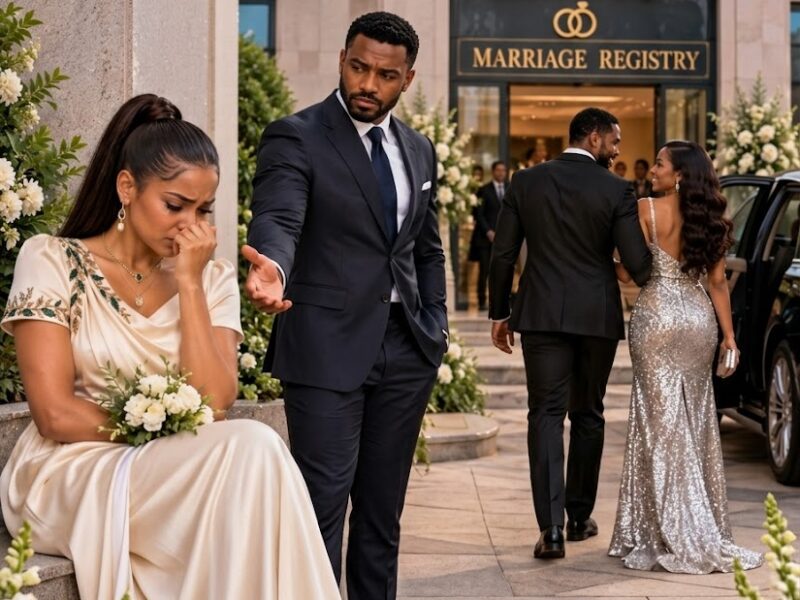
She Married a Stranger Hours After Being Dumped—Then Discovered He Was the Man Her Late Father Had Chosen for Her
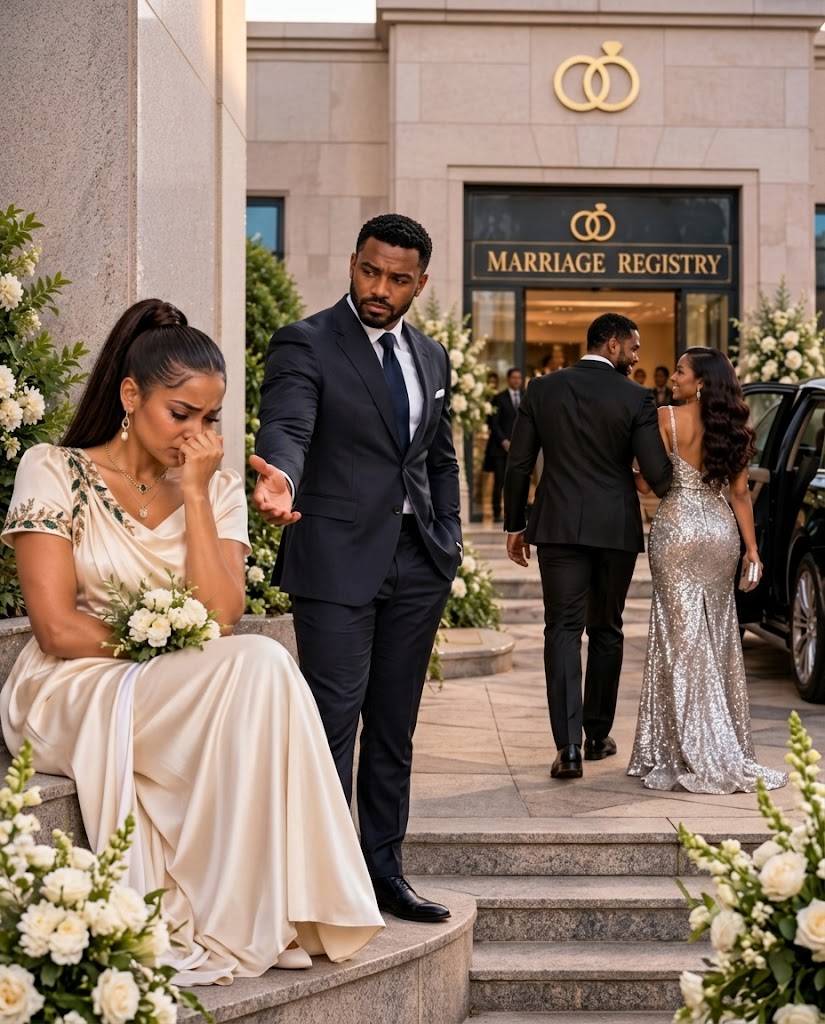
I arrived too early, and I knew it.
I couldn’t help myself. Today was supposed to be the happiest day of my life.
The county clerk’s office didn’t even open for another twenty minutes, so I sat on a wooden bench in the hallway with a folder on my lap. Marriage license. Two photo IDs. Our rings, one of them still in its velvet box.
I had checked the contents twice before leaving my apartment and twice again after I arrived. I checked my phone so many times that I finally flipped it face down on my knee.
Four years. Four years of waiting for Desmond Peters to finish school, settle into his father’s company, and finally feel “ready.”
For four years, I had heard one word from him over and over. “Soon.”
Today, there would be no more soon.
At 9:30, I called him.
“Hey,” I said. “Where are you? I’ve been here for almost half an hour.”
“I know. I’m sorry. Something came up.”
“What happened?”
“Nothing serious. I’m just delayed.”
“How long?”
“I don’t know. Maybe a little while.”
“Should I come and meet you?”
“No.” He said it too fast. “I’ll call you.”
“All right. I’ll wait. You know, I’ve already waited four years. Another thirty minutes won’t kill me.”
“I’ll call you, Zara.”
The line went dead.
Something felt wrong. But it was our wedding day, so I told myself he was only nervous.
Maybe something had happened at work and he didn’t want me to worry. I could be generous for one more hour.
I had no idea that across town, in a quiet coffee shop, he was sitting with the one woman who could undo me.
“You’ve been back for weeks,” Desmond’s shoulders sagged, “and you still haven’t told her.”
Vanessa Whitmore stirred her coffee without drinking it. “We were together before Zara ever came into your life.”
“And it ended when you left for Europe.”
“I came back, Desmond. For weeks you’ve acted like Zara doesn’t need to know. She’s still waiting, isn’t she?”
“Yes.”
“And you’re actually thinking of going to her?”
“No.”
“Then why are you keeping her there?”
“Because four years isn’t something you end in one sentence.”
“You’ve had weeks.” Her voice sharpened. “So what exactly is stopping you?”
“She was good to me.”
“Good to you.” Vanessa laughed softly. “You sound like you’re describing a housekeeper.”
“That’s not what I mean.”
“Then what do you mean?”
He rubbed his forehead. “She stayed when things were difficult. She helped with my father’s company. She supported me. And you can’t marry someone because you feel guilty.”
“I know. So tell her.”
“Do you still want me?” he asked.
“Yes.”
“More than her?”
“Yes.”
“Then what are you afraid of?”
He stared at the table. “She has nobody.”
“Excuse me?”
“Zara grew up without parents. No family name. No connections. Nothing.” He finally looked up. “And you’re different. Your family has influence. Your father can open doors mine can’t. Your name means something. With Zara, everything will always be hard.”
Vanessa smiled the way a person smiles when the trap has already closed.
“So now you understand.”
At 10:05, my phone buzzed.
“Zara, are you almost here?”
“I’m already here, Desmond. I’ve been here since eight forty-five.”
“Zara, I can’t do this.”
I thought I’d misheard. “What do you mean?”
“I can’t marry you.”
The hallway noise seemed to fall away. A couple walked past holding hands, and a toddler in a tiny bow tie wobbled after them.
“Did something happen?” I asked. “Are you in trouble?”
“No.”
“Then what are you saying?”
“Vanessa is back.”
“Vanessa?” I repeated. “What does Vanessa being back have to do with our wedding?”
“I never really stopped having feelings for her.”
I gripped the folder. “You told me she didn’t matter anymore. You said you two were over a long time ago.”
“I didn’t plan for this to happen.”
“Then what did you plan?”
“Zara, please.”
“No. Explain it to me. You left me sitting here while you were with another woman.”
“I was going to tell you.”
“When?”
“I don’t know.”
“After I waited until evening?” My voice cracked, and I hated it. “After I called every hospital in the county because I thought something had happened to you?”
“Please don’t make this harder.”
“Harder for who?”
“I’m sorry.”
“Four years, Desmond.”
“I know.”
“What about the four years we spent together?”
“They were real.”
“Then how can you throw them away this morning?”
“Because I have to think about my future.”
I almost laughed. “What does that mean?”
“Vanessa can give me a different kind of life.”
“What kind of life?”
“Her family has power. Connections. Opportunities.”
“And me?”
“Zara…”
“And me, Desmond?”
He took a breath, and I heard the cruelty arrive before he said it. “You have to be honest with yourself, too. You don’t have anyone behind you. You grew up an orphan. You don’t even know where you came from. I don’t mean it as an insult.”
“It sounds like one.”
“I’m only saying I want more for my life.”
“And I wasn’t enough.”
“It isn’t like that.”
“It is exactly like that.”
“I’m sorry.”
“So this is really your decision.”
“Yes.”
“You’re choosing Vanessa.”
“Yes.”
“Then go.”
“Zara…”
“Go, Desmond.”
“I hope one day you understand.”
“No.” My voice went flat and cold. “I think I understand you perfectly now.”
Four years had just ended in less than five minutes.
Outside the window, life kept moving. People laughed. A man carried a bouquet of white roses toward the elevator. Nothing around me knew that my whole future had just disappeared.
I opened the folder. His name was typed beside mine on the license application. This morning those papers had looked so important.
Now they looked foolish.
Across the city, in a glass-walled kitchen in a house that smelled like cinnamon and money, Nolan Ashford was losing an argument he had lost many times before.
“You can’t keep rejecting every woman we mention,” his mother said.
“I don’t reject every woman.”
“You rejected Cynthia.”
“I met Cynthia twice.”
“You rejected Kayla.”
“Kayla spent our entire dinner talking about how many followers she had.”
“And now Vanessa.”
“Especially Vanessa.”
“Nolan.”
“Mom, you know what she’s like.”
“What is she like?”
He turned toward his father, who sat behind a newspaper. “Dad, help me.”
“Your mother is talking to you,” Mr. Ashford said without lowering the paper. “Don’t bring me into it.”
“Wonderful.”
His mother set down her cup. “The understanding between our families has been there for years.”
“That agreement was never about Vanessa,” Nolan said. “It was supposed to be between this family and the true Whitmores.”
The room went quiet.
“Clara Whitmore disappeared when she was seven,” his father said at last, folding the paper. “Eighteen years have passed. They searched everywhere and never found her.”
“That doesn’t turn Vanessa into her.”
“Nobody said it does,” his mother said gently.
“Then don’t use an old family agreement to push Vanessa on me.”
“Your mother is only worried about you.”
“I know.” He softened. “I’m sorry.”
“You’re thirty-two, Nolan. When exactly do you intend to marry?”
“When I meet someone I actually want to marry.”
“You meet women every day.”
“That isn’t the same thing.”
“So what do you want us to do?”
“Nothing.”
“Nothing.”
“Exactly.”
His mother shook her head. “One day you’ll wake up and realize everyone around you has built a family.”
“Mom, if marrying Vanessa is my only option,” he said, picking up his keys, “I would rather marry the next stranger I meet.”
“Don’t joke about marriage.”
“I’m not joking.”
“You are impossible.”
“I have a meeting.”
“Nolan, at least think about it.”
He was already at the door. “I have. And the answer is no.”
“Aren’t you supposed to be at city hall?” his father called after him.
“Yes. Legal is waiting there. We have company documents to finalize.”
When the door shut, his mother let out a breath. “You really thought he would agree?”
“At this point,” Mr. Ashford said, “I don’t even know what will make that boy marry.”
At city hall, the final filing took twenty minutes.
“That settles it, Mr. Ashford,” the attorney said, snapping his briefcase closed. “Legal will submit the remaining copies today.”
“Good. Send confirmation to my office when it’s done.”
“Of course.”
Nolan stepped into the hallway, loosening his tie. He wanted fresh air and silence. Instead he found a woman on a bench, staring at a stack of papers as if they had personally betrayed her.
It was none of his business. He should keep walking.
He stopped anyway.
“Excuse me.”
She looked up. Her eyes were red but dry, which somehow made it worse. “Yes?”
“Can I sit?”
“There are other chairs.”
“There are. But this one is available.”
She exhaled. “Fine.”
He sat. For a minute neither of them spoke.
“Marriage,” she said finally, to no one. “It was supposed to be…”
“Supposed to be?”
“My fiancé changed his mind today.”
He kept his face neutral. “When?”
“About ten minutes ago.”
“That’s impressive.”
She turned. “What is impressive?”
“The timing. He couldn’t have discovered his stupidity yesterday?”
A sound escaped her. It was almost a laugh. She looked horrified by it. “I don’t even know why I laughed.”
“Because it was funny.”
“It wasn’t.”
“No,” he agreed. “What happened to you wasn’t funny. Your former fiancé, on the other hand…”
“Former,” she said.
“That part already sounds better.”
“You talk too much.”
“I’ve been told. You can cry, if you want.”
“I don’t want to.”
“Okay.”
“You’re not going to tell me it will be fine?”
“No.”
“Why?”
“Because I don’t know you. I don’t know if it’ll be fine. But I do know that marrying someone who can leave you waiting on your wedding day would probably have been worse.”
She studied him. “What are you doing here?”
“Just finished a meeting. And escaping my own wedding problem.”
“You’re getting married, too?”
“So I’m told. My family selected a woman for me.”
“And you don’t want her?”
“Very much.”
“Then say no.”
“I did.”
“Problem solved.”
“You make it sound easy.”
“You just told me my life will probably be better because my fiancé left me this morning.”
“Good point.”
He watched the white roses go by in the hands of a stranger. A foolish thought, the one he’d made out loud in his mother’s kitchen, came back to him.
“This morning I told my mother that if Vanessa was my only option, I would rather marry the next stranger I met.”
“That’s a foolish thing to say.”
“Is it?” He heard himself continue before his sense could catch up. “If you’re still interested in getting married today, I’m available.”
She stared at him. “You’re serious?”
“Strangely, yes.”
“You don’t know me.”
“You don’t know me, either.”
“Exactly.”
“That makes it fair.”
“You’re crazy.”
“Probably.”
“You can’t just marry a stranger.”
“People marry people they know and still regret it.”
“That’s not an argument.”
“I never said it was a good one.”
She stood, gathering her folder. “I thought you’d be going back to your fiancé to beg.”
“No.”
“If he calls tonight?”
“No.”
“If he apologizes tomorrow?”
“Why do you care?”
“I don’t.”
“Then stop following me.”
“I will.” He rose, too, keeping his distance. “But answer one question first. Is marrying me really worse than going home and begging the man who left you?”
She froze with her back to him.
He winced. “I’m sorry. That was too much.”
“No.” She turned around slowly. “You’re right.”
“You really want to do this?”
“I said I was available.”
“What if I’m a terrible person?”
“What if I am?”
“One condition.”
“Already?”
“Neither of us controls the other. You keep your life. I keep mine.”
“Agreed. And there must be no misunderstanding. You don’t tell me what to wear, where to go, or who I can speak to.”
“Agreed.”
“And if this becomes unbearable, we end it peacefully.”
“Agreed.”
“This is insane,” she whispered.
“Absolutely.”
“Fine.”
“Fine.”
“Before I change my mind,” she said, and held out her hand.
Twenty-five minutes later, the clerk looked at them over her glasses.
“Both of you understand that once these documents are signed and filed, this marriage becomes legally binding?”
“Yes,” they said together.
Zara signed her name. Nolan signed his. A stamp came down, loud and final.
“Congratulations,” the clerk said. “Mr. and Mrs. Ashford.”
Zara went pale. “What have I done?”
“That question came very quickly,” Nolan said.
“This isn’t funny.”
“It’s a little funny.”
“You just married a stranger.”
“So did you.”
He pulled a small velvet box from his jacket pocket and opened it. A diamond caught the light.
“You carry a ring around?” she asked.
“My mother gave it to me this morning. For my fiancée.”
“She hopes so?”
“She guessed wrong.” He slid it onto her finger. It fit. That felt unfair. “Your turn.”
“I don’t have anything.”
“Nothing?”
“I came here to marry another man. I didn’t plan to pick up a replacement husband.” She hesitated. Then she lifted a thin silver chain from beneath her collar. At the end hung a small pendant, engraved with a crest of two crossed branches inside a circle.
“This is the only thing I have that means something to me.”
“Family?”
“I don’t know. I was found with it when I was a child. They told me it was around my neck. It’s the only thing I have from before.”
“You don’t remember your parents?”
“Not really.”
He leaned closer. Something about the crest tugged at him. He knew that shape, like a word on the tip of his tongue.
“There’s something familiar about that symbol,” he murmured. “I’ve seen something like it, but I can’t place where.”
She closed her hand around it. “And no, you can’t have it.”
“I was going to ask.”
“It’s not happening.”
“Fair enough.” He pulled out his phone. “Give me your number.”
“You’re serious.”
“I’m your husband. I think I’m allowed.”
She typed it in, shaking her head. His phone buzzed. A voice from his office was already in his ear. “I have a meeting,” he said apologetically.
“You’re leaving?”
“I’m afraid so.”
He walked away, then glanced back once. She was standing in the sunlit hallway, ring on her finger, pendant in her fist, looking as though she had walked off a cliff and found a bridge.
What exactly had he done?
Zara took a cab home with the license folded in her purse. It was hard to believe how much could change in a few hours.
Her key worked. Her door opened. But the shoes by the entrance were not hers.
Neither was the handbag on the kitchen counter. Someone was inside her house.
“Zara?” Greg Peters, Desmond’s younger brother, appeared in the hallway wearing her guest slippers. A woman in a silk robe followed him out of the bedroom.
“Who is she?” Zara asked.
“This is Anita. My girlfriend.”
“Hello,” Anita said brightly.
“Take that off.”
“What? The robe?”
“Come on, Zara,” Greg said.
“What are you doing in my house?”
“Your house?”
“Yes. My house.”
“Desmond said we could stay here.”
“He said what?”
“He said that after you two got married, this place would come to me anyway.”
“Come to you.”
“You know how things are. He said you agreed.”
“I agreed to give you my house?”
“He said you wouldn’t make a problem out of it.”
“Well,” Zara said, setting down her purse, “your brother is dead wrong.”
Greg frowned. “Why are you acting strange? He said you were easy to convince.”
“Pack your things.”
“What?”
“Both of you. Get out.”
“Zara, stop. Just because you and Desmond had one little argument…”
“Of course I know. He called me.”
“And you still came here?”
“We were already here,” Anita said.
“Out.”
“You’ll calm down.” Greg smirked. “By tomorrow you’ll be calling Desmond and begging him to come back.”
“No, I won’t.”
“You’ve been following my brother around for four years. You think you’ll suddenly stop because Vanessa came back?”
“Take your girlfriend and leave.”
“You’ll regret this.”
“No.”
“When Desmond gets tired of Vanessa and comes back, don’t act proud.”
“Desmond isn’t coming back to this house.”
“Why?”
“Because I’m selling it.”
Greg actually laughed. “You can’t sell it.”
“I bought it. I put down every dollar of the deposit. I bought it for our marriage.” Her voice didn’t waver. “And that marriage no longer exists.”
“Desmond will stop you.”
“He can try.”
They left in a storm of muttering and slammed doors. The house went silent.
Zara stood in the living room. The sofa she and Desmond had picked together. The curtains he’d complained were too expensive. He had once promised that they would sit right there and eat breakfast with their children.
Four years. She had planned everything around one man. This morning that man had explained, kindly, why growing up without parents made her less valuable to him.
She picked up her phone.
“Hello, Zara,” her friend Sarah answered. “Aren’t you supposed to be married by now?”
“Desmond didn’t come.”
“What? What happened?”
“Vanessa’s back.”
“That Vanessa?”
“Yes.”
“And he left you today? Of all days? I’m coming over.”
“No, I just need some time. Sarah, your uncle is still looking for a house, isn’t he?”
“Yes, why?”
“Tell him he can come see mine. I’m selling.”
“Zara, wait.”
“I bought this place for a life that isn’t happening anymore.”
“Are you sure? This isn’t just anger?”
“Very sure.”
A long pause. “Okay. I’ll tell him.” Then, gently: “Zara, don’t call Desmond tonight.”
“I won’t.”
By Friday, the house would sell for 685,000 dollars in cash, the first number that would matter in a story she still didn’t know she was in.
In a quiet study across the city, David Whitmore stood at the window with a calendar pinned beside him. One date was circled in red.
“Her birthday is next week,” he said.
“I know,” said his wife, Grace, from the doorway.
“I spoke to the children’s home this morning.”
“Another donation?”
“The orphanages too. And the children’s hospital.”
“You do this every year.”
“What else should I do?” He turned. “If my daughter is somewhere without me, then at least another child can be helped because she was born.”
A knock. Their security chief, Mr. Hayes, stepped in with a folder held in both hands.
“Sir, you said to tell you the moment something came up.”
“What happened?”
“We found something about Clara. Possibly.”
Grace’s hand flew to her mouth.
“A girl was found around the same time your daughter disappeared,” Hayes went on. “She was about seven. She had very little memory of where she came from. She was placed in a children’s home.”
“We’ve checked hundreds of cases like that,” David said.
“This one is different. Her estimated age matches. And the woman connected to that record is alive.”
“Alive.” The word cracked in David’s throat.
“We believe so. We’re still confirming her present identity.”
“How sure are you?”
“Not enough yet.”
“Then become sure. Raise the reward.”
“Sir, it’s already a very large amount.”
“Increase it.” David’s voice shook. “I don’t care about the money. I want every person connected to that old record found. Nurses, police officers, social workers, anyone who saw that child.”
“Yes, sir. Whatever it costs.”
Grace gripped her husband’s arm. “What if it’s her? What if she doesn’t remember us? What if she has another family?”
“Then we’ll accept it.”
“What if she hates us for not finding her?”
“Then we’ll let her hate us until she’s ready.”
“What if she looks at me and sees a stranger?”
David covered her hand with his. “Then we will remember enough for all of us.”
Zara slept badly that night and woke with her mind made up. Heartbreak or no heartbreak, there was one thing left to do.
At the Peters Group headquarters, the receptionist greeted her with a look of pure relief. “Zara, thank God you’re here.”
“What happened?”
“The Benson account. They rejected the revised payment schedule.”
“Did you send the version I prepared yesterday?”
“No. Mr. Peters changed it.”
“Of course he did.”
“He said your terms were too soft.”
“And?”
“They’re threatening to cancel the supply contract.”
“This is a disaster.” Zara rubbed her temple. “Call Mrs. Benson. Tell her the original agreement I prepared still stands. After that, speak to Sandra in finance. She has the approved figures.”
“Thank you.”
Michael from accounting caught up to her at her office door. “Zara. Is something wrong?”
“No.”
“You said you wouldn’t be staying long.”
“I won’t.”
She closed the door and looked around. Three years of her life were inside these walls.
When she first came to Peters Group, the company was struggling. Desmond had begged her to join after graduation. She’d finished near the top of her class. Her professors believed she would join one of the biggest firms in the country.
“My father’s company needs someone like you,” he’d said.
“Someone like me?”
“Stop pretending you don’t know you’re brilliant. You understand numbers. You understand business.”
“I already have two offers.”
“Better offers, I know. But one day it will be our company.”
She had believed him. Standing here three years later, she felt foolish.
She took out her letter, signed it, and called her team in.
“What is that?” Michael asked.
“My resignation.”
“Your what?”
“I’m leaving Peters Group.”
“Okay, that’s funny.”
“I’m serious.”
Sandra stepped closer, stunned. “Zara, is this because of Desmond?”
“Partly.”
“You can’t leave like this.”
“I can.”
“Do you know what happens to Benson, Echo Supply, Meridian, and Martin Holdings if you walk away?” Michael asked. “They only answer our calls because of you.”
“They belong to Peters Group,” Zara said. “Not to me.”
“What about the restructuring? The bank negotiations?”
“The documents are complete.”
“The supplier debts?”
“I already agreed to new terms with them.”
“You prepared everything?”
“Yes.”
“Before today?”
“I don’t leave unfinished work.”
“This company is going to feel this.”
“Don’t say that around Mr. Peters,” she said dryly. “He might cancel your bonuses out of anger.”
The door flew open. Richard Peters, Desmond’s father, filled the frame like a storm cloud.
“What is going on here? Why is everyone in your office?”
“They came to see me.”
“For what?” He grabbed the letter from her desk. “What is this?”
“My resignation.”
“Your what?”
“I’m leaving the company.”
“Everybody out!” he roared. “I said out!”
The room emptied fast.
“What nonsense is this?”
“It’s a resignation letter.”
“I can see that.”
“Then why did you ask?”
“Don’t be disrespectful.”
“I’m not.”
“Because Desmond changed his mind about marrying you, you suddenly think you can walk away from your job?”
“It isn’t sudden.”
“It looks sudden to me.”
“I’ve already handed over everything important.”
“After everything this family has done for you! When you came here, who knew you? If Desmond hadn’t brought you in, you would be nobody.”
Zara stayed perfectly calm. “When Desmond brought me here, this company could barely pay its suppliers. The Benson contract was about to collapse. Three banks had refused to extend your credit. Two major clients were preparing to leave.”
“Watch your mouth.”
“I reorganized the accounts. I renegotiated contracts that were draining the company. I brought back clients you had lost. I built relationships with suppliers who no longer trusted you.”
“This company gave you experience.”
“And I gave this company three years of my life.”
“You were paid.”
“So was everyone else.”
“You should be grateful.”
“I’m grateful for what I learned.”
“Then stop behaving like a child and get back to work.”
“No.”
“Zara…”
“I stayed here because I loved your son. That reason is gone.”
“So that’s what this is about.”
“It’s about knowing when to leave.”
Richard’s jaw worked. “Fine. Then leave after you close the Madison deal.”
“No.”
“That deal is worth 240 million dollars.”
“I know.”
“You’ve been handling it for six months.”
“I’ve already prepared everything. Someone else can finish it.”
“Nobody else can.”
“Then perhaps you should ask yourself why.”
Zara’s phone lit up as she sat on the curb outside the building, holding a box of her desk things. Unknown number. She almost let it ring.
“Hello.”
“Good. You answered.”
She recognized the voice at once. It was warm and unhurried, with an edge of amusement. “Is that why you called?”
“No.”
“What do you want?”
“Where are you?”
“Why?”
“Because I’m trying to find out where my wife disappeared to.”
She closed her eyes. “I’ve been busy.”
“Doing what?”
“Quitting my job.”
A beat. “You resigned.”
“Yes.”
“All right.”
“You’re not going to ask why?”
“You’ll tell me if you want to. Where are you sleeping tonight?”
“I haven’t decided.”
“Meaning?”
“I sold the house.”
“You resigned and sold your house in the same day.”
“It’s been a productive twenty-four hours.”
“Where are your things?”
“My friend Sarah is keeping some for me.”
“And where are you staying?”
“I’ll find somewhere.”
“Zara.”
“What?”
“You have a husband.”
She let out a breath that was half laugh. “I’m still getting used to that.”
“So am I.”
“I don’t want to disturb you.”
“You won’t.”
“We agreed to keep our lives separate.”
“Send me your location.”
“I can drive.”
“Good. Then I’ll send you the address.”
“You don’t have to.”
“I’m not doing it because I have to.”
The line went quiet.
“I’ll see you soon,” Nolan said.
Zara looked at the phone for a long moment. Then she stood, lifted her box, and walked toward a life she had never planned.
The house at the end of the long drive was not a house. It was an estate with a fountain.
Zara sat in her car with the engine off, wondering if she had typed the wrong address. A woman in a gray cardigan appeared at the driver’s window.
“Good evening, ma’am. Mrs. Ashford?”
“Oh.” Zara blinked. “Yes. That’s me.”
“You found it.”
Nolan was leaning in the doorway with his sleeves rolled up, as if he had been waiting there for ten minutes and wanted to pretend he hadn’t.
“This is your house?” she asked.
“I hope so.”
“All of it?”
“No. I share half with a mysterious old woman who lives in the attic.”
“Can you be serious for five minutes?”
“I can try.” He reached for her suitcase.
“I can carry that.”
“I know.”
“Then give it to me.”
“No.”
She followed him through a hall lined with oil paintings. “What exactly do you do?”
“I work.”
“Very funny.”
“You asked.”
“I’m serious, Nolan.”
“I run Ashford Group.”
She stopped walking. “The Ashford Group?”
“Unless there’s another one.”
“Even people who know nothing about business know Ashford Group. Construction, logistics, finance, manufacturing.”
“You look disappointed.”
“Disappointed?”
“You married well.”
“Nolan.”
“You married well.”
“You never told me.”
“You didn’t ask.”
“You don’t casually forget to mention that you run Ashford Group!”
“You also didn’t mention that you marry strangers when you’re angry.”
“This is not funny.”
“It absolutely is.”
“I have lost my mind.”
“I worked that out yesterday.” He grinned. “Better?”
“A little.”
“Good.” He pushed open a bedroom door. “This one’s yours.”
“My room?”
“Yes, Zara.”
“I thought…”
“We may be legally married,” he said, more quietly, “but you don’t owe me anything. You don’t have to share my bedroom. When you’re ready for anything more than this, you tell me. Until then, this room is yours.”
Her throat tightened. “Thank you.”
“No problem. And I only ask one thing.”
“What?”
“Don’t lock me out of my own kitchen.”
The next evening they sat on opposite ends of the same sofa, pretending to read. She tucked her legs beneath her.
“You said yesterday you don’t remember your parents,” Nolan said.
“Not much.”
“How old were you?”
“About seven when I was found.”
“Found where?”
“I don’t know exactly. I was taken to a children’s home. They tried to trace my family. Nobody came.”
“Do you remember your name from before?”
“Bits.”
“Like what?”
“A woman singing, sometimes.”
“Your mother, maybe.”
“Maybe. I remember stairs. A house with stairs.” She frowned. “And I remember the name Clara. Someone used to call me Zara, I think. That’s what I told them. The woman who later became my guardian gave me the surname Collins.”
“Can I see that again?”
“This?” She held out the pendant.
He turned it in the lamplight. The crossed branches, the small circle.
“I’ve seen this before,” he said slowly. “Not recently. In an old photograph.”
“What?”
“Nothing.” He handed it back. “You’ve been staring at it since yesterday.”
“It looks familiar.”
“From where?”
“I can’t remember.”
“If you do, tell me.”
“I will. I should sleep.” She paused at the stairs. “Nolan? I’m sorry about yesterday. About the job.”
“You cared about him.”
“I did.”
“That doesn’t make you foolish.”
“It feels foolish.”
She went up. He sat alone with the lamp. He had seen that crest before. And the longer he sat there, the less he liked where his memory was heading.
At six the next morning he made a call.
“Felix, I need you to do something quietly.”
“How quiet, sir?”
“No one outside you and me.”
“Understood.”
“I want you to trace a symbol. A pendant. Two crossed branches in a circle.”
“Who owns it?”
“My wife.”
A long silence. “Your what?”
“Stay focused.”
“Sir, yesterday morning you didn’t have a wife.”
“Felix.”
“Right. The pendant. I’ll find everything I can.”
Two days later, Felix arrived at the house with a tablet and a face that gave nothing away.
“You should see this yourself, sir.”
The screen showed an old photograph. A little girl in a yellow dress sat on a staircase between two smiling adults. On her chest, clear as day, was the crest.
“That photograph was taken the year before Clara Whitmore disappeared,” Felix said.
“How old was she?”
“Seven when she vanished. Your wife was found around the same age.”
Nolan went very still. “Check her childhood records.”
“Do I have permission?”
“You do.”
“What exactly are we looking for?”
“I don’t know yet.” His voice was rough. “Talk.”
Felix swiped. “Clara Whitmore disappeared eighteen years ago. Your wife entered a children’s home that same year, three weeks later. Estimated age seven. No documents. She remembered the first name Clara and little else. The pendant matches the one in several Whitmore family photographs.”
“Could it be copied?”
“Possible. Unlikely.”
“Anything else?”
“Clara had a small birthmark near the back of her left shoulder. I don’t know if Mrs. Ashford has one. I assume that’s not something you can casually ask.”
“No.”
“What about DNA, sir? The Whitmore family’s private hospital kept a medical sample from an operation Clara had when she was younger. We can compare it, but we’d need your wife’s sample.”
“Do you want me to inform Mr. David Whitmore?”
“No.”
“Sir, if she really is…”
“I said no.” Nolan stared out the window. “They’ve spent eighteen years hoping. I’m not giving them another possibility until I know it’s real.”
“Understood.”
When Felix left, Nolan stayed standing there.
Yesterday, a lifetime ago, he’d joked that he would rather marry the next stranger he met. He had met Zara. He had married her. And now there was a real chance that the stranger he’d chosen was the woman his family had once expected him to marry.
It was impossible. It couldn’t be.
“What?” Zara said from the doorway.
“Nothing.”
She had come back from a walk with her cheeks pink, and she dropped onto the sofa with a sigh. He sat beside her, and before he knew what he was doing, his hand was in her hair.
“What are you doing?”
“There was something there.”
“What?”
“A gray hair.”
“A what?”
“A gray hair.”
“Nolan, I’m twenty-eight.”
“People get gray hair.”
“Give it to me.”
“I already threw it away.”
“Then why is your fist still closed?”
“You’re a suspicious woman.”
“Are you sure it was gray?”
“Completely.”
“If I find one gray hair, I’m blaming you.”
“That seems fair.”
He slid his fist into his pocket and carried it to the lab that afternoon.
A week later, he stood in the same pocket of light by the staircase with an envelope in his hand and no idea what to say. Zara found him there with a tiny gift box.
“You lied to me,” she said.
“About what?”
“There was never a gray hair. I checked in the mirror for three days.”
“I may have been mistaken.”
“You’re a strange man.”
“I’ve heard that before.” He lifted the box. “I brought you something.”
“What is that?”
“Open it.”
Inside lay a necklace, delicate and old, with a small blue stone set in white gold.
“Nolan, this is too much.”
“You haven’t even asked how much it costs.”
“I don’t need to. It’s beautiful.”
“It belonged to my grandmother.”
“Then absolutely not.”
“Why?”
“Because that makes it worse.”
“My grandmother gave it to my mother. My mother gave it to me years ago and said I should give it to my wife.”
“You’ve known me two weeks.”
“Apparently that was enough for us to get married.”
“That isn’t funny.”
“It’s a little funny.” He softened. “You came into this house with two bags. You left your job. You sold the house you bought for another marriage. Your whole life changed in one day. I don’t want you to feel like you’re borrowing space here.”
“We don’t even know what this marriage is yet.”
“That’s true. But you’re my wife, Zara. Even if we both did something mad.”
“That sounded almost romantic.”
“Don’t get used to it. Turn around.”
She turned. The clasp clicked shut. His fingers lingered at her neck a heartbeat too long.
“Thank you,” she said.
“You’re welcome.”
“I really do like it.”
“Good.”
She went upstairs. He stood there, thinking he liked making her smile far more than he should after only two weeks.
Her phone rang the next morning at breakfast. It was Professor Martin.
“Zara, my dear, the alumni reunion is on Saturday. I’d like you to come.”
“Desmond will be there.”
“I assumed. Will that stop you?”
She looked across the table at Nolan, who was pretending not to listen. “No, Professor. I’ll be there.”
“You promised?”
“I promised.”
She hung up. “My professor invited me to our university reunion.”
“Your ex-fiancé will be there.”
“Most likely.”
“You still want to go?”
“Yes. Not because of him.”
“I know.”
“What do you want me to say?”
“I don’t know. Should I tell you not to go?”
“No.”
“Good. You’d probably go anyway.”
“Correct.”
“Take one of the cars.”
“I’ll manage.”
“You don’t have a car. Your friend Sarah borrowed it.”
“How do you know that?”
“You were on the phone beside me last night.”
“I wasn’t that loud.”
“You were.”
“I’ll get a taxi.”
“Fine. Go however you want.”
“Thank you. Enjoy your day.” She paused. “That almost sounded like an order.”
“It wasn’t.”
“Good.”
When the door closed behind her, he told himself that technically, he hadn’t ordered her to take the car. It was good enough for him.
The reunion was held in the ballroom of a downtown hotel, all chandeliers and name tags.
Zara slipped through the crowd with her ring catching the light.
“You came,” said a voice behind her.
Desmond stood in a charcoal suit, with Vanessa glued to his arm like an accessory.
“Yes, Desmond.”
“Why?”
“Because this is my university reunion.”
“We’re finished, Zara. Stop embarrassing yourself.”
She laughed. It was a real laugh.
“What’s funny?” he demanded.
“You.”
“I’m serious.”
“So am I. I didn’t come here for you.”
“Everybody knows what happened,” Vanessa said sweetly. “We heard you left Peters Group.”
“I resigned.”
“I’m beginning to think you enjoy hearing yourself talk,” Zara added, to Desmond.
A warm voice cut through the tension. “I hope all of you have become better behaved since graduation.”
“Professor!”
“There you are. I was starting to think you’d disappoint me.”
“I promised I would come.”
“You were always one of my few students who actually kept promises.” He pressed a cream envelope into her hand. “I brought you something.”
“What is this?”
“Open it. You always understood business better than anyone in your class. Don’t waste that gift.”
Inside lay a gold-edged invitation. THE AFRICAN BUSINESS AND INVESTMENT SUMMIT.
“The summit?” she whispered. “I thought attendance was limited to senior executives, investors, and invited professionals.”
“It is.”
“Then why did Zara get one?” Vanessa asked.
“Because I recommended her,” Professor Martin said. “I heard you left Peters Group, Zara. Good. If a company stops valuing the person doing the work, sometimes leaving is the right decision.”
Vanessa’s smile twisted. “He likes many of his students. An invitation doesn’t suddenly make you important.”
“Did I say it did?”
Before Vanessa could answer, a hotel attendant approached. “Excuse me. Mrs. Ashford?”
“That’s me.”
“Your vehicle has arrived.”
“Ma’am, there must be a mistake. I didn’t…”
“No, ma’am. That man.”
Through the glass doors, a driver in a dark suit stood beside a black sedan with its back door open. The kind of car that did not belong at a reunion. The kind of car that belonged to a head of state.
“You’re really doing all this,” Desmond said. “Trying to make me jealous.”
“I’m not.”
“You don’t have to pretend to be rich.”
“I don’t pretend anything.”
“Somebody just sent you that car?”
“You’re free to believe whatever you want.”
A manager appeared at her elbow. “There’s been a change to your seating arrangement, ma’am. The general manager has moved your reunion to our executive private room.”
“Who organized this?” someone whispered.
“It has to be Vanessa’s family,” someone muttered. “They probably know the hotel owner.”
“I didn’t,” Vanessa said. Then, to the manager: “Which Mr. Ashford sent this?”
“Mr. Nolan Ashford, ma’am. He asked us to make sure Mrs. Ashford and her classmates were comfortable.”
The silence that followed was glorious.
Vanessa recovered first. Her gaze fell to the small blue stone resting at Zara’s collarbone.
“Where did you get that?”
“This? Nolan gave it to me.”
“Take it off.”
“What?”
“I said take it off.”
“Why?”
“Because it isn’t yours.”
“You don’t decide what belongs to me.”
“That necklace belonged to Nolan’s grandmother. His mother wore it for years. Everyone close to the Ashford family knows it is supposed to go to Nolan’s wife.”
“I know. My husband explained that.”
“Your husband?”
“Yes.”
“You’re saying Nolan Ashford is your husband?”
“Yes.”
“You’re mad.”
“Wait,” Zara said. “What did you mean, Nolan’s wife? You said Nolan is supposed to marry someone.”
“There’s an old arrangement between our families.”
“A marriage arrangement.”
“It’s complicated.”
“Vanessa,” Desmond said, very quietly. “You told me you came back because you wanted me.”
“I did.”
“Then why are you supposed to marry another man?”
“This isn’t the time.”
“Then when is the time?”
“Take off the necklace,” Vanessa snapped. “Security!”
“Miss Whitmore, I don’t think this is necessary.”
“That woman stole something belonging to the Ashford family!”
“I did not steal anything.”
“Don’t let her leave!”
“If anyone touches her,” said a calm voice from the doorway, “they’ll answer to me.”
Nolan walked in without hurrying. The room parted for him. He looked at Zara first, only at Zara.
“Are you hurt?”
“No.”
“Did anyone touch you?”
“No. She says I stole the necklace.”
“I can see you’re wearing it.”
“She said you gave it to her,” Vanessa said shrilly.
“I did.”
“You can’t give her that.”
“Why?”
“Because it’s supposed to belong to your wife.”
“Exactly.” He reached into his jacket and drew out a folded document. “Zara is my wife. Here’s the certificate.”
“You carry that around?” Zara whispered.
“I had a feeling today might get interesting.”
“You married him?” Vanessa turned on Zara.
“Yes.”
“When?”
“The day you left me waiting,” Zara said to Desmond.
“You married another man that day.”
“You chose another woman that day.”
“How could you?” Vanessa cried. “You knew our families were discussing us!”
“They were discussing,” Nolan said. “Nobody ever agreed.”
“You embarrassed me!”
“You were dating Desmond,” Nolan said. “That’s different.”
“Only to you.”
“Zara,” Desmond burst out, “you don’t know what she’s using him for. She did the same with my family. She entered my father’s company because of me. We gave her a job when she had nobody.”
“You begged me to join Peters Group.”
“That’s a lie. She depended on us for years, and the moment things ended, she found a richer man.”
Zara’s hands curled into fists. It hurt because it was a kind of truth, bent until it cut.
“He knows exactly how much I sacrificed,” she said.
“I had Peters Group reviewed after Zara left,” Nolan said calmly.
Desmond stiffened. “You did what?”
“I was curious why employees were calling her resignation a disaster. She handled most of your biggest clients. She renegotiated supplier debts. She corrected contracts your company should never have signed. Several clients told my people they stayed with you only because they trusted Zara. And now that she’s gone, they’re reconsidering.” He paused. “So who was living off whom?”
“She didn’t ask me to defend her,” he added, glancing at Zara, “and she didn’t need to. I just wanted to stand next to her.”
Zara could not speak.
“Felix,” Nolan said into his phone, “have my office review every agreement Ashford Group has with Peters Group. Anything that survives only because of personal goodwill ends today.”
“You can’t destroy my father’s company because of this!” Desmond shouted.
“I won’t destroy it. It was already being destroyed the day you pushed away the person holding it together.”
He took Zara’s hand and led her out. Behind them, the executive room stayed silent for a long time.
Felix was waiting in the car with his tablet already open.
“Sir,” he said as the door closed, “the result.”
Nolan’s face changed. “Give me a minute.”
“It’s confirmed.”
“What result?” Zara asked. “What is going on?”
Nolan turned in his seat. “Where did you get the pendant?”
“I told you. I was found with it.”
He passed her the tablet. A photograph glowed on the screen, the little girl on the staircase with the crest on her chest.
“This comes from the Whitmore family records,” he said. “That little girl is Clara Whitmore.”
“Clara,” she repeated.
“She disappeared eighteen years ago. She was seven.”
“So was I.”
“Yes. The dates match.”
“That doesn’t mean anything.”
“The pendant matches.”
“It could be another one.”
“I know. So I checked. The hair.”
“The hair,” she said slowly. “There was no gray hair.”
“No.”
“You pulled my hair for a DNA test.”
“I’m sorry.”
“You could have asked.”
“I didn’t want to give you hope until I knew.”
“Knew what?”
“Your name was Clara Whitmore.” He took a breath. “It’s a direct match. The family hospital kept a sample from an operation Clara had as a child. David and Grace Whitmore are your parents.”
“No.”
“Zara.”
“No.” She was shaking. “That can’t…”
“Do you have a birthmark,” he asked gently, “near the back of your left shoulder?”
She went white. She had always thought it was only a freckle.
The Whitmore mansion was lit from every window. Grace opened the door herself before the bell could ring.
Zara saw a woman in a lavender cardigan, hands pressed to her mouth, eyes already running over. Behind her stood a gray-haired man gripping the doorframe as though the floor might tilt.
“Clara,” he whispered. “You still have it. The pendant.”
“You looked for me,” Zara said, voice breaking. “Everywhere.”
“All this time.”
“I don’t remember you.”
“That’s okay.” Grace’s hands hovered, afraid to land. “I tried to remember you, too. Every day.”
“I don’t even remember your faces.”
“You don’t have to remember us today,” David said. “Just let me love you today.”
She stepped forward, and they closed around her. Eighteen years folded into a single embrace. Nolan stood outside in the cool dusk, watching through the glass, and found his own eyes stinging.
Across town, Desmond read the news twice on his phone.
“Mom, I don’t understand why having him here matters so much.”
“It simply does.”
He barely heard. The woman he had abandoned because he believed she had no family had just been found by the Whitmores. Vanessa’s family. The same name and connections he’d wanted.
For years everyone had treated him as if he’d one day take a place in Whitmore Holdings. Clara was supposed to be gone forever.
Now Clara was alive, married to Nolan Ashford, and back in the family. Everything he thought belonged to him suddenly felt uncertain.
Two days after the reunion, Zara stood in front of the Whitmore family mansion again, gripping Nolan’s sleeve.
“I’m coming,” he said.
“Why?”
“Because you squeezed my hand so hard when your grandfather called that I almost lost circulation.”
“I did not.”
“You did.”
“Fine. Come.”
The long dining table had been set for twelve. At the head sat an old man with silver hair and a cane across his knees.
“My granddaughter,” Charles Whitmore said. “You are alive.”
“Yes.”
“Welcome home.”
“This is your uncle Michael,” David said, “my younger brother. Vanessa is his daughter.”
Michael’s smile was practiced. “A miracle. After all these years.”
“So what happens now?” he added a moment later, almost lightly.
“Michael, what do you mean?” David asked.
“Nothing bad. I’m only thinking ahead. She’s been back two days, but there are practical matters. Shares. Board representation.”
“Enough,” David said.
“It’s fine,” Zara said evenly. “You want to know if I came back for the company.”
“I didn’t say that.”
“You didn’t have to. I came here because I found my parents. I didn’t come asking for shares. I don’t want a board position. I don’t want control of Whitmore Holdings. I lost eighteen years with my family. That’s what matters to me right now.”
“Good,” Michael said, and Zara saw his shoulders drop.
He isn’t relieved because I’m happy, she thought. He’s relieved because he thinks I won’t threaten him. I’ll remember that.
Later, in the car, Nolan said, “You were magnificent.”
“I was terrified.”
“Same thing, apparently.”
Two weeks before the summit, Nolan briefed his board on Phoenix Capital, the firm every company in the country wanted. Zara sat beside him with her coffee, careful to look only as curious as a wife should.
“Phoenix will choose you,” she told him that night.
“You sound very confident.”
“Call it a wife’s intuition.”
Her heart skipped. She didn’t like how much she enjoyed being near him. Or maybe she did. That was the problem.
The summit arrived with a thousand flashbulbs.
Nolan checked his proposal for the fourth time in the car.
“You’ve been quiet all morning,” Zara said.
“I’m preparing for Phoenix.”
“You really are nervous.”
“I’m not nervous. I run Ashford Group. I don’t get nervous.”
“Then why have you checked your proposal four times?”
“You noticed.”
“I’ve been sitting beside you.”
“Fine. Maybe I’m slightly nervous.”
“You’ll be fine.”
“Zara.” Vanessa appeared by the registration desk in a cream suit. “Did you come as his assistant?”
“No.”
“This isn’t an event you attend just because your husband has an invitation.”
“I have my own.”
“It’s fine. We’re wasting time. I hear Ashford Group has submitted an offer to Phoenix.”
“We have,” Nolan said.
“So have we. Ours is much stronger.”
“You’ve seen my offer?”
“No.”
“Then how do you know?”
“Whitmore Holdings has history, money, connections. Phoenix knows what partnering with us would mean.”
“You should never be too sure about someone you’ve never met,” Zara said pleasantly.
“Are you advising me now?”
“Just saying.”
The ballroom lights dimmed. A host in a navy suit stepped to the podium.
“Ladies and gentlemen, we now come to one of the most anticipated sessions of this year’s summit. Phoenix Capital began quietly four years ago with one unusual business recovery agreement. A young strategist agreed to help a struggling manufacturing company restructure. The company could not afford a large consulting fee, so part of the payment was a three percent ownership stake. That company recovered. Two years later, the small stake had become extremely valuable.”
“This is exactly why we need them,” Nolan whispered.
“Phoenix restructures debt, fixes failing contracts, changes management when necessary, and takes strategic ownership stakes. For years, the founder chose not to be the public face of the firm. The reason was simple. When the work began, some business owners refused to believe someone so young could advise them. So Phoenix decided to let the results speak first. Today, for the first time, the founder has agreed to step forward.”
Zara stood.
“Where are you going?” Nolan asked.
“Sit down. The presentation is starting.”
“I know.”
“Zara?”
“Ladies and gentlemen,” the host said, “please welcome Clara Zara Whitmore, founder and chief investment strategist of Phoenix Capital.”
The spotlight swung. It landed on the woman walking up the center aisle in a navy dress, with a small blue stone at her throat and a silver pendant under her collar.
Nolan’s coffee cup slipped in his hand.
“The woman behind Phoenix,” Vanessa said, white-faced.
At the podium, Zara adjusted the microphone. “Good afternoon. I think that could have gone better.”
A ripple of laughter.
“When I started, Phoenix Capital did not have billions. We didn’t have millions to throw around. Our first investment was mostly trust. Near the end of university, Professor Martin introduced me to a family-owned manufacturing company that was close to shutting down. They couldn’t afford a large consulting firm. So I agreed to a small fee and a three percent stake if the company survived. It survived.”
She let the room settle.
“After that, two private investors approached me. They had capital. I had ideas about where that capital could work. That partnership became Phoenix. Our investors provide most of the money behind our deals. Phoenix provides strategy, management support, and long-term ownership. My own wealth didn’t come from one giant payday. It came from keeping small stakes in good companies and helping those companies grow.”
Nolan sat frozen. She was with me, he thought, while all of this was happening. And I never knew.
“I kept my identity private,” Zara continued, “because in the beginning, people heard my age before they heard my ideas. Later, privacy became useful. But today Phoenix is strong enough that I no longer need to hide behind it.”
He found her afterward in a quiet corridor.
“You’re Phoenix.”
“Apparently.”
“You sat in my house listening to me worry about getting Phoenix.”
“You were very serious.”
“I told you my entire strategy.”
“It was a good strategy.”
“You enjoyed this.”
“A little.”
“A little?”
“Fine. A lot.”
“How much of Phoenix do you own?”
“That’s a very rude question.”
“I’m your husband.”
“A husband I met two months ago.”
“Exactly. We should be honest. I thought my unemployed wife had nowhere to stay.”
“Technically, I was unemployed.”
“You own eleven companies combined.”
“That doesn’t mean I had a job.”
“I married trouble.”
“Why Peters Group?” he asked more softly. “You had Phoenix. You had investments. Why work three years for Desmond’s father?”
“I was young and foolish. Phoenix was still small. Our investors handled most of the money. I worked on strategy when needed. Peters Group was supposed to be my real life. I thought Desmond and I would marry, and helping him rebuild meant I was building something that would one day belong to our family. I didn’t put Phoenix money into Peters Group. I just gave them my work.”
“And they treated that like they were doing you a favor.”
“Exactly.”
“He knew you were good.”
“He knew.”
“But he didn’t know about Phoenix.”
“No.”
“He just thought talent mattered less than Vanessa’s family name. Idiot.”
“You say that a lot.”
“Because he keeps earning it.”
She turned away and found Desmond waiting in the corner by the fire exit, pale and out of breath.
“Five minutes,” he begged. “Please.”
“I can handle it,” she told Nolan, who had stepped close. He nodded and moved off.
“You never told me about Phoenix.”
“Would it have changed anything?”
“There’s your answer.”
“No, Zara. Listen. If I had known…”
“If you had known I had money.”
“That’s not what I’m saying.”
“If you had known my surname was Whitmore.”
“Zara…”
“You told me exactly what mattered to you. You said Vanessa had a family name, connections, power. You left me when you thought I was only Zara Collins.”
“I was confused.”
“No. You were very clear.” She smiled, and it surprised her how gentle it was. “Thank you.”
“For what?”
“For leaving before you knew. Because if you had stayed, I would always wonder whether you loved me or what you could get from me.”
The speakers crackled. “We now move to the summit’s main partnership announcement.”
She walked back into the ballroom without another glance at him.
“Phoenix Capital received several strong proposals today,” Zara said from the podium. “We are grateful for every offer, but Phoenix doesn’t choose partners based only on who offers the most money. We look at leadership, stability, long-term value, and trust. Our next major strategic partnership will be with Ashford Group.”
Applause rolled through the room. Vanessa’s face went hard as stone.
“Phoenix Capital will invest alongside our existing private investors while both companies jointly develop new projects. And I will personally lead Phoenix’s strategy team on the partnership.”
When it was over, Nolan couldn’t find her. He found her on a fire escape, looking down at the city.
“You disappeared.”
“I needed air.”
“Are you angry?”
“Why would I be angry?”
“I kept a very big secret.”
“You did.”
“I’m sorry.”
“You didn’t owe me that information when we met.”
“You aren’t upset?”
“I pulled your hair out for a secret DNA test.”
“That was still terrible.”
“I know.”
“So we’re even.”
“Not even close.” He leaned on the rail beside her. “Why Ashford Group?”
“You gave a good proposal.”
“Zara.”
“I saw the other offers. Some were better financially.”
“So why me?”
“You gave me somewhere to stay and never asked for anything. You stood beside me. You found my parents. You kept taking my hand before I even knew I needed someone to hold it.” She looked at him. “I trust you.”
“I’m trying to decide if that was business or something else.”
“Maybe both.”
“I think I’m starting to like you, Zara.”
“Starting?”
“Don’t get proud.”
“I think I’m starting to like you, too.”
His heart jumped. It was absurd. Their marriage had started as an escape. Then it became an arrangement. Little by little it was becoming something else, something neither of them was ready to name but both were beginning to want.
A week later Zara’s father asked them both to dinner.
“Did he tell you why?” Nolan asked in the car.
“No. Just that he wants us there.”
“You look tired.”
“Mom saw me two days ago,” Zara said into the phone. “She said I looked tired then, too.”
“I’ve noticed she doesn’t listen when I tell her to rest,” Nolan told Grace over speaker.
“Then keep telling her,” Grace said.
“Wonderful. You two have joined forces already.”
At the table, David set down his fork. “Zara, I spoke to some members of the board.”
“About what?”
“The future. You’re my daughter. You’re also the person I believe should eventually take over from me.”
“What?”
“I’m not saying tomorrow.”
“Dad…”
“Listen first. You built Phoenix without us. You understand business. You understand people. And more importantly, you don’t seem hungry for power. One day I want you to lead Whitmore Holdings.”
“What does Grandpa think?”
“He agreed. He wants to make it official at his birthday celebration.”
“Dad, I just found this family. I don’t want everyone thinking I came back and immediately started collecting titles.”
“Then let them think whatever they want. You lost eighteen years. Nobody gets to blame you for coming home. You don’t have to decide tonight.”
At his birthday gala, Charles Whitmore stood beneath a crystal chandelier with a glass of sparkling water in his hand.
“After all these years, why am I afraid again?” Zara whispered.
“You’ve squeezed my hand three times,” Nolan murmured.
“I’m nervous.”
“You? The great Phoenix?”
“Don’t start.”
“You’re beautiful when you’re nervous.”
“Many of you know that after eighteen painful years, my granddaughter Clara has returned to us,” Charles said into the microphone. “Our family is grateful. However, after careful thought, I have decided there will be no change to the current family succession structure.”
A murmur crawled through the room.
“Vanessa will remain in the position she has prepared for over the years.”
“Father?” David stood.
“Clara has been away from this family for eighteen years. She does not understand our traditions or our company. She built Phoenix Capital. That does not make her ready to lead Whitmore Holdings.”
“Is that really the reason?” David demanded.
“Look at me, Zara,” Grace said quietly.
“No, Mom. What did I do?”
“Nobody said you did anything.”
“Then why are you punishing me?”
“I am protecting this family,” Charles said.
“From me?”
“She has not earned the right to walk back after eighteen years and take everything,” Michael added smoothly.
“I was seven,” Zara said. “I didn’t leave you. Someone took me.”
“Your parents don’t want you anymore,” a man’s voice said in her memory. A man’s hand, hard and sour-smelling, clamped around her small wrist in the dark.
“I want my mommy.”
She stood stone still in the ballroom. Her whole body went cold.
“It was you.”
“What are you talking about?” Michael said.
“I remember.”
“No, you don’t.”
“I remember your hand.”
“Zara, you’ve been through a lot,” Charles said.
“You told me my parents didn’t want me.”
“What?” David whispered.
“She’s confused,” Michael said quickly.
“I’m not confused. You left me with two men.”
“You’re making things up.”
“I remember crying.”
“Enough! This is what I mean,” Michael cried. “She’s been back a few weeks and suddenly she’s accusing family members of crimes.”
“Did you take my daughter, Michael?”
“David…”
“Dad?” David turned. “Dad, what do you know?”
“He knows nothing,” Michael said.
Charles couldn’t meet his son’s eyes.
“You knew,” David breathed. “You knew Michael took her.”
“I thought… I thought he was taking her to a man of God.”
“For what?”
“The company was losing money. There was a pastor. He said the child was connected to the losses.”
“You thought a seven-year-old girl was destroying your company?”
Charles said nothing.
“Good,” Zara said, her voice shaking but steady. “You don’t need to put me in your family records. I already know who I am. I have my parents and I have my own life. I don’t need your surname to make me important.”
David’s voice cut through the stunned room like a blade. “Neither of you will ever touch my daughter again.”
The emergency board meeting began at eight the next morning.
“After what happened at my father’s birthday last night,” David said, “I called this meeting because we cannot wait. Michael and Vanessa are suspended from all management duties until we complete a full investigation.”
“You don’t have the votes,” Michael said.
“We’ll see.”
“No, we’ll see right now. For eighteen years, David has used company resources to search for his daughter. Investigators, rewards, private security, travel. How much has this obsession cost?”
“Much of that was my personal money,” David said. “Some was not.”
“He put his missing daughter above every shareholder in this company!”
“You helped make her missing,” David said.
“Prove it.”
“Exactly. The expenses need to be reviewed. I’m asking David to step down as chairman.”
“No.” Zara stood from the visitor’s chair.
“This is a board meeting, Zara.”
“I know.”
“You have no position here.”
“Then give me one.”
“What?”
“You think Phoenix means nothing because I haven’t run Whitmore Holdings.”
“Exactly.”
“Fine. Give me temporary authority. Sixty days.”
“To do what?”
“Clean up the company.”
“You think this is one of your small investments?”
“No. I think it’s a company with too much money going into the wrong places. By the end of sixty days I will reduce unnecessary debt, secure new investment, replace the contracts bleeding this company, and increase its independent valuation by at least forty percent.”
“Forty percent,” someone repeated.
“In sixty days?”
“Yes.”
“And if you fail?”
“If I fail, Dad steps down as chairman, and our side of the family will not challenge your control of Whitmore Holdings.”
“Zara, that’s too much,” David said.
“I know what I’m doing. And if I succeed, you and Vanessa surrender your controlling voting shares into the family trust and leave management.”
“Absolutely not.”
“Put it in writing.”
“Are you sure?” Michael asked, enjoying himself.
“If my daughter believes she can do it,” David said, “I believe her.”
The papers were signed by noon. Sixty days. Starting today.
Within a week, the executive floor looked like a battlefield. Zara suspended managers who approved payments to companies tied to Michael, canceled three supplier contracts, froze suspicious accounts, and closed two departments that existed mostly on paper.
“You seem happy that your family company is losing value,” Vanessa sneered.
“I’m happy everyone can finally see you don’t know what you’re doing,” Zara answered. “Give it time.”
Only after the inside was clean did she bring Phoenix partners in. Nolan’s logistics company moved their goods. Whitmore’s unused processing capacity served their farms.
Two weeks into the turnaround, the headlines changed.
“We’re signing a long-term production agreement with Whitmore Holdings,” a spokesman announced. “The agricultural company has signed two, and a major export distributor confirmed another. The banks that were reducing our credit limits have reopened discussions, and an institutional investor has purchased a significant minority position.”
In Michael’s office, Vanessa watched the screen with white knuckles. “She’s going to win.”
“She has forty days left,” Michael said. “We’ll stop it.”
Fifty-one days in, Felix walked into the war room carrying a tablet and an envelope.
“The investigation into Michael’s past finally gave us something important.”
On the screen sat a paunchy man in his sixties, sweating under the lights of a police interview room.
“Who is this?” Zara asked.
“The man who called himself Pastor Samuel eighteen years ago.”
“You found him?”
“Living quietly under his real name.”
“What did he say?”
Felix pressed a key. The man’s voice crackled out. “Michael Whitmore paid me. He told me to tell the old man the girl was bringing bad luck. He said I’d be paid more if the family removed her from the house.”
Zara stopped breathing.
“We also found old financial records,” Felix went on. “The losses Whitmore Holdings suffered during that period weren’t mysterious. Money was being moved through suppliers controlled by Michael’s associates. He was stealing from the company.”
“My daughter was blamed,” David said hoarsely, “for money he was stealing.”
“After Charles agreed to let Michael take Clara for the so-called spiritual intervention, Michael handed her to two men,” Felix said. “One is dead. The second is alive.”
“Did he talk?”
“Yes. Your uncle told them to take you far away and make sure you couldn’t easily be traced. They abandoned you instead.”
“There’s more,” Felix added. “Vanessa’s name appears in the records, too. Several company expenses over the last four years were personal. Enough to become a criminal matter. Michael also moved funds through fake consulting contracts.”
“And Peters Group?” Nolan asked.
“One Whitmore affiliate guaranteed a large credit facility for Peters Group after Vanessa and Desmond got back together.”
“So that’s how Richard kept the company alive after I left,” Zara murmured.
“Partly. Take everything to the lawyers.”
“Not yet,” Zara said. “When does the sixty-day agreement end?”
“Nine days.”
“Then we finish everything at once.”
On day fifty-seven, the independent valuation was complete.
“Forty-six percent,” the auditor read to the silent board room. “Verified.”
“This is temporary,” Michael said.
“It’s independently verified.”
“This can still change.”
“Everything can change,” Zara said. “But the agreement didn’t say the company had to remain frozen forever. It said sixty days.”
“You used Phoenix money,” Vanessa spat.
“No. Phoenix arranged investments from its private partners under normal terms. The company did not receive free money from me.”
“We reviewed it,” the lead auditor confirmed. “The contracts are real. Revenue has already started.”
“And now that the business agreement is settled,” Zara said, slipping a remote from her pocket, “we have something else to discuss.”
“What?” Michael asked.
“The reason I disappeared.”
The recording filled the room. Samuel’s voice. The names. The dates.
“Dad,” Michael said, turning gray. “What is this?”
“The man you paid to pretend he was a pastor confessed,” David said.
“You’re lying.”
“We have the recording. We also have records showing you were stealing from Whitmore Holdings before Clara disappeared.”
“Those documents are fake!”
“And the men you paid to take her?”
“You took my seven-year-old daughter from me,” David said, his voice trembling with eighteen years of grief. “We are brothers. You let me spend eighteen years wondering whether my child was dead!”
“I never told them to kill her! I only wanted her gone for a while!”
“You only wanted my child gone. There is nothing else to discuss.”
“Dad.” Michael swung toward Charles. “Dad, say something!”
The old man sat with his cane across his knees and said nothing at all.
The conference room door opened. Two officers stepped in, followed by a detective with a badge on his belt.
“Michael Whitmore. Vanessa Whitmore. We need you to come with us for questioning regarding the company accounts and false contracts.”
“You did this!” Vanessa shrieked at Zara.
“No,” Zara said. “You did.”
“What will happen to me?” Vanessa was screaming. Her mother’s hands pulled at her sleeve. “What will happen to me?”
“Tell the truth,” David said.
“David, we’re family!”
“You stopped being my family eighteen years ago.”
The doors closed on their voices. The room let out a long, ragged breath.
Charles Whitmore found her an hour later, standing alone at the window of her office on the thirty-second floor.
“Clara.”
She didn’t turn.
“Michael deceived me. He brought that man to me. The company was losing money. I was afraid.”
“I was seven.”
“I know.”
“No.” She faced him. “I don’t think you do. I was seven years old, and somebody told you I was bad luck.”
“I was weak.”
“You were supposed to protect me.”
“I’m sorry.”
“You were my grandfather. You let Uncle Michael take me away because you cared more about a company than a child. You lost eighteen years with me because fear mattered more to you than love.”
“I was wrong,” he whispered. “Please forgive me.”
“I don’t hate you.” Her voice was steady. “That doesn’t mean everything is fine. Forgiveness may come. But trust will have to be earned.”
“I understand.”
He left slowly, leaning on his cane. She watched the city a long time after.
Nolan was awake when she came home, sitting on the bottom stair in yesterday’s shirt.
“You didn’t sleep.”
“I was waiting for you.”
“For me?”
“No. The neighbor’s wife.”
“There’s the annoying man I married.” She sat next to him. “It’s finally over.”
“Most of it.”
“How do you feel?”
“Tired.”
“Understandable.”
“Happy. Also scared.”
“Of what?”
“Everything happened so fast. One day I was supposed to marry Desmond…”
“Please don’t ruin the evening.”
“…the same day I married you.”
“Better decision.”
“Debatable.”
“Very funny.”
“Then I found my parents. Found out I was a Whitmore. Found out my uncle was the reason I disappeared. And somehow, through all of it, you were there.” She turned to him. “Do you regret it?”
“Marrying you?”
“Yes.”
“Never. Every morning I wake up and wonder how I got that lucky.”
“Idiot.”
“Zara.” He took her hand. “I don’t want this marriage to exist because Desmond abandoned you. I don’t want it to exist because my family was trying to push Vanessa on me. I don’t care that our families apparently planned something years ago when we were children. I don’t want you to stay because you needed somewhere to sleep. I want you to stay because you choose me. Properly.”
“And if I don’t?”
“I’ll hate it. But I’ll still let you go.”
“Nolan.”
“Yes?”
“I choose you.” Her eyes were bright. “Not because Desmond left. Not because you’re rich. Not because our parents once planned anything.”
“Then why?”
“Because somewhere in the middle of all this madness, I fell in love with you.”
“You really know how to make a man suffer before saying the important part.”
“What important part?”
“That you love me.”
“I love you.”
“I love you, too.”
“Good.”
“Good.”
“Yes.”
“That’s all I get?”
“No more strange agreements,” she said, laughing. “No more separate rooms. No more pretending we’re only two strangers who made one foolish decision.”
A few weeks later, her parents invited them both to Sunday lunch. Grace had cooked enough for twenty.
“Sit,” David said. “No, sit down.”
A folder lay beside her plate. “What is this?” Zara asked.
“Chairmanship.”
“No.”
“You didn’t even read it.”
“I heard chairmanship.”
“Zara.”
“No.”
“I thought you wanted to help the company.”
“I do.”
“Then why not lead it?”
“Because I spent eighteen years without you,” she said gently. “I don’t want my first years back with my parents to become nothing but board meetings. I already have Phoenix. I’ll help. I’ll advise. Phoenix can remain a strategic partner. But you keep your job.”
“You’re refusing my company.”
“I’m refusing your chair.”
“Talk to your wife,” David told Nolan.
“I enjoy being married,” Nolan said. “I’m staying out of it.”
“I want something else first,” Zara said.
“What?”
“A normal family. I want Mom calling me because she saw a dress she thinks I’ll like.”
“I already do that,” Grace said.
“I want Sunday lunches.”
“We can do that.”
“Arguments. Those are free. And time.”
“You’ll have it,” David said. “Have you eaten?”
“Yes.”
“Mom made food yesterday and you still came home late.”
“Mom, I told you I was working.”
“And when are you coming home again?”
“Dad, stop embarrassing me.”
“I’m your father. It’s part of my job.”
This is what having parents feels like, Zara thought. Not one big emotional moment. Small things, ordinary things, and they mean everything.
Six months into their marriage, Nolan watched his wife across the breakfast table with his coffee halfway to his mouth.
“You still look suspicious every time I smile.”
“What did you do?”
“Why do you always assume I did something?”
“Because I know you.”
“I have something for you.” She slid a small white envelope across the table.
“Another Phoenix deal?”
“No.”
“A new company?”
“No.”
“Your father finally convinced you to become chairman?”
“Definitely no.”
“Then what?”
She waited. He opened the envelope. Inside lay a printed ultrasound, with two small dark shapes on it.
“You’re pregnant.”
“Yes.”
“Say something.”
“Wait. Oh.” He stared. “Two?”
“Yes, Nolan.”
“Two babies.”
“That’s usually what twins mean. Apparently we don’t know how to do anything quietly.”
“We’re having babies.” He was up, around the table, and hugging her.
“Careful.”
“Sorry.”
“I’m pregnant. Not made of glass.”
“Two.”
“Yes.”
“At the same time?”
“Nolan. That’s what twins are.”
“Fine. Stupid question.” He pressed his forehead to hers. “I’m reducing my workload.”
“No.”
“Yes.”
“You are not becoming a full-time house husband.”
“I can.”
“I didn’t marry you for that.”
“You married a stranger. Your judgment is already questionable.”
“My grandchildren!” Grace cried over the phone, an hour later.
“Mom, they’re not even born yet.”
“That doesn’t stop them from being mine.”
My mother. My father. My husband. People I once believed I would never have.
Years ago, someone stole my family from me. For a long time, I thought that loss had decided the rest of my life. It didn’t. The morning Desmond abandoned me felt like the end of everything. Instead it became the day my life changed direction. I found Nolan. I found my parents. I found my real name.
“What?” Nolan asked.
“Nothing.”
“You’re staring.”
“I love you.”
“I know.”
“That answer was too confident.”
“I love you, too.”
“You two know we’re still here,” Grace said from the doorway, with a tray of tea.
“Yes, ma’am,” they said together.
My life isn’t perfect. There are wounds that will take time. There are relationships that will never be what they were. And there are eighteen years nobody can give back.
But I no longer see only what was taken from me. I see what I built, what I found, and what I chose.
I didn’t lose my future. I walked away from the wrong one and found the life that was waiting for me.









