She Humiliated a Quiet Old Man in Public—Then His Billionaire Son Walked Through the Door
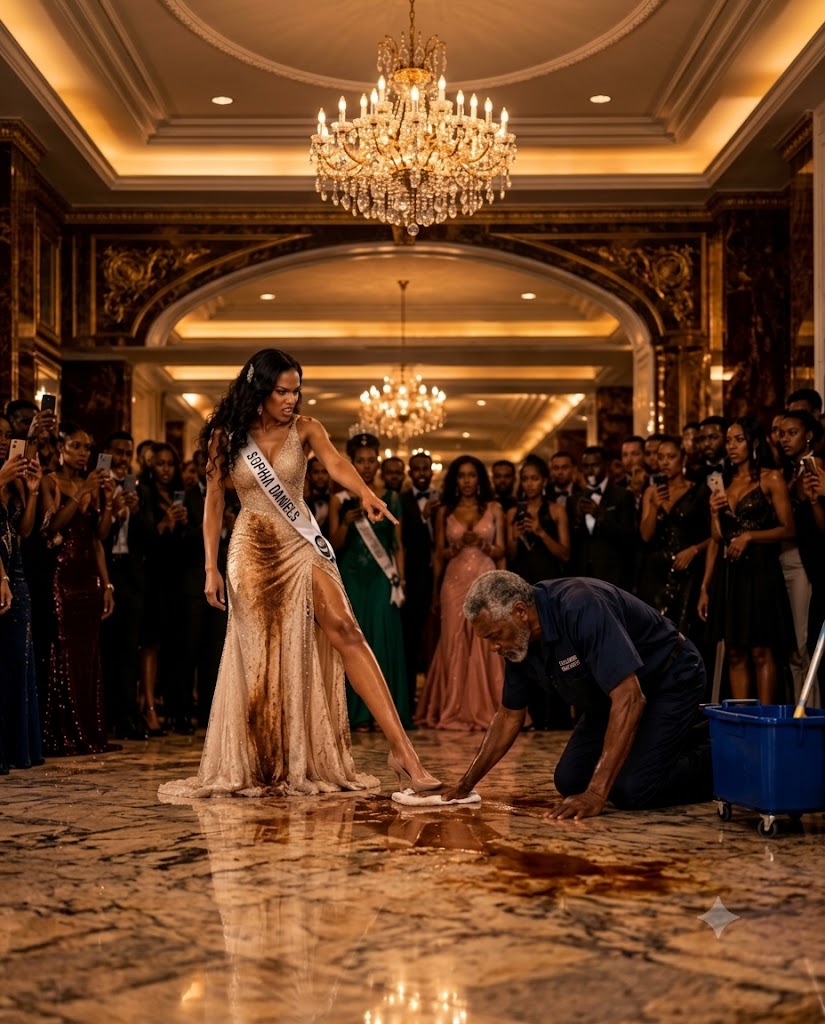
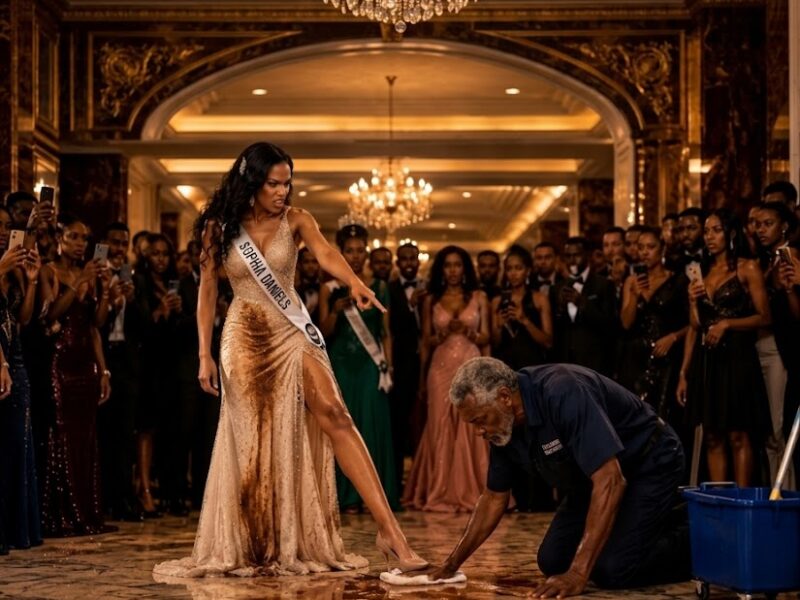
The university hall smelled like old wood and fresh floor wax, the kind of institutional scent that clung to your clothes long after you left. I was on my knees, scrubbing a scuff mark off the baseboard with a rag that had seen better days, when a shadow fell over the polished tiles in front of me. A pair of designer heels stopped inches from my bucket, and a voice sharp enough to cut glass sliced through the quiet afternoon.
“Look what you’ve DONE TO MY DRESS DRESS. DO YOU EVEN KNOW HOW MUCH this costs? Hmm?” I looked up, squinting against the light from the tall windows. It was one of the students, a girl with perfect hair and a face twisted in disgust. I hadn’t even seen her coming. My cart must have brushed against her as she swept past, and a single drop of cleaning solution had landed on the hem of her expensive gown. “I’m very sorry, ma’am,” I said, my voice low and steady. I’d learned long ago not to argue with the ones who wore their money like armor.
“Yes. You did it on purpose to ruin my dress, you old man.” She spat the words at me like they were poison. Her friends giggled behind her, a chorus of cruel laughter that echoed off the high ceilings. I said nothing, just kept my eyes on the floor, hoping she would tire of her game and move on. But she wasn’t done. “Yes! Look at what you’ve done to me. You’re just a filthy cleaner.” The words hung in the air, thick and ugly, and I felt the familiar sting of shame mixed with a weary resignation. Another voice, softer, tried to intervene. “Sophia, please stop.” But Sophia was a storm that would not be calmed. She turned on her friend with a glare that could freeze water. “You did it on purpose to ruin my dress, you old man.” She was repeating herself now, her rage eating its own tail.
On the far side of the hall, a cluster of students had stopped to watch. “Did she really just do that?” one of them whispered, loud enough for everyone to hear. “I can’t believe she treated him like that,” another replied, shaking her head. “He didn’t even say anything to her. Someone should help him.” But no one moved. They were spectators at a gladiator match, morbidly fascinated by the cruelty on display. “She’s gone too far,” a third voice added. The consensus was clear, but the courage to act was absent.
Then the energy in the room shifted. It was a subtle thing, a ripple that started near the main doors and spread through the crowd. “Who is that?” a girl near the front murmured. “I don’t know, but someone important just arrived.” The doors had opened, and a man in a sharp suit walked in, flanked by two others with the unmistakable posture of private security. He wasn’t looking at the crowd. He was looking at me. “This must be someone important,” someone else said. “Who are they? They look like security for someone very important.” The whispers grew into a low hum. “Wow.”
The man in the suit walked straight past the stunned students, past a now-silent Sophia, and stopped directly in front of my cleaning cart. He looked down at me, and his eyes, the same gray as my own, softened. “Mr. Lawson, welcome to Crestview University,” a flustered administrator stammered, hurrying to catch up. “Thank you,” the man said, his voice calm and commanding. “Why does he look like he’s searching for someone?” a student asked. The man’s gaze never left my face. “Dad,” he said, his voice thick with an emotion I hadn’t heard in years. My son. My boy. The one I hadn’t seen since he left for the States with a scholarship and a promise to change the world. The one I had told not to look back, because I didn’t want him to see his father on his knees.
“Dad,” he said again, and this time he knelt down, right there on the freshly polished floor, and pulled me into an embrace. The hall went dead silent. You could have heard a pin drop. He pulled back, his hands on my shoulders, and looked at me with a fierce pride that made my old heart ache. He then stood up and turned to face the crowd, his expression hardening as his eyes landed on Sophia. “Yes, this cleaner is my father,” he announced, his voice carrying to every corner of the hall. “So, this is the kind of students you have here. Who have no respect and empathy and so full of themselves.” Sophia’s face had gone the color of sour milk. “I’m sorry, sir,” she whispered, her voice trembling. “I didn’t mean to. I was just… angry.”
My son didn’t even look at her. He helped me to my feet, took the rag from my hand, and dropped it into the bucket. “Your shift is over, Dad,” he said quietly, just for me. “Let’s go home.” As we walked out, past the silent, staring crowd, past a trembling Sophia, I heard one of the students whisper, “That’s Ethan Lawson. He just came back from the United States. He’s one of the youngest billionaires in the country.” The doors closed behind us, shutting out the world of polished floors and sharp words. I had been invisible to them, a piece of the furniture. Now, I was the father of the man they all wanted to know. And the dress that had caused all the trouble? It was a custom piece from a boutique on Rodeo Drive, worth more than my monthly salary. A fact that no longer mattered, because my son had just bought the entire building we were standing in. He told me so in the car. He’d done it to make sure I never had to scrub another floor for anyone ever again.
That night, we sat on the balcony of his penthouse, the city lights spread out before us like a carpet of stars. He told me about his company, a tech firm worth $4.7 billion, and the foundation he’d started to help veterans and their families. He told me he’d been searching for me for three years, ever since he’d made his first million. “I hired a private investigator,” he admitted, a hint of a smile on his face. “He found you in two weeks. I was just… scared to come back. Scared you’d be disappointed in me.” I laughed, a real laugh, the first one in a long time. “Disappointed? Son, I’ve never been more proud of anyone in my life.” He was quiet for a moment, then he said the words that would change everything. “I’m getting married, Dad. Her name is Cara. She’s a student at Crestview. She was the only one who was kind to you. I saw her bring you food. I saw her stand up for you against Sophia. I want you to meet her.”
The next few months were a whirlwind. I moved out of my small apartment and into a guest suite in Ethan’s mansion. Cara came over for dinner the very next week. She was even kinder than I remembered, with a smile that could light up a room and a heart as big as the ocean. She didn’t treat me like a billionaire’s father; she treated me like a person, like family. She asked about my day, my hobbies, my favorite books. She listened. One evening, as we were sitting in the garden, she confided in me about Sophia. “She’s been my friend since we were kids,” she said, her voice sad. “But she’s changed. The money, the pageant… it’s like it brought out a darkness in her. She threatened to ruin my engagement. She said I stole Ethan from her, that the crown was supposed to be hers.” I nodded, thinking of the sharp-tongued girl in the hallway. “Some people,” I said, “mistake cruelty for strength. They think that because they have money, they can buy anything. They don’t realize that kindness is the only currency that matters.”
The wedding was set for a beautiful June afternoon at a vineyard in Napa Valley. It was a small ceremony, just family and close friends. Cara was a vision in white, her smile radiant as she walked down the aisle. Ethan looked at her like she was the only person in the world. And when the judge asked if anyone had any objections, the silence was perfect, until a rustle from the back row broke the spell. It was Sophia. She was wearing a black dress, a stark contrast to the sea of pastels and florals. She looked like a storm cloud in a garden of roses. “Cara, you look beautiful,” she said, her voice saccharine sweet. “Thank you. I’m so happy you’re here,” Cara replied, her grace unwavering. But Sophia was already moving, a glass of champagne in her hand. “Here is your drink, my bride-to-be,” she said, offering it to Cara with a smile that didn’t reach her eyes.
I saw it then. A tiny flicker of movement, a drop of something clear falling from Sophia’s hand into the glass. My heart stopped. I was on my feet before I even knew what I was doing. “No! Don’t drink it, Cara!” I shouted, my voice cutting through the quiet music. Everyone turned to look at me. Sophia froze, her eyes wide with panic. “I saw everything you did,” I said, my voice trembling with a rage I hadn’t felt in years. “You put something in her drink. You wanted to poison her.” The glass fell from Cara’s hand and shattered on the ground, the amber liquid mixing with the dirt. Sophia’s face crumpled. “It is a lie!” she screamed, but her voice was cracking. “I saw you,” I repeated, my voice stronger now. “You’ve let jealousy and hatred consume you. You tried to hurt the one person who ever truly loved you.”
The police were called. It wasn’t a 911 emergency, but the local Napa County sheriff’s office was quick to respond. Sophia was taken into custody, her black dress rustling as she was led away in handcuffs. She was later charged with attempted poisoning, a felony that could carry a sentence of up to five years in state prison. The evidence was clear; a security camera had captured the entire incident from a mounted post near the ceremony tent. Her life, as she knew it, was over. The pageant crown she had so desperately wanted was now a tarnished memory, and the billionaire she had coveted was standing with his arm around the woman she had tried to kill.
The aftermath was a quiet, gentle thing. Ethan and Cara went on a long honeymoon to a private island in the Maldives. I went back to the mansion and spent my days reading in the garden, or walking the grounds with the dogs. It was a life I could have never imagined, a world of privilege and comfort. But what I valued most was the respect I received. Not because I was Ethan Lawson’s father, but because I had earned it through a lifetime of quiet decency. Cara and Ethan returned, and our family grew. Cara was pregnant within a year, and I became a grandfather to a little girl with her mother’s smile and her father’s gray eyes. They named her Grace, after the grace that had saved Cara’s life and brought us all together.
One afternoon, I was sitting in the garden, watching Grace chase butterflies, when a familiar face appeared at the gate. It was Sophia. She looked older, her spirit diminished, her eyes hollow. She had been released early for good behavior after serving three years. “Mr. Lawson,” she said, her voice a whisper. “I came to apologize. To you, to Cara, to everyone. I was… sick. Consumed by a sickness I couldn’t see.” I looked at her, this girl who had once spat on me, who had tried to destroy my son’s happiness. And I felt nothing but pity. “Sophia,” I said, my voice gentle. “The hardest part of forgiveness is accepting that you don’t deserve it. But that’s exactly when you need it the most.” She nodded, tears streaming down her face. “Can I see Cara? Please?” I shook my head. “She’s not ready. Maybe someday. But for now, you need to focus on your own journey. Find a way to be kind, to yourself and to others. That’s the only path forward.” She left, a broken woman, but with a flicker of hope in her eyes. I watched her go, and I thought about the dress, the one that had started it all. A dress that had cost more than my monthly salary. A dress that had been the catalyst for a chain of events that had destroyed one life and saved another. In the end, it wasn’t the dress that mattered. It was the hearts of those who wore it, and those who didn’t. And the greatest fortune I ever found wasn’t the billions my son had earned, but the kindness he had held onto in a world that so often demanded cruelty. It was the kind of fortune that couldn’t be bought, only built. And it was worth more than any dress, any crown, any kingdom on earth.









