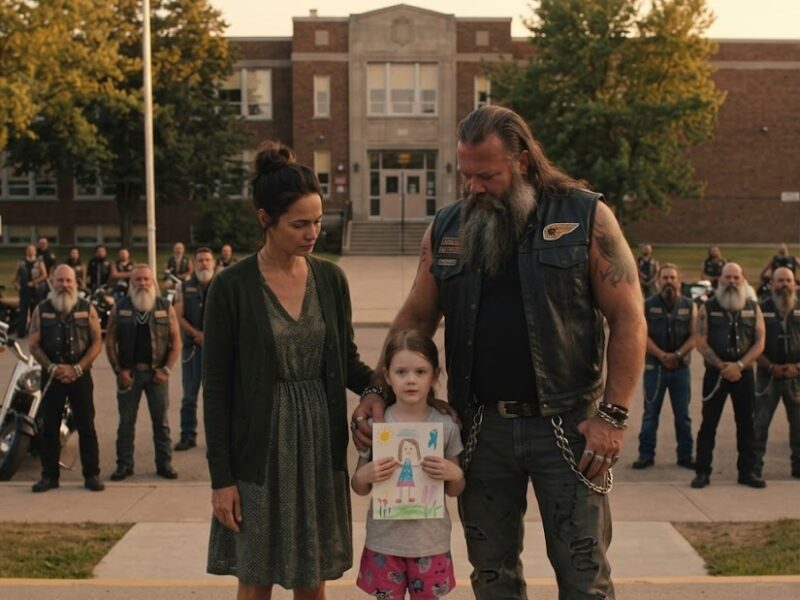
“She Hasn’t Spoken in a Week,” the Teacher Told Her Hells Angels Father—Then He Saw the Note Hidden in Her Backpack
Poppy Halverson had not spoken a single word in Mrs. Kepler’s seventh grade classroom in six days.
And by the seventh morning, when Poppy flinched at the sound of her own name being called for attendance, Mrs. Kepler decided she had waited long enough to find out why.
She had tried the ordinary channels first.
A gentle question after class. A note home in Poppy’s folder. A conversation with the school counselor that yielded concern but no real answers.
Poppy had not eaten lunch in the cafeteria all week, had stopped raising her hand entirely, and had started flinching at sounds that would not have registered with her two weeks earlier.
She had, on the third day, stopped making eye contact with anyone in the room at all. Staring instead at a fixed point on her desk for the better part of a fifty-minute period.
And Mrs. Kepler had begun keeping a private log of the changes. Dated. Specific.
The kind of documentation a nineteen-year veteran teacher keeps when instinct tells her something before proof does.
Mrs. Kepler had taught middle school for nineteen years.
She knew the difference between a bad week and something considerably worse hiding underneath one.
She called Poppy’s father that afternoon.
A man named Jack Halverson, whose contact card in the school system listed, under emergency information, a single line that read plainly, “Hells Angels MC will answer any hour.”
What Jack found out over the following forty-eight hours, because a middle school English teacher trusted her own instincts over a full week of watching a twelve-year-old go quiet, in exactly the way children go quiet when something is wrong, was not something either of them expected when that phone call began.
Jack Halverson was forty-one, a Hells Angel for nineteen years, and had been raising Poppy alone since his wife Renee died of an aggressive cancer three years earlier.
Six months after the diagnosis first arrived, and considerably faster than either of them had let themselves believe possible until it was nearly over, he ran a small welding shop on the edge of town that let him keep hours flexible enough to be home most nights for dinner.
A schedule he had rearranged his entire professional life around the year Renee died.
Because a father with a dead wife and a nine-year-old daughter does not get to treat flexibility as optional.
He remembered with a clarity he wished would fade, the specific week Renee’s decline had gone from manageable to undeniable, and the way Poppy, only nine at the time, had gone quiet in a manner he had assumed then was simple childhood confusion, and understood years later was actually the first version of exactly the silence he was watching her fall into again now.
He had promised himself at Renee’s funeral that he would learn to see it coming the second time.
That promise sat heavier on him now than almost anything else about this whole ordeal.
He had built in three years a version of fatherhood he was reasonably proud of.
He braided Poppy’s hair badly but consistently every morning before school, knew her class schedule better than she sometimes did, and had never once missed a single school event despite a chapter that occasionally needed him elsewhere.
His brothers had, more than once, covered a shift or rearranged a run so Jack could make a school play or a parent-teacher conference, an accommodation none of them treated as remarkable, only as the ordinary cost of being part of something that took its obligations to each other seriously.
He had gotten good, he thought, at reading his daughter’s moods, at knowing the difference between an ordinary bad day and the particular quiet that meant something was actually wrong.
He had not caught this one.
That fact would sit with him uncomfortably for considerably longer than the crisis itself eventually lasted.
He answered Mrs. Kepler’s call on the second ring, standing in the middle of his shop with a half-finished weld cooling on the table behind him, and left work early enough that he was standing in the school’s front office before Mrs. Kepler had finished explaining the full week’s worth of changes she’d observed.
He had not bothered changing out of his work clothes or his cut, a detail the front office secretary would later mention had made her nervous for exactly as long as it took her to see the expression on his face, which had nothing to do with anger toward anyone in that building and everything to do with fear for his own daughter.
Before we get to what Jack found out, if this is your first time here, go ahead and hit subscribe so this story doesn’t get lost in the feed, and drop your city or state down in the comments below.
I read every single one, and it means more than you guess to see how far a story like this can travel.
Now, back to the school office on that Thursday afternoon, because whatever had made Poppy Halverson go silent for an entire week was about to matter a great deal more than anyone in that building yet understood.
Poppy was twelve, quiet by temperament even before any of this started, the kind of kid who preferred a good book to a loud recess, and had inherited her mother’s specific, careful way of choosing words before she used them.
She still, three years on, kept a small photo of Renee taped inside her locker door, and still marked the anniversary of her mother’s death every year by baking the one recipe Renee had taught her before she got too sick to stand in the kitchen for long.
She had two close friends, Maya and Diane, who she had not so much as texted in a week, a fact both girls had noticed and, out of the specific helplessness of twelve-year-olds watching a friend pull away, had not known how to address directly.
The trouble had started two months earlier, slowly, the way these things often do.
A comment here, a shove in the hallway there, a group of three eighth-graders led by a boy named Brody Kessinger, who had decided, for reasons Poppy never fully understood, that she made an easy target.
Brody was thirteen, larger than most of his classmates, and had a reputation among the seventh and eighth grade alike for finding exactly the soft spot in whoever he decided to target that week.
He had settled on Poppy sometime in early autumn, perhaps because her quietness read to him as an absence of anyone who would push back, perhaps for no reason more considered than that.
It had escalated two weeks before Mrs. Kepler’s phone call in the girls’ bathroom during lunch, when Brody’s group had cornered her and one of them had said something cruel enough about her dead mother that Poppy’s careful composure had finally broken entirely into the kind of crying that a twelve-year-old does not recover from quickly in a school bathroom.
She had stood there afterward, alone, splashing cold water on her face for several minutes before she trusted herself to walk back into the hallway looking like nothing had happened at all.
Someone had filmed it.
Brody had made that clear to her within the hour, showing her the video on his phone with the specific casual cruelty of a boy who had not yet learned there was any limit to what he could get away with.
And had told her that unless she brought him five dollars a day from her lunch money and did his math homework besides, the video would go into the eighth grade group chat by Friday.
Poppy had believed him completely.
She had seen what that group chat did to other kids’ reputations before. Seen how fast something humiliating could spread once it left one phone for a dozen others.
And had decided within the same hour that paying him was the only version of this she could survive.
Poppy had not told anyone.
She had not told her father, certain in the specific twisted logic of ashamed twelve-year-old that seeing the video would hurt him considerably more than any of the rest of it.
And that somehow the humiliation was hers to carry alone rather than his to help with.
She had stopped eating lunch to have five dollars ready each day.
Telling herself she wasn’t especially hungry most days anyway. A lie that had gotten easier to believe the less she actually ate.
She had stopped talking almost entirely in class or anywhere else because talking felt like it might crack the careful control she was using to keep from crying again in front of anyone who might film it a second time.
Jack sat with Mrs. Kepler and the school counselor for twenty minutes before anyone thought to ask Poppy directly in a private room without an audience what had actually happened.
Poppy did not answer at first.
She sat with her hands in her lap, trembling slightly. The same careful stillness Jack recognized from the worst weeks of Renee’s illness.
And it was that recognition, the specific fear of watching his daughter disappear into herself the way he had once watched his wife disappear into a hospital bed that finally made him say the thing that broke through.
“Whatever it is,” Jack said, “you’re not in trouble. I promise you that first, before anything else.”
Poppy froze for a moment, her eyes darting to the door as if checking whether anyone else might hear, and then her composure broke completely, and the whole story came out in pieces between the crying, the bathroom, the video, the money, the two months of small cruelties that had led up to it, the specific fear that her father seeing what had happened to her would somehow make it more real than it already was.
“I didn’t want you to see it,” Poppy whispered, her voice barely audible. “I didn’t want you to have to know that happened to me.”
Jack’s hands had gone cold holding his daughter while she cried, a fury building in him that he recognized distantly as considerably more dangerous than anything useful, and he made himself set it aside long enough to do what the moment actually required, which was not fury, but steadiness.
He held her until her breathing evened out, and only then did he ask, gently, whether she felt ready to tell the school counselor and Dr. Osai the same thing she told him a moment earlier, promising he would stay in the room the entire time if she wanted him to.
“Will you be mad at me?” Poppy asked, still not looking at him directly.
“I could never be mad at you for this,” Jack said. “Only mad that I didn’t catch it sooner. That one’s mine to carry, not yours.”
The school’s investigation moved fast once Poppy’s account gave them somewhere concrete to start.
Two other students, once asked directly, confirmed the extortion had been happening for weeks.
One of them describing having witnessed the bathroom incident firsthand and having stayed silent out of the same fear Poppy had been carrying alone. Afraid, in her case, that speaking up would redirect Brody’s attention toward her instead.
The video itself was traced to Brody’s phone, still saved, never actually sent to the group chat.
A detail the principal noted mattered less than the fact that its existence alone had been sufficient to control a child’s entire week.
The principal, a woman named Dr. Osai, who had run the school for eleven years, told Jack privately that this was not the first time Brody’s name had come up in a concerning context.
Though it was the first time anything had risen to a level the school felt it could act on decisively.
She promised a full review of the previous incidents alongside this one. A promise Jack appreciated without fully trusting yet, given how the previous incidents had apparently gone nowhere on their own.
Russ Kessinger, Brody’s father, did not take the meeting well.
He arrived at the school two days later, loud and defensive, insisting his son wasn’t like that. Accusing the school of overreacting to what he called normal kid stuff, and directing most of his frustration at Jack personally once he learned who Poppy’s father was.
“You people always want to make everything into a bigger deal than it is,” Russ said in a conference room with the principal, two teachers, and Jack all present as witnesses. “Kids tease each other. Always have.”
“Your son filmed a twelve-year-old having a breakdown over her dead mother and used it to extort her lunch money for two weeks,” Jack said, his even despite everything underneath it. “That’s not teasing. That’s the kind of thing that follows a kid the rest of her life if nobody stops it.”
“You’re going to lecture me about parenting?”
“Not lecturing,” Jack said. “Telling you what the video shows since the school already has it, and since I imagine you’d rather hear it from me in this room than from a lawyer somewhere considerably less friendly.”
“Is that a threat?”
“It’s a fact,” Jack said. “Extortion of a minor is a considerably bigger legal problem than a school suspension, and I’d rather this stay something the school handles than something that ends up costing your son a lot more than two weeks. Your choice which direction we go from here.”
Russ did not have much of an answer for that.
Dr. Osai, watching the exchange, later told Jack privately that it was the first time in the meeting Russ’s face had actually changed.
The specific shift of a man realizing the consequences on the table were real rather than a negotiating position.
The school suspended Brody for two weeks, mandated counseling as a condition of his return, and confirmed the video had been permanently deleted from every device it had touched.
With Russ considerably quieter by the meeting’s end, agreeing to monitor his son’s phone use going forward as part of the resolution.
None of that, Jack understood, was going to be the part that actually helped Poppy find her voice again.
That part took longer and looked less like accountability and more like patience.
He called his chapter that same week.
Not for retaliation, but for something considerably more useful.
His brothers had among them a retired school counselor, two members who had raised daughters through their own share of middle school cruelty and a collective willingness to show up in whatever way Poppy actually needed rather than whatever felt most satisfying to the adults around her.
One member a woman named Dana who had lost her own mother young spent an afternoon sitting with Poppy in the shop’s back office while Jack worked.
Not offering advice so much as company. The specific gift of someone who understood a particular grief without needing it explained.
Dana brought her own mother’s recipe box that afternoon and the two of them spent an hour comparing notes on the specific ache of baking something from a handwritten card in a dead parent’s own handwriting.
A conversation Poppy would later say made her feel less strange for still marking her mother’s anniversary the exact way she always had.
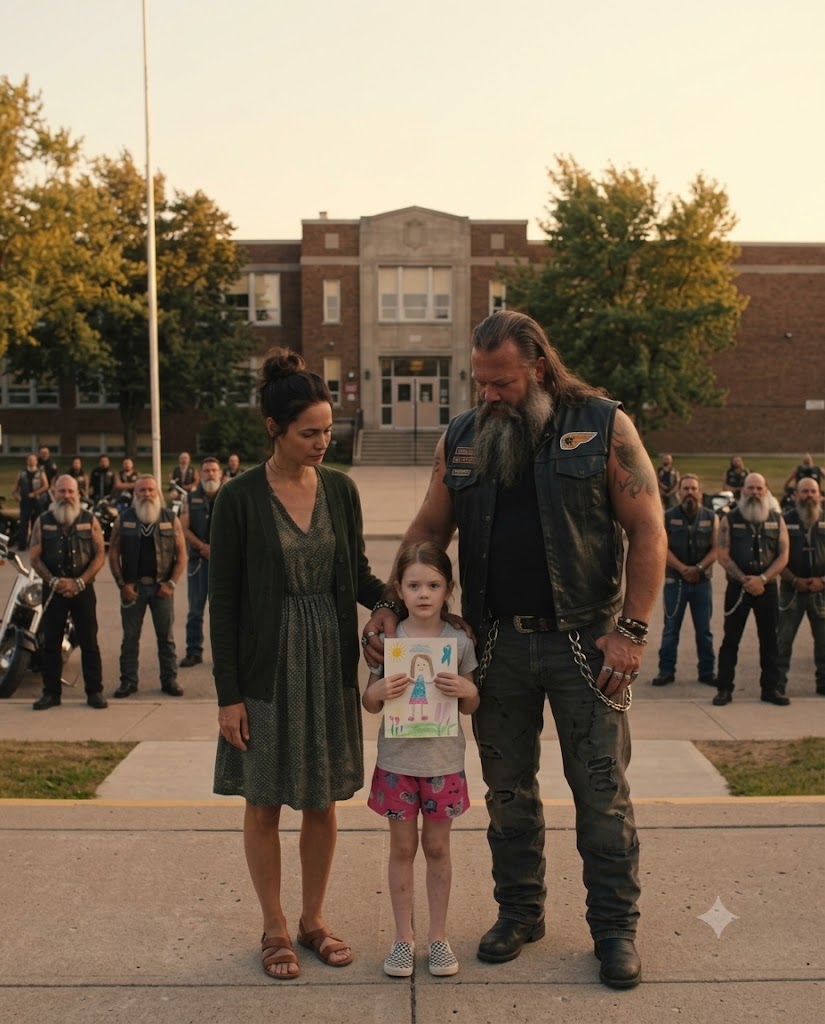
Three weeks later on the day Poppy finally agreed to eat lunch in the cafeteria again instead of hiding in the library. Twenty-two motorcycles escorted her to school instead of Jack’s usual truck.
Not to intimidate anyone.
But because Poppy had mentioned once in an offhand way to her father that she thought it might feel good to walk in somewhere for once feeling like the whole world had her back instead of her dad alone.
She had said it almost as a joke. Testing whether it was a ridiculous thing to want and Jack had taken it considerably more seriously than she expected him to.
Engines.
That was the sound the whole seventh grade hallway heard before the first bell.
Twenty-two bikes idling in the school’s front loop while Jack walked his daughter to the door himself flanked by riders who said nothing to any of the students inside beyond a friendly nod.
There for exactly one reason and making no effort to hide it.
Maya and Diane were waiting inside the doors having been quietly tipped off by Mrs. Kepler the night before, and fell into step beside Poppy the moment she crossed the threshold, the three of them walking to homeroom together for the first time in a month.
Poppy walked into that building that morning and for the first time in three weeks did not flinch at the sound of her own name when the teacher called attendance.
She still keeps that photo of her mother taped inside her locker door.
She has started talking in class again, tentatively at first, and then, as the months passed, with something closer to her ordinary quiet confidence.
She rejoined the school’s book club in the fall, the first extracurricular thing she’d signed up for since the trouble started, and has begun, slowly, trusting Maya and Diane with a kind of small daily details she had stopped sharing with anyone during the worst of it.
She and her father have an agreement now, one they built together in the weeks after that meeting with Russ Kessinger, that whatever happens, whatever feels too big or too embarrassing to say, she tells him first, and he promises every time to make it smaller rather than bigger by knowing about it.
They have tested that agreement twice since, both times over considerably smaller things than what started it, and both times Jack made a point of thanking her for testing it at all.
Mrs. Kepler still checks in with her most mornings, a habit that has outlasted the crisis that started it, because some teachers, it turns out, do not stop paying attention once the immediate danger passes.
“Thank you for calling my dad,” Poppy whispered to her weeks later, the first time she managed to say it out loud without her voice catching.
“Thank you for letting me notice,” Mrs. Kepler said. “That part was yours to allow, and you didn’t have to.”
If this story reached you, if you believe a child’s silence is sometimes the loudest thing in the room, if you know how to listen for it, share it with someone who needs the reminder that noticing early can matter as much as any rescue that comes later.
Subscribe so you never miss the next one.
And down in the comments, tell me where you’re watching from tonight, and whether a teacher ever noticed something in you before you knew how to say it yourself.
And if you believe Poppy deserved every one of those twenty-two engines that walked her to school that morning, type heard below so she knows it reached you, too.









