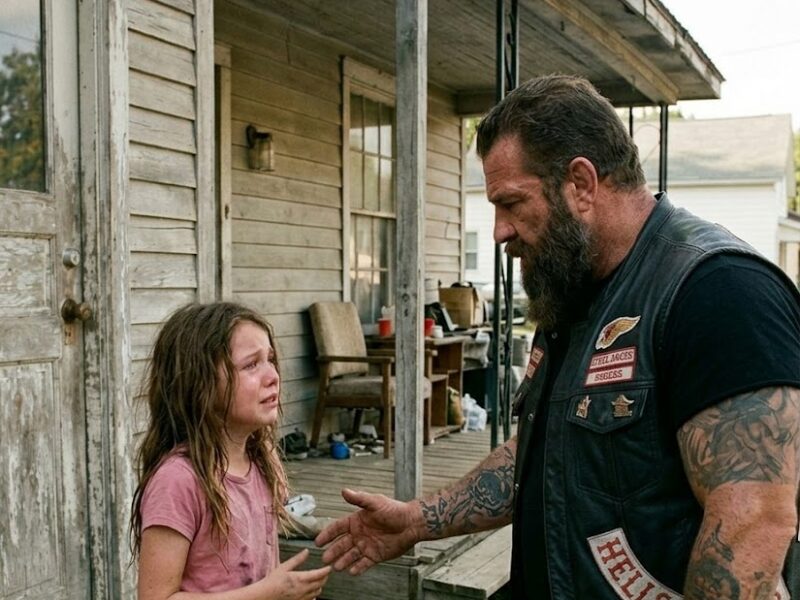
“She hasn’t come out of that room in four days,” the girl whispered at the door. The biker didn’t wait for an explanation—he broke it down.
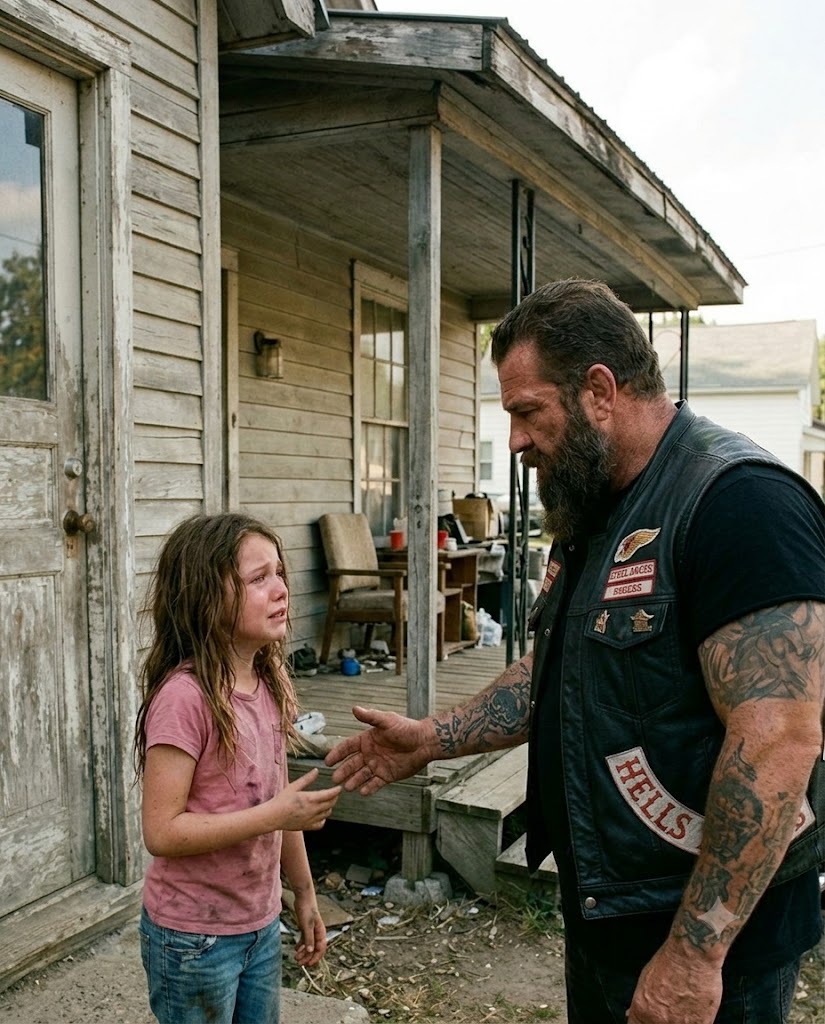
Four days. That’s how long the sound behind my mother’s bedroom door had lasted before it turned into something I couldn’t name. Slow, dragging, like someone pulling breath through a straw.
I was eleven years old, standing in a dark hallway with a peanut butter sandwich going stale at my feet, and every adult I had begged for help had already looked me in the eye and sent me home. The deputy left. The neighbor shut her door. The deacon said he would pray on it. So I did the one thing I had been warned my whole life never to do.
I walked through the rain to the house of the man everyone feared, and I knocked.
The first thing Nicholas Walker noticed was that the knock was too small to be a grown person’s. It came at 6:40 on a Thursday evening in late October. Three soft wraps against the screen door, and then nothing.
Nicholas was at the workbench in his garage with the side door propped open, a carburetor in pieces across a shop towel, a cup of coffee going cold at his elbow. Rain had been falling on Sparta, Tennessee, since noon, the thin, cold kind that settled into the hollows and stayed. He wiped his hands on a rag and stood, and his knees reminded him he was fifty-four.
A girl stood on the concrete apron just outside the light. She was maybe ten or eleven, thin as a fence rail, her brown hair twisted into a braid that had started to come apart. Her pink backpack was patched at one corner with duct tape. She was soaked through and shaking, though he couldn’t tell if it was from the cold.
He knew her—not her name, but her face. She was the kid from the little rental house on Dutch Hollow Lane, three doors down from the corner. Last spring, she had walked her bicycle past his place with the chain hanging off, and he had fixed it in four minutes without saying much. She had tried to hand him a crumpled dollar. He had told her to buy herself something at the gas station.
“Mr. Walker.” Her voice cracked in the middle of his name.
“That’s me.”
She looked past him, at the Harley on its stand, at the leather vest hanging from a nail by the door, at the patch on the back that read IRON HOLLOW RIDERS in curved white letters. Every adult in town had warned her about exactly this man. He could see her remembering it. He could see her deciding anyway.
“My name is Natalie,” she said. “Natalie Hayes. I live on Dutch Hollow. My mom hasn’t come out of her room in four days.”
Nicholas didn’t say anything. He set the rag down on the bench very slowly, the way you move around a skittish animal.
“I told Mrs. Puit,” Natalie said. The words came faster now, like water through a broken dam. “She said mothers need their rest, and I shouldn’t bother grown folks with family business. I told Mr. Whitaker at the church, and he said he’d pray on it. I called the sheriff’s office on Sunday, and a deputy came and knocked, and Mom said she was fine through the door, and he left. But she’s not fine. She stopped talking yesterday. I’ve been knocking and knocking and she doesn’t answer anymore. I can hear her breathing, kind of. It’s a weird sound. It’s like—”
She stopped and pressed her lips together. “I didn’t know who else to ask. Everybody says you’re dangerous, but you fixed my bike and you didn’t want the dollar.”
He had lived fifty-four years in this county and had been called a lot of things. Hoodlum. Gang member. Trouble. He had once been asked to leave a diner because other customers felt uneasy. He had been a mechanic for thirty years, had buried a wife, and had never raised a hand to anyone who hadn’t raised one first. None of that was written on the vest. The vest only said what it said. None of that mattered right now.
“Natalie,” he said, keeping his voice low and level. “Is the door to her room locked?”
“Yes, sir, from inside. It’s the push-button kind.”
“Has she been eating? Drinking? Does she have any sickness you know about?”
Natalie hesitated, and something crossed her face that looked a lot like fear of saying the wrong thing. “She’s got diabetes. The kind where you take shots.” She said the pharmacy wanted too much money since her mom lost her job at the nursing home, and she was making the medicine last. “She said not to worry. She said it would stretch.”
The air in the garage seemed to change. Nicholas didn’t know all the medical words. He knew enough to understand that four days was far too long.
“Okay,” he said. “Here’s what we’re going to do. I’m going to grab a few things, and then we’re going to walk to your house. Walking is faster than starting the truck, and the rain isn’t going to hurt either one of us. Does that sound all right?”
She nodded hard.
He took his phone from the bench, tucked his keys in his pocket, and pulled a flat pry bar and a heavy flashlight from the pegboard. He saw her eyes follow the pry bar.
“For the door,” he said. “I’m not going to hurt anybody, Natalie. I need you to hear me say that.”
“I know,” she said, then quieter: “I think I knew when I knocked.”
He pulled the garage door down behind them and left the lights burning. The vest stayed on its nail by the door. In a canvas work jacket, he looked like what he was—a big, tired, gray-bearded man who needed a haircut. He didn’t know whether that would help. He suspected it wouldn’t with the neighbors, who were already watching because they were watching.
As the two of them stepped onto Dutch Hollow Lane, a curtain moved across the street and a porch light flicked on two houses down. A shape stood motionless behind the glass. Dolores Puit, seventy-three years old, who had called the sheriff on Nicholas twice—once for parking on the shoulder and once for loitering—was watching a man in a work jacket walk a child through the rain. He could almost hear her thinking it.
Natalie’s small, cold hand found his sleeve and held on.
“Four days,” Nicholas said, mostly to himself. “Okay. Let’s go.”
The house on Dutch Hollow Lane was the smallest on the street—a gray rental with a sagging porch and a window air conditioner that had been dead since August. The yard had gone to weeds. The mailbox was so stuffed that envelopes had slid out onto the grass and swollen in the rain. Every other porch on the lane wore its October decorations: plastic skeletons and orange lights and a hay bale with a scarecrow. Natalie’s porch wore nothing. The porch light was off.
She dug a key out from under a cracked flower pot with fingers that wouldn’t stop trembling. Inside, the air was cold and stale. The heat had been turned down to nothing. Nicholas followed her through a living room where a single lamp burned and into a kitchen that told him everything about the last four days. Cereal boxes stood open on the counter. A jar of peanut butter sat beside a knife. A loaf of bread had gone hard at the edges. A school permission slip hung on the refrigerator under a magnet shaped like a strawberry. And beside the toaster, in a neat column of handwriting, was a list.
*Insulin 412. Rent 650. Electric 140.*
Under it, in a different pen, one word underlined twice: *Wait.*
Nicholas read it once and felt his jaw tighten. “Which room?” he asked.
Natalie pointed down the narrow hallway. A single white door stood at the end, a child’s drawing of a sunflower taped to it at the height of a sixth grader’s shoulder. Beneath the drawing, she had stuck a note that said, in careful pencil: *Mom, I made you a sandwich. It’s on the floor. Please eat.*
The plate sat in front of the door, the bread curled and dry. His chest tightened. He knocked three firm wraps and kept his voice gentle.
“Mrs. Hayes, my name is Nicholas Walker. Natalie asked me to check on you. Can you hear me?”
Nothing. He knelt, his bad knee cracking, and pressed his ear to the wood. He heard it then—the sound Natalie had tried to describe. Breathing, but wrong. Deep and slow and heavy. Each breath dragged in and pushed out like someone working a pump. And from the gap beneath the door drifted a smell he had not smelled in thirty-seven years. Faint and sweet and sharp, like nail polish remover.
He knew that smell. When Nicholas was seventeen, his younger brother Danny had come home from football practice thirsty and sick, and by the next morning he was lying in his bedroom breathing exactly this way. Their mother had called the doctor. The doctor had said hours, not days. Danny had lived. Nicholas had never forgotten the smell of that room.
He stood and dialed 911 with a hand that was steadier than he felt.
“911. What’s the address of your emergency?”
“41 Dutch Hollow Lane, Sparta. I have an adult woman behind a locked bedroom door. She’s diabetic. She hasn’t been seen in four days. She’s not answering, and she’s breathing deep and fast with a sweet smell like acetone. I think she’s in diabetic ketoacidosis. I need an ambulance now.”
The dispatcher’s voice sharpened. She confirmed the address and told him units were on the way, ten to twelve minutes out at the edge of town.
“Sir, if you believe she’s in immediate danger and you can safely reach her, you may force the door. Don’t move her once you’re in. Stay on the line.”
“Yes, ma’am.”
He crouched in front of Natalie, who stood against the wall with her backpack still on, hugging the straps. “I need you to do something important. Go stand by the front door and watch for the ambulance. When you see the lights, wave them in. Can you do that?”
“Is she going to die?”
“The people coming are the best chance she has,” he said. “Go on. You’re the one who got us here. Go be their eyes.”
She went, though she looked back twice. He had just lifted the pry bar when the front door banged open and voices flooded the house.
“There he is. There he is, Gerald.”
Dolores Puit came down the hall first, small and fierce in a quilted coat, her gray hair pinned tight. Behind her, filling the narrow hallway, came Gerald Whitaker, sixty-one, deacon at the church on the square, owner of the insurance office next door to it, a man whose handshake and wristwatch were both firm and expensive. He wore a rain jacket over a pressed shirt and the expression of someone who had come to restore order.
“Walker,” Gerald said. “Put that down. You have no business in this house.”
“Mr. Whitaker, there’s a woman dying behind this door.”
“Rebecca Hayes is a grown woman who has made it clear she wishes to be left alone. Deputy Lel came out on Sunday, spoke with her, and was satisfied.” Gerald’s eyes moved over the pry bar, the flashlight, the bearded face. “We will wait for the sheriff.”
“I saw him walking that child down the street,” Dolores said, and her voice shook, though not from fear. “In the rain. A man like that—”
“Mom,” Nicholas said quietly. “Listen.”
He held up one hand and stood completely still. The hallway went silent. Rain tapped the roof, and through the white door came the sound—deep, slow, dragging, impossible to mistake for sleep. Dolores heard it. He watched it land on her face. Her mouth opened, then closed.
“That’s what a person sounds like when she’s running out of time,” Nicholas said. “I’m not asking permission.”
“That is a crime,” Gerald said weakly.
“Then write it down.”
He set the flat end of the pry bar against the frame beside the knob and leaned his weight into it. Wood groaned. Paint cracked. He reset the bar and drove it again, and the frame split with a sound like a rifle shot, and the lock tore free of the jamb. The door swung inward.
The room was dim and cold and smelled of sickness. A woman lay on the floor beside the bed in a tangle of blankets, thin and gray-faced, her lips cracked, her dark hair stuck to her forehead. Her eyes were half open and fixed on nothing. Her chest rose and fell in those terrible laboring pulls. A wastebasket by the bed was full. On the nightstand sat an empty insulin vial, a glucose meter, and a yellow legal pad. He could see the meter’s screen from the doorway. It didn’t show a number. It showed two letters: *HI.*
On the pad, in handwriting that grew shakier line by line, someone had written: *Nat, I’m just resting. Don’t come in. Mom loves you. Monday.*
Nicholas dropped to his knees beside her and found a pulse at her throat, fast and thin as thread. “Rebecca,” he said. “Rebecca, can you hear me? Your daughter sent me.”
Her eyelids fluttered. Her cracked lips parted, and a single word came out, almost no voice at all. “Nat.”
Behind him in the doorway, Dolores Puit had pressed both hands over her mouth. Gerald Whitaker stood perfectly still. Neither of them said a thing, and far down Dutch Hollow Lane, thin and rising, came the first sound of a siren.
The ambulance came up Dutch Hollow Lane with its lights throwing red and white across every wet porch on the street. Natalie ran out to the curb, waving both arms, and a sheriff’s cruiser was right behind it, rolling in so fast its tires threw a sheet of water over the gutter. Two paramedics came through the front door with a stretcher and a bag. The older one, a broad-shouldered man named Owen Bell with a gray mustache, took one look at the woman on the floor and started giving orders in a low, steady voice. A blood sugar check. An oxygen mask. A needle taped into the crook of her arm. A bag of fluid held up like a lantern.
Nicholas backed into the hallway to give them room and found the wall with his shoulders. That was where Deputy Travis Lel found him. Lel was thirty-two, tall, square-jawed, with a fresh haircut and the stiff posture of a man who had been taught procedure and trusted it. He came down the hall with one hand on his holster and saw what the neighbors had described to him on the porch: a splintered door frame, a pry bar on the carpet, and a large bearded stranger standing near an unconscious woman.
“Sir, step away from the door. Hands where I can see them.”
“Deputy, I’m the one who called—”
“Hands now.”
Nicholas raised his hands slowly. He had been here before—a hundred roadside stops, a hundred men who looked at his vest and saw a report already written. He did not argue. Arguing never worked. He let the deputy turn him toward the wall and heard the ratchet of the cuffs closing on his wrists, and he kept his voice level the whole time.
“The woman is diabetic. She’s in ketoacidosis. Ask the paramedics. The girl will tell you.”
“That’s him,” Gerald Whitaker said from the doorway, finding his voice again. “He forced that door with a crowbar. I told him to wait. We all did.”
“He had the child with him,” Dolores said. “He walked her down the street in the rain.”
“No,” said a voice from the front of the house, high and cracked and furious. “No, no, no.”
Natalie came down the hall at a run and threw herself between Nicholas and the deputy, small and soaking wet, her braid half undone. “He didn’t do anything. I went to him. I asked him. He’s the only one who came.”
“Honey,” Lel said, his tone softening. “I need you to step back.”
“Mom was dying and nobody believed me. You came on Sunday and you left.”
Lel flinched. It was small, but Nicholas saw it. Then the deputy took a breath and said, “Ma’am, can you take the girl outside?”
Dolores Puit reached for Natalie’s arm. The girl twisted free, and Dolores caught her again firmly, the way adults do when they’ve decided what’s best, and steered her toward the front door while Natalie screamed Nicholas’s name.
They sat him on the porch. Not in the cruiser. Not yet. Just on the top step under the sagging overhang, wrists cuffed behind him, rain blowing in sideways and soaking the knees of his jeans. Deputy Lel stood three feet away with a notebook, taking Gerald Whitaker’s statement. Gerald spoke smoothly and with great conviction. Nicholas had known him for twenty years, and Gerald had never once said hello to him in a parking lot.
He had learned a long time ago that the safest thing a man like him could do was leave other people’s business alone. Stay in the garage. Keep the vest on the nail. When you were already the story people told about danger, every kindness looked like a trick, and every mistake looked like a crime. He thought about his late wife, Carol, who had gone on attending the church that whispered about him long after he stopped, and whose funeral had left half the pews empty because half the town couldn’t forgive her choice of husband. He thought about how easy it would be to say nothing, give the deputy his statement, take whatever came, and go home to the quiet.
Then he thought of the sound behind the door. No. He would break that door a hundred times.
The front door opened and Owen Bell came out with his gloves off, rain dripping from his cap. His eyes went straight to the cuffs. “Deputy,” he said, “take those off.”
“Sir, we have a report of a forced entry—”
“I’ve got a woman in there whose blood is so acidic it’s shutting down her body. Her sugar’s too high for my meter to read. Another two hours and I’d be calling the coroner, not the hospital.” Bell’s voice stayed level, but his jaw was working. “Whoever got that door open bought her those two hours. I don’t care if he used his bare hands. Take them off.”
Lel looked at the paramedic. Then at the splintered frame, the pry bar, the wet bearded man on the step. He took out his key and unlocked the cuffs.
“You’re not under arrest,” he said stiffly. “But I need you to follow us to the hospital and give a full statement.”
“I’ll follow.” Nicholas rubbed his wrists. “The girl is going to want somebody.”
“She has neighbors,” Gerald said.
“She had neighbors on Sunday,” Nicholas said.
Nobody said anything to that.
They carried Rebecca Hayes out on the stretcher with the mask over her face and the IV bag swaying above her. Natalie broke free from Dolores a second time and ran to the side of the ambulance, and Owen Bell crouched down and told her something Nicholas couldn’t hear. She nodded fiercely. Then she turned her whole body around and looked straight across the yard at the big man on the porch step.
“Mr. Walker,” she called. “Are you coming?”
Every porch on Dutch Hollow Lane seemed to lean in and listen. He stood up. He walked to his truck in the rain without looking at anyone. Bell lifted Natalie into the front seat of the ambulance, and the doors closed, and the lights pulled away down the lane. Nicholas could feel the neighbors watching him go, and for the first time in a very long time, he did not care what they saw.
At the hospital, the doors hissed open on bright light and the smell of floor cleaner. A nurse took Natalie’s hand and led her to a chair. Twenty minutes later, a doctor in blue scrubs appeared in the waiting room—a gaunt woman with tired eyes and a badge that read DR. PATRICIA MOORE.
“Mrs. Hayes is in critical condition,” Dr. Moore said. “Her blood pH was below 7. Her kidneys are struggling. We’ve started fluids and insulin and moved her to intensive care. The next six hours will tell us whether we caught it in time.” She looked around the room. “Is there family here?”
Natalie stood. “I’m her family. I’m her only family. My dad died in the spring.”
Dr. Moore’s face changed. She lowered herself into a chair so she was eye level with the girl. The waiting room held Dolores Puit, who had followed in her own car and sat clutching her purse. It held Gerald Whitaker, jaw set. It held Deputy Lel standing awkwardly by the door with his notebook. It held a gray-bearded man in a wet canvas jacket.
Natalie looked at each of them in turn. Then she walked across the waiting room and sat down in the chair beside Nicholas Walker, folded her hands in her lap, and did not say a word.
For nearly an hour, nobody in the waiting room spoke. Rain ticked against the windows. A vending machine hummed. At a quarter to nine, Deputy Lel finally closed his notebook, walked to the middle of the room, and said in the careful voice of a man trying not to sound like he was in the wrong, “I need to understand how this happened. Mr. Whitaker, Mrs. Puit—Natalie says she came to both of you.”
Gerald straightened. “The girl came to me after services on Sunday. She was agitated, and I told her I’d pray on it. I’m not a physician, Deputy. A child said her mother was tired. Most mothers are.”
“Did you call anyone?”
“I assume the proper channels were being followed. She had called your office herself.”
Lel’s jaw tightened. “She did. I went out. I knocked.”
“And that was Natalie from her chair, her voice small but clear.
Lel looked at her and he did not look away. “And your mother said through the door that she was fine. She sounded calm. She said she had a migraine and wanted to sleep. I asked if she needed anything. She said no.” He swallowed. “Mrs. Puit had told me Rebecca Hayes was private and proud and didn’t like people in her business. I wrote that down. I left.”
“She told you she was fine because she didn’t want me to see her sick,” Natalie said. “She always says that. She says everything’s fine when it isn’t. Dad used to say it was her best quality and her worst.”
The room went still. Nicholas had been sitting with his forearms on his knees, silent, a statue in a wet jacket. Now he looked up at the girl. Her chin was lifted. Her eyes were red and dry and furious.
“There’s something else,” she said. “I wasn’t going to say it because Mom told me not to, but I don’t care anymore.” She turned to Gerald Whitaker. “Two weeks ago, Mom went to your church’s benevolence fund. She wore her good dress. She asked for help with the insulin until her unemployment came through. You told her to fill out a form and that the board would review it in November.”
Gerald’s face went pale, then rigid. “That is the process. We have procedures.”
“It was October,” Natalie said. “She was cutting her doses in half. She told me she could stretch it. She wrote it on her list. *Wait.* That’s what the paper said. *Wait.*”
Nicholas thought of the single word underlined twice on the kitchen counter and felt it land in his chest like a stone.
Dolores Puit made a small sound. She had been sitting very upright, purse in her lap, but now her shoulders began to shake. “I saw the mail,” she whispered. “On Tuesday. I saw it piling up and the lights were off, and I thought, *something is wrong in that house.*” She pressed her fingertips against her eyelids. “And then I saw that child walk into his garage on Thursday night, and I thought—I thought—”
“You thought I was the problem,” Nicholas said. He was not angry. His voice was only tired.
“I’ve called the sheriff on you twice,” Dolores said. “For parking your motorcycle on the shoulder. For standing near my fence. I’ve lived across from you for eleven years, and I have never once seen you do a thing to hurt anybody.” Tears ran down the soft lines of her face. “I called the sheriff on the one man on this street who would have come.”
Nobody spoke. The vending machine hummed.
“Mrs. Puit,” Lel said quietly, “the dispatch log shows something else. Natalie called our office on Sunday and again Wednesday night. The second call was logged as a welfare follow-up and set aside for the morning shift. Nobody got to it.” His face was rigid with shame. “I was the one who went on Sunday. I read the neighborhood instead of the door.”
Natalie stood. She walked into the middle of the room, small in a damp hoodie two sizes too big, and looked at the three adults who had each failed her.
“I knocked on a lot of doors,” she said. “Everybody told me not to bother the biker. Everyone said he was bad news, and I almost listened. I stood on my porch Thursday and I thought, *What if they’re right? What if he’s the dangerous one?* And then I thought, *Mom has been behind that door for four days, and all the people who are supposed to be safe haven’t done anything.*” Her voice cracked. “So I figured maybe safe wasn’t what I needed. I needed somebody who would come.”
She turned to Nicholas. “You came.”
Nobody in that room moved. Then Dr. Moore came through the double doors at a quick walk, and every head turned.
“Natalie Hayes?”
“Yes.”
“Your mother is awake.”
The breath went out of the girl in a rush. She swayed, and Nicholas was on his feet before he knew it, one big hand under her elbow steadying her.
“Her numbers are coming down. She’s not out of danger yet, but she’s responding. She’s confused, and she’s asking for you.” Dr. Moore smiled for the first time all night. “She also asked who got her door open. I told her I’d find out.”
Natalie looked up at Nicholas with enormous eyes. “Come with me.”
“Honey, that’s family—”
“Please. I’m not going in there alone, and you’re the one who came.”
He looked at Dr. Moore, who nodded once. So Nicholas Walker, fifty-four years old, with grease in the creases of his hands and rain still dripping from the hem of his jacket, followed an eleven-year-old girl through the double doors of an intensive care unit while the deacon, the neighbor, and the deputy stood in the waiting room and watched him go.
Rebecca Hayes lay propped on pillows under a tangle of tubes and monitors, her face the color of paper, her dark hair damp against the pillow. When Natalie reached the bed, her mother’s hand came up slowly, shakily, and found her daughter’s cheek.
“Nat,” she whispered. “I’m sorry. I’m so sorry, baby. I thought I could stretch it.”
“I know.” Natalie was crying openly now. “I know, Mom. I know.”
Rebecca’s eyes drifted past her daughter and settled on the large gray-bearded stranger standing in the doorway. She studied him for a long moment.
“You’re the man from the end of the street,” she said hoarsely. “The one with the motorcycle?”
“Yes, Mom. The nurse says you broke my door.”
“Yes, Mom. I’ll fix it.”
Rebecca Hayes, who had spent four days alone in a locked room and a month rationing the medicine that kept her alive, closed her eyes, and a tear slid out of one of them. “Thank you,” she said. “Thank you for listening to my little girl.”
Nicholas could not trust his voice. He nodded.
Rebecca Hayes spent three days in intensive care and four more on a regular floor. Dr. Moore told Natalie, with the plain honesty of someone who didn’t believe in softening things for children, that a few more hours would have been a very different conversation. Insulin, fluids, and careful monitoring did the rest. There was no miracle in it. There was only a door that opened in time.
On the second day, a hospital social worker named Susan Cross sat down beside the bed with a stack of forms. And for the first time in a year, someone explained to Rebecca that manufacturers ran assistance programs for insulin, that the state had a program she had never been told about, and that a clinic across the county charged by income. Rebecca listened with her hand pressed over her mouth.
“Nobody ever told me,” she kept saying. “Nobody ever said.”
Natalie stayed at Dolores Puit’s house those nights. The first evening she sat stiffly at the kitchen table and refused dinner. The second evening Dolores made grilled cheese without asking, set it down, and sat across from her in silence, and Natalie ate every bite. Neither of them said a word about it. Natalie slept with her backpack beside the pillow as if she might need to leave in a hurry, and Dolores left the hall light on. Some apologies don’t have words yet. They start with a sandwich.
On Saturday morning, Nicholas was in his garage with the door rolled up when a sheriff’s cruiser turned into his driveway. Deputy Lel got out in uniform, hat in hand. He stopped on the concrete apron—the same spot where Natalie had stood in the rain—and for a moment he only looked at it.
“Mr. Walker, I came to say something, and I haven’t figured out how.”
“Take your time.”
“I withdrew the report. The forced entry on Dutch Hollow is closed as a welfare response, and I filed a commendation recommendation, for what it’s worth.” Lel turned the hat in his hands. “I also wrote up our dispatch cue. Natalie’s second call sat in a folder until morning shift. The sheriff read it twice.” He drew a breath. “I put handcuffs on the man who saved that woman’s life because he looked like the thing I’d been trained to be afraid of. I’m sorry. I’d like to stop doing that. I don’t know how yet.”
Nicholas wiped his hands on a rag and considered him. “Start by knocking,” he said. “Then listen.” He cleared his throat. “Worked for the kid.”
Lel almost smiled. “Yes, sir.”
The next afternoon, a low rumble rolled down Dutch Hollow Lane. Neighbors came to their windows. Curtains twitched. Twenty-three motorcycles turned onto the street in a slow double column, chrome flashing in the thin October sun, and every porch went quiet. At the front rode Ray Dunmore, sixty years old, retired lineman, president of the Iron Hollow Riders for twenty-two years, a white-bearded man built like a barrel. Nicholas had called him Friday night. He hadn’t asked for anything. Ray had simply said, “What time?”
The bikes parked along the curb. Riders climbed off in leather and denim carrying toolboxes, a new solid-core door, a gallon of white paint, a window air conditioner still in its box, and a coffee can with a hand-lettered label: REBECCA’S INSULIN FUND. They did not knock on anyone’s door. They went to work. Within forty minutes, the splintered frame had been replaced, the door hung and painted, the porch swept, the weeds pulled. A woman in a club vest named Joyce cleaned the gutters while a kid held the ladder.
Dolores Puit came across the street with a covered casserole dish and stopped at the edge of the lawn. She stood there a long time looking at twenty-three motorcycles and the people who rode them. Then she walked up to Nicholas and held the dish out in both hands.
“I owe you more than a casserole,” she said. “I owe you eleven years.”
“Mrs. Puit, that casserole smells wonderful.”
“Dolores,” she said. “Please.”
Gerald Whitaker stayed on the sidewalk, arms folded, for most of an hour. When the paint dried, he finally crossed the grass, stiff-backed, and stopped in front of Nicholas.
“I called an emergency meeting of the benevolence board last night,” he said. “The process has changed. Any medical emergency gets answered the same day. No forms first.” His jaw worked. “I was wrong, Walker. I hid behind procedure because it was easier than looking at what was in front of me.”
“You were wrong,” Nicholas agreed, not unkindly. “Thank you for saying so.”
Gerald nodded once, and for the first time in twenty years, he held out his hand. Nicholas shook it.
Two weeks later, the Iron Hollow Riders held a benefit ride called Ride for Rebecca. Ninety-one motorcycles led a line of pickups and sedans from the courthouse square up the highway and back, and people from the church rode along in their cars, and Dolores waved a hand-painted sign from a lawn chair. The fund raised more than eighteen thousand dollars. A third went to Rebecca’s prescriptions, and the rest to a pharmacy fund managed by the clinic for anyone in the county who had to choose between insulin and rent. Rebecca, thin but upright, stood on her porch in a borrowed coat and watched the line go by with a hand over her heart.
On the last Sunday of November, after the dishes were done and the sun was going orange behind the hickories, Natalie came up Nicholas’s driveway on her bicycle, the chain running smooth and quiet, and sat on the edge of his workbench while he cleaned a spark plug. She looked at the vest hanging on its nail, the white letters curving across the back.
“Mr. Walker, what does the patch actually mean?”
He thought about it. “It means we ride together. Somebody breaks down on the highway in the rain, you stop. You don’t ask who they voted for or what church they go to. You stop.” He set the plug down. “That’s all the club has ever been. People got so busy looking at the leather they forgot to look at the people wearing it.”
Natalie considered this with the seriousness of an eleven-year-old. “Then you were wearing it right all along.”
Nicholas laughed. It was a real laugh, rough from lack of use, and it startled them both.
On Monday, he took the vest down, put it on, and walked into the diner on the square. Conversations dipped. Then an old farmer at the counter—a man who had never nodded at him before—lifted his coffee cup an inch in greeting. Nicholas lifted two fingers back and took the stool next to him.
That evening, as the light drained from the sky over Dutch Hollow Lane, the porch light came on at the little gray house—the first time in months. Across the street, Dolores’s came on, too. Nicholas walked home past a street where every porch lamp was lit.
A town can look safe from the street and still fail a child for four days. And a man can look dangerous from the street and still be the only one who comes when you knock.









