She Gave an Elderly Woman a Meal Every Day—Then Followed Her and Discovered Who Was Really Eating It
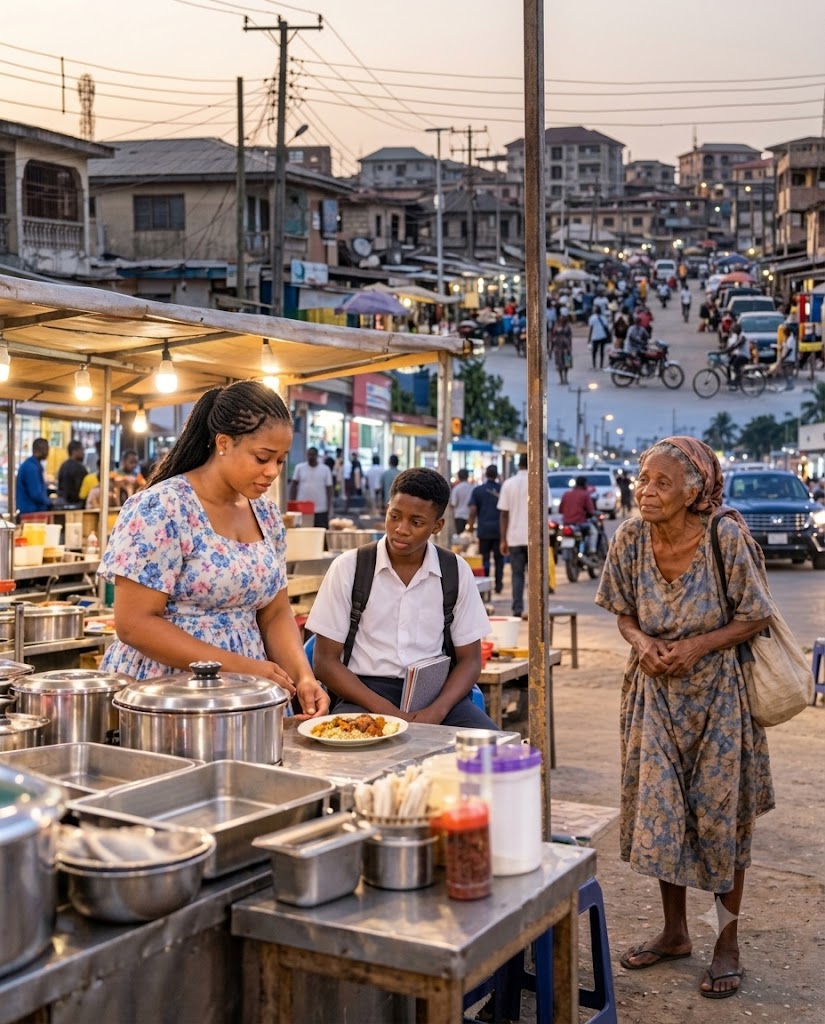
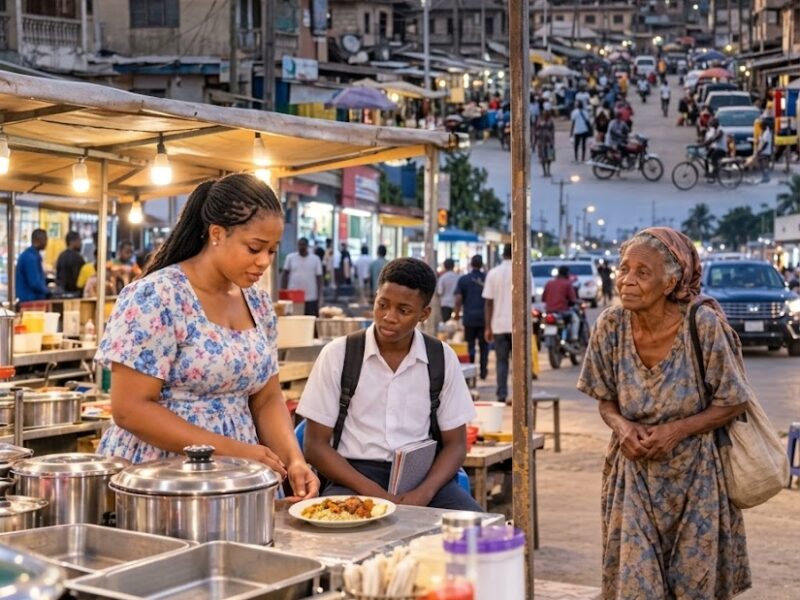
The old woman reached Chiamaka’s food stall just as the evening rush was dying down, and only one plate of rice and stew remained under the bright roadside lights.
One plate. One customer’s worth of food in a day that had brought almost nothing.
Three people had come before noon. Two ordered the cheapest meals on the menu. One complained the portion was too small.
“Ma’am, this food is too small for this money.”
“Sir, things are very expensive now. Please just bear with us today.”
The few dollars in Chiamaka’s cash box would barely cover tomorrow’s ingredients, and that last plate was supposed to be her dinner. Toby, her seventeen-year-old brother, knew that.
He sat beside the stall on a plastic chair, still wearing his school trousers, his exercise books tucked beneath one arm. He looked at the plate, then at Chiamaka, then back at the plate.
“Please don’t give that one away.”
Chiamaka’s hand stopped above the food container. “I wasn’t going to.”
Toby raised an eyebrow. “You were thinking about it.”
“I was only looking.”
“You always look at food before you give it away.”
Chiamaka smiled faintly, then looked across the road. An elderly woman stood beneath a faded concrete sign. She wasn’t calling out. She wasn’t asking anyone for money. She simply stood there waiting.
The woman looked to be in her seventies. Her dark brown skin was weathered by age, and a few gray strands escaped from beneath her faded headscarf. Her dress was old but clean. Her sandals were worn thin at the edges.
Chiamaka looked away and picked up a spoon, but something made her look again. The woman was still there, her eyes fixed on the stall.
Chiamaka opened the cash box and counted the money one more time. Not enough. She closed it. Then she picked up the plate.
Toby sat up. “You’re really doing this?”
“I’ll find something.”
“You said that yesterday.”
She carried the plate across the road. “Is this for me?” the woman asked.
“Yes.”
She accepted it with both hands, her thin fingers trembling slightly. “Thank you.”
Chiamaka turned to leave, then noticed the woman hadn’t moved. She had sat on a low concrete step, taken one small spoonful of rice, chewed slowly, then another bite. After that, she stopped.
She looked behind her quickly, her expression tightening. Then she reached beneath her wrapper and brought out a small, carefully washed plastic container. Slowly, she transferred the remaining rice and stew inside, even the small piece of meat.
“Mama, aren’t you hungry?”
“I am.”
“Then why are you packing the food?”
The woman held her gaze for a moment. “Not everything we receive is meant to be finished by us.”
Chiamaka frowned. “What does that mean?”
The old woman only smiled. She tucked the container beneath her wrapper, waited for a passing motorcycle to disappear, then began walking. After a few steps, she looked back, then continued.
Chiamaka watched until she vanished into the evening crowd. She looked down at the empty plate in her hands. The woman had been hungry. Chiamaka had watched her eat. But she had carefully packed almost everything else away.
Why had the old woman taken almost all the food away?
—
The following evening, Chiamaka found herself looking at the road before she even realized she was waiting. It was almost the same time. The roadside was beginning to quiet. A few motorcycles passed. The smell of grilled meat drifted from a nearby stand, mixing with the aroma of Chiamaka’s rice and stew.
Toby noticed her looking toward the corner. “You’re waiting for her.”
Chiamaka turned. “Who?”
Toby gave her a look. “The old woman.”
Chiamaka shook her head. “I’m not waiting for anybody.”
“You’ve looked at that corner six times.”
“I have not.”
Chiamaka laughed despite herself. But when she looked back toward the road, the old woman was there, standing in exactly the same place, waiting.
Chiamaka’s smile disappeared. The woman slowly crossed the road. She approached the stall without saying anything. Chiamaka already knew what she wanted.
She prepared a plate—rice, stew, a small piece of meat. She handed it over.
“Thank you,” the woman said softly. Then she sat on the same concrete step.
Toby watched from behind the stall. This time he didn’t pretend to be busy. The old woman ate two small spoonfuls. Then she stopped again. She opened the same clean plastic container and carefully packed the rest.
Toby leaned toward his sister. “She’s doing it again.”
Chiamaka whispered, “Keep your voice down.”
“Why doesn’t she eat?”
“I don’t know.”
“Maybe she isn’t hungry.”
“Then why does she come for food?”
Toby’s question stayed with Chiamaka. The old woman finished packing. Before standing, she looked around—left, right, behind her. Then she tucked the container beneath her wrapper.
Chiamaka couldn’t hold back any longer. “Mama.”
The woman stopped. Chiamaka stepped closer. “Mama, why don’t you ever eat what I give you?”
The old woman looked at her. There was something almost sad in her eyes. Then she smiled. Not a nervous smile, not an embarrassed one—a knowing smile.
“Some things are not meant for the person who receives them.”
Chiamaka frowned. “What does that mean?”
But the old woman had already turned away. “Mama.”
She didn’t stop. She walked down the road until the crowd swallowed her.
Toby waited until she disappeared. Then he looked at Chiamaka. “That answer made no sense.”
“I know.”
“So, you’re going to find out.”
Chiamaka shook her head. “No, you will.”
“I’m not following an old woman.”
“I didn’t say follow her. You were thinking it.”
Toby smiled. “I was.”
Chiamaka laughed quietly, but her eyes remained on the road. Something about the woman’s answer bothered her.
—
The next evening, Chiamaka made a decision. She didn’t tell Toby. She cooked the usual amount of rice, divided the stew, and placed the meat carefully on two plates. Two portions. She left them side by side beneath the stall’s bright light.
Toby stared. “You said you weren’t going to investigate.”
“I’m not.”
“Then why are there two plates?”
Chiamaka didn’t answer. They waited. Minutes passed. Then the old woman appeared. She crossed the road, walked straight to the stall. Her eyes fell on the two plates.
For the first time, Chiamaka saw something change in her expression. Relief.
The old woman reached for one plate. Then she reached for the second. She took both. No question, no hesitation. She held the two plates carefully against her chest.
Chiamaka stared at her. Toby slowly looked at his sister. Neither of them spoke. They didn’t need to. The mystery had just become something much bigger.
There was someone else.
—
By the end of that week, Chiamaka was no longer the only person who had noticed. People had started talking. It began with small comments.
A woman buying beans from the next stall leaned toward Chiamaka one afternoon. “That old woman still comes here.”
Chiamaka looked up. “Yes.”
“Why?”
The woman lowered her voice. “Just be careful.”
“Careful of what?”
The woman glanced toward the road. “Her.”
Then she walked away. Chiamaka frowned.
That evening, another customer said something different. “That woman has been wandering around this area for years.”
“Doing what?”
The customer shrugged. “Nobody knows.”
Another person claimed Mama Eber used to live in a large house. Someone else said she had never owned a house in her life. One person insisted she had seven children who disappeared. Another swore she had never had children at all.
Then somebody whispered that she was a witch.
Chiamaka stopped chopping vegetables. “A witch?”
The man immediately looked around. “Don’t say it too loudly.”
“Why?”
He shrugged. “People have their reasons.”
“What reasons?”
He couldn’t answer. That was what bothered Chiamaka most. Everyone had a story. Nobody had proof.
One woman said Mama Eber could predict deaths. Another said she had seen the old woman talking to herself at midnight. Someone else claimed chickens disappeared whenever she passed nearby.
But when Chiamaka asked where these things had happened, the stories became uncertain. “Someone told me.” “My sister heard it.” “I can’t remember exactly.” “It happened a long time ago.”
The stories contradicted one another so badly that Chiamaka almost laughed. Yet nobody laughed when Mama Eber approached. Conversation stopped. Eyes followed her. People moved aside.
Mama Eber never reacted. She simply walked to Chiamaka’s stall, accepted whatever food Chiamaka offered, and left.
And every evening, Chiamaka noticed the same thing. Mama Eber barely ate. She always took the food away. But Chiamaka had stopped asking questions—at least for now. She wasn’t ready to follow the woman. She wasn’t ready to believe the rumors either.
So she simply continued feeding her.
Then one evening, Mama Eber arrived earlier than usual. She looked tired—more tired than Chiamaka had ever seen her. Chiamaka prepared a plate. But before she handed it over, Mama Eber touched her arm.
“Do you have anything soft?”
Chiamaka paused. “Soft?”
The old woman nodded. “Something easy to chew.”
Chiamaka looked at the rice. “I can make some porridge.”
Mama Eber hesitated. Then she said quietly, “Someone’s teeth are bad.”
Chiamaka froze. The roadside noise seemed to disappear for a moment. Someone? Not her.
Chiamaka slowly lowered the spoon. “Someone?”
Mama Eber nodded.
“Yes, who?”
The old woman looked at her. For a second, Chiamaka thought she might answer. Instead, Mama Eber simply said, “Please, something soft.”
Chiamaka prepared the food, but this time she watched every movement. When Mama Eber received it, she didn’t leave immediately. She carried the food to a quiet corner beside the stall. Then she sat down. She opened the container she always carried.
Chiamaka watched. One portion went inside, then another, then another. The old woman carefully separated the food again. Chiamaka stopped breathing.
Mama Eber wasn’t packing one meal. She wasn’t even packing two. She divided the food into four portions.
Four.
She closed each container carefully. Then she looked up. Their eyes met. For the first time, Chiamaka understood that the question was no longer whether Mama Eber was strange. The question was much more frightening.
Who were the people waiting for her?
—
Chiamaka told herself she was not following Mama Eber. She was only walking in the same direction. At least that was what she told herself as she left the food stall that evening.
Mama Eber had collected the four portions and disappeared down the road. Chiamaka waited several minutes before locking the stall.
Toby watched her. “Where are you going?”
“Home.”
“You don’t walk home that way.”
Chiamaka paused. “I need to check something.”
Toby’s face tightened. “What?”
“I’ll be back.”
“Chiamaka—”
“I’ll be back.”
She walked quickly before he could ask another question. Ahead of her, Mama Eber moved slowly through the evening crowd. She wasn’t carrying a bag. The food containers were hidden beneath her wrapper. Every few minutes, she glanced behind her.
Chiamaka noticed, so she began keeping her distance. The old woman turned away from the main road and entered a narrow street Chiamaka had never had a reason to use. The houses became fewer. The streetlights became farther apart.
Then Chiamaka saw it. An old sign covered in dirt and faded paint. *Community Primary School.*
The school had clearly been abandoned for years. The walls were cracked. Several windows were broken. Grass had grown through the edges of the concrete walkway. A rusted gate hung loosely from one hinge.
Chiamaka slowed. Mama Eber stopped outside. She didn’t enter immediately. She looked left, then right, then behind her. Chiamaka quickly stepped behind a concrete wall. Her heart pounded.
Mama Eber stood still for several seconds. Finally, she pushed the gate open and disappeared inside.
Chiamaka waited one minute, two. Then she heard footsteps. Not Mama Eber. Someone else was approaching.
A black SUV stopped outside the school. A man stepped out. He wore a perfectly pressed white shirt beneath a dark jacket. His shoes were polished. His posture was confident.
Chiamaka recognized him. Gideon Afolabi.
Everyone in the area knew Gideon. He owned businesses. He sponsored community events. His name appeared on banners during charity programs. People called him a respectable man.
Gideon walked through the gate. Chiamaka remained hidden. A moment later, she heard his voice.
“Mama Eber.”
The old woman came outside. She didn’t look frightened, but she didn’t look pleased either.
“You came.”
Gideon smiled. “I said I would.”
“What do you want?”
His smile remained. “Can’t I come and check on the community?”
Mama Eber stared at him. “This place is not your concern.”
Gideon glanced toward the building. “You cannot keep hiding people here forever.”
Chiamaka’s breath caught. People. There were people inside.
Mama Eber folded her arms. “They have nowhere else.”
Gideon sighed. “That’s not my problem.”
The old woman’s expression changed. For the first time, Chiamaka saw anger in her eyes. “It became your problem when you took their homes.”
Gideon’s smile disappeared. Silence settled between them. He looked at Mama Eber for several seconds. Then he spoke more quietly.
“You should be careful about the things you accuse people of.”
“I remember what happened.”
“So do I.”
“Then you know they were promised houses.”
Gideon’s jaw tightened. “And you know promises are complicated.”
“Not when people lose everything because of them.”
He stepped closer. “Mama Eber. You’re an old woman. Don’t make this harder than it needs to be.”
She didn’t move. “Those people trusted you.”
Gideon looked toward the building. “They should have known better.”
Chiamaka’s stomach tightened. What had he done? Why were people hiding in an abandoned school? And why was Gideon talking as though he had something to do with it?
Mama Eber’s voice remained steady. “You took their land.”
Gideon’s eyes hardened. “You have no evidence.”
The words hung in the air. Mama Eber didn’t answer. Gideon turned toward the gate.
“Keep doing this and you will regret it.”
Then he walked away. The SUV started. Within seconds, it disappeared down the road.
Chiamaka remained behind the wall. Her mind raced. She had followed an old woman expecting to discover a secret. Instead, she had stumbled into something far bigger.
Mama Eber entered the building again. Chiamaka slowly stepped out from hiding. She looked at the cracked walls, the broken windows, the abandoned classrooms. Then she heard movement inside—a weak cough, a chair scraping across the floor. Someone speaking softly.
Chiamaka moved closer to the doorway. She was about to look inside when a voice suddenly called out from the darkness.
“Mama Eber, did you bring the food?”
Chiamaka froze. Her eyes widened. There was someone inside. Actually, there were several people—and whatever had happened to them was somehow connected to Gideon Afolabi.
—
Chiamaka stood frozen at the doorway.
“Mama Eber, did you bring the food?”
The voice came again. This time it was weaker. Chiamaka looked at Mama Eber. The old woman stood completely still. Then she sighed.
“You can come inside.”
Chiamaka hesitated. “Who are they?”
“You’ll see.”
Mama Eber pushed the door open. Chiamaka stepped inside. The first thing she noticed was the smell. Not the smell of an abandoned building. Food, soap, medicine. Someone had been living here.
Her eyes slowly adjusted to the dim room. Then she saw the mattresses—four of them, one in each corner. Thin blankets were neatly folded on top. Beside the first mattress sat a walking stick. Near another was a small plastic bag filled with medicine.
Clothes hung from a rope stretched across the room. There were cooking pots, plastic bowls, bottles of water, a pair of old slippers, and photographs. So many photographs.
Chiamaka picked up one carefully. It showed a younger man standing beside a woman and two children. The man in the picture looked proud, happy.
Chiamaka looked at the elderly man sitting nearby. He lowered his eyes. “That was my family.”
Chiamaka put the photograph down. “I’m sorry.”
The man gave a faint smile. “Don’t be.”
He introduced himself as Mr. Nwosu. He was seventy-eight, thin but sharp-eyed, with silver hair and a neatly trimmed gray beard. His back was slightly bent, but there was still authority in the way he spoke.
The other three slowly introduced themselves. Mama Ngozi was seventy-six. She had once owned a small stall in the market and spoke with the confidence of someone who had spent her life dealing with difficult people.
Pa Johnson was eighty-one, a former mechanic. His hands were large, rough, and permanently stained from years of working with engines.
Mama Sadie was seventy. She had been a seamstress. She spoke very little, but her eyes followed everything.
Chiamaka looked around again. “You all live here?”
Nobody answered immediately. Mama Eber placed the food containers on a small wooden table. Then Mama Ngozi said quietly, “Where else would we live?”
Chiamaka felt something tighten inside her chest. She looked at Mama Eber. “How long?”
“Years,” Mama Eber answered.
Chiamaka stared at her. “Years?”
The old woman nodded.
“And nobody knows.”
“They know who?”
Mama Ngozi gave a bitter laugh. “They know enough to ignore us.”
Chiamaka sat down. Mr. Nwosu leaned forward. “We had houses.”
His voice was calm. That somehow made the words hurt more. “Proper houses. Land our families had lived on for decades.”
Pa Johnson nodded. “Then Gideon came.”
Chiamaka’s eyes sharpened. “Gideon Afolabi.”
“Yes.” Mr. Nwosu continued. “He came with officials. They told us the area would be redeveloped. They said the houses were too old. They promised us new ones.”
Mama Sadie finally spoke. “They showed us drawings. Beautiful houses.”
Mama Ngozi added, “They told us nobody would be abandoned.”
“What happened?”
Mr. Nwosu looked toward the broken window. “They demolished everything.”
Chiamaka stared at him. “And the new houses—they never came.”
Silence filled the room. Pa Johnson clenched his fists. “We waited.”
Mama Ngozi’s voice cracked. “We slept with relatives. Some relatives got tired of us.”
Mama Sadie looked down. “I lost everything.”
Chiamaka looked at the mattresses again. Suddenly, they no longer looked like simple beds. They looked like the remains of four lives.
“But how did you end up here?”
Mr. Nwosu looked at Mama Eber. “She found us.”
Mama Eber shook her head. “I only gave them somewhere to sleep.”
“You gave us our lives back,” Mama Ngozi said.
Chiamaka looked at the food. Four portions. Four people. Now everything made sense except one thing.
“Gideon said you had no evidence.”
Mr. Nwosu’s expression changed. “We had evidence.”
“Had.”
He looked directly at her. “That’s why he is dangerous.”
Chiamaka’s stomach tightened. Mama Eber remained silent. Mr. Nwosu slowly stood and walked toward a broken window.
“Come.”
Chiamaka followed. He pointed beyond the trees. At first, she saw nothing. Then the lights appeared. Bright. Elegant. Rows of luxurious buildings stood behind a tall security fence. Perfect landscaping, security gates, expensive cars—a massive development that seemed completely out of place beside the abandoned school.
Chiamaka recognized it immediately. She had seen those buildings. Everyone had. People admired the estate. People took pictures there. People talked about how beautiful it was.
“Gideon’s estate,” she whispered.
Mr. Nwosu nodded. “Look carefully.”
Chiamaka stared. The same land. The same stretch of road. The same place where these elderly people had once lived.
Her mouth went dry. “The estate was built on our land.”
Nobody spoke. Chiamaka looked from the luxury buildings back at the mattresses. From the bright estate, back to the medicine bottles. From the expensive security fence back to the four elderly people sitting inside an abandoned school.
One side had everything. The other had almost nothing. And somehow they were connected.
Chiamaka slowly turned toward Mr. Nwosu. “Why doesn’t he simply leave you alone?”
The old man stared through the window. His voice dropped almost to a whisper. “Because we remember.”
Chiamaka said nothing. Mr. Nwosu turned toward her. “That man doesn’t want us alive long enough to remember.”
—
The next morning, Chiamaka woke with one thought pressing against her mind. *They knew.* She couldn’t explain why. But after what she had seen inside the abandoned school, sleep had barely come.
By mid-morning, she was at the food stall when three men arrived. They did not look like customers. They wore dark trousers and matching shirts, and they walked with the confidence of men who expected people to move when they spoke.
One of them pointed toward the road. “Everyone inside the building has to leave.”
Chiamaka’s heart dropped. “What building?”
The man looked at her. “The old school.”
She immediately thought of Mama Eber. Before she could respond, the men walked away.
Chiamaka abandoned the stall and hurried toward the school. She arrived to chaos. A mattress lay outside the gate. Then another. A blanket had been thrown into the dirt. A plastic bag of medicine had burst open. Tablets scattered across the ground.
Mama Sadie stood trembling beside the doorway. “Please,” Mama Ngozi cried. “Those are our things.”
One of the men pushed another mattress outside. “Clear the building.”
Mr. Nwosu stood in front of the doorway. “Where do you expect us to go?”
“That’s not our concern.”
Mama Eber stepped forward. “You will not remove them.”
The man laughed. “Old woman, don’t make this difficult.”
“They have nowhere to go.”
“Then they should find somewhere.”
Pa Johnson grabbed his walking stick. “You destroyed our homes.”
The man’s expression hardened. “We are not discussing that.”
Chiamaka stepped through the gate. “Yes, you are.”
Everyone turned. The man looked her up and down. “Who are you?”
“Someone who knows they have nowhere to go.”
He stepped closer. “Go back to your business.”
Chiamaka didn’t move. Then a vehicle stopped outside. The atmosphere changed immediately.
Gideon Afolabi stepped out. No shouting, no anger—just a calm expression that somehow frightened Chiamaka more than the men had. He walked toward her.
“Chiamaka.”
She stared. “You know my name.”
He smiled. “I make it my business to know what’s happening in my community.”
His eyes moved toward the elderly residents, then back to her. “You are making a mistake involving yourself in matters you don’t understand.”
Chiamaka swallowed. “I understand that they have nowhere to go.”
Gideon’s smile remained. “Neither will you if you keep interfering.”
Nobody spoke. Chiamaka felt the threat beneath those polite words. Gideon turned and walked away. His men followed, but they didn’t take the residents away that day. Instead, they left the mattresses scattered outside. They left the medicine in the dirt. And they left everyone wondering when they would return.
The answer came quickly.
—
The following week, Chiamaka’s vegetable supplier suddenly refused to sell to her.
“Sorry.”
“Why? I was told not to give you anything on credit.”
“I always pay.”
“I know.”
“Then why?”
He wouldn’t look at her. Then another supplier stopped coming. A few days later, two officials appeared at her stall. They inspected her cooking area. They checked her permits. They measured distances. They asked questions nobody had asked before. One of them finally said, “We’ll be back.”
After that, customers became fewer. Some crossed the road when they saw her. Others came once and never returned.
Toby noticed. One evening, he counted the day’s money and quietly pushed the cash box toward her. “This isn’t enough.”
Chiamaka said nothing.
“Are we going to lose the stall?”
She looked at him. “I don’t know.”
Toby lowered his voice. “Is it because of that man?”
Chiamaka couldn’t answer. For the first time, she understood what Gideon’s warning truly meant. He didn’t need to touch her. He didn’t need to shout. He could simply reach into her life and begin removing things—her suppliers, her customers, her peace.
And if he could do that to her, what had he done to people who had nothing left?
That night, Chiamaka returned to the abandoned school. Everyone was quiet. Mr. Nwosu sat beside the window.
“You understand now?” he said.
Chiamaka nodded. “Gideon is powerful.”
“No.” Mr. Nwosu looked at her. “Powerful men are not always dangerous.” He paused. “Men who know they can get away with anything are.”
Chiamaka sat beside him. “Then how do we stop him?”
Mr. Nwosu stared at the luxury estate glowing in the distance. His voice became almost a whisper. “I know how he took the land.”
—
Mr. Nwosu stared at Gideon’s estate in the distance for a long moment before turning to Chiamaka. “There is something you need to know about me.”
Chiamaka waited.
“Before all this happened, I was the community records clerk.”
Her eyes widened. “You kept the records?”
“I handled them.”
He walked toward an old wooden cabinet and pulled it away from the wall. Behind it was a narrow opening. Chiamaka stared.
Mr. Nwosu reached inside and brought out a dusty metal box. Mama Eber stiffened.
“Are you sure?”
Mr. Nwosu nodded. “It’s time.”
He placed the box on the table and opened it. Inside were folders—dozens of them. Some were yellowed with age. Others had handwritten dates across their covers.
“What are these?” Chiamaka asked.
“The truth.”
He opened the first folder. Land records, names, property numbers, boundaries, signatures. Chiamaka recognized several names immediately. They belonged to the elderly people sitting around her.
“This was before the redevelopment,” Mr. Nwosu said.
He pulled out another document. “This is the agreement.”
Chiamaka read it carefully. The residents had surrendered their properties temporarily for redevelopment. In return, they were promised replacement homes. There were signatures, official stamps, dates. Everything appeared legitimate.
“They were promised houses,” Chiamaka whispered. “All of them.”
Mr. Nwosu turned another page. “But they never built anything.”
Chiamaka looked at Mama Ngozi. “You waited for months?”
Mama Ngozi answered. “Then years.”
Mr. Nwosu continued showing her the records—receipts, community meeting minutes, demolition notices, development approvals, promises of replacement homes. Every document connected to the next. Then he stopped.
“Look at this.”
Chiamaka leaned closer. A signature appeared at the bottom of the page. She compared it with another document. Her stomach tightened.
“Gideon.”
Mr. Nwosu nodded. “He signed them.”
“The same company.”
“The same company.”
Chiamaka’s eyes moved across the papers. The names matched. The property numbers matched. The dates matched. Then she found the demolition documents. The houses had been destroyed. She found the replacement home plans. Approved, promised, never completed. Then came the transfer documents. The land had changed ownership. Finally, she saw the development plans for Gideon’s estate.
Chiamaka slowly looked through the window. The luxurious buildings stood glowing in the distance.
“The estate was already planned,” she said.
Mr. Nwosu nodded. “Before they were given new homes.”
Silence filled the room. The estate no longer looked beautiful. To Chiamaka, it looked like evidence.
“If we take these to the authorities,” she began.
“They can expose him,” Mama Ngozi said.
“For once,” Pa Johnson added, “someone will listen.”
Hope entered the room. For the first time, they had more than memories. They had proof.
Chiamaka looked at Mr. Nwosu. “Why did you keep these?”
“I knew one day we might need them.”
“Did Gideon know?”
Mr. Nwosu hesitated. “I don’t think so.”
That answer should have comforted Chiamaka. Instead, it made her uneasy. Still, they began discussing what to do next. Chiamaka left that night believing they finally had a chance.
By morning, that hope was gone.
—
Her phone rang. It was Mama Eber.
“Chiamaka, come quickly.”
Chiamaka ran to the school. The door stood open. Inside, mattresses had been moved. Clothes lay scattered. A chair was overturned. Medicine had been knocked onto the floor.
But Chiamaka’s eyes went straight to the cabinet. It was open. Empty.
The metal box was gone.
Mr. Nwosu stood beside the wall, his face pale. “They took them.”
“The records.”
He nodded. “The land records. Agreements. Receipts. Meeting minutes. Demolition documents. Everything.”
“Everything.”
Mama Ngozi began crying. Pa Johnson slammed his fist against the wall. Chiamaka looked around. Something didn’t make sense. Whoever broke in had ignored the food. They ignored the clothes. They ignored the medicine. They took only the records. Only the evidence.
Chiamaka slowly walked toward the hidden cabinet. Then she stopped. Near the opening was a fresh footprint pressed into the damp earth. The edges were still sharp. She crouched beside it. Her heart began pounding.
This wasn’t someone searching blindly. They had known exactly where to look. Chiamaka slowly stood. Someone knew about the records.
—
That afternoon, Chiamaka found Mama Eber sitting alone behind the abandoned school, staring through a broken window.
Finally, Chiamaka asked, “Why do you do all this?”
Mama Eber’s fingers tightened around her wrapper. “Because once I had a child.”
Chiamaka went still. Mama Eber looked down.
“I was pregnant. I had chosen a name. I imagined tiny hands holding my finger. I imagined someone calling me mama.” Her voice cracked. “Then I lost the baby.”
“I thought I would recover.” Mama Eber continued. “But my husband changed. He stopped speaking to me. His family blamed me. They said I had failed as a woman. When years passed without another pregnancy, people stopped asking if I was all right. They started calling me childless as if it were my name.”
“My husband eventually left. He said a home without children was an empty home.”
“And you believed him?”
“No.” Mama Eber shook her head. “But for years I lived as though he was right.”
She pointed toward the room. “People thought because I never had children, I had nobody to love. They were wrong.”
Inside, Mama Ngozi laughed softly at something Pa Johnson had said. Mama Sadie sat beside Mr. Nwosu folding clothes.
Mama Eber watched them. “I found people who needed what I still had inside me. Care, patience, protection, love.”
Mama Eber had not simply been feeding four old people. She had built a family from people the world had abandoned.
Then Mama Eber reached beneath her clothing and pulled out a small brown envelope. “The documents they took from the school were not everything.”
“You kept another copy.”
“Not a copy.” Mama Eber’s voice dropped. “An original.”
Before Chiamaka could ask where, Mr. Nwosu appeared. “There is something else you need to know.”
He closed the door behind him. “I know who helped Gideon alter the community records.”
“Who?”
“I will tell you, but not here.”
“Why?”
“Because if that person learns we still have the original, we may not get another chance.”
A vehicle horn sounded outside. Mr. Nwosu moved to the window. A black SUV rolled slowly past the school. Gideon stepped out.
A final meeting had been announced.
—
Gideon’s notice was calm. The occupants of the abandoned school will be removed immediately.
Mama Ngozi’s face drained of color. Pa Johnson gripped his walking stick. Chiamaka looked at Mama Eber.
“No more hiding,” Mama Eber said quietly.
Mr. Nwosu nodded. “This time we face him with the truth.”
But Chiamaka remembered the stolen records. They had one original document left—and Gideon was already moving. The final meeting was no longer about proving what happened. It was about surviving long enough to prove it. That was everything.
—
By noon, the community hall was packed. Gideon Afolabi stood at the front in an immaculate suit, smiling confidently. Behind him sat officials, a lawyer, and men from the school.
Mama Eber and the four elderly residents sat near the back. Gideon opened the meeting with concern.
“We are here because some vulnerable people have been occupying public property illegally.”
He described himself as a businessman who had invested in the community and supported families. Then he pointed toward Mama Eber.
“She has turned an abandoned building into an unauthorized shelter.”
A murmur moved through the room.
“She has encouraged others to trespass. And unfortunately, Chiamaka has joined her.”
Every eye turned toward Chiamaka. Gideon smiled faintly.
“This young woman is running a struggling food stall. She has enough financial difficulties without involving herself in matters beyond her understanding.”
Heat rushed into Chiamaka’s face. He knew exactly where to hurt her. Her stall. Her income. Toby. She imagined losing everything. What if customers stopped coming? What if Toby’s schooling became impossible?
Maybe she should just leave. Maybe silence was safer.
Then Mama Ngozi stood. Her knees shook, but her voice did not.
“My house stood where his luxury buildings stand today.”
The room quieted.
“I was told my home would be replaced. They demolished it while I watched.”
Pa Johnson rose next. “These hands repaired engines for forty years,” he said, lifting his rough palms. “I built my house with those hands. They destroyed it and called it development.”
Mama Sadie stood. “I kept every receipt they gave me. Every promise. Every date.”
Gideon shifted in his chair. Then Mr. Nwosu stood. The old man everyone had dismissed adjusted his glasses.
“March 14th, 2019. Property file 47B. Temporary surrender for redevelopment.”
Gideon stopped smiling completely.
“June 2nd, 2019. Demolition notice.”
Mr. Nwosu continued. “August 19. Transfer documents processed.”
He recited another property number, then another. Names, signatures, dates, boundaries. Gideon’s lawyer leaned toward him.
“Enough,” Gideon snapped.
Mr. Nwosu looked directly at him. “You remember me now?”
Before Gideon could answer, Mrs. Grace stepped forward. “The food Chiamaka gave Mama Eber was leftover food. Food that would have been thrown away.”
She faced the crowd. “She wasn’t stealing from customers. She was giving away what she could not sell.”
The room changed. Then the doors opened.
Toby.
Chiamaka stared. Her brother walked in.
“I heard what happened,” he said. He moved straight toward her. “I came because you shouldn’t stand alone.”
Chiamaka looked around. Mama Ngozi. Pa Johnson. Mama Sadie. Mr. Nwosu. Mama Eber. Mrs. Grace. Toby.
For the first time, she understood. She wasn’t alone.
Chiamaka walked toward the table. The hall fell silent. She placed Mama Eber’s original document on the table. Gideon’s eyes fixed on it.
Chiamaka looked at him. “Then let’s stop talking about what you say happened. Let’s look at what actually happened.”
Nobody moved. Gideon stared at the document. And for the first time that day, the man controlling the room looked afraid.
—
For several seconds, nobody touched the document. Then the community secretary leaned forward.
“Let me see that.”
Mr. Nwosu opened the original carefully. The signatures were clear. The property numbers matched the records he had memorized. The dates matched the demolition notices.
Then someone brought out an old community register. Another witness produced a receipt. A former official admitted that replacement houses had been promised, but they were never built. The room erupted.
Gideon’s lawyer tried to interrupt. “This proves nothing.”
Mr. Nwosu pointed to the development plans, then explained why these properties were transferred before the promised houses existed.
Nobody answered.
Another resident stood. “My father’s land is there too.”
Then another voice came from the crowd. “And mine.”
Fear was breaking. People who had remained silent for years began telling their stories. One after another. They described the same pattern. Promises. Demolitions. Missing documents. Disappearing officials.
Then the estate manager was questioned. The luxury estate had been built on several of the exact property numbers listed in the original documents.
Gideon tried to deny everything, but each denial created another question, and each question produced another witness. His polished reputation began collapsing in front of the same people who once praised him.
By evening, authorities had stopped the eviction. The abandoned school would remain untouched while the land transfers were investigated. Gideon’s lawyers left first, then his supporters. He remained seated, staring at the table.
For years, fear had protected him. Now people were no longer afraid.
Chiamaka looked toward Mama Eber. The old woman stood quietly beside the four residents. No anger, no celebration—just relief.
A woman from the crowd approached her. “We were wrong about you.”
Mama Eber said nothing.
Another woman stepped forward. “They called you a witch.”
Mama Eber lowered her eyes.
Chiamaka finally understood why Mama Eber had never defended herself. She had been too busy defending people who had nobody else.
She wasn’t a witch. She was feeding abandoned people. She wasn’t hiding something evil. She was hiding people who had been deliberately forgotten.
And suddenly, Chiamaka understood the meaning of every leftover plate Mama Eber had carried through that door. It had never been about food alone. It had been about telling someone forgotten by the world, “You still matter.”
—
That night, the four elderly residents sat around a table inside the school. For the first time, nobody was hiding. Mama Eber placed food before them.
Chiamaka smiled, but before she could sit, Mr. Nwosu whispered something that made her smile disappear.
“There is still one name missing from those records.”
Chiamaka looked at him. “Whose name?”
Mr. Nwosu glanced toward Gideon’s empty chair. “That,” he said, “is the question we must answer next.”
—
*Mama Eber was called a witch because people judged what they didn’t understand. But the truth was simple. She was protecting people the world had forgotten. Sometimes one small act of kindness can uncover a truth, restore hope, and change lives.*









