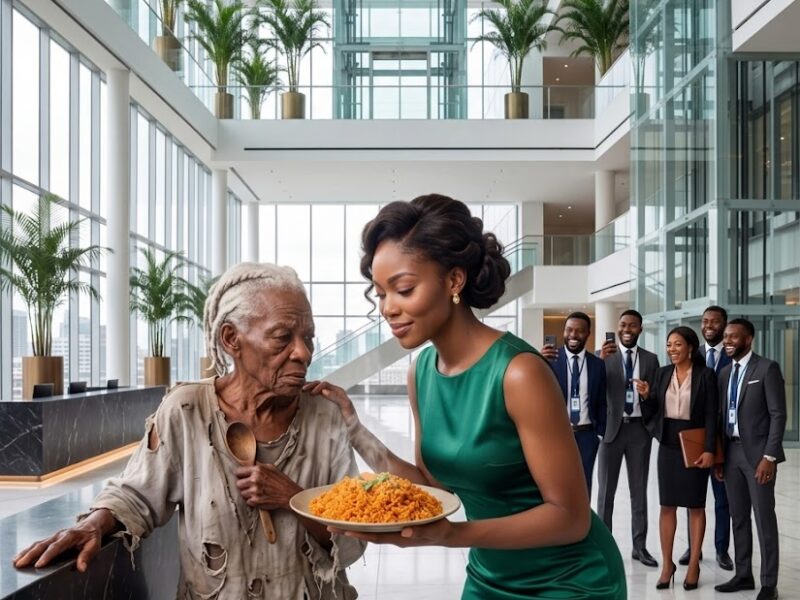
She gave a hungry old woman her very last meal — with no idea that the stranger’s daughter was the richest woman alive.
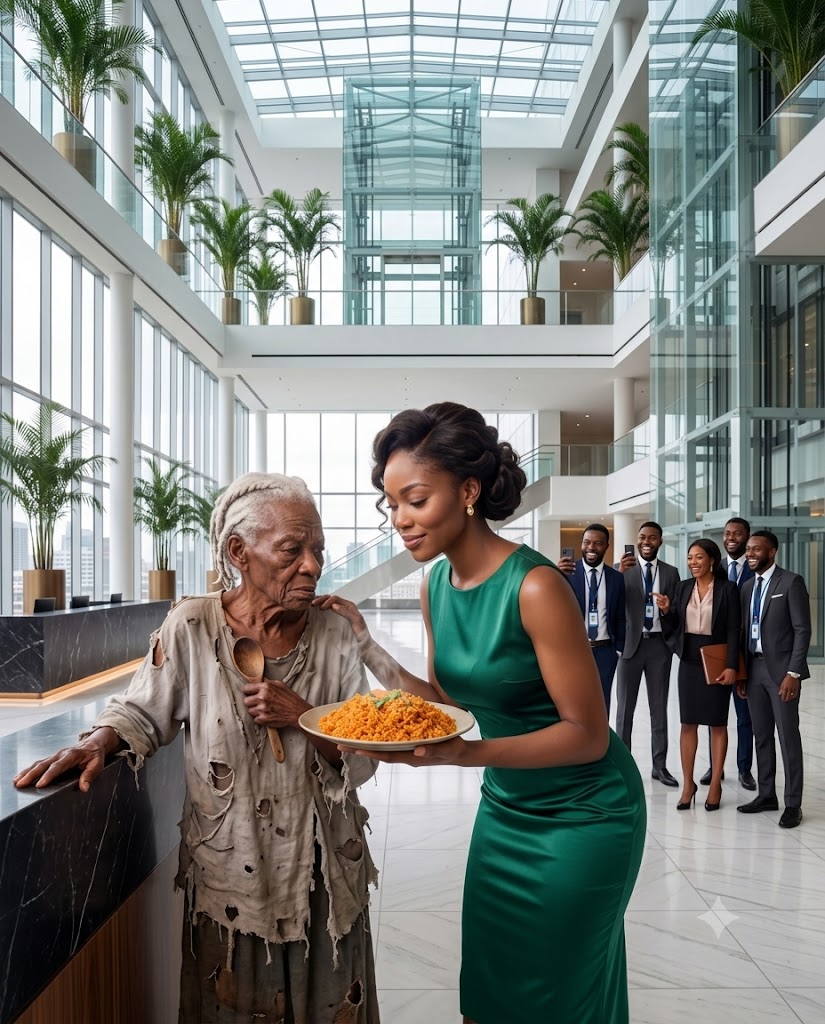
The evening market smelled like rain that never came. Ada wiped down her last pot with a rag that had once been a shirt, watching the gate where the woman always appeared just before closing. Nobody knew her name. Nobody asked. She wore the same gray coat in every season and stood at the edge of the stalls like she was waiting for permission to exist. Ada had been feeding her for four months, one plate at a time, never telling anyone because the market committee would have charged her for it. Gold, who sold fabric two stalls down, called the woman “the market ghost” and spat when she said it.
“You’re going to lose customers,” Gold warned that Monday, snapping a measuring tape against her palm like a tiny whip. “People don’t buy peppers from someone who attracts beggars.”
“She’s not a beggar,” Ada said, ladling pepper soup into a bowl she kept specifically for this. “She’s just hungry.”
Gold laughed, but there was no music in it. “Hungry, crazy, same thing to a wallet.”
The woman appeared at seven. She never spoke, never nodded, never smiled. She took the bowl with both hands and ate standing up, always facing the wall, always finished in four minutes. Then she placed the bowl on Ada’s counter, turned, and walked into the dark like she was returning to a place that didn’t want her.
—
That night, Ada counted her money twice. Fifteen dollars short of rent. The gala order from the tower would fix everything, but the client wanted fifty plates and she only had enough pots for thirty.
“I’ll make it work,” she told Blessing, the girl who helped her wash dishes for tips. “I always make it work.”
Blessing, who was sixteen and had the eyes of someone who had already survived three lifetimes, shook her head. “The gala lady called again. She wants you to sign a paper saying you won’t serve anyone outside the order that night.”
“That’s ridiculous.”
“That’s money.”
Ada signed the paper because her roof had a hole in it and her landlord had a son who liked to remind her. She told herself the old woman would understand. She told herself one missed meal wasn’t a tragedy.
The old woman came at seven. Ada stood behind her counter with her hands shaking and her mouth full of excuses. The woman looked at the empty pot. Then she looked at Ada. For the first time in four months, their eyes met, and something passed between them that Ada couldn’t name.
“I’m sorry,” Ada whispered. “I have to think about tomorrow.”
The woman nodded once, like she had expected nothing else, and walked away. Ada cried into her dishwater that night, and the tears made the soap sting.
—
The next evening, the old woman didn’t come. Ada waited until nine, then ten, then eleven. She walked the perimeter of the market twice, calling out to someone whose name she didn’t know. Gold watched from her stall with a cigarette she wasn’t supposed to be smoking.
“Maybe she finally died,” Gold said. “Problem solved.”
Ada wanted to hit her. Instead, she went home and couldn’t sleep.
Three days passed. On the fourth day, a black car with tinted windows pulled up to the market entrance at noon, which was strange because nobody with money came to this market before dark. A woman stepped out wearing a suit that cost more than Ada’s entire stall. She was tall, composed, and looked like she hadn’t slept in months.
“I’m looking for the cook who feeds my mother,” the woman said.
Ada’s heart stopped. “Your mother?”
“Oryaku. She’s been missing for four months. The last video we have of her shows her eating at this market. Every evening. From a woman in a blue apron.”
Ada’s apron was blue. Her hands trembled around the ladle she was holding. “She ate here,” Ada said carefully. “But I don’t know her name. She never spoke.”
“She hasn’t spoken in a year.” The woman’s voice cracked, just slightly, like a foundation finally showing its hairline fractures. “She buried her grandson and then she stopped. She left my house because every wall had his face. I’ve spent four months and a fortune trying to find her.”
“Your grandson?”
“My son. He was seven.” The woman pulled a photograph from her pocket. A boy with a missing tooth and eyes that laughed before his mouth did. “He drowned in our pool. My mother was watching him. She turned away for one minute.”
Ada felt the floor tilt. “I fed her every night,” she said. “She never said thank you. She never said anything.”
“That’s how I know it was really her.”
—
The woman’s name was Amara Okafor, and she owned the tower that was hosting the gala. The same gala that Ada had signed a contract for. The same gala that had made her turn away a hungry woman.
“I didn’t know,” Ada said, and the words tasted like ash. “I swear I didn’t know.”
“I know.” Amara sat on a stool that was meant for customers and looked around at Ada’s tiny kingdom of pots and peppers. “My mother ate here for four months. You fed her when nobody else would. That’s worth more than I can pay.”
“You don’t have to pay me.”
“I know.” Amara smiled, and it was the saddest smile Ada had ever seen. “But I want to.”
—
The gala was on Friday. Ada arrived at the tower at 5 a.m. with all thirty of her pots and Blessing, who had refused to let her go alone. The kitchen was stainless steel and cold, the size of Ada’s entire market. A consultant was already there, a man named Obina who was inspecting the generator room and complaining about the noise.
“If it is married, no wonder it is angry,” he said when Ada walked past. “I practically sleep in that generator room.”
“The kitchen is this way,” Ada said.
“I know. I was looking for the generator room. New consultant, based on site until the opening.” He held out a hand. “Obina.”
“Ada.”
“I know who you are. Everyone does. You’re the one who fed the missing woman.”
Ada froze. “You heard about that?”
“The whole tower heard about that. Madame Okafor gave a speech yesterday. Something about how the finest people in this building learned kindness from a market cook.”
—
The gala was a success. Fifty plates of authentic food, served with respect, exactly as Ada had promised. But when the guests asked about the cook, Ada refused to come out of the kitchen. She stood by the stove, stirring a pot that didn’t need stirring, and thought about the old woman who had eaten standing up with her face to the wall.
“You should be out there,” Blessing said. “They’re toasting you.”
“I didn’t do anything.”
“You fed a stranger every night for four months. That’s something.”
“It wasn’t enough.”
—
After the gala, Amara offered Ada a job in the tower kitchen. Ada refused.
“Then let me invest in you,” Amara said. “I want to rebuild your corner. Bigger. With tables and chairs and a sign that says nobody eats alone.”
“Why?”
“Because my mother told me something before she died.”
Ada’s chest tightened. “She died?”
“No. She spoke.” Amara’s eyes filled with tears. “For the first time in a year, she spoke. She said, ‘The cook knew I was hungry. That was enough.'”
—
The new kitchen opened a month later. Ada stood behind a counter that didn’t wobble and looked out at a line of people that stretched around the block. Some were rich. Some were poor. Some were just lonely. The sign above the door said “The Last Plate,” and beneath it, in smaller letters: “Nobody eats alone.”
A stocky man with sawdust on his shirt approached the counter. “Are you hiring?”
“Depends. Can you cook?”
“I can build.” He held out a hand. “Name’s Obina. I used to work at the tower, but I quit. The generator room was too noisy.”
Ada laughed. “You’re the consultant.”
“I’m the engineer. And I brought my own spoon.” He pulled a wooden spoon from his pocket, carved with a pattern that looked like a river. “My father had a spoon like this. He fed half our street and died owing nobody.”
Ada looked at the spoon, then at the man. “You’re hired.”
—
The old woman came back every evening. She sat at a table by the window and ate her pepper soup slowly, watching the market crowd through the glass. Sometimes she nodded at Ada. Sometimes she just ate. But she always came, and Ada always had a plate waiting.
“Your grandmother is here,” Obina said one night, sliding into the seat across from Ada. “She’s smiling.”
“She’s not my grandmother.”
“She could be.” He reached across the table and took her hand. “If you want her to be.”
Ada thought about the hole in her roof. She thought about the landlord’s son and the market committee and Gold, who had lost three contracts and was now selling fruit at a discount just to keep her stall. She thought about the first night she had fed the old woman, not knowing anything, not expecting anything, just seeing a hungry person and doing what her mother had taught her.
“I want a lot of things,” she said.
“Name one.”
“A family.”
Obina grinned. “That’s more than one. But I have time.”
—
The wedding was in the market. Amara paid for everything, but Ada planned every detail. The first plates went to the cooks, because that was the rule. The second plates went to the workers who had helped build the new kitchen. The third plates went to the market vendors, including Gold, who cried when Ada handed her a bowl.
“I was wrong,” Gold said. “I was so wrong.”
“You were scared,” Ada said. “We all are. That’s why we need each other.”
The old woman sat at the head table, wearing a dress Amara had bought her and holding the wooden spoon Obina had carved. She didn’t speak, but she ate, and she nodded, and when Ada walked past, she reached out and touched Ada’s hand.
“Thank you,” the old woman whispered.
Ada froze. “You spoke.”
“I spoke.”
“Are you—”
“I’m happy.” The old woman squeezed her hand. “For the first time in a year, I’m happy.”
—
That night, Ada stood on the roof of the market and looked out at the city. Obina stood beside her, his hand in hers, his thumb tracing circles on her palm.
“How many kitchens do you want?” he asked.
“Ten.”
“That’s a lot of spoons.”
“You have time to carve them.”
“I’ll need a workshop.”
“I know a market.”
He laughed and kissed her, and the city below them flickered with lights that looked like stars that had fallen and decided to stay.
—
*Six months later*
The Last Plate had become a chain. Ten kitchens across the city, each one with the same sign and the same rule: Nobody eats alone. Ada and Obina ran the main branch, which was still in the market, which still had the same blue apron hanging on a hook by the door.
The old woman, whose name turned out to be Oryaku, lived with them. She spent her days sitting in the kitchen, watching the cooks, occasionally peeling peppers when her hands didn’t shake too badly. She never spoke much, but she smiled a lot, especially when Obina brought her the first plate of the evening.
“The first plate knows its owner,” he always said.
“Old habits,” Oryaku replied.
—
Amara visited every Sunday. She sat at the table by the window and ate her mother’s favorite soup and watched the market crowd with the same intensity her mother had. Sometimes she brought contracts for new kitchen locations. Sometimes she just brought flowers.
“You saved her,” Amara said one Sunday.
“No,” Ada said. “She saved me.”
“How?”
“I was just surviving. Feeding her gave me a reason to keep the pot on the fire.”
Amara looked at her mother, who was laughing at something Obina had said, and then looked back at Ada. “My board called your business model bad business.”
“What do they call it now?”
“Revolutionary.” Amara smiled. “They want to franchise you.”
“Tell them I’m not for sale.”
“I already did.”
—
The market committee changed the rules after that. Nobody eats alone. Nobody is chased. The corner where Gold had once sold fabric became a community table, where vendors and customers and strangers sat together and shared whatever they had.
“We sold cloth,” the market president said at the dedication ceremony. “We sold pepper. Now we sell something better.”
“What’s that?” someone called from the crowd.
“Kindness.”
—
The wooden spoon hung on the wall of The Last Plate, framed in glass, with a small plaque beneath it that read: *The first plate knows its owner. The last plate knows its purpose.*
Ada looked at it every morning before she started cooking. She thought about the evening she had turned away a hungry woman, and the evening she hadn’t, and all the evenings in between. She thought about how wealth fills your table, but kindness fills your name. She thought about how a pot that feeds only its owner is just a bucket.
Then she tied on her apron and got to work.
—
The old woman died in her sleep two years later. She was holding the spoon Obina had carved, the one with the river pattern, the one she refused to let anyone else touch. Ada found her in the morning, with the sun on her face and a smile on her lips.
“She’s not hungry anymore,” Obina said, holding Ada while she cried.
“She never was,” Ada said. “She was just alone.”
—
The funeral was in the market. All ten kitchens closed for the day, and the vendors covered their stalls with white cloth, and the whole city came to say goodbye to a woman who had once been invisible.
Amara gave the eulogy. She talked about her son, who had died too young, and her mother, who had stopped speaking because the grief was too loud. She talked about the cook who had fed a stranger every night for four months, and the market that had chased her away, and the tower that had brought her back.
“She gave her last meal to someone she didn’t know,” Amara said. “And that meal came back carrying a family, a kitchen, and a mother’s voice.”
—
After the funeral, Ada stood in the kitchen of The Last Plate and looked at the spoon on the wall. She thought about the first time she had seen the old woman at the market gate. She thought about the night she had turned her away. She thought about the night she had come back, and the night she had spoken, and the night she had died with a smile on her face.
“What are you thinking?” Obina asked, wrapping his arms around her from behind.
“I’m thinking about how you never know what a plate of food means to someone.”
“It means survival.”
“It means more than that.” Ada turned to face him. “It means someone saw you. Someone thought you were worth feeding. Someone chose you over their own fear.”
Obina kissed her forehead. “You chose her.”
“I did.”
“And she chose you.”
Ada looked at the spoon again. “She chose all of us.”
—
The Last Plate expanded to twenty kitchens over the next five years. Each one had the same sign, the same rule, the same blue apron hanging by the door. Ada and Obina had two children, a boy and a girl, who grew up in the kitchen and learned to cook before they learned to read.
“The first plate knows its owner,” Ada told them every night, as she set the table.
“The last plate knows its purpose,” they recited back.
—
Amara sold her tower and used the money to fund a foundation that trained cooks from poor neighborhoods. She named it after her son, and the logo was a wooden spoon with a river pattern.
“He would have liked this,” Amara said at the opening ceremony.
“He would have loved it,” Ada said. “He would have eaten everything.”
Amara laughed. “He was always hungry.”
“So was your mother.”
“So are we all.”
—
The market where it all started became a landmark. Tourists came to take pictures of the corner where a cook had fed a stranger, and the community table where rich and poor ate side by side, and the plaque on the wall that read: *Nobody eats alone.*
Gold became the manager of the community table. She wore a blue apron now, and she never spat when she said the word “beggar.” She had learned, the hard way, that hunger doesn’t care about your bank account.
“You know what I regret?” Gold said one evening, as she and Ada closed up the market.
“What?”
“Not feeding her myself. I saw her every night. I could have given her something. But I was too scared.”
“Fear is bad for business,” Ada said, quoting Gold’s own words back at her.
Gold winced. “I know. I’m sorry.”
“I forgave you a long time ago.”
“Why?”
“Because you’re not the same person who said those things. And because holding a grudge is like carrying a pot that never empties. It just gets heavier.”
—
The last scene of the movie that was eventually made about Ada’s life was the first scene of her real life. The director, a woman from the city who had heard the story at a dinner party, wanted to capture the moment Ada first fed the old woman. She set up cameras at the market gate and hired extras to play the vendors and the customers and the woman herself.
“Action,” the director called.
The actress who played the old woman walked to the gate and stood there, looking lost. The actress who played Ada ladled soup into a bowl and held it out.
“Cut,” the director said. “It’s not working. There’s no chemistry.”
Ada, who was watching from the sidelines, stepped forward. “Can I try something?”
“Be my guest.”
Ada walked to the pot and ladled soup into a bowl. She walked to the gate and stood in front of the actress, who looked nothing like the old woman but had the same haunted eyes.
“Here,” Ada said. “Eat.”
The actress took the bowl. She ate standing up, facing the wall, just like the old woman had done. When she finished, she placed the bowl on the counter and turned to walk away.
“Wait,” Ada said.
The actress turned back.
“You don’t have to thank me. You don’t have to say anything. Just know that someone saw you. Someone thought you were worth feeding.”
The actress cried. The director cried. The whole crew cried.
“Print that,” the director said. “Print all of it.”
—
The movie was called *The Last Plate*, and it won awards, and it made people think about hunger in a way they hadn’t before. But Ada didn’t care about the awards. She cared about the letter she received from a woman in another state who had started a similar kitchen after watching the film.
“I saw your story,” the woman wrote. “And I thought, if she can do it, so can I. I opened a kitchen last month. We’ve fed 300 people so far. Nobody eats alone.”
Ada framed the letter and hung it next to the spoon.
—
Obina carved ten more spoons over the years. One for each kitchen. Each one had a different pattern—a river, a mountain, a tree, a sun. The one he kept for their own table was plain wood, no pattern, no decoration. Just a spoon.
“Why plain?” Ada asked.
“Because the first spoon was plain,” he said. “And it was enough.”
—
The children grew up and went to college and came back with degrees and ideas. The boy wanted to expand the foundation to other countries. The girl wanted to write a book about her grandmother, the woman who had fed a stranger and changed a city.
“Can I interview you?” she asked Ada.
“You can ask me anything.”
“Did you ever regret feeding her? The first time, I mean. Before you knew who she was.”
Ada thought about the night she had turned the old woman away. The guilt. The tears. The empty pot.
“No,” she said. “I regretted not feeding her. But I never regretted the feeding.”
“Why?”
“Because it was the right thing to do. And because the right thing doesn’t always come with a reward. Sometimes it just comes with a quiet heart.”
—
The old woman’s grave was in a cemetery on a hill overlooking the city. Ada visited every year on the anniversary of her death. She brought pepper soup in a thermos and a wooden spoon from Obina’s workshop. She sat on the grass and ate her own lunch and talked to the woman who had once been invisible.
“I opened another kitchen,” she said one year. “That makes twenty-five. The foundation is training cooks in three states. Amara is talking about going international.”
The wind blew through the trees. Somewhere, a bird sang.
“I miss you,” Ada said. “I know that’s strange, because we never really talked. But I miss the way you nodded. The way you ate. The way you trusted me with your hunger.”
She poured the rest of the soup on the grave.
“The first plate knows its owner,” she said. “The last plate knows its purpose.”
—
The market where it all started was renovated a few years later. New stalls, new lights, new pavement. But the corner where Ada had fed the old woman stayed the same. The community table was still there. The plaque was still there. The blue apron was still there, hanging on a hook by the door.
A young cook from the foundation was assigned to the market. Her name was Zara, and she had grown up in a shelter, and she had learned to cook because a woman from Ada’s foundation had taught her.
“Why do you do this?” Zara asked Ada one evening, as they closed up.
“Do what?”
“Feed people. For free. You could be rich.”
Ada laughed. “I am rich.”
“I mean really rich. Like Amara. Like the people in the tower.”
Ada looked at the market, at the vendors packing up their stalls, at the community table where a group of strangers were sharing a meal, at the sign that said *Nobody eats alone*.
“I am really rich,” she said. “I have a family. I have a purpose. I have a name that people say with kindness.”
Zara frowned. “But you don’t have money.”
“I have enough.”
—
The truth was, Ada had more money than she knew what to do with. The Last Plate had become a brand, and the brand had become a movement, and the movement had become a legacy. But she still lived in the same apartment above the market. She still cooked with the same pots. She still wore the same blue apron.
“Why don’t you move?” Amara asked her once.
“Because this is where I belong.”
“But you could live anywhere.”
“I could. But then I wouldn’t be here.”
—
The old woman’s spoon was stolen once. A teenager broke into The Last Plate at night and took it from the wall. The police found him two days later, trying to sell it at a pawn shop.
“Why did you take it?” Ada asked him.
“I don’t know. I thought it was worth something.”
“It is worth something. But not in the way you think.”
She didn’t press charges. Instead, she offered him a job. He started washing dishes and worked his way up to line cook. Ten years later, he ran one of the foundation’s kitchens.
“You gave me a chance,” he said at his graduation ceremony. “You saw me when I was nothing.”
“I saw you,” Ada said. “That’s all anyone needs.”
—
The movie was remade twenty years later. A new director, a new cast, a new generation of viewers. Ada was invited to the premiere but didn’t go. She stayed home and cooked dinner for Obina and their grandchildren.
“Why don’t you want to see it?” her granddaughter asked.
“Because I lived it.”
“But it’s about you.”
“It’s about a woman who was hungry,” Ada said. “And a woman who fed her. That’s everyone’s story.”
—
The last time Ada saw the old woman in her dreams, they were sitting at the community table in the market. The old woman was eating pepper soup and smiling. The sun was setting, and the market was full of people, and nobody was alone.
“Thank you,” the old woman said.
“For what?”
“For seeing me.”
Ada woke up with tears on her face. She walked to the kitchen and looked at the spoon on the wall. Then she started cooking. There were people coming for breakfast. There were always people coming.
—
The foundation now had kitchens in ten countries. The sign was translated into twelve languages. The rule was the same everywhere: Nobody eats alone.
Ada was old now, and her hands shook when she ladled soup, but she still came to the market every morning. She still wore the blue apron. She still stood at the gate and watched for hungry people.
“You don’t have to do this,” Obina said one morning, as he helped her tie the apron strings.
“I know.”
“You could retire.”
“I know.”
“So why don’t you?”
Ada looked at the market. At the community table. At the sign.
“Because there’s always someone who needs a plate,” she said. “And I’m always going to be the one who gives it.”
—
She died on a Tuesday, in the kitchen, with a pot of pepper soup on the stove. Obina found her in the chair by the window, with the wooden spoon in her lap and a smile on her face.
“She’s with the old woman now,” he told the children. “She’s not hungry anymore.”
—
The funeral was in the market. All the kitchens closed. The vendors covered their stalls. The whole city came to say goodbye to the woman who had fed a stranger and changed everything.
Amara gave the eulogy again. She was old now, too, and her voice cracked when she spoke.
“She gave her last meal to someone she didn’t know,” Amara said. “And that meal came back carrying a family, a kitchen, and a mother’s voice. She taught us that wealth fills your table, but kindness fills your name. She taught us that nobody eats alone.”
—
The market renamed the corner where it all started. They called it Ada’s Gate. They put a statue there, a woman with a ladle and a blue apron, looking out at the street like she was waiting for someone.
The plaque beneath the statue read:
*She gave her last meal to a stranger. The stranger gave her back the world.*
—
The wooden spoon was placed in a museum. It sat in a glass case next to a photograph of Ada and the old woman, taken on the night the old woman first spoke. They were both smiling.
The caption read: *The first plate knows its owner. The last plate knows its purpose.*
—
Years later, a young girl visited the museum with her class. She stood in front of the glass case and stared at the spoon.
“Why is a spoon in a museum?” she asked her teacher.
“Because it belonged to a woman who changed the world.”
“How?”
“She fed people.”
“That’s it?”
“That’s everything.”
—
The girl went home and told her mother about the spoon. Her mother, who had grown up hungry, who had eaten at a Last Plate kitchen once, who had never forgotten the taste of pepper soup and kindness, smiled.
“I know that story,” her mother said.
“Will you tell it to me?”
“Every night,” her mother said. “Until you know it by heart.”
—
And so the story spread. From mother to daughter. From market to market. From city to city. A story about a woman who gave her last meal to a stranger. A story about a stranger who turned out to be the mother of the richest woman alive. A story about kindness, and hunger, and the way a single plate of food can change everything.
The first plate knows its owner.
The last plate knows its purpose.
Nobody eats alone.
—
*The End*









