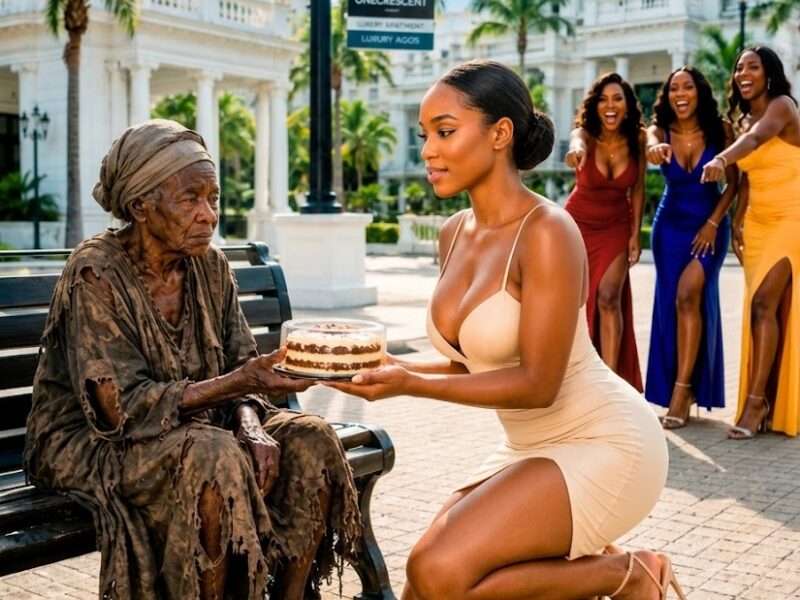
She Gave a Hungry Elderly Woman Her Family’s Last Meal—The Visitor Who Arrived the Next Morning Changed Everything
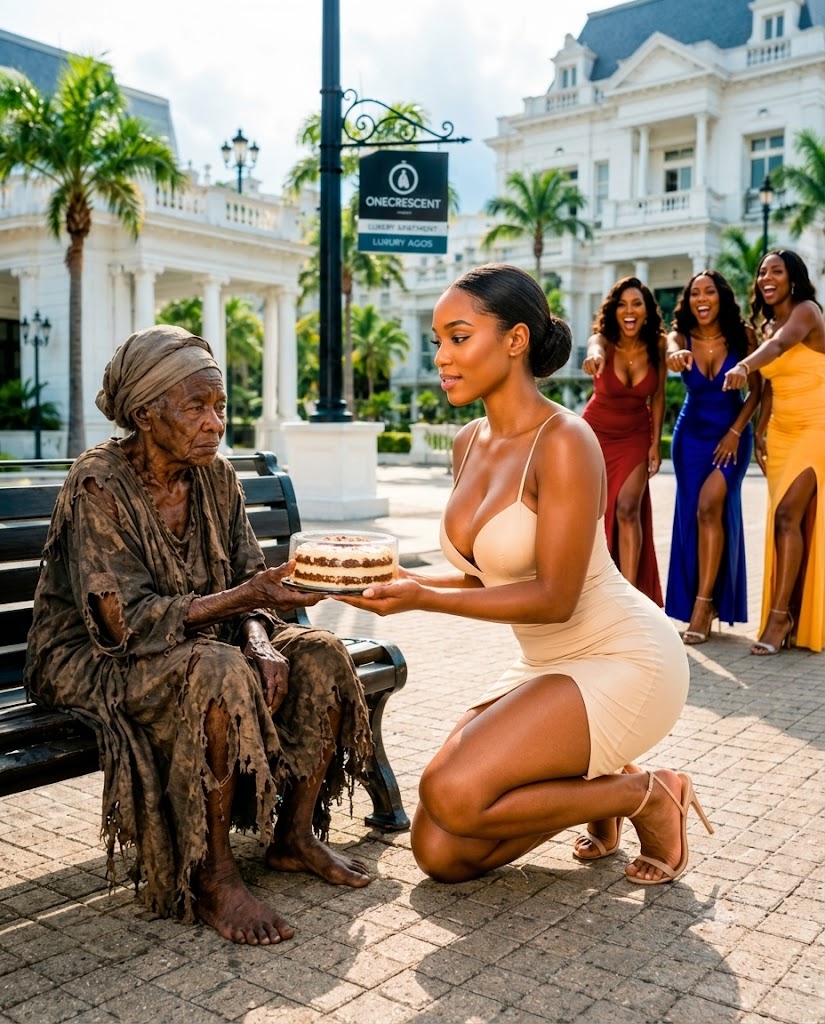
The rain came down in sheets across the parking lot of the Food Lion on Route 9, the kind of cold October rain that made even the fluorescent lights inside the store look warm and inviting. Nwali stood at the bus stop with her collar turned up, watching the automatic doors slide open and closed, open and closed, each time releasing a puff of heated air that vanished before it reached her. She had exactly seven dollars and forty cents in her checking account, and she knew this because she had checked the balance three times on her phone before the screen cracked and stopped responding altogether. Seven dollars and forty cents, and a bus that was now twenty-two minutes late.
She was twenty-six years old, and she was hungry in a way that had stopped being dramatic and had become simply mathematical. Two meals yesterday, one meal the day before, and today nothing yet because she had been foolish enough to believe the temp agency when they said the check would clear by Friday. It was Friday. The check had not cleared. The woman on the phone had said these things happen, and Nwali had said yes, they do, and then she had walked out of the temp agency office and stood on the sidewalk for a long time, trying to decide whether to cry or to laugh.
She had chosen neither. She had chosen to walk to the Food Lion because walking was free and the store was warm, and because sometimes they marked down the day-old bakery items to fifty cents, and fifty cents was something she could still afford.
The old woman appeared at the edge of the parking lot like she had been there all along, like the rain had simply decided to arrange itself into a human shape. She was small and bent and wore a coat that had been repaired so many times the original fabric was more suggestion than substance. She was holding a plastic bag that had split open at the bottom, and the few things she had been carrying, a can of beans, a loaf of bread that was mostly crust, a single apple with a bruise the size of a quarter, were scattered across the wet asphalt.
No one was helping her. People walked past with their umbrellas and their full shopping carts, their eyes fixed on the dry safety of their cars. Nwali watched for a moment, and then she did the math again. Seven dollars and forty cents. A bus that was now twenty-eight minutes late. A hunger that had become a kind of background noise, constant and manageable.
She walked over and knelt down in the rain.
“Let me help you,” she said.
The old woman looked at her with eyes that were cloudy with age but sharp in a way that made Nwali feel seen in a manner she was not entirely comfortable with. “I had it,” the woman said. “I had it all, and then the bag gave out.”
“It’s okay,” Nwali said. “We’ll get it.”
She gathered the can, the bread, the apple. The bread was soaked through, the apple had rolled under a car, and the can was dented in a way that suggested it had been dropped before. Nwali put them all in her own bag, a canvas tote she had gotten free at a library fundraiser two years ago, back when she had a library card and an address and a life that made sense.
“Where are you going?” Nwali asked.
“Home,” the old woman said. “It’s not far.”
“It’s raining.”
“I know.”
Nwali looked at the bus stop, then at the old woman, then at the Food Lion with its warm lights and its day-old bakery items. She thought about the seven dollars and forty cents. She thought about the bus that was now thirty-one minutes late and might not come at all.
“Come with me,” she said.
—
Inside the Food Lion, the fluorescent lights hummed like tired bees. Nwali led the old woman to the bakery section, where a small cart held the marked-down items: a few muffins, a loaf of Italian bread, a single slice of honey cake wrapped in plastic with a yellow sticker that said fifty cents. The honey cake was the last one, and it looked like it had been made for a celebration that had never happened.
Nwali picked it up. The old woman watched her.
“You don’t have to,” the old woman said.
“I want to,” Nwali said, and she meant it, and that was the strange thing. She meant it.
She paid fifty cents for the honey cake and forty cents for a cup of hot coffee from the machine near the registers, and she gave both to the old woman, who held them like they were made of gold. They sat on a bench near the entrance, and the old woman ate the cake slowly, breaking off small pieces and letting them dissolve on her tongue like she was tasting something she had forgotten.
“My name is Nwali,” Nwali said.
“I know,” the old woman said.
Nwali blinked. “How?”
“I know a lot of things,” the old woman said. “I know you’re hungry. I know you’re tired. I know you gave me your last food, and I know you didn’t do it because you thought I would pay you back.”
“I didn’t,” Nwali said.
“I know,” the old woman said. “That’s why.”
She finished the cake and drank the coffee, and then she stood up, and she looked at Nwali with those cloudy-sharp eyes, and she said something that Nwali would think about for the rest of her life.
“The truth always finds its way, child. Sometimes it just needs someone to help it along.”
And then she walked out into the rain, and she was gone.
—
The next day, Nwali got a call from the temp agency. The check had cleared. They had a placement for her, a front desk job at a private security firm, starting Monday. It paid eighteen dollars an hour, which was more than she had ever made in her life. She said yes before they finished describing the job.
The firm was called Sentinel Group, and it occupied the top three floors of a glass building downtown. Nwali showed up on Monday in the only professional outfit she owned, a navy skirt and a white blouse she had ironed three times the night before, and she sat at the front desk and answered phones and smiled at people who walked past without seeing her. She was good at being invisible. She had practice.
On her third day, a man came through the lobby who did not walk past without seeing her. He was tall and broad-shouldered and wore a suit that fit him like it had been made for him, which it probably had. He stopped at her desk and looked at her nameplate, which she had printed herself because HR had not gotten around to it yet.
“Nwali,” he said. “That’s an unusual name.”
“Is it?” she said.
“I like it,” he said. “I’m Alen.”
“I know who you are,” she said. “You own this company.”
“I do,” he said. “But that’s not why I’m standing here.”
“Why are you standing here?”
“Because you’re the first person in three days who hasn’t looked at me like I’m a number on a spreadsheet,” he said. “And I wanted to see if that was real.”
Nwali looked at him. She thought about the old woman, and the honey cake, and the way the truth sometimes needed help finding its way. She thought about the seven dollars and forty cents, which was now thirteen dollars and twenty cents after three days of work, and about how she was still hungry, and about how none of that mattered right now.
“It’s real,” she said.
Alen smiled. “Good,” he said. “I’ll see you tomorrow.”
—
He came back the next day, and the day after that, and the day after that. He brought her coffee that was better than the machine near the registers. He asked her questions that no one had ever asked her before, about where she grew up, about what she wanted, about why she had a habit of looking at the door like she was ready to leave at any moment. She told him the truth, or most of it, because she had learned that the truth was a currency that not everyone deserved, and she was still deciding if he was one of the people who did.
She did not tell him about the old woman. She did not tell him about the seven dollars and forty cents. She did not tell him that she was still hungry, that she was still sleeping on a friend’s couch, that her life was held together by duct tape and hope and the kindness of strangers.
But he figured it out anyway.
“You’re not eating,” he said one day, when they were sitting in the cafeteria and she had pushed her tray away after two bites.
“I’m not hungry,” she said.
“You’re lying,” he said. “And you’re bad at it.”
“Excuse me?”
“I’ve been watching you,” he said. “You eat like someone who doesn’t know when their next meal is coming. You look at the door like someone who’s waiting for the other shoe to drop. You don’t talk about your family, you don’t talk about your past, and you flinch every time someone mentions money.”
Nwali stared at him. “That’s a lot of watching.”
“I’m a security guy,” he said. “It’s what I do.”
“I thought you were the owner.”
“I’m both,” he said. “And I’m also the guy who wants to know why you gave your last fifty cents to an old woman in a grocery store two weeks ago.”
The room went very quiet. Nwali could hear her own heartbeat, loud and fast, like a drum in a small room.
“How do you know about that?” she said.
“I have cameras,” he said. “I have people. I have a strange habit of noticing things that don’t add up. You showed up at my company with a resume that says you’re a temp, but you talk like someone who’s been through things, real things. You look at the world like you’re waiting for it to hurt you. And then I find out you gave your last food to a stranger, and I think, that’s not a temp. That’s a person.”
“I don’t know what you want me to say,” Nwali said.
“I don’t want you to say anything,” Alen said. “I want you to let me help.”
—
She did not let him help. Not at first. She was proud in the way that people who have nothing are proud, which is to say she was terrified of being seen. But he kept showing up, kept bringing coffee, kept asking questions, kept looking at her like she was a person and not a problem to be solved.
And then, one night, everything changed.
She was walking home from the bus stop, through a part of town that was not dangerous but was not safe, either, when she heard footsteps behind her. She turned, and there was a man, and he had a knife, and he wanted her bag. She gave it to him. She gave him everything, the thirteen dollars and twenty cents, the cracked phone, the canvas tote, and he took it and ran, and she stood there in the dark, shaking, and thought about the old woman, and the honey cake, and the truth that always finds its way.
She called 911. She gave a statement. She went home to her friend’s couch and lay there, staring at the ceiling, and thought about how she had nothing, again, still, always.
The next morning, Alen was waiting for her at the front desk.
“I heard what happened,” he said. “Are you okay?”
“I’m fine,” she said.
“You’re not fine,” he said. “You’re shaking.”
“I’m fine,” she said again, and then she started to cry, and she couldn’t stop, and he held her, and she let him, and that was the moment when everything began to change.
—
He took her to dinner that night. A real dinner, at a real restaurant, with tablecloths and candles and a menu that did not have prices on it because people who ate there did not need to know the prices. Nwali ordered the cheapest thing she could find, and Alen ordered for both of them, and the food came, and she ate until she was full, truly full, for the first time in months.
“I want to tell you something,” he said, when they were done.
“Okay,” she said.
“I know who you are,” he said. “Not just your name. I know where you came from. I know about your mother, and your father, and the foster homes, and the years of moving from place to place. I know about the temp jobs and the couch-surfing and the hunger. I know all of it.”
Nwali put down her fork. “How?”
“I told you,” he said. “I’m a security guy. It’s what I do.”
“You investigated me.”
“I did,” he said. “And I’m sorry. But I needed to know if you were real.”
“And?”
“And you are,” he said. “You’re the realest person I’ve ever met. And I want to help you, Nwali. Not because I feel sorry for you. Because I see you. Because you gave your last food to a stranger, and that’s the kind of person I want in my life.”
“I don’t need your charity,” she said.
“It’s not charity,” he said. “It’s an offer. Come work for me. Not as a temp. As my head of security. You have instincts. You have guts. You have a way of seeing people that most people don’t. I’ll pay you a real salary. I’ll give you a real life. And in return, you give me the truth. Always. No secrets. No lies. No disguises.”
Nwali looked at him. She thought about the old woman. She thought about the honey cake. She thought about the seven dollars and forty cents, and the knife in the dark, and the way the truth always finds its way, sometimes with a little help.
“Yes,” she said. “Okay. Yes.”
—
The job was harder than she expected and better than she imagined. She learned about security systems and threat assessment and the delicate art of reading people without them knowing they were being read. She learned that Alen was not just the owner of a company but the heir to a fortune, the kind of money that made people behave strangely, the kind of money that turned families into enemies and friends into strangers. She learned that he had been lied to before, by people who wanted his money, and that he had built walls around himself that were high and thick and almost impossible to climb.
She climbed them anyway.
She did not tell him about the old woman. Not at first. She kept that story close, like a talisman, like a reminder that even when she had nothing, she had been able to give something. And then, one night, when they were lying in bed and the city lights were painting patterns on the ceiling, she told him everything.
“The honey cake,” she said. “It was the last thing I had.”
“I know,” he said.
“No,” she said. “You don’t know. You know about the store. You know about the cameras. You don’t know what it felt like. To give away the last thing I had. To watch her eat it. To know that I would go hungry so she wouldn’t have to.”
Alen was quiet for a long time. Then he said, “I know what it feels like to give away something you need. I’ve done it. Not food. But things. Money. Trust. And every time, I wondered if it was worth it.”
“Was it?” Nwali asked.
“Sometimes,” he said. “And sometimes it was just something I did because I didn’t know what else to do.”
“That’s how I felt,” she said. “I didn’t know what else to do. So I did that.”
“And it changed your life,” he said.
“It did,” she said. “But not because of the cake. Because of what came after. Because of you. Because of the truth.”
—
Two years later, they were married. The wedding was small, just close friends and the few family members who still spoke to Alen, and it was held in a garden that was warm and bright and smelled like honey. Nwali wore a dress that cost more than everything she had owned three years ago, and she walked down the aisle with her head held high, and she thought about the old woman, and the honey cake, and the truth that always finds its way.
And then, just before the ceremony began, she saw her.
The old woman was sitting in the back row, wearing a coat that had been repaired so many times the original fabric was more suggestion than substance. She was holding a plastic bag that had split open at the bottom, and inside the bag was a single slice of honey cake, wrapped in plastic, with a yellow sticker that said fifty cents.
Nwali stopped walking. The music kept playing. The guests kept smiling. Alen looked at her, confused, and then he followed her gaze, and he saw the old woman, and he understood.
“She’s real,” Nwali whispered.
“I know,” Alen said. “I’ve always known.”
“You knew?”
“I told you,” he said. “I’m a security guy. I notice things.”
The old woman stood up. She walked to the front of the garden, slowly, carefully, like someone who had been waiting a long time for this moment. She stopped in front of Nwali and held out the bag.
“I brought you something,” she said. “For the wedding.”
Nwali took the bag. Inside was the honey cake, the same kind she had bought that night in the Food Lion, the same kind she had given away without knowing why. She looked at the old woman, and the old woman looked at her, and for a moment, the whole world was silent.
“It was never about the cake,” the old woman said. “It was about the choice. You chose to give when you had nothing. That’s the kind of choice that changes everything.”
“Who are you?” Nwali asked.
“I’m just an old woman,” she said. “But I was also a test. A test of who you were, and who you could become. And you passed, child. You passed.”
She turned and walked away, and this time, Nwali did not try to stop her. She watched her go, and she thought about the seven dollars and forty cents, and the honey cake, and the truth that always finds its way, and she knew, with a certainty that went beyond words, that everything was exactly as it should be.
—
Alen found her later, after the ceremony, standing alone in the garden, holding the slice of honey cake.
“Are you okay?” he asked.
“I’m fine,” she said. “I’m better than fine. I’m whole.”
“What did she mean?” he asked. “About the test?”
Nwali looked at him. She thought about the years of hunger and fear and loneliness. She thought about the night she gave away her last food to a stranger. She thought about the job, the love, the life she had built from nothing.
“I think,” she said, “that some people are put in our path to see if we’re paying attention. And if we are, they show us who we really are.”
“And who are you?” Alen asked.
Nwali smiled. She took a bite of the honey cake. It was sweet and soft and tasted like everything she had ever wanted.
“I’m someone who gives,” she said. “Even when I have nothing. Especially when I have nothing.”
And then she kissed him, and the sun set, and the truth, at last, had found its way home.
—
But that was not the end. That was the beginning.
The honey cake became a symbol, a reminder, a promise. Every year on the anniversary of the night she gave it away, Nwali bought a slice of honey cake from the Food Lion on Route 9 and gave it to someone who needed it. Sometimes it was a homeless man on the corner. Sometimes it was a single mother in the checkout line. Sometimes it was a child who looked hungry and scared and alone.
She never told them why. She never asked for anything in return. She just gave, and she watched, and she waited for the truth to find its way.
And it always did.
Three years after the wedding, Nwali and Alen started a foundation. They called it The Honey Cake Project, and its mission was simple: to help people who had nothing give something to someone else. The idea was that generosity was not about what you had but about what you chose to do with it.
The foundation grew. It spread. It touched thousands of lives. And every time Nwali read a letter from someone who had been helped, someone who had given their last dollar to a stranger and then found their life changed in ways they could not explain, she thought about the old woman, and the honey cake, and the truth that always finds its way.
She never saw the old woman again. But she felt her presence in every act of kindness, every choice to give when giving was hard, every moment when someone decided to be better than they had to be.
And she knew, with a certainty that went beyond words, that the old woman had been real. Not just a test, not just a symbol, but a person. A person who had seen Nwali when no one else did. A person who had believed in her when she did not believe in herself.
A person who had given her the greatest gift of all: the knowledge that she was worthy of love.
—
The years passed. Nwali and Alen had children, two girls who inherited their mother’s sharp eyes and their father’s quiet strength. They grew up hearing the story of the honey cake, of the old woman in the rain, of the truth that always finds its way.
And when they were old enough, Nwali took them to the Food Lion on Route 9. The store had been renovated, the fluorescent lights replaced with LEDs, the bakery section expanded, but the honey cake was still there, still wrapped in plastic, still marked with a yellow sticker.
“Mom,” her daughter asked, “why do we always come here?”
Nwali knelt down. She looked at her daughter, and she thought about the old woman, and she said the words that had been given to her so many years ago.
“The truth always finds its way, child. Sometimes it just needs someone to help it along.”
And then she bought two slices of honey cake, one for each of her daughters, and they sat on a bench near the entrance, and they ate, and they watched the people walk by, and they waited for the truth to find its way.
Because it always did. It always does.
—
But there was one more thing. One more piece of the story that Nwali did not learn until many years later, when she was old herself, when her daughters were grown and her husband had passed and she was sitting in a garden that was warm and bright and smelled like honey.
A young woman came to her, a reporter, writing a story about the foundation. She asked Nwali about the old woman, about the honey cake, about the night that had changed everything.
“I’ve heard the story,” the reporter said. “But I’ve always wondered: who was she? The old woman. Did you ever find out?”
Nwali was quiet for a long time. Then she said, “I found out. Years later. After Alen died. I was going through his things, and I found a file. A file about a woman named Eleanor Vance.”
“Who was she?”
“She was a private investigator,” Nwali said. “Alen hired her, years before he met me. He hired her to test the people who came into his life, to see if they were real. She was the one who found me. She was the one who told him about the honey cake.”
“She was a test?”
“She was,” Nwali said. “But she was also a person. She had her own story, her own pain, her own reasons for doing what she did. And she chose to help me, even though she didn’t have to. She chose to see me, even though I was invisible.”
The reporter wrote something down. “And what did you learn from her?”
Nwali smiled. She thought about the seven dollars and forty cents. She thought about the honey cake. She thought about the truth that always finds its way.
“I learned,” she said, “that we are all connected. That every choice we make, every kindness we offer, every truth we tell, ripples out into the world in ways we cannot see. And that sometimes, the smallest act of generosity can change everything.”
She looked at the reporter, and she saw herself in the young woman’s eyes. She saw hunger and hope and the desperate need to believe that the world was good.
“Would you like a slice of honey cake?” Nwali asked.
The reporter blinked. “I’m sorry?”
“Honey cake,” Nwali said. “It’s the last one. I was saving it for someone special.”
The reporter looked at the cake, then at Nwali, then at the garden around them. And then she smiled, and she said yes.
And Nwali gave her the cake, and watched her eat it, and knew, with a certainty that went beyond words, that the truth had found its way once again.
Because it always did. It always does.
—
That night, Nwali dreamed of the old woman. She was standing in the rain, in the parking lot of the Food Lion on Route 9, holding a plastic bag that had split open at the bottom. She was smiling.
“You did well, child,” the old woman said. “You did very well.”
“I had help,” Nwali said.
“We all have help,” the old woman said. “That’s the secret. None of us do it alone.”
“Will I see you again?”
The old woman laughed. It was a sound like honey, sweet and warm and full of light.
“You see me every day,” she said. “In every choice you make, in every kindness you offer, in every truth you tell. I am the voice that says give when you have nothing. I am the hand that reaches out when no one else will. I am the love that never dies.”
And then she was gone, and Nwali woke up, and the sun was shining, and the world was full of possibility.
She got out of bed. She made herself a cup of coffee. She looked out the window at the city below, at the people walking by, at the lives being lived and the stories being told.
And then she went out into the world, and she found someone who needed help, and she gave them what she had.
Because that was the truth. That was always the truth.
And the truth, at last, had found its way home.









