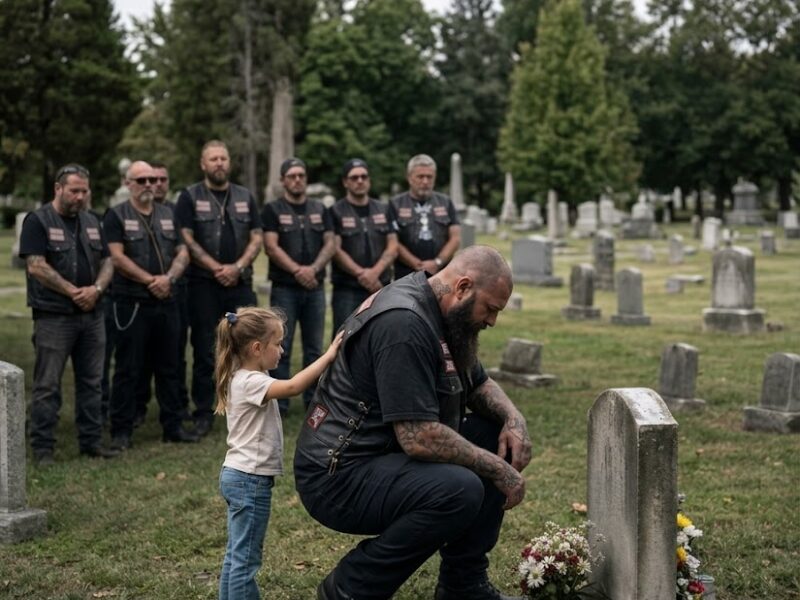
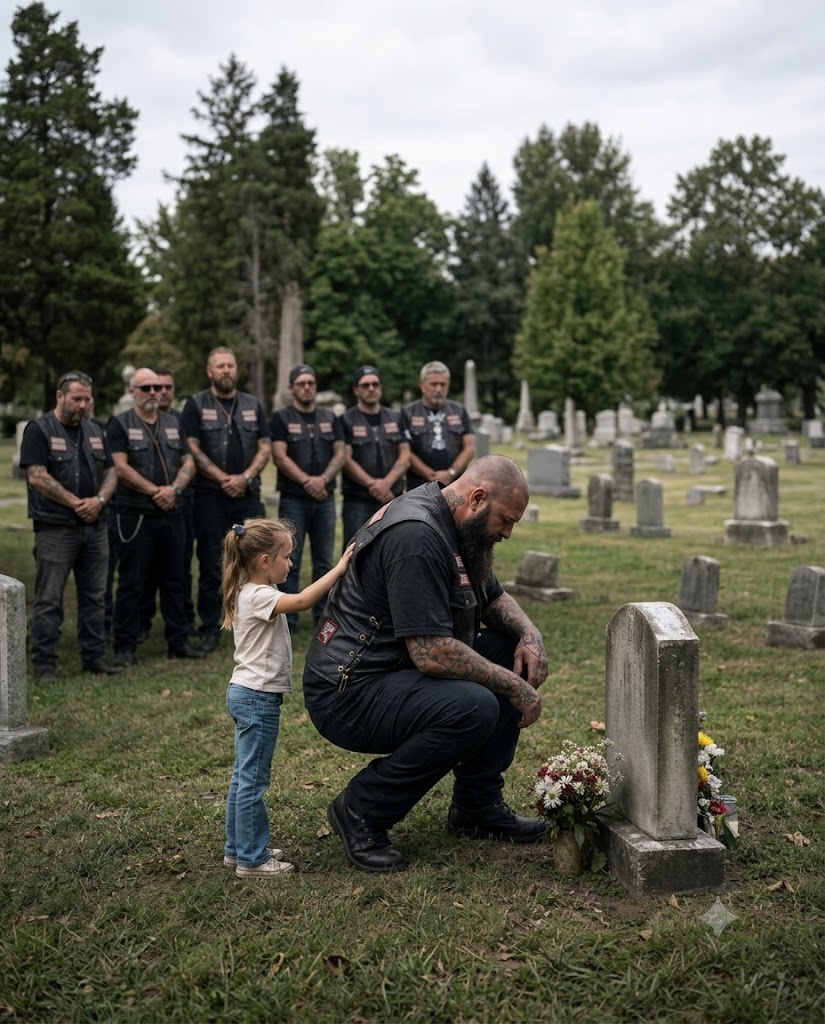
She found a Hells Angel crying alone at a cemetery. What 1,200 bikers did next left everyone speechless.
Part 1
She was seven years old, and she walked straight toward him without hesitating. He was six-foot-two, 230 pounds, covered in tattoos, crying alone at a grave in a cemetery that had gone very quiet. She stopped in front of him. He looked up. She said four words, and those four words would put 1,200 motorcycles on the road, crack open a town’s certainty about itself, and turn one man’s grief into something that nobody—not the newspaper, not the neighborhood association, not 1,200 bikers riding in from six states—could have predicted when they woke up that morning. Nobody ever does. You already know how this ends. What you don’t know, what nobody knew until it happened, is how something this impossible became this real.
The October air in Harrisburg carried the particular cruelty of a Pennsylvania fall—cold enough to remind you that warmth was leaving, but not cold enough to numb anything that mattered. Gerald Whitmore pulled his Road King into the gravel path of Rolling Hills Cemetery just before 9:00 in the morning. The engine growled low before going silent like a held breath. He sat on the bike for a moment, one boot resting on the kickstand, both hands gripping the handlebars as though he needed them to stay upright. He did.
He was not a small man. Gerald stood six-foot-two when he bothered to stand straight, which was less often than it used to be. His arms were sleeves of faded tattoos—an anchor on his left forearm, a bald eagle spanning his right bicep, names and dates and symbols layered over twenty-five years of choices and consequences. His beard had gone silver at the edges. His face was the kind of face that made strangers on sidewalks find something interesting to look at on the other side of the street. He had learned not to take it personally, most days.
He wore his cut, the leather vest that bore the winged skull patch of the Harrisburg chapter, over a black thermal. The patch read “Gerald” on the left breast. No last name. In the club, last names were for paperwork and funerals. Today was a funeral in its own way. He dismounted slowly, the way men do when their knees have absorbed too many Pennsylvania winters and too many miles of interstate. He carried nothing except a small bundle wrapped in newspaper—wildflowers he’d stopped to pick on Route 39 just outside of town, the kind that grew in the median and that nobody planted on purpose. He hadn’t been able to find a flower shop open that early. He hadn’t tried very hard, either. Somehow the wildflowers felt more honest.
The cemetery was nearly empty. A groundskeeper was working at the far end, raking leaves from the path near the older section of graves. Two women in dark coats walked side by side near the entrance, speaking softly. Nobody paid Gerald any attention yet. That would change, he knew, the moment they looked up long enough to take stock of him. He walked the familiar path without needing to check the map near the entrance gate. He had been here fourteen times in two years. He knew every tree, every cracked section of concrete, the way the land dipped slightly near the older graves and leveled out again where the newer ones were placed.
Row G, plot 14. The headstone was dark gray granite, modest and clean. His chapter had paid for it. Gerald had insisted on that, even when the others had said it wasn’t necessary, even when the national organization had offered funds. He had written the check himself, with the handwriting of a man who rarely writes checks but does so with great deliberateness when the occasion demands it. Thomas Ray Whitmore, 1981–2022. Brother, son, he rode with honor. Thomas had been Gerald’s younger brother by eleven years. He had followed Gerald into the club at twenty-three with a particular combination of reverence and recklessness that younger brothers carry when they look up at their older siblings. Gerald had tried to talk him out of it, which was its own form of hypocrisy, and Thomas had laughed in the easy way he laughed at everything.
“You can’t protect me from the thing you built, Jerry,” he’d said. And he was right. Gerald had never fully forgiven himself for that truth. Thomas had died on a Tuesday in March—not violently, not dramatically, in the way that people who know bikers always seem to expect. He had collapsed in his kitchen from a heart defect nobody knew he had. He was forty-one years old. He was three weeks away from the birth of his first child. Gerald lowered himself to one knee in front of the headstone. The gravel bit through the denim. He placed the wildflowers at the base of the stone, arranging them with a care that would have surprised most people who knew him. He pressed one large tattooed hand flat against the granite, which was cold in the October morning, cold in the way that reminded you of the difference between stone and skin.
He didn’t speak. He never spoke at the grave. He had tried early on, and the words had felt wrong—too rehearsed, too performative, like he was acting grief rather than carrying it. So he just stayed. He stayed and breathed and let the weight of it settle over him without fighting it. That was when the tears came. They came the way they always did—not dramatically, not in heaving sobs, but quietly and without warning. Two lines tracing down through the silver-edged beard. His jaw tightened. His hand pressed harder against the stone. His broad shoulders drew inward slightly, that particular collapse of big men when they have no more use for their bigness.
He was so occupied with the business of his grief that he did not hear the small footsteps on the gravel path behind him.
“Are you sad?”
The voice was so close and so unexpected that Gerald’s head snapped up and he pushed to his feet in a single reflexive motion. One hand instinctively moving to his side. Old habits, wrong context. He turned and found himself looking down at a child. She was small, maybe six or seven years old, with dark brown curls pulled into two uneven pigtails that suggested she’d done them herself. She wore a yellow raincoat despite the absence of rain and rain boots with small frogs printed on them. She held a single orange marigold in her right hand, the stem bent slightly where she’d been gripping it too hard. Her eyes were large and very dark and entirely unafraid. She was looking up at him the way children look at things they find genuinely interesting, without any of the social calculus that adults layer over their curiosity.
“Are you sad?” she repeated, because he hadn’t answered.
Gerald stared at her for a moment. He cleared his throat. He wiped his face with the back of his hand in a motion that was not subtle, but was intended to be. “I’m fine,” he said. It came out rougher than usual. The girl tilted her head. She looked at the headstone, then back at him.
“My grandma says it’s okay to be sad when someone you love goes away,” she said. “She says crying is just love with nowhere to go.”
Gerald opened his mouth, closed it. He had faced difficult situations in his life—bar confrontations, police interactions, the kind of conversations that happened in the back rooms of places with no windows. None of them had left him quite as disarmed as this. “That’s—” he started. “That’s a good thing to say.” The girl nodded as if this confirmed something she’d already suspected. She stepped forward and with great ceremony placed her marigold against the base of the headstone, right next to his wildflowers. Then she straightened up and looked at the name carved in the granite.
“Did you know him?” she asked.
“He was my brother.”
“Oh.” She was quiet for a moment. “I’m sorry your brother went away.”
Gerald’s throat tightened. He had received condolences from dozens of people over the past two years—at the funeral, at the chapter meetings, from people at the bar who’d known Thomas, from people at the bar who hadn’t known Thomas but knew how to read a room. None of them had hit quite like this. There was no performance in it. There was no careful selection of appropriate words. There was just a small child in a yellow raincoat who was sorry.
“Thank you,” he said, and meant it more than he had meant anything in a long time.
“I’m Vivian,” the girl said, extending her right hand with the seriousness of someone who has recently learned the value of proper introductions. He reached down and shook it gently. “Gerald.”
“My daddy’s over there.” She pointed toward a bench near the path about forty feet away. A man sat there—mid-thirties, wearing a gray jacket, watching them with an expression that was somewhere between concern and paralysis. He had clearly seen his daughter approach the large tattooed biker and had either trusted her judgment or had been too stunned to intervene in time. Gerald raised a hand in the man’s direction. A simple gesture. The man, after a visible pause, raised one back. Vivian turned back to Gerald.
“We come to see my grandpa,” she said. “He went away last year. Daddy says it’s important to visit so he knows we still love him.”
“Your daddy sounds like a smart man.”
“He cries, too,” Vivian said matter-of-factly. “But only when he thinks I’m not looking.” She paused. “I think grown-ups think crying is a secret.”
Gerald almost smiled. Almost. “Maybe some grown-ups do.”
“Do you?”
The October wind moved through the cemetery, sending a small cascade of oak leaves across the gravel path. In the distance, the groundskeeper’s rake made its quiet, rhythmic sound. “I used to,” he said finally. “I’m working on it.” Vivian seemed to find this acceptable. She looked at the headstone one more time, then back at Gerald.
“Your brother’s flowers are pretty,” she said. “The ones without the pots are my favorite kind. They look like they came from somewhere.”
“They did,” Gerald said. “Route 39, the median near the Chambers Hill exit.”
She nodded gravely, as if filing this information away. Then she said, “I hope you feel better,” turned around, and walked back toward her father with the complete and unhurried confidence of someone who has done what they came to do. Gerald watched her go. He watched the father stand and take the girl’s hand and say something to her quietly, glancing back at Gerald once more. Gerald nodded. The father nodded back. They moved off down the path. He stood alone at the grave for another ten minutes. The crying had stopped—not forced away, but genuinely quieted, the way a storm sometimes simply passes. He had not expected that. He had not expected any of it.
When he finally walked back to his bike, started the engine, and pulled out of Rolling Hills Cemetery onto the main road, Gerald Whitmore did not know that the conversation he’d just had—sixty-three words from a child in a yellow raincoat—was about to fracture something open in the life of his town. He just knew that for the first time in weeks, the weight on his chest felt, if not lighter, then at least more bearable. He was not prepared for what would come next. None of them were.
Gerald stopped at Manny’s Diner on Derry Street on his way back from the cemetery, the way he did most Saturday mornings. Manny’s was not a biker bar. It was a neighborhood diner with vinyl booths, a laminated menu that hadn’t changed in fifteen years, and a coffee so strong it had a local reputation. Gerald had been coming here since 2009, when the neighborhood had still been the kind of place where nobody asked questions about the man on the loud motorcycle who sat in the corner booth and ordered the same thing every time. The neighborhood had changed since then. The street had gotten newer restaurants, a boutique, a yoga studio that shared a wall with a porn shop in what felt like a zoning oversight. The demographics had shifted. Gerald in his cut and his silence had become something of a relic, a fixture that the newer residents hadn’t asked for but had learned to work around.
He sat in the corner booth. Sandra, the waitress who had been at Manny’s longer than Gerald had been a customer, brought his coffee without being asked and said, “You look like you had a morning.”
“Cemetery,” he said. She nodded. Sandra was sixty-two, had the efficient sympathy of someone who’d been listening to people’s problems across a counter for four decades, and knew when to speak and when not to. She did not speak. She poured the coffee and left him to it. The diner was about half full. Gerald recognized a few faces—the couple from the hardware store two blocks over who came in every Saturday, the retired postal worker who sat at the counter and read the paper, a young woman he didn’t know working on a laptop near the window. Nobody looked at him with anything other than the mild acknowledgment of regular coexistence. This was the equilibrium Gerald had established through years of showing up, ordering, paying, tipping well, and leaving without incident.
What had disrupted that equilibrium, though he didn’t know it yet, was a man named Paul Kettner. Paul Kettner was thirty-four, worked in insurance, and had been at Rolling Hills Cemetery that morning visiting the grave of his college roommate who had died in an accident three years prior. Paul had arrived at the cemetery around the same time as Gerald, had taken a longer path through the older section, and had ended up walking past row G just as a small girl in a yellow raincoat was approaching a large tattooed man kneeling at a grave. Paul had taken out his phone because Paul Kettner was the kind of man who took out his phone. He had filmed thirty-seven seconds of the interaction—the child’s approach, the conversation he couldn’t hear, the moment she placed her flower next to Gerald’s, the handshake.
He had posted it to the Harrisburg Community Connect Facebook group at 9:47 a.m. with the caption, “Interesting scene at Rolling Hills this morning. Little girl wasn’t afraid.” By noon, the post had 340 reactions and 89 comments. By 3:00, it had been shared 1,200 times. The comments were, as they tend to be, a study in human contradiction. Many were warm. “Children see people, not appearances.” “This made my day.” “That little girl is braver than most adults.” But a significant portion were not. “Why is a Hells Angel hanging around a cemetery where families go?” “Someone should have stepped in.” “I’m sorry, but this made me uncomfortable.” “What are we teaching our kids?” And then there were the ones that fell somewhere in the middle, the curious ones. “Does anyone know who this is?” “Is this the same chapter that had trouble a few years back?” “Someone should find out more about this guy before we call it heartwarming.”
Gerald found out about the post because Denny called him. Denny Marsh was the sergeant-at-arms of the Harrisburg chapter, a compact, broad-shouldered man of fifty-one who had a habit of knowing things before other people did, which Gerald had always attributed to the fact that Denny talked to literally everyone and forgot nothing. Denny called at 2:00 in the afternoon while Gerald was in his garage doing the kind of maintenance that doesn’t need doing but fills the hours.
“You’re the internet,” Denny said without preamble.
Gerald put down the wrench. “Explain that.”
Denny explained it. Gerald listened. When Denny was done, Gerald said, “How bad?”
“Mixed,” Denny said. “Some of it’s good. Some of it’s the kind of thing that turns into a thing.”
“I don’t want it to turn into a thing.”
“I know you don’t, but there’s a reporter from the Patriot News who commented asking if anyone knows your name. And that particular train has a way of leaving the station.”
Gerald was quiet for a moment. Through the open garage door, he could see the neighbor’s dog moving through the leaf-covered yard next door. “The girl,” he said. “Is she in the video?”
“Partially. You can’t see her face clearly. The angle’s from behind and to the side.”
“Good. I don’t want her family pulled into this.”
“Agreed. What do you want to do?”
Gerald thought about it. He thought about Vivian in her yellow raincoat, the way she’d placed the marigold with such deliberateness, the way she’d said, “I hope you feel better,” as if it were the most natural thing in the world, the way her father had watched from the bench with that particular expression of a man who is afraid and choosing trust simultaneously. “Nothing,” Gerald said. “I want to do nothing. It’ll pass.”
It did not pass. By Sunday morning, the Patriot News had run a short piece on its website. The reporter, a young woman named Cassandra Holt, had done her homework. The piece identified Gerald by name, referenced the Harrisburg chapter of the Hells Angels, included a brief history of the club’s national reputation, and mentioned, with careful journalistic neutrality, that the chapter had been investigated by the Pennsylvania State Police in 2018 for alleged ties to illegal activity, though no charges had been filed against any Harrisburg members. The piece was factual. It was also, Gerald felt when he read it, a document designed to let readers draw conclusions that the reporter herself could not be held responsible for. There was the warm moment in the video, carefully described, and then there was the history, carefully presented. The reader was left to decide what to do with the proximity of those two things.
The comments on the news article were significantly less mixed than the Facebook post. “This man has no business being around children.” “But the Hells Angels are a criminal organization, period.” “The history doesn’t lie.” “I feel sorry for that little girl’s parents.” “Call me old-fashioned, but I would not want my kid talking to a member of a biker gang in a cemetery.” Gerald read them once. He did not read them again. What he did instead was go to the chapter meeting that Sunday evening at the clubhouse on Paxton Street—a converted auto shop that the chapter had owned since 1997, with a common room, a small kitchen, and a back office that smelled of old coffee and machine oil. There were eleven members present. Gerald sat at the head of the table because he was the chapter president, a position he had held for six years, a position he sometimes thought he’d held for six years too long. He told them what had happened—the cemetery, the girl, the video, the news article. He kept it brief and factual, which was how he kept everything.
When he was finished, there was a silence of the kind that happens in rooms full of men who were all thinking the same thing but waiting to see who says it first. It was Roy Sykes who said it. Roy was fifty-seven, had been in the chapter for twenty years, and had the particular bluntness of a man who had decided somewhere in his early forties that there was no longer any value in being tactful. “They’re going to use this to come at the chapter,” Roy said. “The 2018 thing is already in the article. That’s not an accident.”
“I know,” Gerald said.
“So what do we do?”
Gerald leaned back in his chair. He looked around the table at faces he had known for years, at men who had built lives that the outside world had decided to read as threats before they’d read anything else. He thought about Thomas. He thought about Vivian’s flower placed next to his wildflowers. He thought about the father on the bench choosing trust. “We do what we always do,” Gerald said. “We live right and let people catch up.” Roy made a sound that was not quite agreement. Around the table nobody spoke, but several men nodded, and Gerald understood that nod. He had been understanding that nod for twenty years. It meant, “We’re with you.” It meant, “We don’t love this.” It meant, “All right.”
What he did not tell them—what he could not yet tell them because it was still forming in the back of his mind like weather on the horizon—was that the idea had already arrived. Not fully shaped yet, not ready to be spoken aloud, but there. The week that followed was the kind of week that ages a person. Gerald went to work. He ran an automotive repair shop on the eastern edge of Harrisburg, a legitimate business he had built from a two-bay garage in 2004 that now had six bays, three full-time mechanics, and a reputation for honest work at fair prices. His customers were ordinary people—teachers, contractors, retired couples, a woman who drove a food truck, a man who delivered medical supplies to rural clinics. They had chosen Gerald’s shop because the work was good and the prices were fair, and most of them had over the years made a quiet peace with the leather vest that hung on the hook behind the front counter.
That week, two of them did not. A woman Gerald had not previously met called to cancel an appointment she had made for Wednesday. She did not give a reason, but she asked twice whether the owner of the shop was indeed Gerald Whitmore and confirmed twice that she would not be bringing her car in. A man who had been a customer for three years came in on Tuesday for a scheduled oil change, sat in the waiting area for twenty minutes without speaking, and then told Gerald’s front desk employee Brenda that he’d changed his mind and left. Brenda, who was sixty and had the energy of someone twenty years younger and the patience of someone who had earned it, told Gerald about this at the end of the day with the particular expression she used for things she found both infuriating and worth managing carefully.
“You want me to do anything about it?” she asked.
“No,” Gerald said.
“They’ll come back,” she said.
“Or they won’t. Either way.”
“Either way,” he agreed.
The harder thing was the school. Vivian’s father, Gerald learned through a mutual acquaintance on Thursday, was a man named Douglas Hale, who taught fifth-grade math at a local elementary school and coached the youth soccer league on weekends. Douglas had seen the Facebook post. He had seen the news article. He had been, according to Gerald’s acquaintance, quietly furious about both—not at Gerald, but at the world’s decision to transform his daughter’s uncalculated act of kindness into a public event without asking his permission. Douglas had posted his own comment on the Facebook thread, a short plain statement: “That’s my daughter. She did what she was raised to do. The man she spoke to was kind and respectful. I don’t believe in demonizing people I don’t know. That’s all.”
The response to Douglas’s comment had been, if anything, more divided than the original post. He had received private messages—some thanking him, some warning him, and at least one that was hostile enough that he had reported it to Facebook. The hostile ones, Gerald was told, were specifically about allowing a child to interact with a Hells Angel. Gerald heard this and felt the particular anger of a man who knows that the anger itself won’t help. He had felt it before many times—the anger at being judged by a label that had been applied to a complex thing because the Hells Angels were a complex thing, a fact that the world preferred not to accommodate. They were a brotherhood with a history that included both genuine criminal conduct and genuine acts of community. They were men who raised money for veterans and men who had made serious mistakes, and sometimes those were the same men at different points in their lives. The national reputation was real, and Gerald did not pretend otherwise, but he also knew that the Harrisburg chapter—his chapter—had spent the past decade building something different, something that the 2018 investigation had probed and found clean because it was clean. None of that nuance found its way into comment sections.
On Thursday evening, the idea that had been forming since Sunday arrived fully. Gerald was sitting on his back porch with a cup of coffee watching the last of the October light fade behind the tree line when Denny called again.
“You heard about the town hall,” Denny said. Gerald had heard. A neighborhood association in the Midtown Harrisburg district, a group called the Harrisburg Residents for Community Safety, had scheduled an emergency meeting for the following Tuesday. The stated topic: motorcycle clubs and community standards. Three city council members had been invited. The Patriot News had confirmed they would send a reporter.
“They want to put you on trial,” Denny said. “The whole chapter.”
“I know.”
“What are we going to do about it?”
Gerald looked at the tree line. A crow moved through the last of the light and disappeared. He thought about Thomas at twenty-three laughing and saying you can’t protect me from the thing you built, Jerry. He thought about Vivian’s hand in his—small, trusting, entirely unimpressed with everything about him that the town found threatening. He thought about Douglas Hale posting his quiet plain defense and receiving hostility in return. He thought about the idea.
“I’m going to make some calls,” Gerald said.
“What kind of calls?”
“The kind that take a few days to set up.”
Denny was quiet for a moment. “Jerry, if you’re thinking what I think you’re thinking—”
“I’m not thinking anything yet,” Gerald said. “I’m making calls.”
He hung up and sat with the cooling coffee for another twenty minutes. Then he went inside and started dialing. The first call was to the president of the Allentown chapter. The second was to the president of the Philadelphia chapter. The third was to a man in Pittsburgh he had known for twenty-two years who owed him a favor he had never called in and whose network stretched across six states. He made eleven calls that night. He made nine more on Friday. By Saturday morning, he had responses from seventeen chapters and two independent riding clubs, and a number that had started small and was growing in a way that made Gerald Whitmore sit down at his kitchen table and press his hands flat against the wood and breathe.
He had made the calls because of the idea. The idea was simple in the way that ideas that come from grief and love are often simple. The town had decided what the chapter was. Gerald intended to show them something different—not through argument. He had tried argument before in various forms and found it an insufficient tool for moving the kind of certainty that people build around their fears. Through presence, through numbers, through the image of something that the town’s mental picture of a Hells Angel could not easily contain. He did not yet know exactly what form it would take. He knew the where: Rolling Hills Cemetery on the Saturday after the town hall. He knew the what: a ride, a gathering, a presence. He knew the why: because Thomas deserved to be honored by the people who loved him, and because a little girl had placed a marigold next to wildflowers, and the world had tried to make that something frightening, and Gerald Whitmore had decided, in the particular way of a man with very little left to lose, that he was done letting that stand. The number by Saturday evening was 400 and climbing. By Monday, it was 900. By the day of the town hall, it was 1,200.
Part 2
The town hall was held at the Harrisburg Area Community College’s Wildwood Conference Center—a room with fluorescent lighting and stackable chairs that held on a Tuesday evening in late October approximately 230 people, which was 170 more than the organizers had expected. Gerald attended alone. He had considered bringing Denny, had decided against it. Two men in cuts would read as a delegation, a counterforce. One man in a cut read as a person who showed up. He sat in the back row with the particular discipline of a man who has learned to occupy space without claiming it. The meeting was run by a woman named Margaret Flowers, who was the chairperson of the Harrisburg Residents for Community Safety and who had clearly prepared for this evening with the seriousness of someone who believed they were doing important work. She probably was, Gerald thought—just not the work she imagined.
The three city council members sat at a table at the front. There was a microphone. There was an agenda. The agenda included in its third item a discussion of the appropriate community response to outlaw motorcycle clubs. Gerald noted the word outlaw. He did not react. For the first forty minutes, the meeting was a parade of concerns. A woman who lived two blocks from the clubhouse on Paxton Street talked about noise and property values. A man who described himself as a former law enforcement officer talked about the national history of the Hells Angels with the authority of someone reading from a document. A young couple who had recently moved to Midtown said they didn’t feel comfortable with a motorcycle club in the neighborhood when they had young children. Each of them spoke with the conviction of people who have made up their minds and have come to find confirmation, not information.
Gerald listened. He kept his face neutral. He folded his hands in his lap. When the open comment period arrived, he raised his hand. Margaret Flowers saw him. There was a perceptible pause—barely a second, but visible to anyone watching for it. Then she said, “Yes, the gentleman in the back.” Gerald walked to the microphone. The room rearranged its attention in a way that was almost physical. He did not introduce himself as a Hells Angel. He said, “My name is Gerald Whitmore. I’ve lived in Harrisburg for twenty-six years. I own a repair shop on Jonestown Road. I have six employees and they all live within five miles of here.” He paused. The room was very quiet.
“My brother died two years ago. He was a member of my club. He was also a man who coached a Little League team in Steelton for eight years, who donated to the Dauphin County Food Bank every November, and who was three weeks from becoming a father when his heart stopped. I don’t tell you this because I think it cancels anything out. I tell you because it’s true and because the story you’re telling about people like me has some facts in it and some assumptions in it. And I think you should know the difference.” He could hear the room breathing. “On Saturday,” he said, “I’m going to be at Rolling Hills Cemetery with some friends. We’re going to visit my brother’s grave. You’re welcome to come—not to argue, just to see.” He stepped back from the microphone. He returned to his seat. He did not look around to read the room’s reaction.
Margaret Flowers called for a brief recess. During the recess, one of the city council members—a man named Leonard Briggs, who was sixty-three and had represented the district for nine years, and who had the particular political intelligence of a man who had survived many cycles of public opinion—walked to the back of the room and sat in the empty chair next to Gerald.
“That was a measured thing to say,” Leonard Briggs said.
“I’ve had a long time to think about what to say in rooms like this,” Gerald replied.
“What’s happening on Saturday?”
“People are going to visit a grave,” Gerald said. Briggs nodded slowly.
“How many people?”
Gerald looked at him for a moment. “More than you’d expect,” he said. Cassandra Holt, the Patriot News reporter, caught Gerald on his way out and asked if he would speak for the record. He said he had nothing to add to what he’d said at the microphone. She asked if she could be at the cemetery on Saturday. He said Rolling Hills was a public place and she was welcome in it.
He rode home in the dark. The night air had dropped to near freezing. By the time he reached his house, his face was numb and his hands inside the gloves were cold and he felt, despite everything, something that was not quite hope but was related to it. The ride north on I-81 from Philadelphia began at 5:00 in the morning on Saturday. It was led by a man named Carl Ingram, the Philadelphia chapter president, who had organized eighteen chapters’ worth of logistics with the particular competence of someone who had spent thirty years coordinating large groups of independent people and had made peace with the fact that plans always require adjustment. He had been in contact with Gerald by phone daily since Monday. He had handled the routing, the timing, the communication with the Pennsylvania State Police, who had been informed of the ride as a courtesy and had responded with a single sergeant assigned to observe, which Carl took as a good sign.
Gerald was at Rolling Hills Cemetery by 7:30. He had come early alone to visit Thomas first. He stood at the grave in the cold morning light and said the things he hadn’t been able to say before—not because the words were different, but because something had shifted in him enough to let them through. “I don’t know if this does anything,” he said quietly, one hand on the granite. “I know you don’t need it. Maybe I need it. Maybe that’s the same thing.” He cleared his throat. “There’s going to be a lot of people here today for you, but also for the idea of you. I think that’s okay. I think you’d think it was funny, honestly.” He stood there for a few more minutes. The cemetery was very quiet. A thin frost lay on the grass.
At 8:15 he heard the first engine. It came from the south, from the direction of I-83. A low rumble that grew with the particular geometry of sound carrying through cold air. Then more engines joined it, the way a choir grows when each voice finds the others, and the rumble became a sound that Gerald felt in his chest before he heard it fully with his ears. He walked to the cemetery entrance. They came in columns of two, organized by chapter, the leads keeping to a respectful speed on the cemetery road. They wore their cuts—patches from Philadelphia, Allentown, Pittsburgh, Reading, Lancaster, York, and chapters from New Jersey, Maryland, Delaware, and New York. There were independent riders mixed in, men and women who had come because the story had reached them through the networks of people who ride and who understood, without needing it explained, what was being said by showing up.
They parked in the cemetery lot, which could not hold them all, and along the road outside, which had been cleared by arrangement with the city. They filed into the cemetery in a procession that was almost entirely silent. Engines off, voices low, boots on gravel, the collective breath of 1,200 people in the cold October air rising in small clouds. Cassandra Holt was there with a photographer. Leonard Briggs was there, which surprised Gerald and didn’t. Margaret Flowers was there, which surprised him more. Douglas Hale was there standing near the path with his daughter Vivian, who was wearing the yellow raincoat again, and whose eyes, when they found Gerald’s, went wide with the particular delight of a child who has recognized someone they met before. She waved; he waved back.
The 1,200 gathered around row G, spilling out through the adjacent rows, standing quietly in the cold. Someone had brought wildflowers—dozens of bunches, handed through the crowd, placed around the grave until Thomas Ray Whitmore’s headstone was surrounded by color. Gerald stood at the front. He had not prepared a speech. He was not a man who prepared speeches. He stood at the front because it was where the situation had put him, and he had spent enough years being a leader to know that sometimes leadership is simply the decision to stand where you are and let the moment be what it is. He said simply, “This is my brother Thomas. He was a good man. Thank you for coming to meet him.” And 1,200 people stood in silence with him in the October cold, and the silence was the loudest thing Harrisburg had heard in years.
The photograph ran on the front page of the Patriot News on Sunday morning. Cassandra Holt’s photographer, a man named Eric Vance, who’d been shooting for the paper for eleven years, had found the frame that contained everything. He had stood on a rise near the older section of the cemetery and used a wide lens to capture the scope of it—the sea of leather cuts and civilian jackets spreading through the headstones, the bare October trees, the thin frost on the grass, and at the center, clearly visible, the headstone surrounded by wildflowers and the large figure of Gerald Whitmore standing before it. The headline read, “1,200 Bikers Honor Fallen Brother at Harrisburg Cemetery.”
The article, which Cassandra Holt had clearly understood was the most significant piece she had written in her career, was careful and thorough and did something that the previous week’s coverage had not done. It let people speak for themselves. She quoted Gerald’s statement at the town hall. She quoted Leonard Briggs, who said, on the record, “What I saw on Saturday challenged a number of assumptions I had carried without examining.” She quoted Denny Marsh, who told her that the chapter had raised over $40,000 for veterans organizations in the past five years and whose name she spelled correctly on the first try. She quoted Carl Ingram, who said simply, “We came because it was right.” She also quoted Margaret Flowers, who had stood in the cemetery for forty-five minutes before saying quietly to a woman next to her who happened to be a reporter, “I don’t know what I expected, but it wasn’t this.” And she quoted Douglas Hale, who said, “My daughter went up to a man who was crying and she was kind to him. That’s what we teach her. I’m glad the world got to see that something good can come from it. I wish the world had been a little less complicated about the rest.”
The photograph posted to the Patriot News social media accounts at 6:00 in the morning had been shared 40,000 times by noon. Gerald saw none of this immediately. He was in his garage on Sunday morning doing the maintenance that didn’t need doing because his hands needed something to do while his mind sorted through the weight of the day before. The garage smelled of oil and metal and the radio was playing something low and indistinct and he was aware in the particular way that comes after significant events of the specific quality of ordinary silence. Denny came by around 11:00 with the newspaper—physical copy, folded under his arm. Gerald read the article at his kitchen table with a cup of coffee. He read it twice. He set it down.
“The town hall group put out a statement this morning,” Denny said from where he was leaning against the counter. “Margaret Flowers signed it. It’s—” He paused, finding the right word. “Careful, but it’s not hostile.”
“What does it say?”
“Essentially, that the community looks forward to a continued dialogue about coexistence and that they appreciate the chapter’s participation in the town hall.” Denny shrugged. “It’s politician language, but it’s not a fight.”
Gerald nodded. “I’ll take it.”
“Briggs wants to meet,” Denny said. “Officially. With you and maybe two other chapter members to talk about—” He made a small gesture with his hand. “Ongoing things.”
“Set it up.”
“There’s something else.” Denny put a piece of paper on the table. “Email forwarded from the chapter contact address. It’s from Thomas’s wife. Lisa.”
Gerald looked at the paper. Lisa Whitmore had moved to Maryland after Thomas died to be closer to her family, which had been right and good and which had also meant that Gerald saw her rarely and thought about her often with the specific guilt of a man who knows he reminds someone of their loss simply by existing. She had attended the cemetery gathering the day before. Gerald had seen her from a distance, had nodded, and she had nodded back, and they had left it at that, which was what they both needed. The email was short.
“Gerald, I don’t have the words for yesterday. I’ve been trying to find them since I got home last night. Thomas would have been embarrassed and incredibly proud, and he would have made some joke about it that would have made everyone laugh, and then he would have gone very quiet for a moment, the way he did when something actually got to him. Thank you. Just that. Thank you. Lisa.”
Gerald folded the paper once and put it in his shirt pocket. He drank his coffee. He looked out the window at the November approaching sky.
“The shop called?” he asked.
“Brenda says you’ve had eight new appointment requests this week,” Denny said. “Including the woman who canceled.”
Gerald considered this. It meant something and it didn’t mean everything. Public opinion was a weather system. It moved. It changed. It was never entirely predictable, and a man who built his life on it would never have a solid foundation. What had happened on Saturday was real. What would be sustained from it depended on things that couldn’t be controlled—time, events, the individual decisions of individual people. But eight appointment requests was eight appointment requests. “Tell her to book them,” he said.
He thought about calling Douglas Hale. He had the number—Denny had found it, had offered it without being asked, which was Denny’s way. He thought about what he would say. He thought about the image of Vivian, small in her yellow raincoat, recognizing him across the cemetery and waving with the straightforward happiness of a child who has not yet learned to moderate her expressions according to what others might think. He decided against the call. It wasn’t the right moment. Some things needed to sit before they needed to be acknowledged.
Three days later, though, a card arrived at the shop. It was a children’s card—the kind with a simple drawing on the front, in this case what appeared to be a motorcycle rendered in crayon with the particular proportions of someone who is still working out the relationship between circles and rectangles, but whose enthusiasm for the subject was unmistakable. On the inside, in careful block letters that showed the concentration of a child who is practicing a skill: “Dear Gerald, thank you for coming back. Your brother’s flowers were very pretty. Your friend Vivian.” And below that, in adult handwriting, smaller: “She insisted on sending this herself. She also wanted you to know the motorcycle she drew has flames on it, though the crayon color didn’t quite work out. Doug Hale.”
Gerald read the card twice. He set it on the counter in front of him. He looked at it for a long moment. Brenda came in from the back with a cup of coffee, saw his expression, looked at the card, and said nothing. She set the coffee next to him and went back to work, which was exactly the right thing to do. Gerald pinned the card to the corkboard above the counter next to the shop’s operating license and a photograph of Thomas taken at a rally in 2019, where Thomas was laughing at something off camera with the particular full-body laugh he had, the one that used his whole face. He stood back and looked at the board. There was the shop’s license—a piece of paper that said Gerald Whitmore had the right to operate a business in this county, that he had met the standards required, that he was here legitimately. There was Thomas laughing, alive in the way only photographs hold people after they’re gone. And there was a crayon motorcycle with invisible flames sent by a seven-year-old girl in a yellow raincoat who had seen a big man crying and had thought, with complete simplicity, that the right thing to do was to be kind.
Gerald had spent twenty-five years riding under a patch that the world had decided—sometimes rightly, sometimes not—to be afraid of. He had spent those years navigating the territory between who the world thought he was and who he actually was, in the way that all people do, but some people—people who look different, sound different, wear different things—are required to do more visibly and with higher stakes. He had not changed the world on Saturday. He understood that. Cassandra Holt’s article would be replaced by other articles. Margaret Flowers’s careful statement would either become a foundation or a moment, and only time would tell which. Leonard Briggs would either follow through on his meeting request or he would not. The eight new appointments at the shop might become regulars or might not return. The comment sections would continue to be comment sections.
But 1,200 people had stood in a cemetery in October for a man named Thomas who had coached Little League and given to food banks and never gotten to meet his child. And a little girl had placed a marigold next to wildflowers from the Route 39 median, and her father had chosen trust when fear would have been easier, and those things had happened—actually happened in the physical world, in the cold air of a Pennsylvania morning, in a way that could not be un-happened. That was not nothing. Gerald Whitmore understood, in the particular way of a man who has learned that most of life’s important lessons come without ceremony, that you cannot make a town see you. You can only keep living in a way that makes the seeing possible. And then you have to wait, and the waiting is the hardest part, and the only thing that makes the waiting bearable is the people who wait with you.
He picked up his coffee. He went back to work. Outside on Jonestown Road, the morning traffic moved in its ordinary patterns. A school bus passed. A woman walked a dog. Two men carried a ladder into a house two doors down. The world, in its persistent and democratic way, continued. And in Rolling Hills Cemetery, on a dark gray granite headstone in row G, plot 14, the wildflowers and the marigold and the hundreds of flowers left by 1,200 visitors had gone dry in the October cold, but they were still there—still arranged, still visible to anyone who walked past and looked down and chose to see what they actually were.
Part 3
The meeting with Leonard Briggs happened on a Thursday afternoon in the councilman’s district office, a narrow storefront on Third Street with a hand-painted sign and a window that looked out onto a bus stop. Gerald brought Denny and Roy Sykes. Three men in cuts in a councilman’s office was a photograph nobody took but everybody noticed. Briggs had coffee in a cardboard box and a plate of pastries from a bakery two doors down, and he gestured at the chairs around a conference table with the practiced ease of a man who had spent nine years making people comfortable in rooms where they were not sure they belonged.
“I’ll be direct,” Briggs said, sitting down. “What happened at that cemetery is the single strangest thing I’ve seen in nine years of public office. And I’ve seen a lot of strange things.” He looked at Gerald. “I’ve also been around long enough to know a moment when it’s happening. You could have made that a protest. You made it a funeral. That was smart.”
“It wasn’t a strategy,” Gerald said. “It was a funeral.”
“I know. That’s what made it smart.” Briggs leaned back. “Here’s my problem. The people who showed up to that town hall—the ones who are frightened, the ones who are angry—they’re not going away. They’re my constituents. Some of them voted for me. I can’t ignore them, and I shouldn’t. But I also can’t ignore what I saw on Saturday. So I need something I can point to. Something ongoing. Something that makes this a beginning instead of a spectacle.”
Roy Sykes, who had been quiet, spoke up. “What kind of something?”
“I don’t know yet,” Briggs admitted. “That’s why we’re talking. I want to hear what the chapter actually does—not what the newspaper says, not what the internet says. What you do.”
Gerald thought about it. He thought about the $40,000 for veterans. He thought about the food bank donations every November. He thought about the toy drive the chapter had run for eleven straight years, the one that never made the paper because nobody thought to call the paper. “We do things,” he said. “We just don’t talk about them. That’s part of the problem. We figured quiet was better. Turns out quiet looks like hiding when people are already suspicious.”
“So talk about them,” Briggs said.
“It’s not that simple,” Denny said. “We’re not a PR firm. Most of our guys would rather get a root canal than do a photo op.”
“I’m not asking for a photo op,” Briggs said. “I’m asking for a relationship. A real one. One where I can call you when something happens in this district and you can call me when something happens to your people. That’s what I have with the churches, with the small business association, with the neighborhood watch. I don’t have it with you. Part of that is on me. Part of it is on you.” He looked at Gerald. “I’m offering to change my part.”
Gerald was quiet for a moment. He looked at the councilman—sixty-three years old, nine years in office, the kind of tired that comes from doing a job that never stops needing to be done. He recognized something in the man’s face that he recognized in his own: the knowledge that most of what you do is invisible, and that the invisible work is the work that matters. “All right,” Gerald said. “Let’s talk about what that looks like.”
They talked for an hour and a half. By the end of it, they had agreed to three things. The chapter would provide a written account of its charitable work for the past five years. Briggs would convene a small working group—not a public forum, not a town hall, but a working group—of chapter representatives and community members to talk about coexistence and specific issues like noise and property values and the clubhouse on Paxton Street. And the chapter would host an open house at the clubhouse on a Saturday afternoon in December, not to recruit but to let people see the inside of a place they had only seen from the street.
Roy Sykes was skeptical on the way out. “An open house,” he said, shaking his head. “We’re going to have the whole neighborhood in the clubhouse.”
“Maybe not the whole neighborhood,” Denny said.
“Maybe not,” Roy agreed. “But some of them. The ones who want to see if we’ve got a dungeon.”
Gerald said, “We don’t have a dungeon.”
“I know that,” Roy said. “You know that. The point is they don’t. That’s why we’re doing this.”
The open house happened on a gray Saturday in December, three weeks before Christmas. It snowed lightly in the morning, then stopped, leaving the streets wet and the air cold and clean. The clubhouse had been cleaned in a way that suggested a spring cleaning had been moved to winter by force of will. The common room smelled of pine cleaner and coffee. Someone had hung a string of lights—not Christmas lights, just ordinary white string lights—along the wall above the bar. Somebody else had brought in a folding table and set out cookies and a bowl of punch. It looked, Denny observed, like a church basement.
Fifty-three people came. Not the whole neighborhood. But more than Gerald had expected. The couple from the hardware store. The retired postal worker. A woman who lived two blocks over and had complained about noise at the town hall, who stood in the corner with her arms crossed for the first twenty minutes before slowly uncrossing them and accepting a cup of coffee. Leonard Briggs came and stayed for an hour. Margaret Flowers did not come, but she sent a handwritten note that Denny read aloud in the back office and then pinned to the corkboard next to the chapter’s meeting minutes: “I’m not ready to attend. I hope you understand. But I am ready to listen. Thank you for the invitation.” Gerald read the note twice. He did not expect more from her. He understood the difference between a person who has made up their mind and a person who has opened a door. Margaret Flowers had opened a door. That was enough.
Douglas Hale came with Vivian. Gerald saw them come in—Douglas in his gray jacket, Vivian in a red winter coat and a knit hat with a pompom. She spotted Gerald immediately and waved with her whole arm. He waved back. Douglas approached him with the particular expression of a man who has rehearsed a conversation and is now discovering that the rehearsal does not quite cover the reality. “I wanted to say thank you,” Douglas said. “For what you said at the town hall. For what you did at the cemetery. For—” He gestured at the room. “This.”
“You didn’t have to come,” Gerald said.
“I know. That’s why I did.” Douglas looked around the clubhouse—the wood paneling, the photographs on the wall, the coffee urn, the cookies. “It’s not what I pictured.”
“What did you picture?”
Douglas considered the question honestly. “I don’t know. Something harder. Something with more—” He made a vague gesture. “More threat.”
“There’s no threat here,” Gerald said. “There’s just a bunch of people who like motorcycles and don’t fit in well at cocktail parties.”
Douglas laughed—a short, surprised laugh. “I teach middle school math,” he said. “I don’t fit in well at cocktail parties either.” Vivian, who had been standing quietly at her father’s side, tugged on his sleeve. Douglas leaned down. She whispered something in his ear. He straightened up. “She wants to know if you have a motorcycle inside.”
“No,” Gerald said. “The motorcycles stay outside. It’s a rule.”
“What about pictures of motorcycles?”
“We have pictures of motorcycles.”
Vivian nodded, satisfied. Douglas said, “She’s going to be talking about this for weeks. Just so you know.”
“Let her talk,” Gerald said.
The open house lasted three hours. By the end of it, Gerald had shaken hands with people who had never spoken to him before, had answered questions about the chapter’s charitable work, had listened to a man from the neighborhood association talk about a planter project on Paxton Street and had agreed to make a donation. Denny told him later that the woman who had complained about noise at the town hall had, on her way out, said quietly to one of the chapter members, “Your coffee is better than I expected.” It was not a compliment about coffee. They both knew that.
That night, Gerald sat in his living room with the television off and the lights low and thought about the arc of things—the cemetery in October, the town hall, the ride, the open house, all of it. It had not changed the world. It had not solved the problem of being judged by a patch. But something had shifted. Something small and real. Leonard Briggs had called the chapter a “community partner” in a council meeting the following week, and the phrase had made the local paper, and a man had written a letter to the editor complaining about it, and another man had written a letter defending it, and the debate was now a debate instead of an assumption. That was not nothing. That was, in fact, what community looked like when it was working—messy, contested, never finished.
Part 4
The following spring, in April, the chapter held its annual charity run for veterans. It was not a new event; they had been doing it for nine years. But this year the run started at Rolling Hills Cemetery instead of the clubhouse. It was Gerald’s idea—a small one, a quiet one. He had mentioned it at a meeting in February and no one had objected, and so it was decided. Eighty motorcycles gathered in the cemetery lot on a Saturday morning in April. The trees were green with new leaves. The grass was soft with rain from the night before. Gerald stood at Thomas’s grave and placed a wildflower from the Route 39 median next to the headstone. The flowers from October were long gone. The new ones were fresh.
Vivian and Douglas came to the run. Douglas had signed up to ride as a passenger with Denny, a concession to the fact that he did not own a motorcycle. Vivian stood with Gerald at the grave while the motorcycles rumbled to life behind them. She was wearing a blue raincoat now—yellow was last year’s color—and she held a dandelion she had picked from the edge of the parking lot. She placed it next to Gerald’s wildflower with the same ceremony she had used the first time.
“Your brother would have liked this,” she said.
“How do you know?”
She looked up at him with the patient expression of a child explaining something obvious. “Because you’re his brother,” she said. “And you made it happen.”
Gerald did not cry. He had cried in October, and the crying had changed something, and now he found that he could stand at the grave without the tears. But he felt the weight of it—not the heaviness of grief, which had been pressing on him for two years, but something different. Something lighter. The weight of having been seen and having been given a chance to be seen differently. The weight of a small hand in his, a dandelion next to wildflowers, a town that had not changed overnight but had changed enough to allow an open house and a councilman’s phone call and a debate in the letters to the editor.
“You want to ride?” he asked Vivian. She looked at the motorcycles, at her father, who was standing by Denny’s bike with an expression of mild terror, at the line of riders waiting to pull out of the cemetery. “Can I?”
“You have to ask your dad.”
She ran to Douglas and asked, and Douglas looked at Gerald across the parking lot and nodded—a slow, deliberate nod, the kind of nod that says I trust you, the same nod he had given from the bench in October. Gerald lifted Vivian onto the back of his Road King and handed her a helmet that Denny had found somewhere, a small black helmet with a sticker of a frog on it, a coincidence that made Vivian laugh. She wrapped her arms around his waist. The engine started. The line of motorcycles pulled out of Rolling Hills Cemetery and onto the main road, eighty bikes stretching for half a mile, and Gerald Whitmore rode with a seven-year-old girl behind him and the wind in his face and the particular feeling of a man who has been given something he did not know he needed.
They rode through the streets of Harrisburg, and people came out of their houses to watch. Some waved. Some did not. Some held up their phones. Some held up their hands in greeting. The line of motorcycles moved through the town like a sentence that had been started in October and was finally, in April, being finished. They ended at the veterans’ center on the north side, where the chapter presented a check for $12,000 raised from the run and from a raffle and from donations that had come in from people who had seen the story and wanted to contribute. Vivian stood next to Gerald during the check presentation, and when the director of the veterans’ center asked who she was, Gerald said, “She’s my friend.” It was the simplest thing he could say. It was also the truest.
The sun was going down when Gerald dropped Vivian back at the cemetery parking lot, where Douglas was waiting. She climbed off the bike and took off the helmet and handed it to Gerald with both hands, the way she did everything—with ceremony. “Thank you for the ride,” she said.
“Thank you for the flowers,” he said.
She nodded. Douglas walked over and put a hand on her shoulder. “We should get going,” he said. “School tomorrow.” He looked at Gerald. “That was—I don’t have a word for it. But it was something.”
“It was a good day,” Gerald said.
“It was a good day,” Douglas agreed. He turned to go, then turned back. “There’s a thing at her school next month. A career day. They’re looking for people from different jobs—not the usual stuff. I told them I might know someone with a motorcycle shop.”
Gerald looked at him for a long moment. “You want me to come to career day.”
“I want you to come to career day.”
“To talk about being a mechanic.”
“To talk about being a mechanic,” Douglas said. “And maybe about being a person who rides a motorcycle. And maybe about being a person who visited a grave and got a card with a crayon motorcycle on it.” He shrugged. “Whatever you want to talk about. I just thought—I don’t know. I thought it might be good.”
Gerald thought about it. He thought about a room full of fifth graders, a bunch of kids who had never seen a Hells Angel and had probably heard the word on the news and had probably formed opinions without knowing they were forming them. He thought about what he could say to them, and what he could not, and what he could show them—his hands, his shop, his life, the patch on his vest and the life that went with it. “All right,” he said. “I’ll come.”
Douglas nodded. “I’ll send you the details.” He took Vivian’s hand. They walked toward their car. Vivian turned around and waved one more time, and Gerald waved back, and then they were gone.
He stood in the parking lot for a while, the empty motorcycle lot with its gravel and its puddles from the morning rain. The cemetery was quiet. The groundskeeper had gone home. The light was fading. He thought about the word “friend”—how Vivian had used it, how he had used it. He thought about Thomas, who had been his brother and his friend and who had been gone for two years and who had been in that cemetery in October and in the open house in December and in the ride in April and in all of it. He thought about the wildflowers from Route 39 and the marigold and the dandelion and the crayon motorcycle with invisible flames. He thought about the way a thing like grief can be carried alone and then, somehow, through no plan and no strategy and no intention other than showing up, carried together.
He got on his bike and rode home. The spring air was warm. The trees were heavy with leaves. The town went by in its ordinary way—houses and streets and people walking dogs and kids on bicycles and a bus pulling into a stop. Nothing had changed and everything had changed. He pulled into his driveway and shut off the engine and sat for a moment in the silence. Then he went inside and made a cup of coffee and sat at his kitchen table and looked out the window at the darkening sky.
The card from Vivian was still on the corkboard at the shop, next to Thomas’s photograph and the operating license. He thought about the career day, about what he would say to a room full of fifth graders. He didn’t know yet. But he had time to figure it out. That was the thing about a town that had decided to see you—it gave you time. It gave you the chance to be in the world as you actually were, and the chance to let people catch up, and the chance to wait with the people who were waiting with you.
He drank his coffee. He thought about Thomas, laughing at something off camera in 2019. He thought about Vivian in her yellow raincoat, placing a marigold next to wildflowers. He thought about 1,200 motorcycles on a cold October morning and the silence that had been the loudest thing Harrisburg had heard in years. And then he thought about nothing in particular, which was its own kind of grace, and the evening settled around him like a blanket, and the waiting continued, and the waiting was bearable, and the waiting was enough.
The following month, on the morning of career day, Gerald Whitmore stood in front of a fifth-grade classroom at Douglas Hale’s school. He had brought his mechanic’s tools and a photograph of his shop and a small model of a motorcycle that he passed around the room. He had also brought, in the pocket of his jacket, the card that Vivian had sent him—the crayon motorcycle with invisible flames. He did not show it to the class. It was not for them. It was for him, a reminder of the thing he had learned and was still learning: that you cannot make people see you, but you can keep living in a way that makes the seeing possible. And sometimes, if you are lucky, a seven-year-old girl in a yellow raincoat comes along and sees you before you have figured out how to see yourself, and the world cracks open, and 1,200 motorcycles ride in from six states, and the town that had been so certain about you begins, slowly, to be certain about something else instead.
He stood at the front of the classroom. The kids looked at him—some curious, some wary, some already writing him off as just another adult with a job to explain. He understood. He had been that age once. He had known what it was like to decide about people before you met them. He cleared his throat.
“My name is Gerald,” he said. “I fix cars. I also ride a motorcycle. And a while ago, a friend of mine gave me a flower.” He paused. The room was quiet. “I’m going to tell you about that. And then I’m going to tell you what I do for a living. And then you can ask me anything you want.” He pulled out a chair and sat down. The kids leaned forward. And in the back of the room, Douglas Hale stood against the wall with his arms crossed and a small, satisfied smile on his face, and the morning light came through the windows, and the story continued, as stories do, long after the telling.









