She Flew Home for Christmas—But Strangers Had Taken Over Her Sick Mother’s House
## Part 1
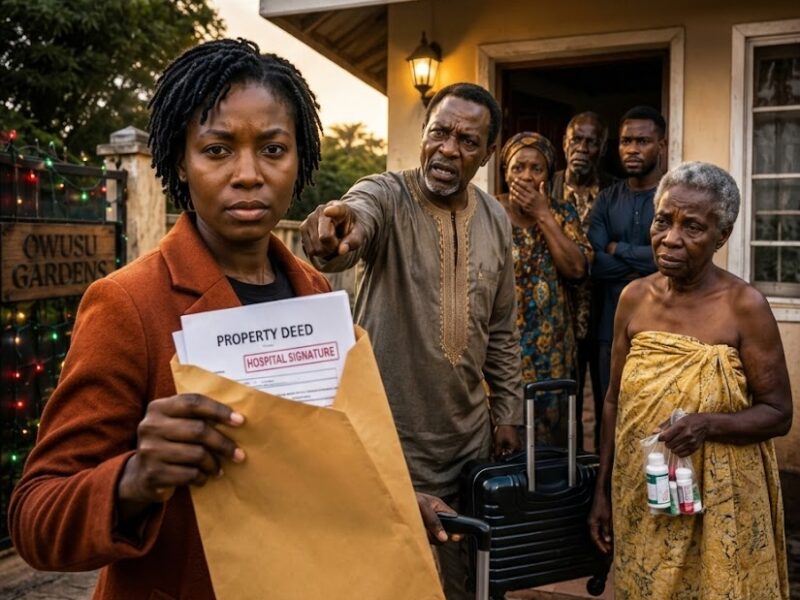
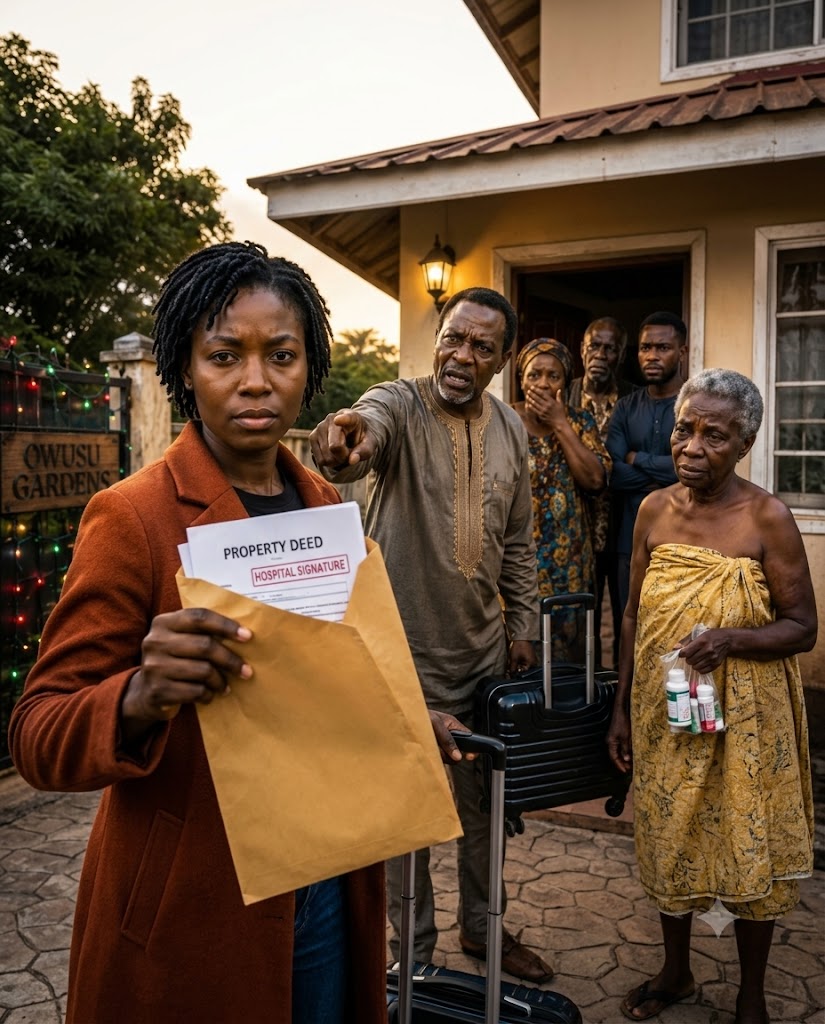
Get this woman off my veranda before I finish my coffee.
Uncle Yaw said it the way a man reads a grocery list, not even turning his head.
The colored Christmas lights he had strung across the gate blinked red, then green, then red, throwing little dabs of light onto the face of a woman he was pretending not to know.
Mama Abena stood at the bottom of the steps in a faded yellow wrapper, holding a small plastic bag of medicine.
Her weak right hand curled the way it had curled since the stroke.
A stranger’s suitcase already sat in the doorway, exactly where her bed used to be.
And then the front door opened, and a family she had never met in her life stepped out onto her own porch to watch her be sent away.
A taxi door slammed at the gate, and every head turned.
A woman crossed the compound in a burnt orange coat she had worn on the plane, moving slow, moving calm, carrying nothing in her hands but a single brown envelope.
No shouting.
No crying.
She stopped in front of Uncle Yaw, and when she spoke, her voice was so quiet the neighbors had to lean in.
“Uncle, my mother’s husband built this house with his own hands.”
She tapped the envelope against her palm.
“So tell me one thing and take your time.”
The Christmas lights blinked.
“When exactly did my mother agree to sell it?”
She let the question sit in the air like smoke.
“And why does the paper say she agreed while she was lying in a hospital bed?”
The compound went silent.
Even the Christmas lights seemed to hold their breath.
And the man standing in that doorway, the stranger nobody had bothered to introduce, went very, very still because he already knew the answer.
He had been carrying it in his pocket for three weeks, waiting for someone to finally ask.
Stay with me.
Because what looked like a simple family quarrel over a house was about to open up into something none of them saw coming.
—
Let me take you back.
Her name is Afia Osu, thirty-four years old.
For the last six years, she has worked as an intensive care nurse in Charlotte, North Carolina, on the kind of night shifts that turn a person quiet.
She is not a woman who fills a room.
She wears a gray hoodie until it thins at the elbows.
She drives a car with a door that only opens from the inside.
When people meet her, they underestimate her, and she lets them because Afia learned a long time ago that the loudest person in a room is rarely the one holding the truth.
She had not been home to Kumasi in three years.
Not because she didn’t love it, because every time she saved enough for the ticket, something came up back home.
A hospital bill.
A roof repair.
A small family matter.
And she would wire the ticket money instead and tell herself, “Next Christmas.”
Her father, Kwabena Osu, had died two years before.
A careful man, a land surveyor by training, who had built the family house on a plot off the old Bekwai Road with a stubbornness that his neighbors used to laugh at, laying every block like he expected it to outlive him.
Above the gate, he had hung a small wooden sign that he carved himself.
Two words: Osu Gardens.
It was the proudest thing he owned.
After he died, Afia’s mother, Mama Abena, stayed on in that house alone.
And then eight months later, the stroke came.
It was a small one.
The doctor said it stole the strength from her right hand and put a slur into some of her words, but it did not touch her mind.
Abena still knew everyone’s birthday.
She still corrected the pastor when he misquoted Scripture.
She simply could no longer sign her own name in a straight line, and she tired easily, and she needed help with the paperwork of being old and widowed in a country that runs on paperwork.
That is where Uncle Yaw stepped in.
Yaw was Kwabena’s younger brother.
Where Kwabena had been quiet and patient, Yaw was loud and impatient and always, always certain he was right.
He had failed at three businesses and blamed all three on other people.
And when his brother died and his brother’s widow fell sick, Yaw discovered something that felt to him like a calling.
He would manage the family’s affairs.
He would protect his brother’s legacy.
The whole street praised him for it.
What a good brother-in-law.
What a responsible man.
Taking care of the sick widow.
Handling her pension, her hospital forms, her land documents so she wouldn’t be cheated.
And here is the thing you have to understand, because it is the whole story.
Nobody suspected him.
Not the neighbors, not the pastor, not even Afia, wiring money from four thousand miles away because everything he did looked exactly like love.
Afia had been sending money home the entire six years.
It started small when she was still a student nurse.
Whatever she could spare.
After the stroke, it grew.
She doesn’t remember the exact total, and honestly, she never wanted to count it because counting felt like keeping score against your own mother.
She only knows she gave up three Christmases, a car with a door that opened, and a man who had wanted to marry her but hadn’t wanted to marry her monthly wire transfers to Ghana.
She sent it because Uncle Yaw told her month after month that the money was going to Mama Abena’s care.
Medicine.
A physiotherapist.
Good food.
A woman to sit with her.
And for the last several weeks, she had not been able to speak to her mother alone.
Not once.
Every call went through Yaw’s phone or his wife Akosua’s phone.
Her mother’s voice was always somewhere behind them, thin and far away.
And the moment Abena started to say something real, someone would cut in.
“She’s tired now, Afia. Call back later.”
And the line would go dead.
That was the thing that finally put Afia on a plane.
Not proof.
Not evidence.
Just a feeling.
A cold little feeling that her mother was being kept from her like a message someone didn’t want delivered.
So she didn’t announce it.
She didn’t call.
She landed at Kumasi Airport three days before Christmas into wet December heat and the smell of roasting groundnuts and, drifting over the car park, a church choir practicing carols.
She took a taxi straight to the old Bekwai Road, and she saw the gate, and her stomach dropped.
Her father’s carved wooden sign was gone.
In its place hung a shiny black metal one, and on it in silver letters, someone had written a new name for the house.
Not Osu Gardens.
It said Sanca Court.
And strung all across it, blinking cheerfully into the dusk, were Christmas lights she had never bought and her mother could never have afforded.
A young man she didn’t recognize stepped out of the gatehouse.
“Yes, who are you looking for?”
“My mother,” Afia said.
“Abena Osu. This is her house.”
The young man’s face did something strange.
It flinched.
“There is no Osu here,” he said, but he wouldn’t meet her eyes.
Then Akosua came out.
Yaw’s wife.
She did not hug Afia.
She looked past her shoulder toward the road as if checking whether anyone had followed.
“Afia,” she said in a voice like cold soup.
“You’ve grown fat in America, and you still do surprise like a small girl who wasn’t raised properly.”
And behind Akosua, through the open door, Afia saw the living room.
Her father’s bookshelf was gone.
The wall where her parents’ wedding photograph had hung for thirty years was bare.
And in the middle of the room, around a table, sat a family of complete strangers eating an early Christmas dinner off her mother’s good plates.
“Where is my mother?” Afia asked.
Nobody would give her a straight answer.
That was the first thing she noticed, and it was louder than any confession.
Ask a family where their mother is, and if they love her, the answer comes in half a second.
Here, every person gave her a different address.
Akosua said Abena had gone to a rehabilitation center.
A cousin said she was staying with relatives in the village.
Someone else said she’d gone to visit an old friend at the market.
Three answers.
Not one of them could give her a phone number, a street, a name.
And then she saw Kwame.
Kwame was Yaw’s son, twenty-seven, soft-faced, the kind of young man who had spent his whole life avoiding trouble by looking at his shoes.
He was standing at the edge of the yard, and when Afia’s eyes found his, he looked away.
But not fast enough.
For one second, before he could hide it, his face filled with shame.
One second.
And that one second told Afia everything the adults were working so hard to hide.
She didn’t confront him.
She had learned that too in the ICU.
When someone is drowning in guilt, you don’t grab them.
You wait for them to reach for you.
Instead, she walked back out to the road, and she went looking the way her father would have.
Slowly.
Asking the people the family had forgotten to buy off.
The woman who sold cocoa and kenkey from a pot at the corner.
The man who fixed radios under the mango tree.
The old seamstress two doors down.
It was the cocoa seller, Auntie Edoa, who finally set down her ladle, looked around to make sure no one was listening, and said quietly, “Behind the old row of shops near the lorry station. There is a storeroom at the back. Nobody rents it. Go before dark, my daughter, and may God be with you.”
The sun was already going down when Afia found it.
A row of shuttered shops, and behind them, past a gutter and a heap of broken block, one metal door, rusted, half off its hinge.
She pushed it open.
The smell hit her first.
Damp cement.
Old urine.
The sweet rot of expired medicine.
A single yellow bulb hung from a wire, swinging a little in the draft from the door.
In the corner sat a covered bucket where a toilet should have been.
And on a thin foam mattress on the bare floor, under a green and white bed sheet that Afia recognized because she had bought it herself and shipped it home from Charlotte two Christmases ago, lay her mother.
Mama Abena’s leg was wrapped in a strip of dirty cloth.
There was a blister on her heel gone dark and angry, the kind Afia had seen a hundred times on patients no one turned in their beds.
On an upturned crate beside the mattress sat a blister pack of blood pressure tablets.
Afia picked it up.
The expiration date had passed four months ago.
Her mother stirred.
She couldn’t see the doorway well in the dim light, so she turned her head toward the sound of footsteps, half afraid, and lifted her good hand into the air, feeling.
“Who is it?” she whispered.
“Who is there?”
Afia knelt.
She took her mother’s searching hand and pressed it against her own cheek, the way she used to when she was small and frightened of thunder.
And Abena went completely still.
Because a mother doesn’t need her eyes or a good light to know her own child.
She knows the shape of the hand.
She knows the weight of the head against her palm.
“Afia,” she breathed.
Just the name.
Nothing else.
As if the name was the only prayer she had left.
Afia did not scream.
She did not weep, though everything in her wanted to.
Instead, and remember this because it is who she is, she took out her phone and she photographed everything.
The room.
The bucket.
The wound on the heel.
The four-months-expired medicine.
The green and white sheet on the cement floor.
Then, and only then, she called for an ambulance.
And as they waited, her mother gripped her hand and said the sentence that would break Afia’s heart into the shape it stayed for the rest of the story.
“Do not fight them,” Abena whispered.
“Your uncle says the house belongs to the family now.”
She swallowed.
“He says I gave it. Maybe I gave it and I forgot. My memory is not…”
She stopped.
“Do not fight your own blood, Afia. It will only shame us.”
Afia held her mother’s face in both her hands.
“Mommy,” she said.
“Look at me. I did not fly home to fight anybody blindly. I came home to find out the truth. And I promise you, whatever the truth is, it is going to be enough.”
—
## Part 2
At the hospital, the doctor who received them was a young woman named Dr. Yaa Frimpong, and she did not waste words.
Dangerously high blood sugar.
An infected pressure ulcer from lying too long in one position.
Malnutrition in a woman whose daughter had been wiring money for food for six straight years.
Dr. Frimpong wrote it all down, and then she looked at Afia and said something that Afia would repeat later in a courtroom.
“I’ve seen this before,” the doctor said.
“There’s a name for it. Financial abuse and neglect. It happens most often to exactly this kind of woman, a sick parent whose children are far away and sending money.”
She capped her pen.
“Money sent is not the same thing as care received. Keep every photo you took. Don’t edit a single one. You may need them.”
While they were still in the corridor, Afia’s phone rang.
It was Uncle Yaw, and the mask slipped just for a moment because he was angry.
“Who gave you permission to move her?” he barked.
“You come from America and think you can just carry my brother’s wife around like luggage?”
“Uncle,” Afia said quietly.
“That place had no toilet. She was lying in her own filth on a cement floor.”
There was a pause.
And then Yaw said the thing that told Afia he had already built a whole story in his head where he was the hero.
“You don’t understand the burden I have carried for this family,” he said.
“You send small money from America and you think that makes you the owner of everything? I am the one who has been here.”
And he hung up.
That night, Afia opened a fresh notebook, and on the first page, she wrote a single sentence.
What did they tell her she was signing?
And under it, she began line by line to build the thing that would eventually bring Uncle Yaw down.
Not anger.
Anger is fast and it makes mistakes.
She built a record.
The next morning, Uncle Yaw made his big mistake.
He decided to end the whole matter by showing off.
He arrived at the hospital with a folder and a smile, and in front of Afia and two of the aunties he had brought as his witnesses, he laid down a photocopy of a document with the air of a man laying down a winning card.
“There,” he said.
“You want the truth? Here is the truth. A deed of assignment. Your mother transferred this property legally with her consent to a buyer through me because she trusted me to handle it while she was sick. It is registered. It is stamped. There is nothing you or your American lawyers can do.”
And for a moment it looked airtight.
That was the terrible, clever part.
Because there really was a signature.
There really was a stamp.
There really was a buyer who had really paid real money.
But Afia did not reach for the deed.
She reached instead for a different document underneath it.
A second paper Yaw had brought by accident, tucked into the same folder.
It was a power of attorney.
And this was the paper her mother had actually signed.
Afia read it slowly out loud so the aunties could hear.
“I, Abena Osu, being unwell, do appoint my brother-in-law Yaw to act on my behalf, to receive my pension, to settle my medical expenses, and to complete the renewal of the family land documents following the death of my husband.”
She looked up.
“To receive my pension. To settle my medical bills. To renew the land documents.”
She set it down gently.
“Uncle, where in this paper does it say you can sell my mother’s house?”
And for the first time, Uncle Yaw’s certainty flickered.
“It is understood,” he said.
“Handling the documents includes everything. She gave me full authority.”
“No,” said Afia.
“She gave you three specific things, and selling her home to strangers was not one of them.”
Now, this is where a lesser man would have folded.
But not Yaw, because a man who is certain he is righteous will always find a new lie to protect the old one.
He snatched the power of attorney back and stormed out.
And within two days, he counterattacked, cleverly, viciously.
He went to the police and reported that Afia had stolen family documents from the house.
He got some of the older relatives to sit Afia down and beg her to drop the whole thing before she disgraced the family name in the whole of Kumasi.
And he moved his sick sister-in-law’s case into the one place he thought he controlled.
The shame of the family.
So Afia did the one thing he did not expect.
She got a lawyer who could not be shamed.
Barrister Efua Asante was forty-five years old and had the calm of a woman who had watched a hundred confident men talk themselves into a corner.
She did not promise Afia a victory.
In fact, the first thing she said was, “I never promise victory. I promise sequence. Anger is like speed. Justice requires order. So we are going to do this slowly, and we are going to do it in the right order, and we are not going to say a single thing out loud that we cannot prove.”
When the police came for Afia over the stolen documents, Barrister Asante met them at the door with one question.
“Which specific original document is missing? Name it. Show me the report that lists it.”
There was no such document because Afia had only ever photographed, never taken.
The complaint collapsed.
No one was arrested.
And Yaw learned for the first time that the woman in the gray hoodie had brought a knife to what he thought was a shouting match.
Then Barrister Asante began to pull the thread, and the deeper she pulled, the worse it looked for Uncle Yaw.
First, the medical file.
Dr. Frimpong’s records showed the exact dates Abena had been admitted, sedated, and physically unable to travel or transact.
And the deed of assignment was dated squarely inside one of those hospital stays.
On the day the deed claimed Abena was calmly selling her home, she had in fact been on a drip in a ward with a fever.
Second, the power of attorney itself.
Barrister Asante laid the two versions side by side.
The copy Afia had glimpsed in Yaw’s folder, and the official copy filed at the lands registry.
And they were not the same document.
The registry version had an extra clause typed onto a separate page, with full and unrestricted power to sell, transfer, and dispose of any and all property.
That page used a slightly different typeface.
That page was not initialed by Abena the way every other page was.
That page had been added after her thumbprint went onto the original pages, after she was told the whole thing was about her pension and her medicine.
And third, the thing the law does not forgive.
The buyer.
Barrister Asante traced the company that had bought the house.
Sanca Estates Limited.
And on the register of that company’s directors sat a name that made her put down her pen and smile for the first time.
Akosua.
Yaw’s own wife.
A man cannot use his power of attorney to sell his sick relative’s house to a company his own family controls.
That is not a sale.
That has a name in law, and the name is self-dealing, and it makes the whole transaction void from the beginning.
It was, on paper, a very clever fraud.
A real signature on a real document, notarized by a real official, sold to a buyer who paid real money.
Everything looked like consent.
Everything looked like love.
And it would have held.
It very nearly did.
Except for one thing Yaw had never counted on.
The stranger in the doorway.
—
## Part 3
Because here is the twist that turned the whole case.
The thing none of them, not Yaw, not Akosua, not even Afia, had seen coming.
The family living in the house, the strangers eating dinner off Abena’s plates that first evening, were not accomplices.
They were victims, too.
Their name was Dano.
And the head of that household, a quiet man of sixty-six named Kofi Dano, had paid the full price for that house in good faith with the savings of his entire working life, believing every document was clean.
And of all the people in the whole of Kumasi that Yaw could have chosen to defraud, he had chosen the one man who would recognize the crime on sight.
Because before he retired, Kofi Dano had spent thirty-one years working inside the lands registry.
He knew what a clean file looked like.
And from the very first week in that house, something had itched at him.
The reference number on his deed didn’t match the sequence in the registry’s own daybook.
There was a survey plan attached that had been redrawn.
An old official stamp from years back had been photographed and pasted onto a new document.
And most of all, when he had done his own due diligence before paying, he had been given a copy of the power of attorney by Yaw himself.
And Mr. Dano, being the careful old civil servant he was, had kept that copy in a drawer.
It was the honest version.
The one without the extra page.
The one that said, in plain language, pension, medical expenses, land renewal, and nothing about selling anything.
Mr. Dano had been carrying that drawer copy around in his jacket for three weeks, sick to his stomach, trying to work up the courage to do something about it.
Because he had understood, slowly and with horror, that he was not living in a house he had bought.
He was living in a house that had been stolen.
And the old woman it had been stolen from had been thrown into a storeroom behind the lorry station.
So when Afia had stood at the gate that first evening and asked her uncle when exactly her mother had agreed to sell, the man in the doorway had gone still.
Not out of guilt.
Out of relief.
Because someone had finally come.
Someone had finally asked the question he had been too afraid to ask alone.
The man everyone had assumed was the enemy turned out to be the single most important witness in the case.
When the money was traced, the picture became complete.
The sale of the house had brought in a large sum.
And in the days right after it landed, that money had not gone anywhere near Abena.
It had gone into a new SUV.
It had gone into a deposit on an apartment across town in Ahodwo.
It had gone into Akosua’s personal account.
What went toward the medicine and the doctor and the care of the woman who actually owned the house was so small it barely registered.
A few notes now and then, thrown at a problem to keep it quiet.
And against all of that stood six years of Afia’s wire transfers from Charlotte.
Barrister Asante lined them up beside what could actually be proven to have reached Abena.
Real food.
Real medicine.
Real care.
And the gap was staggering.
A tiny fraction.
Enough to keep the old woman breathing.
Never enough to let her see a proper doctor or sleep in a room with a door.
All of this came to its breaking point at a full family meeting.
Thirty relatives crowded into an aunt’s parlor, called by Yaw himself to settle the matter and pressure Afia into silence.
Yaw stood in the middle of the room and gave a speech about loyalty, about respect for elders, about the shame of dragging family into court.
When he finished, Afia did not give a speech back.
She asked four quiet questions.
“Where are the hospital receipts for my mother’s care?”
Silence.
“Where did the money from selling her house actually go?”
Silence.
“Who watched my mother agree to sell her home on a day the hospital says she was on a drip?”
Silence.
“And can anyone in this room tell me why my mother was sleeping next to a bucket?”
And into that silence, a chair scraped back.
It was Kwame.
The soft-faced son who had looked at his shoes his whole life.
He stood up shaking, and he would not look at his father, and he said the eight words that ended it.
“Auntie Abena did not agree to sell that house.”
He swallowed.
“I know because I was the one who drove her to the hospital that day. She was too weak to hold a cup.”
The case went to court the following year.
And in the courtroom, Uncle Yaw destroyed himself exactly the way Barrister Asante had predicted.
By trying to be right in two directions at the same time.
To explain why his sister-in-law was now denying everything, he told the court she was confused, forgetful, not of sound mind.
But to explain how she had validly sold him her house, he needed her to have been perfectly clear, fully aware, freely consenting.
He could not have both.
A woman cannot be too confused to remember a sale and clear enough to have made one.
He stood in the witness box and contradicted himself so plainly that even the relatives who had come to support him began, one by one, to look at the floor.
Akosua broke on the stand when the barrister asked her gently to explain the page with the thumbprint, to explain why she had guided a sick woman’s hand to a document and called it an insurance form for her medical treatment.
She could not finish her sentence.
And then the witnesses fell into place like tumblers in a lock.
Dr. Frimpong with the dates.
The retired registry clerk with the missing entry in the daybook.
The surveyor with the pasted stamp.
And Mr. Kofi Dano, the stranger from the doorway, who walked to the stand, took the honest copy of the power of attorney out of his jacket where it had lived for weeks, and laid it beside the registry’s altered version so the judge could see with his own eyes the page that did not belong.
Last of all, they brought in Mama Abena.
She sat in a chair because standing tired her, a fresh pale green scarf around her shoulders, her weak hand resting in her lap.
The barrister asked her only one thing.
Whether she had sold her home.
Abena was quiet for a moment.
Then she lifted her head.
“I forget small things now,” she said, and her slurred voice carried to the back of the room.
“I forget where I put my glasses. Sometimes I forget what day it is.”
She paused.
“But I did not forget giving away the roof my husband built with his own hands, because I never gave it.”
She looked at Yaw.
“You brought me a paper. You told me it was for my medicine. I trusted you because you were my husband’s brother.”
Her voice did not rise.
“That was my only mistake. I trusted my own blood.”
The judge did not take long.
The deed of assignment was declared void.
Ownership of the house was restored to Abena Osu.
The court ordered that the rents and monies collected be accounted for and returned, placed an injunction against any sale or demolition, and referred the forged documents to the authorities for criminal investigation.
The Dano family, who had lost their life savings to a fraud, had their claim protected and their purchase price ordered returned from the assets Yaw had scattered into cars and apartments.
And here is what happened to Uncle Yaw, because you deserve to know that the ledger did balance in the end.
He lost the house he thought he had stolen.
The SUV was seized and sold.
The apartment deposit in Ahodwo was clawed back.
He was voted out of the chairmanship of the residents association he had loved so much, the little bit of power that had made him feel important.
His name, the family name he had claimed to be protecting, became the one thing no one in Kumasi would put on a document.
His wife’s company was struck off.
His son Kwame testified against him and then left home for good, taking a junior job at a small accounting firm, starting over from the bottom with a clean conscience instead of a comfortable lie.
But the punishment that seemed to reach Yaw the deepest was not the money or the house or even the criminal file.
It was a single afternoon months later when he came to the family house, restored now, the black metal sign taken down, his brother’s carved wooden Osu Gardens hanging over the gate again where it belonged.
He came to ask Abena to sign a letter saying she forgave him, so he could show it to the court and soften what was coming.
And for once, standing on that veranda, something in the man cracked.
Because his sister-in-law looked up at him from her chair, and she did not shout, and she did not curse him.
She just looked at him with a kind of tired pity that was worse than any curse.
And Yaw heard himself begin to say his old sentence.
“But it was family money. It was for the good of the…”
And this time, the words died in his own mouth.
Because for the first time in his life, he heard how they sounded.
He heard that they had never once been true.
There was no version of the story left standing in which he was the hero.
And he finally, finally understood that he had not managed his brother’s legacy.
He had robbed a sick woman of her home and her dignity and had almost gotten away with calling it love.
He did not finish the sentence.
He turned around, and he walked out through the gate under his dead brother’s carved sign.
An old man who had traded his family and his name for a house he never got to keep.
That was his sentence.
Not the court’s.
His own, to carry every day, the knowledge of exactly what he was.
As for Mama Abena, she came home, but she did not fill the house with her old things.
When Afia asked her what she wanted to bring back first, out of everything that had been taken, her mother thought about it, and then she asked for only one object.
A low wooden prayer stool.
The one thing Yaw’s family had thrown out into the yard because it was worth nothing to anyone.
“They touched everything else with greed,” Abena said, running her good hand along its worn edge.
“This one they left because it was worthless to them. But it reminds me who I was before fear walked into this house. And that is the only thing I truly wanted back.”
—
## Part 4
She did one more thing.
She took the little front storeroom of the house, a room not so different from the one they had hidden her in, and she turned it into something she named The Open Door.
On the first Saturday of every month, a lawyer, a doctor, and a retired registry clerk sit in that room for free.
And they tell old men and old women one simple thing.
How to read what they are signing, and how to protect the roof over their heads from the people who love them most.
Mr. Dano is there every single month.
He says it is the only way he knows how to give the years back.
And Afia?
Afia did not quit her job in America and move home out of guilt.
Guilt is not care, and she had learned that lesson at a terrible price.
What she did instead was build a system.
She pays the pharmacy directly now, every month, so the medicine can never be someone else’s to sell.
She set up a shared calendar with Dr. Frimpong for every appointment.
And every single night, without fail, she calls her mother.
Her mother’s own phone, in her mother’s own hand.
No gatekeeper standing beside her.
No one to cut in and say she’s tired.
Just a daughter’s voice and a mother’s across four thousand miles, for as long as they both want to talk.
Because the biggest thing that was stolen in this story was never the house.
Houses can be won back with the right paper and a patient lawyer.
The thing that was stolen, the thing that took a courtroom and a stranger’s courage to give back, was an old woman’s right to be believed inside her own family.
So let me leave you with one small thing to do this Christmas.
Call the oldest person in your family.
Not the person who answers their phone for them.
Ask them what they actually need.
Then check that they got it.
Keep the receipts of love, not just the transfers.
Because if this story taught you anything, let it be this.
Respect is not something we owe people after they prove in a courtroom that they are strong.
It is what we owe them exactly when the world has decided they are too old, too sick, and too weak to fight.
If you believe that, if you believe dignity should never have to wait until someone wins in court, then do me one favor before you go.
Tell me in the comments where you’re watching from, and type the words: respect them now.
Subscribe so the next family gets warned in time.
And share this with someone you love who is far from home.
Because somewhere tonight, an old woman is holding a phone, waiting to hear a voice that is really hers to hear.
Don’t let a stranger answer it for her.
—
*This is a dramatized story. All names, places, companies, and events are fictional. Any resemblance to real persons, living or dead, is entirely coincidental.*









