
She Fired the Quiet Janitor Before the Entire Company—Then He Asked, “Who Signed Your Appointment Letter?”
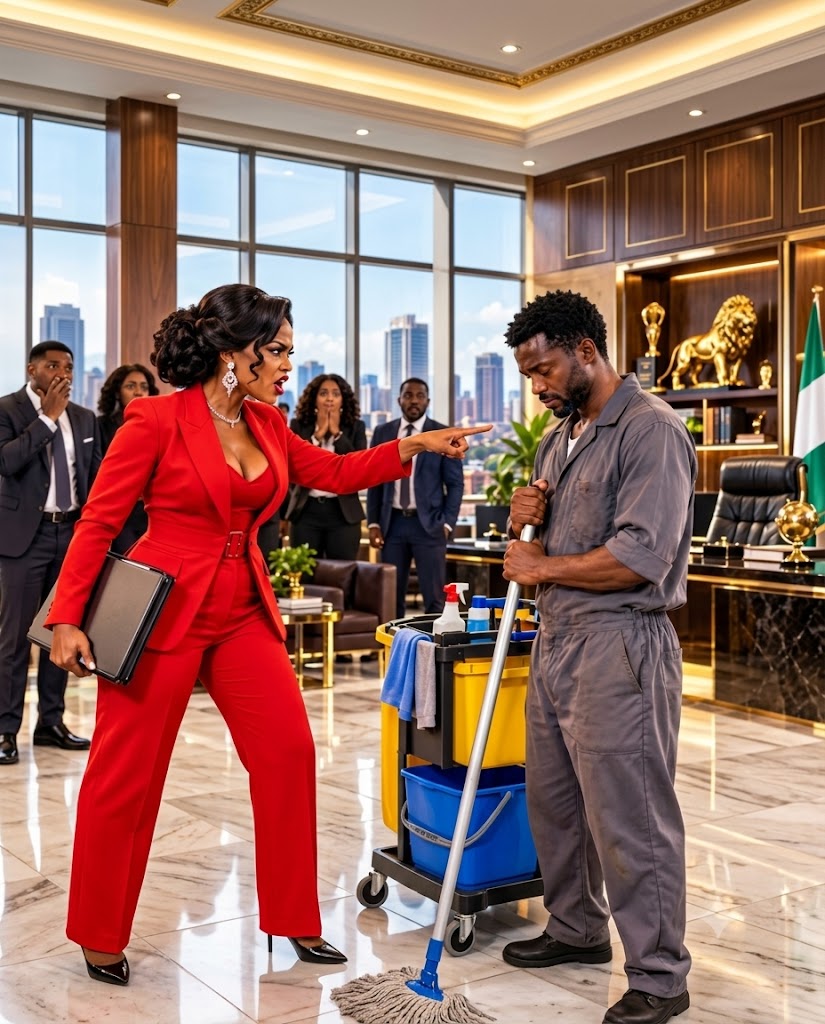
The mop hit the floor with a wet slap that echoed through the executive corridor like a gunshot.
“Drop that mop, Henry. You’re fired.”
The words came from Ifeoma Okonkwo, Chief Operating Officer of Meridian Capital Partners, her voice sharp enough to cut glass. She stood in the doorway of the boardroom, designer heels clicking against Italian marble, arms crossed over a blazer that cost more than most people’s monthly rent.
Henry didn’t flinch. He simply straightened his back, the worn cotton of his janitor’s uniform stretching across shoulders that seemed too broad for the role he played.
“You’re firing me?”
“Did I stutter?” Ifeoma’s eyes narrowed. “Security! Emeka, I said escort him out.”
Emeka stepped forward from his post near the elevator bank, his security uniform crisp and professional. But something flickered in his expression—hesitation, maybe even confusion.
“Ma’am, are you sure?”
“Why wouldn’t I be?”
The question hung in the air like smoke. Henry watched the exchange with quiet eyes, the kind of eyes that had seen too much to be surprised by anything anymore.
“It’s all right, Emeka.” Henry’s voice was calm, almost gentle. “But before I leave, Ifeoma, answer me one question.”
She blinked at the use of her first name, her jaw tightening. “What?”
“Does this company belong to you?”
—
Three hours earlier, Henry had arrived at the Meridian Capital Partners building before almost anyone else. The security guard at the front desk barely glanced up as Henry swiped his access card and headed toward the service elevator.
“Good morning, Emeka.”
“Morning, Henry. You’re early again.”
Henry smiled, pressing the button for the executive floor. “You learn a lot about a company when you arrive before everyone else.”
Emeka chuckled, shaking his head. “Sometimes you talk like you’re the boss.”
“Maybe I just care.”
The elevator doors slid open on the fourteenth floor, and Henry stepped into the quiet corridor. The morning light filtered through floor-to-ceiling windows, casting long shadows across the polished floors. He retrieved his cart from the supply closet, checking his supplies with the practiced efficiency of someone who had done this work for years.
Or someone who wanted everyone to believe he had.
At 7:45 AM, the first executives began arriving. Henry kept his head down, mopping the floors near the reception area as Ifeoma Okonkwo swept past him in a cloud of expensive perfume.
“Good morning, ma’am. The board meeting has been moved to 4.”
She didn’t slow down. “How many times must I remind you to stay out of the way when executives arrive?”
“Good morning, ma’am. I’ll move it.”
“See that you do.”
Henry stepped aside, pulling his cart closer to the wall. A young man in a tailored suit approached, sympathy written across his face.
“Don’t take it personally. She’s under a lot of pressure today.”
Henry looked up, meeting the young man’s eyes. “Pressure doesn’t change a person’s character, Chidi.”
Chidi froze, his coffee cup hovering halfway to his lips. “You know my name?”
“I pay attention.”
The moment stretched, something unspoken passing between them. Then the elevator dinged again, and Chidi hurried toward his office, glancing back once over his shoulder.
Henry returned to his work, but his attention remained sharp. He noticed everything—the nervous energy in the corridors, the hushed conversations behind half-closed doors, the way people’s eyes darted toward the boardroom and then away.
At 8:30 AM, he found the folder.
It lay on the conference table in the small meeting room adjacent to the boardroom, abandoned and forgotten. The cover bore the Meridian Capital Partners logo and a single word: “CONFIDENTIAL.”
Henry didn’t touch it. He simply stood in the doorway, studying it the way a detective studies a crime scene.
“What are you doing here?”
The voice came from behind him. Henry turned to find Ada Nwosu, the executive assistant, her face pale and tense.
“Cleaning. Someone left a folder on the table.”
Ada’s eyes widened. “You didn’t touch it, did you?”
“No, I didn’t touch it.”
She rushed past him, snatching the folder and clutching it to her chest. “Most people would ignore it.”
“That won’t make it disappear.”
Ada paused, turning back to look at him. “You don’t sound like a janitor.”
“People expect too little.”
She studied him for a long moment, something like recognition flickering in her eyes. “You did the right thing, telling me. Some things shouldn’t be left where anyone can find them.”
“Who exactly are you, Henry?”
The question hung between them, heavy with implication. Before Henry could answer, footsteps echoed in the corridor—Ifeoma’s distinctive rhythm, sharp and impatient.
“What is going on here? Henry, were you inside that boardroom?”
Henry could have ended it then. One sentence, and everything would change. But telling the truth would expose his secret, and there was still so much he needed to see.
“No. I never entered the room. I saw the folder from outside and called Ada.”
Ifeoma’s eyes narrowed. “He’s telling the truth, Ada?”
“Yes, ma’am. He never entered the room. He noticed this folder and called me immediately.”
“Fine. But you have no business near the boardroom.”
“I was doing the job I was assigned to do.”
“Then stick to it.”
“Understood.”
She turned to leave, then stopped. “Seriously? This is exactly what I was talking about.”
“Ma’am, the spill happened before—”
“I don’t need excuses, Henry. I need people who can do their jobs properly.” She gestured at the executive floor. “This is an executive level. Small mistakes here can create serious problems. The standard is different up here.”
“I understand, ma’am. I was only trying to help.”
“Henry, focus on your duties. Distractions are costly.”
“Yes, ma’am.”
She walked away, her heels clicking against the marble like a metronome counting down to something inevitable. Henry watched her go, his expression unreadable.
His phone buzzed. He glanced at the screen, then answered quietly.
“Hello? Yes. He just arrived? I understand. I’ll inform her.”
—
Everyone thought Henry was just the cleaner. A phone call would reveal he was not who they believed.
At 9:15 AM, Ifiok Bassey, the receptionist, approached Ifeoma’s office with visible nervousness.
“Ms. Okonkwo, there’s someone here asking about Henry.”
Ifeoma looked up from her laptop. “Henry? The cleaner?”
“Yes, ma’am. They specifically asked for him.”
“Where’s Henry?”
“On the fourteenth floor, I believe.”
Ifeoma frowned. “Send them up. I want to know what’s going on.”
The visitor was a tall man in his sixties, silver-haired and distinguished, wearing a suit that spoke of old money and careful tailoring. He introduced himself as Marcus Webb, a name that meant nothing to Ifeoma but would have meant everything to anyone who understood Meridian’s history.
“I’m looking for Henry.”
Ifeoma stood, extending her hand. “I’m Ifeoma Okonkwo, COO. May I ask what this is regarding?”
Marcus smiled, a knowing expression that made her uncomfortable. “That would be me.”
Everyone turned. Henry stood in the doorway, mop still in hand, his uniform wrinkled from a morning of work. But something about the way he carried himself had shifted—his posture straighter, his gaze more direct.
“Henry, it has been a long time.”
“You know him?” Ifeoma asked.
Marcus laughed softly. “Know him? I was waiting for the day he would finally return.”
“Return?” Ifeoma’s voice sharpened. “What exactly do you mean?”
“I mean exactly what I said. Henry founded this company long before most of you ever walked through those doors.”
The silence that followed was absolute. Ifeoma’s face went through a series of expressions—confusion, disbelief, and then something that looked almost like fear.
“That’s impossible. He’s been working here as a janitor.”
Henry set down the mop, his movements deliberate. “Because I wanted to see this company from the bottom. When people know you’re the owner, they show you their best behavior. I wanted to know how they act when they think nobody is watching.”
“Henry, why hide your identity?” Ifeoma’s voice had lost its edge, replaced by something raw and uncertain.
“I wanted to know the truth. When people know the owner is watching, they become careful. They become polite and follow rules. But when they think nobody is watching, that is when you see who people really are.”
“So you were observing us?”
“I was looking for character.”
Ifeoma sank into the nearest chair, her composure cracking. “Henry, I owe you an apology. I judged you by your uniform. I forgot that the people who make this company work deserve respect, too.”
“I appreciate your apology, Ifeoma. But leadership is not only about protecting a company.”
“What do you want me to do?”
“Tomorrow, I want you to spend the day with the people who keep this company running.”
“You mean the staff?”
“Yes. Listen to them. Understand their challenges.”
Ifeoma nodded slowly. “I understand.”
“Good leaders don’t just manage people. They understand them.”
—
The next morning, Ifeoma stood before the assembled employees in the main conference room. Her usual armor of designer clothes and sharp confidence had been replaced by something more vulnerable—a willingness to listen.
“Good morning, everyone. Today I don’t want reports or presentations. I want to hear from you—the people who keep this company moving every day. I spent too much time looking at positions and not enough time looking at people.”
Henry watched from the back of the room, a small smile playing at his lips.
That is where true leadership begins.
After the meeting, Ifeoma approached him. “Henry, I understand now why you did what you did. But why did you choose me to be part of this?”
“Because leadership is revealed when things become difficult. I watched how you handled pressure, how you treated people, and how you responded when you were wrong.”
“And what did you see?”
“I saw someone who was willing to change. But leaders must remember—they are not positions on an organization chart. The best leaders don’t just build successful companies. They build people.”
Henry, I understand why you tested us. But why was this so important to you?”
“Because this company was never just about money. My father built Meridian Capital Partners believing that every person mattered—from the boardroom to the person cleaning it.”
“So you became a cleaner to protect his vision?”
“I became a cleaner to find out if that vision was still alive. I looked around to see what my father left behind. And I found something I didn’t expect.”
“What did you find?”
“I found character.”
—
The peace lasted exactly one week.
Henry was in the lobby, reviewing the quarterly maintenance schedule with Samuel, the night custodian, when Ada appeared at his side.
“Henry, we have a problem.”
He looked up, reading the tension in her face. “What is it?”
“The company has a bigger problem than any of us realized. The person responsible has been inside this company for years.”
Henry set down the clipboard. “What did you find?”
Ada led him to her office, where she pulled up a series of financial records on her computer. “There’s an issue affecting our quarterly returns that’s been happening without my knowledge. Funds have been diverted—not a lot at first, but it’s been going on for a while.”
“How long?”
“Long enough for us to take a closer look. Henry, we checked the records. Something doesn’t match.”
“What did you find?”
“Some decisions were made when you were away. Approvals that shouldn’t have gone through. Payments to vendors that don’t exist.”
Henry’s jaw tightened. “Then we need to understand why. Don’t accuse anyone yet. First, find the truth.”
Ada nodded, but before she could respond, her phone buzzed. She glanced at the screen, and her expression shifted.
“Henry, I found something unusual.”
“What?”
“Someone accessed the executive area after hours.” She turned the screen toward him, showing security footage. “Did you see who it was? There. Look at the person entering.”
Henry leaned closer, studying the grainy image. Then his blood ran cold.
“Wait. I know him.”
“So do I.”
“Who is he?”
“His name is Daniel Adebayo. He works in the executive office.”
“Daniel?” Henry’s voice was quiet, controlled. “From the executive office? But Daniel couldn’t have done this alone.”
“What makes you say that?”
“Because the access he used was never given to him. Someone with higher clearance had to provide it.”
Ada pulled up another file. “Henry, I have a clearer image now.”
“Show me.”
She clicked, and the image sharpened. A man in his fifties, well-dressed, moving through the executive corridor with the confidence of someone who belonged there.
“That’s Mr. Bamidele.”
“The finance director?”
“He has access to almost every executive office.”
“Then we stop guessing.” Henry straightened. “Is he still in the building?”
“Yes. His card was used downstairs ten minutes ago.”
“Good.”
—
Henry didn’t need to send anyone for Bamidele. The finance director arrived on his own, pushing through the doors of the executive conference room with the arrogance of someone who believed he was untouchable.
“You don’t need to send anyone for me. I know why you’re looking for me.”
Henry stood at the head of the table, his janitor’s uniform a stark contrast to the expensive suits around him. But no one was laughing now.
“Finished?”
Bamidele sneered. “With what? Playing janitor? I must admit, Henry, you had us all fooled.”
“Emeka. Mr. Bamidele, come with me.”
But Bamidele wasn’t done. “Before I leave, there’s something you need to hear. You came back looking for everyone else’s mistakes, but you never asked what happened while you were gone. I’m responsible for my choices, but this company didn’t lose its way overnight. It started losing its way when its owner disappeared.”
Henry said nothing, but something shifted in his expression—a flicker of something that might have been regret.
“It’s time to go, sir.”
Emeka stepped forward, and Bamidele allowed himself to be led away. The room remained silent until the door closed behind them.
“Please, everyone, sit down.”
The executives exchanged glances but obeyed. Ifeoma took her usual seat, her face pale.
“Henry, is this meeting about what happened yesterday?”
“Yesterday is exactly why we’re here, but this isn’t about Bamidele. Then why did you call everyone in so early?”
“Because I came back looking for what was wrong with this company.”
“And did you find it?”
“Yes, and the problem wasn’t just one person.”
“What do you mean?”
“Somewhere along the way, this company forgot what it was supposed to stand for.”
“But you weren’t here when most of this happened.”
“Exactly. I walked away and expected everyone else to protect what I built.”
“So you’re blaming yourself?”
“Bamidele is responsible for his choices. But I’m responsible for mine.”
“What happens now?”
“Now, we start seeing the people we’ve been overlooking.”
Henry gestured toward a chair at the head of the table—the chair that had remained empty throughout the meeting.
“Henry, who is that chair for?”
“I’ve been wondering the same thing. Someone this company should have noticed a long time ago.”
“Are we expecting someone?”
“Yes.”
“Who?”
“You’ll understand when he walks through that door.”
—
The door opened, and Emeka stepped inside—not the security guard who had escorted Bamidele out, but a different man entirely. Or perhaps the same man, finally seen for who he really was.
“Sir, you asked to see me?”
“Yes, Emeka. Come in.”
“The empty chair is for him?”
“Emeka, take that seat.”
“Sir, are you sure?”
“I’ve never been more sure.”
“Henry, what’s going on?”
“You all know Emeka as security. But there’s more to him, isn’t there?”
Emeka’s jaw tightened, but he nodded.
“Emeka has been studying management for years. While working here? Every chance I got. He applied internally three times.”
“Three times?”
“I never got an interview.”
“Why wasn’t he interviewed?”
“Because everyone saw his uniform. And nobody saw the man wearing it.”
Henry walked around the table, stopping beside Emeka’s chair. “I’m not handing you an executive position. I’m giving you the opportunity to earn one.”
“That’s all I ever wanted.”
“Management development program, starting Monday.”
“I won’t waste the opportunity.”
“You shouldn’t have had to wait this long.”
—
The meeting ended, but Henry asked Ifeoma to stay behind.
“You’re going to fire me, aren’t you?”
“Would you blame me?”
“No.”
“Why did you treat that janitor differently?”
“Because I thought he couldn’t affect my future.”
“Exactly. So what happens to the next cleaner?”
“I treat them with respect.”
“Because they might secretly own the company?”
“No. Because they’re human.”
“Now you understand.”
“So what happens to me?”
“You keep your job.”
“Why?”
“Don’t thank me. Make me right about you.”
—
The weeks that followed brought changes no one could have predicted.
Emeka excelled in the management development program, his natural leadership abilities finally given room to grow. Ifeoma became a different leader—not softer, but more aware, more willing to listen before she spoke.
And Henry began to understand that his father’s vision had never truly died. It had simply been waiting for someone to nurture it back to life.
But the changes went deeper than policies and programs. They changed how people saw each other—the way a receptionist’s smile could brighten someone’s day, the way a security guard’s vigilance protected everyone, the way a custodian’s careful work created the foundation for everything else.
Henry was in the lobby one evening, reviewing the day’s reports, when a young woman approached him.
“Excuse me, are you Mr. Henry?”
“I am. What’s your name?”
“Amara. I just started in the mailroom.”
“Welcome, Amara. How are you finding it here?”
She hesitated. “It’s different than I expected. People actually talk to me. They ask how I’m doing. They remember my name.”
“That’s how it should be.”
“Is it true what they say about you? That you pretended to be a janitor to see how people treated you?”
“It’s true.”
“Why?”
Henry considered the question, the weight of it settling over him. “Because I learned something important during my time as a janitor.”
“What did you learn?”
“That the people who make this company work—the ones who clean the floors, guard the doors, answer the phones—they see everything. They know who the good leaders are. They know who treats people with respect and who doesn’t.”
“And what did you see?”
“I saw people who deserved better. People who had been overlooked for too long. People who had ideas and talents that no one bothered to discover.”
“So you decided to change things?”
“I decided to give people a chance to show who they really are.”
—
The final meeting happened on a Friday afternoon, the city skyline glowing through the conference room windows.
“There’s one more thing everyone needs to know,” Henry said.
“What is it?”
“I’m leaving the company.”
“Leaving? After everything that happened?”
“Henry, that doesn’t make sense.”
“It will.”
“Who’s going to run the company?”
“I won’t make that decision alone.”
“Then who will? Chidi?”
“Don’t look at me.”
“Neither of you should guess. The board will choose the next managing director.”
“From outside the company?”
“No. From inside this room. For the first time, every department can nominate someone.”
“What?”
“Every department?”
“Everyone.”
“Even security?”
“Security. Cleaning. Reception. Everyone.”
“You’re changing the whole system.”
“A title tells me what you do. It doesn’t tell me what you can become.”
“Your father would have liked that.”
“And where are you going?”
“Nowhere.”
“You just said you’re leaving.”
“I’m leaving the CEO’s office. Not my company.”
“You scared everybody.”
“So what will you do now?”
“What I should have done years ago.”
“Which is?”
“Listen.”
—
The evening was quiet, the building mostly empty. Henry walked through the lobby, stopping at the security desk where Samuel sat.
“Good evening, sir.”
“Good evening. What’s your name?”
“Samuel, sir.”
“How long have you worked here?”
“Almost two years, sir.”
“Then I should have known your name.”
“You’re still watching people?”
“No.”
“Then what are you doing?”
“I’m finally seeing them.”
“I know what you mean now.”
“Good. Don’t forget it.”
—
Ifeoma found him in the parking garage, leaning against a car that looked far too modest for a man of his wealth.
“There you are. We’ve been looking for you.”
“For what?”
“Some of us would like to go home tonight.”
“Good night, Mr. Henry.”
“Good night, Samuel. You remembered.”
—
The company changed after that. Not overnight—real change never happens that quickly. But slowly, deliberately, the culture shifted.
The management development program expanded, reaching people who had been overlooked for years. Pay scales were reviewed. Training opportunities were created. The distance between the executive floor and the ground floor shrunk, not just physically but psychologically.
And Henry? Henry kept his promise. He stayed—not as CEO, but as something harder to define. A presence. A reminder. A man who had walked in everyone else’s shoes and refused to forget what he had learned.
He was in the building on the day the board announced their decision—an unexpected choice that surprised everyone except the people who had been paying attention.
The new managing director stood at the front of the conference room, still wearing the slightly rumpled suit of someone who had never expected to stand there.
“I don’t know what to say,” Emeka said, his voice thick with emotion. “I never thought someone like me could have a chance like this.”
“Someone like you?” Henry asked from his seat in the back. “What do you mean?”
“Someone from security. Someone who didn’t go to the right schools. Someone who—”
“Someone who proved that character matters more than pedigree.” Henry stood, walking toward the front. “You earned this, Emeka. Not because I gave it to you, but because you showed everyone what you’re capable of.”
“I won’t let you down.”
“You haven’t yet.”
—
The reception that evening was modest by Meridian standards—sandwiches and soda instead of champagne and caviar. But the laughter that filled the room was genuine, the conversations unforced.
Ifeoma found Henry by the window, looking out at the city.
“Everything okay?”
“Everything’s fine.”
“You know, I’ve been thinking about what you said. About seeing people.”
“And what have you concluded?”
“That I have a lot of work to do.” She paused. “But also that I’m finally ready to do it.”
“That’s all I ever wanted to hear.”
“Henry, I know you’re leaving. But I want you to know—you changed this company. Not just the policies or the programs. You changed how we see each other.”
“Thank you, Ifeoma.”
“One question, though. Why did you choose me? Out of everyone in this company, why did you trust me to lead?”
“Because I watched you, Ifeoma. Every day. I saw how you treated people when you thought no one was looking. And I saw someone who was struggling—not because she didn’t care, but because she had forgotten how to care without getting hurt.”
“And what made you think I could change?”
“You were the hardest on the people who couldn’t fight back. The cleaners, the security guards, the receptionists. You treated them like they were invisible.”
“I did.”
“Until you didn’t. Until you realized that they were human beings with their own stories. Their own struggles. Their own dignity.”
“So you tested me.”
“I gave you an opportunity to see yourself.”
Ifeoma was quiet for a long moment. Then she nodded slowly.
“What’s your name?”
“Amara, ma’am.”
“Ifeoma. You can call me Ifeoma.”
—
Henry left the party early, slipping out a side door into the cool night air. He walked through the streets of the city that had been his home for so many years, past the restaurants and shops and offices that made up the fabric of daily life.
He thought about his father—a man who had built something from nothing, who had believed that success meant nothing if it came at the expense of others. He thought about the years he had spent pretending to be someone he wasn’t, and the lessons he had learned along the way.
And he thought about the people he had met—the ones who had shown him kindness when they had no reason to, the ones who had shown him cruelty when they thought he couldn’t affect their futures.
He thought about Emeka, who had worked his entire career in the shadows, waiting for a chance that never came. And he thought about all the other Emekas—the millions of people whose contributions went unnoticed because they didn’t fit the image of what a leader was supposed to look like.
The world was full of invisible people, Henry thought. People who did their jobs without complaint, who showed up every day without recognition, who made everything work without ever receiving credit.
And the world was full of visible people—the ones who got the attention, the promotions, the praise—who often didn’t deserve any of it.
Henry had spent years trying to bridge that gap. Not by giving people what they hadn’t earned, but by giving them the opportunity to earn it. By seeing them as human beings instead of job titles. By believing that everyone had something to contribute if only someone would give them the chance.
His phone buzzed. A text from Ifeoma.
“The new security chief wants to know if you’re coming back. They want to name the training program after you.”
Henry smiled, typing a response.
“Tell them to name it after Emeka. He’s the one who taught us what courage looks like.”
—
The sun was setting over the city, painting the sky in shades of orange and purple. Henry stopped at a small park, sitting on a bench that overlooked a playground. Children were playing, their laughter carrying on the evening breeze.
He thought about his father, who had died too young, who had left behind a company and a vision that Henry had almost let slip away.
“You would have liked this, Dad. You would have liked seeing people get a chance. Not because they deserved it, but because everyone deserves it.”
The words felt inadequate, but they were true. The best thing he could do was make sure people didn’t have to wait for permission to be seen. The best legacy he could honor was the one his father had lived.
His phone buzzed again. This time it was a text from an unknown number.
“Mr. Henry? This is Samuel. The night custodian. I just wanted to say thank you. I’ve worked here for two years, and no one ever asked my name before. No one ever asked how I was doing. I just wanted you to know that it mattered. It really mattered.”
Henry stared at the message for a long moment, something tight in his chest.
This was why he had done it. Not for the dramatic reveal. Not for the satisfaction of seeing people’s faces when they realized who he really was.
He had done it for moments like this. For the chance to remind people that everyone mattered. That everyone had a name and a story and a life that deserved recognition.
He typed a response.
“Thank you, Samuel. I’ll remember your name. I’ll remember all of them.”
—
The following Monday, the management training program officially launched. Emeka stood at the front of the room, his posture straight, his voice steady.
“My name is Emeka Obi, and I’m the new Director of Security Operations. But before I was that, I was a security guard in this building. I know what it’s like to be invisible. I know what it’s like to feel like you don’t matter.”
He paused, looking out at the faces gathered before him—a mix of young and old, men and women, executives and staff.
“But I also know what it’s like to have someone see you. To have someone believe in you. To have someone give you a chance when no one else would.”
He looked at Henry, sitting in the back of the room.
“Henry saw me. Not the uniform. Not the job title. Me. And that made all the difference.”
—
The years passed, as they always do. Meridian Capital Partners grew and changed, expanding into new markets, developing new products, reaching new heights of success.
But it never forgot what it had learned.
The management training program became a model for other companies—not just in the city, but across the country. The pay scales were adjusted, the benefits improved, the opportunities expanded.
And the people—the invisible people who had made everything work for so long—finally got the recognition they deserved.
Henry visited occasionally, walking through the corridors that had once been his domain. He saw the changes—the new faces, the new attitudes, the new culture.
He saw the janitor who was now a supervisor, training others in the proper care of the building.
He saw the security guard who was now studying for his MBA, with dreams of leading his own company someday.
He saw the receptionist who was now a manager, respected and admired by everyone who worked with her.
And he knew that his father’s vision was alive—not just in the policies and programs, but in the hearts and minds of the people who made them work.
The building stood, as it always had, in the heart of the city. It was a monument to what could happen when people were given a chance. When they were seen. When they were valued.
And Henry, the janitor who was really a CEO, the man who had walked in everyone else’s shoes, the leader who had learned to follow, watched it all with quiet satisfaction.
He had kept his promise. He had listened.
And that had made all the difference.
—
On a warm spring evening, Henry stood in the lobby of the Meridian building, watching the last of the employees leave for the day. He was older now, his hair grayer, his steps slower. But his eyes were still sharp—still watching, still seeing.
His phone buzzed. A message from Ifeoma.
“I found something. You need to see this.”
Henry typed back. “On my way.”
He walked toward the elevator, passing the security desk where a young guard sat.
“Good evening, Mr. Henry.”
“Good evening. What’s your name?”
“David, sir.”
“David. I’ll remember that.”
He stepped into the elevator, pressing the button for the executive floor. As the doors closed, he thought about all the names he had learned over the years—all the people who had passed through this building, each with their own story, their own struggles, their own dreams.
He had tried to honor every one of them.
The elevator doors opened, and Henry stepped into the corridor. The lights were dim, the offices empty. But he knew the building was never truly empty. There were always people here—cleaners, security guards, maintenance workers—the invisible army that kept everything running.
He heard it then—the soft sound of conversation, punctuated by laughter. He followed it through the corridors until he reached the small break room on the executive floor.
Inside, the graveyard shift was gathered around the table. A coffee pot gurgled in the corner. Day-old pastries sat on a plate.
Emeka sat at the head of the table, deep in conversation with Marcus Webb, the man who had revealed Henry’s secret all those years ago.
“—and that’s when I realized,” Emeka was saying, “that leadership isn’t about being the smartest person in the room. It’s about making everyone else feel like they belong.”
Marcus nodded. “That’s what Henry taught me. Not directly, of course. But by example.”
Henry stood in the doorway, listening.
“You know what he told me once?” Emeka continued. “He said, ‘A title tells me what you do. It doesn’t tell me what you can become.’ I think about that every day.”
“Me too.”
Henry smiled, then turned and walked away. He didn’t need to be part of the conversation. He just needed to know it was happening.
The elevator carried him down to the lobby, where David sat at the security desk, reading a book.
“What are you reading?”
David looked up, startled. “Oh, Mr. Henry. It’s a management textbook. I’m hoping to apply for the training program next year.”
“That’s a good goal.”
“Thank you, sir. I figure if Emeka can do it, anyone can.”
Henry nodded. “You’re right about that. Anyone can. As long as someone gives them a chance.”
He walked out into the night, the city lights reflecting off the windows of the building behind him.
The world was full of invisible people. But not for long.
Not if Henry had anything to say about it.
—
**THE END**









