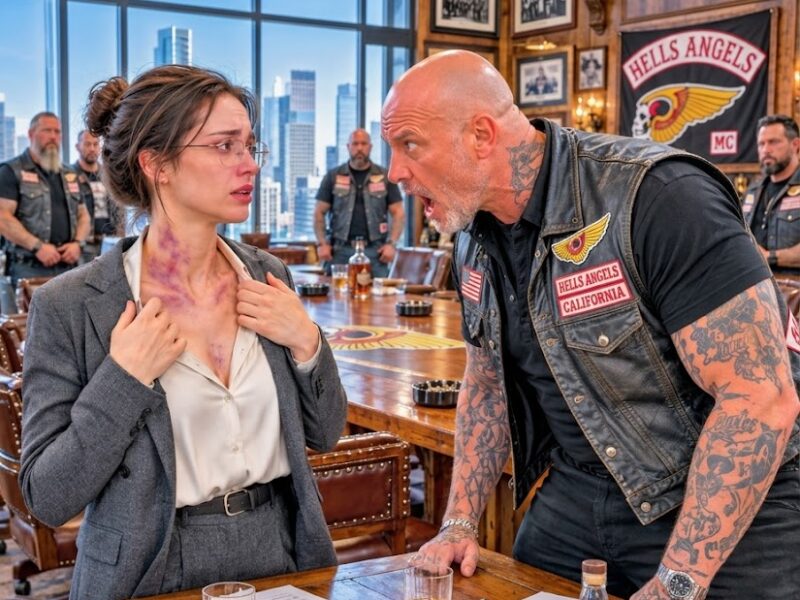
She came to work with fingerprints on her neck. She didn’t say a word. She didn’t have to. The Hells Angels boss saw them—and immediately locked the door
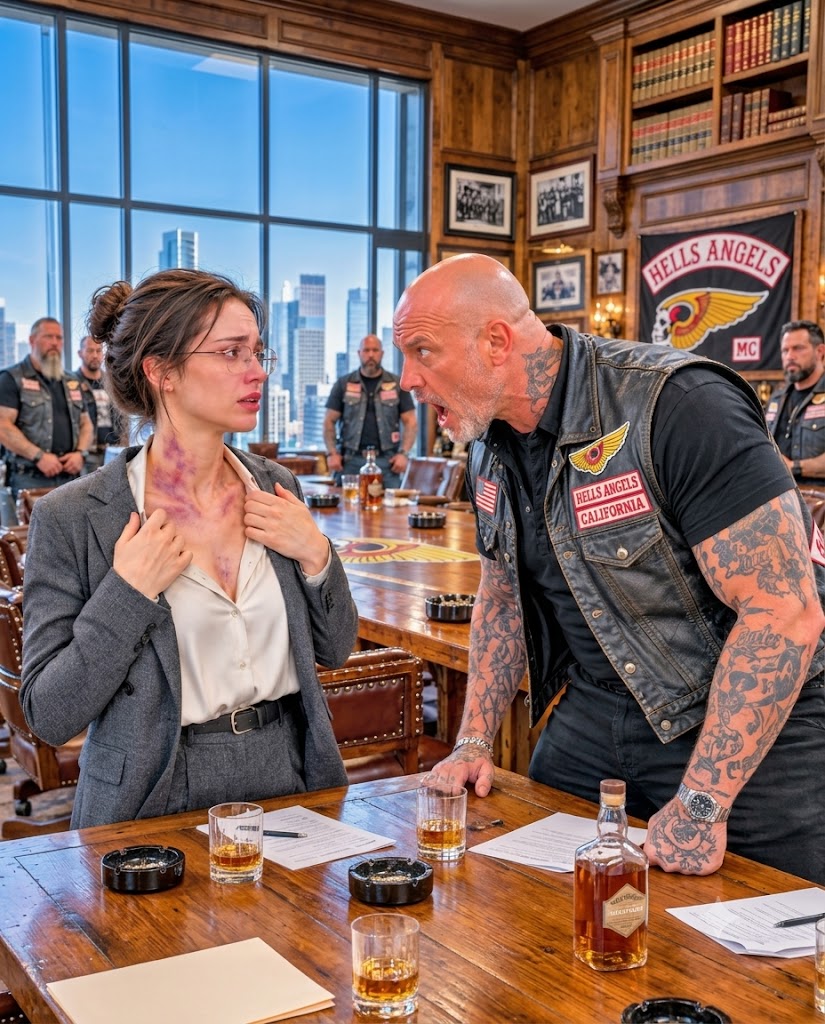
A hand closed around a woman’s throat and squeezed.
Her back hit the kitchen wall with a sound like a door slamming in a house nobody was home in.
Her feet lifted off the floor for a second, kicking at nothing, toes scraping the baseboard where the paint had chipped three winters ago and never got fixed because he said he’d get to it and he never got to anything except her.
Fingers dug into the soft skin under her jaw, pressing hard, leaving marks that would last for days.
She didn’t scream.
She had learned a long time ago that screaming only made it worse.
When the grip finally let go, she dropped to her knees and gasped for air, loud and ragged, hands flat on the linoleum she’d mopped twice the day before because he said the floor looked dirty and she couldn’t have that, could she.
Then she stood up, washed her face, and pulled a scarf out of a drawer.
Her name was Dana Kowalski.
She was thirty years old, and in a few hours, she would walk into a small-town diner to work her morning shift, carrying those fingerprints on her neck like a collar nobody could see.
What happened inside that diner would empty every bar in the county.
Stay with me on this one.
—
The Iron Creek Diner sat at the edge of Red Fork, Montana, where the main road gave up and turned to gravel, and the gravel gave up and turned to dirt, and the dirt didn’t give up to anything because there was nothing left to give up to.
Twelve tables.
Eight stools.
A coffee pot that was never allowed to go empty.
Ranchers came in at dawn, truckers all day, and three mornings a week when the roads got quiet, the parking lot filled up with motorcycles.
That was because of the man who owned the place.
His name was Royce Callaway, but nobody had called him Royce in thirty years.
They called him Padre.
Sixty-one years old, gray-bearded down to the second button of his shirt, hands the size of oven mitts and twice as scarred.
He’d ridden with the Hells Angels since he was nineteen, president of the local charter, and he’d buried more brothers than he liked to count.
When his niece told him the long rides were over, he bought the diner with cash and hung a sign that said Open 5:00 A.M.
And he meant it.
Padre was there every morning.
He didn’t cook.
He didn’t wait tables.
He sat at the end of the counter with a cup of black coffee and watched.
People thought he was a tired old biker enjoying his retirement.
They were half right.
Nothing happened in that building without him seeing it.
—
Dana had worked for him two years.
Quiet.
Showed up early.
Never called in sick.
Never asked for a thing.
She wore long sleeves even in July and flinched whenever a plate dropped.
Padre noticed that the first week.
He noticed a lot of things.
He never said a word because pushing a scared person only made them run, but he kept an eye on her.
That was his way.
This morning was cold.
Frost on the windshields, steam off the coffee, a sky that flat gray it gets before a Montana sunrise when the mountains haven’t decided if they’re going to let the sun through or not.
Padre was in his seat when the front door opened and the chime rang.
Dana came in fast.
Too fast.
Scarf pulled high, almost to her chin, face turned down like she was reading the floor for errors.
She tried to slide past the counter without looking at anybody.
“Morning, Dana,” Padre said.
She jumped.
The chime was still swinging and she jumped like a gunshot had gone off.
Her hand flew up to her throat, then came back down just as quick, like she’d caught herself doing something wrong.
“Morning,” she said.
Rough.
Scratchy.
Like she’d been yelling, or like something had been pressed against her windpipe too long.
Padre set down his cup.
He didn’t stand.
He looked at her the way he’d look at a dog that had been kicked one too many times.
Slow and careful.
“You feeling all right?” he asked.
“I’m fine,” she said, already reaching for her apron off the hook.
“Slept wrong is all.”
“Neck’s a little stiff.”
Now, here’s the thing.
Padre had been lied to by professionals.
By men with guns and lawyers and badges.
He knew a lie the way a farmer knows rain is coming.
And I slept wrong was about the oldest, saddest lie there was.
He got up off his stool.
His knees popped.
He walked around the counter and Dana went still because men walking toward her was a thing her body had learned to fear.
But Padre didn’t come at her.
He stopped a few feet away, reached out one big finger, and gently hooked the edge of her scarf.
He didn’t yank it.
He just let it fall an inch.
An inch was enough.
Four marks across the front of her throat and one on the side.
Dark purple fading to green at the edges.
The thumb on the right.
The four fingers wrapping toward the back of her neck.
A right hand had done that.
A big one.
Recently.
And more than once.
Because under the fresh bruises were the yellow ghosts of old ones.
Dana grabbed the scarf back up.
Her eyes filled, but she didn’t let the tears go.
“I told you I slept wrong.”
Padre didn’t argue.
He didn’t raise his voice.
He never did anymore.
He nodded slow, like she’d told him something true.
Then he walked past her to the front door.
He flipped the sign from Open to Closed.
He turned the deadbolt, slid the chain across, locked the side door and the back door by the freezer, and came back to where Dana stood frozen with her apron still in her hands.
“Padre,” she said, “it’s five in the morning.”
“The ranch crews will be here in twenty minutes.”
“You can’t close.”
“I can do whatever I want,” he said.
“I own it.”
—
He pulled out a chair from the nearest table, turned it to face the one across.
Then he went behind the counter, poured a fresh cup of coffee, carried it over, and set it down in front of the empty chair.
“Sit down, Dana.”
“I’ve got side work.”
“I’ve got to roll the silverware.”
“Sit down.”
It was still soft.
Still gentle.
But it landed like a hand on the shoulder.
She sat.
Her legs had gone out from under her.
Truth be told.
Padre lowered himself into the chair across from her and the old wood groaned.
He wrapped both hands around his cup and looked at her across the steam.
“Now,” he said, “I’m going to tell you one thing, and then you don’t have to say anything you don’t want to.”
“All right.”
Dana nodded, staring at the coffee like it might be a trap.
“Nobody who put those marks on your neck is walking through that door today,” Padre said.
“Not while I’m breathing.”
“You understand me?”
“You’re safe in here.”
“For the first time in a long time, I’d guess.”
“So you sit and you drink that coffee and you let yourself be safe for a minute.”
“That’s all I’m asking.”
And that broke her.
She didn’t sob.
She was too worn down for that.
She put her face in her hands and her shoulders started shaking.
Quiet.
Like she’d trained herself to cry without making a sound.
Padre didn’t reach for her.
He sat with her and let her do it because sometimes the kindest thing a man can do is take up space and stay quiet in it.
When she finally lifted her head, she started talking.
—
His name was Cole.
Cole Mercer.
Married four years.
It started small, the way it always does.
A grabbed wrist.
A shove.
A slammed door.
He was sorry every time.
Cried harder than she did sometimes.
Then it got bigger and the sorry got smaller.
And somewhere in year three, she’d stopped recognizing her own life.
Last night, he’d found a text on her phone from a girlfriend asking if she wanted to come stay a few days.
Just that.
An invitation.
He decided it meant she was planning to leave him.
And he put his hand around her throat and lifted her off the kitchen floor and told her that if she ever tried to walk out, he’d make sure she never walked anywhere again.
“He’s got a truck,” she said.
“Black Silverado.”
“Lifted.”
“He’ll come looking when he wakes up and sees I took the car.”
“He always does.”
“He likes to check up on me.”
“Likes me to know he can find me anywhere.”
Padre listened to all of it without moving.
Then he stood, carried his coffee to the window, and looked out at the gray lot and the empty road.
“Then I guess we’ll be here when he does,” he said.
—
He took out his phone.
An old flip phone scratched to hell.
He dialed one number.
When somebody picked up, he said six words.
“Iron Creek.”
“Now bring the boys.”
Then he closed the phone and put it back in his vest.
Dana didn’t understand what she’d heard.
Maybe he’d called the sheriff.
She picked up the coffee with both hands and took a sip.
Hot and strong.
And for a second, the shaking in her hands stopped.
The diner was warm.
The locks were thrown.
The man across the room had a calm about him like a mountain has come.
Nothing bad could reach her in here.
She let out a long breath she felt like she’d been holding for four years.
It was over.
Whatever this was, it was over and she was safe.
That was when the sound of a motorcycle rolled in off the road.
Then another.
Then four more.
Then so many she couldn’t count them.
—
The first bike pulled in at 5:25.
By 5:45 there were eleven parked in a row, chrome dull under the gray sky, engines ticking as they cooled.
The men who got off did not hurry.
They never hurried.
Padre let them in one at a time, and each one nodded to Dana, polite as churchgoers, took a seat, and said not one word about the scarf around her neck.
She knew some of their faces.
The big one with the red beard was Tiny, which was a joke because Tiny was built like a vending machine.
The lean one with the gray ponytail was Deacon.
A young one they called Spoke couldn’t have been more than twenty-five.
By six, there were close to two dozen filling the booths and the stools, and the lot that was usually half ranch trucks was now a wall of leather and steel.
Nobody ordered food.
Nobody needed to.
They drank coffee and waited.
And the quiet in that room was the loudest thing Dana had ever heard.
She leaned toward Padre.
“What did you tell them?”
“Didn’t have to tell them much.”
“I told them one of ours got hurt.”
“I’m not one of yours.”
“I just wait tables.”
Padre looked at her and for the first time that morning something almost a smile moved through his beard.
“You’ve poured my coffee every morning for two years.”
“You never once let it go empty.”
“You think I don’t know who my people are?”
She didn’t have an answer.
She’d never been anybody’s people before.
And that’s when she saw it through the front window.
A black truck, lifted high, turning off the main road into the gravel lot.
The engine too loud.
It always was.
He’d put a kit on it so people would hear him coming.
Dana’s whole body went cold.
The old cold.
The cold that said run, hide, make yourself small.
“That’s him,” she whispered.
“That’s Cole.”
—
The room didn’t erupt.
That was the thing she’d remember forever.
Nobody jumped up.
Nobody reached for anything.
Padre just stood slow and set his coffee cup down with a soft little click.
And the sound of it was somehow worse than any shout.
“Stay in your seat,” he told Dana.
“You don’t have to do a thing.”
“You already did the hard part.”
“You walked in that door this morning and you let me see.”
The Silverado parked crooked across two spaces.
The door opened and Cole Mercer stepped down.
Cole was a big man.
Broad through the shoulders, thick in the neck, the kind of big that gym mirrors encourage.
He wore a canvas jacket and walked across that lot like he owned it, like the two dozen motorcycles weren’t even there.
Most men see a lot full of Hells Angels and get back in the truck.
Cole didn’t even slow down.
He walked straight to the glass door and grabbed the handle and it didn’t open.
And that was the first time all morning something didn’t go his way.
He cupped his hands against the glass and looked inside.
He saw his wife at a table.
He saw a room full of men looking back.
And then he did the thing that told everyone exactly who he was.
He smiled.
—
He pulled back the left side of his jacket slow so they could all see it.
Clipped to his belt was a badge.
Next to it, a holstered pistol.
Cole Mercer was a deputy with the Carbon County Sheriff’s Department.
“Open the door,” he called through the glass.
His voice was confident.
“I know you can hear me.”
“I’m an officer of the law and that woman in there is my wife and she left our home this morning without permission.”
“So I’m going to need you to open this door before I start making phone calls that ruin everybody’s whole year.”
Now, the nature of the thing had changed and Dana felt it change in her stomach.
This was no longer a scared woman hiding from an angry husband.
This was a cop.
Cole had the law.
A badge and a gun and a radio and friends on the other end of that radio.
And in a town like Red Fork, a deputy’s word weighed a thousand pounds.
For four years, that badge had been the thing that kept her trapped.
Who do you call when the man choking you is the man they send when you call for help?
Who believes you then?
Padre walked to the door.
He didn’t unlock it.
He stood on his side of the glass, a foot from Cole’s face, looked at the badge, then the gun, then the man’s right hand, the hand with the thick fingers, and he knew that was the hand.
“You a deputy,” Padre said.
Not a question.
“That’s right, old man.”
“So you’re going to want to—”
“That’s good,” Padre said.
“Means you took an oath.”
“Swore to protect folks.”
“I like that.”
“I’m going to hold you to it.”
“Open the door.”
“No.”
—
Cole’s easy smile tightened at the corners.
He wasn’t used to no.
“You understand I can have every one of these bikes impounded by lunch.”
“Have this health-code death trap shut down by Friday.”
“I know people.”
“You’ve got no idea the trouble you’re buying.”
“Son,” Padre said, and his voice stayed soft, stayed level.
“I’ve been to prison twice.”
“I’ve buried nine brothers.”
“I had a knife put in my side in a bar in Bakersfield and drove myself to the hospital.”
“You think you’re the trouble in this story?”
“You’re not even the weather.”
For a second, something flickered across Cole’s face.
Doubt.
The first he’d felt in years, probably.
Because a bully runs on one fuel, and that fuel is other people’s fear.
And this old man had none of it.
Not a drop.
Then Cole did the thing that ended it.
He put his hand on his gun.
He didn’t draw.
He rested his palm on the grip the way cops do when they want you to understand the conversation is almost over.
“Last time,” he said.
“Open the door.”
“Give me my wife.”
“And nobody writes a report.”
“Or I open it myself and this becomes a whole different kind of morning for all of you.”
Behind Padre, Dana heard it.
Two dozen men standing up at once.
Not fast.
Not loud.
Just the slow scrape of chairs and the creak of leather and boots coming down all at once like a tide coming in.
She turned and saw them rise.
Everyone.
And move to stand behind Padre, filling the window, a wall of men three deep.
Tiny.
Deacon.
Spoke.
Men whose names she didn’t know.
They said nothing and looked at the man with the badge through the glass.
Cole looked at that wall and for the first time, the hand came off the gun.
—
Padre turned the deadbolt, then the chain.
He opened the door, stepped outside into the cold, and pulled it shut behind him so it was just the two of them in the lot with two dozen witnesses pressed to the glass.
“Here’s how this goes,” Padre said quietly, so quietly Dana had to read it off his lips through the window.
“You’re not getting your wife.”
“Not today.”
“Not ever.”
“You put your hands around a woman’s throat and lifted her off her own kitchen floor.”
“I saw the marks.”
“So did every man in that building.”
“And a few of us have daughters.”
“You can’t prove a thing,” Cole said, but his voice had lost the easy in it.
“Don’t need to prove it to a jury,” Padre said.
“I’m not the law.”
“I’m the other thing.”
“The thing that was here before the law and will be here after it.”
Cole’s hand twitched back toward the gun.
The move of a man who’d never once been in a fight he might lose.
And that was his mistake because he telegraphed it and he was slow.
And the men behind that glass had been in more fights than Cole had had hot dinners.
The door opened and they came out.
Not in a rush.
Just steady.
Tiny reached Cole first and put one enormous hand flat on his chest and walked him backward into the side of his own truck, pinning him there like a note to a corkboard, not even straining.
Deacon unsnapped the holster and took the pistol and dropped the magazine into the gravel and racked the slide so the chambered round spun away under the truck and handed the empty gun to Padre grip first.
Polite.
“You can’t do this,” Cole said, and now there was a crack in it.
The first true fear.
“I’m an officer.”
“You put a hand on me, that’s your whole club gone.”
“That’s RICO.”
“That’s federal.”
“You hear me?”
“You touch me and they’ll bury every one of you.”
“Nobody’s going to touch you,” Padre said.
And nobody did.
That was the part Cole couldn’t understand.
Tiny stepped back.
Deacon stepped back.
They stood around him in a loose circle.
Two dozen men, arms folded, and looked at him.
No fists.
No weapons.
Just eyes.
—
Padre pulled out his old flip phone again, but he didn’t dial.
He turned it around and showed Cole the screen, and Cole went white.
“See, while you were out here running your mouth,” Padre said, “I’ve been recording every word.”
“You on my property, hand on your weapon, telling me you’d shut down my business and impound my brothers’ bikes if I didn’t hand over a grown woman like she was a sack of feed.”
“That’s a threat under color of law from a sworn deputy.”
“You know who loves that kind of recording?”
“The FBI’s got a whole office for it.”
“Public corruption.”
“They call it a civil rights violation.”
“Deprivation of rights under color of law.”
“I looked it up one time for a different reason.”
He smiled and it wasn’t warm.
“Ten years a count.”
Cole lunged.
Stupid and desperate.
And exactly what a man like that does when the floor drops out.
He went for Padre.
Both hands.
He didn’t get close.
Spoke, the young one, stepped in and dropped his shoulder and Cole went down into the gravel hard.
The wind knocked clean out of him.
And then four of them had him, one on each limb, holding him down, but not hitting him.
Never hitting him.
Just holding, while he screamed into the dirt that they were all going to prison.
“Deacon,” Padre said, “call it in.”
And this was the part that turned Cole’s blood to ice water.
Deacon took out his own phone and dialed 911, calm as Sunday.
And when the dispatcher answered, he said, “Yeah, we’ve got an off-duty deputy out here at the Iron Creek Diner who assaulted his wife last night and came down here this morning threatening a business owner with his service weapon.”
“We’ve got it all on video.”
“We’ve secured his firearm so nobody gets hurt.”
“We’d appreciate it if you’d send the sheriff himself.”
“Not a deputy.”
“The sheriff.”
“We’ll wait right here.”
Then he hung up and put his phone away.
—
They let Cole up off the ground.
They didn’t have to hold him anymore, and they all knew it because a man who understands he’s finished stops fighting.
Cole got to his knees in the gravel, his face gone from red to gray, and he looked up at the diner window.
Dana was standing in it.
She’d come to the glass without realizing she’d moved.
Her scarf had slipped down off her throat, and she hadn’t pulled it back up.
She was letting them see.
All of them.
Her husband on his knees in the gravel and the marks on her neck in plain daylight.
And for the first time in four years, she was the one standing up and he was the one on the ground.
And nobody was going to hurt her for it.
Cole opened his mouth.
Maybe to say sorry.
He was good at sorry.
Sorry had always worked before.
Padre stepped between them so Cole couldn’t see her anymore.
“No,” he said.
“You don’t get to look at her.”
“You lost that this morning.”
—
Sheriff Bill Hadley arrived eleven minutes later.
He came alone in his own truck, no lights.
And when he got out and saw the lot full of Hells Angels and his own deputy sitting in the gravel, he stopped and took a long breath because he’d been sheriff of Carbon County nineteen years, and he knew trouble when it was this big and this quiet.
Padre walked over.
The two men had known each other a long time.
Red Fork was small and over nineteen years a sheriff and a club president learned to keep a careful peace.
Padre handed him the empty pistol and the magazine and the flip phone.
“Watch the video before you do anything, Bill.”
“All of it.”
“Then you decide.”
Hadley watched it right there, leaning against his truck.
His jaw worked the whole time.
When it was done, he looked over at Cole, and whatever had been holding him up went out of him because Hadley had wondered about Cole Mercer for a while now.
A deputy’s wife who flinched.
Complaints that got walked back.
A couple of domestic calls out at the Mercer place that somehow never turned into reports.
Hadley had looked the other way and he knew it and he was looking at the price of that right now.
He walked over to Dana first.
Took his hat off.
That mattered, the hat.
“Ma’am,” he said, “I’m going to need to take some photographs of your neck if you’ll let me.”
“And I’d like to get you to the clinic to have a doctor look at you and write it all down proper.”
“And then I’d like to hear everything in your own time with a victim’s advocate right next to you.”
“Is that all right?”
Dana looked at Padre.
Padre nodded.
“Yes,” she said.
“That’s all right.”
Then Hadley put the cuffs on his own deputy and read him his rights in front of two dozen witnesses and a phone still recording.
And that was the end of Cole Mercer.
Not just the morning.
The whole thing.
The badge, the gun, the power, the hand that had choked her.
All of it ended in the gravel of the Iron Creek parking lot while a man who used to scare an entire county knelt down and cried.
And this time, nobody told him it was all right, because it wasn’t.
And it was never going to be again.
—
The charges came down heavy.
The video made sure of that.
Assault, once the clinic photos and Dana’s statement and the old hospital records were pulled together.
And there turned out to be a lot of old records once somebody finally went looking.
But it was the parking lot video that did the real damage.
The deputy with his hand on his gun threatening a citizen.
And the federal folks took an interest just like Padre said.
Deprivation of rights under color of law.
Cole Mercer traded a badge for a number.
He got six years.
Served four.
Dana didn’t go back to the house.
Never set foot in it again.
Tiny and Spoke and three others rode out that same afternoon with her permission and a key and loaded everything she wanted into the back of a truck while a sheriff’s deputy stood by to keep it legal and carried it to a little rental above the hardware store and carried it up the stairs for her.
And Tiny fixed the kitchen faucet that had been dripping two years before he left because that’s just the kind of thing Tiny does.
She kept working at the diner.
Of course she did.
But it was different now.
—
The first morning back, she came in with her scarf out of habit.
And halfway through tying her apron, she realized she didn’t need it.
She took it off, folded it up, put it in her bag, and worked the whole shift with her neck bare, the bruises fading yellow now.
And nobody stared.
And nobody whispered.
And for the first time, she understood what safe actually felt like.
Not the absence of a fist.
The presence of people who’d put themselves between her and the fist without being asked.
The club made her an unofficial part of the family, which is the only kind of part there is with those men.
Not a member.
They don’t do that.
But her coffee was free forever, which is a joke because she was the one who poured it.
On her birthday that year, a line of motorcycles showed up and gave her a ride through the mountains.
Dana on the back of Deacon’s bike with her arms out like wings, laughing.
Actually laughing.
And Padre followed in his truck because his knees were past all that, and he watched her laugh in his rearview mirror and had to pull over for a minute.
—
People in Red Fork tell the story different ways now.
Some make it bigger than it was.
Some say there were a hundred bikes.
Say Padre knocked the deputy out with one punch.
Say all kinds of things that didn’t happen.
But the ones who were there, the ranch crews who showed up at six and found the door locked and watched the whole thing through the window with their hats in their hands, they tell it straight.
They say the old man never once raised his voice.
They say that was the scariest part.
That he did the whole thing in a voice you’d use to order toast.
Padre and Dana never made a big deal out of what passed between them.
They weren’t that kind.
But there was a morning a few months on, a cold one with frost on the windshields and steam off the coffee, when the diner was quiet before the crews came in, and Dana set a fresh cup down in front of him at his spot at the end of the counter.
“Why’d you do it?” she asked.
She’d never asked.
“You didn’t know me.”
“Not really.”
“I just poured your coffee.”
“Why lock the doors for me?”
Padre wrapped both hands around the cup.
He was quiet a while.
Then he said, “Long time ago there was a woman who kept a scarf on in July and a bunch of men who told themselves it wasn’t their business.”
“I was one of those men.”
“I was young and I was stupid and I told myself a man’s home was his own.”
“And one morning she didn’t come to work.”
He looked at the coffee.
“I made myself a promise after that.”
“Next time I see the scarf, I lock the door.”
“Took me thirty years to get the chance to keep it.”
Dana didn’t say anything.
There wasn’t anything to say.
She reached across the counter and put her hand over his big scarred one and he let her.
And the two of them sat there in the quiet while the sun came up gray over the mountains and the first truck pulled into the lot.
—
That’s the thing about a hand.
A hand can close around a throat in a kitchen at five in the morning.
Or a hand can reach out and hook the edge of a scarf, gentle, and let a person know they’ve been seen.
Same five fingers.
Whole different world.
Dana Kowalski went to work one morning with fingerprints on her neck and a lie ready on her lips.
She left that afternoon with none of it.
No bruises to hide.
No truck idling outside her window at night.
No badge standing between her and help.
Just a little apartment above the hardware store, a faucet that didn’t drip, and a whole lot of people who had decided without her asking that nobody was ever going to put their hands on her again.
And the sign on the door went back to Open 5:00 A.M.
—
The weeks that followed had a rhythm Dana had never known before.
She woke up in the apartment above the hardware store to the sound of Mr. Delgado opening the shop below, the roll of the metal door, the clank of the lock, the smell of sawdust drifting up through the floorboards.
She made coffee in a kitchen that was hers.
She took a shower in a bathroom where the door locked from the inside.
She walked to work with her head up.
The diner was the same and it wasn’t.
The ranch crews came in at dawn like always.
The truckers came through all day like always.
But now when the door chime rang, Dana didn’t flinch.
Now when a man walked toward her, she didn’t go still.
She learned that not every hand was a fist waiting to happen.
She learned that some hands held doors and poured coffee and fixed faucets and rested gentle on shoulders.
Padre watched her change and said nothing.
That was his way.
—
But Cole Mercer wasn’t the only ghost in Carbon County.
There were other women in Red Fork who wore long sleeves in July.
Other women who flinched when plates dropped.
Other women whose husbands had badges or boots or bank accounts or bloodlines that made them untouchable.
The story of what happened at the Iron Creek Diner traveled.
Not fast.
Nothing travels fast in a town where the road turns to gravel.
But it traveled.
And one Tuesday morning in November, a woman came into the diner who Dana had never seen before.
She was maybe forty, with hair pulled back so tight it looked painful, and a bruise on her wrist that her sleeve didn’t quite cover.
She sat at the counter and ordered coffee and didn’t drink it.
She just held the cup and looked at Dana like she was trying to find the words for something she’d been carrying for a long time.
Dana poured herself a cup and leaned on the counter.
“You okay?” she asked.
The woman’s eyes filled.
“I heard what happened,” she said.
“I heard what he did for you.”
She nodded toward Padre, who was in his usual spot at the end of the counter, pretending to read a newspaper, not pretending at all.
“I don’t have anybody,” the woman said.
“I don’t have a club.”
“I don’t have a job.”
“I don’t have a place to go.”
Dana looked at Padre.
Padre looked at Dana.
And something passed between them that didn’t need words.
—
Her name was Maria.
She’d been married to a man named Dennis who worked at the feed store and coached Little League and had never once been arrested for anything because nobody had ever called.
She had two kids, a boy and a girl, and she’d stayed for them.
She’d stayed through the broken wrist and the black eye and the night he put her head through the drywall.
She’d stayed because she didn’t know where else to go.
Dana listened.
She didn’t interrupt.
She didn’t tell Maria what to do.
She just listened the way Padre had listened to her.
And when Maria was done, Dana said, “You want to see something?”
She pulled down the collar of her shirt and showed Maria the last of the bruises, faded now to almost nothing, just a shadow of yellow on brown skin.
“That was me three months ago,” Dana said.
“I walked in that door with fingerprints on my neck and a lie ready on my lips.”
“And that man at the end of the counter locked the door.”
“He didn’t ask me anything.”
“He didn’t make me prove anything.”
“He just locked the door and said I was safe.”
Maria looked at Padre.
Padre folded his newspaper and set it down.
“You want breakfast?” he asked.
Maria blinked.
“What?”
“You want breakfast?”
“On the house.”
“You look like you haven’t eaten in a while.”
Maria started crying.
Padre got up and walked to the kitchen and came back with a plate of eggs and toast and bacon and set it down in front of her.
“Eat,” he said.
“Then we’ll figure out the rest.”
—
That was how it started.
The diner became something more than a diner.
It became a place where women came when they didn’t have anywhere else.
Not officially.
Not with a sign on the door.
But word got around.
If you’re in trouble, go to the Iron Creek.
Ask for Padre.
He’ll lock the door.
Dana became the one who talked to them first.
She’d been there.
She knew the language.
She knew the shame and the fear and the thousand small reasons why leaving felt impossible.
She knew how to listen without pushing.
She knew how to say I believe you in a way that landed.
Padre handled the rest.
He had contacts.
Lawyers who owed him favors.
Doctors who’d write things down proper.
A network of people across three states who knew how to make a woman disappear if she needed to.
He never asked for anything in return.
He never kept score.
He just did it because thirty years ago he’d been one of the men who told himself it wasn’t his business.
And he was never going to be that man again.
—
By the following spring, there were eleven women who owed their lives to the Iron Creek Diner.
Not that any of them would put it that way.
They’d say they owed their lives to themselves.
To their own courage.
To the stubborn thing inside them that kept them breathing.
But Dana knew the truth.
She knew what it felt like to walk into a room with no one on your side.
She knew what it felt like to walk into a room where everyone was on your side.
And she knew the difference was a man with oven-mitt hands and a gray beard and a flip phone who’d made a promise to himself thirty years ago and finally got the chance to keep it.
—
The club held a barbecue that summer.
It was an annual thing, held out at a property the charter owned up in the hills, forty acres of pine and meadow with a creek running through it.
Dana had never been.
She’d never been invited to anything like that before.
But when Deacon showed up at the diner and said You’re coming, she didn’t argue.
She rode on the back of his bike with her arms around his waist and the wind in her face and the mountains rising up on either side like the walls of a church.
The barbecue was loud and smoky and full of men who looked like they could break her in half and women who looked like they’d break her in half if she let them.
But nobody did.
Nobody touched her without asking.
Nobody said anything about the scars on her neck, faded now to almost nothing.
They just handed her a plate of food and a cold drink and treated her like she belonged there.
Because she did.
—
Padre was at the grill, flipping burgers with a spatula the size of a shovel.
He looked up when Dana walked over and something in his face changed.
Not much.
Not something anyone else would notice.
But Dana noticed.
“You okay?” she asked.
Padre nodded.
“Been thinking,” he said.
“About what?”
“About that morning.”
“The morning you came in with the scarf.”
Dana waited.
“I almost didn’t see it,” Padre said.
“I almost let you walk past me to the back and start your shift and never said a word.”
“I almost told myself it wasn’t my business.”
“What stopped you?”
Padre was quiet for a moment.
Then he said, “You flinched when the chime rang.”
“That’s all.”
“You flinched and I saw the scarf and I thought about that woman thirty years ago and I thought about all the mornings I didn’t lock the door because I told myself it wasn’t my business.”
“And I decided I wasn’t going to be that man anymore.”
Dana reached out and took his hand.
The one with the thick fingers and the scars and the calluses.
The one that had hooked the edge of her scarf and let it fall an inch and changed everything.
“Thank you,” she said.
Padre didn’t say anything.
He just squeezed her hand once, gentle, and went back to flipping burgers.
—
That night, Dana sat by the fire and watched the flames and thought about the woman she used to be.
The woman who wore long sleeves in July.
The woman who flinched when plates dropped.
The woman who’d learned to cry without making a sound.
She thought about the kitchen floor and the hand around her throat and the lie she’d told herself for four years.
That it wasn’t that bad.
That he loved her.
That she deserved it.
She thought about the morning she walked into the diner with fingerprints on her neck and a scarf pulled up to her chin.
And she thought about the moment Padre hooked that scarf and let it fall an inch.
An inch was enough.
An inch was everything.
—
The woman sitting next to her was named Sarah.
She’d come to the diner six weeks ago with a black eye and a story that sounded like Dana’s.
She was staying at a shelter in the next county, working at a gas station, saving up for a car.
She had a long way to go.
But she was here.
She was alive.
She was sitting by a fire at a barbecue full of Hells Angels, eating a burger, laughing at something Tiny said.
And that was something.
Dana reached over and squeezed her hand.
Sarah looked at her.
“What was that for?”
“Just because,” Dana said.
“You’re doing good.”
Sarah smiled.
It was a small smile.
A careful smile.
But it was real.
And that was enough.
—
The sign on the diner door still said Open 5:00 A.M.
And every morning, Padre was there.
Every morning, Dana poured his coffee.
Every morning, the door chime rang and somebody walked in.
Some days it was ranchers.
Some days it was truckers.
Some days it was motorcycles.
And some days it was a woman with a scarf pulled up to her chin and a look in her eyes that said she’d run out of places to go.
On those days, Padre set down his cup.
He walked to the door.
He flipped the sign from Open to Closed.
He turned the deadbolt, slid the chain across, locked the side door and the back door by the freezer.
And he pulled out a chair from the nearest table.
He turned it to face the one across.
He went behind the counter, poured a fresh cup of coffee, carried it over, and set it down in front of the empty chair.
And he said the same thing he’d said to Dana all those months ago.
“Sit down.”
“I’m going to tell you one thing, and then you don’t have to say anything you don’t want to.”
And the woman would sit.
And she would listen.
And she would drink the coffee.
And for the first time in a long time, she would let herself be safe for a minute.
And that minute would turn into an hour.
And that hour would turn into a day.
And that day would turn into a life.
—
That’s the thing about a hand.
Same five fingers.
Whole different world.
—
Dana Kowalski went to work one morning with fingerprints on her neck.
She left that afternoon with none of it.
And the sign on the door went back to Open 5:00 A.M.
—
*But the story didn’t end there.*
—
It never does.
—
Two years later, Dana stood in front of a small crowd in the community center in Red Fork.
She was wearing a blue dress and her hair was down and her neck was bare.
There were no bruises.
There hadn’t been for a long time.
She was nervous.
She’d never spoken in public before.
She’d never told her story to anyone except Padre and the women who came to the diner.
But tonight was different.
Tonight was the first meeting of the Carbon County chapter of the Montana Coalition Against Domestic Violence, and she was the keynote speaker.
She looked out at the crowd.
Ranchers and truckers and bikers and teachers and nurses and a few faces she recognized from the diner.
Padre was in the back row.
He’d come in his truck because his knees were worse than ever.
He was wearing a clean shirt and his gray beard was combed and he looked like a man who’d rather be anywhere else.
But he was there.
For her.
Dana took a breath.
She looked down at her notes and then she looked up and decided to throw them away.
“I’m not going to tell you my whole story,” she said.
“Because it’s not just my story.”
“It’s the story of every woman who ever walked into a diner with a scarf pulled up to her chin.”
“It’s the story of every woman who ever flinched when a plate dropped.”
“It’s the story of every woman who ever learned to cry without making a sound.”
She paused.
“But I’ll tell you one part of it.”
“The part where a man I barely knew locked a door and said I was safe.”
“The part where he didn’t ask me to prove anything.”
“The part where he saw the marks on my neck and instead of looking away, he looked closer.”
“That man is in the back row.”
“His name is Royce Callaway, but everybody calls him Padre.”
“And he taught me something I’ll never forget.”
She looked at Padre.
He looked back.
“He taught me that safety isn’t something you find,” Dana said.
“It’s something somebody gives you.”
“And once you have it, once you really have it, you can give it to somebody else.”
“And that’s what we’re here to do.”
She stepped back from the podium.
The room was quiet.
Then somebody started clapping.
Then everybody was clapping.
Padre just sat there with his hands folded and his eyes wet and his mouth set in a line like he was trying not to smile.
—
After the meeting, Dana found him outside by his truck.
He was leaning against the door, looking up at the stars.
“Not bad,” he said.
“What?”
“Your speech.”
“Not bad.”
Dana laughed.
“High praise from you.”
Padre shrugged.
“I don’t give high praise.”
“I know.”
They stood there in the quiet for a while.
The parking lot was emptying out.
People were driving home.
The lights in the community center were going off one by one.
“You know what I keep thinking about?” Dana said.
“What?”
“That morning.”
“When I walked in and you saw the scarf.”
“I keep thinking about what would have happened if you hadn’t seen it.”
“If you’d just let me walk past.”
Padre nodded slow.
“I think about that too,” he said.
“Every time a woman walks in with that look in her eyes.”
“What do you think about?”
Padre was quiet for a long time.
Then he said, “I think about that woman thirty years ago.”
“The one who kept a scarf on in July.”
“The one I didn’t help.”
“The one who didn’t come to work.”
He looked at Dana.
“I think about what would have happened if somebody had locked the door for her.”
“Maybe she’d still be alive.”
“Maybe she’d have kids and grandkids.”
“Maybe she’d be standing right here, having this conversation.”
He shook his head.
“I don’t know.”
“I’ll never know.”
“But I know this.”
He looked at Dana.
“I’m not going to be the man who didn’t lock the door.”
“Not anymore.”
“Not ever again.”
Dana reached out and took his hand.
The one with the thick fingers and the scars.
The one that had hooked her scarf and changed everything.
“You’re not that man,” she said.
“You haven’t been for a long time.”
Padre didn’t say anything.
He just squeezed her hand once.
Gentle.
—
They stood there under the stars for a while longer.
Then Padre said, “You want to know something funny?”
“What?”
“I almost didn’t buy the diner.”
“Really?”
“Really.”
“My knees were bad and I figured I’d just ride until I couldn’t ride anymore.”
“But my niece said the long rides were over and I needed something to do.”
“So I bought the diner.”
“And I hung the sign.”
“And I sat at the counter every morning with a cup of coffee.”
“And I watched.”
Dana waited.
“I watched a lot of people come and go,” Padre said.
“Ranchers and truckers and bikers and families passing through.”
“And I never saw anything like what I saw the morning you walked in.”
“What did you see?”
Padre looked at her.
“I saw a woman who was still fighting,” he said.
“Even after everything.”
“Still walking into work.”
“Still tying her apron.”
“Still pouring coffee.”
“Still getting up every morning and putting one foot in front of the other.”
“That’s not weakness.”
“That’s the strongest thing I’ve ever seen.”
Dana felt tears in her eyes.
She didn’t try to stop them.
“Thank you,” she said.
“For what?”
“For seeing me.”
Padre nodded.
“Somebody should have seen that woman thirty years ago,” he said.
“Somebody should have locked the door.”
“I’m sorry nobody did.”
“It’s not your fault.”
“I know.”
“But I still think about it.”
“I know.”
They stood there in the quiet.
The stars were bright.
The night was cold.
But Dana didn’t feel cold.
She felt warm.
She felt seen.
She felt safe.
—
That’s the thing about a hand.
Same five fingers.
Whole different world.
—
The diner is still there.
It’s still at the edge of Red Fork, where the main road turns to gravel.
It’s still got twelve tables and eight stools and a coffee pot that’s never allowed to go empty.
The sign on the door still says Open 5:00 A.M.
Padre is still there every morning.
He’s older now.
His knees are worse.
His beard is grayer.
But he still sits at the end of the counter with a cup of black coffee and watches.
And Dana is still there.
She still pours his coffee every morning.
She still never lets it go empty.
And when a woman walks in with a scarf pulled up to her chin and a look in her eyes that says she’s run out of places to go, Dana sees her.
She sees the flinch when the chime rings.
She sees the hand that flies up to the throat.
She sees the lie ready on the lips.
And she walks over and says, “You want some coffee?”
And the woman usually says yes.
And Dana pours her a cup and sets it down and says, “You’re safe here.”
And the woman usually cries.
And Dana sits with her.
She doesn’t reach for her.
She doesn’t touch her.
She just sits with her and lets her do it because sometimes the kindest thing a person can do is take up space and stay quiet in it.
And when the woman is done crying, Dana starts talking.
She tells her about a morning two years ago when she walked into this diner with fingerprints on her neck and a lie ready on her lips.
She tells her about a man named Padre who locked the door and said she was safe.
She tells her about the months that followed and the women who came after her and the life she built out of the wreckage of the one she left behind.
And she says, “You can have that too.”
“You can have a life where nobody puts their hands on you.”
“You can have a life where you don’t flinch when a plate drops.”
“You can have a life where you laugh and mean it.”
“And I’m going to help you get there.”
“If you want.”
“And if you don’t, that’s okay too.”
“But I’m going to leave the door unlocked for you.”
“Whenever you’re ready.”
—
The woman usually comes back.
Not always.
But usually.
She comes back the next day or the next week or the next month.
And Dana is there.
And Padre is there.
And the door is always unlocked.
And the coffee is always hot.
And the sign on the door always says Open 5:00 A.M.
—
That’s the thing about a hand.
A hand can close around a throat in a kitchen at five in the morning.
Or a hand can reach out and hook the edge of a scarf, gentle, and let a person know they’ve been seen.
Same five fingers.
Whole different world.
—
Dana Kowalski went to work one morning with fingerprints on her neck.
She left that afternoon with none of it.
And the sign on the door went back to Open 5:00 A.M.
—
*Some stories end.*
*Some stories just keep going.*
—
*This one keeps going.*
—
*Because there’s always another woman.*
*Another scarf.*
*Another lie.*
*Another door that needs locking.*
—
*And there’s always Padre.*
*Sitting at the end of the counter.*
*With a cup of black coffee.*
*Watching.*
*Waiting.*
*Ready.*
—
*Open 5:00 A.M.*
—
*Every morning.*
—
*Forever.*
—
*Or at least until his knees finally give out.*
—
*Which, knowing Padre, will be never.*
—
*Because men like that don’t quit.*
*They just find another door to lock.*
*Another woman to save.*
*Another cup of coffee to pour.*
—
*And another morning to wake up and do it all over again.*
—
*Open 5:00 A.M.*
—
*The end.*
—
*Or the beginning.*
—
*Depends on how you look at it.*
—
*Dana looks at it as the beginning.*
*Because that morning in the diner wasn’t the end of her story.*
*It was the first page.*
—
*And she’s still writing.*
—
*One cup of coffee at a time.*
—
*One locked door at a time.*
—
*One woman at a time.*
—
*Open 5:00 A.M.*
—
*Every morning.*
—
*Forever.*









